Along with my Halloween-tide R.I.P. reading (here and here), I’ve been reading books about ancestors and the dead – appropriate for All Saints’ Day (yesterday) and All Souls’ Day (today). Both are in the Church calendar but less a part of popular culture.
My mind naturally turns toward the dead as October advances: on the 30th, it was three years since my mother’s death (plus the 25th marked a year since we started losing sweet Alfie). To allay dread at the impending anniversary, I booked myself a treat to look forward to that day. For some reason, Wantage Literary Festival included a Gin Tasting Extravaganza alongside its bookish events. I didn’t fancy any book talks but was keen to try 10 British Isles gins, 9 of which were new to me and 5 of which were ticks in my 101 Gins to Try before You Die book.


Beforehand, I did some secondhand book shopping. Regent is an excellent and enormous maze of a bookshop that I’d been to once before. It has an exhaustive selection and great prices (£2.50 paperbacks / £3–5 hardbacks) that haven’t changed in three years. I considered this return trip a chance for another birthday book haul and was delighted with my finds (the Gleeson was from a charity shop in the town).


My All Souls’ stack includes a poetry collection and three #NonfictionNovember reads.
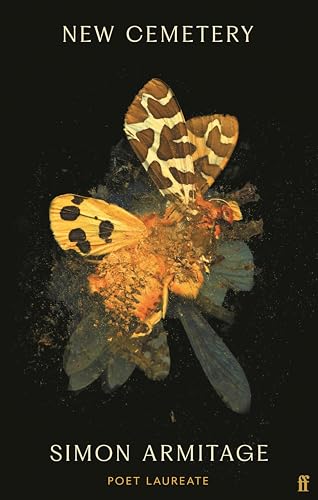
New Cemetery by Simon Armitage (2025)
Not far from the English Poet Laureate’s home in Huddersfield, some cow fields were recently converted into a municipal graveyard. I can’t do better than Armitage’s own description of the style in this collection: “short-lined tercets linked with/by intermittent rhymes and half-rhymes … like threading daisy chains.” Each one is titled in brackets after a species of moth, in a rather arbitrary way, as he acknowledges. The point was to – in a time of climate breakdown – include nature in the inevitable march of death and decay. I most liked the poems about the cemetery, whereas the majority of the book is about everyday moments from a writer’s life.

There are some amusing and poignant lines among the rest:
 I died and went
to Bristol Parkway
for my sins,
interchange
between soul and flesh
the whispered half-rhymes
of earth and death
on the spade’s tongue.
I also appreciated this haiku-like stanza: “Almond blossom / slash rotten confetti / clogging the church drains.” But there was little that struck me otherwise. I’ve tried to love Armitage’s poetry, but this third experience again leaves me unmoved. I’ve preferred his travel memoirs. Still, the book ends on the perfect note:
the dead are patiently
killing time
between visiting hours,
deaf, blind, mute
and numb,
unable to love
but capable still
of being loved.
(Public library) 
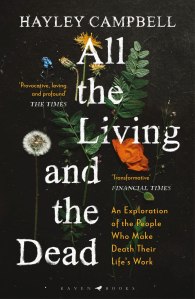 I’ve read the first two chapters of a long-neglected review copy of All the Living and the Dead by Hayley Campbell (2022), in which she shadows various individuals who work in the death industry, starting with a funeral director and the head of anatomy services for the Mayo Clinic in Minnesota. In Victorian times, corpses were stolen for medical students to practice on. These days, more people want to donate their bodies to science than can usually be accommodated. The Mayo Clinic receives upwards of 200 cadavers a year and these are the basis for many practical lessons as trainees prepare to perform surgery on the living. Campbell’s prose is journalistic, detailed and matter-of-fact, but I’m struggling with the very small type in my paperback. Upcoming chapters will consider a death mask sculptor, a trauma cleaner, a gravedigger, and more. If you’ve enjoyed Caitlin Doughty’s books, try this.
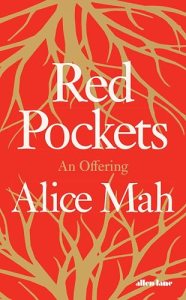 I’m halfway through Red Pockets: An Offering by Alice Mah (2025) from the library. I borrowed it because it was on the Wainwright Prize for Conservation Writing shortlist. During the Qingming Festival, the Chinese return to their hometowns to honour their ancestors. By sweeping their tombs and making offerings, they prevent the dead from coming back as hungry ghosts. When Mah, who grew up in Canada and now lives in Scotland, returns to South China with a cousin in 2017, she finds little trace of her ancestors but plenty of pollution and ecological degradation. Their grandfather wrote a memoir about his early life and immigration to Canada. In the present day, the cousins struggle to understand cultural norms such as gifting red envelopes of money to all locals. This is easy reading but slightly dull; it feels like Mah included every detail from her trips simply because she had the material, whereas memoirs need to be more selective. But I’m reminded of the works of Jessica J. Lee, which is no bad thing.
Death of an Ordinary Man by Sarah Perry (2025)
Perry recognises what a sacred privilege it was to witness her father-in-law’s death, which occurred just nine days after his diagnosis with oesophageal cancer. She concludes, like Simone de Beauvoir does of her mother in A Very Easy Death, that David’s end was as good as one might hope for. Viz., he was in his late seventies, remained at home, was looked after by his son and daughter-in-law, more or less maintained his mental capacity until the end, and showed minimal signs of pain or distress. Still, every death is fraught, to some degree, with bureaucracy, medical error and pangs of regret. There is a searing encounter here with an unfeeling GP; on the other hand, there is such kindness from nurses, relatives and a pastor.
The beauty of Perry’s memoir is its patient, clear-eyed unfolding of every stage of dying, a natural and inexorable process that in other centuries would have been familiar to anyone – having observed it with siblings, children, parents, neighbours, distant relatives and so on. She felt she was joining a specifically womanly lineage of ministering, a destiny so quotidian that she didn’t feel uncomfortable with any of the intimate care involved. I thought of my sister and her mother- and sister-in-law sitting vigil at my brother-in-law’s deathbed in 2015.
 Perry traces the physical changes in David as he moved with alarming alacrity from normal, if slowed, daily life to complete dependency to death’s door. At the same time, she is aware that this is only her own perspective on events, so she records her responses and emotional state and, to a lesser extent, her husband’s. Her quiver of allusions is perfectly chosen and she lands on just the right tone: direct but tender. Because of her and David’s shared upbringing, the points of reference are often religious, but not obtrusive. My only wish is to have gotten more of a sense of David alive. There’s a brief section on his life at the start, mirrored by a short “Afterlife” chapter at the end telling what succeeded his death. But the focus is very much on the short period of his illness and the days of his dying. During this time, he appears confused and powerless. He barely says anything beyond “I’m in a bit of a muddle,” to refer to anything from incontinence to an inability to eat. At first I thought this was infantilizing him. But I came to see it as a way of reflecting how death strips everything away.
As I read, I often had tears in my eyes, thinking of the deaths I have experienced at second hand and the many more that will come my way until my own. In this gift of a book, Perry captures the emotional poles of bearing witness, and the dignity and uniqueness of every life:
There was relief, and there was loss – it was the saddest thing we’d ever seen, and the best thing we had ever done – all these things existing together undiminished, and never cancelling each other out.
now I understand there are no ordinary lives – that every death is the end of a single event in time’s history: an event so improbable it represents a miracle, and irreplaceable in every particular.
(Public library) 
Death and grief are common topics in my stacks at all times of year. I see more books on dying and the dead in my immediate future, starting with two rereads for #NovNov – The Death of Ivan Ilych and Death in Venice, along with The Field by Robert Seethaler (narrated by the inhabitants of a cemetery), the latter two for #GermanLitMonth; and A Single Man by Christopher Isherwood.
 Bookish Beck = Rebecca Foster. American transplant to England. Freelance proofreader and book reviewer.
 Bookish Beck
Noting your comment about small type, I read almost exclusively on Kindle for iPad. It would serve me very well if you mentioned if your reviewed books are available in Kindle ebooks! I know I can look them up, but thought I’d mentions it. You can make the type as large as you want in Kindle! (and other ebook readers I imagine!)
Thanks.
LikeLiked by 1 person
I always mention where I source a book from, which will indicate whether I read it in print or digitally. Aren’t the vast majority of books available for Kindle? (I do appreciate that function on my e-readers!)
LikeLike
Wow, the Sarah Perry sounds very good. Perimenopause finds me on the brink of tears quite often–books like this can be tough. Or, I’d need more than one of the gin flights. Love that idea, since I’m not much of a whisky or bourbon person. Fun!
LikeLiked by 1 person
I feel you — I’m there or nearly there myself.
The opportunity to taste a couple of gins made our trip to Islay (famous for its whiskies) the other summer feel worthwhile!
LikeLiked by 1 person
The Perry sounds really beautiful. And the gin tasting sounds amazing!
LikeLiked by 1 person
Both were indeed amazing 🙂
LikeLiked by 1 person
These are all such interesting choices – Sarah Perry’s sounds the most appealing to me. I’ve never read her nonfiction (she wrote one other called Essex Girls) and it sounds like she’s restrained some of her stylistic tendencies in writing about this particular topic, which would be all to the good.
Thinking of you as you remember your mom and dear Alfie. It can be a hard time of year for that. My friend who died age 34 of a diagnosed but underestimated heart condition did so around this time of year – I can’t recall her exact date, but I know it was an early Sunday morning at the very end of October, so during our All Souls name reading yesterday, she was particularly on my mind. Well done for booking yourself in for a treat that day – that gin tasting looks divine.
LikeLiked by 1 person
Restrained would be a great descriptor for the book, and I think the religious references would be meaningful to you.
I’m so sorry about your friend (and others who died too soon). I went to the All Souls’ service at our church the year after my mom died and put her and my stepfather on the list of names. It was a very emotional experience. I haven’t been able to face going again, but I needed it then.
LikeLike
Thank you. It’s cathartic for many, I think, myself included. This year the reading of the names was rather gabbled by a temporarily filling-in priest (our new vicar doesn’t arrive until February), which I found surprisingly troubling.
LikeLike
Oh, that’s a shame. I understand that one can get tongue-tied reading a long list of names, but a bit of advance practice and taking it slowly is the least one can do when these are people’s loved ones. An interregnum is a tricky time!
LikeLike
What a great post….books and gin tasting! I’ll look at all these books. Question: Did you taste Tannery No 10 and the The Botanist? Which one got the highest mark? I’m curious b/c I want to celebrate my birthday next week with a “new to me” gin! ( &tonic)
LikeLiked by 1 person
Yes, we tasted Tanqueray Ten and The Botanist — the latter was the only one I’d had before and ended up tied for second place with a couple of others. Tanqueray was my number 4 out of 10. First place honours went to The Muff Liquor Co. from Ireland!
Happy birthday for next week! I was lucky enough to receive two bottles of gin for my birthday last month: Skywave from Oxfordshire and Makar from Glasgow.
LikeLike
Thanks so much for the feedback! I ordered “The Botanist” for the big day and unfortunately Muff Liquor Irish Gin is not available in The Netherlands. I’ll just have to go to Ireland for a vacation to try it!
LikeLiked by 1 person
Hope you enjoy! I don’t think I realized you were in the Netherlands.
LikeLike
…lived here since I emigrated from USA decades ago! The Netherlands is 2nd on the list of Quality of Life Index, evaluating countries by cost of living, safety levels, healthcare quality, pollution, and user feedback. So, I’m sitting pretty good among the tulips!
LikeLiked by 1 person
Sarah Turley (Market Garden Reader) is also based in the Netherlands, but originally from England I think.
LikeLike
Just tasted The Botanist…it is delicious!!
LikeLiked by 1 person
I’m so glad you like it! It’s a tried-and-true favourite in our cabinet. In fact, the bottle is running fairly low and will have to be replaced soon 😉
LikeLike
Do you use it mostly for G&T or other cocktails?
LikeLike
Just G&Ts — I don’t think I’ve ever tried it in a cocktail. For cocktails I either use Gordon’s or another London dry.
LikeLike
Perry’s memoir sounds devastating. The title reminds me of Margaret Forster’s Diary of an Ordinary Woman (which is not so sad). What a tough time of year for you, generally. ❤
LikeLiked by 1 person
Ooh, I have a copy of that!
LikeLike
[…] Death of an Ordinary Man by Sarah Perry: Perry recognises what a sacred privilege it was to witness her father-in-law’s death nine days after his diagnosis with oesophageal cancer. David’s end was as peaceful as could be hoped: in his late seventies, at home and looked after by his son and daughter-in-law, with mental capacity and minimal pain or distress. The beauty of this direct but tender memoir is its patient, clear-eyed unfolding of every stage of dying, a natural and inexorable process that in other centuries would have been familiar to all. […]
LikeLike
[…] got ever more into gin and cocktails, with tastings in Abingdon and Wantage (and in December I led two informal tastings for friends). I also acquired the taste for […]
LikeLike