This is the best thing we’ve read in my time with the Literary Wives online book club (out of 16 books so far). In the early pages it reminded me of Richard Yates’s work, but by the end I was thinking of it as on par with Stoner by John Williams, a masterpiece I reread last year. Is Mrs. Bridge a female Stoner? In that she is an Everywoman, representative of a certain comfortable, conventional interwar life but also of common longings to be purposeful, experience novelty, and connect with others – I’d say yes. From the first line onwards, we see her as at odds with the facts of her life, which at least appear to her to be unalterable: “Her first name was India – she was never able to get used to it.” She’s never lived up to her exotic name, she feels; her parents must have expected something of her that she couldn’t be.
Connell (1924–2013) sets this portrait of a marriage in his native Kansas City, Missouri. The story is not contemporaneous to its publication but begins in the 1930s; this doesn’t become clear until two-thirds of the way through when, on a European tour that workaholic lawyer Walter Bridge arranged as a belated birthday gift to his wife, news comes that the Nazis have invaded Poland and they have to hurry home. Bear in mind that this is the man who refused to move when a tornado threatened their country club and every single other person had moved to the basement. He insisted on staying at the table and finishing his steak. (So … he expects the weather to bow to his will, if not world leaders?) It’s an astonishing scene, and occasions an astute summation of their relationship dynamic:
It did not occur to Mrs Bridge to leave her husband and run to the basement. She had been brought up to believe without question that when a woman married she was married for the rest of her life and was meant to remain with her husband wherever he was, and under all circumstances, unless he directed her otherwise. She wished he would not be so obstinate; she wished he would behave like everyone else, but she was not particularly frightened. For nearly a quarter of a century she had done as he told her, and what he had said would happen had indeed come to pass, and what he had said would not occur had not occurred. Why, then, should she not believe him now?
(That attitude of blind faith seems more appropriate in a father–daughter or God–mortal relationship than husband–wife, does it not?)
The structure of the book must have been groundbreaking for its time: it’s in 117 short, titled vignettes – a fragmentary style later popularized by writers such as Elizabeth Hardwick, Sarah Manguso and Jenny Offill – that build a picture of the protagonist and her milieu. Even though many of them seem to concern minor incidents from the Bridges’ social life (parties, gossip, the bores they’re forced to have lunch with every time they’re in town), they also reveal a lot about India’s outlook. She wears stockings even on the hottest summer days because “it was the way things were, it was the way things had always been, and so she complied.” Like many of her time and place, she is a casual racist, evidenced by comments on her children’s Black and “gypsy” friends. It pains her that she doesn’t understand her three children. To her it seems they do strange, shocking things (okay, Douglas building a tower of junk is pretty weird) when really they’re just experimenting with fashion and sexuality as any teenager would.
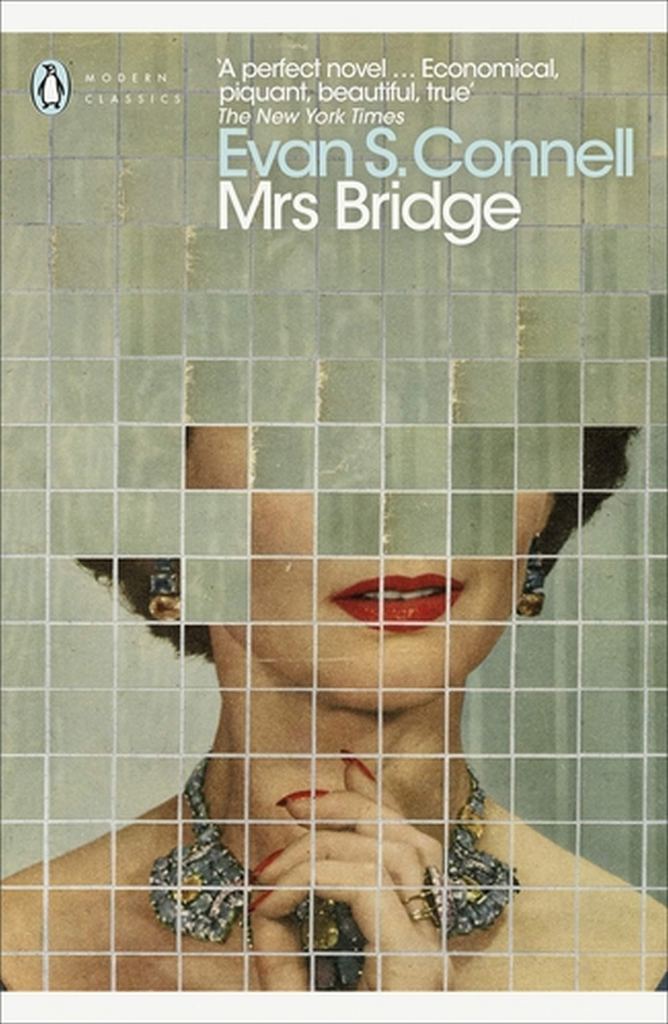
India is in awe of the women of her acquaintance who step out of line, like Grace Barron and Mabel Ong. Grace, in particular, is well informed and confident arguing with men. India seriously considers breaking away from Walter and voting liberal at the next election, but loses her nerve at the last minute; her viewpoint is fundamentally conservative. The novel justifies this by showing how those who flout social rules are shamed or punished in some way.
Mostly, India feels pointless. With a housekeeper around, there’s nothing for her to do. She has nothing but leisure time she doesn’t know how to fill. And yet the years fly past, propelling her into middle age. Occasionally, she’ll summon the motivation to sign up for painting classes or start learning Spanish via records, but she never follows through. So it’s just unnecessary shopping trips in a massive Lincoln she never figures out how to park properly.
She spent a great deal of time staring into space, oppressed by the sense that she was waiting. But waiting for what? She did not know. Surely someone would call, someone must be needing her. Yet each day proceeded like the one before. … Time did not move. The home, the city, the nation, and life itself were eternal; still she had a foreboding that one day, without warning and without pity, all the dear, important things would be destroyed.
It may be fashionable to scorn the existential despair of the privileged, but this is a potent picture of a universal condition. It’s all too easy to get stuck in the status quo and feel helpless to change life for the better. I came across a Slightly Foxed article (Spring 2016) by William Palmer, “The Sadness of Mrs Bridge.” Palmer suggests that Connell was an oddity to his publishers because he wrote in so many genres, and never the same kind of book twice. He dubs this Connell’s finest work. I marked out a couple of passages from his appreciation:
The genius of Connell is to show that this is how most people live: first in their own minds, then in their families, then in their limited social circles; most historical novels fail to realize that most people simply do not notice whatever great moments of history are being enacted around them unless they actually impinge upon their lives.
What is truly compelling about Mrs Bridge is her very ordinariness, notwithstanding all her petty snobbery, conformism and timidity. The list is easy to make and appears to be a fairly damning indictment, but Connell is not writing a satirical portrait. His intention is to show us the utter uniqueness of this one human life, irreplaceability of body and soul that is India Bridge. Connell portrays her so tenderly that we come to sympathize with her and, more, to care for her.
{SOME SPOILERS IN THE REMAINDER}
The way Mrs. Bridge ends indicates that Mr. Bridge, which was published 10 years later, will be not a sequel but a companion piece. I’m somewhat wary of reading it, but it will be intriguing to see how events overlap and to what extent Connell is able to make Walter a more sympathetic character. (Palmer remarks, “It is terrifying how little the two portraits have in common – they might be describing two entirely different worlds.”) Connell’s work remains influential: Claire Fuller has featured the pair of novels in one of her year-end reading roundups, and the husband’s surname in Manguso’s Liars is Bridges.
I’ve written much more than I intended to about Mrs. Bridge, but wanted to do justice to what will no doubt be one of my stand-out reads of the year.
(My omnibus edition came from the free bookshop we used to have in the local mall.) 
The main question we ask about the books we read for Literary Wives is:
What does this book say about wives or about the experience of being a wife?
Based on Mrs. Bridge’s experience, one would be excused for thinking that being a wife involves the complete suppression of one’s own personality, ambitions and desires – including sexual, as dealt with very succinctly in the first chapter: Walter usually initiates; the one time she tries to do so, he gives her a patronizing hug and falls asleep. “This was the night Mrs Bridge concluded that while marriage might be an equitable affair, love itself was not.” A wry statement from Connell as marriage is certainly not equitable in this novel.
Granted, this was the 1910s–1930s. By the 1940s, when her daughters are young women, they’re determined to live differently, the one by becoming a New York City career girl, single and promiscuous. The other also vows to do things differently – “Listen, Mother, no man is ever going to push me around the way Daddy pushes you around” – yet ends up pregnant and battered. When India tries to encourage her to placate her husband through sex, she replies, “Oh no, don’t tell me that! I don’t want any part of that myth.”
So we see attitudes starting to change, but it would be another couple of decades before there were more options for both of these generations of women.
A common observation in many of the novels we’ve considered is that, even in a marriage, it is possible for the partners to be a complete mystery to each other. I’ll be interested to see whether Walter’s side of the story illuminates anything or portrays him as clueless. And a main moral I draw from most of our reads is that defining oneself by any relationship – mostly marriage, but also parenthood – sets one up for disappointment, or worse.
See the reviews by Becky, Kate, Kay and Naomi, too!
We recently welcomed a new member, Marianne, and will soon be choosing our books for the next two-plus years. Here’s the club page on Kay’s blog with the current members’ profiles plus all the books covered since 2013.
Our next selection will be Interpreter of Maladies by Jhumpa Lahiri in June. I’ve not read Lahiri before but have always meant to, so I’m particularly looking forward to this one.
 Bookish Beck = Rebecca Foster. American transplant to England. Freelance proofreader and book reviewer.
 Bookish Beck
I like the comparison to Stoner. I loved that novel. Good point about people being a mystery to each other. This is an excellent review.
LikeLiked by 1 person
Thanks, Kay! Did you go on to read the sequel / will you?
LikeLiked by 1 person
I haven’t done it yet. I’m thinking about it. What about you?
LikeLiked by 1 person
I will, to get the complete picture, but I think I’ll wait until much later in the year.
LikeLike
Fabulous review, Rebecca! I agree – it’s one of the best books we’ve read for this group.
I’m glad you mention the tornado scene. That’s such a great quote.
I’m even more curious now about “Mr. Bridge” after reading that Palmer remarks on how little they have in common. How does Mr. Bridge see all of this??
One of the things I think I like so much about this book is how quietly and gradually the whole thing sneaks up on you. My copy has an “Afterword” written by James Salter in which he describes the novel: “without extraordinary events but with the gradually increasing, almost imperceptible weight of what happens day-by-day…”
LikeLiked by 1 person
Thanks, Naomi. I wish I could read that Salter afterword. It’s clever how the novel puts all the deceptively simple vignettes together into something so profound and devastating. I think I’m curious enough to read Mr. Bridge this year, but I’ll probably wait some months.
LikeLiked by 1 person
Excellent review! It’s well over a decade since I read Mrs Bridge but you’ve brought it back to me. I remember feeling that Hitler’s invasion seemed more of an inconvenience to the Bridges rather that a shattering world event. Wise final sentence, too.
LikeLiked by 1 person
Thanks, Susan! Did you read the companion novel, too? That’s true, world events are very much in the background.
LikeLiked by 1 person
I did and was a bit disappointed but my expectations were high
LikeLiked by 1 person
You’ve certainly given Mrs Bridge the hard sell, and comparing the writing with that of Yates and William sealed the deal for me. It’s not in our library, so I’ll be off to source it soon.
LikeLiked by 1 person
I hope you manage to find it easily enough.
LikeLiked by 1 person
Let’s see. The library has let me down for once.
LikeLike
Oh I remember seeing that movie years ago! I didn’t realise that it was based on a book.
LikeLiked by 1 person
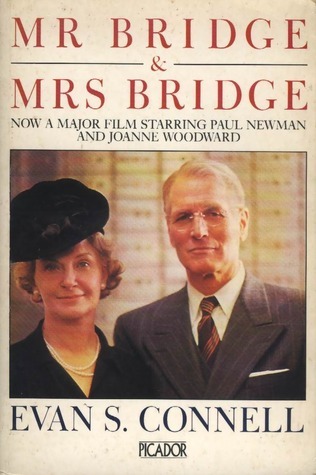
It’s a still from the Newman/Woodward film on the cover of my omnibus edition. In the Slightly Foxed article, Palmer says it’s a “good, sensitive film that somehow missed the point of the essential loneliness of these two life partners.”
LikeLiked by 1 person
I’m really looking forward to this (!) I have Stoner still to read as well and I’m feeling very lucky!
LikeLiked by 1 person
A stellar pair!
LikeLiked by 1 person
I’ve had Mr Bridge forever, and then bought Mrs Bridge last year, but have still to read either. I’m so excited to do so, now! (Also, Interpreter of Maladies is phenomenal – what a good pick for the club.)
LikeLiked by 1 person
I hope you find it as exceptional as I did.
LikeLike
I’ve had this pair in mind for a project for ages but only came into possession of them last summer on a second-hand bookbuying jaunt. You’ve inspired me to scribble them down for next year, but the other comments you’ve shared about his writing make me think I should have a look out for others he’s written too (whereas previously I thought these were considered the best by far). Thanks for the spoiler warning: I stopped exactly there. Have you read others by Lahiri or would IofM be the first? (You read tonnes, I know, but I miss writers entirely all the time.)
LikeLiked by 1 person
These are certainly his best-known books, but I’d be intrigued to try more (he also wrote essays, short stories and poetry).
Lahiri will be all new for me! I have two more of her books on the shelf after this one as well.
LikeLike
[…] The Easter Parade and Cold Spring Harbor and also recently experienced Evan S. Connell’s Mrs. Bridge, so I knew the sort of suburban despair I was in […]
LikeLike