Simon and Karen’s classics reading weeks are always a great excuse to pick up an older book or two from my shelves. I’m just back from 12 days in Portugal and Spain (about which more anon) in time to post a review for the latest one, the 1961 Club. I own the film tie-in paperback of Revolutionary Road and indeed saw the Leonardo DiCaprio–Kate Winslet film when it first came out, but had no specific memory of the plot. However, I’d read Yates’s The Easter Parade and Cold Spring Harbor and also recently experienced Evan S. Connell’s Mrs. Bridge, so I knew the sort of suburban despair I was in for.
Frank and April Wheeler appear to be the perfect 1950s American family, with a lovely home in Connecticut’s Revolutionary Hill Estates, a daughter and a son, and Frank’s comfortable New York City job at Knox Business Machines – which he is proud of getting without so much as mentioning that his father was a long-time Knox employee. But neither Frank nor April ever intended to be trapped in provincial conventionality. Frank has “made it clear, time and again, that his job was the very least important part of his life, never to be mentioned except in irony.” The ennui hiding under the surface of their marriage seeps out through alcoholism and adultery. In one fantastic sequence, Frank calculatedly seduces the office receptionist on his 30th birthday, arriving home late for April and the kids’ homemade cake.
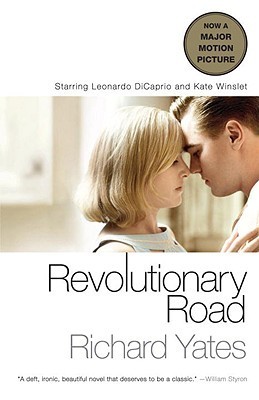 The Wheelers begin to dream of escape, specifically moving to Paris, where April could be the family breadwinner as an ambassador’s secretary and Frank would finally be free to produce the novel he’s been toying with writing ever since he finished his military service. They start telling their acquaintances – their drinking buddies, Shep and Milly Campbell; the local real-estate agent, Helen Givings – about the plan to leave for Europe in the fall. They’re sure it’s their chance to push back at capitalist conformity, leave small-mindedness behind, and be happy and bohemian. That is, until April finds out that she’s pregnant a third time.
Yates really plays up the ironies of the situation. The Wheelers try to be avant-garde but keep getting sucked back into the same old ways of doing things. Glimpses into the main couple’s upbringings hint at their psychological motivations but don’t explain away their mistakes. The omniscient narrator’s occasional highlighting of others’ perspectives is particularly effective for contrasting radical ideas with the status quo. Shep is in love with April and has his own romantic fantasies, while Mrs. Givings hopes that the Wheelers could be a good influence on her son, John, who pays visits to them on the Sunday afternoons that he’s temporarily let out of a mental institution. It is only John, the ‘mad’ character, who truly appreciates the gravity of what Frank and April are attempting, and mocks them for faltering: “You figure it’s more comfy here in the old Hopeless Emptiness after all[?]”
Are the Wheelers revolutionary – in what they long for, in what they attempt, in what they admit to themselves? To an extent. But there’s also what they settle for, and what is possible in 1955; April, in particular, isn’t allowed to become her own person. As in Jude the Obscure, punishment seems inevitable for those who reach above their station or outside of social norms. This is a justly famous novel of ordinary angst, a tragedy so realistic it can’t be ignored. (Secondhand purchase – Wonder Book and Video, many years ago) 
Here are some other famous 1961 titles that I’ve read but mostly not reviewed (I’ve now read just 5 of the top 20 on the Goodreads list of the most popular books published that year):
James and the Giant Peach by Roald Dahl
A Grief Observed by C.S. Lewis (twice)
The Prime of Miss Jean Brodie by Muriel Spark (twice)
Travels with Charley: In Search of America by John Steinbeck
I’ve previously participated in the 1920 Club, 1956 Club, 1936 Club, 1976 Club, 1954 Club, 1929 Club, 1940 Club, 1937 Club, 1970 Club, 1952 Club and 1925 Club.
 Bookish Beck = Rebecca Foster. American transplant to England. Freelance proofreader and book reviewer.
 Bookish Beck
Oh, I DO like Yates’ writing, and it’s so long since I’ve read his work: the last one I read was Eleven Kinds of Loneliness. But this one, astonishingly, I haven’t read. That will change. Thanks, Rebecca.
LikeLiked by 1 person
It’s odd and surprising that I managed to read two lesser-known Yates novels before this one! It is well worth it. I’m going to see what else I can access through my libraries.
LikeLiked by 1 person
Suburban despair – yes, that’s how I remember Yates although it’s ages since I read him! Glad you enjoyed this so much!
LikeLiked by 1 person
It holds true for the three I’ve read, anyway. Thanks for your hosting!
LikeLiked by 1 person
You convinced me I have to read this. I’m a little scared though, that quote about Frank’s job is exactly how I talk about my job (though daddy didn’t get it for me!)
LikeLiked by 1 person
It’s one of the reasons the novel is so realistic. So many people hate their job, or at least don’t want to be defined by it. I’m sorry that’s also the case for you!
LikeLike