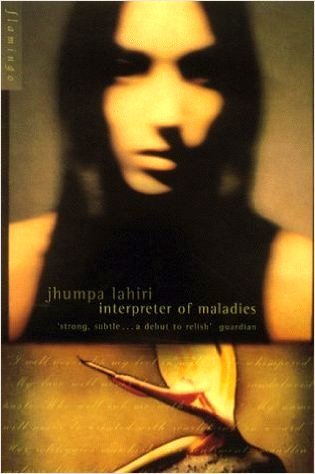
This was an unusual selection for us in that it’s a short fiction collection, not all of whose stories are about marriage. Lahiri won a Pulitzer Prize for this debut work and I’m so pleased to have finally had an excuse to pick it up. Her characters tend to be Indian or Bengali (first- or second-generation) immigrants in New England, though there are also two pen portraits of unfortunate peasant women back in India. These two are less fixed in time and feel rather fable-like, especially with the plural observers’ voice in “The Treatment of Bibi Haldar.”
Of the nine stories, six are in the third person and three in first. Apart from a couple set in 1969 or 1971, the rest are contemporary. Lahiri alternates between relationship studies and accounts of encounters with strangers across generations and/or cultures. There’s a girl’s impressions of the dignified fellow expat visitor at a time of political instability in “When Mr. Pirzada Came to Dine,” and the American boy who gets a glimpse into an unfamiliar world on afternoons at his Indian child-minder’s house in “Mrs. Sen’s.” Culture shock goes the other way for the narrator of “The Third and Final Continent,” who has moved from Calcutta to London to Cambridge and rents a room from a formidable 103-year-old landlady.
 Often, food is a reminder of home; there are lots of delicious descriptions of curries. Extramarital infatuation is contrasted with true knowledge of another person – a child is wise beyond his years in defining “sexy” as “loving someone you don’t know.”
If you seek out just one story from this excellent collection, make it “A Temporary Matter,” about a couple reeling from a stillbirth. On five successive evenings when the power company cuts their electricity to repair the line, they cook a special meal, light candles and tell secrets, including one concerning the child they lost. This story, which opens the collection, blew me away. The other highlight among a very strong pool is “This Blessed House,” in which a couple keep finding tacky Christian religious relics the previous owners left behind. Even though they’re Hindus, Twinkle decides to keep it all up for superstitious reasons, though her new husband disapproves.
All but one of the stories are standouts, and I could see how they’ve influenced story writers in the decades since, including Anuja Varghese. What linked them all together for me was the theme of denying or affirming common humanity.
More fool me for waiting all these years to try Lahiri! I have two more of her books on the shelf that I’ll try to get to soon. (Secondhand – Community Furniture Project, Newbury) 
The main question we ask about the books we read for Literary Wives is:
What does this book say about wives or about the experience of being a wife?
Marriage can be a welcome support, or a handicap. We see timid wives adjusting to a new country, and newlyweds – via arranged marriage or choice – trying to understand each other’s ways. The loss of a baby threatens to separate one couple, but instead they cling to each other. (Statistics show that 20% of marriages break up over the death of a child; previously it was thought to be 80%.) The villagers think marriage will cure Bibi Haldar, but no man will have her. Mrs. Sen is dependent on her husband for everything because she’s too scared to learn to drive.
In some traditional cultures, it’s risky for wives to assert their independence. America seems to offer women greater freedom. Mrs. Das, from the title story about an Indian American family touring India, transgresses traditional expectations by admitting to not loving her husband and children and having had an affair. Twinkle, too, flouts conventionality by refusing to submit to her husband’s wishes. But, of course, this doesn’t guarantee happiness.
See the reviews by Becky, Kate, Kay, and Marianne, too! (Naomi has stepped down from the club.)
 Bookish Beck = Rebecca Foster. American transplant to England. Freelance proofreader and book reviewer.
 Bookish Beck
I’m quite a Jhumpa Lahiri fan, so tahnks for reminding me I’ve yet to get hold of this one.
LikeLiked by 1 person
It’s a must! And quite a slim book, not at all difficult to get through.
LikeLiked by 1 person
Ahhhh I have to read this. “A Temporary Matter” sounds wonderful. I loved “The Third and Final Continent”, and the way that the depiction of the arranged marriage in that story shifts and develops from selfishness and timidity to mutual settled affection.
LikeLiked by 1 person
It’s good to find stories that don’t paint arranged marriage as doomed to failure.
LikeLiked by 1 person
I have been sick most of the month and haven’t had time to review the book again. However, I read it before and here is my post.I will come back to this once I am better and write a new review with regards to our subject. And comment on your post.
LikeLiked by 1 person
Sorry to hear that, Marianne. Hope you’re feeling better now.
LikeLike
Thanks, it is slowly getting better. But my brother died, so I don’t feel it.
LikeLike
So sorry to hear about your brother, Marianne. Wishing you peace and fond memories.
LikeLike
We picked out some similar points of interest this time, particularly the impact of the death of a child on marriage, and that cultural expectations can be both a support and a handicap.
Overall, I didn’t enjoy this collection as much as you did, but I attribute it partly to the fact that I was in a bit of a rush reading it (and my reading coincided with finishing all of my university assessments).
LikeLiked by 1 person
I was able to have a one-story-per-day habit for the most part, and that helped.
LikeLike
You’ve prompted me to take this one on the shelves for a reread.
LikeLiked by 1 person
A fine choice.
LikeLiked by 1 person
Hmm, I didn’t think Twinkle kept the religious items out of superstition. I think she thought they were funny and sort of charming.
LikeLiked by 1 person
Perhaps both?
LikeLiked by 1 person
Maybe!
LikeLike
I read this so long ago that I can’t remember anything about it. An interesting choice for the challenge!
LikeLiked by 1 person
I don’t recall how it made it onto our list. Even with only 3-4 stories strongly relevant to the theme, I was glad to read it. Lahiri is a gem!
LikeLiked by 1 person
Lahiri is brilliant – I need to get to her second short story collection, Unaccustomed Earth. I also loved her novels The Lowland and The Namesake.
LikeLiked by 1 person
I own Unaccustomed Earth and The Namesake — maybe I’d even pull out the latter for 20BoS.
LikeLiked by 1 person
This has been lurking on my shelves for far too long because I always read something else when I need an Indian author for my reading the world challenge, which resets every year. It’s on the 1001 list, too, so I must fit it in somewhere! It sounds fabulous.
LikeLiked by 1 person
The Club was a good excuse for me to read it. I hope you’ll find your own soon 🙂
LikeLiked by 1 person
This is one of the collections I read early on, when I’d decided that I’d avoided short stories for too long, and it just won me over completely. In some ways, I feel like the rest of her books have been quite different… and I haven’t loved the recent ones quite as much and, yet, I know some readers have preferred those, so that might be me… but I loved her way of seeming both cool and all-seeing and distant but still managing to invite us into very intimate situations too. (Also, have you read Nell Freudenberger? The Newlyweds made me want to reread these Lahiri stories.)
LikeLiked by 1 person
That’s a good description, omniscient yet intimate. I read The Newlyweds in 2012, yes, but with only my 3-star rating to go on, can only conclude that I didn’t appreciate it that much.
LikeLike
So you read it when it was new! I came to it a few years later and sometimes I think that works in the book’s favour (no… or hazy… expectations)?
LikeLike
I can’t reply to my original post since it has not been approved, yet.
So, here is my final review: https://momobookblog.blogspot.com/2026/06/lahiri-jhumpa-interpreter-of-maladies.html
LikeLiked by 1 person
Sorry about that, Marianne. I was away in the States for 10 days and didn’t have access to WordPress.
LikeLike
No problem, Rebecca. We all have a life besides blogging.
And I solved it.
LikeLike
[…] Interpreter of Maladies by Jhumpa Lahiri: Lahiri won the Pulitzer for this debut. Her characters tend to be Indian or Bengali immigrants in New England. Relationship studies trade off with accounts of encounters with strangers across generations and/or cultures. Often, food is a reminder of home. An overall theme is denying or affirming common humanity. […]
LikeLike