Blog Tour: Two Voices, One Story
“[B]eing an adoptive parent is like parenting in Technicolor: everything is just a little more intense. This means the highs can be really high, but it also means that the lows are going to be really low. You have to prepare yourself.”
~Sharon Roszia, quoted in A Book about Love, by Jonah Lehrer
Two Voices, One Story is a mother–daughter memoir that splits narration duties between Elaine Rizzo and Amy Masters, the now-teenage daughter she adopted from China in 1999. Elaine’s sections provide the main thread of their story, while Amy’s passages, generally shorter and printed in italics, chime in to give her perspective on various events and relationships that have been important in her life.
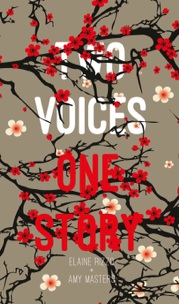 Elaine is forthright about her infertility and the miscarriage that led to her decision to adopt. In the late 1990s, China’s one-child policy was still in place, but it was the severe flooding of the Yangtze River that led directly to Amy’s adoption. Thousands died and millions more were displaced. Given the context, it’s not so surprising that baby Amy was left outside a welfare center. She was given the Chinese name Tong Fang – “Copper Child.”
For me the highlight of the book was Elaine and Lee’s trip to China to pick up Amy. Although they were nervous and disoriented, they experienced the kindness of strangers and responded with compassion of their own, taking along extra toiletries and clothes of different sizes and leaving the surplus with the care center. Amy had bronchitis, one more worry on top of all the paperwork and red tape they had to go through to finalize the adoption.
Back in England, Amy had some behavioral problems that were likely vestiges of her time at the orphanage. She hated noise, especially thunderstorms; she hit herself and others; and she often woke up screaming. Private schooling ensured she wouldn’t get left behind, and there were many happy times with extended family and holidays to Australia and the west coast of Wales, where Elaine and Amy would later settle with Elaine’s second husband.
But life wasn’t always rosy: Amy was strong-willed and uncooperative – perhaps nothing out of the ordinary for a teenager, but still a challenge for her parents. Elaine recalls a social worker telling them “that very often adoptive parents don’t feel like they have the right to tell their child off, or that they think they shouldn’t say or do anything which might upset the child, because they are trying to compensate for what has happened prior to the adoption.”
Lengthy commuting to her job back in England and years-long house renovations demanded much of Elaine’s attention, yet she remained alert to what was going on with Amy. Unfortunately, in her teen years Amy experienced racism from a few schoolmates, including abusive Facebook messages that drove the family to contact the police. Amy herself, though, always comes across as easygoing about being different: “Every Christmas we used to do a Nativity show and I remember being an angel first and then one of the kings, which I suppose was the right role for me because I really do come from the East.”
Even though this is a very quick read, my interest waxed and waned. The telling can be clichéd and sentimental, and I felt too much space was given to banal details that added little to an understanding of the central mother–daughter relationship. This self-published book has a very appealing cover but needs another look from an experienced editor who could fix the fairly frequent typos and punctuation issues and cut out the bullet points (nine pages’ worth) and speech tics like “I will also say…” and “I have to comment…”
I would certainly recommend this book to those who have a personal experience of or interest in adoption, particularly from overseas (for a fictional take on adoption from China, you might also try The Fortunes by Peter Ho Davies, The Red Thread by Ann Hood, and This Must Be the Place by Maggie O’Farrell), as well as to anyone wondering how to parent or educate a child who is in some way different.
I’ll end with some lovely words from Amy:
when my Chinese mum left me outside the gates of the welfare center almost eighteen years ago now, because there was nothing left for me in Tongling, she must have had the desperate hope that I would find a happy life with people who loved me. I can only say that her wish did come true.
My rating: 
Two Voices, One Story will be published by Clink Street Publishing on March 21st. Thanks to Rachel Gilbey of Authoright Marketing & Publicity for arranging my free copy for review.
I was pleased to participate in the blog tour for Two Voices, One Story.
First Encounter: Karl Ove Knausgaard
 For years I felt behind the curve because I had not yet read the two prime examples of European autofiction: Elena Ferrante and Karl Ove Knausgaard. It seemed like everyone was raving about them, calling their work revelatory and even compulsive (Zadie Smith has famously likened Knausgaard’s autobiographical novels to literary “crack”). Well, my first experience of Ferrante (see my review of My Brilliant Friend), about this time last year, was underwhelming, so that tempered my enthusiasm for trying Knausgaard. However, I had a copy of A Death in the Family on the shelf that I’d bought with a voucher, so I was determined to give him a go.
I read this first part of the six-volume “My Struggle” series over the course of about two months. That’s much longer than I generally spend with a book, and unfortunately reflects the fact that it was the opposite of compelling for me; at times I had to force myself to pick it up from a stack of far more inviting books and read just five or 10 pages so I’d see some progress. Now, a couple of weeks after finally reading the last page, I can say that I’m glad I tried Knausgaard to see what the fuss is all about, but I think it unlikely that I’ll read any of his other books.
Written in 2008, when he was 39, this is Knausgaard’s record of his childhood and adolescence – specifically his relationship with his father, a distant and sometimes harsh man who drank himself to an early death. And yet at least half the book is about other things, with the father – whether alive or dead – as just a shadow in the background. I found it so curious what Knausgaard chooses to focus on in painstaking detail versus what he skates over.
For instance, he spends ages on the preparations for a New Year’s Eve party he attended in high school: acquiring the booze, the lengths he had to go to in hiding it and lugging it through a snowy night, and so on. He gives a broader idea of his school years through some classroom scenes and word pictures of friends he was in an amateur rock band with and girls he had crushes on, but these are very brief compared to the 50 pages allotted to the party.
Part Two feels like a significant improvement. It opens at the time of composition, with Karl Ove the writer and family man in his office in Sweden – a scene we briefly saw around 30 pages into Part One. I like these interludes perhaps best of all because they make a space for his philosophical musings about writing and parenthood:
Even if the feeling of happiness [fatherhood] gives me is not exactly a whirlwind but closer to satisfaction or serenity, it is happiness all the same. Perhaps, even, at certain moments, joy. And isn’t that enough? Isn’t it enough? Yes, if joy had been the goal it would have been enough. But joy is not my goal, never has been, what good is joy to me? The family is not my goal, either. … The question of happiness is banal, but the question that follows is not, the question of meaning.
Writing is drawing the essence of what we know out of the shadows. That is what writing is about. Not what happens there, not what actions are played out there, but the there itself.
At about the book’s halfway point we finally delve into the title event. About a decade previously Karl Ove got a call from his older brother, Yngve, telling him that their father was dead. Almost instantly he found himself trying to construct a narrative around this fact, assessing his thoughts to see if they had the appropriate gravity:
this is a big, big event, it should fill me to the hilt, but it isn’t doing that, for here I am, staring at the kettle, annoyed that it hasn’t boiled yet. Here I am, looking out and thinking how lucky we were to get this flat … and not that dad’s dead, even though that is the only thing that actually has any meaning.

Karl Ove Knausgaard at Turku Book Fair, 2011. By Soppakanuuna (Own work) [CC BY-SA 3.0 (http://creativecommons.org/licenses/by-sa/3.0) or GFDL (http://www.gnu.org/copyleft/fdl.html)%5D, via Wikimedia Commons.
What puzzles me, once again, is Knausgaard’s fixation on detail. He describes every meal he and Yngve shared with their grandmother, their every conversation, what he ate, how he slept, what he wore, what he cleaned and how and when. How could he possibly remember all of this, unless the journal that he mentions keeping at the time was truly exhaustive? And why does it all matter anyway? Does this slavish recreation fulfill the same role that obsessive action did back then: displacing his feelings about his father?
This is all the more unusual to me given the numerous asides where the author/narrator denigrates his memory:
I remembered hardly anything from my childhood. That is, I remembered hardly any of the events in it. But I did remember the rooms where they took place.
nostalgia is not only shameless, it is also treacherous. What does anyone in their twenties really get out of a longing for their childhood years? For their own youth? It was like an illness.
Now I had burned all the diaries and notes I had written, there was barely a trace of the person I was until I turned twenty-five, and rightly so; no good ever came out of that place.
Why did I remember this so well? I usually forgot almost everything people, however close they were, said to me.
The best explanation I can come up with is that this is not a work of memory. It’s more novel than it is autobiography. It’s very much a constructed object. Early in Part Two he reveals that when he first tried writing about his father’s death he realized he was too close to it; he had to step back and “force [it] into another form, which of course is a prerequisite for literature.” Style and theme, he believes, should take a backseat to form.
Ultimately, then, I think of this book as an experiment in giving a literary form to his father’s life and death, which affected him more than he’d ever, at least consciously, acknowledged. Even if I found the narrative focus strange at times, I recognize that it makes for precise vision: I could clearly picture each scene in my head, most taking place in an airy house with wood paneling and shag pile carpeting matching its 1970s décor. Maybe what I’m saying is: this would make a brilliant film, but I don’t think I have the patience for the rest of the books.
My rating: 
Whether or not you’ve read Knausgaard, do you grasp his appeal? Should I persist with his books?
Medical Mysteries: Joselin Linder’s The Family Gene
Yes, another memoir on a medical theme! I really do read a lot of them. My eye was drawn to The Family Gene: A Mission to Turn My Deadly Inheritance into a Hopeful Future by Joselin Linder because of the medical mystery aspect: 14 members of Linder’s Ashkenazi Jewish family are the only known exemplars of their particular genetic disease, so rare it doesn’t have a name or surefire treatment protocol, but now at least has a location on a chromosome.
 Linder’s awareness of her family’s peculiar medical problems began when her father, William, himself a doctor near their home in Columbus, Ohio, started having a persistent build-up of lymph (also known as chyle) in his abdomen – usually a sign of heart or liver failure. At one point doctors tapped four liters of the stuff from his lungs. Her father’s illness threw Linder, then a junior in college, for a loop; drugs and music started to replace academics. After he died, aged 49, in September 1996, she became a nomad, moving from Prague to San Francisco to Brooklyn and dabbling in different careers.
Only gradually did they all realize that the same thing had happened to William’s uncle, Nathan, in the 1960s and his grandmother, Mae, before that. While Mae lived to age 54, Nathan died at 34, even after treatment at NIH. Along with the lymphedema, a heart murmur was a common factor. William’s brother, Norman; Linder and her older sister, Hilary; and various cousins of their generation were diagnosed in this way. The author’s own symptoms were initially easily to ignore – swollen ankles and a low platelet count – but escalated in her thirties: a blocked vein in her liver meant she was in danger of bleeding out if she vomited.
It’s rare to be able to trace a genetic disease from its founder through to the present. In Linder’s case, her great-great-grandmother, Ester Bloom, is the first known sufferer. Researchers eventually isolated their family’s gene on the X chromosome, near the location for asthma. This explained why, historically, female family members had a better prognosis than males – they have one normal X chromosome and one diseased one; men only get the defective X chromosome – and why asthma medication helped to an extent.
There are a couple of chapters here on the basics of genetics that felt a little condescending to me; for anyone with a high school or A level biology qualification, the simplistic metaphors explaining the workings of DNA may seem superfluous. I also had trouble relating to Linder’s immediate reaction to her father’s death. Although he’d been severely ill for years by then, her attitude still seems a little heartless. Of the decision to take him off dialysis, she writes, “I was on board. It was time to call it a day.” When the family went around expressing opinions, she said, “I think it’s time, Dad. You’ve been through so much,” to which he replied “F— you”! An ex-boyfriend’s suicide a couple years later affected her much more than her own father’s death. Grief affects people in strange and unpredictable ways, I guess.
What I most appreciated was how the book sensitively reveals the ways a genetic condition complicates life, especially in America: Linder had to do without health insurance for 10 years, having been denied it in Ohio on the grounds of a pre-existing condition. In addition, she and her sister faced a quandary common to those who carry genetic diseases: should they have children? While Hilary underwent pre-implantation genetic diagnosis, a form of IVF, to bear healthy twins, Linder ultimately decided against having children.
I enjoyed the earlier part of this genetic quest narrative a bit more than the later material about Linder’s symptoms. Still, I can recommend this to viewers of House and readers of Susannah Cahalan’s Brain on Fire and the like.
The Family Gene is released by Ecco today. With thanks to Beth Parker and James Faccinto for the electronic review copy via Edelweiss.
My rating: 
Narcissism for Beginners by Martine McDonagh
Don’t talk like we were stuck in a lift.
Why would I be missing you so violently?
We’re all the hero when directing the scene,
But therapy for liars is a giant ice cream.
(from “Montparnasse” by Elbow)
I broke one of my cardinal reviewing rules—write about the book while it’s still fresh in your mind—and waited two weeks after finishing Martine McDonagh’s Narcissism for Beginners before writing it up. Luckily the Elbow stanza above (Guy Garvey’s lyrics are like poetry, after all) brought back to me some of the themes I want to explore: how you can miss someone you barely know, the way that ties ebb and shift such that your blood kin are strangers and the unrelated become like family, and how a narcissistic personality can use coercion and deception to get his or her way. Plus there’s the ice cream metaphor of the last line, a link to the terrific cover on finished copies of the novel—not on my proof, alas.
 The novel is presented as Sonny Anderson’s extended letter to the mother he doesn’t remember. He’s lived with his guardian, a Brit named Thomas Hardiker, in Redondo Beach, California for 11 years; before that they were in Brazil with Sonny’s father. A month ago, on his twenty-first birthday, Sonny received the astounding news that he’s a millionaire thanks to a trust fund from his late father, Robin Agelaste-Bim, better known as Guru Bim. His mother is Sarah Anderson: once a Scottish housewife, now untraceable. Despite his youth, Sonny has been a meth addict and kicked the habit through NA. This kid’s done a lot of living already, but sets out on a new adventure to learn about his parents from those who knew them. And while he’s in Britain, he’ll squeeze in some tourism related to his favorite movie, Shaun of the Dead.
Starting with Sonny’s plane ride to Heathrow, the book is in the present tense, which makes you feel you’re taking the journey right along with him. Although this isn’t being marketed as young adult fiction, it has the same vibe as some YA quest narratives I’ve read: John Green’s The Fault in Our Stars, both of David Arnold’s books, and Nicola Yoon’s The Sun is Also a Star. Sonny is more bitter and world-weary than those teen protagonists, but you still get the slang and the pop culture references along with the heartfelt emotions.
Sonny’s first visit is to Torquay octogenarian Doris Henry, who was the Agelaste-Bims’ servant and Robin’s wet nurse circa 1970. Next up: London and Ruth Williams, whom Sonny’s mother, then going by Suki, recruited into a LifeForce meditation group. Ruth remembers taking against Guru Bim immediately: “He was faking it to get in with Suki. I understood the attraction, though; those narcissistic types are always charming.” Bim and Suki formed a splinter group, Trembling Leaves and soon announced Suki’s pregnancy, but things went awry and Suki fled to Scotland with her ex-boyfriend, Andrew.
This slightly madcap biographical trip around Britain also takes in Brighton, Scotland and Keswick in the Lake District. At each stop Sonny’s able to fill in more about his past, but it’s the letters Thomas sent along for him that contain the real shockers. It’s an epistolary within an epistolary, really, with Thomas’s series of long, explanatory letters daubing in the details and anchoring Sonny’s sometimes-earnest, sometimes-angry missive to his mother.
I loved tagging along on this kooky hero’s quest. My one small criticism about an otherwise zippy novel is that there is a lot of backstory to absorb, from Sonny’s former drug use onwards. For an American expat, though, it was especially fun to watch Sonny trying to get used to some peculiarities of Britain: “apparently it’s compulsory to eat potato chips and on Brit trains” and “We argue about which floor she lives on. I say second and Ruth says first, until we realise we mean the same thing.”
In a year that opened with a narcissist being installed in the White House and will soon see the publication of a new book about cult leader Jim Jones (The Road to Jonestown by Jeff Guinn, April 11th), McDonagh’s picture of Guru Bim is sure to strike a chord. As Ruth tells Sonny, in Ancient Greek an agelast was someone with no sense of humor; and she accused Bim of being “a manipulative charlatan.”
For Sonny, whose very name places him in relationship to others, coming to grips with who he came from means deciding to live differently and be content with his own piecemeal family, including Thomas, the Great Dudini (their dog), and maybe even a cool old lady like Ruth. You’ll love spending time with them all, and I imagine you’ll get a particular kick out of this if you like Shaun of the Dead. (Whisper it: I’ve never seen it.)
Narcissism for Beginners was published in the UK on March 9th. With thanks to Unbound for the review copy.
My rating: 
Martine McDonagh was an artist manager in the music industry for 30 years and now leads the Creative Writing & Publishing MA at West Dean College, Sussex. This is her third novel, following I Have Waited, and You Have Come and After Phoenix.
Four Books for World Kidney Day
Today, March 9th, is World Kidney Day. “The kidneys are like the Rodney Dangerfield of vital organs—they get no popular respect,” Vanessa Grubbs (whose memoir I discuss below) wryly comments. Chances are you rarely have occasion to think about your kidneys. But I’m honoring them with a reading list because several years ago I was diagnosed with polycystic kidney disease, a degenerative condition that runs in my family. My maternal grandmother had it – we’ve never definitively traced it further back than her – and four of her six children have it, too. (If you took a high school genetics class, you might remember that with an autosomal dominant condition offspring have a 50% chance of inheriting the gene for the disease.) A few cousins of my generation also have PKD, and starting with my mom we’ve had a few successful kidney transplants in the family so far.
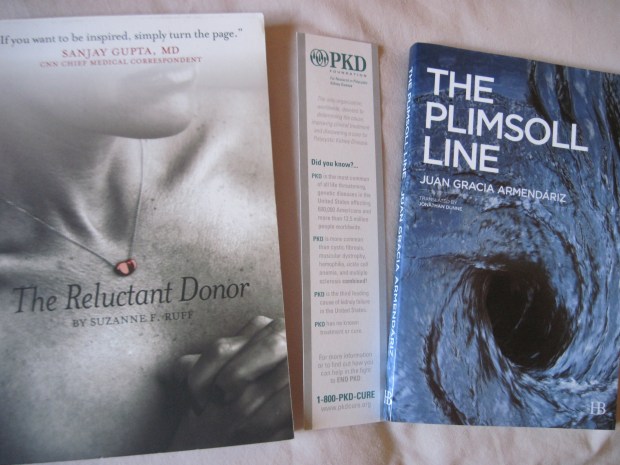
I must mention the excellent work done by the PKD Foundation in the States and the PKD Charity here in the UK. Both are a great support and source of information for me and my wider family.
The Plimsoll Line by Juan Gracia Armendáriz
As soon as I read Melissa’s review at The Book Binder’s Daughter, I knew I had to get this one. “The Plimsoll line” is a maritime term indicating how low a cargo-laden ship can sit in the water without sinking; here it’s used metaphorically to ask just how much one man can take. Gabriel Ariz is a 52-year-old art professor who lives not far from the city yet surrounded by oak woods. He’s divorced from Ana, who’s pressuring him to sell the house, and their young adult daughter Laura died a few years ago in a car accident. Now this pack-a-day smoker who gets drunk with his brother, traveling photographer Óscar, learns that he has end-stage renal disease and his life will have to change. On indefinite leave from work, he attends a dialysis clinic several times a week and joins the organ transplant list.
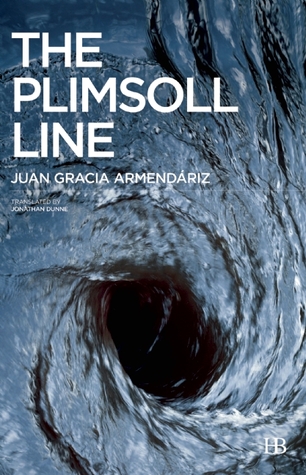 At times this was a bit overwritten for my tastes – some paragraphs stretch to several pages, and I’ve had to look up words, including “lentitude” and “logomachy” – but I did love the author’s trick of jumping into different perspectives. On multiple occasions he employs an “anonymous observer,” and in various chapters the point-of-view shifts to a member of the animal kingdom: Polanski the cat, a black kite flying overhead, a mole popping up in the garden, or a beetle winging across the detritus of Gabriel’s untidy household. We also get an extended section from Laura’s journals that reveals a disturbing family secret.
This is not one for the squeamish as it gives an unflinching account of dialysis: “His forearm throbbed, lacerated by needle marks. Sara had taken a while to find the fistula, and now the pain spread under the surgical tape like a jellyfish sting.” But for every passage that makes you cringe there’s a beautiful one that captures things perfectly: “he is living in constant deferment, between parentheses” and “If the succubus of his bad dreams were to say to him, ‘Make a wish,’ he would ask to be able to mold himself to the geological quietude of stones.”
The Plimsoll Line won Spain’s Premio Tiflos de Novela in 2008 and first appeared in English translation in 2015. It is part of a “Trilogy of Illness”; I presume the other volumes are not yet available in English, though I’ve enquired of the translator, Jonathan Dunne, via a Facebook message just in case. Forget Ferrante and Knausgaard; this is the semi-autobiographical series I’ll be awaiting the next installment of with bated breath.
My rating:
Hundreds of Interlaced Fingers by Vanessa Grubbs
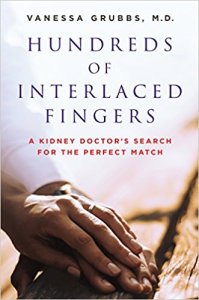 Grubbs is a nephrologist and assistant professor of medicine at San Francisco General Hospital. Well before she made the kidneys her clinical area of expertise, a personal encounter made them special to her. In 2003 she met Robert Phillips when she was an attending trying to get support for her Office of Diversity Affairs; he was a hospital trustee. She only later learned, after they started dating, that due to FSGS his kidneys had failed in his twenties and he’d been on dialysis for years. In 2005 she donated him one of her kidneys. Robert’s health was touch-and-go for a little while there, but he proposed to her soon afterwards. I read about a third of this and then skimmed the rest because I wasn’t all that interested in their separate histories. However, I did like the context Grubbs gives, such as a brief history of dialysis, nephrology case studies, and a great set of FAQs. She also notes that minorities are less likely to get organ transplants, a disparity she is working to rectify.
This memoir grew out of an essay for Health Affairs, “Good for Harvest, Bad for Planting.” Releases June 13th.
My rating:
The A to Z of You and Me by James Hannah
 (First reviewed in November 2015; here’s a shortened version.) Lying in a hospice bed, 40-year-old Ivo looks back on his life. Even after just four short decades and a modest career at a garden center, he has plenty to regret. Hard partying and drug use exacerbated his diabetes and prompted kidney failure. His lifestyle also led indirectly to his girlfriend, nursing student Mia (the “you” he often addresses directly), leaving him. He’s estranged from his sister and his friends from school days, especially Mal. How did he mess up so badly and cut himself off so completely that he’s now dying alone? And how much can he put right before he goes?
There’s plenty of affecting writing in Hannah’s debut novel. I liked how he captures the routines of institutional life. Nurse Sheila’s A to Z game, encouraging Ivo to think of a memory attached to body parts starting with each letter of the alphabet, provides a hokey but effective structure. Keeping in mind that in British English Z is pronounced ‘zed’, the title doesn’t rhyme, but this is still somewhat sappy. I’d recommend it to fans of Mark Haddon and David Nicholls. I’ll follow Hannah’s career and hope he avoids melodrama and a contrived setup – the two near-pitfalls of this one – in the future.
My rating: 
The Reluctant Donor by Suzanne F. Ruff
A sepia-toned photograph at the centerfold tells a solemn tale: six of these eight members of Ruff’s Irish-Catholic Chicago family died, directly or indirectly, as a result of PKD. I’ve always known there’s a long waiting list for transplant kidneys, but I was surprised to learn that dialysis machines used to be rare; demand far exceeded supply, and the procedure was not covered by Medicare until 1973. Ruff’s aunt, Sister Mike, decided the lives of people with children were more important than her own, so didn’t press for dialysis; when her kidneys failed in her forties, death followed just a few months later.
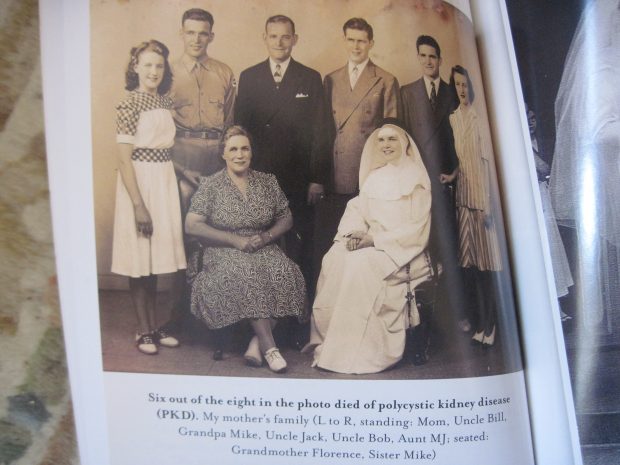 Things had greatly improved by the time Ruff’s mother needed a transplant. Joan sounds like a feisty, lovable character, with plenty of good advice on being a patient: fight for your rights (the meek ones often end up being carried out feet first), get up and walk as soon after surgery as you possibly can, and appreciate the joy of an entirely ordinary day. Ruff’s parents had her and her sisters tested for PKD when they were teenagers. Having gone to the trouble, they then lied about the results! They said no one had PKD, but in the end two out of three did; only Ruff was spared. This is how she ended up donating a kidney to her younger sister, JoAnn. The more interesting sections of the book are about Ruff’s family history; her internal struggle to convince herself to commit to organ donation makes for pretty repetitive moaning.
 In general, the writing isn’t great. Skimming through, I found a page with 16 of my proofreading marks; on most pages it’s more like 2–3. There’s also a tendency to over-write when portraying emotion: “Genetic disease. Those two words made my spine shiver, my ears ring, my throat close, and my heart pound; I became lightheaded and faint. Terror crept into my core and gripped me in its vice [sic].” While I’m not sure I could recommend this to someone who doesn’t have a personal stake in organ donation, for those who are interested in an autobiographical account of genetic disease/transplant surgery, it’s a quick, pleasant read.
My rating:
Plus two more kidney-themed novels I’m on the look-out for:
- Useful, Debra Oswald, about a man who decides to donate a kidney to a stranger
- The Kidney Hypothetical: Or How to Ruin Your Life in Seven Days, Lisa Yee, a YA comedy in which a girl asks her boyfriend if he’d give her a kidney. Hypothetically, right?
 I’m on the fence about:
- Larry’s Kidney: Being the True Story of How I Found Myself in China with My Black Sheep Cousin and His Mail-Order Bride, Skirting the Law to Get Him a Transplant—and Save His Life, Daniel Asa Rose (I think the subtitle says it all!)
- I, Kidney, Chris Six: a self-published, semi-autobiographical novel
Two Years and Counting
As of today I’ve been blogging for exactly two years.

By Joey Gannon from Pittsburgh, PA (Candles) [CC BY-SA 2.0 (http://creativecommons.org/licenses/by-sa/2.0)%5D, via Wikimedia Commons.
If I were to play the bibliotherapist and prescribe myself just one book from my Kindle backlog for today, it would be this one:

I am terrible about comparing myself to others on social media: number of likes, number of followers, level of engagement, etc. I so often think that other bloggers are involved in interesting projects or leading the way on various initiatives, whereas I’m just plodding along. It’s hard to ignore the quantitative indicators and just be content doing what I do.
Still, ideas keep coming, so I’ll roll with it.
Thank you to everyone who takes time out for my blog.
Midwinter Cedes to Spring
I’ve marked the turn of the seasons by following a ‘Midwinter’ book with a ‘Spring’ one.
Moominland Midwinter by Tove Jansson
 My third and favorite Moomins book (so far).
Moomins are supposed to sleep through the winter, but this year young Moomintroll awakens and finds himself in a “strange and dangerous” world transformed by snowdrifts. He can’t get his parents to wake up so is effectively a temporary orphan, surrounded by peculiar creatures from Jansson’s menagerie, this time including a dim-witted squirrel, invisible shrews, a glum little dog who wishes he could run with wolves, and the Dweller Under the Sink (with its exceptionally bushy eyebrows).
While Moomintroll searches for totems of familiarity—
He looked at the cupboard in the corner and thought of how nice it was to know that his own old bath-gown was hanging inside it. That something certain and cosy still remained in the middle of all the new and worrying things.
—Too-ticky has the opposite mindset: “All things are so very uncertain, and that’s exactly what makes me feel reassured.” She goes fishing under the ice, builds a life-size horse out of snow, and assembles tree trunks and old furniture for the midwinter ritual of a huge bonfire.
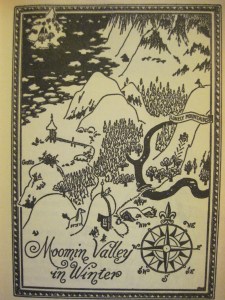 When they receive a visit from the Hemulen, who’s keen on skiing and declares the indoors too stuffy in winter, the creatures quickly tire of his energetic optimism. The truth is that they like sitting around being miserable. “I’m cold! I’m lonely! I want the sun back again!” Moomintroll pouts, but even he is too affable to make the Hemulen leave.
Of course the spring finally arrives, as it does every year, but it’s depressingly long in coming and for Moomintroll becomes a matter of faith. I love the strangeness of Jansson’s imagination, the balance of melancholy and comedy, and the little philosophical nuggets buried along the way – children and adult readers alike will get a lot out of this. It doesn’t talk down to children with a rosy message about everything being alright.
My rating:
Spring: An anthology for the changing seasons, edited by Melissa Harrison
Although this was the first of the Wildlife Trusts anthologies published in 2016, I got a late start last year so am reading this as the final of four. In common with the other volumes, it’s a terrific mix of contemporary and historical writing, big names and newcomers, observation and reflection. Compared with the other books, it seems to have more about WT sites in particular, with a few pieces from current volunteers or former employees. I also noticed that there’s a bit more of a focus on birds – with essays on the chiffchaff, the birds encountered on the Cley Marshes, cuckoo festivals, young dippers, and a tawny owl chick.
 That said, there’s still plenty of variety here, with everything from spring flora* to adders fueling the generally two- to three-page essays. I especially liked Kate Long’s piece on filming hedgehogs at night and Vijay Medtia’s on how people of color living in cities have little access to nature; he recalls spotting a magpie with a twig in its beak at a train station and having to ask someone what it was called. Of the previously published authors, I enjoyed hearing more from Rob Cowen and Miriam Darlington and laughed at Will Cohu’s ice cream and underwear metaphors applied to varieties of cherry trees.
You can’t beat George Orwell on toad sex, and it’s fun to encounter excerpts from classic novels in the context of a nature book: The Wind in the Willows, Lorna Doone, and Jane Eyre (which, shamefully, I didn’t recognize until Lowood was mentioned in the last paragraph). I think my favorite piece of all, though, was Jo Sinclair’s about watching spring’s arrival after a major operation and noting nature’s inscrutable jumble of beauty and brutality.
And my favorite passage:
Year after year all this loveliness for eye and ear recurs: in early days, in youth, it was anticipated with confidence; in later years, as the season approaches, experience and age qualify the confidence with apprehension lest clouds of war or civil strife, or some emergency of work, or declining health, or some other form of human ill may destroy the pleasure or even the sight of it: and when once again it has been enjoyed we have a sense of gratitude greater than in the days of confident and thoughtless youth. Perhaps the memory of those days, having become part of our being, helps us in later life to enjoy each passing season.
(from Sir Edward Grey’s The Charm of Birds, 1927)
This passage from Reverend Francis Kilvert’s diary (April 14, 1871) makes me look forward to our trip to nearby Hay-on-Wye next month: “The village is in a blaze of fruit blossom. Clyro is at its loveliest. What more can be said?” Simply that these anthologies are an essential companion to the seasons.
*Like my husband’s piece, positioned right before the R.D. Blackmore extract.
(See also my reviews of Summer, Autumn and Winter.)
My rating:
Marginalia, Bookmarks, Etc. Found in Books
 In two of the books I currently have on the go, items found in books are a key element. First there’s Swimming Lessons in Claire Fuller, in which one strand of the narrative is told via a series of letters Ingrid hid in various thematically relevant books from her husband’s overflowing collection before she disappeared 12 years ago.
I’ve also been skimming Reading Allowed, novelist Chris Paling’s book of mildly amusing anecdotes from his time working in a public library. As little interludes he records the items he’s found being used as bookmarks in library volumes: a postcard, a shopping list, a meal plan, a CV, and so on.
In my years working in bookshops and libraries I found lots of proper bookmarks left behind in books; this photo shows the ones I’ve kept (others I’ve given away, recycled or donated to the library basket).

This doesn’t account for all the train tickets, receipts, newspaper clippings, etc. that were serving as makeshift bookmarks. The strangest thing I think I ever found in a book was an old-fashioned faux pearl-topped hatpin marking a place in a copy of Elizabeth Barrett Browning’s collected poems.
And then there are the written messages I’ve found in books: other people’s bookplates (I especially like the one that appears in the front of each volume of my 1919 Chapman & Hall set of the complete works of Dickens – such an enviable reward for good attendance!);


a heartfelt message of friendship in the copy of May Sarton’s The Fur Person I got free from Book Thing of Baltimore;

a young lady’s thoughts strewn across the selected poems of Ted Hughes;

and a dead-simple recipe for a tropical fruit drink pencilled on the back cover of Patricia Volk’s memoir, Stuffed.

For me, the random objects and messages you might find are all part of the fun of buying secondhand books.
What’s the strangest thing you’ve ever found in a secondhand book?
Making Plans for March
How is it March already?! The last weekend of February flew by with a trip to Exeter to visit friends. Between Saturday and Sunday we spotted: a humpback whale off the Devon coast at Slapton (occasioning many cries of “Thar she blows!”), a giant pug painted on an underpass, a mighty fine cream tea, and far too many secondhand books at Book-Cycle.


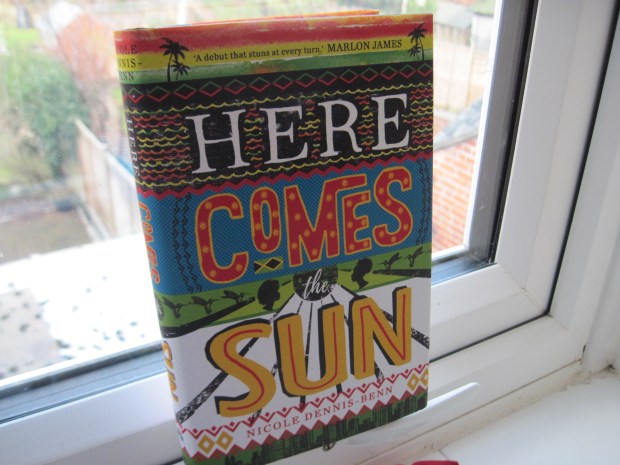
For me the month of March holds an alarming number of deadlines for book reviews: 15, to be precise. Yipes! Luckily I’ve already managed to submit two of these reviews, and I plan to write a third this afternoon. Most of those are as part of my paid work, but I’ll also be participating in two blog tours for nonfiction books on adoption and foxes, respectively, and contributing a review of Here Comes the Sun by Nicole Dennis-Benn to Shiny New Books.
As to other planned blog posts for the month…
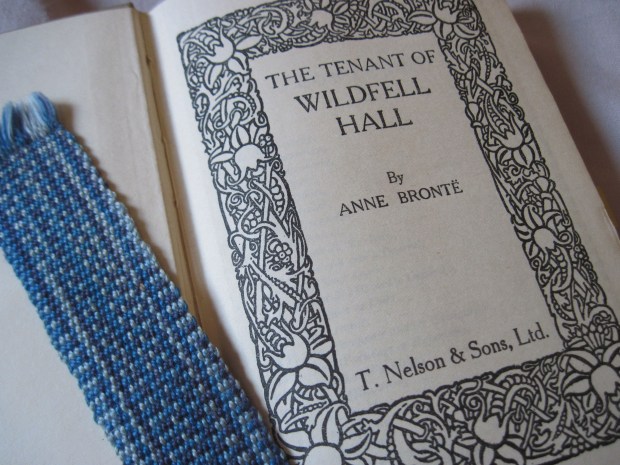
- Thanks to your comments I’ve started The Tenant of Wildfell Hall as my monthly classic (27 pages in and I’m loving it already).
- I’m doing some thematic reading for World Kidney Day on the 9th.
- I’m thinking of getting my first Haruki Murakami book, The Wind-Up Bird Chronicle, out from the library as my doorstopper of the month.
- I’ll be reviewing Narcissism for Beginners by Martine McDonagh (terrific) and The Family Gene by Joselin Linder (haven’t started yet).
- A couple more books may turn up from publishers if I’m lucky.
Some other themed reading challenges are underway but will probably roll over to future months.
Today I’m picking up three library holds: The Good People by Hannah Kent, The Best of Adam Sharp by Graeme Simsion and Days Without End by Sebastian Barry (this one’s for a BookBrowse review due in April). All are likely to be requested after me, so somehow I have to fit them in during the next three weeks. I do hope they’re quick reads!
So, a busy month – back to the reading! How does the month look for you?
Three Recommended March Releases
Here are three enjoyable novels due out next month that I was lucky enough to read early. The first two are debuts, while the third is by an author I’ve had good luck with before. I’ve pulled 250-word extracts from my full reviews and hope you’ll be tempted by one or more of these.
Spaceman of Bohemia by Jaroslav Kalfař
(Coming on March 7th from Little, Brown and Company [USA] and March 9th from Sceptre [UK])
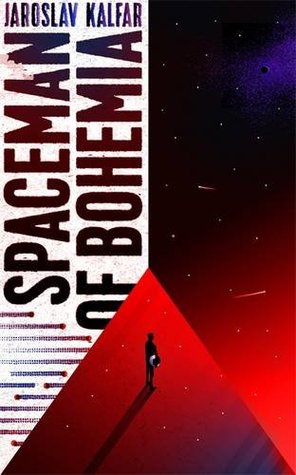 Call this a cross between Everything Is Illuminated (Jonathan Safran Foer) and The Book of Strange New Things (Michel Faber). In April 2018 Czech astronaut Jakub Procházka is launched to investigate cosmic dust storm “Chopra,” but realizes he can never escape his family history or the hazards of his own mind. Amid the drudgery of daily life onboard the JanHus1 space shuttle, he makes a friend: a giant, alien spider he names Hanuš. Jakub has the sense that Hanuš is sifting through his memories, drawing out the central tragedies that form his motivation for going to space, including the shame and persecution that resulted from his father being a Party loyalist and member of the Secret Police prior to the Velvet Revolution.
This debut novel is a terrific blend of the past and the futuristic, Earth and space. There is much to enjoy: Jakub’s sometimes baroque narrative voice (“What good am I, a thin purse of brittle bones and spoiling meat?”) – all the more impressive because Jaroslav Kalfař is in his late twenties and has only spoken English for about 13 years; the mixture of countryside rituals and the bustle of Prague; and the uncertainty about whether Jakub has a viable future, with or without his wife Lenka. The book goes downhill in Part Two and doesn’t quite pull everything together before its end. However, it’s still one of the best debuts I’ve encountered in recent years, and I’ll be eager to see what Kalfař will come up with next.
My rating:
The Idiot by Elif Batuman
(Coming on March 14th from Penguin [USA] and June 1st from Jonathan Cape [UK])
 An odd but very funny anti-Bildungsroman. This is Selin Hanim’s account of her freshman year at Harvard (circa 1995) and the summer of European travel that follows. A daughter of Turkish immigrants, she wants to become a writer, but even as she minutely records every happening and thought she doubts the point of it. In Russian and linguistics classes, in interactions with her roommates and her Serbian friend Svetlana, and in her growing obsession with Ivan, a senior math major from Hungary, she includes a Knausgaardian amount of mundane detail yet always remains at an emotional distance from events. The tone is so very deadpan that you may never warm to Selin. However, it feels appropriate for what the novel is attempting: a commentary on the difficulty of having real, meaningful conversations when language breakdown is rife.
Once again Batuman has borrowed a Dostoevsky title (her 2010 memoir was called The Possessed). I suspect her debut novel is generally indebted to Eastern European literature in the randomness of the incidents and the way they are bluntly recounted rather than explained. This can be problematic for the story line: it feels like things keep happening that serve no purpose in the grander scheme. It’s as if Batuman is subverting the whole idea of a simple coming-of-age trajectory. At the same time, she convincingly captures what it’s like to be young and confused. This reminded me of my college and study abroad experience; that familiarity plus the off-the-wall humor kept me reading.
Sample lines:
(On a plane) “I opened the foil lid and looked at the American meal. I couldn’t tell what it was. The man in the seat ahead of me started tossing and turning. His pillow fell into my dessert. The pink whipped foam formed meaningful-looking patterns on the white fabric. I saw a bird—that meant travel.”
“Spiderwebs attached themselves, like long trails of agglutinative suffixes, onto our arms and faces.”
My rating:
My Darling Detective by Howard Norman
(Coming on March 28th from Houghton Mifflin)
 When Jacob Rigolet’s mother Nora, former head of Halifax Free Library, throws ink on a photograph during an art auction in 1977, it sparks an unusual quest into his past. Jacob’s fiancee Martha Crauchet, the detective of the title, learns two startling facts from Nora’s police file: Jacob was born in the Halifax library; and Bernard Rigolet had been serving overseas for more than a year before his birth in 1945, so can’t be his father. Three years ago Nora’s obsession with World War II led to a breakdown she calls her “fall from grace”; she’s been confined to a rest home ever since. As Jacob gives up being an art buyer to attend library school, Martha gets involved in a cold case that involves his real father. The film noir atmosphere is enhanced by a hardboiled detective radio program he and Martha are hooked on: set in the year of Jacob’s birth, Detective Levy Detects keeps overlapping with real life.
This offbeat mystery reminded me of The World According to Garp. I could see it working as a low-budget indie movie or TV special. I loved how climactic things kept happening at the library, and enjoyed glimpses of bad borrower behavior: selling the library’s art books to a secondhand bookstore and a 105-year overdue loan found in someone’s attic. I have a suspicion this novel won’t linger long in my mind, but it was a fun weekend read. (Historical note: one character’s mother was killed in the Halifax Explosion.)
My rating:
 Bookish Beck = Rebecca Foster. American transplant to England. Freelance proofreader and book reviewer.
