Better Late than Never: The Signature of All Things
 Who knew Elizabeth Gilbert had it in her? I’ve read and loved all of her nonfiction (e.g. Big Magic), but my experience of her fiction was a different matter: Stern Men is simply atrocious. I’m so glad I took a chance on this 2013 novel anyway. Many friends had lauded it, and for good reason. It’s a warm, playful doorstopper of a book, telling the long and eventful story of Alma Whittaker, a fictional nineteenth-century botanist whose staid life in her father’s Philadelphia home unexpectedly opens outward through marriage, an adventure in Tahiti, and a brush with the theories of Charles Darwin and Alfred Russel Wallace.
The novel’s voice feels utterly natural, and though Gilbert must have done huge amounts of research about everything from bryophytes to Tahitian customs, nowhere does the level of historical detail feel overwhelming. There are truly terrific characters, including mystical orchid illustrator Ambrose Pike, perky missionary Reverend Welles, and a charismatic Polynesian leader named Tomorrow Morning.
We see multiple sides of Alma herself, like her enthusiasm for mosses and her sexual yearning. For a short time in her girlhood she’s part of a charming female trio with her adopted sister Prudence and their flighty friend Retta. I loved how Gilbert pins down these three very different characters through pithy (and sometimes appropriately botanical) descriptions: “Prudence’s nose was a little blossom; Alma’s was a growing yam,” while Retta is “a perfect little basin of foolishness and distraction.”
Gilbert also captures the delight of scientific discovery and the fecundity of nature in a couple of lush passages that are worth quoting in full:
(Looking at mosses on boulders) Alma put the magnifying lens to her eye and looked again. Now the miniature forest below her gaze sprang into majestic detail. She felt her breath catch. This was a stupefying kingdom. This was the Amazon jungle as seen from the back of a harpy eagle. She rode her eye above the surprising landscape, following its paths in every direction. Here were rich, abundant valleys filled with tiny trees of braided mermaid hair and minuscule, tangled vines. Here were barely visible tributaries running through that jungle, and here was a miniature ocean in a depression in the center of the boulder where all the water pooled.
The cave was not merely mossy; it throbbed with moss. It was not merely green; it was frantically green. It was so bright in its verdure that the color nearly spoke, as though—smashing through the world of sight—it wanted to migrate into the world of sound. The moss was a thick, living pelt, transforming every rock surface into a mythical, sleeping beast.
Best of all, the novel kept surprising me. Every chapter and part took a new direction I never would have predicted. Like The Goldfinch, this is a big, rich novel I can imagine rereading.
My rating: 
One of my favorite parts of reviewing (e.g. for Kirkus and BookBrowse) is choosing “readalikes” that pick up on the themes or tone of the book in question. I’ve picked four for The Signature of All Things:
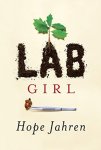 Lab Girl, Hope Jahren: An enthusiastic, wide-ranging memoir of being a woman in science. There’s even some moss! This was a really interesting one for me to be reading at the same time as the Gilbert novel. (See Naomi’s review at Consumed by Ink.)
Euphoria, Lily King: Based on Margaret Mead’s anthropological research among the tribes of Papua New Guinea in the 1930s, this also has a wonderfully plucky female protagonist.
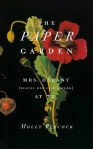 The Paper Garden, Molly Peacock: This biography of Mary Delany, an eighteenth-century botanical illustrator, examines the options for women’s lives at that time and celebrates the way Delany beat the odds by seeking a career of her own in her seventies.
The Seed Collectors, Scarlett Thomas: A quirky novel full of plants and sex.
Agatha Christie’s Life as a Graphic Novel
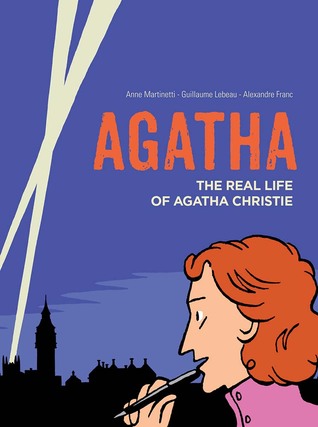 Agatha, a biography in graphic novel form written by Anne Martinetti and Guillaume Lebeau and illustrated by Alexandre Franc, opens – appropriately – with the real-life mystery at the heart of Agatha Christie’s story. In December 1926 the celebrated crime novelist disappeared, prompting a full-scale police investigation. She had abandoned her car by a lake in Surrey and traveled by train to Harrogate, where she checked into a hotel under a false name. Was it all an elaborate act of revenge for her husband’s philandering? Christie strikes up a conversation with Hercule Poirot, her most famous creation, in the hotel room, while back in London a clairvoyant is brought in to confirm she is alive. The medium’s look into Christie’s past sets up the novel’s first half as an extended flashback giving her history up until 1926.
Agatha Miller was raised in a wealthy household in Torquay, Devon. I never knew that she was a flaming redhead or that her father was American. His death when she was 11 was an early pall on an idyllic childhood of outdoor exploration and escape into books – even though her mother opined, “No child ought to be allowed to read until the age of 8. Better for the eyes and the brain.” She first turned her hand to writing while laid up in bed in 1908, completing her first story in two days. She and her mother took an exciting trip to Egypt, and in 1912 she met Lieutenant Archibald Christie at a ball. During the First World War she was a nurse at the town hospital in Torquay, where she came across a Belgian refugee who – at least in the authors’ theory – served as the inspiration for Poirot.
The Christies’ only daughter, Rosalind, was born in 1919. The following year The Mysterious Affair at Styles, the first Poirot mystery, was published. Christie’s career successes are intercut with her round-the-world travels (portrayed as sepia photographs), marriage difficulty and a new romance with archaeologist Max Mallowan, and the occasional intrusion of real-world events like World War II.
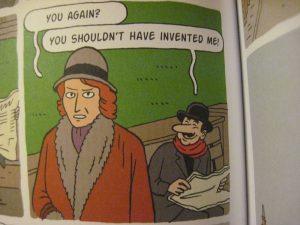 Meanwhile, her invented detectives jockey for her attention: not just Poirot, but Miss Marple and Tommy and Tuppence too. You have to suspend your disbelief during these scenes. I don’t think the authors are literally suggesting that Christie hallucinated conversations with her characters. Rather, it’s a whimsical way of imagining how her detectives took on lives of their own and became ‘real people’ she cared for yet found exasperating – she often threatens to do away with Poirot as Arthur Conan Doyle tried to do with Sherlock Holmes. There were only a couple of pages where I felt that a conversation with Poirot was a false way of conveying information. For the most part, this strategy works well; when coupled with the opening scene in 1926, it keeps the biography from being too much of a chronological slog.
With the exception of the sepia-tinged travel sections, this is a book packed with bright colors, particularly with Christie’s flash of red hair animating the first three quarters. It finishes with a timeline of Christie’s life and a complete bibliography of her works – no doubt invaluable references for diehard fans. I’ve only read one or two Christie books myself (my mother is the real devotee), but I enjoyed this quick peek into a legendary writer’s life. I was reminded of just how broad her reach was: from Hollywood studios to the West End, where The Mousetrap has been showing for a record-breaking 63 years. Her influence cannot be denied.
With thanks to the publisher, SelfMadeHero, for the free copy. Translated from the French by Edward Gauvin. (This one is in paperback!)
My rating: 
Are you an Agatha Christie fan? Does this tempt you to read more by or about her?
Summer Reading Plans
In June my husband and I will be off to Europe for two weeks of train travel, making stops in Brussels, Freiburg (Germany), two towns in Switzerland and another two in Austria. I like picking appropriate reading material for my vacations whenever possible (even though I’ll never forget Jan Morris’s account of reading the works of Jane Austen on a houseboat in Sri Lanka – a case of the context being so wrong it’s right), so I’ve been thinking about what to take with me and what to read ahead of time.
Back in October I picked up a lovely little secondhand hardback of Jerome K. Jerome’s Diary of a Pilgrimage for £1. Given that it’s a novel about a journey by train and boat from England to Germany to see the Oberammergau Passion Play and that Jerome is a safe bet for a funny read, this one is definitely going in my luggage. I also plan to take along a library paperback of A Whole Life by Robert Seethaler, a novella set in the Austrian Alps at the time of the Second World War.
Last year I discovered Austrian writer Daniel Kehlmann through the brilliant F: A Novel, and now have two more of his waiting: Me and Kaminski and Measuring the World, which sound completely different from each other but equally appealing (see Naomi’s review of the latter). What I might do is read one just before the trip and the other soon after we get back.
There are a few thin classics I have on my shelves and might be tempted to slip into a backpack, but for the most part I’ll plan to save space by taking a well-loaded Kindle. (It currently houses 300 books, so there’s no risk of running out of reading material!) I think I’ll treat myself to a few July/August books from my priority advanced reads list, like (fiction) The Hemingway Thief by Shaun Harris and The Book that Matters Most by Ann Hood, and (nonfiction) Playing Dead by Elizabeth Greenwood and On Trails by Robert Moor.
Once we get back to England, my self-imposed restriction for the rest of the summer will be reading only my own books. That means no library books, NetGalley/Edelweiss ARCs, or unpaid review books. This should work out well because it looks like we’ll be moving on August 18th, so I’ll be able to cull some books after reading them to reduce the packing load.
In any case, it will be a good chance to reassess my collection and get through some doorstoppers like A Suitable Boy, City on Fire, and This Thing of Darkness. During moving week itself I may have to stick to Kindle books while the print ones are inaccessible, but then as I rediscover them through unpacking I can try to push myself through a few more.
What are your summer and/or vacation reading strategies?
The Violet Hour by Katie Roiphe
I don’t believe that you can learn how to die, or gain wisdom, or prepare, and the work I have done on this book has, if anything, confirmed that suspicion, but I do think you can look at a death and be less afraid.
 The subtitle – “Great Writers at the End” – gives you a hint of what to expect from this erudite, elegiac work of literary biography. In a larger sense, it is about coming to terms with the fear of death, one of the last enduring Western phobias.
Roiphe was a sickly, morbid child. After a serious, extended case of something like pneumonia, she had half a lung removed, and her chosen reading was books about Armenian genocide. Although she was convinced she was going to die at 12, it was only a blip; her next significant encounter with death was her father’s cardiac arrest at age 82. Once again, she was utterly unprepared. In investigating six great authors’ deaths, Roiphe is not so much looking for sage tour guides to the underworld as asking how one faces and narrates death.
To start with I was skeptical about Roiphe’s set of chosen writers. Between Susan Sontag, Sigmund Freud, John Updike, Dylan Thomas, Maurice Sendak and James Salter there’s no class or racial diversity, and the gender balance is poor. Yet as I read on I set these quibbles aside. There are literally hundreds, maybe thousands of subjects Roiphe could have chosen, so in a sense the particular authors discussed here are arbitrary. She’s eschewed more obvious candidates like Christopher Hitchens, probably because he wrote enough about his own impending mortality himself. The criteria were probably as plain as this: an author who meant something to Roiphe, left a lot of documentary evidence, preferably had some living descendants and colleagues to interview, and whose death was drawn out enough that s/he had time to wrestle with the thought of it in writing.
Starting each chapter with the vigil at an author’s deathbed in a hospital room or at home, Roiphe skips back and forth in time to pinpoint where illness and death cropped up in that author’s life and work. For Susan Sontag, dying at New York’s Sloan Kettering in 2004, it was her third bout with cancer. A final extreme intervention, a bone marrow transplant at Seattle, had recently failed. Still Sontag shirked the notion of death, refusing even to talk about it. Work was how she had always transcended the specter of death – by writing books like Illness as Metaphor and inserting scenes of false death into her fiction – and now it was all that kept her going. Perhaps, Roiphe theorizes, there was a kind of solipsism at the heart of Sontag’s denial of death: she just could not believe that anything would continue existing without her. Well before her first experience of cancer in the 1970s, she wrote in a notebook: “Too abstract: death. Too concrete: me.”

Susan Sontag’s grave at the Cimetière du Montparnasse, Paris. (By Wikimedia Commons / Mu (Own work), via Wikimedia Commons.)
One might expect Freud to have been more disciplined about the business of dying, what with his theory of Thanatos (the death drive) and his frequently professed acceptance. However, as Roiphe emphasizes, it is one thing to say you accept death, and quite another thing to actually accept it. In Freud’s case, his refusal to give up cigars despite painful throat cancer and 33 oral surgeries flew in the face of his otherwise rational methods. Cigars were his only vice, he shrugged. Is a cigar just a cigar, or are there overt sexual connotations? For Updike, sex was like Freud’s cigars: sensual evidence that life goes on. Adultery, a frequent theme in his fiction, was perhaps an unconscious strategy for ‘cheating’ death. It was only after his diagnosis with lung cancer that death replaced sex as the central obsession of his work. His last book, like his first, would be poetry: Endpoint, one last valiant effort before death.

Freud with one of his beloved cigars, 1922. Max Halberstadt [Public domain], via Wikimedia Commons.
Each chapter is its own microcosm. The author herself only appears in the prologue and epilogue; in between, although she obviously interviewed survivors (and Salter, who died before he could read the finished book), she edits herself out so we can be right there with the subject. There’s no distance at all. That sense of intimacy is clearest in the chapter-heading photographs of the authors’ (posthumously?) empty studies. These are haunting images. Look at Sendak’s desk covered in paints and drawings, slippers carefully waiting underneath; a cardigan on the back of the chair – there’s such a sense of life. The life continues in the work.
None of these authors got death perfectly right. Several of them fought it right to the end; several of them veered towards faith despite a lifelong antipathy to religion; several of them were ultimately taken aback by the simple realization that they, too, were mortal. Roiphe discovers no magic formula for how a writer should do death. Despite their contradictory approaches, though, all her subjects had the same destination:
here’s what I learned from the deaths in this book: You work. You don’t work. You resist. You don’t resist. You exert the consummate control. You surrender. You deny. You accept. You pray. You don’t pray. You read. You work. You take as many painkillers as you can. You refuse painkillers. You rage against death. You run headlong toward it.
In the end the deaths are the same. They all die. The world releases them.
This would be an ideal book for fans of Olivia Laing (see my review of The Lonely City) or Julian Barnes’s Nothing to Be Frightened of. What Roiphe observes of Sendak’s habit of drawing the dead and dying could equally be applied to The Violet Hour: it’s about seeing the beauty in what terrifies you. One of my top few nonfiction reads of 2016 so far.
With thanks to Grace Vincent of Virago for sending a review copy. The Violet Hour releases today in the UK; it was published on March 8th in the States by The Dial Press.
My rating:
My Life in Book Quotes
I keep an ongoing Word file with details on my year’s reading: books finished with the date, number of pages, and source – similar information to what’s recorded on Goodreads – plus any quotations that particularly stood out to me. It occurred to me that by looking back through these annual book lists for the quotes that meant the most to me I could probably narrate my recent years. So here are the 2015–2016 quotes that tell my story.

Career
“I’m learning that what’s important is not so much what I do to make a living as who I become in the process. … the heroine, when at a juncture, makes her own choice—the nonheroine lets others make it for her.”
(A Year by the Sea: Thoughts of an Unfinished Woman, Joan Anderson)
“The dishes. The dishes! The goddamn dishes! No wonder women don’t succeed.”
(The author’s mother’s explosion in The Year My Mother Came Back, Alice Eve Cohen)
“Success says, What more can I get?
Craft says, Can you believe I get to do this?”
(How to Be Here: A Guide to Creating a Life Worth Living, Rob Bell)
“Amateurs look for inspiration; the rest of us just get up and go to work.”
(Everyman, Philip Roth)
Finding a Home
“In Orcadian, ‘flitting’ means ‘moving house’. I can hear it spoken with a tinge of disapproval or pity: the air-headed English couple who couldn’t settle.”
(The Outrun, Amy Liptrot)
“Where, after we have made the great decision to leave the security of childhood and move on into the vastness of maturity, does anybody ever feel completely at home?”
(A Circle of Quiet, Madeleine L’Engle)
“there is no such thing / as the right route or a clear passage / no matter where you start, / or how you plan it.”
(from “Aneurysm,” Selected Poems, Kate Clanchy)
Life vs. Books
“He had accepted that if you were a bookish person the events in your life took place in your head.”
(Golden Age, Jane Smiley)
“my way of seeing has always been different, shyer. To see the world I’ve always opened a book.”
(The Violet Hour: Great Writers at the End, Katie Roiphe)
“Other people’s lives, and the lives I read about in books, seem richer, mine seems so threadbare.”
(The Past, Tessa Hadley)
Overthinking
“She remembered finding her first white hair somewhere near her thirtieth birthday and it had sent her on a tailspin for half a day. It’s starting, she’d thought then. The follicle that produced that hair is dying. I’ve reached the tipping point and from now on it’s nothing but slow decline.”
(Dog Run Moon: Stories, Callan Wink)
“All the most terrifying Ifs involve people. All the good ones do as well.”
(A Little Life, Hanya Yanagihara)
“I wished then, and still do, that there was something in me also that would march steadily in one road, instead of down here or there or somewhere else, the mind running a net of rabbit-paths that twisted and turned and doubled on themselves, pursued always by the hawk-shadow of doubt.”
(Now in November, Josephine Johnson – to be reviewed here within next couple weeks)
Library Checkout: April 2016
You’ll notice a lot of familiar titles: some I’ve reviewed here recently; others have been hanging around since last month. It’s high time I actually read some of these – especially the Elizabeth Gilbert, for which I have high hopes. It’s a long Bank Holiday weekend coming up here in the UK, so maybe I’ll use that as the excuse to sink into a nice long library book…
LIBRARY BOOKS READ
- The Human Age: The World Shaped by Us by Diane Ackerman
- The Zimzum of Love: A New Way of Understanding Marriage by Rob and Kristen Bell
- To the River by Olivia Laing
- The Observances by Kate Miller (poetry)
- Dream Work by Mary Oliver (poetry)
- One of Us: The Story of a Massacre and Its Aftermath by Åsne Seierstad
- Golden Age by Jane Smiley
Skimmed only:
- My Brilliant Friend by Elena Ferrante
- The Towers of Trebizond by Rose Macaulay
LIBRARY BOOKS CURRENTLY READING
- Words in Air: The Complete Correspondence between Elizabeth Bishop and Robert Lowell, edited by Thomas Travisano [It’s over 800 pages, so I’ll probably be reading it all year!]
 CHECKED OUT, TO BE READ
- In the Unlikely Event by Judy Blume
- The Revised Fundamentals of Caregiving by Jonathan Evison
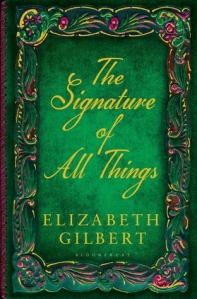
- The Signature of All Things by Elizabeth Gilbert
- The Great Soul of Siberia by Sooyong Park (about tigers)
RETURNED UNREAD
- The Land Ballot by Fleur Adcock
- Song of the Sea Maid by Rebecca Mascull
(Thanks, as always, to Shannon of River City Reading for the great blog idea and template!)
Books in Brief: Five I Loved Recently
The Human Age: The World Shaped by Us
By Diane Ackerman
 A perfect tonic to books like The Sixth Extinction, this is an intriguing and inspiring look at how some of the world’s brightest minds are working to mitigate the negative impacts we have had on the environment and improve human life through technology. As in David R. Boyd’s The Optimistic Environmentalist, Ackerman highlights some innovative programs that are working to improve the environment. Part 1 is the weakest – most of us are already all too aware of how we’ve trashed nature – but the book gets stronger as it goes on. My favorite chapters were the last five, about 3D printing, bionic body parts and human–animal hybrids created for medical use, and how epigenetics and the microbial life we all harbor might influence our personality and behavior more than we think.
My rating: 
I Will Find You
By Joanna Connors
 Connors was a young reporter running late for an assignment for the Cleveland Plain-Dealer when she was raped in an empty theatre on the Case Western campus. Using present-tense narration, she makes the events of 1984 feel as if they happened yesterday. It wasn’t until 2005 that Connors, about to send her daughter off to college, felt the urge to go public about her experience. “I will find you,” her rapist had warned her as he released her from the theatre, but she turned the words back on him, locating his family and learning everything she could about what made him a repeat criminal. She never uses this to explain away what he did, but it gives her the necessary compassion to visit the man’s grave. This is an excellent work of reconstruction and investigative reporting.
My rating:
One of Us: The Story of a Massacre and Its Aftermath
By Åsne Seierstad
 An utterly engrossing account of Anders Behring Breivik’s July 22, 2011 attacks on an Oslo government building (8 dead) and the political youth camp on the island of Utøya (69 killed). Over half of this hefty tome is prologue: Breivik’s life story, plus occasional chapters giving engaging portraits of his teenage victims. The massacre itself, along with initial interrogations and identification of the dead, takes up two long chapters totaling about 100 pages – best devoured in one big gulp when you’re feeling strong. It’s hard to read, but brilliantly rendered. Anyone with an interest in psychology or criminology will find the insights into Breivik’s personality fascinating. This is a book about love and empathy: what they can achieve; what happens when they are absent. It shows how wide the ripples of one person’s actions can be, but also how deep individual motivation goes. All wrapped up in a gripping true crime narrative. Doubtless one of the best books I will read this year.
My rating:
Cold: Adventures in the World’s Frozen Places
By Bill Streever
 “Cold is a part of day-to-day life, but we often isolate ourselves from it, hiding in overheated houses and retreating to overheated climates, all without understanding what we so eagerly avoid.” In 12 chapters spanning one year, Streever covers every topic related to the cold that you could imagine: polar exploration, temperature scales, extreme weather events (especially the School Children’s Blizzard of 1888 and the “Year without Summer,” 1815), ice ages, cryogenics technology, and on and on. There’s also a travel element, with Streever regularly recording where he is and what the temperature is, starting in his home turf of Anchorage, Alaska. My favorite chapters were February and March, about the development of refrigeration and air conditioning and cold-weather apparel, respectively.
My rating:
A Series of Catastrophes and Miracles
By Mary Elizabeth Williams
 “SPOILER: I lived,” the Salon journalist begins her bittersweet memoir of having Stage 4 metastatic melanoma. In August 2010 she had a several-millimeter scab on her head surgically removed. When the cancer came back a year and a half later, this time in her lungs as well as on her back, she had the extreme good luck of qualifying for an immunotherapy trial that straight up cured her. It’s an encouraging story you don’t often hear in a cancer memoir. On the other hand, her father-in-law’s esophageal cancer and her best friend Debbie’s ovarian cancer simply went from bad to worse. As the title suggests, Williams’s tone vacillates between despair and hope, but her writing is always wry and conversational.
My rating:
(For each one, read my full Goodreads review by clicking on the title link.)
Have you read any of these? Which one takes your fancy?
Jane Smiley’s Last Hundred Years trilogy
Jane Smiley’s “The Last Hundred Years” trilogy is a saga prioritizing the experiences of the Langdons, an Iowa farming family, over the century beginning in 1920. In chronological chapters, one per year from 1920 to the near future of 2019, Smiley follows an ordinary couple, their six children and several generations of their descendants as they navigate America’s social changes and re-evaluate their principles during decades of upheaval.
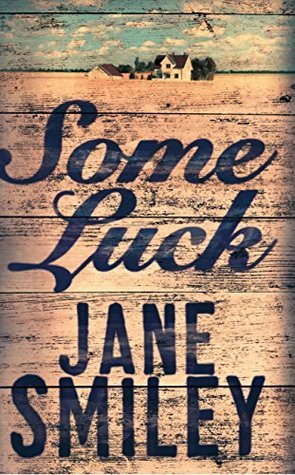 Some Luck
Here’s an excerpt from my Shiny New Books review in early 2015: “Farming, unpredictable and frequently heartbreaking, is an appropriate framework for an all-American story. Aspects of the Great American Novel are certainly on display: immigrant roots, coming-of-age trajectories for individuals and the nation, and American dream scenarios of reinvention. Within the confines of its third-person omniscient point-of-view, the novel shifts between the perspectives of each main character, especially the children. Smiley avoids a gimmicky One Day effect by varying the time of year so most chapters highlight different events, birthdays or holidays. Droughts, the Great Depression, the Second World War, and McCarthyism all feature, while the start of the Cold War – including paranoia over the Russians getting the bomb – sets up the second volume.”
My rating:
Some months ago it occurred to me that I never followed up with the Langdons. Although I don’t generally read sequels or series, I nonetheless made it a priority to find the other two volumes of the trilogy from the library.
Early Warning
The second book covers 1953 to 1986. The family loses one member to Vietnam, one to cancer, and one to the easiest, simplest death you could imagine. There’s a shotgun wedding, a divorce, and several affairs. In short, it feels like a real family, like your family. Events seem arbitrary at the time but later take on the cast of inevitability. Historical landmarks are there as background information, not as clichéd points of action (a good example is the JFK assassination). The Vietnam War threads through the middle section, but isn’t overpowering. The connections with history are pretty subtle here. One of my favorites is when Janet, at a Vietnam protest march, suddenly realizes she’s behind Martin Luther King, Jr. and Dr. Spock. Her later involvement with the Peoples Temple grew tiresome for me, but I appreciated the ironic eye on the future: in 1980, “Well, I guess, they invaded Afghanistan…wherever that is!”
 Iowa was still my preferred setting, an ideal site for pondering time’s workings and how money comes and goes: Joe “knew enough at his age to know that dollars were like drops of mist – they fluttered around you and then dissipated.” I also like Andy’s therapy sessions, frequently featured in the first half. There’s even a gentle mystery in this book: a boy who doesn’t seem to be related to the family keeps showing up, but by the end we figure out who he is.
People may rise and fall in importance, just as they do in real life, but everyone has a perspective. That’s part of Smiley’s message here, I think. Early on she observes that Rosanna “hadn’t thought of Roland Frederick as having a point of view.” Recognizing other people as valid subjects, overcoming solipsism, is really what literature is all about.
Although I’m interested in what happens next, I don’t like the grandchildren generation all that much; Richie and Michael are especially unpleasant, and I have a feeling they will be major players in Golden Age. Still, I feel invested in and close to this family, so I’m going to see it through to the end.
Favorite passage:
Joe’s dystopian vision: “But he could see it, looking south – he could see all the layers lift off – the roof of the house, the second floor, the first floor. He could see the children and Jesse and Jenny and Lois and Minnie being lifted out on a fountain of debt and scattered to the winds; then he could see the corn and beans scoured away, and the topsoil, once twelve inches thick, now six inches thick, and below that, the silty clay loam, more gray than black, then the subsoil, brownish clay all the way down, down, down to the yellow layer, mostly, again, clay, all of it exposed, all of it flying into the atmosphere like money, burning up in the hot sunshine, disappearing.”
My rating:
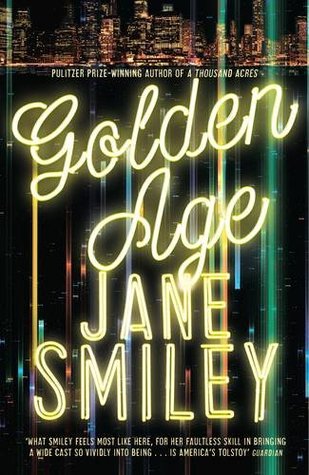
Golden Age
Alas, the final installment was my least favorite. There are a few reasons for this. One is simply that I didn’t like the third- and fourth-generation characters as much. Another is that, with such a large family tree, you get more lists of names and catch-up sessions. The intrusion of history is also more overt. I noted this in the 2011 chapter, especially, which mentions the Japanese earthquake, Utøya and the Occupy movement. One character dies on 9/11; another gets a flesh-eating bacteria. One is struck by lightning; another dies in a hit and run. Not only are several of the deaths unrealistic, but, true to the winding-down spirit, there are simply a lot of them.
 As people disperse and the second generation starts to die off, the bonds between the family members weaken. The Iowa farm diminishes in real-life and symbolic importance compared to the action on the coasts: California, New York and Washington, where Richie is a congressman. I might actually have preferred if Smiley had imagined an alternative history for the 2000s and 2010s. (Of course, that would have broken the mold she made for herself.) For me, it all felt too close. I had a sense of her picking easy targets: “I would like to thank the members of the U.S. Congress for being so easy to satirize,” she writes in her acknowledgments. There’s also too much horse material – a frequent indulgence for Smiley.
The last five or so chapters were speculative at the time Smiley was writing, and some of her predictions already seem a little silly, like violent protests against a Harper government in Vancouver in 2016. However, her environmental worries are right on, and her words about the 2012 presidential election seem prescient in relation to this year’s race: a character advises his family to vote Democrat “as a protest against the Republican Party for offering a roster of candidates that went from bad to worse to worst ever.”
My rating: 
Ultimately, my favorite overall character was Andy, who reinvented herself as a young woman and does so again as a widow, turning into a computer and investment whiz. Frank was an early favorite in Some Luck, where he reminded me a lot of Mad Men’s Don Draper, but I grew less enamored with him over the years. Henry was perhaps my second favorite in the previous two books, but he rather fades into the background in the final book.
My advice to anyone wondering whether they should read this trilogy would be to start with Some Luck and, if you really like it, proceed to Early Warning. Golden Age is largely unnecessary and can be reserved for die-hard Smiley fans or series completists.
Further reading: Literary Hub article, “Why Wasn’t Great American Novelist Jane Smiley on the Cover of a Magazine?”
Book Spine Poetry
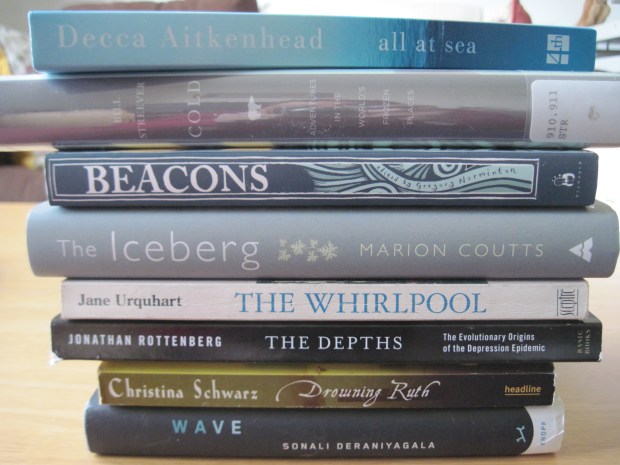
April is National Poetry Month, so I thought I’d try my hand at some book spine poetry. Thanks to Naomi at Consumed by Ink and Cathy at 746 Books for the fun idea! I have taken the liberty of adding punctuation between some lines, but the book titles themselves appear exactly as on the spines. This has been a fun project to do a bit at a time over the last couple of weeks – it’s always a nice break from my editing and more analytical writing.
Peruse your own shelves or the local library’s and have a go. It’s an easy way to get creative!
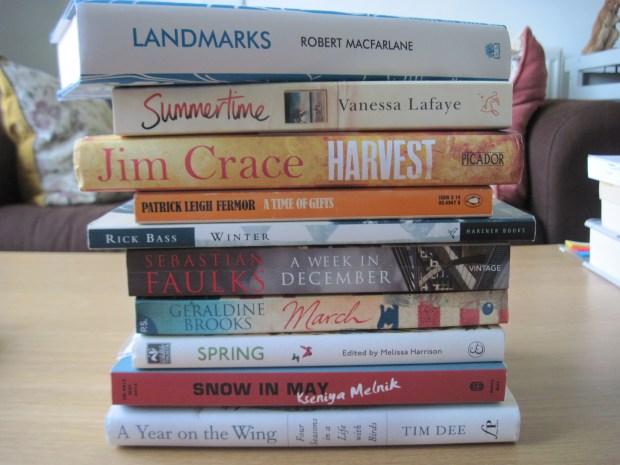
The years go by so fast…
Landmarks
Summertime
Harvest
A time of gifts
Winter
A week in December
March
Spring
Snow in May
A year on the wing
A morbid little number, with a riff on Stevie Smith:
All at sea
Cold beacons:
The iceberg,
The whirlpool,
The depths.
Drowning Ruth,
Wave.
Memento mori:
In fond remembrance of me
How to read a graveyard:
A tour of bones,
Mostly harmless.
Last night on earth?
Nothing to be frightened of.

Thanks to my husband, we have a ton of bird-themed books. The concluding line from Emily Dickinson makes this one a bit of a cheat.
Adventures among birds
To see every bird on earth:
The secret lives of puffins,
Last of the curlews,
The life of the skies.
Rare encounters with ordinary birds:
Songbird journeys,
An eye on the sparrow,
The goldfinch.
Falcon fever:
The armchair birder
Feeding the eagles,
Chasing the wild goose.
Hope is the thing with feathers.

An attempt to lay the groundwork for some progressive theology:
How (not) to speak of God
Jesus among other gods:
Atonement?
Blessed assurance?
Everything is illuminated?
The nice and the good
Crossing to safety?
A new kind of Christianity
The story we find ourselves in.
An unquiet mind
Until I find you.
Love wins;
No man is an island;
We make the road by walking.

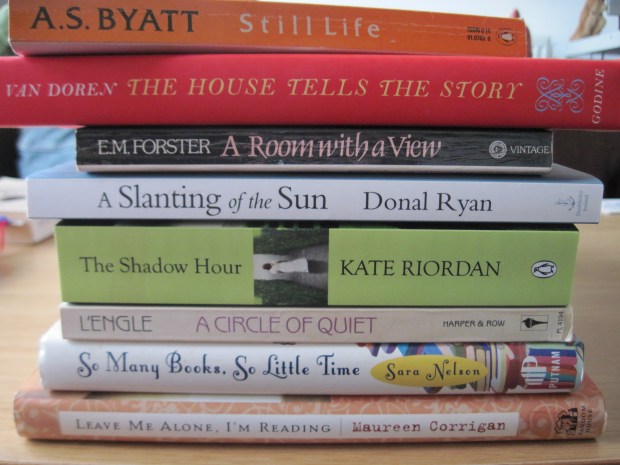
This one’s my favorite – a tribute to my peaceful days spent working from home.
Still life
The house tells the story:
A room with a view
A slanting of the sun
The shadow hour
A circle of quiet.
So many books, so little time;
Leave me alone, I’m reading.
Happy 200th Birthday, Charlotte Brontë!
Today marks a big anniversary: the bicentennial of Charlotte Brontë’s birth. I’ve noticed a whole cluster of books being published or reissued in time for her 200th birthday, many of which I’ve reviewed with enjoyment; some of which I’ve sampled and left unfinished. I hope you’ll find at least one book on this list that will take your fancy. There could be no better time for going back to Charlotte Brontë’s timeless stories and her quiet but full life story.
Short Stories Inspired by Jane Eyre
MINOR SPOILERS AHEAD.
 Reader, I Married Him: Stories Inspired by Jane Eyre, edited by Tracy Chevalier
A mixed bag. Although there are some very good stand-alone stories (from Tessa Hadley, Sarah Hall, Emma Donoghue and Elizabeth McCracken, as you might expect), ultimately the theme is not strong enough to tie them all together and some seem like pieces the authors had lying around and couldn’t figure out what else to do with. Think about it this way: what story isn’t about romance and the decision to marry?
A few of the tales do put an interesting slant on this age-old storyline by positing a lesbian relationship for the protagonist or offering the possibility of same-sex marriage. Then there are the stories that engage directly with the plot and characters of Jane Eyre, giving Grace Poole’s (Helen Dunmore) or Mr. Rochester’s (Salley Vickers) side of things, putting Jane and Rochester in couples therapy (Francine Prose), or making Jane and Helen Burns part of a post-WWII Orphan Exchange (Audrey Niffenegger). My feeling with these spinoff stories was, I’m afraid, what’s the point? Plus there were a number of others that just felt tedious.
My least favorites were probably by Lionel Shriver (incredibly boring!), Kirsty Gunn (unrealistic, and she gives the name Mr. Rochester to a dog!) and Susan Hill (the title story, but she’s made it about Wallis Simpson – and has the audacity to admit, as if proudly, that she’s never read Jane Eyre!). On the other hand, one particular standout is by Elif Shafak. A Turkish Muslim falls in love with a visiting Dutch student but is so unfamiliar with romantic cues that she doesn’t realize he isn’t equally taken with her.
In Patricia Park’s story, my favorite of all, a Korean girl from Buenos Aires moves to New York City to study English. Park turns Jane Eyre on its head by having Teresa give up on the chance of romance to gain stability by marrying Juan, the St. John Rivers character. I loved getting a glimpse into a world I was entirely ignorant of – who knew there was major Korean settlement in Argentina? This also redoubled my wish to read Park’s novel, Re Jane. She’s working on a second novel set in Buenos Aires, so perhaps it will expand on this story.
The Bookbag reviews
Charlotte Brontë’s Secret Love by Jolien Janzing
Charlotte and Emily Brontë’s time in Belgium – specifically, Charlotte’s passion for her teacher, Constantin Heger – is the basis for this historical novel. The authoritative yet inviting narration is a highlight, but some readers may be uncomfortable with the erotic portrayal; it doesn’t seem to fit the historical record, which suggests an unrequited love affair.
Sanctuary by Robert Edric
Branwell Brontë narrates his final year of life, when alcoholism, mental illness and a sense of disgrace hounded him to despair. I felt I never came to understand Branwell’s inner life, beneath the decadence and all the feeling sorry for himself. This gives a sideways look at Charlotte, Emily and Anne, though the sisters are little more than critical voices here; none of them has a distinctive personality.
Mutable Passions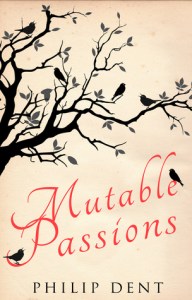 : Charlotte Brontë: A Disquieting Affair by Philip Dent
Dent focuses on a short period in Charlotte Brontë’s life: with all her siblings dead and Villette near completion, a surprise romance with her father’s curate lends a brief taste of happiness. Given her repeated, vociferous denial of feelings for Mr. Nicholls, I had trouble believing that, just 20 pages later, his marriage proposal would provoke rapturous happiness. To put this into perspective, I felt Dent should have referenced the three other marriage proposals Brontë is known to have received. Overwritten and suited to readers of romance novels than to Brontë enthusiasts, this might work well as a play. Dent is better at writing individual scenes and dialogue than at providing context.
Two Abandonees
I had bad luck with these two novels, which both sounded incredibly promising but I eventually abandoned (along with Yuki Chan in Brontë Country, featured in last month’s Six Books I Abandoned Recently post):
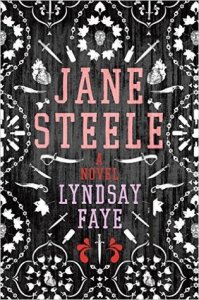 Jane Steele by Lyndsay Faye
Jane Steele is not quite Jane Eyre, though her life seems to mirror that of Brontë’s heroine in most particulars. How she differs is in her violent response to would-be sexual abusers. She’s a feminist vigilante wreaking vengeance on her enemies, whether her repulsive cousin or the vindictive master of “Lowan Bridge” (= Cowan Bridge, Brontë’s real-life school + Lowood, Jane Eyre’s). I stopped reading because I didn’t honestly think Faye was doing enough to set her book apart. “Reader, I murdered him” – nice spin-off line, but there wasn’t enough original material here to hold my attention. (Read the first 22%.)
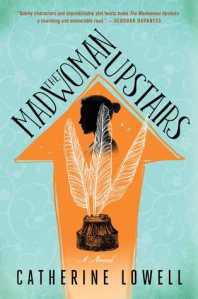 The Madwoman Upstairs by Catherine Lowell
There was every reason for me to love this novel – awkward American narrator, Oxford setting, Brontë connections aplenty, snarky literary criticism – but I got bored with it. Perhaps it was the first-person narration: being stuck in sarcastic Samantha Whipple’s head means none of the other characters feel real; they’re just paper dolls, with Orville a poor excuse for a Mr. Rochester substitute. I did laugh out loud a few times at Samantha’s unorthodox responses to classic literature (“Agnes Grey is, without question, the most boring book ever written”), but I gave up when I finally accepted that I had no interest in how the central mystery/treasure hunt played out. (Read the first 56%.)
An Excellent Biography
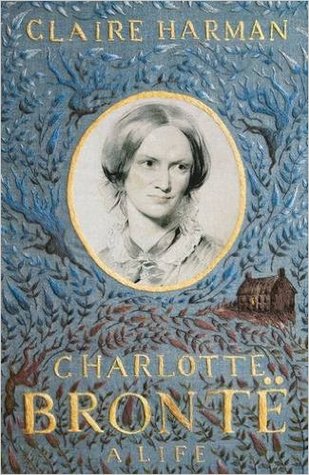 If I could recommend just one book from the recent flurry of Brontëana, it would be Charlotte Brontë: A Life by Claire Harman, which I reviewed for For Books’ Sake back in November.
One of the things Harman’s wonderful biography does best is to trace how the Brontës’ childhood experiences found later expression in their fiction. A chapter on the publication of Jane Eyre (1847) is a highlight. Diehard fans might not encounter lots of new material, but Harman does make a revelation concerning Charlotte’s cause of death – not TB, as previously believed, but hyperemesis gravidarum, or extreme morning sickness. This will help you appreciate afresh the work of a “poet of suffering” whose novels were “all the more subversive because of [their] surface conventionality.” Interesting piece of trivia for you: this and the Janzing novel (above) open with the same scene from Charlotte’s time in Belgium.
 Bookish Beck = Rebecca Foster. American transplant to England. Freelance proofreader and book reviewer.

