Wellcome Prize Shortlist, Pt. 2: The Tidal Zone by Sarah Moss
This is Sarah Moss’s third consecutive appearance on the Wellcome Book Prize shortlist, after Bodies of Light in 2015 and Signs for Lost Children in 2016, a pair of linked novels about a female doctor in the nineteenth century. The Tidal Zone, on the other hand, is a contemporary story of how a sudden, strange illness shakes up one middle-class family.
It’s a clichéd image from television and films: new parents tiptoe into their baby’s room every night to make sure he or she is still breathing. But 15 years later, narrator Adam Goldschmidt starts doing the same thing for his teenage daughter, Miriam, after she collapses on her school’s sports field and stops breathing for a few minutes. Thanks to a teacher’s quick thinking, CPR and paramedics soon see her stable again, but for Adam and his wife Emma, herself a GP, this is like a biblical loss of innocence: for the first time they realize that something calamitous could happen to Miriam or their eight-year-old, Rose, at any moment. Adam feels himself part of a global web of suffering parents, including those whose children are bombed in the Middle East or shot by police in America. All he sees are potential Pietàs.
It comforts me to think that most parents in most of time and most of the world have lived with this fear as a matter of course. It comforts me to think that while I have little fellowship in my fear with the parents at the school gate, the massed ghosts of England and the majority of parents living in the world now are with me. Although it turns out, of course, once people have a reason to tell you, that more of the school-gate parents than you used to imagine live in the overlap between ordinary life and tragedy.
Miriam is a delightfully sarcastic kid, lefty and socially engaged. I love her banter with the rest of the family. She was never going to be a meek angel in a hospital bed. Still, she’s ready to resume regular life long before Adam and Emma are ready to let her out of their sight for more than an hour or two. Meanwhile, Adam has to keep things ticking over at home. A stay-at-home dad in Coventry, he teaches the occasional art history class at the local university and is slowly writing a book about Coventry Cathedral, which was bombed to destruction during World War II and later rebuilt. Occasional chapters about the cathedral’s history make the narrative arc even clearer: this is all about catastrophe and reconstruction. How does a family, or a city, bounce back from what looked like the end?
Eventually a diagnosis and suggested treatment arrive, but the mystery remains of what caused Miriam’s cardiac arrest in the first place. What combination of factors – what she’d eaten, how much she’d exercised, what was in the air – could account for a failure to keep breathing? And could there be a genetic aspect to this condition that could link back to Adam’s mother’s unexpected death when he was nine?
It’s from Adam’s early memories of his mother that the title comes: when he was a boy they explored the tidal zone at the Cornwall coast, looking for creatures in the rock pools. Just as tidal pools mark the boundary between the land and the sea, this novel probes the liminal space between survival and death. But it also recognizes that even in that crucial gap, daily activities continue: hanging up the laundry, emptying the dishwasher, fielding pleas for a cat, and carping about NHS and university bureaucracy. Moss writes so well about normal life – something I also noticed in Night Waking, the other novel of hers that I’ve read, which is narrated by a mother of young children (and a character who’s briefly mentioned here, as Adam’s friend) – she lends correct weight to the everyday without overlooking epiphanies and moments of timelessness.

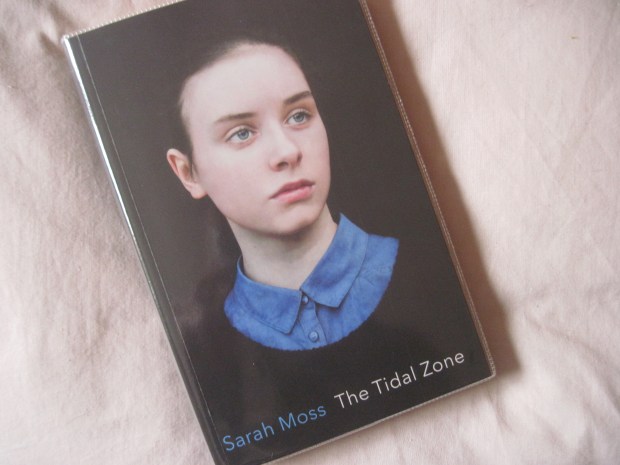
I love this striking cover: Eliza (2015) by Michael Gaskell. It’s an acrylic portrait on board of his niece and won second prize in that year’s BP Portrait Awards – but it’s so amazingly crisp I would have sworn it was a photograph!
I admired many things about the novel, particularly how easily Moss writes from a male viewpoint and the ways in which she reflects on the storytelling impulse. The extraordinary first chapter opens with “Once upon a time” and narrates the quotidian miracles of conception, pregnancy, birth and child development before making this personal, proceeding from “the girl” to “you” and finally to “I” in the second chapter. On several (perhaps one too many) occasions Moss repeats that fairytale opener to tell about Miriam’s medical journey or explain how Adam’s mother and American-born father met at a commune. This emphasizes the way we construct narratives around everything from our origins to our health.
A plan is a story about the future … a diagnosis is a story, brings a story’s promise of safe conduct through time and place to an anticipated ending.
I felt a bit too much time was spent on Adam’s father, and in the back of my mind was the niggling thought that this First World family is never facing true disaster because they have all kinds of safety nets in place; Moss’s is a very middle-class vision. I also think some readers could struggle with the slight aimlessness of the plot, though by the end you do get the sense that the characters are looking to the future in simple ways.
However, I don’t think those small complaints detract from the novel’s power. It’s a sobering but ultimately reassuring story with a simple message: we are all fragile, and we must appreciate life and health while we can.
You can’t go round not loving things because they’ll die.
May we forget. It is a pity that the things we learn in crisis are all to be found on fridge magnets and greetings cards: seize the day, savour the moment, tell your love—May we live long enough to despise the clichés again, may we heal enough to take for granted sky and water and light, because the state of blind gratitude for breath and blood is not a position of intelligence.
My rating: 
My gut feeling: Moss’s fiction shows true commitment to probing issues of health and medicine, and she’s an underrated author in general. Glancing back at the description of the books the Wellcome Prize panel is looking for (“At some point, medicine touches all our lives. … The subjects these books grapple with might include birth and beginnings, illness and loss, pain, memory, and identity”), I think this novel is a very strong contender indeed.
More reviews:
Clare’s at A Little Blog of Books
Eleanor’s at Elle Thinks
Eric’s at Lonesome Reader
Shortlist strategy:
Currently reading: I Contain Multitudes, Ed Yong’s (surprisingly?) enjoyable book about microbial life – I’m nearly halfway through and have taken it with me on our mini-holiday. Also The Gene by Siddhartha Mukherjee, a daunting 500+-page history of genetics, but I’ve loved this author’s work before (The Emperor of All Maladies).
I’m away in Hay-on-Wye through Thursday the 6th but will be back and responding to comments on Friday the 7th.
Wellcome Prize Shortlist, Part 1: de Kerangal and Kalanithi
I’m delighted to announce the final members of our Wellcome Book Prize 2017 shadow panel:
Ruby blogs at My Booking Great Blog.
GrrlScientist is an ornithologist and science journalist who was on the judging panel for the 2016 Royal Society Insight Investment Science Book Prize.
Along with Paul and Amy, this brings us up to five people – the same number as the official judging panel.
Luckily, I’ve already read two of the shortlisted titles, one quite recently and one nearly a year and a half ago. Here are the reviews I published on Goodreads at the time. I’ll be getting both books back out of the library soon to have another look before we choose our winner.
Mend the Living by Maylis de Kerangal
(translated from the French by Jessica Moore; published in the USA as The Heart)
[This is the French author’s second novel to be translated into English. It has been made into a film and won the Prix Orange du Livre and the Grand prix RTL du livre. It was also recently shortlisted for the Albertine Prize, an American readers’ choice award for contemporary French fiction. If you’re based in the States, feel free to vote by April 30th!]
 Nineteen-year-old Simon Limbeau is declared brain dead in a French hospital after a car accident, but his heart lives on: metaphorically through the love of his parents, sister, friends, and girlfriend; but also literally, in the recipient of his organ donation. Again and again de Kerangal makes a distinction between the physical reality of organs and what they represent: “Simon’s eyes are not just his nervous retina, his taffeta iris, his pupil of pure black in front of the crystalline – they are also his gaze; his skin isn’t just the threaded mesh of his epidermis, his porous cavities – it’s his light and his touch, the living sensors of his body.”
The novel spends time with Simon’s family, especially his mother, but also with the transplant coordinator, the surgeons, the nurse, and so on. I was reminded of ER as well as the French TV show The Returned – this would work really well on screen, and would be a way of avoiding the more off-putting aspects of the author’s style. She writes long, run-on sentences: sometimes half a page, sometimes even stretching to two pages, and stuffs her prose with abstruse vocabulary (or at least that’s how the translator has rendered it), a lot of it medical but some of it simply inaccessible: “emollient conjugality” plus at least a dozen English words I’d never encountered (e.g. abulic, tumid, atony, claudicant, auscultation, precellence, torticollis, naevi, scialytic).
The worst example of the unnecessary opacity is “the digitigrade gait of the sardana dancer when he’s nearing a quintal, the corpulence of an ex-obese man calibrating him in thickness, in fullness, but without visible excrescence” – in plain English, the guy is stocky.
Read in November 2016.
My rating: 
My gut feeling: The novel gives a vivid sense of the fragility of life and imbues parts of the body with metaphorical meaning. However, I think the style makes it too inaccessible and I can’t see its appeal ever being more than niche.
More reviews:
Annabel’s at Shiny New Books
Carolyn’s at Rosemary and Reading Glasses
When Breath Becomes Air by Paul Kalanithi
[The first posthumous nominee for the Wellcome Book Prize. I’ll be interested to see what I make of this one when I revisit it.]
 Paul Kalanithi was 36 and just completing his neurosurgery residency in Stanford, California when he was diagnosed with advanced lung cancer that did not respond well to treatment. It came as a complete surprise to this non-smoker, and set his life on a new course. He and his coterie of doctors managed his symptoms so he could operate for as long as possible, but when the time came he knew he wanted to devote his last year to writing this memoir. In addition, he would get a brief, sweet taste of fatherhood: he and his wife Lucy, also in the medical field, decided to have a child, a daughter named Cady.
Kalanithi grew up the son of Indian immigrants in Arizona. “I was driven less by achievement than by trying to understand, in earnest: What makes human life meaningful?” he recalls. Degrees in English literature and human biology were disparate attempts to find an answer. Like Henry Marsh (Do No Harm), he has a surgeon’s knowledge of the anatomy of reasoning, but realizes that does not provide the full picture. He recognizes the responsibility of holding others’ lives in the balance, and regrets occasional failures of empathy.
Those burdens are what make medicine holy and wholly impossible: in taking up another’s cross, one must sometimes get crushed by the weight.
It’s intriguing to see religious language in that statement – indeed, Kalanithi saw his work as a calling, and one with moral connotations. Christian imagery shows up repeatedly:
Instead of being the pastoral figure aiding a life transition, I found myself the sheep, lost and confused.
Openness to human relationality does not mean revealing grand truths from the apse; it means meeting patients where they are, in the narthex or nave, and bringing them as far as you can.
When’s the last time you encountered the word “narthex”?! The vocabulary is striking throughout, as in another favorite passage: “A tureen of tragedy was best allotted by the spoonful. Only a few patients demanded the whole at once; most needed time to digest.”
Kalanithi died in March 2015. In addition to the foreword by Abraham Verghese, there’s a lovely epilogue from his widow, who’s more than competent to carry on his legacy.
I appreciate stories lived on the knife edge of life and death, but I would recommend this to those who don’t normally choose to read illness narratives, simply for the beauty of its prose – a fine blend of literature and medicine – and the wholehearted picture of a life cut short.
Read in October 2015 (Random House were looking for early readers via NetGalley).
My rating: 
My gut feeling: I suspect this is by far the most popular and best-selling title on this year’s shortlist. So many people have taken it to their hearts. It will take a truly special book to knock it from the top spot.
More reviews:
Shadow panelist Paul’s at Nudge
Shadow panelist Ruby’s at My Booking Great Blog
Susan’s at A life in books
Shortlist strategy:
Currently reading: The Tidal Zone by Sarah Moss – about halfway through.
Up next: Whichever of the remaining nonfiction titles turns up to the library for me first!
I’ve also sent off an emergency e-mail to Bodley Head asking for a copy of Ed Yong’s I Contain Multitudes; it’s on loan through my library system until April 19th, which gives me no time to read it even if it comes back on time.
Wellcome Book Prize 2017 Shadow Panel
Newsflash! I’ve started a shadow panel of readers who will make our way through the six medical-themed titles shortlisted for the Wellcome Book Prize and deliberate to choose our own winner before the official prize announcement on Monday, April 24th. I hope to get the panel up to five – I’ve been in contact with a couple of science journalists via Twitter – but for now we are three, including:
Paul Cheney: blogs at Halfman, Halfbook and writes for Nudge’s Book Life section.
Amy Pirt: blogs at This Little Bag of Dreams and writes for Mookychick and g3 magazine.
The Wellcome Book Prize is an annual award sponsored by the Wellcome Trust, a global charitable foundation founded by Sir Henry Wellcome in 1936 and dedicated to improving health. The current incarnation of the prize has been running since 2009 and the winner gets a whopping £30,000. Books are nominated by their publishers, and for the 2017 award cycle they must have been issued in the UK between January 1, 2016 and December 31, 2016.
One thing that’s unique about the Wellcome Prize is that both fiction and nonfiction books are eligible. Here’s how the website describes the aim of the prize:
To be eligible for entry, a book should have a central theme that engages with some aspect of medicine, health or illness. At some point, medicine touches all our lives. Books that find stories in those brushes with medicine are ones that add new meaning to what it means to be human. The subjects these books grapple with might include birth and beginnings, illness and loss, pain, memory, and identity. In keeping with its vision and goals, the Wellcome Book Prize aims to excite public interest and encourage debate around these topics.
So as we’re reading (or looking back at) the six shortlisted books, those are the criteria we’ll be keeping in mind.
Here’s the full 2017 shortlist:
- How to Survive a Plague by David France: a history of the AIDS crisis.
- When Breath Becomes Air* by Paul Kalanithi: a posthumous memoir by a neurosurgeon.
- Mend the Living* by Maylis de Kerangal (trans. Jessica Moore): a novel about a donor heart [published in the USA as The Heart].
- The Tidal Zone by Sarah Moss: a novel about a child who suddenly falls ill.
- The Gene by Siddhartha Mukherjee: a thorough history of genetics.
- I Contain Multitudes by Ed Yong: a survey of the human body’s microbes.

* = the two I’ve already read and reviewed on Goodreads. I’ll get these reviews together for my first shortlist post on Thursday. Next up for me is The Tidal Zone, which I plan to start today. I have the three other nonfiction titles on request from the public library and hope they’ll come in soon – each one is well over 300 pages, so I’ll need plenty of time with them!
For more on this year’s nominees and the official judging panel, see this Guardian article.
What interests you from the Wellcome Book Prize shortlist? Are there some titles you’ve already read? If you’ve reviewed any of these, let me know and I’d be happy to link to your reviews when I post mine.
Also, if you’d like to read any of the shortlisted books along with us over the next five weeks, I’d love to know that you’re taking part and will help share your reviews, so do get in touch!
(A huge thanks to Naomi of The Writes of Woman for advice on running a shadow panel.)
And the Winner Is…
In case you haven’t already heard, the winner of the Man Booker Prize 2016 is
The Sellout by Paul Beatty
 He’s the first American winner of the Booker Prize, for which I must express a modicum of pride. Yet I’m gobsmacked by the judges’ decision. Do you know that lovely bit of British slang? It means, roughly, astounded. You see, I would have placed The Sellout fifth out of six in terms of its likelihood of winning (ahead of only Eileen).
When I reviewed it for Shiny New Books back in early June, I expressed my doubts that this outrageous racial satire would strike a chord in Britain as it had in the States. It’s a zany, irreverent take on racial politics in America today, crammed with old stereotypes of African-Americans. For me, the satire wore thin and I yearned for more of an introspective Bildungsroman. But it’s clear that, with police shootings of black men in America a seemingly daily news phenomenon, the Booker judges chose a timely and incisive winner.
Here’s a taste of the sort of audacious lines the book is chock-full of:
“I understand now that the only time black people don’t feel guilty is when we’ve actually done something wrong, because that relieves us of the cognitive dissonance of being black and innocent, and in a way the prospect of going to jail becomes a relief.”
“When a white bitch got problems, she’s a damsel in distress! When a black bitch got problems, she’s a welfare cheat and a burden on society. How come you never see any black damsels? Rapunzel, Rapunzel, let down your weave!”
Amid the laughs, you still get a sense of how important it is to Beatty that race remain a topic for public discussion. An exchange the narrator has with a police officer could just as easily describe the author’s purpose:
“It’s illegal to yell ‘Fire’ in a crowded theatre, right?”
“It is.”
“Well, I’ve whispered ‘Racism’ in a post-racial world.”
No whisper, this, but a brazen shout.
Did the panel get it right this year?
Polishing off the Booker Prize Shortlist
This is the second year in a row that I’ve managed to read the whole of the Man Booker Prize shortlist before the announcement of the winner. (In 2013 and 2014 I only got through four of the six titles.) Here’s my take on the final two from the shortlist (see my quick impressions of the others here and here), plus one from the longlist. I finish with thoughts about my favorites and the likely winner.
All That Man Is by David Szalay
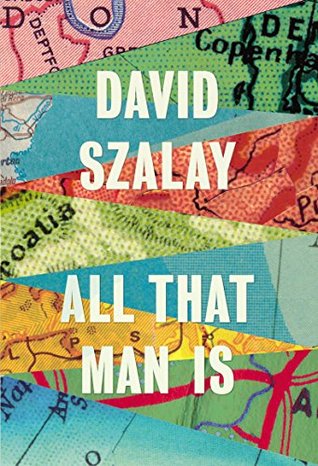 In a riff on the Ages of Man, Szalay gives nine vignettes of men trying to figure out what life is all about. His antiheroes range from age 17 to 73. Each section has several chapters and follows a similar pattern: a man from one European country travels to another European country; there are lots of scenes set at airports or otherwise in transit, and part of the overall atmosphere of dislocation is simply the effort of having to adjust to foreignness. These trips are made for various reasons: feckless French twentysomething Bérnard has been fired by his uncle so goes ahead with a vacation to Cyprus; tabloid journalist Kristian flies from Denmark to Spain to confirm rumors of a government minister’s involvement in a scandal; recently impoverished oligarch Aleksandr takes his yacht for a farewell Adriatic cruise.
Predictably, sex is a major theme: reluctant hook-ups, fantasy lovers, affairs regretted, wild oats never sown. At times I was ready to fill in the title phrase in my best Cockney accent with “All That Man Is…is a bloody wanker.” As individual stories, there’s nothing particularly wrong with these. Inevitably, though, some are more interesting than others, and they don’t quite succeed in feeding into an overarching message, unless to confirm a mood of hedonism and angst. Life is short and pointless; enjoy its moments while you can, eh? Overall, I didn’t find this to be the philosophical and elegiac experience I expected. The prose is great, though; I’d certainly read a more straightforward novel by Szalay.
Favorite lines: “How little we understand about life as it is actually happening. The moments fly past, like trackside pylons seen from a train window.”
My rating: 
Do Not Say We Have Nothing by Madeleine Thien
 “Music and stories, even in times like these, were a refuge, a passport, everywhere.” A sweeping epic of life in China in the turbulent 1960s–80s, this is the Canadian novelist’s fourth book. Narrated from the present day by Marie (or Ma-Li), who lives in Vancouver with her mother, the novel plunges into layers of flashbacks about her family’s connection to Ai-Ming and her musician father, Sparrow. With loyalty to the Communist Party (the title is a line from its anthem) considered the gold standard of behavior and Western music widely denounced as revolutionary, these characters are in a bind: will they pursue their identity as artists, or keep their heads down to avoid trouble? This theme reminded me of Julian Barnes’s fictionalized biography of the Russian composer Shostakovich, The Noise of Time, which also asks whether music can withstand political oppression.
If, like me, you know next to nothing about China’s Cultural Revolution and the transition from Chairman Mao to successive leaders, you will learn so much. There is no denying the power of this portrayal of history. In addition, I was consistently impressed by the book’s language. Thien incorporates Chinese characters and wordplay, musical bars, and snatches of poetry and folk songs. However, I didn’t find this easy reading. The flashbacks can feel endless, such that I experienced Marie’s sections as a relief and wished for more of them. I had to set daily reading targets to get through the novel before the library due date. Yet it is the sort of epic the Booker Prize loves – with echoes of Ruth Ozeki’s The Tale for the Time Being (which should have won in 2013) and Richard Flanagan’s The Narrow Road to the Deep North – and is full of wise observations about what keeps us going when life falls apart. (See my full review at Nudge.)
My rating: 
And here’s another from the longlist that I read recently:
The Many by Wyl Menmuir
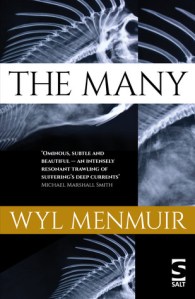 A short work of muted horror, all about atmosphere and the unexplained. Set in a Cornish fishing village, it sees newcomer Timothy Buchannan trying to figure out what happened to Perran, the man who occupied his rundown cottage until his death 10 years ago, and why everyone refuses to talk about him. Flashbacks in italics give glimpses into Timothy’s life with his wife, Lauren, who is meant to join him when he finishes the renovations; and into the fisherman Ethan’s past. I enjoyed the unsettling mood and the language used to describe the setting and Timothy’s dreams. Ultimately I’m not sure I fully understood the book, especially whether the late turns of the plot are to be viewed literally or allegorically. What I take away from it, and this is perhaps too simplistic, is an assertion that we are all joined in our losses. A quick, creepy read – you could do worse than pick it up this Halloween.
My rating: 
My two favorites from the shortlist are #1 His Bloody Project by Graeme Macrae Burnet and #2 Hot Milk by Deborah Levy. But my prediction for tomorrow’s winner is Do Not Say We Have Nothing by Madeleine Thien.
What have you managed to read from the Booker shortlist? What’s your prediction for tomorrow?
Booker Longlist Mini Reviews
Tomorrow the Man Booker Prize shortlist will be announced. I’d already read and reviewed four of the nominees (see my quick impressions here), and in the time since the longlist announcement I’ve managed to read another three and ruled out one more. Two were terrific; another was pretty good; the last I’ll never know because it’s clear to me I won’t read it.
His Bloody Project by Graeme Macrae Burnet
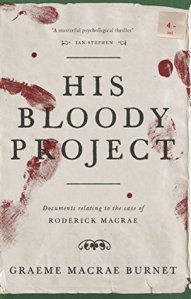 What a terrific, propulsive tale Burnet has woven out of a real-life (I think) nineteenth-century Scottish murder case. The seams between fact and fiction are so subtle you might forget you’re reading a novel, but it’s clear the author has taken great care in assembling his “documents”: witness testimonies, medical reports, a psychologist’s assessment, trial records, and – the heart of the book and the most fascinating section – a memoir written by the murderer himself. As you’re reading it you believe Roddy implicitly and feel deeply for his humiliation (the meeting with the factor and the rejection by Flora are especially agonizing scenes), but as soon as you move on to the more ‘objective’ pieces you question how he depicted things. I went back and read parts of his account two or three times, wondering how his memories squared with the facts of the case. A great one for fans of Alias Grace, though I liked this much better. This is my favorite from the Booker longlist so far.

Eileen by Ottessa Moshfegh
 “I often felt there was something wired weird in my brain, a problem so complicated only a lobotomy could solve it—I’d need a whole new mind or a whole new life.” This isn’t so much a book to enjoy as one to endure. Being in Eileen’s mind is profoundly unsettling. She’s simultaneously fascinated and disgusted by bodies; she longs for her alcoholic father’s approval even as she wonders whether she could get away with killing him. They live a life apart in their rundown home in X-ville, New England, and Eileen can’t wait to get out by whatever means necessary. When Rebecca St. John joins the staff of the boys’ prison where Eileen works, she hopes this alluring woman will be her ticket out of town.
There’s a creepy Hitchcock flavor to parts of the novel (I imagined Eileen played by Patricia Hitchcock as in Strangers on a Train, with Rebecca as Gene Tierney in Laura), and a nice late twist – but Moshfegh sure makes you wait for it. In the meantime you have to put up with the tedium and squalor of Eileen’s daily life, and there’s no escape from her mind. This is one of those rare novels I would have preferred to be in the third person: it would allow the reader to come to his/her own conclusions about Eileen’s psychology, and would have created more suspense because Eileen’s hindsight wouldn’t result in such heavy foreshadowing. I expected suspense but actually found this fairly slow and somewhat short of gripping.

Hot Milk by Deborah Levy
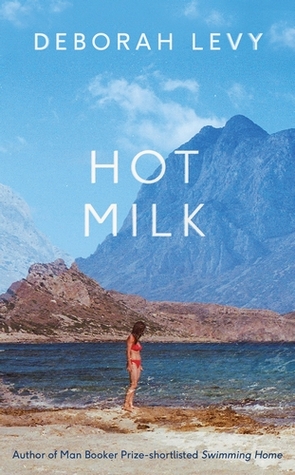 This is a most unusual mother–daughter story, set on the southern coast of Spain. Twenty-five-year-old Sofia Papastergiadis has put off her anthropology PhD to accompany her mother, Rose, on a sort of pilgrimage to Dr. Gómez’s clinic to assess what’s wrong with Rose’s legs. What I loved about this novel is the uncertainty about who each character really is. Is Rose an invalid or a first-class hypochondriac? Is Dr. Gómez a miracle worker or a quack who’s fleeced them out of 25,000 euros? As a narrator, Sofia pretends to objective anthropological observation but is just as confused by her actions as we are: she seems to deliberately court jellyfish stings, is simultaneously jealous and contemptuous of her Greek father’s young second wife, and sleeps with both Juan and Ingrid.
Levy imbues the novel’s relationships with psychological and mythological significance, especially the Medusa story. I don’t think the ending quite fits the tone, but overall this is a quick and worthwhile read. At the same time, it’s such an odd story that it will keep you thinking about the characters. A great entry I’d be happy to see make the shortlist.
[One I won’t be reading: The Schooldays of Jesus by J.M. Coetzee. I opened up the prequel, The Childhood of Jesus, and could only manage the first chapter. I quickly skimmed the rest but found it unutterably dull. It would take me a lot of secondary source reading to try to understand what was going on here allegorically, and it’s not made me look forward to trying more from Coetzee.]
 As for the rest: I have All That Man Is by David Szalay and Serious Sweet by A.L. Kennedy on my Kindle and will probably read them whether or not they’re shortlisted. The same goes for Do Not Say We Have Nothing by Madeleine Thien, for which I’m third in a library hold queue. I’d still like to get hold of The Many by Wyl Menmuir. That leaves just Hystopia by David Means, which I can’t say I have much interest in.
I rarely feel like I have enough of a base of experience to make accurate predictions, but if I had to guess which six books would make it through tomorrow, I would pick:
His Bloody Project by Graeme Macrae Burnet
The Schooldays of Jesus by J.M. Coetzee
Hot Milk by Deborah Levy
The North Water by Ian McGuire
My Name Is Lucy Barton by Elizabeth Strout
Do Not Say We Have Nothing by Madeleine Thien
That would be three men and three women, and a pretty good mix of countries and genres. I’d be happy with that list.
What have you managed to read from the Booker longlist? How do your predictions match up against mine?
A Booker Prize & Libraries Action Plan, Etc.
On Wednesday the Man Booker Prize’s longlist of 13 novels was announced. I never bother making predictions in advance of prize list announcements because inevitably I forget what was released during the eligibility period and I’m no good at squaring personal favorites with what a judging panel is likely to admire. See the Guardian’s photo essay and Karen’s thorough discussion at Booker Talk for more information about the nominees.
It turns out I’ve read and reviewed four of the longlisted books:
The Sellout by Paul Beatty for Shiny New Books: This is such an outrageous racial satire that I kept asking myself how Beatty got away with it. The Sellout struck a chord in America, but I’m slightly surprised that it’s also been received well in the UK.
The North Water by Ian McGuire for BookBrowse: A gritty, graphic novel about 19th-century whaling that traverses the open seas and the forbidding polar regions. It’s a powerful inquiry into human nature and the making of ethical choices in extreme circumstances.
Work Like Any Other by Virginia Reeves on Goodreads: I was meant to review this for BookBrowse but couldn’t rate it highly enough despite the competent writing. Between the blurb and the first paragraph, you already know everything that’s going to happen.
My Name Is Lucy Barton by Elizabeth Strout on Goodreads: I won a free copy through a Goodreads giveaway. I read this in one sitting on a plane ride and found it to be a powerful portrayal of the small connections that stand out in a life.
As for what’s next from the longlist, I finally have an excuse to read the copy of The Childhood of Jesus by J.M. Coetzee I won from Goodreads many moons ago – a sequel to which (The Schooldays of Jesus) is among the nominees. It’ll be my first Coetzee; if I like it I’ll be sure to read the follow-up book when it comes out in September.
I already knew I was interested in Eileen by Ottessa Moshfegh, a creepy debut novel about a misfit; All That Man Is by David Szalay, a linked short story collection about stages of men’s lives; and Do Not Say We Have Nothing by Madeleine Thien, set in Canada in the wake of the Tiananmen Square protests. I’ve only read one novel each by A.L. Kennedy and Deborah Levy and wasn’t hugely keen on either author’s style, but the subject matter of both Serious Sweet and Hot Milk is more tempting. I might seek them out from the library.
 And then there’s the books I’d simply never heard of. Of these I’m most interested in His Bloody Project by Graeme Macrae Burnet, based on a true-life murder in Scotland in the 1860s, and The Many by Wyl Menmuir, a debut novella about a village newcomer.
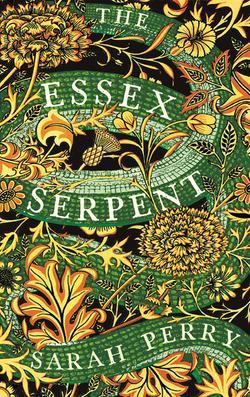
The surprise omission for me is Sarah Perry’s The Essex Serpent. I might also have expected to see Julian Barnes, Adam Haslett, and maybe even Ann Patchett on the longlist.
We’ve found a new rental house and hope to move in on August 15, but we’re waiting for our reference check to be complete and the tenancy contract to be drawn up before we can start doing official things like hire movers, change our address with a zillion service providers, and start packing in earnest.
This past week I’ve busied myself with comparing removals quotes and doing pre-packing tasks I’ve tried to convince myself are useful, like sorting through drawers of mementoes, assessing what’s in storage under the beds, and shifting some unwanted possessions through Freegle, a local web forum for giving away free stuff. So far I’ve gotten rid of a spice rack, 11 empty bottles, 55 empty CD cases, a cat tower plus some food and toys our fussy cat won’t use, and a wildly popular picnic hamper (11 offers came through!). It’s really gratifying to see things go to a good home.
Alas, we did also have to take some items to the local recycling center this weekend, which always seems like something of a failure, but no one’s going to want a broken vacuum cleaner and printer. My hope is that the small appliances dumped there will at least be mined for parts, so it’s better than sending them to landfill.
The weekend has also included berry picking at the local pick-your-own farm and making a summer pudding, a labor-intensive but delicious annual tradition. Plus this afternoon we’re off to Northampton to meet our newest nephew, born on the 20th.

Last year’s summer pudding.
I did finally start boxing up books last night. Much as I love my print library, it’s dispiriting just how much space it takes up. It took five boxes just to empty the small spare room bookcase! Before packing anything I did another full inventory of unread books in the flat and came up with a total of 205, higher than last time but not too bad considering the review books I’ve acquired recently as well as the secondhand shopping I’ve done. I’ve made good progress in my attempt to read mostly books I own for the summer, but it’s a resolution that will have to carry over into the autumn and winter.
The one thing that might scupper me in that plan is that, although we’re only moving 45 minutes away, we’ll be in a new council area where library reservations are free! For years I’ve been a part of library systems where it costs 40 or 50 pence to reserve each book, so I’ve kept holds to an absolute minimum. But from now on you can be sure I’ll be putting myself on the waiting list for every new and forthcoming book that appeals to me! Expect the monthly Library Checkout posts to resume by September.
Any thoughts on this year’s Booker Prize longlist? How are you doing on reading from public libraries or from your own personal collection?
Bloxham Festival of Faith and Literature
Bloxham Festival of Faith and Literature, “a literary festival with a theological slant,” has been running since 2011, but this past weekend marked the first time I managed to attend a few Saturday sessions. It was held at Oxfordshire’s very posh Bloxham School (sample course schedule: Mandarin, riding, and Shakespeare on Film). The theme for this year being “All the World’s a Stage,” all the events were given Shakespeare lines as titles. Hey, even the free chocolate bars from the Meaningful Chocolate Company were tailored to the Shakespeare theme!
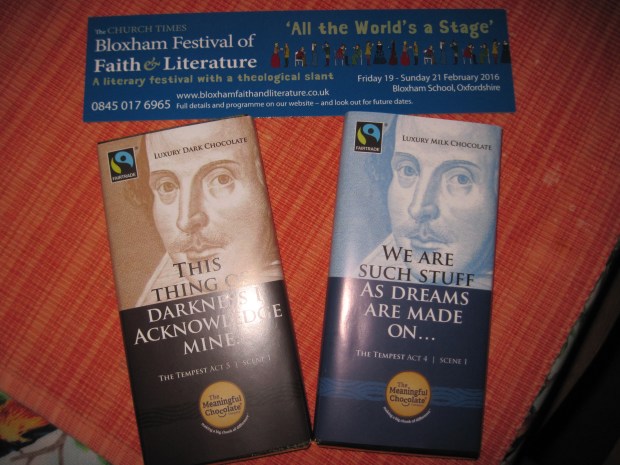
The morning began with an interview with Sarah Perry. Now, I have to admit that I didn’t really get on with her first novel, After Me Comes the Flood. Still, I was intrigued by how she incorporates biblical themes and her religious background in her fiction, so I thought I’d give it a go. Perry herself wasn’t at all as I expected her to be. I’d only ever seen one tiny press photo, in which she had a somewhat tomboyish haircut and had a demurely downcast gaze. So I was pleasantly surprised to find she was voluble, learned, and confident; in a black lacey dress and with loosely pinned hair, she resembled a modern Gibson Girl with a Gothic twist.
Interviewed by the editor of the Church Times newspaper, Perry spoke a bit about her upcoming novel, The Essex Serpent (to be published in the UK by Serpent’s Tail on June 18th), set in 1890s London and an invented village on the Essex marshes. In keeping with the talk’s title, “I would not wish any companion in the world but you,” the book is about friendship, specifically that between a vicar and a widowed amateur naturalist. Inspired by her own relationship with her (male) best friend and by intimate ‘love letters’ she found that passed between friends (like St. Paul to the Philippians and D.H. Lawrence to Jack Murray, or Montaigne writing about his best friend), the novel seeks the goodness in its characters.
The two readings Perry gave were lush, Dickensian descriptions of the City under rain and a drunken man going for a dip in the marsh and seeing what appears to be a sea creature. Perry was surprised when her debut novel was described as Gothic, but she’s embraced the label now: her third book, currently in progress, is full-on Gothic horror. What links all of her work, she thinks, is the Gothic notion of the thing lurking over the shoulder. For Perry, that ever-present threat is Reformation theology: the idea that man is born in sin and deserves damnation. During her Strict Baptist upbringing (which she, not coincidentally, describes as being like living in the 1890s), she was cut off from contemporary culture and influenced primarily by the King James Bible and Foxe’s Book of Martyrs.
Perry spent a short time as a missionary in the Philippines and was a biblical fundamentalist until age 25, when she and her husband (whom she met at 13 and married at 20) left the church. Stepping outside of that limiting community was the impetus she needed to start writing; although she had had stories looping around her head since the age of four, she had rarely written anything down. She completed a creative writing MA and PhD, all while working full time at the Inns of Court.
 After Me Comes the Flood was rejected by 14 publishers; even her viva examiners, who passed her without corrections, were “ungracious,” she remarked. What it comes down to, she thinks, is simply that no one liked the book or knew what to make of it. It seemed unmarketable because it didn’t fit into a particular genre. At this point I was sheepishly keeping my head down, glad that Perry couldn’t possibly know about my largely unfavorable review in Third Way magazine. I confess that my reaction was roughly similar to the general consensus: “Not quite an allegory, [the book] still suffers from that genre’s pitfalls, such as one-dimensional characters,” I wrote.
A glowing Guardian review from poet John Burnside was enough to give Perry confidence to keep going as a novelist, and – having taken forever over writing her first book, an experience she likens to like pulling teeth because she had no idea what she was doing and could rarely overcome her natural laziness – she went on to write The Essex Serpent within just 10 months. And I’m glad she did, because this new book sounds right up my alley.
 It will be interesting to see how she imagines a platonic friendship between the sexes in a historical setting, and the Dickensian and Gothic touches, even from the little taster I got, were delicious. I was especially intrigued to learn about her research into the friendship ‘triangle’ (betrayal! early death! forgiveness!) between William Ewart Gladstone, Alfred Tennyson, and Arthur Henry Hallam. Perry said she thinks the tide may be turning, that friendships rather than romantic love could be starting to dominate fiction; perhaps Hanya Yanagihara’s A Little Life from last year would be a good example.
 In the other sessions I attended, a group of clergy revealed the shortlist for the £10,000 Michael Ramsey Prize for theology (to my surprise, I’d read one of the nominees, Unapologetic by Francis Spufford) and panelists introduced a forthcoming anthology of essays on Anglican women novelists from Charlotte Brontë onwards (to be published by Bloomsbury in January 2018). Jane Williams, wife of former archbishop Rowan Williams, will contribute a chapter on Barbara Pym, who obviously loved the Church but also sits at an anthropological distance to poke gentle fun at it. Her novels sound like great fun. Judith Maltby, one of the editors, convinced me that I need to read Rose Macauley’s The Towers of Trebizond (1956), while co-editor Alison Shell made the case for P.D. James’s late inclusion.
 Chaired by contemporary Anglican novelist Catherine Fox, the panel noted two common threads in many of the featured novelists: detective fiction and humor. The striking number of crime novelists (including Dorothy L. Sayers and Ellis Peters), Shell suggested, one might attribute to an Anglican license to moralize or a preoccupation with ‘last things’. Humor, meanwhile, seems to arise from the little hypocrisies inherent to religious life and to the fact that liturgical seriousness can often tilt into comedy. Other repeated themes include the sacraments, the role of the spinster, and class – the clergy are often educated but poor. I came away with a list of authors to try; many of their works are available through Virago reprints.
All in all, it was a terrific, thought-provoking experience for me – a perfect mixture of literature and theology, and a great way to spend a blustery February Saturday.
In Praise of Literary Prizes
I like a spot of competition. Whether watching Olympic figure skating, playing board games like Scrabble and Boggle, entering a low-key Oscars pool, or rooting for my favorites in American Idol seasons and Miss America pageants, I’ve always loved trying to pick the best. This means that literary prizes are hugely exciting for me, and I follow the races closely.
I’m particularly devoted to the Man Booker Prize. I was delighted to see Hanya Yanagihara’s A Little Life on the recent longlist (catch up on it here), a truly interesting set of books, diverse in terms of their genres and authors’ nationalities and nicely balanced between male and female writers (6:7). I’ve read four of the longlisted titles so far:
 The Fishermen, Chigozie Obioma (full review in May 2015 issue of Third Way): From a young Nigerian debut novelist comes a haunting tale of sibling rivalry and revenge. With sectarian riots afoot, the four oldest Agwu boys decide to make money by skipping school and fishing in the Omi-Ala River. Things get more complicated when Abulu, the local madman, issues a prophecy that seems bound to divide the brothers. The first quarter of the novel, especially, is drenched in foreshadowing (not always subtle, nor do the plot turns often rise above the predictable). Rich with prophecy and allusions, this owes much to biblical narratives and tragedies from Shakespeare to Chinua Achebe.
- Lila, Marilynne Robinson – reviewed at For Books’ Sake
- A Spool of Blue Thread, Anne Tyler – also reviewed at For Books’ Sake
- A Little Life, Hanya Yanagihara – reviewed at Shiny New Books

 Next up: I’m reviewing The Green Road by Anne Enright for the November 2015 issue of Third Way. The Booker Prize shortlist will be announced on September 15th and the winner on October 13th.
Beyond the Booker, here are some of the other prizes I follow throughout the year, listed in vague chronological order:
 The Not the Booker Prize run by the Guardian. On this year’s shortlist is Shame by Melanie Finn, a book I loved when I reviewed it for Third Way’s April 2015 issue. It’s a powerful story of regret and the search for redemption. Though it has elements of a straightforward psychological thriller, the daring structure and moral complexities are more akin to Graham Greene. In alternating chapters, Pilgrim Jones contrasts flashbacks to her car accident and the subsequent investigation back in Switzerland with her present-tense African odyssey. This is Conrad’s Africa, a continent characterized by darkness and suffering. The question of culpability remains murky, yet the possibility of salvation shines through. [Voting will take place in October.]

- The Guardian First Book Award (open to both fiction and nonfiction): the shortlist will be announced this Friday, August 14th. One entry, Spill Simmer Falter Wither by Sara Baume, has already been chosen by readers, and the other nine are selected from publishers’ submissions. [Winner announced in late November.]
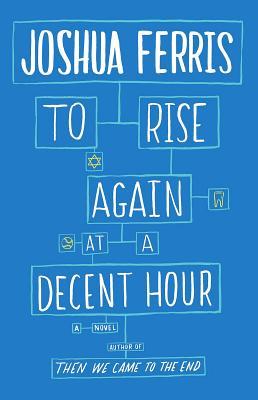
 The Dylan Thomas Prize for young writers (under 39) went to Joshua Ferris for To Rise Again at a Decent Hour last year. [Longlist in September, shortlist in October and winner announced in November.]
- The Costa Book Awards give separate prizes for fiction, debut fiction, biography, poetry, and children’s books, and also choose one overall winner. [Category shortlists in late November, category winners in early January and overall winner on January 26, 2016.]
- The Folio Prize, only two years old, considers any work of fiction published in English; before the Booker expanded to include American entries last year, it was the most Catholic of the fiction prizes. Now it risks being considered redundant; especially since it lost its Folio Society sponsorship, it’s unclear whether it will continue. [Shortlist in February and winner announced in March.]
 The Wellcome Book Prize is for medical-themed literature, fiction or nonfiction. Last year’s winner, The Iceberg by Marion Coutts, meant a lot to me for personal reasons but was also one of the most unusual and impressive memoirs I’ve ever read. I reviewed it for The Bookbag here. [Shortlist in March and winner announced in April.]

- The Pulitzer Prize is America’s premier literary award. I confess I often feel a little out of touch with the winners and don’t necessarily make a conscious effort to seek out the nominated books. I’d like to be more familiar with Pulitzer winners. Next year marks the prize’s centennial, so there’s no better time! [Winners announced in April.]
- The Independent Foreign Fiction Prize is for any book that has been translated into English and published in the UK in the previous year. I’ve found some great offbeat reads by browsing through previous longlists. As of next year, the prize is merging with the Man Booker International award, which previously recognized the life work of a foreign author every other year. [Longlist in March, shortlist in April and winner announced in May.]
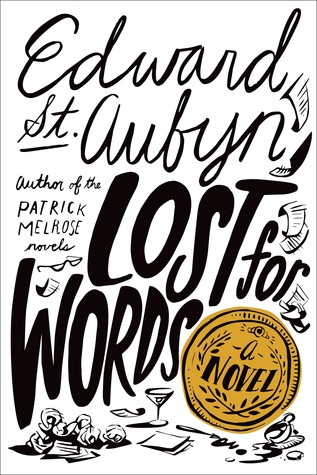
 The Bollinger Everyman Wodehouse Prize, the UK’s prize for comic literature, has run since 2000. Among the past winners are Paul Torday, Howard Jacobson, Terry Pratchett, Geoff Dyer, Gary Shteyngart, and (surprise!) Ian McEwan. I’ve read five of the winners, including Lost for Words by Edward St. Aubyn. [Shortlist in March and winner announced in May.]
- The Baileys Women’s Prize for Fiction (formerly known as the Orange Prize). Ali Smith won the 2015 award for How to Be Both. [Longlist in March; shortlist and winner announced in June.]
Do you follow literary prize races? Do you make a point of reading the winner and/or the shortlisted books? All comments welcome!
 Bookish Beck = Rebecca Foster. American transplant to England. Freelance proofreader and book reviewer.
 Bookish Beck