Library Checkout: August 2018
After I got back from America the library pile started out tiny and gradually grew bigger as I added on more reservations for books I’d forgotten about or saw were on order.

LIBRARY BOOKS READ
- To the Is-Land: An Autobiography by Janet Frame

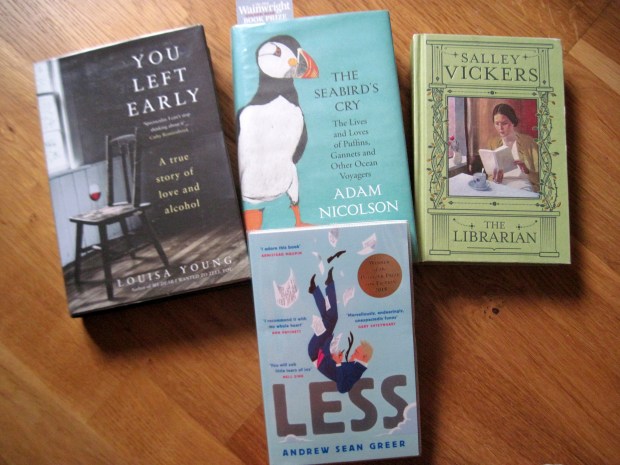
- Less by Andrew Sean Greer

- The Sparrow by Mary Doria Russell
SKIMMED ONLY
- Every Third Thought: On Life, Death and the End Game, Robert McCrum

CURRENTLY READING
- Madame Zero by Sarah Hall
- Taking Mesopotamia by Jenny Lewis [poetry]
- The Seabird’s Cry: The Lives and Loves of Puffins, Gannets and Other Ocean Voyagers by Adam Nicolson
- You Left Too Early: A True Story of Love and Alcohol by Louisa Young
CURRENTLY READING-ish (set aside temporarily)
- The Catcher in the Rye by J.D. Salinger
CHECKED OUT, TO BE READ
- Happiness by Aminatta Forna
- The Western Wind by Samantha Harvey
- The Patrick Melrose novels by Edward St. Aubyn [I plan to read only the second volume, Bad News]
- First, We Make the Beast Beautiful: A New Story about Anxiety by Sarah Wilson

These university library books have been hanging around for a loooooooooooong time, and most likely will continue to do so for months to come:
- The Amazing Adventures of Kavalier & Clay by Michael Chabon
- The Brief Wondrous Life of Oscar Wao by Junot Díaz
- On the Road by Jack Kerouac
- The Cabaret of Plants: Botany and the Imagination by Richard Mabey
- The Magnificent Spinster by May Sarton
IN THE RESERVATION QUEUE
- A Ladder to the Sky by John Boyne
- French Exit by Patrick deWitt
- All Among the Barley by Melissa Harrison
- Pages & Co by Anna James
- The Sealwoman’s Gift by Sally Magnusson
- Now We Shall Be Entirely Free by Andrew Miller
- Ghost Wall by Sarah Moss
- Rosie: Scenes from a Vanished Life by Rose Tremain
RETURNED UNFINISHED
- The Librarian by Salley Vickers
RETURNED UNREAD
- The Stopping Places: A Journey through Gypsy Britain by Damian Le Bas – I lost interest and the first few pages didn’t grab me.
What have you been reading from your local libraries? Does anything appeal from my stacks?
(If you’re participating in Library Checkout this month, use the link below to add your post via Inlinkz.)
My Patchy Experience with Book Clubs
I know that a number of you have long-term, faithful book clubs. Boy, am I envious! You might find it surprising that I’ve only ever been in one traditional book club, and it wasn’t a resounding success. Partway through my time working for King’s College, London, an acquaintance from another library branch started the club. A group of five to eight of us from Library Services aimed to meet after work one evening a month at a Southbank venue or a staff room to discuss our latest pick. By poring over old e-mails and my Goodreads library, I’ve managed to remember 10 of the books we read between November 2011 and June 2013:
- Do Androids Dream of Electric Sheep?, Philip K. Dick [classic science fiction]
- The Little Shadows, Marina Endicott [Canadian historical fiction]
- A Spot of Bother, Mark Haddon [contemporary fiction]
- The Talented Mr. Ripley, Patricia Highsmith [classic suspense]
- The Vintner’s Luck, Elizabeth Knox [bizarre historical fiction/magic realism]
- What Was Lost, Catherine O’Flynn [contemporary fiction]
- Franny and Zooey, J.D. Salinger [classic short fiction]
- The Rabbi’s Cat, Joann Sfar [graphic novel in translation]
- Girl Meets Boy, Ali Smith [an update of Greek myth]
- Angel, Elizabeth Taylor [an obscure English classic]
That may well be the complete list. Although I was a member for 20 months until I quit to go freelance, we often only managed to meet every other month because we couldn’t find a mutually convenient free evening or no one had read the book in time. I was consistently frustrated that – even when our selections were only about 200 pages long – I was often one of the only people to have read the whole book.
Overall, the quality of books we chose struck me as mediocre: I rated half of these books 2 stars, and the rest 3 stars. (I think I was a harsher rater then, but it’s not a good sign, is it?) Perhaps this is part of the inevitable compromising that goes with book clubs, though: You humor other people in their choices and hope they’ll be kind about yours? My suggestion, for the record, was the pretty dismal Little Shadows, for which I got a free set of book club copies to review for Booktime magazine. But I also voted in favor of most of the above list.
Looking back, I am at least impressed by how varied our selections were. People were interested in trying out different genres, so we ranged from historical fiction to sci-fi, and even managed a graphic novel. But when we did get together for discussion there was far too much gossipy chat about work, and when we finally got around to the book itself the examination rarely went deeper than “I liked it” or “I hated all the characters.”
If it was profound analysis I was after, I got that during the years I volunteered at Greenbelt, an annual summer arts festival with a progressive Christian slant. I eagerly read the eclectic set of three books the literature coordinator chose for book club meetings in 2010 – Star of the Morning: The Extraordinary Life of Lady Hester Stanhope by Kirsten Ellis, The First Person and Other Stories by Ali Smith, and The Bridge of San Luis Rey by Thornton Wilder – and then as a literature volunteer for the next three years I read and prepared copious notes and questions about our festival “Big Read.” We did Exile by Richard North Patterson in 2011, Dark Eden by Chris Beckett in 2012 and So Many Ways to Begin by Chris Beckett in 2013, and each time I offered to chair the book club meetings.
Unfortunately, due at least in part to logistical considerations, these were run in the way many festival events are: a panel of two to five talking heads with microphones was at the front of the tent, sometimes on a raised dais, while the audience of whatever size sat towards the back. This created a disconnect between the “experts” and the participants, and with the exception of the McGregor meeting I don’t recall much audience input. I’ve mostly blanked out the events – as I tend to for anything that entails public speaking and nervous preparation for something you can’t control – but I was pleased to be involved and I should probably make more of this on my CV. It wasn’t your average book club setting, that’s for sure.
In recent years the closest thing I’ve had to a book club has been online buddy reading. The shadow panels for the Wellcome Book Prize and Sunday Times Young Writer of the Year Award fall into this category, as do online readalongs I’ve done for several Iris Murdoch novels and for C.S. Lewis’s Mere Christianity with various female family members. A few of us book bloggers chatted about Andrea Levy’s Small Island in an online document earlier this year, and my mom and I e-mailed back and forth while reading W. Somerset Maugham’s The Painted Veil in May. I’m also doing my last three of the #20BooksofSummer as online buddy reads, checking in occasionally on Twitter.
Of course, there are some inherent limitations to this kind of discussion – people read at different paces and don’t want to spoil the plot for others, and at some point the back-and-forth fizzles out – but it’s always been easier for me to organize my thoughts in writing, so I likely feel more comfortable contributing than I might in an in-person meeting.
This is all context for my decision to join my neighborhood book club next month. The club arose some months back out of our community’s Facebook group, a helpful resource run by a go-getting lady a few doors down from us. So far it’s turning out to be a small group of thirty- and fortysomething women who alternate meetings at each other’s houses, and the name they’ve chosen gives an idea of the tone: “Books, Booze and Banter.”
I made the mistake of not getting involved right at the start; I wanted to hang back and see what kind of books they’d choose. This means I wasn’t part of the early process of putting titles in a hat, so I’ve looked on snobbishly for several months as they lurched between crime and women’s fiction, genres I generally avoid. (Still, there were actually a couple books I might have joined them for had I not been in America and had they been readily available at the public library.) For many people a book club selection will be the only book they get through that month, so I can understand how they’d want it to be something ‘readable’ that they’d be happy to pick up anyway. Even though statistically I read 27 books a month, I’m still jealously protective of my reading time; I want everything I read to be worthwhile.
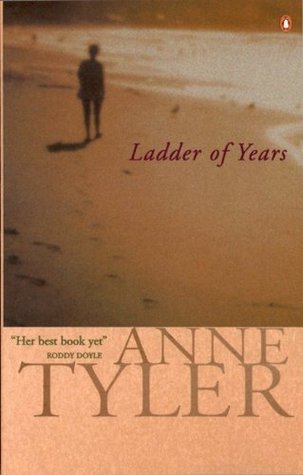 So for September I managed to steer the group away from a poorly received historical novel of over 400 pages and the new Joël Dicker and onto Ladder of Years by Anne Tyler, which the bookstore chain Waterstones has been promoting heavily as one of their books of the month. I already had a charity shop copy in hand and the others liked the sound of it, so we’re all set for September 12th! Future months’ literary fiction choices look promising, too, so provided I enjoy the discussion and the camaraderie I plan to stick with it: a backlist Pat Barker novel I’ve not read, and Kirsty Logan and Jonathan Coe novels I’ve read before and won’t reread but will remind myself about briefly before the meetings.
I’m out of practice with this book club thing. My mother tells me that I have a lot to contribute but that I must also be open to what I’ll learn from other people – even if I don’t expect to. So I don’t want to set myself up as some kind of expert. In fact, I probably won’t even mention that I’m a freelance book reviewer and book blogger. Mostly I’m hoping to find some friendly faces around the neighborhood, because even though we’ve lived here just over two years I still only know a handful of names and keep myself to myself as I work from home. Even if I have to read books I wouldn’t normally, it’ll be worth it to meet more people.
What has your experience with book clubs (in person and online) been?
20 Books of Summer #4 + Substitutes & Plane Reading
You’ll have to excuse me posting twice in one day. I’ve just finished packing the last few things for my three weeks in America, and want to get my latest #20BooksofSummer review out there before I fly early tomorrow. What with a layover in Toronto, it will be a very long day of travel, so I think the volume of reading material I’m taking is justified! (See the last photo of the post.)
Four Wings and a Prayer: Caught in the Mystery of the Monarch Butterfly by Sue Halpern (2001)
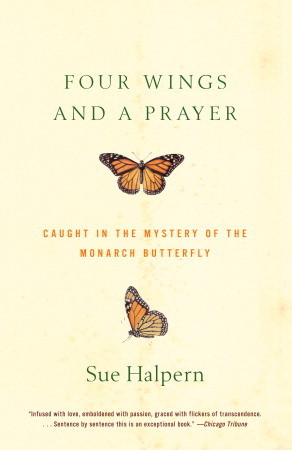 I admire nonfiction books that successfully combine lots of genres into a dynamic narrative. This one incorporates travel, science, memoir, history, and even politics. Halpern spent a year tracking monarch butterflies on their biannual continent-wide migrations, which were still not well understood at that point. She rides through Texas into Mexico with Bill Calvert, field researcher extraordinaire; goes gliding with David Gibo, a university biologist, in fields near Toronto; and hears from scientists and laymen alike about the monarchs’ habits and outlook. It happened to be a worryingly poor year for the butterflies, yet citizen science initiatives provided valuable information that could be used to predict their future.
The book is especially insightful about clashes between environmentalist initiatives and local livelihoods in Mexico (tree huggers versus subsistence loggers) and the joy of doing practical science with simple tools you make yourself. It’s also about how focused attention becomes passion. “Science, like belief, starts with wonder, and wonder starts with a question,” Halpern writes.
The style is engaging, though at nearly 20 years old the book feels a bit dated, and I might have liked more personal reflections than interviews with (middle-aged, white, male) scientists. I only realized on the very last page, through the acknowledgments, that the author is married to Bill McKibben, a respected environment writer. [She frequently mentions Fred Urquhart, a Toronto zoology professor; I wondered if he could be related to Jane Urquhart, a Canadian novelist whose novel Sanctuary Line features monarchs. (Turns out: no relation. Oh well!)]
Readalikes: Farther Away by Jonathan Franzen & Ruins by Peter Kuper
My rating: 
I’ve already done some substituting on my 20 Books of Summer. I decided against reading Vendela Vida’s Girls on the Verge after perusing the table of contents and the first few pages and gauging reader opinions on Goodreads. I have a couple of review books, Twister by Genanne Walsh and The Life and Loves of Lena Gaunt by Tracy Farr, that I’m enjoying but will have to leave behind while I’m in the States, so I may need that little extra push to finish them once I get back. I’ve also been rereading a favorite, Paulette Bates Alden’s memoir Crossing the Moon, which has proved an excellent follow-up to Sheila Heti’s Motherhood.
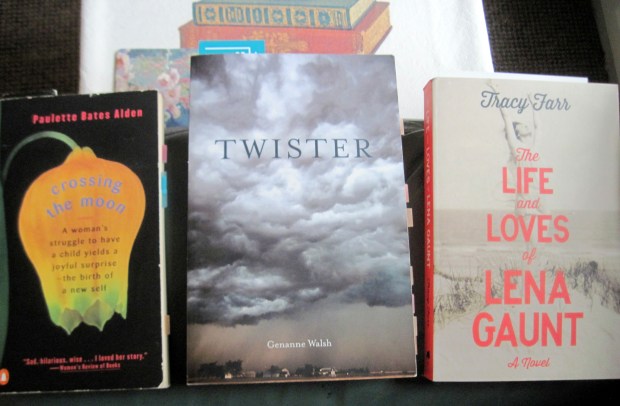
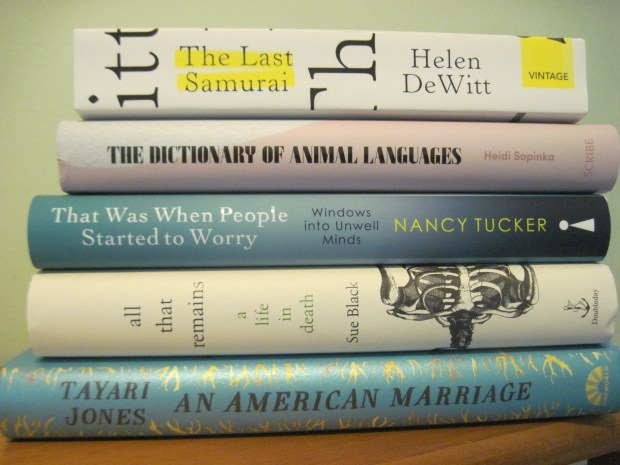
(What I haven’t determined yet is which books these will be standing in for.) Waiting in the wings in case further substitutions are needed is this stack of review books:
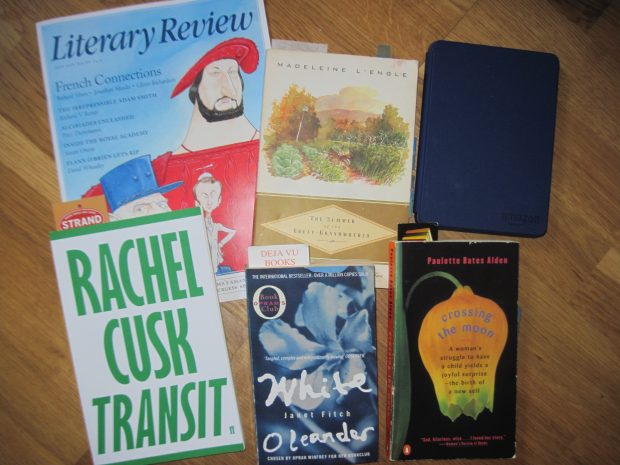
Also from the #20Books list and coming with me on the flight are Madeleine L’Engle’s The Summer of the Great-Grandmother and Janet Fitch’s White Oleander, which are both terrific thus far. The final print book joining me for the journey is Transit by Rachel Cusk. I have attempted to read her twice before and failed to get through a whole book, so we’ll see if it’s third time lucky. It seems like the perfect book to read in transit to Canada, after all.
Finally, in progress on the Kindle are Summer by Karl Ove Knausgaard, the last in his set of four seasonal essay collections, and The Late Bloomers’ Club by Louise Miller, another cozy novel set in fictional Guthrie, Vermont, which she introduced in her previous book, The City Baker’s Guide to Country Living.
It’ll be a busy few weeks helping my parents pack up their house and moving my mom into her new place, plus doing a reduced freelance work load for the final two weeks. It’s also going to be a strange time because I have to say goodbye to a house that’s been a part of my life for 13 years, and sort through box after box of mementoes before putting everything into medium-term storage.
I won’t be online all that much, and can’t promise to keep up with everyone else’s blogs, but I’ll try to pop in with a few reviews.
Happy July reading!
Where My Books Came from in the First Half of 2018
I find it interesting to look back at where my books come from, and how this changes from year to year. So far this year, it seems like I’m reading fewer e-books and more from various libraries. I’m also doing a bit better about reading the secondhand books I already own, but – like last year – the largest proportion of my reading is still review copies of new books.
Here are the statistics for the year so far, in both real numbers and percentages (not including the books I’m currently reading, DNFs and books I only skimmed BUT including picture books, which I don’t count towards my yearly total):
- Free print or e-copy from the publisher or author: 45 (28%)
- Public library: 42 (26%)
- Secondhand purchase: 29 (18%)
- Downloaded from NetGalley or Edelweiss: 27 (17%)
- University library: 8 (5%)
- Gifts: 5 (3%)
- Twitter giveaway win: 3 (2%)
- New (bargain) book purchase: 1 (0.5%)
- Kindle purchase: 1 (0.5%)
Where do you get most of your books from?
All the Books I’ve Abandoned So Far This Year
I abandon about 15% of the books I start. I try not to go on too much about the books I don’t finish, partially because a DNF still feels like something of a failure on my part (to choose the right book; to stick with what I’ve started) and partially because a book blog would ideally be a place where you just wax lyrical on the books that you love. But every time I have written abandoned books posts they have been absurdly popular, so if you need encouragement to ditch the books that aren’t working out for you right now, do take this as my blessing!
If there are books on my list that you have finished and loved, I’d be glad to hear from you. Equally, if there are some here that you also abandoned, do reassure me that I’m not totally off base. I know I can be inconsistent in how I deal with DNFs: how many pages I give them, how much I write about them, and whether I choose to rate them. If I feel I gave a book enough of a try to know what I would have thought of it overall, I go ahead and rate it. Others will almost certainly think that this is unfair to the author and their hard work. Thoughts?
These are in chronological order of my attempted reads, with the pages or percentages read in parentheses. I’ve omitted any books I’ve already written about on the blog.
The Light of Amsterdam by David Park: This is the second time I’ve been seduced by Park’s amazing-sounding plots – the blurb for this one and The Poets’ Wives are ever so appealing – but ended up unable to engage with them. Here, not one of the characters interested me. Park’s writing is noteworthy, but a bit belabored: there are more words and images there than you really need to make the point (“The solace he tried to take in his intellectual superiority was thinning in spiteful synchronicity with the thinning of his hair”; “in this game, intensity or passion were the illegitimate children of commitment”). (32 pp.)
Census by Jesse Ball: I’d enjoyed Ball’s previous novel, How to Start a Fire and Why. This one is very different, though – probably closer to his usual style, based on accounts I’ve read from others. It’s strange, dreamy, and philosophical. With its flat, simple, repetitive language; short sentences and paragraphs; and no speech marks, it is fable-like and oblique, and altogether hard to latch onto. The author opens by saying this is a tribute to his brother, who had Down’s syndrome and died 20 years ago. But in the portion that I read, the character with Down’s syndrome has no apparent presence or personality. People who like dystopian allegories (Saramago and the like?) may well enjoy this, but it wasn’t for me. (10%)
Exodus: A Memoir by Deborah Feldman: A memoir about a woman’s loss of faith – here, that involved leaving her marriage and her Hasidic Jewish community – should be right up my alley, but I had trouble connecting with Feldman’s voice. I didn’t sense honest wrestling, just hipster angst. Should I bother trying her previous memoir, Unorthodox? (20 pp.)
Tender by Belinda McKeon: I could relate to Catherine, an awkward and initially unconfident university student who doesn’t know what she’s good at. Perhaps because I’ve never had close male friends, though, I found it harder to understand her intimate friendship with James. I liked their snappy conversations, but the run-on nature of the narration was slightly off-putting. I would try other work by McKeon, or possibly even give this one another go some years in the future. (140 pp.) 
The Man on the Middle Floor by Elizabeth S. Moore: Initially I enjoyed the first-person voice of Nick, who is on the autism spectrum and relies on careful weekly schedules and lists of rules of how the world works to fit in. However, the second section featuring him is ill-advised and damaging, branding ASD people as violent and horny. All really rather unpleasant, with two of the main characters walking stereotypes and undistinguished writing. (16 pp. plus some further skimming)
Life in the Garden by Penelope Lively: This is a gorgeous physical book, but inside it’s writing by numbers: It feels so stiff you can see how Lively filled in an outline. One chapter even ends with “This has been a discussion of the written garden”. Early chapters are on the history of gardens, gardens as metaphors, and gardens in literature (Vita Sackville-West, Elizabeth von Arnim, the Sitwells, et al.). I think you’d have to be much more of a gardening enthusiast than I am – I’m a lazy, frustrated amateur at best – to get a lot out of this. (79 pp.) 
The Mermaid and Mrs. Hancock by Imogen Hermes Gowar: Gowar has an accomplished and knowing narrative voice, and the historical setting is totally convincing. But I didn’t get drawn into the story. A merchant unwittingly acquires a hideous fish-like creature and decides to make as much money from displaying it as he can. Meanwhile, a high-class madam decides she needs a new gentleman protector for one of her best whores. Given the title, I think I know what we can expect. The scenes set in the brothel particularly bored me, and the thought of another 350+ pages appalled me. (70 pp. plus some further skimming)
Things Bright and Beautiful by Anbara Salam: I had been looking forward to this historical novel about a missionary marriage in the South Pacific. Unfortunately, I did not find it compelling in the least. Even the twist in the last line of the prologue was not enough to keep me reading. You might try Euphoria by Lily King instead. (6%)
Leap In: A Woman, Some Waves and the Will to Swim by Alexandra Heminsley: I really enjoyed Part 1, which is about leaping into life, whatever that means for you. For her it was learning to swim, undertaking outdoor swimming challenges everywhere from her hometown of Brighton to Ithaca, Greece, but also getting married and undergoing IVF. I especially appreciated her words on acquiring a new skill as an adult and overcoming body issues. But then it seems like her publishers said, “Meh, too short; add in more stuff!” and so we get the history of swimming, what gear you should buy, FAQs, etc. – boring! (Part 1) 
The Lost Girls of Camp Forevermore by Kim Fu: We get a brief introduction to a set of nine- to eleven-year-old campers from the early 1990s on an isolated overnight adventure – they’re pretty hard to keep straight – before diving deep into one’s life for the next 20+ years. The long interlude means Fu doesn’t sustain suspense about whatever bad thing happened when the girls were campers. A disappointment after For Today I Am a Boy. (86 pp.)
The Underneath by Melanie Finn: I requested this on the strength of Finn’s previous novel. Jumping between italicized passages set in Africa and Kay and Michael’s troubled marriage playing out its end in Vermont 10 years later, the narrative feels fragmented. Another strand is about Ben of Comeau Logging and his drug-addicted friend Shevaunne. It’s clear these subplots will meet up at some point, but I didn’t have the patience to hang around. There is a lot of gritty violence towards animals, too. (15 pp. plus some further skimming)
Carry On, Warrior: The real truth about being a woman by Glennon Melton: Melton was an alcoholic and bulimic for nearly 20 years until she found herself pregnant and cleaned up her act, fast. Her approach here is like a cross between Brené Brown, Elizabeth Gilbert and Anne Lamott: generically Christian encouragement to be your authentic self, do your best work, and choose love. But something about the voice grated, and the short essays felt repetitive. (37 pp.)
Life & Times of Michael K by J.M. Coetzee: I should know by now that this is just the sort of book I hate: a spare, almost dystopian allegory that’s not rooted in time or place and whose characters are symbols you hardly care about. The Childhood of Jesus was similar. This starts off as Michael K’s quest to get his ailing mother to Prince Albert, but that’s very soon derailed, and with it my interest. (20 pp. plus some further skimming)
The Conservationist by Nadine Gordimer: Alas, I was 0 for 2 on South African Booker Prize winners. Nice landscape descriptions, but despite the discovery of a body there’s no narrative momentum, and one doesn’t warm to Mehring. My favorite passage, with ironically apt adjectives in bold, was “The upland serenity of high altitude, the openness of grassland without indigenous bush or trees … A landscape without theatricals except when it became an arena for summer storms … – a typical Transvaal landscape, that you either find dull and low-keyed or prefer to all others (they said).” (44 pp.)
The Trick to Time by Kit de Waal: There’s nothing wrong with the book per se; I just wasn’t compelled to read more. Mona is a lonely 60-year-old who runs a toy shop in a seaside town and makes custom-designed dolls. There are some major losses in her past, at first just hints and then whole stories. In memory Mona can relive the limited moments she had with her loved ones. I could recommend this to fans of Rachel Joyce – the story line is particularly reminiscent of The Unlikely Pilgrimage of Harold Fry and The Snow Garden – but wonder if de Waal’s previous book would feel more original. (70 pp.)
The Best of Everything by Rona Jaffe: I had a weird reverse case of déjà vu: this is awfully similar to Mad Men, Suzanne Rindell’s Three-Martini Lunch, and A.J. Pearce’s Dear Mrs Bird, though of course they would have been based on Jaffe’s novel rather than the other way round. Caroline Bender, fresh out of a broken engagement, arrives for her first day as a typist at a New York City publishing house and has to adjust to catty office politics. I think I’ll enjoy this, but need to find another time when I can give it my full attention. (Ch. 1)
The Day that Went Missing: A Family Tragedy by Richard Beard: In August 1978, when the Beard family was on holiday at the beach in Cornwall, nine-year-old Nicholas was taken by the undertow and drowned. Eleven-year-old Richard was the last person to see him alive. He digs up evidence and stories of who Nicky was in his brief life and what exactly happened on that fateful day. The matter-of-fact, even cavalier, tone detracts from any potential emotional power. The other problem is there’s simply not very much to say about a nine-year-old and his rather average English family. (28 pp. plus some further skimming)
The Lido by Libby Page: The kindest word I could apply to the prose is “undemanding.” I’d hoped the charm of a story about a lonely twentysomething journalist and an octogenarian who band together to rescue their local swimming pool would outweigh the dull writing, but not so. Comparisons with Eleanor Oliphant didn’t fill me with confidence, either. (25 pp.)
The Great Believers by Rebecca Makkai: There’s a near-contemporary story line that’s not very compelling; while I enjoyed the 1980s strand about a group of gay friends in Chicago, there are a lot of secondary characters we don’t get to know very well, plus the details of Yale’s art deal slow down the narrative. I really wanted to appreciate the book more because I loved Makkai’s two previous novels so much, but I didn’t feel the impetus to continue. (50 pp. plus some further skimming)
A Long Island Story by Rick Gekoski: I loved Darke, so jumped at the chance to read Gekoski’s second novel. I liked our introduction to mother Addie and father Ben, who works for the Department of Justice but has ambitions as a writer so stays up until all hours typing. They drive out with kids Becca and Jake one summer morning to Long Island to stay with Addie’s parents, Maurice and Perle, at their bungalow. I didn’t sense a lot of promise. It’s interesting to see in the acknowledgements that Gekoski originally tried writing this as a memoir of his 1950s childhood. I think that could have been much more interesting. (35 pp.)
An Actual Life by Abigail Thomas: Thomas writes terrific memoirs-in-essays, so I was intrigued to try her fiction. Nineteen-year-old Virginia got pregnant the first time she slept with Buddy; now she’s married to him and a stay-at-home mother to Madeline. This reads like a cheap knockoff of Anne Tyler, and the shortage of punctuation is maddening. (46 pp.)
The Book of Salt by Monique Truong: I never warmed to the voice of Bình, the Vietnamese cook for Gertrude Stein and Alice B. Toklas in 1930s Paris, nor was I interested enough in what I read about the “Mesdames” to continue getting to know them. I found the narration overwritten: “This language that I dip into like a dry inkwell has failed me. It has made me take flight with weak wings and watched me plummet into silence.” I couldn’t resist the terrific setup, but the delivery was ever so slightly dull. (31 pp.)
Library Checkout: June 2018
I’ve read some terrific stuff from the library over the past month! As usual, I’ve added in star ratings and links to any Goodreads reviews if I haven’t already featured the books on the blog in some way.
Note: I’m going to skip the month of July because I’m spending three weeks of it in America helping my parents pack and move out of their house. My plan is to return all the public library books I still have out and cancel most of my reservation requests before I fly out. (I can always request them again as soon as I get back; for now I like the idea of a clean slate.)
LIBRARY BOOKS READ
- Anecdotal Evidence by Wendy Cope [poetry]
- The Lie of the Land by Amanda Craig
- The Unmapped Mind: A Memoir of Neurology, Incurable Disease and Learning How to Live by Christian Donlan

- Leaving Before the Rains Come by Alexandra Fuller
- The White Book by Han Kang
- Cold Earth by Sarah Moss
- The Long Goodbye: A Memoir of Grief by Meghan O’Rourke
- The Reading Promise: 3,218 Nights of Reading with My Father by Alice Ozma
- Never Mind by Edward St. Aubyn
- The Hate U Give by Angie Thomas
SKIMMED ONLY
- The Wonder Down Under: A User’s Guide to the Vagina by Dr. Nina Brochmann and Ellen Støkken Dahl
- A Moment of Grace by Patrick Dillon
- Morning—How to Make Time: A Manifesto by Allan Jenkins
- When I Hit You by Meena Kandasamy
CURRENTLY READING-ish (set aside temporarily)
- To the Is-Land: An Autobiography by Janet Frame
CHECKED OUT, TO BE READ
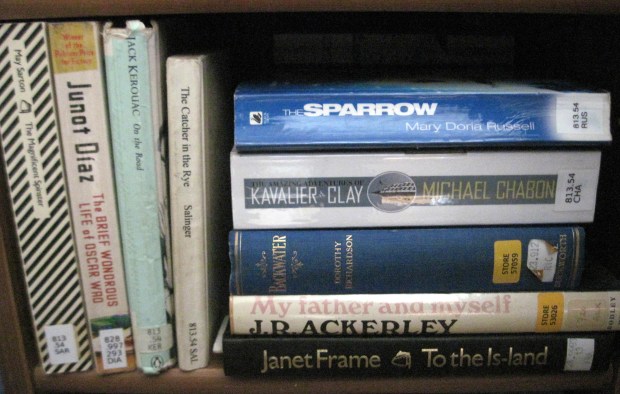
These university library books have been hanging around for a loooooooooooong time, and most likely will continue to do so for months to come:
- My Father and Myself by J.R. Ackerley
- The Amazing Adventures of Kavalier & Clay by Michael Chabon
- The Brief Wondrous Life of Oscar Wao by Junot Díaz
- On the Road by Jack Kerouac
- The Cabaret of Plants: Botany and the Imagination by Richard Mabey (not pictured)
- Backwater by Dorothy Richardson
- The Sparrow by Mary Doria Russell
- The Catcher in the Rye by J.D. Salinger
- The Magnificent Spinster by May Sarton
IN THE RESERVATION QUEUE
- Whistle in the Dark by Emma Healy
- The Stopping Places: A Journey through Gypsy Britain by Damian Le Bas
- The Secret Barrister: Stories of the Law and How It’s Broken
- Rosie: Scenes from a Vanished Life by Rose Tremain
- The Librarian by Salley Vickers
RETURNED UNFINISHED
- The Day that Went Missing: A Family Tragedy by Richard Beard
- The Trick to Time by Kit de Waal
- Tender by Belinda McKeon
- The Lido by Libby Page
RETURNED UNREAD
- Places I Stopped on the Way Home: A Memoir of Chaos and Grace by Meg Fee
- That Was when People Started to Worry: Windows into Unwell Minds by Nancy Tucker
(I requested these from the publisher way back in November 2017 and was astounded when, 6.5 months later, copies turned up on my doorstep! I’d given up on them ever coming.)
- The Owl at the Window by Carl Gorham
- See What I Have Done by Sarah Schmidt
(I lost interest in these two and wasn’t drawn in by the first few pages.)
What have you been reading from your local libraries? Does anything appeal from my stacks?
The Bookshop Band & The June–July Outlook
The Bookshop Band played in an Oxfordshire village 35 minutes’ drive from us yesterday evening. I’ve now seen them four times; I don’t think that quite qualifies me as a groupie, though I do count them among my favorite artists and own their complete discography.
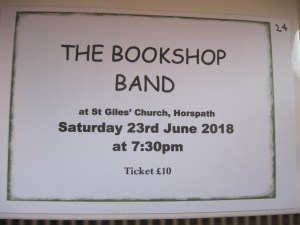
The small church provided great acoustics and an intimate setting, and the set list was a fun mixture of old and new. All of their songs are based on literature: When they were the house band at Mr B’s Emporium of Reading Delights in Bath, they would write two songs based on an author’s new book on the very day that s/he would be making an appearance at the shop in the evening. A combination of slow reading and procrastination, I suppose. You’d never believe it, though, because their songs are intricate and thoughtful, often pulling out moments and ideas from books (at least the ones I’ve read) that never would have occurred to me.
Here’s what they played last night, and which books the songs were based on:
- “Once Upon a Time” – For a radio commission they crafted this compilation of first lines from various books.
- “Cackling Farts” – A day-in-the-life song featuring archaic vocabulary words from Mark Forsyth’s The Horologicon.
- “You Make the Best Plans, Thomas” – Hilary Mantel’s Bring Up the Bodies (one of my absolute favorites of their songs).
- “Why I Travel This Way” – Yann Martel’s The High Mountains of Portugal (I have heard this live once before, but it’s never been recorded).
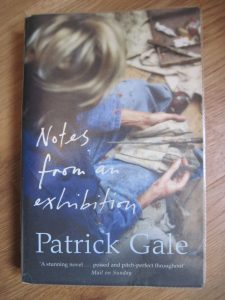 “Petroc and the Lights” – Patrick Gale’s Notes from an Exhibition (which reminds me that I really need to read it soon!).
- “Dirty Word” – A brand-new song based on Aldous Huxley’s Brave New World; it stemmed from their recent commission to write about banned books for the V&A.
- “How Not to Woo a Woman” – Rachel Joyce’s The Unlikely Pilgrimage of Harold Fry (it must be a band favorite as they’ve played it every time I’ve seen them).
- “Curious and Curiouser” – Lewis Carroll’s Alice in Wonderland.
- “Sanctuary” – A new song they wrote for the launch event at the Bodleian Library for Philip Pullman’s La Belle Sauvage (The Book of Dust, #1).
- “Room for Three” – The other song they wrote for the Pullman event
- “We Are the Foxes” – Ned Beauman’s Glow.
- “Edge of the World” – Emma Hooper’s Etta and Otto and Russell and James.
- “Faith in Weather” – The only one not based on a book; this was inspired by a Central European folktale about seven ravens (another of my absolute favorites).
- “Thirteen Chairs” – Dave Shelton’s Thirteen Chairs (another one they’ve played every time I’ve seen them).
I’m always impressed by Ben and Beth’s musicianship (guitars, ukuleles, cello, harmonium and more), and I also admire how they’ve continued touring intensively despite being new parents. They’re currently on the road for two months, and one-year-old Molly simply comes along for the ride!

A gorgeous sunset as we left the gig last night.
It’ll be a busy week on the blog. I have posts planned for every day through Saturday thanks to Library Checkout, the Iris Murdoch readalong, and various features reflecting on the first half of the year and looking ahead to the second half.
It turns out I’ll be in America for three weeks of July helping my parents pack and move, so I may have to slow down on the 20 Books of Summer challenge, and will almost certainly have to substitute in some books I have in storage over there. (I’m pondering fiction by Laurie Colwin, Hester Kaplan, Antonya Nelson and Julie Orringer; and nonfiction by Joan Anderson, Haven Kimmel and Sarah Vowell.) I have a few books lined up to review for their July release dates, but it’ll be a light month overall.
Some of My Recent and Upcoming Bylines
Next month marks five years that I’ve been a freelance reviewer, and I turn 35 later in the year. With these milestones in mind, I’ve been pushing myself a bit more to make contact with new publications and try to get my work out there more widely.
Most recently, I was pleased to have my first article in Literary Hub, an essay about rereading Little Women in its 150th anniversary year in conjunction with the new BBC/PBS miniseries production. (I shared this article intensively on social media, so do forgive me if you’ve already seen it somewhere else!) This is the first time, apart from here on the blog, that I’ve blended book commentary with personal material. I think it’s probably the best “exposure” I’ve had for my writing thus far: last time I looked, Literary Hub’s Facebook post about the article had gotten 123 likes and 33 shares, with 71 likes and 22 retweets on Twitter.
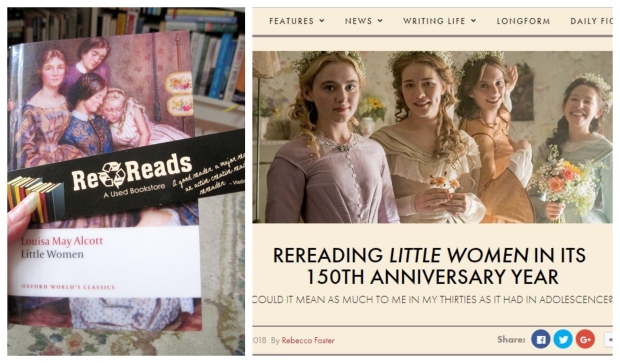
[Note: I now know that the spelling is Katharine Hepburn and have asked twice over e-mail for the editor to correct it, but it’s clearly very low on their list of priorities!]
I continue to review for the Pittsburgh Post-Gazette on a regular basis. My latest review was quite a negative one, alas, for Richard Flanagan’s First Person (). Upcoming: Slave Old Man by Patrick Chamoiseau () and A Weekend in New York by Benjamin Markovits.


I still contribute the occasional review to Shiny New Books. My latest two are of From Here to Eternity by Caitlin Doughty () and All the Beautiful Girls by Elizabeth J. Church ().


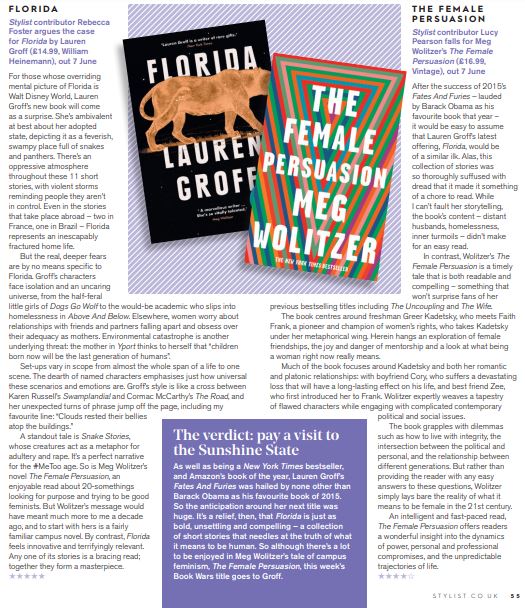
I reviewed Florida by Lauren Groff (), my fiction book of the year so far, for Stylist magazine. This is the fourth time I’ve volunteered for their “Book Wars” column, but the first time I’ve ‘won’ – I attribute it to the high class of book!
Bylines coming later in the summer:
- A dual review of two nature-themed memoirs in the Times Literary Supplement (June 15th issue). This is my third piece for the TLS, but as it’s a longer one it feels a little more ‘real’.
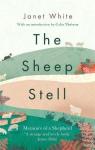
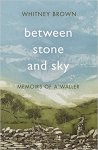
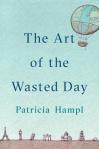
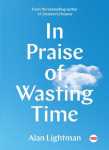
- An essay on two books about “wasting time” (including Alan Lightman’s) in the Los Angeles Review of Books (June 20th).
- A dual review of a memoir and a poetry volume by African writers in Wasafiri literary magazine (Issue 95).
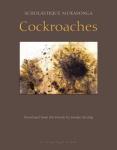
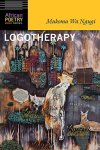
Upcoming work, with no publication date yet:
- A dual review of two death-themed poetry collections for PN Review.

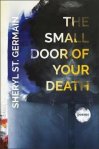
- Two book lists for OZY, one on the refugee crisis and another on compassion in medicine.
- A review essay on Gross Anatomy by Mara Altman for Glamour Online.
Library Checkout: May 2018
I know lots of my readers are dedicated library users. Why not join in with Library Checkout this holiday weekend, or next month? It’s a quick and fun post to put together, it celebrates libraries, and it gets me some of my best engagement! I generally post on the last Monday of the month, but whenever suits your schedule is fine. Use the image above, and paste a link to your post in the comments. (I haven’t worked out an official link-up system yet.)
As usual, my “Checked Out” pile is so stupidly big that I’m just going to list and photograph the new arrivals since last month. Also as usual, I’ve added in star ratings and any links to Goodreads reviews of books I haven’t already featured on the blog.
LIBRARY BOOKS READ
- The Only Story by Julian Barnes
- The Darling Buds of May by H.E. Bates
- The Woman in the Window by A.J. Finn
- Sugar Money by Jane Harris
- The Executor by Blake Morrison
- Brainstorm: Detective Stories from the World of Neurology by Suzanne O’Sullivan
- Home Fire by Kamila Shamsie
- The Enchanted April by Elizabeth von Arnim
- Night Sky with Exit Wounds [poetry] by Ocean Vuong
- Tin Man by Sarah Winman
- Island Home: A Landscape Memoir by Tim Winton
SKIMMED ONLY
- The Most Perfect Thing: Inside (and Outside) a Bird’s Egg by Tim Birkhead
- Sight by Jessie Greengrass
- How to Develop Emotional Health by Oliver James
- Eat Up!: Food, Appetite and Eating What You Want by Ruby Tandoh
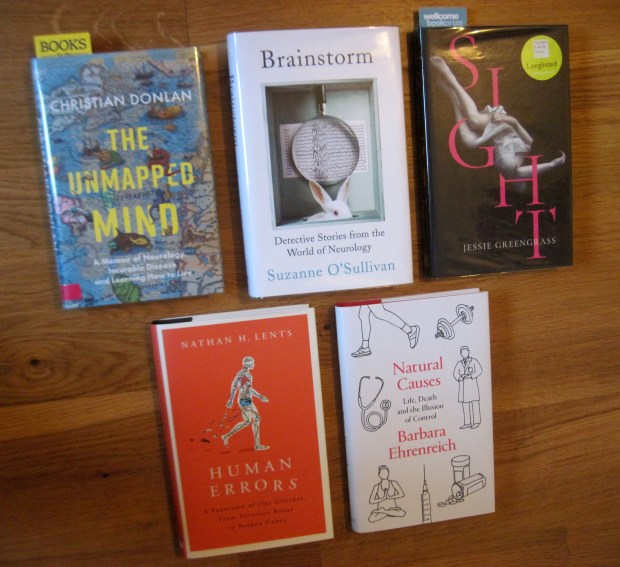
Recent and current Wellcome Book Prize themed reading. Top row from library.
CURRENTLY READING
- Anecdotal Evidence by Wendy Cope [poetry]
- The Trick to Time by Kit de Waal
- The Unmapped Mind: A Memoir of Neurology, Incurable Disease and Learning How to Live by Christian Donlan
- Places I Stopped on the Way Home: A Memoir of Chaos and Grace by Meg Fee
- Leaving before the Rains Come by Alexandra Fuller
- When I Hit You by Meena Kandasamy
- The Long Goodbye: A Memoir of Grief by Meghan O’Rourke
- The Reading Promise: 3,218 Nights of Reading with My Father by Alice Ozma
- The Hate U Give by Angie Thomas
CURRENTLY READING-ish (set aside temporarily)
- To the Is-Land: An Autobiography by Janet Frame
- Tender by Belinda McKeon
- Never Mind by Edward St. Aubyn
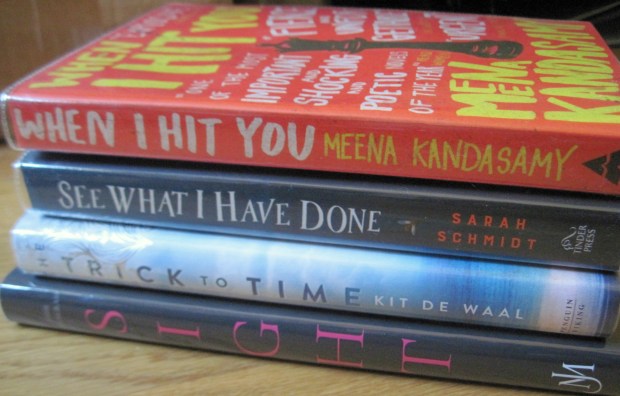
Women’s Prize long- and shortlisted books.
CHECKED OUT, TO BE READ
- The Day that Went Missing: A Family Tragedy by Richard Beard
- Happiness by Aminatta Forna
- The Sun Does Shine: How I Found Life and Freedom on Death Row by Anthony Ray Hinton with Lara Love Hardin
- The White Book by Han Kang
- The Seabird’s Cry: The Lives and Loves of Puffins, Gannets and Other Ocean Voyagers by Adam Nicolson
- A Normal Family: Everyday Adventures with Our Autistic Son by Henry Normal
- The Still Point by Amy Sackville
- That Was when People Started to Worry: Windows into Unwell Minds by Nancy Tucker
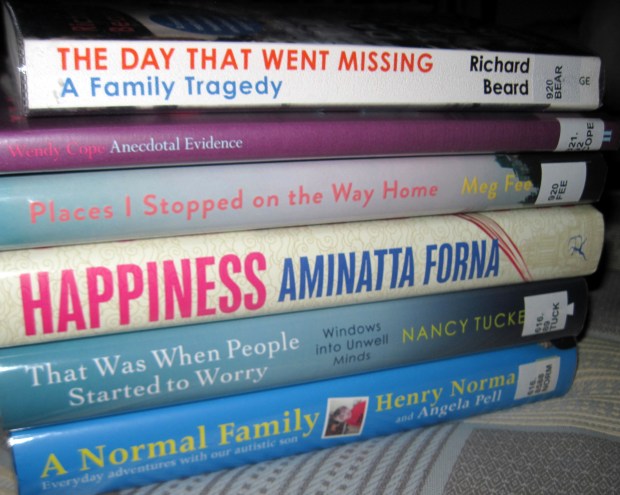
Latest library book haul
ON HOLD, READY TO BE PICKED UP
- The Lido by Libby Page
- First, We Make the Beast Beautiful: A New Story about Anxiety by Sarah Wilson
IN THE RESERVATION QUEUE
- A Moment of Grace by Patrick Dillon
- The Stopping Places: A Journey through Gypsy Britain by Damian Le Bas
- The Hidden Ways: Scotland’s Forgotten Roads by Alistair Moffat
- The Secret Barrister: Stories of the Law and How It’s Broken
- The Crossway by Guy Stagg
- Rosie: Scenes from a Vanished Life by Rose Tremain
- The Librarian by Salley Vickers
- Shepherd of Another Flock: The Charming Tale of a New Vicar in a Yorkshire Country Town by David Wilbourne
- The Boy behind the Curtain: Notes from an Australian Life by Tim Winton
- The Paper Lovers by Gerard Woodward
RETURNED UNFINISHED
- Carry On, Warrior: The Real Truth about Being a Woman by Glennon Melton
RETURNED UNREAD
- Other Minds: The Octopus and the Evolution of Intelligent Life by Peter Godfrey-Smith (lost interest, plus it’s requested after me)
- The Sealwoman’s Gift by Sally Magnusson (requested after me; I’ll get it out again another time)
What have you been reading from your local libraries? Does anything appeal from my stacks?
Library Checkout: April 2018
The last two months were bumper editions and saw me getting through loads of library books. That’s slowed down this month, replaced by books I own, review copies and advanced reads from NetGalley or Edelweiss. Boy, are the library books stacking up! My public library system’s website says you can have 15 books out at a time … but the self-service machines don’t cut you off until after you pass 30, at least not in my experience, so I currently have 32 books on loan. (No, I’m not particularly sorry about that. I’m keeping the library system in business, and the few remaining staff members in their jobs! And anyone who wants these books can simply put in a free reservation request, so I don’t feel that I’m hogging them.)
The “Checked Out” pile is so stupidly big that I’m just going to list and photograph new arrivals since last month. As usual, I’ve added in star ratings and any links to Goodreads reviews of books I haven’t already featured on the blog.
LIBRARY BOOKS READ
- The Grave’s a Fine and Private Place by Alan Bradley
- The Church Mouse by Graham Oakley
- To Be a Machine: Adventures among Cyborgs, Utopians, Hackers, and the Futurists Solving the Modest Problem of Death by Mark O’Connell
- In the Days of Rain by Rebecca Stott
SKIMMED ONLY
- The Wood: The Life and Times of Cockshutt Wood by John Lewis-Stempel
- The Vaccine Race by Meredith Wadman
CURRENTLY READING
- The Woman in the Window by A.J. Finn
- How to Develop Emotional Health by Oliver James
- The Enchanted April by Elizabeth von Arnim
- Night Sky with Exit Wounds [poetry] by Ocean Vuong
- Island Home: A Landscape Memoir by Tim Winton
CURRENTLY READING-ish (set aside temporarily)
- To the Is-Land: An Autobiography by Janet Frame
- Tender by Belinda McKeon
- Never Mind by Edward St. Aubyn
CHECKED OUT, TO BE READ
- The Tattooist of Auschwitz by Heather Morris
- The Executor by Blake Morrison
- The Seabird’s Cry: The Lives and Loves of Puffins, Gannets and Other Ocean Voyagers by Adam Nicolson
- Home Fire by Kamila Shamsie
- The Hate U Give by Angie Thomas
- Tin Man by Sarah Winman
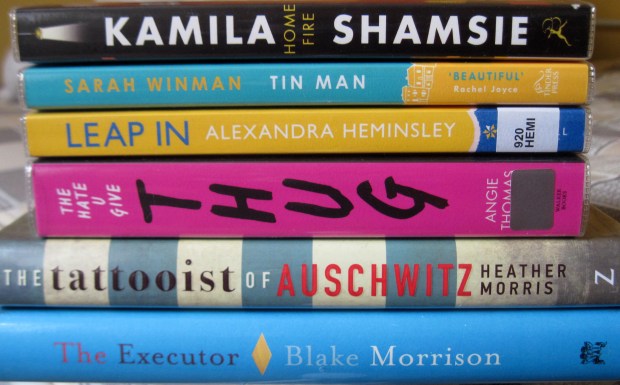

ON HOLD, READY TO BE PICKED UP
- The Sun Does Shine: How I Found Life and Freedom on Death Row by Anthony Ray Hinton with Lara Love Hardin
- Eat Up! by Ruby Tandoh
IN THE RESERVATION QUEUE
- The Trick to Time by Kit de Waal
- The Unmapped Mind: A Memoir of Neurology, Incurable Disease and Learning How to Live by Christian Donlan
- Happiness by Aminatta Forna
- Other Minds: The Octopus and the Evolution of Intelligent Life by Peter Godfrey-Smith
- Sight by Jessie Greengrass
- When I Hit You by Meena Kandasamy
- The White Book by Han Kang
- The Sealwoman’s Gift by Sally Magnusson
- Mrs. Moreau’s Warbler: How Birds Got Their Names by Stephen Moss
- Brainstorm: Detective Stories from the World of Neurology by Suzanne O’Sullivan
- The Still Point by Amy Sackville
- See What I Have Done by Sarah Schmidt
- Rosie: Scenes from a Vanished Life by Rose Tremain
RETURNED UNFINISHED
- The Mermaid and Mrs. Hancock by Imogen Hermes Gowar
- Leap In: A Woman, Some Waves, and the Will to Swim by Alexandra Heminsley
- Life in the Garden by Penelope Lively
 Bookish Beck = Rebecca Foster. American transplant to England. Freelance proofreader and book reviewer.
 Bookish Beck