The November Outlook
Normally I’d start the month off with a few recommendations for new books, but I’ve only finished one November book I can recommend (Skating on the Vertical, short stories by Jan English Leary; not yet reviewed); I DNFed another couple and skimmed one more. So instead I’ll give a quick survey of what the month holds.
- Young Writer of the Year reviews and events. I’ve read The Lauras; expect my review on Monday. I’m currently reading The Lucky Ones, Conversations with Friends, and the Steven Runciman biography, which will be my doorstopper for the month. There will be a shortlist event in London on the 18th, and on the 24th the shadow panel is meeting up to select a winner.

- I’ll be finishing up a brief climate change feature for Foreword Reviews magazine, consisting of mini-reviews of four upcoming books on an environmental theme.
- Review books I owe write-ups for: Jacob’s Room Is Full of Books by Susan Hill (released last month) and The Smell of Fresh Rain by Barney Shaw (out on the 14th). I’m fascinated by the science of smell and taste, so I’m intrigued to find out what Shaw has to say about a sense that often gets little attention.
- Blog tour for Celeste Ng’s new novel, Little Fires Everywhere, on the 14th. I haven’t started it yet but I’m looking forward to it immensely.
- You’d think with all those review books and library piles I wouldn’t be taking on any more projects…but I couldn’t resist agreeing to another “Book Wars” column (my third) for Stylist magazine, due on the 17th. I used to love reading Stylist when I worked in London; if you’re lucky enough to come across the magazine in your commuting, look out for my contribution to the Christmas-themed special.
- The Iris Murdoch Readalong begins with Under the Net. I’ll aim to squeeze it in before the end of the month. (Can I count it as my Classic?!)
- If I get a chance, I’ll also participate in German Literature Month by reading Bernhard Schlink’s The Woman on the Stairs on my Kindle.
- I’m revisiting some of my favorite Victorian pastiches for an article on neo-Victorian novels for Bookmarks magazine, due at the end of the month.
- Otherwise, I’ll be focusing on novellas for November, including some nonfiction novellas. I have a big pile of books set aside that are around 150 pages or shorter. I’ll get to as many of them as I can and summarize them in a roundup or two. They’re quick wins, true, often read in a single sitting (I read Alice Hoffman’s Survival Lessons this morning, for instance), but this doesn’t feel like a cheaty way to build up the book list because brevity is such an admirable skill.
How does November look for you?
Library Checkout Reboot
The Library Checkout blog meme was created by Shannon of River City Reading and previously hosted by Charleen of It’s a Portable Magic. I’m taking over as the host as of this month. There’s nothing too complicated about this challenge; it’s just a way of celebrating the libraries that you frequent, whether that’s your local public library branch or another specialist library. Maybe keeping track of your borrowing habits will encourage you to make even more use of libraries. Use ’em or lose ’em, after all.

I usually post this on the last Monday of the month, but you can post whenever is convenient for you. I’ll look into a proper link-up service, but for now just paste a link to your own post in the comments. (Feel free to use the above image, too.) The basic categories are: Library Books Read; Currently Reading; Checked Out, To Be Read; On Hold; and Returned Unread. Others I sometimes add are Skimmed Only and Returned Unfinished. I generally add in star ratings and links to reviews of any books I’ve managed to read.
A couple of weeks ago I went nuts at the university library on my husband’s campus. As a staff member he can borrow 25 books pretty much indefinitely (unless they’re requested). One or both of us has been associated with the University of Reading for over 15 years now, so the library there is a nostalgic place I love visiting. It’s technically currently undergoing a major renovation, but the books are still available, so it doesn’t make much difference to me.
LIBRARY BOOKS READ
- Interlibrary Loan Sharks and Seedy Roms: Cartoons from Libraryland by Benita L. Epstein
 (So dated, I’m afraid! A few good ones, though.)
 - Fall Down 7 Times, Get Up 8 by Naoki Higashida

- Autumn by Karl Ove Knausgaard

- A Sand County Almanac by Aldo Leopold [university library]

SKIMMED ONLY
- Option B by Sheryl Sandberg and Adam Grant
CURRENTLY READING
- Slade House by David Mitchell
- Halfway to Silence by May Sarton [poetry; university library]
CHECKED OUT, TO BE READ
A manageable selection from the public library:
Plus loads of books from lots of different genres from the university library; these will keep me going well past Christmas, I reckon!


RETURNED UNFINISHED
- The Seventh Function of Language by Laurent Binet
Have you been taking advantage of your local libraries? What appeals from my library stacks?
Library Checkout: September 2017
I’ve mostly been reading review copies, books from my own shelves, and Kindle books this month, though I did manage one library read during our trip to Amsterdam. While I was at the public library on Thursday, however, I was tempted by several titles from the bestsellers display – these are two-week loans with no renewals, so I have to devote some serious time to them this week and into early October. I’ve read and enjoyed one previous book each by Binet, Knausgaard and Higashida (I just realized those are all translated – how about that? Usually I have to urge myself to remember to read literature in translation!), so will be interested to see how their most recent work stacks up.
LIBRARY BOOKS READ
- Tulip Fever by Deborah Moggach
CURRENTLY READING
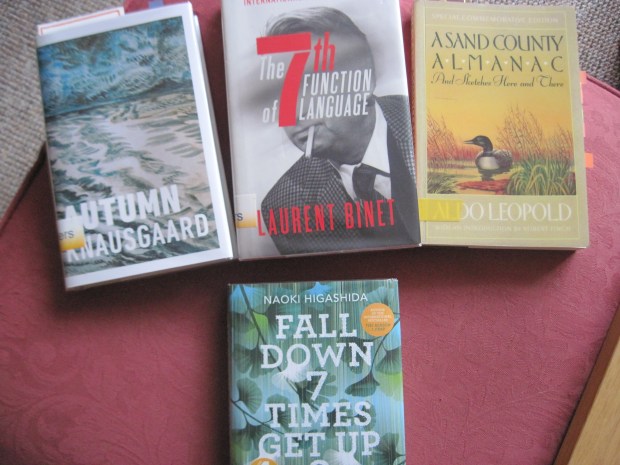
- The Seventh Function of Language by Laurent Binet
- Autumn by Karl Ove Knausgaard
- A Sand County Almanac by Aldo Leopold [from university library]
CHECKED OUT, TO BE READ
- Fall Down 7 Times, Get Up 8, Naoki Higashida
(Hosted by Charleen of It’s a Portable Magic.)
Have you been taking advantage of your local libraries? What appeals from my list?
Off to Europe Again, and What Books I’m Packing
We’re off to continental Europe again on Monday. This isn’t a major trip like last summer’s; it’s just a one-week break to take advantage of my husband presenting a paper at a landscape ecology conference in Ghent, Belgium. Though we’ve been to Ghent before, it’s a lovely town, so in between keeping up with a normal editing workload I’ll enjoy being a flâneuse on the streets and seeing the few sights we missed last time. Afterwards we head to Amsterdam for several days; it’ll be my first time there and I’m excited to take it all in.
Coincidentally, I recently read Bernard MacLaverty’s Midwinter Break for a BookBrowse review. It’s about a retired couple, Stella and Gerry, facing up to past trauma and present incompatibility during a short vacation in Amsterdam. They visit a number of the city’s most famous tourist destinations: from the art treasures of the Rijksmuseum to a drink taken in the dubious red light district. It was fun to take a virtual tour with them. We’ll see how much of our itinerary overlaps with theirs – the Anne Frank House, certainly; maybe I should also stop by the Begijnhof since it means so much to Stella.
When possible I like to do some geographically appropriate reading, so I’ve saved up a couple of Dutch-themed novels to take along on the trip:
- The Detour by Gerbrand Bakker [published as Ten White Geese in the USA]: By a Dutch novelist, with a plot split between Amsterdam and rural Wales.
- Tulip Fever by Deborah Moggach: Set in 17th-century Amsterdam and with an art theme (there are some full-color plates of works by Dutch masters); this was recommended by Annie Spence.

I’m mostly focusing on short fiction in September – short stories, novellas, and novels that are perhaps too long to technically be called novellas but still significantly under 200 pages – so may also pack the following:
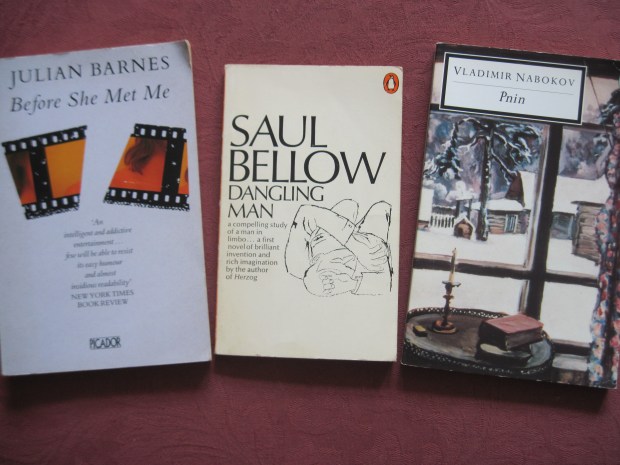
- Before She Met Me by Julian Barnes: I don’t know much about it (adultery + film?) but it’s one of just a few of his books I haven’t read yet.
- Dangling Man by Saul Bellow: I recently read The Shadow in the Garden: A Biographer’s Tale by James Atlas, about becoming a biographer of Delmore Schwartz and Saul Bellow. It’s stellar, quite possibly my book of the year, and whetted my appetite to try some Bellow. I imagine The Adventures of Augie March would be the better place to start, but I picked this up in Oxfam Books the other day.
- Pnin by Vladimir Nabokov: Lolita is the only Nabokov I’ve read thus far; I liked the sound of this comic novel set on a college campus.
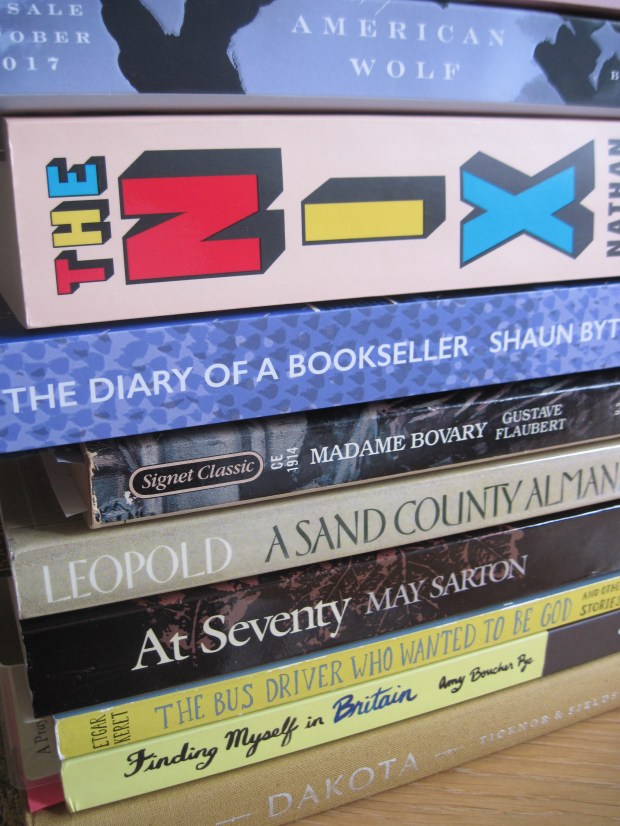
I also have to decide whether to take any of the books I currently have on the go, including my Classic (Madame Bovary) and Doorstopper (The Nix) for the month. Luckily we’re going by train, so space and weight limitations aren’t really an issue, though it would probably be prudent not to pack too many print books. I’ll probably at least take the Etgar Keret short stories: they’re flash fictions perfect for reading two or three at a time in a short sitting.
At any rate, I’ll be continuing my two e-books in progress: Cork Dork by Bianca Bosker, about the crazy world of wine obsessives and would-be top sommeliers; and Honeydew, short stories by Edith Pearlman. If I get bored, my Kindle has another 330 titles to choose from. (Isn’t it amazing? – a nearly weightless library!)
We’re back late on the 18th; I’ll be scheduling a couple of posts for while we’re away.
Happy reading!
Library Checkout: August 2017
A thin month for library books overall, although I did read two very good ones. The Aldo Leopold book is a nature classic I’m pleased we could find via the library of the university where my husband works. In the second week of September I’m going along with him to Ghent, Belgium, where he’ll be presenting a research paper at a landscape ecology conference. Though we’ve been before, it’s a lovely town I’ll enjoy wandering – in between keeping up a normal virtual workload. After that we head on to Amsterdam for a long weekend; it’ll be my first time there and I’m excited to take in all the sights.
LIBRARY BOOKS READ
- The Argonauts by Maggie Nelson

From my parents’ local branch in America:
- Sparky! by Jenny Offill [a picture book illustrated by Chris Appelhans]
CURRENTLY READING
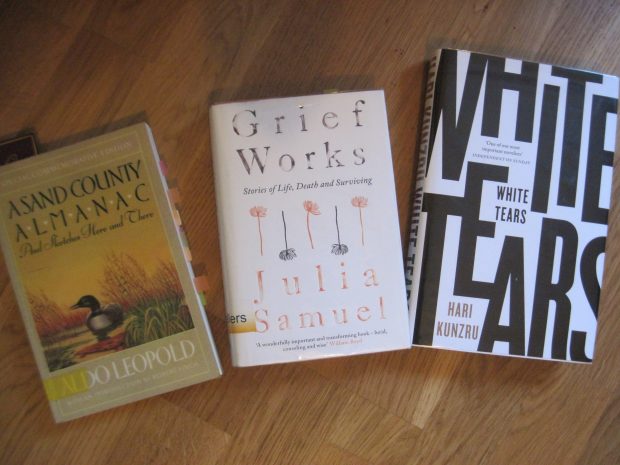
- A Sand County Almanac by Aldo Leopold
CURRENTLY SKIMMING
- Grief Works: Stories of Life, Death and Surviving by Julia Samuel
CHECKED OUT, TO BE SKIMMED
- 2 guide books to Belgium
- 2 guide books to Amsterdam
RETURNED UNFINISHED
- White Tears by Hari Kunzru – I read the first 145 pages, skimmed another 70 or so, then gave up. The vibe is Jonathan Franzen meets Zadie Smith circa The Autograph Man; the theme is cultural appropriation, especially of a blues song by a forgotten master. (I had the song from The Wire in my head the whole time.) My interest started to wane after what happens to Carter happens, and by the time the parallel road trips kicked in I was lost. So to what extent this was realist or magic realist or absurdist or whatever I couldn’t tell you. I liked the writing enough that I would try something else by Kunzru if I thought I’d connect to the subject matter more.
(Hosted by Charleen of It’s a Portable Magic.)
Have you been taking advantage of your local libraries? What appeals from my lists?
Culling My Goodreads TBR
You could say my Goodreads to-read shelf has gotten out of hand. As of July 17th it was at 7190 titles. That includes pretty much every book I’ve ever heard about and thought “yeah, maybe I’ll read that someday.” Inspired by Eleanor’s “Down the TBR Hole” posts, I decided something needed to be done – but not just 5–10 titles at a time or I’d be at this forever. So in the last couple weeks I’ve looked through a few hundred or so entries on my TBR each day, starting with the ones that were added longest ago.
My culling strategies were as follows:
Remove:
- Any duplicates – it’s possible to add multiple editions of a book (especially print vs. Kindle) without realizing it.
- Anything I don’t recognize in the slightest, even after a brief refresher on the blurb.
- Anything that doesn’t look like something I would read; yes, I’m afraid this involves judging the book by its cover.
- Anything labeled #1, or that I know is a sequel – I don’t generally read series.
- Most of what came up in searches for “murder,” “kill,” “detect,” “body,” “blood” or “mystery” – just facing facts here: I don’t ever read crime fiction. If a murder is incidental to a plot, fine, but I don’t search out mysteries.
- Any book I already own in print or e-format; the book itself serves as the reminder that I intend to read it. [Exception: I maintain “Kindle priority” and “priority advanced 2017 read” shelves.]
Get down to just one to-find-next title for each author. I already know I’ll read anything by Wendell Berry or Margaret Atwood, so I don’t need 10 titles on my TBR; I’ll keep the one I’m most keen on at the moment. Likewise, I discovered three titles each by Ivan Doig, Helen Garner and Tom Drury on the TBR but can’t remember how I even heard of these authors; I cut down to one title apiece. [Exceptions:
- If an author has written in very different genres, I’ll retain two books to showcase the diversity, perhaps one fiction and one nonfiction.
- If it’s an author I know I want to read everything by and there’s just a handful more books that I need to find to complete the set (e.g. Carol Shields and Marcus Borg), I’ll keep them all on the list so I know to look out for them.]
Transfer some reference-type books (e.g. philosophy/ethics books, essay collections, anthologies and cookbooks) to my “to skim only” shelf.
Say goodbye to an author who’s disappointed me in the past (Marina Endicott), who I’ve decided I might not be interested in after all (Russell Banks), or whom I’ve gone off (Howard Jacobson).
Scan through for notably low average ratings.
- For any book where this is below, say, 3.4, I’ll look back at the blurb and scan through the reviews, especially those by friends, and decide on a case-by-case basis whether I want to keep it on the list.
- Any book with a rating significantly below 3.0 gets deleted as a matter of course. There is the potential here for deleting some books that are polarizing and I might just love, but it’s a risk I’m willing to take; if I’m meant to read a book in my lifetime, it’ll happen somehow. [At one point, to hurry things along, I organized the to-read shelf by ascending average rating and (after getting past a bunch of 0.00 ratings for pre-release or unrated books) managed to cull a good number of books with a 2.-something average.]
This has turned out to be a much more laborious process than I’d hoped, mostly because you can only delete one title at a time and always have to click “OK” to verify. It would go so much faster if I could select 10 or 20 titles to delete at once. Yet it’s ended up being a rewarding undertaking because I’ve rediscovered many books I’d completely forgotten about. Along the way I’m adding loads to my thematic shelves and have updated my “priority to find” list. I’ve also created various new shelves like “parenting,” “dementia” and “Nancy Pearl recommendation”.
After working on this off and on for two weeks – keeping a Goodreads window open all day while doing other computer work – I managed to get the TBR down to 5498 titles. So I’ve cut the original list down by about 23.5%. However, I still have 91 pages of results to sift through. It’s a bit depressing that after all the effort I’ve put in I still have so much to do when I get back from America. At the same time, it’s quite the addictive little task. The idea is that ultimately the TBR will be significantly shorter and more targeted to my tastes.
I shall report back when I’m finally finished!
How do you keep your (virtual or physical) TBR shelf under control?
Library Checkout: July 2017
I’m flying out to America later today on a short trip for my sister’s wedding, so I’ve been focusing on finishing most of the books I have out from the library, including some that have hung around for a number of months already. I’ll have just one or two awaiting me on my return.
(Ratings and links to any books that I haven’t already featured here in some way or don’t plan to soon.)
LIBRARY BOOKS READ
- Hidden Nature: A Voyage of Discovery by Alys Fowler

- Bee Quest: In Search of Rare Bees by Dave Goulson
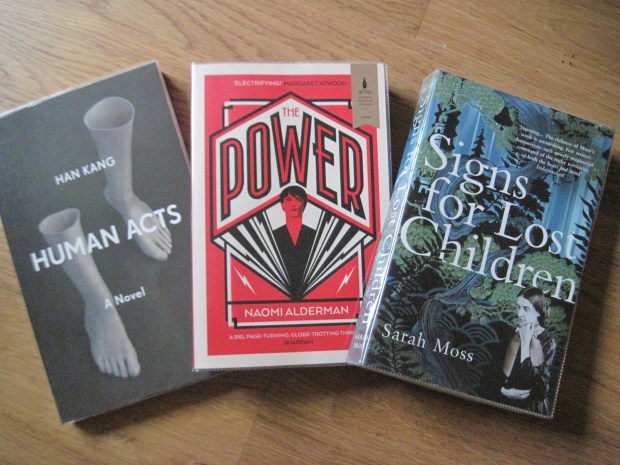
- A Horse Walks into a Bar by David Grossman
- Signs for Lost Children by Sarah Moss

LIBRARY BOOKS SKIMMED
- The Power by Naomi Alderman
CURRENTLY READING
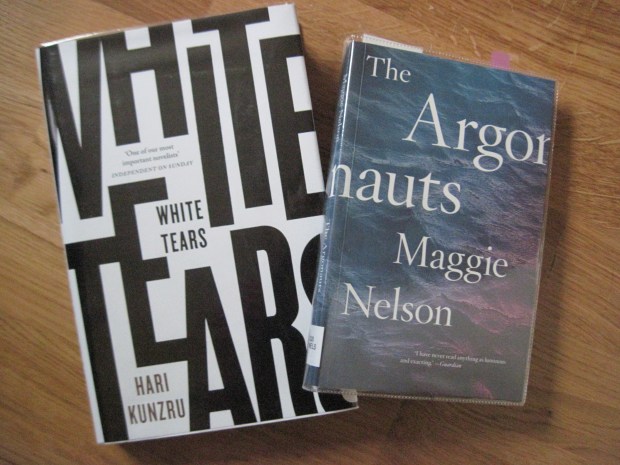
- The Argonauts by Maggie Nelson – I’ll either take this with me or put it on hold until I come back; I haven’t decided as of the time of scheduling this post. In any case, it’s the sort of fragmentary narrative that doesn’t have to be read all at once.
CHECKED OUT, TO BE READ
- White Tears by Hari Kunzru
RETURNED UNFINISHED
- Human Acts by Han Kang – I read the first 115 pages and then set this aside, not because it was too harrowing or challenging, but simply because I’d been bored for at least 45 pages and didn’t have the patience to see how the various chapters, each from a different perspective (2nd person, then 1st, then 3rd) might fit together.
RETURNED UNREAD
- Tiny Giants by Nate Powell – I glanced at the first few pages of this graphic novel but didn’t like the drawing style or the narration.
(Hosted by Charleen of It’s a Portable Magic.)
Have you been taking advantage of your local libraries? What appeals from my lists?
Library Checkout: June 2017
I’ve mostly been reading my own books, review books, and stuff on Kindle during and since my America trip, so I haven’t actually completed any library books in June. However, I have several on the go at the moment, so next month should look a bit more impressive!
CURRENTLY READING
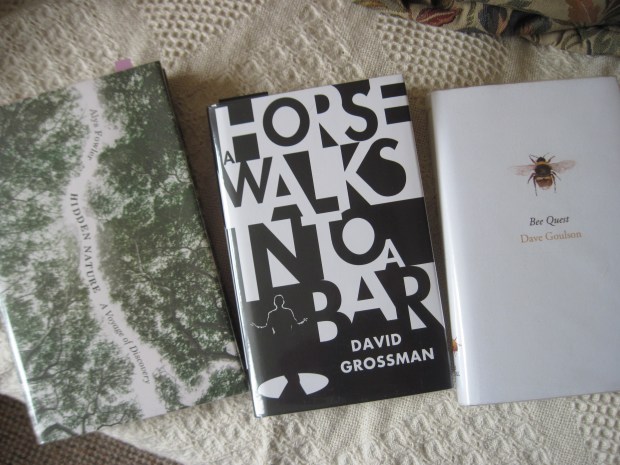
- Hidden Nature: A Voyage of Discovery by Alys Fowler
- Bee Quest: In Search of Rare Bees by Dave Goulson
- A Horse Walks into a Bar by David Grossman
CHECKED OUT, TO BE READ
- Human Acts by Han Kang
- White Tears by Hari Kunzru
- Signs for Lost Children by Sarah Moss

RETURNED UNFINISHED
- Between the World and Me, Ta-Nehisi Coates [AMERICA]
RETURNED UNREAD
Requested by someone else:
- Island Home: A Landscape Memoir by Tim Winton
Lost interest:
- Multitudes: Eleven Stories by Lucy Caldwell
- What Belongs to You by Garth Greenwell
- Gerontius by James Hamilton-Paterson
- Tiny Beautiful Things by Cheryl Strayed [AMERICA]
(Hosted by Charleen of It’s a Portable Magic.)
Have you been taking advantage of your local libraries? What appeals from my lists?
America Reading & Book Haul, Etc.
On Wednesday we got back from two weeks in the States. We were so busy catching up with family and friends we hadn’t seen in a year and a half or more that my reading really slowed down: aside from the three books I took on the plane and finished within my first week, I only read another two books (not counting two during the trip back). Alas, I seem to be in a bit of a rut: everything I read was 3 stars. I haven’t finished anything I’d rate higher than that since late May. I do hope I can break that pattern before June ends!
What I Read:
 In Dear American Airlines by Jonathan Miles, Bennie Ford writes an extended letter during an unexpected overnight layover in Chicago, ostensibly to demand his $392.68 back, but really to tell his life story. His daughter is getting married in California tomorrow; it’s Bennie’s chance to make things right after years of estrangement. Will he make it to the wedding or not? The structure of the book means it doesn’t particularly matter, and I stopped caring a little bit as it went on. The sections of a novel Bennie is translating from the Polish felt irrelevant to me. Still, amusing, and a good one to read in the airport and on a plane.
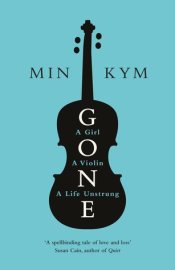 Gone: A Girl, a Violin, a Life Unstrung by Min Kym: I’m completely unmusical, so I enjoyed learning about what it’s like to be a violin virtuoso and a child prodigy, and what it means to fall in love with an instrument. Kym also puts things into the context of being a Korean immigrant to London. The central event of the book is having her Stradivarius, worth hundreds of thousands of pounds, stolen from a train station café in late 2010. It’s a brief and fairly immersive story, but the style is melodramatic and choppy at times.
 Back When We Were Grown-ups was my fifth Anne Tyler novel. Rebecca is in her fifties and the pillar of the large Davitch family, even though she only married into it six years before her husband’s sudden death. The Davitches are always renting out their home for their party business, and Rebecca has over the years developed a joyous persona that she’s not sure is really her true self. What would life have been like if she hadn’t become a stepmother to Joe’s three girls but instead married her college sweetheart, Will? While this is funny and warm, and a cozy read in the best possible way, it didn’t really stand out for me.
Three Singles to Adventure by Gerald Durrell, first published in 1954, tells of his animal collecting in Guiana, South America. The highlight is pipa toad reproduction and birth.
 Grief Cottage by Gail Godwin is a very atmospheric read, set on a South Carolina island with a haunted cottage where a family was swept away by a hurricane. However, I thought the rhythm of the young narrator’s languid summer days caring for his great-aunt became tedious, and I struggled to buy how self-aware he was meant to be of his fragile mental state at the age of 11. It’s reminiscent of John Irving (quirky secondary characters and so on) but without the same spark. I was sent a review copy for BookBrowse but found I couldn’t recommend it with 4 stars or higher.
To my surprise, I completely went off Kindle reading on this trip until the flight back, when I raced through Salmon Doubts by Adam Sacks, a sweet but inconsequential graphic novel about the salmon’s life cycle. I also started the poetry collection Fast by Jorie Graham but left it unfinished.
Two more DNFs from the trip were The Reluctant Fundamentalist by Mohsin Hamid and Between the World and Me by Ta-Nehisi Coates. I may try again with both in the future. Alas, library reading was a total wash: Hourglass by Dani Shapiro didn’t arrive in time, I abandoned the Coates, and I didn’t feel in the mood for advice letters so ended up not even starting Tiny Beautiful Things by Cheryl Strayed.
 My enjoyable read on the long journey back was Mennonite in a Little Black Dress by Rhoda Janzen. Janzen gave the Mennonite tradition she’d forsaken a second look after her life fell apart in her early forties: her husband left her for Bob, whom he met on a gay dating site; and she was in a serious car accident. It’s more in the form of linked autobiographical essays than a straight memoir, so she keeps cycling round to some of the same themes, and it gets less laugh-out-loud funny as it goes on. Still, I was impressed by how the author has managed to pull what’s good from experiences most would consider disastrous. (I also read the first third of Hotel du Lac by Anita Brookner.)
Now that I’m home I’ve started a huge pile of review books and library books and instead of the 1–3 books at a time I was reading while we were away I’m back up to my more usual 14.
What I Bought:
Day 2: A stop at my parents’ local Dollar Tree to stock up on greetings cards for the year’s events (2 for $1!) also brought some unexpectedly good book finds. [Not pictured: a paperback of Jonathan Franzen’s Freedom, our favorite of his novels.] Total spend: $3.18.
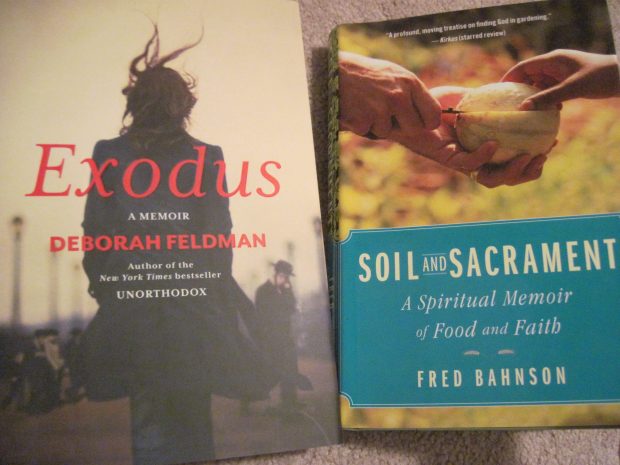
Day 4: The obligatory visit to Wonder Book & Video in Frederick, Maryland, one of my happy places.
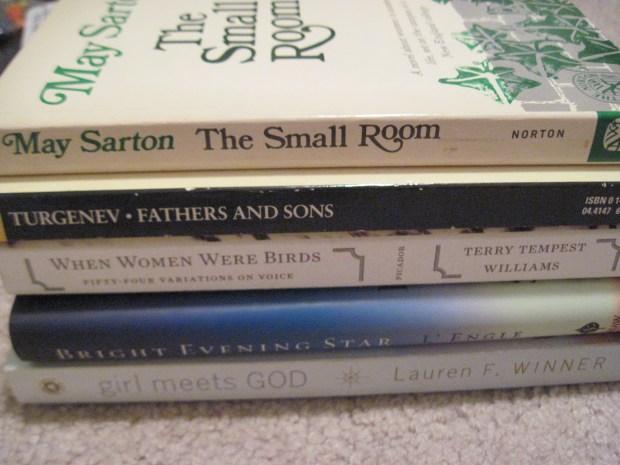
Day 5: A trip to bookstore chain 2nd & Charles in Hagerstown, MD. Total spend (minus my trade-in of various books and CDs): $5.19.
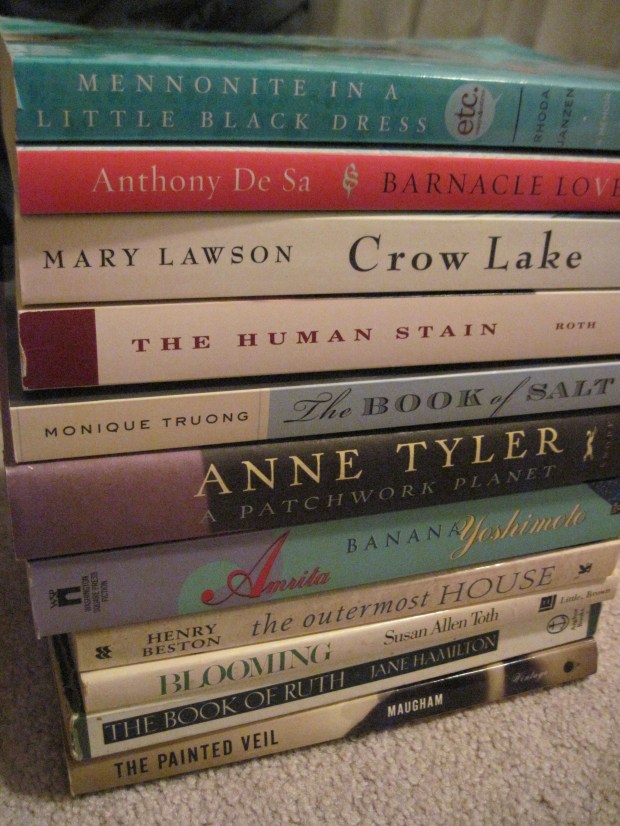
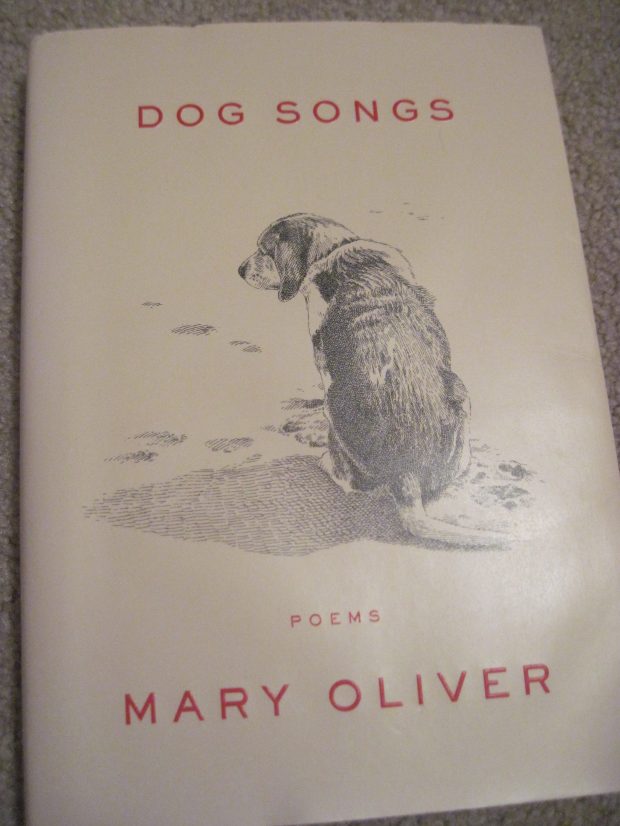
Day 6: A book of Mary Oliver poems from the Goodwill store in Westminster, MD.
Day 14: Some bargains from a thrift store in Rehoboth Beach, Delaware, where we met up with my friend and her family while they were on holiday. Total spend: $4.50.

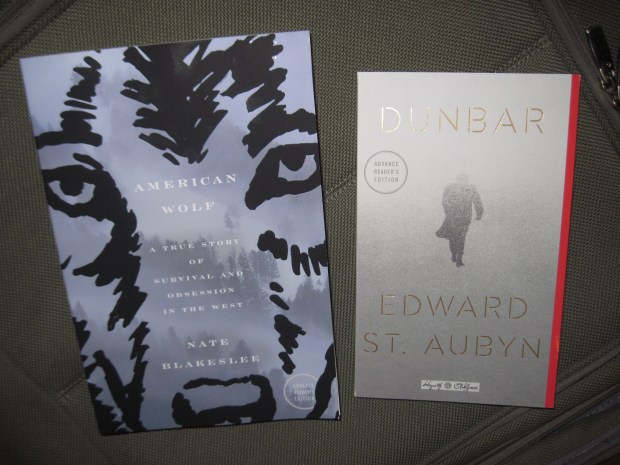
I also managed to snag a couple of Crown ARCs that are not out until October.
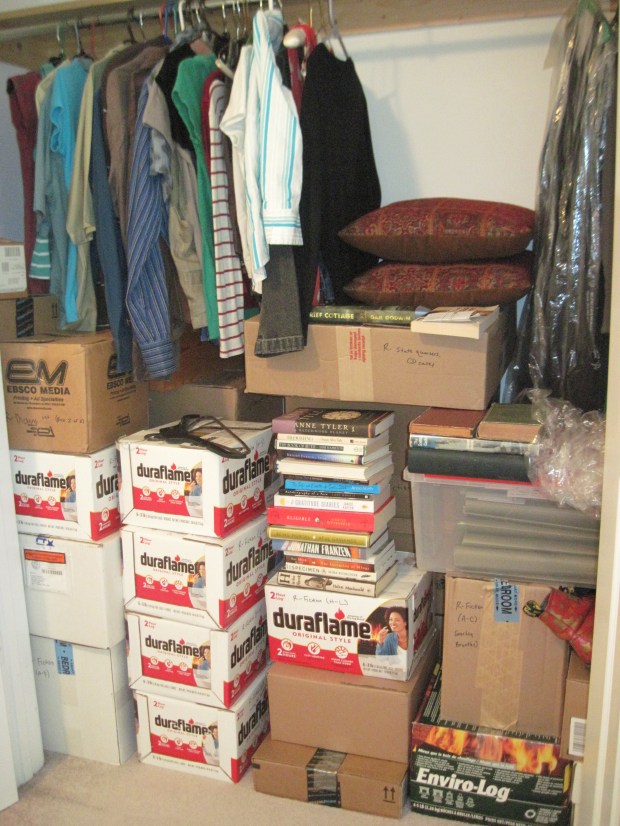
The state of my closet back in the States (most of those boxes contain books):
Other Bookish Sightings:
A Little Free Library at my parents’ local organic supermarket. I dropped off a few proof copies before I left.

The Peabody Library of Johns Hopkins University in Baltimore.

A trip to Mermaid Books in Williamsburg, Virginia (overpriced – no purchases), where I spotted an amusing cover on Anne Tyler’s first novel – she still has the same hairdo!


Ephemera in two of my purchases.


Other highlights of the trip:
- Meeting my sister’s fiancé (!) and his kids.
- Going to an alpaca farm with my sister and nephews.
- Surprising my mom with her early 70th birthday gift: a mother–daughters trip to the Kennedy Center in Washington, D.C. for dinner and a showing of Shear Madness, a long-running improvisational murder mystery with audience participation.
- Exploring Williamsburg (and Jamestown Island) for the first time since I was a kid.
- A day trip to Cape May, New Jersey – a place to go back to, methinks.
- Plus all our meet-ups, however brief, with friends.
- Not forgetting the total of seven cats and two dogs we got to spend time with.
- Two weeks of doing absolutely no work. I didn’t miss it for a second.
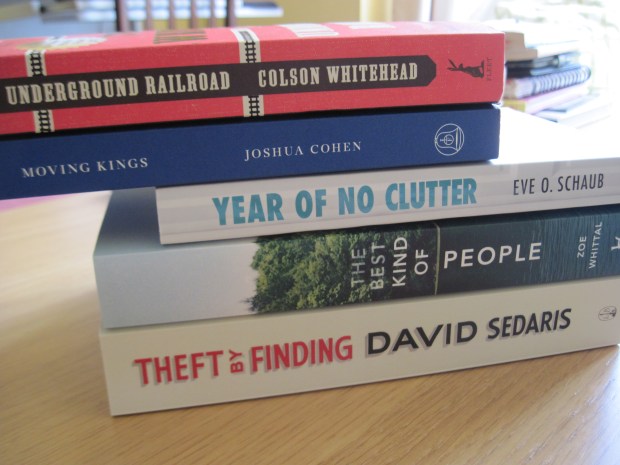
One last book haul photo: These were the review copies (top two) and giveaway books awaiting me when I got back to the UK. (I won the Schaub from Liz’s blog; I’m on a great run with Goodreads giveaways at the moment: along with these Sedaris and Whittal titles, I have new books by Cathy Rentzenbrink and Anne de Courcy on the way.)
How has your summer reading been going?
Library Checkout: May 2017
We fly to America tomorrow morning, but, as you can see, despite my best efforts I’ve managed to leave behind a sizeable pile of library books for when I get back.
And that’s not to mention this gorgeous set of review copies awaiting my return!

I’ve added in ratings and links to any reviews of books I haven’t already featured here in some way.
LIBRARY BOOKS READ
- Ashland & Vine by John Burnside
- The Otters’ Tale by Simon Cooper

- Glad of These Times by Helen Dunmore [poetry]
- The Valentine House by Emma Henderson
- Bodies of Light by Sarah Moss
- Mothering Sunday by Graham Swift
- Gizelle’s Bucket List: My Life with a Very Large Dog by Lauren Fern Watt
SKIMMED ONLY
- A Smell of Burning: The Story of Epilepsy by Colin Grant

- Sculptor’s Daughter: A Childhood Memoir by Tove Jansson
- In the Bonesetter’s Waiting-Room: Travels through Indian Medicine by Aarathi Prasad
- Where Poppies Blow: The British Soldier, Nature, the Great War by John Lewis-Stempel
CHECKED OUT, TO BE READ
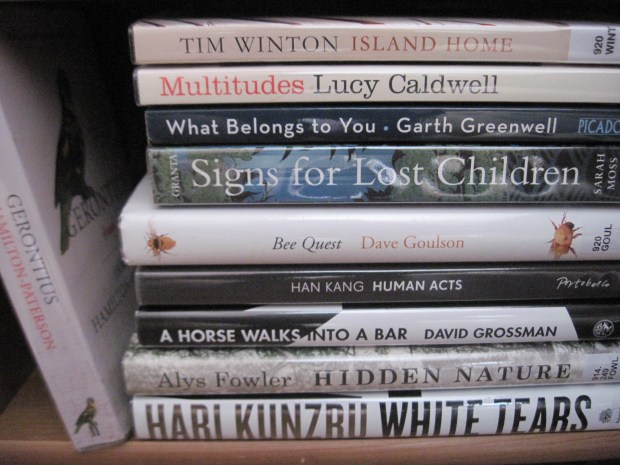
- Multitudes: Eleven Stories by Lucy Caldwell
- Hidden Nature: A Voyage of Discovery by Alys Fowler
- Bee Quest: In Search of Rare Bees by Dave Goulson
- What Belongs to You by Garth Greenwell
- A Horse Walks into a Bar by David Grossman
- Gerontius by James Hamilton-Paterson
- Human Acts by Han Kang
- White Tears by Hari Kunzru
- Signs for Lost Children by Sarah Moss
- Island Home: A Landscape Memoir by Tim Winton
As to America: I hope you would agree I have been very restrained in only requesting three books to borrow from my parents’ local public library. The Coates and Shapiro are extremely short memoirs I should have no trouble getting through, and the Strayed, a collection of advice columns, is the kind of book that I can dip in and out of. My Kindle and my personal library will more than make up for any further shortfall in reading material.
ON HOLD, TO BE CHECKED OUT
- Between the World and Me, Ta-Nehisi Coates
- Tiny Beautiful Things, Cheryl Strayed
IN THE RESERVATION QUEUE
- Hourglass, Dani Shapiro
(Hosted by Charleen of It’s a Portable Magic.)
Have you been taking advantage of your local libraries? What appeals from my lists?
 Bookish Beck = Rebecca Foster. American transplant to England. Freelance proofreader and book reviewer.
