Some Advanced 2017 Reads
I haven’t had much chance to explore 2017’s offerings yet. Although I technically have access to loads of pre-release titles through NetGalley and Edelweiss, the books in front of me and, of course, the ones I’m reading on assignment tend to take priority. Much as I’d like to be ahead of the trend, I’ve only read five 2017 titles, three of which I can recommend. Two of these happen to be poetry books; the third is a wonderful bereavement-themed memoir.
Whereas by Stephen Dunn
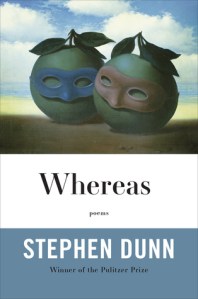 “A Card from Me to Me,” the prefatory poem, sets the tone, as the poet wishes himself a happy 75th birthday and marvels at “the strangeness, the immensity, of what I have / and have had and every small thing that against the odds continues to be.” Much of what follows is about life and death, success and failure, and what we learn from it all. For example, writing about a funeral: “at such moments / everyone is an amateur of feelings.”
I especially liked “Unnatural,” with its meditation on nature vs. artifice, “Let’s Say,” and “Nothing Personal,” about an author killing off a character (or is that God killing off the narrator?). These are very lucid poems, reading like complete sentences and thorough trains of thought, with memorable alliteration and vocabulary. I’d read more from Dunn.
Releases February 21st.
My rating: 
The Analyst by Molly Peacock
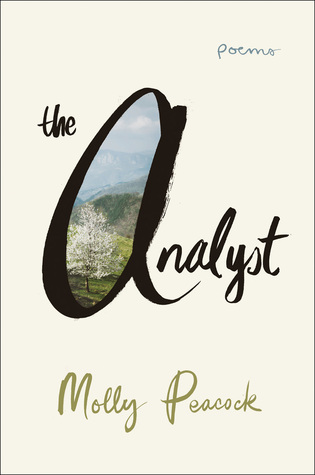 Peacock wrote this in tribute to her longtime psychoanalyst, Joan Workman Stein, who practiced in New York City until she suffered a stroke in 2012. This collection contains a rich mixture of autobiographical reflection and translations. The form and style vary from poem to poem, but I was always struck by the imagery, often drawn from the culinary and art worlds – everything from marinara sauce and a skinned rabbit to paper dolls and methods of expressing gratitude in French. I presumed the entire book would be about Stein, but instead the poems about her pre- and post-stroke life share space with ones about Peacock’s own life, from childhood onward. Having enjoyed The Paper Garden, the author’s biography of eighteenth-century artist Mary Delany, I was especially tickled to see several poems that mention collage and other paper arts, such as “Authors.”
“Mandala in the Making,” the final poem, meditates on the contrast between the drive to make art and the essential impermanence of life: “When they’re done, // they’ll brush it all away. You can’t believe it. / Nothing stays (including the memory you’ve lost). / What lasts?”
I was really impressed with this collection and will be searching out Peacock’s previous poetry books as well.
Releases January 3rd.
My rating: 
Traveling with Ghosts: A Memoir by Shannon Leone Fowler
“This is a story about finding love and learning to live with loss. But mostly, it’s a story about all the places in between.” In August 2002, Fowler was traveling in Thailand with her fiancé Sean. They were embracing in shallow water outside their cabana when Fowler felt something brush past her thigh. The highly toxic box jellyfish stung Sean on his leg, and by the time she brought help he was already dead, though clinic staff went through the motions of trying to resuscitate him.
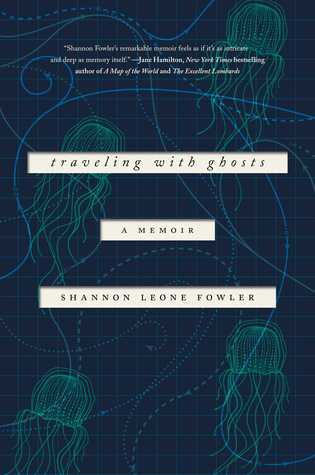 This memoir concentrates on the four and a half months that followed Sean’s death, a time that Fowler filled with constant travel through Eastern Europe – “a place where the endings [in folk tales as well as in real life] were rarely happy, but the stories were told just the same.” She had a compulsion to keep moving, as if Sean’s death was something she could outrun; she sought out risky places, going to Bosnia and then to Tel Aviv to visit the Israeli girls who helped her deal with the practicalities of Sean’s death.
Fowler toggles between her blithe trips with Sean in the few years they had together, her somber travels after his death, and the immediate aftermath of his death. Each short section is headed by the date and place, but the constant time shifts are meant to be disorienting and reflect how traumatic memories linger. Your average memoir might have brought things up to the present day by showing how the author learned and grew from the experience. This is not your average memoir. It delves into the thick of the grief and stays there. It doesn’t give easy answers about how to get over things or suggest life will later be perfect, just in a different way. It’s honest and unusual and has stayed with me. Highly recommended.
(Note: The author is the daughter of novelist Karen Joy Fowler.)
Releases February 21st.
My rating:
Two more 2017 books are on my reading stack:
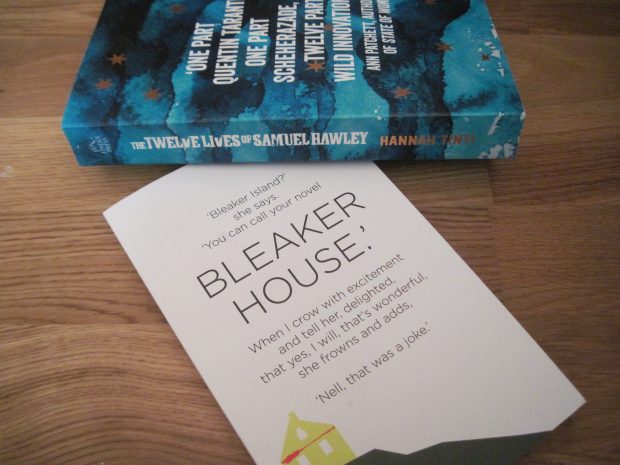
- I’m halfway through Bleaker House by Nell Stevens, a memoir about her failed attempt to write her debut novel during several months of isolation on Bleaker Island in the Falklands. It’s weird but funny, and I think any writer will relate to the feelings of loneliness and a lack of confidence. I’ll be reviewing it for Nudge. (Releases March 14th.)
- I’ll be reviewing The Twelve Lives of Samuel Hawley by Hannah Tinti for The Bookbag sometime before its March 28th release.
Have you sampled any 2017 books yet?
Year-End Reading Goals
With less than a month left in the year, it’s time to be realistic about what I’m likely to finish before the end of 2016. My goals are fairly simple:
- Finish all the books I’m currently reading.
- Get through my stack from the public library; it’s not as daunting as it seems because I plan to just skim two or three of them.
- Make as much of a dent in my giveaway books pile (below) as possible. This particular goal is looking increasingly unlikely. I certainly don’t have any illusions about getting through the 900+ pages of City on Fire, though I might start it over Christmas and hope to get caught up in it. Before then I’ll try to read another couple books I won in various giveaways; any that remain will be priorities for January.
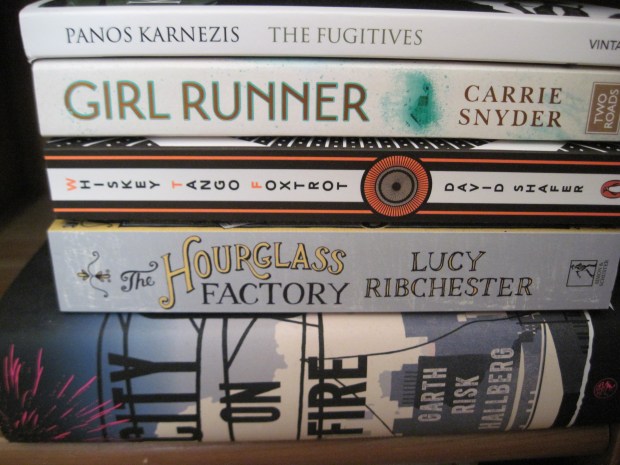
- Finish my next two review books for BookBrowse, due in early January: Valiant Gentlemen by Sabina Murray and The Sun Is Also a Star by Nicola Yoon. They’re extremely different – rollicking historical fiction set in the 1880s–1910s and a contemporary YA story with teen narrators – but I’m very much looking forward to both.
- I had hoped to make this the year I finally try Karl Ove Knausgaard. I might start the first volume over Christmas and see how I get on with it. I was also thinking about picking up the first book of Mervyn Peake’s Gormenghast trilogy. Luckily, Christmas promises to be conducive to reading: a very quiet few days sat around the fire in my in-laws’ Hampshire rectory and at their home by the coast!
As usual, a peek at a few Books of the Year lists has left me feeling glum about how few of the year’s best books I seem to have read. From the Kirkus list, I’ve read 11, skimmed one, and am currently reading another two = 13/100 read. I’ve done slightly better according to the New York Times list: I’ve read 20, skimmed two, abandoned one, and have one (Murray, see above) to read soon = 21/100 before the end of the year.
What do you hope to read before the end of 2016?
How have you done on various best-of lists?
Library Checkout: November 2016
I’m winding down with public and university library books for the year and hope to get to the end of the stacks before 2016 is out. I read some terrific books this month! Some of them I’ve already talked about here, and others I may feature in a future post or two. (I’ve given ratings for all the books I finished, and added links to Goodreads for those I managed to review.)
LIBRARY BOOKS READ
- Hag-Seed: The Tempest Retold by Margaret Atwood
- Keeping an Eye Open: Essays on Art by Julian Barnes
- Open City by Teju Cole
- Mend the Living by Maylis de Kerangal
- The Yellow House on the Corner by Rita Dove (poetry)

- Squirrel Pie (and other stories): Adventures in Food across the Globe by Elisabeth Luard

- Thirteen Ways of Looking by Colum McCann
- Diving into the Wreck by Adrienne Rich (poetry)
- As We Are Now by May Sarton
- The Tobacconist by Robert Seethaler

- Autumn by Ali Smith
- The Pursuit of Happiness: Why Are We Driving Ourselves Crazy and How Can We Stop? by Ruth Whippman
CURRENTLY READING
- Man Walks into a Room by Nicole Krauss
CHECKED OUT, TO BE READ
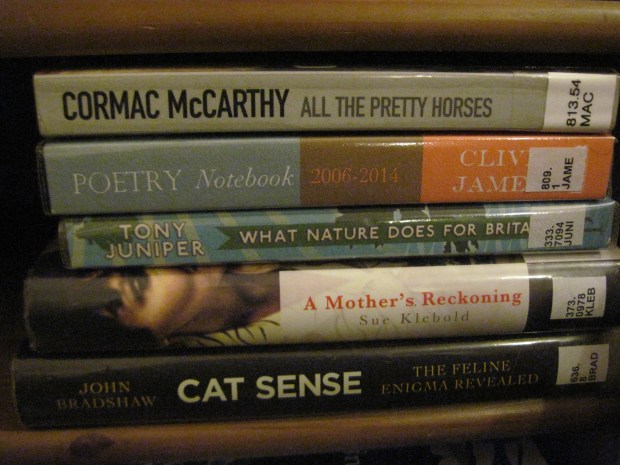
- Cat Sense by John Bradshaw [to skim only, I think]
- Poetry Notebook, 2006–2014 by Clive James [to skim only, I think]
- A Mother’s Reckoning by Sue Klebold
- All the Pretty Horses by Cormac McCarthy
- What Nature Does for Britain by Tony Juniper [to skim only, I think]
ON HOLD, TO BE PICKED UP
- The Cat Who Came for Christmas, Cleveland Amory
- The Cat Who Stayed for Christmas, Cleveland Amory
IN THE RESERVATION QUEUE
- The Dark Flood Rises by Margaret Drabble
- Cure: A Journey into the Science of Mind over Body by Jo Marchant
- Family Life by Akhil Sharma
- To Say Nothing of the Dog by Connie Willis
RETURNED UNREAD
- The Course of Love by Alain de Botton – requested; I’ll read it on my Kindle instead.
- The Lie Tree by Frances Hardinge – I scanned the first few pages and wasn’t in the mood; I may try it again another time.
- Dear Mr. M by Herman Koch – I read the first 20 pages, but it wasn’t gripping me at all.
- The Painted Bridge by Wendy Wallace – same as for the Hardinge.
(Thanks, as always, go to Shannon of River City Reading for the great blog idea and template!)
Landmark Books in My Life, Part II
This is a follow-up to a piece I wrote in September about the books that shaped my early life. I think of my twenties in general, and 2005–7 in particular, as a golden period in my reading life, when I started to develop the tastes that still guide my book choices today.

 I was an English and Religion major and studied abroad in England for my junior year in 2003–4. As I was getting ready to go overseas for that first time in the summer of 2003, Susan Allen Toth’s trilogy of travel memoirs, starting with My Love Affair with England, and Paul Collins’s Sixpence House whetted my appetite for travel in Great Britain and, in the case of the latter, made me determined to get to Hay-on-Wye, Wales as soon as I could. (I first visited in May 2004 and have gone back several times since.)
 One of the most memorable books I read during my year abroad was Robert Elsmere by Mrs. Humphry Ward. It’s almost forgotten nowadays, but was a bestseller at its release in 1888. The story of a minister’s loss of faith and how it affects his marriage, it’s a stand-in for a whole faith-and-doubt subgenre that was wildly popular at the time. The novel is long, brooding and overwritten—in many ways it exemplifies the worst characteristics of the Victorian novel—but it resonated with my own crisis of faith and planted the seed for my Master’s thesis on women’s faith and doubt narratives in Victorian fiction.
 Part of working through that ongoing crisis of faith was seeing other religions more objectively and being open to the similarities between them. I found Karen Armstrong’s comparative study of the Abrahamic faiths (Christianity, Judaism and Islam), A History of God, absolutely riveting when I read it in my senior year of college. It’s a classic.
 My academic conference career began and ended with one I attended the summer after college graduation. I adapted a paper I’d written about D.H. Lawrence’s new moral framework for sexuality and was accepted to present it at the D.H. Lawrence Society of North America’s annual conference in 2005, which that year was held in Santa Fe, New Mexico. Thankfully, I’ve mostly blanked out my actual paper presentation as part of a panel of three young people, but the trip as a whole was wonderful—it was my first time in the southwest, and the conference included great field trips to Lawrence’s ranch at Taos and the Georgia O’Keeffe museum. I prepared for the experience by reading David Lodge’s Small World, a paperback I’d plucked from the shelves of the bookstore where I worked part-time during my senior year. “A satire about the academic conference circuit? I’m there!” I thought, and since then David Lodge has become one of my two or three favorite authors.
 It wasn’t until I returned to England to get my Master’s in 2005–6 that I really reclaimed reading as a leisure activity. The last couple years of college had been so busy I’d barely been able to cope with my assigned reading; I remember never making it very far in any paperback I picked up from the public library (like Charles Frazier’s Cold Mountain, which I’ve never gone back to). But the long, lonely evenings in Leeds had to be filled somehow, and the upstairs stacks of the magnificent Brotherton Library had plenty to offer in the way of literary fiction. In that year I made my way through loads of books by A.S. Byatt and Julian Barnes, as well as David Lodge (my top 3, probably). Possession made the biggest impression, but I love pretty much all of Byatt’s work. If pressed to name my favorite author, it would be her.
 In the partial year between finishing my Master’s and getting married back in England, I lived at home with my parents and worked part-time at a community college library. My evening shifts were often dead quiet, so I got plenty of reading done behind the circulation desk. One book I selected at random from the public library shelves, Abigail Thomas’s A Three Dog Life, had a big impact on me in 2007. The memoir tells of her husband’s traumatic brain injury and the aftermath. Thomas writes in a fragmentary, episodic format that felt fresh and jolted me. I wasn’t entirely sure I liked the style, but it sure was intriguing.

 I picked up Meredith Hall’s Without a Map around the same time, which cemented my interest in women’s life stories. Memoirs have been among my favorite genres ever since. Mark Doty’s exquisite Heaven’s Coast, which I read the following year, kickstarted my particular fascination with bereavement memoirs. Also, I think it was through following up his memoirs with his collections of poems that I first got into contemporary poetry.
In recent years I’ve tried to branch out (e.g. into graphic novels and literature in translation), but contemporary literary fiction, historical fiction, memoirs, theology and travel books remain my preferred genres. Most of these loves I can trace back to my early twenties.
What books meant the most to you in young adulthood?
Library Checkout: October 2016
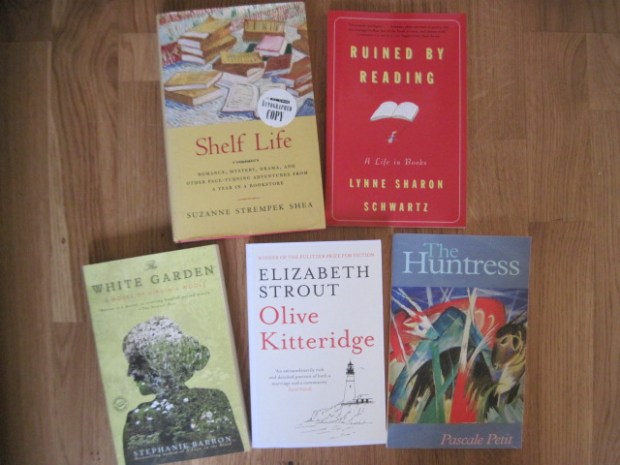
I continue to power through public library books at the same time as I keep acquiring books – including the ones below that I bought with birthday money from my sister: two novels I’ve been keen to read, a book of poetry, and two bibliomemoirs (one of them a signed copy but still stupidly cheap!).
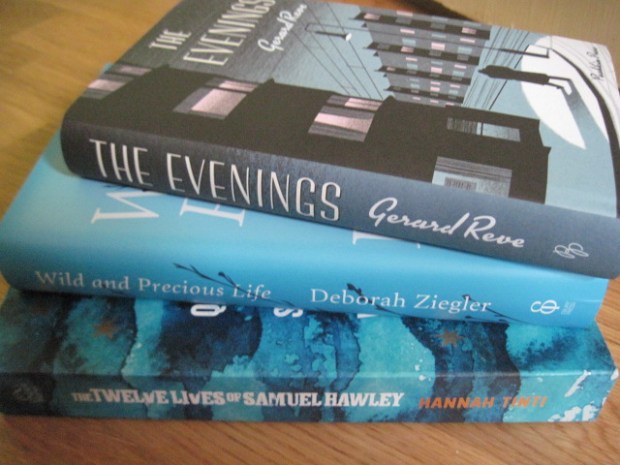
I also have this gorgeous trio of blue-hued books to be reviewing for The Bookbag.
I’ve given ratings for all the books I finished, and added links to reviews for those I managed to write about.
LIBRARY BOOKS READ
- Ozone Journal by Peter Balakian (poetry)

- Thrice the Brinded Cat Hath Mew’d by Alan Bradley

- The Crime Writer by Jill Dawson

- The Library of Unrequited Love by Sophie Divry
- Let Me Tell You about a Man I Knew by Susan Fletcher
- The Man Who Wouldn’t Get Up and Other Stories by David Lodge
- Nutshell by Ian McEwan
- The Many by Wyl Menmuir
- Do Not Say We Have Nothing by Madeleine Thien
CURRENTLY READING
- Keeping an Eye Open: Essays on Art by Julian Barnes
- Open City by Teju Cole
CHECKED OUT, TO BE READ
Many familiar titles still hanging around from last month, plus a few new ones…
- A Chinese street food cookbook to browse for ideas
- Hag-Seed: The Tempest Retold by Margaret Atwood
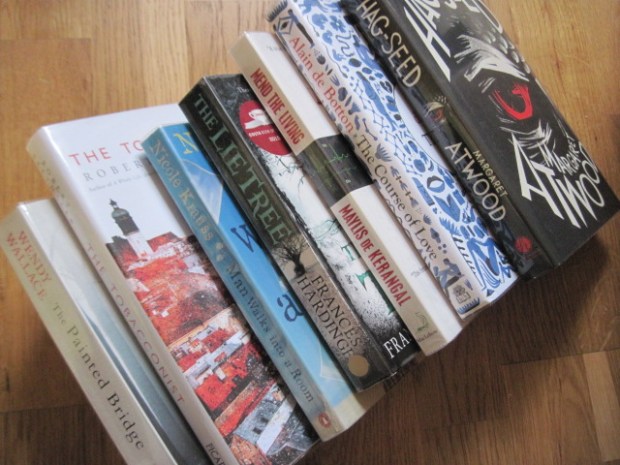
- The Course of Love by Alain de Botton
- Mend the Living by Maylis de Kerangal
- The Lie Tree by Frances Hardinge
- Man Walks into a Room by Nicole Krauss
- Thirteen Ways of Looking by Colum McCann
- The Tobacconist by Robert Seethaler
- The Painted Bridge by Wendy Wallace
IN THE RESERVATION QUEUE
- Poetry Notebook, 2006–2014 by Clive James
- Dear Mr. M by Herman Koch
- Squirrel Pie by Elisabeth Luard
- Cure: A Journey into the Science of Mind over Body by Jo Marchant
- Autumn by Ali Smith
- The Pursuit of Happiness: Why Are We Driving Ourselves Crazy and How Can We Stop? by Ruth Whippman
RETURNED UNREAD
- Two for Joy by Dannie Abse – I read about a third of these poems; not a single one stuck out for me.
- The Most Perfect Thing: Inside (and Outside) a Bird’s Egg by Tim Birkhead – requested; I’ll have to get it back out another time.
- Citizen: An American Lyric by Claudia Rankine – Skimmed. Kudos to Rankine for revealing overt/casual racism in America – Lord knows we still need it in the public eye. (Ditto to Paul Beatty’s The Sellout winning the Booker Prize.) But is this poetry? Not even a quarter of the book is composed of what I would call poems, even prose poems. It’s more like a book of essays, which I wasn’t in the mood for. Best lines: “because white men can’t / police their imagination / black men are dying.”
- The House at the Edge of the World by Julia Rochester – also requested.
(Thanks, as always, go to Shannon of River City Reading for the great blog idea and template!)
Five Reasons I Love My E-Readers
As an inveterate book sniffer and hoarder of musty paperbacks, I was always skeptical about e-readers—that is, until I got my first one three years ago. A birthday present from my husband, my Nook soon became an essential tool in my working life. A year and a bit later, I was sent a Kindle on “permanent loan” through one of my reviewing gigs, and it has quickly become one of my most prized possessions. I know some of my blog readers don’t read e-books at all, and I can sympathize with certain of your feelings. But here are five reasons I love my e-readers, followed by why they will never replace print books for me.
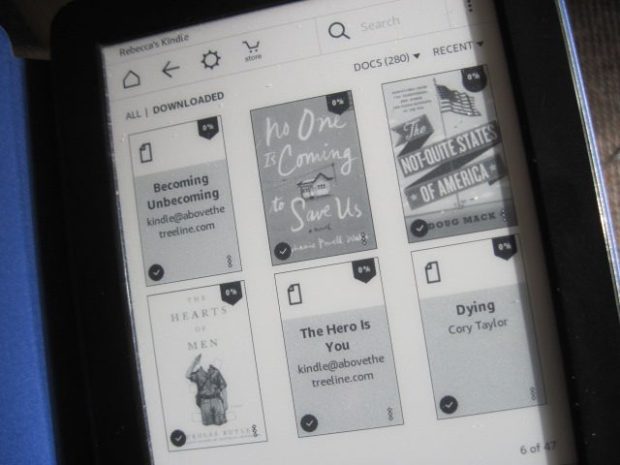
Some recent and upcoming titles I’m keen to try.
- A portable library. I often have between 250 and 300 books on my Kindle. Hundreds of books right at my fingertips, all in a slim 4 x 6 ″ rectangle! If I’m ever stuck somewhere due to delayed or broken-down transport, I’ll never be without ample choices of reading material. E-readers are perfect for cutting down on luggage when traveling (I had to cull 14 books from my suitcase on my last trip to America to stay under the weight limit) and are my usual choice for reading in the car. The Nook’s built-in light is especially useful on nighttime drives. As much as I love my print library, moving house frequently—as we have done over the past decade—always reminds you just how much weight and space books represent.
- Digital review copies. Being willing and able to read PDF and ePUB books is the only thing that has allowed me to work for lots of American companies, which is where the reviewing money seems to be. I can also request advance access to books through NetGalley and Edelweiss, particularly titles not yet published in the UK; and any Kindle downloads do not expire. When traveling I have occasionally found it useful to put other kinds of documents on my Kindle as PDFs, too, like maps and confirmation e-mails. Since I’ve never had a smartphone, this is a kind of compromise between all print and all online.
- Searching and fact-checking. My e-readers’ search function has been invaluable when writing reviews. Often I’ll need to check facts like a character’s last name, the exact city in California, when someone makes their first appearance, or how often a particular word or phrase appears. For instance, I felt that a certain quotation was overused in a memoir, so did a search for it and, indeed, found 12 occurrences!
- Moving between books. I generally have 3 or 4 Kindle books of different genres on the go at any one time, and it couldn’t be easier to move between them with a few finger taps. I’ll often switch books after every couple of chapters, or when I reach a milestone percentage.
- Perfect for certain situations. An e-reader is less obtrusive for reading in public, especially now that etiquette doesn’t seem to preclude phone and tablet use in company. It’s also easier to get one out when you’re going just a few stops on a crowded subway system. I turn to my Kindle for reading over solitary meals/snacks or any other activity that requires my hands, like using a hairdryer. When I think about the lengths I once went to in my former life as a library assistant to read print books—holding pages open with a precariously balanced apple or the edge of a plate during meal breaks; hiding books under the service desk for surreptitious reading at a quiet moment—I think how silly I was not to get an e-reader sooner!
Some of my current reading and review books.
Yet there are definitely things I don’t like about using an e-reader:
- E-books don’t feel like “real” books; I treat them as temporary and disposable and don’t do any nostalgic rebrowsing.
- Battery life can be an issue, though not as often as you might think. (During a period of average use my Kindle probably lasts two weeks, and you can charge it either via a USB cable or at a wall plug.)
- My Nook has a pretty small capacity.
- There are no page numbers on Kindle, just percentages and numerical locations.
- (A pathetic admission) I still haven’t figured out how to highlight passages on my e-readers!
- Because I’m fine with e-copies I don’t get free print books out of most of my review gigs.
- I can’t easily browse the covers/blurbs/first few pages of books to remind myself what they are and decide what I’m in the mood for—as a result, there are dozens of books on my Kindle whose titles I barely recognize.
- I sometimes wonder whether my concentration on and retention of words read on a screen are inevitably lower.
I still love books as physical objects: beautiful covers, delicious smells, the heft of them in your hand and the chance to flick through pages. I like having big stacks of them around as visible signs of progress made and challenges still to come. Arranging and rearranging my library on bookshelves is a periodic treat. So although my e-readers are extremely useful tools, using them is not an unadulterated joy; they will only ever supplement paper books for me, not replace them. I think it’s telling that when given a choice between print and electronic formats—like if I come across an available public library copy of a book I know I have on my Kindle—I’ll choose the print book every time.
How do you feel about e-readers?
Library Checkout: September 2016
I’ve been powering through the public library books, even as I keep amassing owned books – including from local charity shops and the bargain shelves at Poundland and Waterstones.
I’ve given ratings for all the books I finished, and added links to Goodreads reviews for those I managed to write about. A few of these books were truly remarkable, so I’ll probably pull them out to highlight in a future post.
The stack I currently have on loan, plus the ones on reserve, should easily see me through the autumn and into winter! (* = poetry books)
LIBRARY BOOKS READ
- Not That Kind of Girl: A Young Woman Tells You What She’s “Learned” by Lena Dunham
- The Malarkey by Helen Dunmore*
- Late Fragments: Everything I Want to Tell You (about This Magnificent Life) by Kate Gross
- The Reason I Jump: One Boy’s Voice from the Silence of Autism by Naoki Higashida
- Hot Milk by Deborah Levy
- Keeping Mum by Gwyneth Lewis*
- Winter by Christopher Nicholson

- Letter Composed during a Lull in the Fighting by Kevin Powers*
- How Snow Falls by Craig Raine*
- The Last Act of Love: The Story of My Brother and His Sister by Cathy Rentzenbrink
- The Complete Maus by Art Spiegelman
- Golden Hill by Francis Spufford

- The Wallcreeper by Nell Zink
CHECKED OUT, TO BE READ
- Ozone Journal by Peter Balakian*
- Open City by Teju Cole
- The Course of Love by Alain de Botton
- Mend the Living by Maylis de Kerangal
- The Library of Unrequited Love by Sophie Divry
- Let Me Tell You about a Man I Knew by Susan Fletcher
- The Lie Tree by Frances Hardinge
- Man Walks into a Room by Nicole Krauss
- The House at the Edge of the World by Julia Rochester

ON HOLD, TO BE PICKED UP
- Keeping an Eye Open: Essays on Art by Julian Barnes
- The Most Perfect Thing: Inside (and Outside) a Bird’s Egg by Tim Birkhead
- Thrice the Brinded Cat Hath Mew’d by Alan Bradley
- Thirteen Ways of Looking by Colum McCann
- Do Not Say We Have Nothing by Madeleine Thien
- The Painted Bridge by Wendy Wallace
IN THE RESERVATION QUEUE
- The Crime Writer by Jill Dawson
- The Man Who Wouldn’t Get Up and Other Stories by David Lodge
- Nutshell by Ian McEwan
- The Many by Wyl Menmuir
- Fingers in the Sparkle Jar by Chris Packham
- The Tobacconist by Robert Seethaler
- Autumn by Ali Smith
RETURNED UNREAD
- Aftermath: On Marriage and Separation by Rachel Cusk [I sampled the first few pages and found it flat and affectless; perhaps I’ll try her fiction instead.]
- Kid Gloves: A Voyage round My Father by Adam Mars-Jones [I decided an interest in the subject matter couldn’t overcome my frustration with the author’s style.]
(Thanks, as always, go to Shannon of River City Reading for the great blog idea and template!)
Short Stories in September
In 2014 I read 20 short story collections, but in 2015 and 2016 (at least so far) I’ve only managed 10 per year. Three of those have all clumped within the last month or so, though. I started The Pier Falls back in May but set it aside at the halfway point; luckily, when I returned to it earlier this month I devoured the rest within a few hours. I also reviewed the second annual anthology of Best Small Fictions for the Small Press Book Review, a new online venue for me, and tried out Alexandra Kleeman’s short stories after loving her debut novel last year. Mini reviews below…
Best Small Fictions 2016, edited by Stuart Dybek
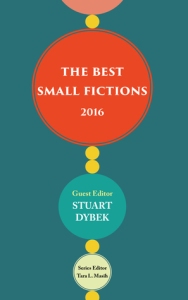 This collects 45 super-short stories that stand out for their structure, voice, and character development—all in spite of often extreme brevity. Humor and pathos provide sharp pivot points. It helps to have an unusual perspective, like that of a Venus flytrap observing a household’s upheavals (Janey Skinner’s “Carnivores”), or of potential names gathering around a baptismal font (Alberto Chimal’s “The Waterfall”). Hard as it is to choose from such a diverse bunch, I do have three favorites: Elizabeth Morton’s “Parting,” in which a divorce causes things to be literally divided; Mary-Jane Holmes’s “Trifle,” where alliteration and culinary vocabulary contrast an English summer with Middle Eastern traces; and Amir Adam’s “The Physics of Satellites,” which uses images from astronomy and a recent suicide to contrast falling, flying, and barely holding on. There are fewer highlights than in the previous volume, but this is still an excellent snapshot of contemporary flash fiction. (See my full review at the Small Press Book Review.)
The Pier Falls by Mark Haddon
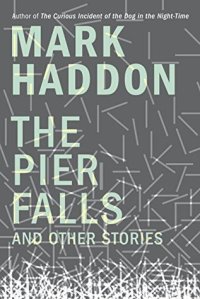 These nine stories examine what characters do in extreme, often violent situations. My three favorites were “Bunny,” reminiscent of The Fattest Man in Britain with its picture of a friendship between an obese man and a young woman who sees more in him than his size; “The Woodpecker and the Wolf,” a brilliantly suspenseful tale set in space – it reminded me of the Sandra Bullock movie Gravity; and “The Weir,” which imagines the unexpectedly lasting relationship between a lonely middle-aged man and the young woman he rescues from a near-suicide by drowning. “Wodwo” starts off as a terrific Christmas horror story but goes on far too long and loses power. I would say that about several of these stories, actually: they’re that bit too long, so that you start waiting for them to be over. I prefer sudden endings that give a bit of a kick. All in all, though, two-thirds of the stories are fairly memorable, and I’d say I liked this better than any of Haddon’s three novels.
Intimations by Alexandra Kleeman
 Kleeman’s debut novel, You Too Can Have a Body Like Mine, was a surprise favorite of mine from last year. Alas, her stories don’t pack the same punch. True, some of them employ a similar combination of surreal plot and in-your-face ideology, but only four out of the 12 stories seemed to me strong enough to stand alone. These were “Lobster Dinner,” surely inspired by David Foster Wallace’s Consider the Lobster, in which crustaceans wreak revenge on their consumers; “The Dancing-Master,” about a man who tries to introduce a nineteenth-century feral boy to culture only for wildness to come creeping back; “I May Not Be the One You Want,” in which Karen, writing a profile about a dairy farmer, avoids men’s attempts to turn her into a sexual object; and “Fake Blood,” another pseudo-horror story about a girl in a nurse costume who can’t decide whether she’s caught up in a murder mystery game or a real serial killer’s trap. Of the rest, four or five – including vignettes from Karen’s future life – are okay and a couple are pointless as well as seemingly endless (“A Brief History of Weather” and “Hylomorphosis”). Students of feminist literature, especially fans of Angela Carter, may be willing to exchange satisfying storytelling for messages about women’s bodies and anxiety about motherhood.
 On Tuesday I finished All That Man Is by David Szalay, from the Booker Prize shortlist. Whether it’s a novel or actually short stories is certainly a matter for debate! After I read Madeleine Thien’s shortlisted novel (I’ll be picking it up from the library on Friday) I’ll report back on both in advance of the prize announcement at the end of October.
 I’m also currently making my way through How Much the Heart Can Hold, a set of seven stories from the likes of Carys Bray and Donal Ryan on the theme of different types of love, and Petina Gappah’s forthcoming collection, Rotten Row. (Both are out in early November.)
Collections on my Kindle that I’m keen to read soon, maybe even before the end of this year, include We Come to Our Senses by Odie Lindsey, Music in Wartime by Rebecca Makkai, and Honeydew by Edith Pearlman.
Are you a short story fan? Read any good ones recently?
Landmark Books from My Early Life
I initially wanted to title this post “Books that Changed My Life,” but soon realized it would probably be more accurate to speak about them as the books that have shaped my life as a keen reader and meant the most to me as the years have passed.
In making this list I was inspired by a book I recently finished, Kate Gross’s memoir Late Fragments, which finishes with a bibliography of books that influenced her during different periods of her life. Gross, who died of colon cancer at age 36 in 2014, divides her reading life into five distinct, whimsically named eras: “With my back to the radiator” (childhood), “The grub years” (adolescence), “Emerging from the cocoon” (early adulthood), “The woman in the arena” (career life) and “End of life book club.”
I’ll do a follow-up post on the key books from my twenties next month, but for now I want to focus on the books that defined my growing-up and teen years.
What Bewick’s Birds was for Jane Eyre, my parents’ book on flower arranging was for me. I couldn’t tell you the title or author, but I think this green fabric covered tome with its glossy pages and lush full-color photographs was the origin of my love of books as physical objects. I must have spent hours paging through the illustrations and breathing in the new-book aroma. I’ve been a book sniffer ever since.
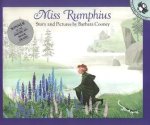 I can’t recall many of the individual picture books my mother read with me when I was little, but one that does stand out in my memory is Miss Rumphius by Barbara Cooney, about an eccentric woman who goes about planting lupines. Again, it’s a gorgeous book filled with flowers – you’d think I might have become a botanist!
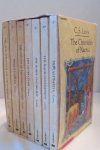 C.S. Lewis’s The Chronicles of Narnia were the first books I ever read by myself, starting at age five. It took me years to get to the allegory-heavy The Last Battle, but I read the other volumes over and over, even after the PBS television movies came out. The Silver Chair was always my favorite, but I’m sure I must have read the first three books 10 or 20 times each.
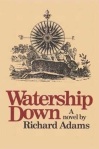 Richard Adams’s Watership Down was the first book I ever borrowed from the adult section of the public library, at age nine. Crossing the big open lobby of the Silver Spring, Maryland library from the children’s room to the imposing stacks of Adult Fiction was like a rite of passage; when I emerged clutching the fat plastic-covered hardback I felt a little bit like a rebel but mostly just pretty darn proud of myself. I inhaled the several hundred pages of this bunny epic and for years afterwards considered it my favorite book.
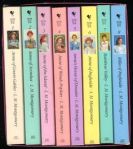 Nowadays I don’t like to commit to series, but as a kid I couldn’t get enough of them: after Narnia, I devoured the Babysitter’s Club and Saddle Club books, the Anastasia Krupnik books, and so on. Whenever I found an author I loved I dutifully read everything they’d written. The Anne of Green Gables series by L.M. Montgomery, in particular, accompanied me through my early teen years. I think I saw the CBC/PBS television miniseries starring Megan Follows first and read the books afterwards. Bereft once the eight-book cycle was over, I read the much darker Emily trilogy, but it just couldn’t live up to the Anne books.
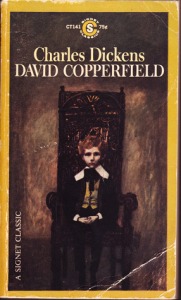 My first foray into the realm of heavy-duty classics was Charles Dickens’s David Copperfield at age 14. I bought a battered secondhand paperback from a library sale and was immediately entranced, from the first line onwards: “Whether I shall turn out to be the hero of my own life, or whether that station will be held by anybody else, these pages must show.” No doubt the idea of discovering my own potential heroism was what drew me in, but I loved everything about this novel: the rich panorama of nineteenth-century life, the vibrant secondary characters, the under-the-surface humor you had to work a little bit to understand, and the sweet second-chance romance. This was the start of my love affair with Victorian literature. I’ve read it three times since then. If ever asked for my favorite book, this is what I name.
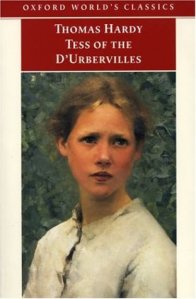 It wasn’t my first Hardy novel (that was Far from the Madding Crowd, another all-time favorite), but Tess of the D’Urbervilles is most memorable for the circumstances in which I read it. At age 19 I accompanied my sister, who’d won a singing contest on local radio, to the Season 2 finale of American Idol in Hollywood. If you were a loyal viewer, you might recall that this was the showdown between Ruben Studdard and Clay Aiken, on whom I had a hopeless crush – it later emerged that he’s gay. I read Tess on the flight to Los Angeles. Stranger pairings have been known, I’m sure, but I’ll never forget that disconnect between bleak England (where I hadn’t yet been at that point) and the sunny entertainment capital.
What are some of the books that meant the most to you in your early years?
Six from My Shelves
My resolution to read just my own books for the summer largely fell by the wayside, but I did manage to get through another handful of print books from the shelves. Below I give brief write-ups of what I’ve finished lately and recall how these books came to be in my collection.
 In Fond Remembrance of Me by Howard Norman: A strange, short book that blends memoir and Inuit legends. In 1977 Norman travelled to Churchill, Manitoba to transcribe an oral storyteller’s folktales. Most of these were about Noah coming into contact with the peoples of the far north and displeasing them by refusing to give over the exotic animals of his ark as food. Helen Tanizaki, a scholar in her late thirties who tried half-heartedly to hide the fact that she was dying of stomach cancer, was also there to translate stories into Japanese. It’s easy to see why she impressed Norman with her mystical stoicism. She was a keen birdwatcher, and declared she wanted to be reincarnated as a seabird. The portrait of Helen is compelling, but the book doesn’t hang together well, especially because the interspersed legends are so repetitive. [From my Amazon wish list last Christmas.]
 An Anthology of Animal Poetry, ed. Kenneth A. Mason: This was assembled in 1940 by a 19-year-old, and it shows. The choices are obvious and old-fashioned; too many of the poems are long and insist on rhyming. However, I discovered some real gems. Three poems in a row are about skylarks – by Gerard Manley Hopkins, Wordsworth and Shelley – and they’re all brilliant, using the bird as an emblem of freedom. Shelley’s “To a Skylark,” in particular, I can’t believe I’ve never encountered before. Its 21 stanzas praise the bird’s pure joy and wonder how careworn humans might emulate it: “We look before and after, / And pine for what is not … Teach me half the gladness / That thy brain must know.” My vintage Pelican copy has ads for chocolate and cigarettes that made me laugh. [Bought from a secondhand bookstore in Tunbridge Wells for 10 pence.]


 The Mistress’s Daughter by A.M. Homes: This grew out of a New Yorker article Homes published about meeting her biological parents in her early 30s. Her mother carried on an affair with her married boss, starting when she was just a teenager – Homes learned that she was the mistress’s daughter. This is the story of how her birth mother tried to get involved in her life, in a really rather stalker-ish way, and the occasional contact she had from her birth father. The blow-by-blow gets a little boring, especially when it’s Homes and her father only communicating via lawyers. Homes doesn’t really make much of a contribution to the literature of adoption, though this is a pleasant enough read. “I am an amalgam. I will always be something glued together, something slightly broken.” [Bought from a library book sale in America for $1.]
 Summertime by Vanessa Lafaye: An enjoyable historical novel based on several true-life elements: a work camp of army veterans based at the Florida Keys, segregation and lynching, and a massive hurricane that hit in 1935. Main characters Missy and Henry are well drawn, but beyond them I thought Lafaye splits the perspective too far: I didn’t need to see through the eyes of lots of the veterans, the shopkeeper, or the policeman investigating the brutal beating of a local white woman. As for this crime, I knew whodunit pretty much right away, so there wasn’t any suspense regarding that plot point. However, Lafaye does do a great job of building tension in the novel’s final third as the storm approaches. The U.S. title (Under a Dark Summer Sky) is much better; “Summertime” evokes strangely rosy images and so is inappropriate. [I won a copy in a Goodreads giveaway.]
 So Many Books, So Little Time: A Year of Passionate Reading by Sara Nelson: Nelson is forthright about what she likes and doesn’t like; she also ruefully reflects on the gap between what she meant to read and what she actually read in 2002. Her reading diary tells a lot about her personal life too: having a non-reading spouse and a novelist sister; memories of her late father; and the struggle to instill a love of reading into her young son. Inevitably a little dated as it engages with ‘It’ books of the time like A Million Little Pieces and Kitchen Confidential, the book has staying power because in each chapter Nelson broadens out from her discussion of one or more books to craft a thematic essay. This was meant to be my bedside book for the second half of the year, but I devoured it in less than seven weeks. It’s full of lines bibliophiles can relate to. [Free from The Book Thing of Baltimore.]
 The Debt to Pleasure by John Lanchester: Tarquin Winot, the snobby Francophile who narrates Lanchester’s debut novel, has a voice reminiscent of Oliver in Julian Barnes’s Talking It Over and Love etc. His opinionated, verbose speech provides much of the book’s wit. “This is not a conventional cookbook,” the first line warns, but a foodie’s tribute to traditional English and French dishes that compose the best seasonal menus. As we travel with Tarquin from Portsmouth to Provence we learn more about this peculiar character through the memories dishes elicit: about his Irish nanny, his sculptor brother’s boarding school years, etc. Lanchester subtly introduces notes of doubt about the narrator’s reliability, until we have to wonder how much his tale resembles Perfume or The Talented Mr. Ripley. Deliciously clever and sinuous. [Bought from a London charity shop for 20 pence.]
I spent much of the summer bogged down in several very good but not particularly page-turning works of nonfiction. I’ll review those in due course.
Up next, though, are a few Booker Prize longlist mini-reviews in advance of the shortlist announcement on Tuesday.
 Bookish Beck = Rebecca Foster. American transplant to England. Freelance proofreader and book reviewer.
 Bookish Beck