Classic of the Month: Agnes Grey by Anne Brontë
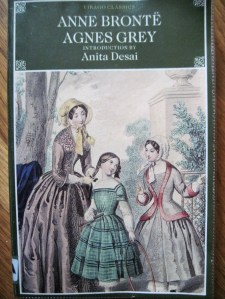 This was my neighborhood book club’s selection for January – a good excuse to also use it for relaunching my Classic of the Month feature. It was 22 months ago (how?!) that I featured Anne Brontë’s The Tenant of Wildfell Hall (1848) as my monthly classic; ever since, I’ve meant to read Anne’s only other novel, Agnes Grey (1847). I’ve now read all the Brontë sisters’ works apart from Shirley, an obscure one by Charlotte. I’d recommend Agnes Grey as a short, accessible classic that echoes Jane Austen with its realistic picture of money/class and romance in nineteenth-century England.
The first-person narrative tells the highly autobiographical tale of a young woman who becomes a governess to support her impoverished family. Agnes is the daughter of a clergyman who makes a poor investment and loses everything, then falls ill. Her sister Mary can make money from her paintings, but with no particular skills and no other choice Agnes sets out to be a governess, first for the Bloomfield family at Wellwood House. The master is exacting and difficult to please, and her four charges are all unruly and obstinate. Worst of all is Tom, who seems almost autistic – he goes into rages and has to be held to calm him down. But the way Agnes writes about these children, it’s as if she thinks they’re not just naughty, but evil. Tom’s wanton cruelty to animals is wielded as a surefire sign of his badness.

It was originally published under a male pseudonym and tacked onto Wuthering Heights. TC Newby, 1847 [Public domain], via Wikimedia Commons.
Here her main charge is the vain, supercilious teenager Rosalie, who, once she realizes Agnes admires the curate, Edward Weston, sets about sidelining Agnes and making him fall for her instead. Agnes is up front with the reader about her feelings for Weston, as in the chapter entitled “Confessions,” and she understands what’s going on with Rosalie’s scheming, but does nothing to combat it, just meekly steps back and lets things play out. Only internally does she allow herself to cry out at the unfairness of it all: “I have lived nearly three-and-twenty years, and I have suffered much, and tasted little pleasure yet: is it likely my life all through will be so clouded?” The Brontës all led fairly sad and small lives. Without giving specific spoilers, I’ll say that Agnes Grey gives Anne the happy ending she didn’t get in life.

Anne Brontë c. 1834, painted by Patrick Branwell Brontë [Public domain], via Wikimedia Commons (restored version).
My rating: 
Next month: Doing double duty as my classic and doorstopper will be East of Eden by John Steinbeck, which I’m doing as a buddy read with my mother – we’ll exchange thoughts via e-mail.
Classic of the Month: Under the Net (#IMReadalong)
I plan to dip in and out of Liz Dexter’s two-year Iris Murdoch readalong project to increase my familiarity with Murdoch and get through some of the paperbacks I happen to own. Even though I don’t own it, I decided to join in with Under the Net (1954) to see how her fiction career began. My university library copy is a rebound 1960s Penguin paperback, so – alas! – has a generic cover. See Liz’s introductory post for the different cover images and to get a peek at some of the recurring Murdochian themes that make their first appearance here.


Under the Net is narrated by Jake Donoghue, a translator who arrives back in London after a trip to France to find that he’s being kicked out of the flat where he’s been living for free with his friend Finn. In his desultory search for where to go next he takes readers along to Mrs Tinckham’s cat-filled shop, his Jewish philosopher friend Dave’s place, and the theatre where a former girlfriend, Anna Quentin, is in charge of props. (One of my favorite scenes has him accidentally locked into the theatre overnight; he has to sleep among the costumes.)
Anna’s sister Sadie, an actress, offers Jake a role as her bodyguard; she has a stalker of sorts, fireworks manufacturer and film studio owner Hugo Belfounder – whom, it turns out, Jake already knows. Together they were guinea pigs for an experiment on the common cold, and Jake secretly worked up Hugo’s conversations into a poorly received book called The Silencer. “Hugo was my destiny,” Jake muses; even though he’s embarrassed to see Hugo again, he gets drawn back into a connection with him.
One of the central themes of the novel, playing out with various characters, is the difficulty of seeing people clearly rather than resting with the image of them you’ve built up in your mind. I enjoyed Jake’s contrasting of physical and intellectual work, and his (sometimes contradictory) reflections on solitude and introversion:
I sometimes feel that Finn has very little inner life. I mean no disrespect to him in saying this; some have and some haven’t. I connect this too with his truthfulness. Subtle people, like myself, can see too much ever to give a straight answer.
I hate solitude, but I am afraid of intimacy. The substance of my life is a private conversation with myself which to turn into a dialogue would be equivalent to self-destruction. The company which I need is the company which a pub or a café will provide.
If like myself you are a connoisseur of solitude, I recommend to you the experience of being alone in Paris on the fourteenth of July.
Many readers probably expect Murdoch’s books to be dense and difficult, bogged down with philosophical ideas. But what I most noticed about this first novel is how humorous it is: it’s even madcap in places, with some coming and going via windows and Mister Mars, the film star dog, playing dead to get Jake out of a sticky situation. Over at Liz’s blog we’ve been discussing whether Murdoch is a typical ‘woman writer’; if her books had been published anonymously or under her initials, would it have been assumed that she was a man? I think so, given her success in creating a male narrator and her focus on the world of work and less traditional domestic arrangements.
This is my sixth Murdoch book. I didn’t enjoy Under the Net as much as the Booker Prize-winning The Sea, The Sea or The Bell ( ), but liked it more than The Black Prince and An Unofficial Rose (
 ) [I’ve also read one of her philosophy books, The Fire and the Sun (
 ; I could make neither head nor tail of it)], so it falls in the middle for me so far at a solid
  . I’m looking forward to participating with several more of the readalong books next year, starting with A Severed Head in March.
Another favorite line, spoken by Hugo: “One must just blunder on. Truth lies in blundering on.”
Have you read anything by Iris Murdoch? Do you enjoy her work?
Join us for one or more of the readalong books!
Classic of the Month: The Rector’s Daughter by F.M. Mayor
I sought this out because Susan Hill hails it as a forgotten classic and it’s included on a list of books to read in your thirties in The Novel Cure.* It’s a gentle and rather melancholy little 1924 novel about Mary, the plain, unmarried 35-year-old daughter of elderly Canon Jocelyn, a clergyman in the undistinguished East Anglian village of Dedmayne. “On the whole she was happy. She did not question the destiny life brought her. People spoke pityingly of her, but she did not feel she required pity.” That is, until she unexpectedly falls in love. We follow Mary for the next four years and see how even a seemingly small life can have an impact.
 I expect Ella Berthoud and Susan Elderkin chose this as a book for one’s thirties because it’s about a late bloomer who hasn’t acquired the expected spouse and children and harbors secret professional ambitions. The struggle to find common ground with an ageing parent is a strong theme, as is the danger of an unequal marriage. Best not to say too much more about the plot itself, but I’d recommend this to readers of Elizabeth Taylor. I was also reminded strongly at points of A Jest of God by Margaret Laurence and Tender Is the Night by F. Scott Fitzgerald. It’s a short and surprising classic, one well worth rediscovering.
Some favorite lines:
- “she had written almost as a silkworm weaves a cocoon, with no thought of admiration.”
- “after three years in one place, suburban people, whatever their layer in society, become restless and want to move on.”
- “She had found self-pity a quagmire in which it was difficult not to be submerged.”
My rating:
Note: Flora Macdonald Mayor (1872–1932) published four novels and a short story collection. Her life story is vaguely similar to Mary Jocelyn’s in that she was the daughter of a Cambridge clergyman.
*I’ve now read six of the 10 titles on their list. The remaining four, which I’ll probably try to read by the end of next year, are London Fields by Martin Amis, The Best of Everything by Rona Jaffe, The Jungle by Upton Sinclair, and Miss Mackenzie by Anthony Trollope. I own the Sinclair in paperback, the Jaffe is on shelf at my local public library, and I can get the Amis and Trollope from the university library any time.
9 Things that Surprised Me about Madame Bovary
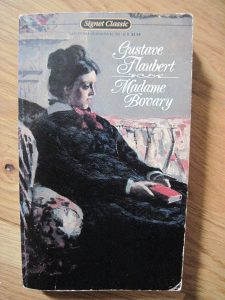
My classic for September was one of those books that are so ingrained in the canon you most likely know the basic story line even if you’ve never read a word Gustave Flaubert wrote. I’d happened to read a fair bit about Madame Bovary (1857), mostly via Julian Barnes, and had also encountered some modern novels that might be said to be updates (Hausfrau by Jill Alexander Essbaum and perhaps even George and Lizzie by Nancy Pearl), but never picked up the book itself until earlier this month. While the essential turns of the plot were indeed familiar to me, there was also plenty that surprised me in terms of the details and the mechanics. I’ve set this out in nine points below; if you’re determined to avoid anything that seems like spoilers, I’d suggest skipping over #6–8.
#1. We open with Charles Bovary.
And in the first-person plural: “We were studying when the headmaster came in, followed by a new boy”. I suppose I assumed the book would open immediately on Emma Bovary, already married to Charles. Instead, we get a quick tour through Charles’s adolescent schooling and independent medical studies.
 #2. There are two “Madame Bovarys” before the one we’re interested in.
The original Madame Bovary, and the only one to survive the book, is Charles’s mother. Charles also has a brief first marriage to Heloise, an older widow. Conveniently, she dies by the end of the second chapter, in which Charles met Emma when he went to set her farmer father’s broken leg.
#3. There’s a lovely Hardyesque flavor to the novel.
Flaubert’s original subtitle was “Provincial Morals,” and the scenes set among country folk – especially Emma and Charles’s wedding procession and reception and the later agricultural fair – reminded me of Far from the Madding Crowd.
#4. Emma has a child.
Despite all I’d absorbed about the book, I never knew Emma had a baby girl, Berthe. They lodge the infant with a wet nurse and servants do most of the hard work of raising her, so Berthe has only a tiny role. The scene in which Emma violently pushes the little girl away from her is meant, I think, to reflect her fundamental unfitness for motherhood.
#5. In the world of the novel, literature is a danger and religion is no balm.
On the advice of Charles’s mother, he cancels Emma’s lending library subscription lest novels exacerbate her discontent. Manual labor is what Emma needs, Old Madame Bovary proclaims. When Emma goes to the parish priest for advice about her angst, he tells her she must be ill if she benefits from all the physical comforts she could need yet cannot be happy. (An excellent and wrenching scene.)

Gustave Flaubert. (Public domain, via Wikimedia Commons.)
#6. There’s a strong medical theme.
Charles is a doctor, of course, but I didn’t know his profession would enter into the plot. There’s a crucial sequence in which he performs a groundbreaking operation on a stable boy with a clubfoot, but gangrene sets in and the leg has to be amputated. (Emma guiltily buys the boy a false leg.) Emma’s somewhat prolonged death by poisoning, and the appearance of her corpse, are also described in recognizable medical detail.
#7. Emma’s death isn’t the end.
There’s still two more chapters to go, and things only get worse. It’s as if Emma is still a negative influence after her death: pushing Charles on to extravagances he can’t afford, and sending him deeper into despair when he finds undeniable evidence of her two affairs.
#8. Homais, the arrogant pharmacist, is triumphant.
Monsieur Homais is one of the key secondary characters in Yonville, this small town near Rouen. He’s a middling community member who’s gotten above himself, yet he succeeds whereas Emma is crushed. The very last line of the novel goes to him: “He has just received the Legion of Honor.” In the introduction to my Signet Classic edition, Mary McCarthy suggests that Homais is “not just Emma’s foil; he is her alter ego.”
#9. Madame Bovary went on trial.
Appended to my copy is a 78-page transcript of the novel’s trial. As I skimmed it, I was reminded of the Lady Chatterley’s Lover obscenity case, which took place just over 100 years later (1959–60). Flaubert and his publisher were accused of “offenses against public morality and religion,” specifically of portraying Emma as lascivious and making adultery appealing compared to the banality of marriage. The defense countered that Charles receives all the reader’s sympathy and Emma all the reader’s revulsion. Flaubert was acquitted (as was Lady Chatterley), but the judge’s ruling was essentially “Naughty boy, don’t you know literature has a mission to exalt the spirit, not to hold up vice as an object of horror?”
Now for what doesn’t surprise me about Madame Bovary: the beautiful writing and the enduring power of what is ultimately a rather commonplace story line. The percentage of novels with an adultery subplot must be very high nowadays, but Madame Bovary and Anna Karenina were two of the first to consider the female experience.
Flaubert famously declared “Madame Bovary, c’est moi” (“Madame Bovary is me”), and I think every reader must see something of him-/herself in this character: the lure of a romantic and luxurious life, the boredom of the day to day, the longing to make something more out of existence, and an increasing desperation to cover up one’s mistakes. A book that has had meaning for generations, Madame Bovary is a true classic.
Some favorite lines:
“But her life was as cold as an attic with northern exposure, and boredom, that silent spider, was spinning its web in all the dark corners of her heart.”
“Mealtime was the worst of all in that tiny room on the ground floor, with the smoking oven, the creaking door, the damp walls, and the moist flagstones; all the bitterness of her existence seemed to be served up to her on her plate, and the steam from the boiled beef brought up waves of nausea from the depths of her soul.”
“No one can ever express the exact measure of his needs, or conceptions, or sorrows. The human language is like a cracked kettle on which we beat out a tune for a dancing bear, when we hope with our music to move the stars.”
(Isn’t that last sentence incredible?!)
My rating:
I read a Signet Classic edition of Mildred Marmur’s 1964 translation.
See also Susan’s review of Sophie Divry’s recent update, Madame Bovary of the Suburbs, at A life in books.
Classic of the Month: Fathers and Sons by Ivan Turgenev
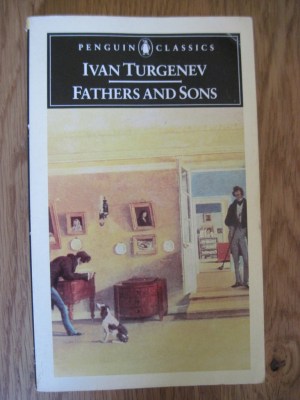
Last month’s classic was Father and Son (Edmund Gosse); this month is Fathers and Sons, the 1861 novel by Ivan Turgenev (1818–83). I couldn’t resist pairing up the similar titles, and it turns out that even though one is nonfiction and the other fiction, they are thematically similar, dwelling on the clash of generations and contrasting romanticism and rationalism.
 Nikolai Kirsanov’s son Arkady, newly graduated from university, has just returned to his father’s estate with his haughty fellow student Yevgeny Bazarov in tow. Bazarov intends to take a medical degree and follow in his father’s footsteps as a country doctor, so spends the time at his friend’s house dutifully poring over chemistry texts and dissecting frogs. Arkady, by contrast, seems earnest but aimless, happy to simply while away the days. The major change at home is that his father, a widower, has taken the servant girl Fenichka as his mistress and they have a baby, Mitya. (Gasp!) Yet the real shock in the world of the novel seems to be that Nikolai is consorting with someone of the lower classes. “In any case, it’s not for a son to sit in judgment on his father – least of all for me, and least of all with a father like you, who has never restricted my freedom in any way,” Arkady graciously concedes.
Together Nikolai and his rakish brother Pavel (“Women lost their heads over him, and men dubbed him a fop but were secretly envious”) represent an outmoded idealism that values art, nature, poetry, and true love. On the other side is Bazarov, who means to tear down those dated notions and recruit Arkady to the side of realism, even nihilism. “Nature is not a temple, but a workshop, and man’s the workman in it,” he explains to Arkady. But the pals’ notions get uncomfortably muddled when they meet the regal widow Anna Odintsov at the governor’s ball. On extended visits to her country house, Bazarov and Arkady become fixated on her and her younger sister, Katya, but differ in their willingness to give in to love.
Romantic love may be a madness best avoided in some of the characters’ view, but family love is a constant. Even Bazarov, though he makes a show of being embarrassed by their fussing when he goes home briefly after three years away, values his parents’ approval. His father proudly takes him along on his medical rounds, while his superstitious mother buttresses him with her prayers. She reminds her husband that Yevgeny is fundamentally different from them: “A son is an independent person. He’s like a falcon that comes when he wills and flies off when he lists; but you and I are like the funguses growing in a hollow tree.”
I was pleasantly surprised by how enjoyable and accessible Turgenev’s writing is. My experience with the Russian masters is shamefully limited; Leo Tolstoy’s The Death of Ivan Ilyich might literally be the only thing I’ve read previously. I was worried that all the patronymics, place names, and historical and cultural references would trip me up, but it’s no trouble to adjust to them here. You might think of Fathers and Sons as a friendly way of easing in to works like War and Peace: although elements of the story reminded me of Tolstoy’s epic (as I know it purely from the recent BBC miniseries) – the range of characters, from rich to poor, and their interactions; the long visits to acquaintances; the peaceful countryside; even a duel – it is on a much smaller scale, and has a correspondingly lower page count of about 220.
Something in nearly every character’s psyche rang true for me: Arkady’s relief at being home; Nikolai’s sense of being left behind; Bazarov’s feeling of smallness in an uncaring universe; his mother’s benevolent contentment with the status quo; Madame Odintsov’s well-ordered but purposeless life; and so on. Turgenev’s asides about Russia and about human nature give the narration a playful, knowing quality reminiscent of George Eliot. The idea of fathers and children being on different tracks extends to other forms of paternalism: religion (though this is a minor theme compared to in Father and Son) as well as masters versus serfs. “We all know there’s the master’s will; on account of you bein’ like our fathers. An’ the more strict the master rules, the better it be for us peasants,” as one rustic opines to Bazarov.
This is a thought-provoking but markedly readable classic that I can heartily recommend. Turgenev only wrote five other novels; if they’re all as strong (and roughly as short) as this one, I’d be happy to read them all – and will likely return to Fathers and Sons in the future.
My rating:
(With thanks to Karen at Kaggsy’s Bookish Ramblings for putting Turgenev on my radar.)
I read a Penguin Classics edition of Rosemary Edmonds’s 1965 translation. Her brief introduction gives helpful background and is a lovely piece of writing in its own right. Beware: only read a literary introduction after finishing the text, because critics assume you know the basic story line and so spoil who falls in love with whom, who dies in the end, etc. My edition is preceded by a lengthy lecture Isaiah Berlin gave on Turgenev in 1970.
Classic of the Month: Father and Son by Edmund Gosse
I can’t believe how long it’s taken me to get to this splendid evocation of 1850s–60s family life in an extreme religious sect. I’d known about Edmund Gosse’s Father and Son (1907) for ages, and even owned a copy. Two of its early incidents – the son’s anticlimactic birth announcement in the father’s diary, and the throwing out of a forbidden Christmas pudding – were famously appropriated by Peter Carey for creating Oscar’s backstory in his Booker Prize-winning novel Oscar and Lucinda (1988), which I read in 2008 but didn’t much like. I was reminded of that literary debt when I worked for King’s College London’s library system and did a summer placement in the Special Collections department in 2011. For my “In the Spotlight” article about a book in particular need of conservation, I chose Philip Henry Gosse’s Omphalos, his well-meaning but half-baked contribution to the Victorian science versus religion debate, and did a lot of secondary reading about the Gosses and their milieu.
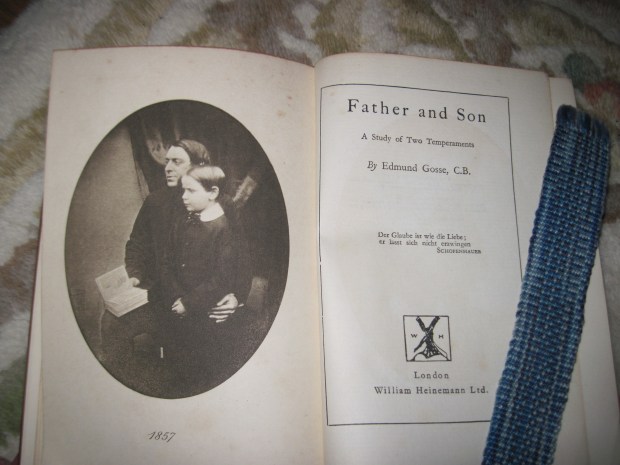
The book’s subtitle, “A Study of Two Temperaments,” gives an idea of the angle Gosse takes here: this is not a straightforward biography (after all, he’d already written his father’s life story in 1890) or a comprehensive memoir, but a snapshot of his early years and an emotional unpicking of the personality clash that results from fundamentally different approaches to life. While Gosse père (1810–88) was a devoted naturalist as well as a dogged believer in the literal truth of the Bible, even in adolescence his son (1849–1928) was a literature aficionado and troubled skeptic. Philip Gosse was a minister with the Plymouth Brethren and married late, at 38; his wife was 42, very late for contemplating motherhood in those days. Like Thomas Hardy, the infant Edmund was presumed dead at birth and set aside, so it’s thanks to keen-eyed nurses that we have these two late Victorians’ significant literary output today.
Although his first word was “book” and he could read by age four, Edmund was initially forbidden to read fiction. His mother quashed her own love of making up stories because she believed fiction was in some way sinful. It was always taken for granted that Edmund would follow his father into the ministry, and early on he had a sense of a split self: the external persona he put on to please his parents, and the deeper self that struggled to divine its purpose. He would cheekily test the limits of his familial faith by petitioning the Almighty for an expensive toy that he ‘needed’ and praying to a wooden chair to see if he’d be struck down for idolatry. The absurdity of such scenes is a welcome foil to the sadness of his mother’s death when Gosse was just seven. A year later the boy and his father moved from London to Devon, where both were captivated by the sea. (Indeed, if Philip Gosse is remembered as a natural historian today, it’s largely for his work on marine life – he discovered a new genus of sea anemones in 1859.) After Philip remarried, Edmund began attending a weekday boarding school and fell in love with literature, especially Shakespeare and the Romantic poets.
There’s a stretch of the book at about the two-thirds point that I found less compelling; much of it describes the other members of his father’s congregation (“the saints”) and the tedium of Sundays. It’s also a shame there isn’t a brief afterword that continues the story through to his father’s death. But for much of its length this is a riveting investigation of how the conflict between reason and religion plays out both within individual souls and between family members. The purpose here is to chart the course that led him out of religion and made the supernatural rift between him and his father permanent by the time he was 15 or so, and Gosse fulfills that aim admirably. In doing so he maintains a delicately balanced tone: Although he vividly recreates funny moments from his childhood, he also makes clear-eyed, scathing assessments of a religion that is ostensibly based on love but all too often veers towards judgment instead:
Here was perfect purity, perfect intrepidity, perfect abnegation; yet here was also narrowness, isolation, an absence of perspective, let it be boldly admitted, an absence of humanity. And there was a curious mixture of humbleness and arrogance; entire resignation to the will of God and not less entire disdain of the judgment and opinion of God.
[H]e allowed the turbid volume of superstition to drown the delicate stream of reason.
He who was so tender-hearted that he could not bear to witness the pain or distress of any person, however disagreeable or undeserving, was quite acquiescent in believing that God would punish human beings, in millions, for ever, for a purely intellectual error of comprehension.
Even so, this is a loving portrait, as well as a nuanced one, and a model of how to write family memoir. I enjoyed it immensely, and will no doubt read it again.
My rating: 
Further reading:
- Glimpses of the Wonderful: The Life of Philip Henry Gosse 1810–1888 by Ann Thwaite
- In the Days of Rain, Rebecca Stott’s memoir of growing up in the Plymouth Brethren in the 1960s
Classic of the Month: Anna of the Five Towns
This was my first experience with Arnold Bennett’s fiction; I’d previously read his Literary Taste. (He is not to be confused, as I’ve done in the past, with novelist and playwright Alan Bennett (An Uncommon Reader, etc.)!) Bennett (1867–1931) was from the Potteries region of Staffordshire and moved to London in his early twenties to work in a law office. Anna of the Five Towns (1902) was his second novel and first moderate success, but it was The Old Wives’ Tale (1908) and the Clayhanger trilogy (1910–16) that truly made his name.
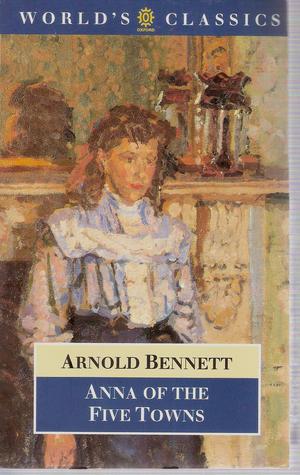 Bennett was a contemporary of D.H. Lawrence, James Joyce and Thomas Hardy (though Hardy had given up on novels by that point), and Anna reminds me of each of these authors to an extent – but particularly of Lawrence, what with his working-class Midlands roots. I also frequently thought of A Portrait of the Artist as a Young Man (religious angst) and Far from the Madding Crowd (a heroine who faces romantic entanglements and financial responsibility for the first time).
Twenty-year-old Anna Tellwright is a Methodist Sunday school teacher and lives with her twelve-year-old sister, Agnes, and their ill-tempered father, Ephraim, in “Bursley” (Bennett’s name for Burslem, now part of Stoke-on-Trent). The family is well off thanks to Ephraim’s canny property investments and inheritances he and his late wife received. Yet Anna is still dumbfounded to learn, on her twenty-first birthday, that she’s worth £50,000. Ephraim, generally referred to as “the miser” – there’s no nuance here; he’s typecast and never rises above the label – is happy to turn over certain aspects of the business to Anna, like hounding their tenants the Prices for late rent, but doesn’t give her autonomy over her daily spending. She must meekly approach her father each time she wants to purchase something for herself.
Anna has a suitor, Henry Mynors, whose business Ephraim supports as a sleeping partner. She loves the idea of being loved – and the suspicion that she has unwittingly wrenched a desirable prospect away from pretty Beatrice Sutton. But she doesn’t seem to be truly in love with Henry, just like her heart isn’t fully committed to the local revival put on by the Methodists. After all, she hasn’t had the emotional conversion experience that would prove irrefutably that she is saved. Much as she beats herself up over her so-called sins, the desired transformation never arrives. Instead, the closest thing she has to an epiphany comes when she’s standing atop a hill on the Isle of Man on her first-ever holiday:
She perceived that the monotony, the austerity, the melancholy of her existence had been sweet and beautiful of its kind, and she recalled, with a sort of rapture, hours of companionship with the beloved Agnes, when her father was equable and pacific. Nothing was ugly nor mean. Beauty was everywhere, in everything.
The Prices take on unforeseen significance in the novel, and in her dealings with them Anna is caught between a wish to be Christlike in her compassion and the drive to act as the shrewd businesswoman her father expects. Though she is eventually able to wrest back something like financial independence, she remains bound by the social convention of marrying well.

Arnold Bennett.
Anna is more timid and introspective than your average heroine; I felt great sympathy for her not in spite of but because of those character traits. I recently took the Myers-Briggs test for the first time, and wondered if Anna could be an ISTJ like me – she dreads having to visit her pupils’ homes and make small talk with the parents, comes across as curt when nervous, and can’t seem to turn her brain off and just feel instead. (Kate Scott of Parchment Girl runs a blog series about characters who exemplify the different Myers-Briggs personality types.)
There’s a lack of subtlety to Bennett’s writing, something I particularly noted in the physical descriptions (“She was tall, but not unusually so, and sturdily built up. Her figure, though the bust was a little flat, had the lenient curves of absolute maturity”) and some heavy-handed foreshadowing (“It was on the very night after this eager announcement that the approaching tragedy came one step nearer”). But I can let him off considering that this was published 115 years ago. It’s an excellent example of regional literature (can you think of another book set in Staffordshire?), with Anna’s visit to Henry’s pottery works a particular highlight. Bennett takes an unpromising setting and rather humble people and becomes their bard:
Nothing could be more prosaic than the huddled, red-brown streets; nothing more seemingly remote from romance. Yet be it said that romance is even here—
Several miles away, the blast-furnaces of Cauldron Bar Ironworks shot up vast wreaths of yellow flame with canopies of tinted smoke. Still more distant were a thousand other lights crowning chimney and kiln, and nearer, on the waste lands west of Bleakridge, long fields of burning ironstone glowed with all the strange colours of decadence. The entire landscape was illuminated and transformed by these unique pyrotechnics of labour atoning for its grime, and dull, weird sounds, as of the breathings and sighings of gigantic nocturnal creatures, filled the enchanted air.
The tea, made specially magnificent in honour of the betrothal, was such a meal as could only have been compassed in Staffordshire or Yorkshire—a high tea of the last richness and excellence, exquisitely gracious to the palate, but ruthless in its demands on the stomach. At one end of the table … was a fowl which had been boiled for four hours; at the other, a hot pork-pie, islanded in liquor, which might have satisfied a regiment. Between these two dishes were … hot pikelets, hot crumpets, hot toast, sardines with tomatoes, raisin-bread, currant-bread, seed-cake, lettuce, home-made marmalade and home-made jams. The repast occupied over an hour, and even then not a quarter of the food was consumed.
I enjoyed this for the pacey plot, the religious theme, the sympathetic protagonist, and the loving look at an industrial area. I’ll certainly be looking out for copies of Bennett’s other novels in secondhand bookshops; meanwhile, Project Gutenberg also has a good selection of his writings. (My copy was withdrawn from Lambeth Libraries stock and sold for 10 pence.)
My rating:
Classic of the Month: The Moon and Sixpence
This was indeed the perfect follow-up to Fabrizio Dori’s Gauguin, the SelfMadeHero graphic novel I reviewed earlier in the month. W. Somerset Maugham’s short novel functioned like a prequel for me because, whereas Dori focuses on Gauguin’s later life in the South Pacific, Maugham concentrates on his character Charles Strickland’s attempt to make a living as a painter in Paris.
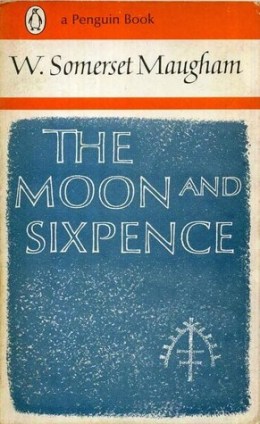 The Moon and Sixpence – the unusual title comes from the TLS reviewer’s description of the protagonist in Of Human Bondage as so absorbed in reaching for the moon that he doesn’t notice the sixpence at his feet – is narrated by an unnamed author drawn into Strickland’s orbit through his wife Amy Strickland’s attendance at London literary soirées. He hasn’t gotten to know the couple very well at all when he hears that Charles, a stockbroker, has abandoned his family and left for Paris to pursue painting – a hobby for which he’s never previously shown any aptitude.
Amy sends the narrator off to Paris to talk sense into her husband, but Charles never shows the least remorse. The narrator marvels at his insouciance and utter conviction that he is meant to be an artist.
He was single-hearted in his aim, and to pursue it he was willing to sacrifice not only himself – many can do that – but others. He had a vision. Strickland was an odious man, but I still think he was a great one.
I noted familiar themes from Of Human Bondage (published in 1915, four years prior to The Moon and Sixpence), especially the artist’s struggle, nomadism and the threat of poverty. Dirk Stroeve, the talentless Dutch painter who becomes friendly with the narrator in Paris and recognizes Strickland’s brilliance even as he lets the man walk all over him, reminded me of the happy-go-lucky Thorpe Athelny in Bondage.
At less than a third of the length of that earlier novel, though, The Moon and Sixpence struck me as a condensed parable about genius and sacrifice.
Beauty is something wonderful and strange that the artist fashions out of the chaos of the world in the torment of his soul. … It was the work of a man who had delved into the hidden depths of nature and had discovered secrets. … There was something primeval there and terrible. It was not human. It brought to … mind vague recollections of black magic. It was beautiful and obscene.
This is a fascinating character study, whether or not you’re aware of Gauguin’s life as the inspiration, and would be a great introduction to Maugham’s work if you’ve not read him before. (Secondhand copy from Bookbarn International.)
My rating:
Failing at Classics of the Month
I’ve attempted two Dickens novels in the last five years, and left both unfinished. I at least got about 200 pages into Dombey and Son in 2012 before I gave up, but my recent attempts to get past the first couple of chapters in Our Mutual Friend have been utterly unsuccessful. I finally gave myself permission to set it aside at page 41 – and I didn’t even read all of that; I’d started skimming in a last-ditch attempt to get myself hooked by the story. Have I lost my Dickens mojo? Do I not have sufficient patience to read Victorian triple-deckers anymore? I truly hope this is just a phase and I’ll be able to get back into Dickens someday. I certainly intend to read his whole oeuvre eventually, even the obscure ones.
So I don’t have a classic for April, nor a true doorstopper (I’ve classified David France’s How to Survive a Plague as such – a bit of a cheat since I only skimmed it). Instead what I have to offer are a modern classic and a graphic adaptation of another Dickens novel.
On the Black Hill by Bruce Chatwin, which I mostly read during our trip to Hay-on-Wye earlier in the month, is worthy of being called a modern classic. It has echoes of D.H. Lawrence and especially Thomas Hardy, and it’s a pleasantly offbeat look at the developments of the twentieth century as seen through the lives of Welsh identical twins Benjamin and Lewis Jones. Opening in the 1980s, when the brothers are eccentric old gents sleeping side by side in their late parents’ bed, the book then retreats to the beginning: at the turn of the last century ornery Amos Jones fell for an educated rector’s daughter and their volatile relationship played out at The Vision farm. One son was caught up in the First World War, one had love affairs; neither “ever strayed further than Hereford.” Through sickness, community scandal, and the rise and fall of fortunes, they remain wedded to Welsh village life.

“The Vision” farm is in the background to the right.
I especially loved Chatwin’s descriptions of the natural world (he’d visited Radnorshire as a boy and considered it a kind of spiritual home), and the glimpses he gives into the twins’ preternatural closeness:
Lewis and Benjamin gambolled ahead, put up grouse, played finger-football with rabbit-droppings, peered over the precipice onto the backs of kestrels and ravens and, every now and then, crept off into the bracken, and hid. They liked to pretend they were lost in a forest, like the Twins in Grimms’ fairy-tale, and that each stalk of bracken was the trunk of a forest tree. … They lay on their backs and gazed on the clouds that crossed the fretted patches of sky … they would press their foreheads together, each twin losing himself in the other’s grey eye.
(Clearance book from Blackwell’s in Oxford. )
 The David Copperfield graphic novel by Jacqueline Morley (illustrated by Penko Gelev) is part of the Graffex series of graphic novel literary retellings issued by Salariya Book Company. It’s remarkably faithful to Dickens’s original, with just a bit of condensing in terms of the plot and a few secondary characters cut out or greatly reduced in importance. Although this is no substitute for reading David Copperfield itself (my favorite book), I could see it being useful for high school or college students who need a quick recap of what happens when preparing for a quiz or essay. The three main young females are amusingly similar and idealized, but all the other characters’ looks are true to the novel’s descriptions (and previous adaptations). The end matter – a brief biography of Dickens, commentary on the novel, a timeline of stage and screen versions – is particularly helpful, though in the chronology of Dickens’s works they forgot Dombey and Son!

(Remainder copy from Addyman Books in Hay-on-Wye.  )
)
Next month: I’ve pulled out a couple of short (~210 pages each) classics from the shelf. I recently read a graphic novel about Gauguin that I’ll be reviewing on Monday, so I fancy following it up with W. Somerset Maugham’s The Moon and Sixpence, which is said to be based on Gauguin’s life. It’ll be only my second Maugham after Of Human Bondage, which I loved in 2015. Anna of the Five Towns will be my first taste of Arnold Bennett’s fiction (though I’ve read his Literary Taste).
Classic of the Month: The Tenant of Wildfell Hall
Thank you to those who recommended Anne Brontë’s The Tenant of Wildfell Hall (1848) as my classic for March. I’m glad I read it, not least because, like Narcissism for Beginners, it’s an epistolary within an epistolary – bonus! I imagine most of my readers will already be familiar with the basic plot, but if you’re determined to avoid spoilers you’ll want to look away from my second through fourth paragraphs.
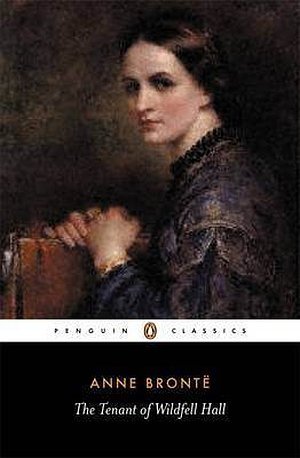 The chronology and structure of the novel struck me as very sophisticated: in 1847, gentleman farmer Gilbert Markham is writing a detailed letter to a friend, describing how he fell in love with the widow Helen Graham – the new tenant at Wildfell Hall, a painter who’s living there in secret – starting in the autumn of 1827. (I even wondered if this could have been one of the earliest instances of a female author writing from a male point-of-view.) Their interrupted and seemingly ill-fated courtship reminded me of Lizzy and Darcy’s in Pride and Prejudice: Gilbert initially thinks Helen stubborn and argumentative, especially in how she refuses to accept neighbors’ advice on how to raise her young son, Arthur. Gradually, though, he comes to be captivated by this intelligent and outspoken young woman on whose “lofty brow … thought and suffering seem equally to have stamped their impress.”
And indeed, at the heart of Gilbert’s narrative is a lengthy journal by Helen herself, starting in 1821, explaining the misfortune that drove her to take refuge in the isolation of Wildfell Hall. For, as in Anne’s sister Charlotte’s Jane Eyre, there’s an impediment to the marriage of true minds in the form of a living spouse. Helen is still tied to Arthur Huntingdon, a dissolute alcoholic she married against her family’s advice and has ever since longed to see reformed. In a phrase I was highly bemused to see in use in the middle of the nineteenth century, she defends him thusly: “if I hate the sins I love the sinner, and would do much for his salvation.” The novel’s religious language may feel outdated in places, but the imagined psyche of a woman who stays with an abusive or at least neglectful partner is spot on.
For the most part I enjoyed the story line, but I must confess that I wearied of Helen’s 260-page account, filled as it is with repetitive instances of her incorrigibly loutish husband’s carousing. I had a bit too much of her melodrama and goody-goody moralizing, such that it felt like a relief to finally get back to Gilbert’s voice. The last 100 pages, though, and particularly the last few chapters, are wonderful and race by. I loved this late metaphor for Helen’s chastened beauty:
This rose is not so fragrant as a summer flower, but it has stood through hardships none of them could bear. The cold rain of winter has sufficed to nourish it, and its faint sun to warm it; the bleak winds have not blanched it or broken its stem, and the keen frost has not blighted it. Look, … it is still fresh and blooming as a flower can be, with the cold snow even now on its petals.
Anne Brontë c. 1834, painted by Patrick Branwell Brontë [Public domain or Public domain], via Wikimedia Commons (restored version).
As always, I’m dumbfounded by the Brontës’ profound understanding of human motivation and romantic love given their sheltered upbringing. Theirs were wild hearts. I’ll always be a Charlotte fan first and foremost, but I was delighted with my first experience of Anne’s work and look forward to trying Agnes Grey in the near future.
Lest you think Victorian literature is all po-faced, righteous ruminating, I’ll end with my favorite funny quote from the book. This is from Gilbert’s snide, sporty brother Fergus (I wish he’d had a larger role!), seeming to mock Jane Austen with this joke about needing to know everything about Helen Graham as soon as she arrives in town:
“mind you bring me word how much sugar she puts in her tea, and what sort of caps and aprons she wears, and all about it, for I don’t know how I can live till I know,” said Fergus very gravely. But if he intended the speech to be hailed as a masterstroke of wit, he signally failed, for nobody laughed. However, he was not much disconcerted at that; for when he had taken a mouthful of bread and butter, and was about to swallow a gulp of tea, the humour of the thing burst upon him with such irresistible force that he was obliged to jump up from the table, and rush snorting and choking from the room.
My rating:
Next month: Eleanor of Elle Thinks recommends Our Mutual Friend as the book that will finally get me back into Dickens, so I plan to make it do double duty as my Classic and Doorstopper for April.
 Bookish Beck = Rebecca Foster. American transplant to England. Freelance proofreader and book reviewer.
 Bookish Beck