The Man I Became (Peirene)
The latest book from Peirene Press is narrated by a gorilla. That’s no secret: it’s an explicit warning given in the blurb. Yet the narrator doesn’t remain a gorilla. The clue is in the title: in The Man I Became, the eleventh novel by Belgian Flemish author Peter Verhelst (translated from the Dutch by David Colmer), various species are captured and forcibly humanized. Our narrator – whose name we never know – remembers his happy life in Africa:
We caught termites by pushing long twigs, as flexible as blades of grass, into their mounds and then licking the twigs clean. … We hung from branches one-handed to show off our muscles. We felt like princes and princesses. We were young and beautiful and our bliss was never going to end.
But soon his fellows start disappearing, and eventually the riders come for him too. He’s captured and marched across the desert to the sea to be shipped to the New World. The gorillas’ training begins soon after they arrive.
We learned to walk upright. ‘Faster! Taller!’ said the human. … Then we learned how to shave. … We learned a new language word by word. We learned to eat from a bowl and then with knife and fork. … We learned to powder our skin to make it lighter.
 At this point I started to get a bit nervous about the book’s racial connotations. Especially as the gorillas-in-transition become sexual objects, I wondered what Verhelst could be attempting to say about the notions of the noble savage and the purification of the race.
The creatures’ progress is carefully documented. They carry phones that function as identification as well as an external memory. The art of conversation is something they practice at cocktail parties, where the narrator learns that he and his kind are not the only ones; giraffes, buffalo, leopards, parrots, lions and bonobos have all been subjected to the same experiment. With all of them together in the same room, the animals have to suppress their natural fear reactions.
The narrator becomes an animal trainer for the evolution-in-action show at Dreamland, an amusement park with roller coasters and fast food. There are different classes of animals, you see; some remain animals and do menial duties, while a chosen few are transformed into humans. He halfheartedly looks for his brother and has a brief affair with Emily. When a violent incident leaves several dead and the narrator’s human is caught acquiring animals through the black market, Dreamland’s very existence is threatened. (If you know the history of the real Dreamland, a longtime Coney Island attraction, you may have an inkling.)
This novella is scarcely 120 pages. Short books can be wonderful, but that’s not the case if there’s no space to craft a believable plot. The pace is so quick here that there’s no chance to bed into scenes and settings, and the narrator is never entirely convincing – whether as a gorilla, a man or something in between. Too much of the book feels dreamlike and fragmentary.
Meanwhile, the ideology bothered me. Is this simply a social satire à la Animal Farm, to which it’s compared in the prefatory material? A sort of ‘some animals are more equal than others’ message? If so, then, well, that’s been done before. Nor is there any shortage of books mocking caste systems and eugenic experimentation. Apart from a handful of memorable lines, the prose is quite simplistic, and the overall storyline doesn’t feel original.
Verhelst has written that he was inspired by three things: a troop of cheeky baboons encountered in South Africa, the history of the early-twentieth-century Dreamland, and news of the completed human genome project. “What is a human? Is it a creature that can smile while walking on two legs? A creature with a signature and a mobile phone?” he asks. These are interesting questions, certainly, but I felt they were not explored with particular depth or panache here.
The Man I Became was my third Peirene book, after The Looking-Glass Sisters. This one was a disappointment, but I will not let that deter me from trying more, including the other two in the “Fairy Tale series: End of Innocence”: Marie Sizun’s Her Father’s Daughter and Linda Stift’s The Empress and the Cake.
With thanks to Peirene Press for the free copy.
My rating: 
Better Late than Never: The Goldfinch
And the painting, above his head, was the still point where it all hinged: dreams and signs, past and future, luck and fate. There wasn’t a single meaning. There were many meanings. It was a riddle expanding out and out and out.
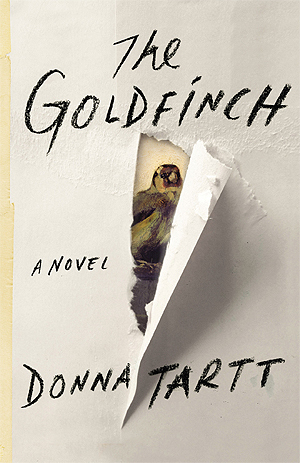 My pristine paperback copy of Donna Tartt’s The Goldfinch cost all of £1 at a used bookshop in Henley. Talk about entertainment value for money! Although it took me nearly a month to read, starting with Christmas week, it was more gripping than that timeframe seems to suggest. I read it under a pair of cats in the bitter-cold first week of a Pennsylvania January, then tucked it under my arm for airport queues (no way would it fit in my overstuffed carry-on bag) and finally finished it during my first week of bouncing back from transatlantic jetlag. Somehow Theo Decker’s fictional travels – from New York to Las Vegas and back; to Amsterdam and home again – blended with my sense of having been on a literal journey with the book to make this one of my most memorable reading experiences in years.
That’s not to say that the book was flawless. In fact, I found the first 200 pages or so pretty slow. You almost certainly know the basics of the plot already, but if not, glance away from the rest of this paragraph. Theo, 13, is separated from his mother during a terrorist attack on a New York City museum. Among the dying he encounters an older man – guardian of the pretty red-haired girl Theo had been checking out just moments before – who gives him a ring and tells him to go to Hobart and Blackwell antiques. But this is not the only souvenir Theo takes from his ordeal; he also steals the little Dutch masterpiece by Fabritius that appears on the book’s cover. Stumbling around the streets of New York, the shell-shocked Theo undoubtedly resembles a 9/11 victim. As the years pass, he is moved from guardian to guardian, but a few things remain constant: his memory of his mother, his obsession with the painting, and his love for Pippa, that red-haired girl who, like him, was among the survivors.
The aftermath of the attack was the most tedious section for me. It felt like it took forever for Theo’s future to be set in motion, and I thought if I heard him complain of how his head was killing him one more time I might just scream. It’s when Theo gets to Vegas, and specifically when he meets Boris, that the book really takes off. Boris is simply a terrific character. He’s lived all over and has a mixed-up accent that’s part Australian with heavy Slavic overtones. Like Theo, he has an unreliable father who is often too drunk to care what his kid is doing. This leaves the two young teens free to do whatever they want, usually something classified as illegal. Indeed, there’s a lot of drug use in this book, described in the kind of detail that makes you wonder what Tartt was up to during her years at Bennington.
As a young man Theo, back in New York, joins Hobie (of Hobart and Blackwell) in selling antiques both genuine and ersatz, and reconnects with an old friend’s family in a surprising manner. The story of what becomes of the painting was in danger of turning into a clichéd crime caper, yet Tartt manages to transform it into a richly philosophical interrogation of the nature of fate. Theo’s intimate first-person narration makes him the heir first of Dickensian orphans and later of the kind of tortured antiheroes you’d find in a nineteenth-century Russian novel: “I had the queasy sense of my own life … as a patternless and transient burst of energy, a fizz of biological static just as random as the street lamps flashing past.”
Similar to my experience with Of Human Bondage, I found that the latter part of the novel was the best. The last 200 pages are not only the most addictive plot-wise but also the most introspective; all my Post-It flags congregate here. It’s also full of the best examples of Tartt’s distinctive prose. The best way I can describe it is to say it’s like brush strokes: especially in the scenes set in Amsterdam, she’s creating a still life with words. Often this is through sentences listing images, in phrases separated by commas. Here’s a few examples:
Floodlit window. Mortuary glow from the cold case. Beyond the fog-condensed glass, trickling with water, winged sprays of orchids quivered in the fan’s draft: ghost-white, lunar, angelic.
Out on the street: holiday splendor and delirium. Reflections danced and shimmered on black water: laced arcades above the street, garlands of light on the canal boats.
Medieval city: crooked streets, lights draped on bridges and shining off rain-peppered canals, melting in the drizzle. Infinity of anonymous shops, twinkling window displays, lingerie and garter belts, kitchen utensils arrayed like surgical instruments, foreign words everywhere…
Such sentence construction shouldn’t work, yet it does. I’ve never been one to fawn over Donna Tartt, but this is writing I can really appreciate.
[I did take issue with some of the punctuation in the novel, though whether that’s down to Tartt, her editor or the UK publication team I couldn’t say. Take, for instance, this description of a station clerk: “a broad, fair, middle aged woman, pillowy at the bosom and impersonally genial like a procuress in a second rate genre painting.” Another solid allusion to Dutch art, but missing two hyphens if you ask me.]
The Goldfinch contains multitudes. It’s the Dickensian coming-of-age tale of a hero much like David Copperfield who’s “possessed of a heart that can’t be trusted.” It’s a realist record of criminal escapades. It’s a story of unrequited love. It’s a convincing first-hand picture of anxiety, addiction and regret. It has a great road trip, an endearing small dog, and a last line that rivals The Great Gatsby’s (I’ll leave you to experience it for yourself). It’s a meditation on time, fate and the purpose of art. It’s not perfect, and yet I – even as someone who pretty much never rereads books – can imagine reading this again in the future and gleaning more with hindsight. That makes it worthy of one of my rare 5-star recommendations.
Caring too much for objects can destroy you. Only—if you care for a thing enough, it takes on a life of its own, doesn’t it? And isn’t the whole point of things—beautiful things—that they connect you to some larger beauty? Those first images that crack your heart wide open and you spend the rest of your life chasing, or trying to recapture, in one way or another?
My rating: 
Books in Brief: Five I Loved Recently
Why We Write about Ourselves: Twenty Memoirists on Why They Expose Themselves (and Others) in the Name of Literature
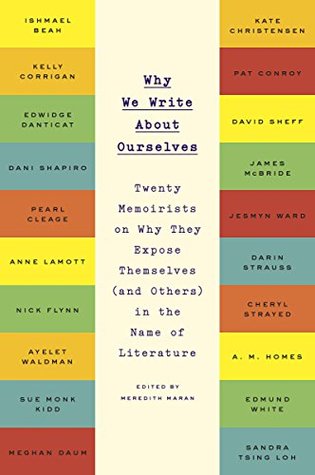 (Edited by Meredith Maran)
A great collection of first-person pieces from memoir authors, charting their individual journeys into autobiographical writing and giving their top tips. Opinions vary as to whether you have to get the approval of the people who appear in your work – some think that’s essential; others simply change the names and get on with it. Sometimes this has led to fallout within families. One thing everyone agrees on, though, is that a memoir has to be as carefully crafted as any novel, with a clear narrative arc and distinctive dialogue and scenes. My favorite pieces were from Kate Christensen, Edwidge Danticat and Darin Strauss.
Can’t We Talk about Something More Pleasant?
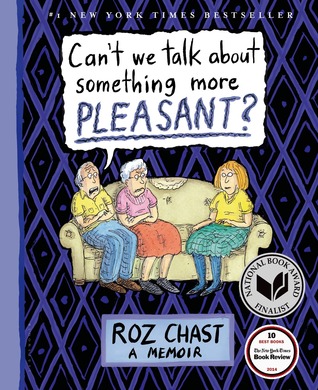 (By Roz Chast)
Memoir + graphic novel = graphic memoir. This one’s about her parents’ aging, senility and death yet still manages to be laugh-out-loud funny. It also includes photos of her parents’ apartment filled with ancient stuff they’d hoarded and a touching series of sketches she made of her mother while she was dying. This and Fun Home are the two best graphic memoirs I’ve read. A favorite line, uttered when her mother bounced back temporarily from hospice care: “Where, in the five Stages of Death, is EAT TUNA SANDWICH?!?!?”
Best Food Writing 2015
(Edited by Holly Hughes)
 “Food is intimate. We take it into our bodies. When we gather at the table with friends and family, we’re gathering to affirm something.” The title doesn’t lie – these essays are terrific. There wasn’t a single one I didn’t find interesting, whether the topic was lab meat; seeking out the perfect burger, Bolognese sauce or gumbo; particular chefs or restaurants; food fads; starting a simple meatball supper club; or feeding picky kids. A couple favorites were “Finding Home at Taco Bell” by John DeVore and “The One Ingredient that Has Sustained Me during Bouts of Leukemia” by Jim Shahin. This series has been running since 2000, but this is the first time I’ve picked up one of the books. I’ll be looking out for it again next year.
 The Longest Night
(By Andria Williams)
Utterly absorbing historical fiction. What with the remote setting and the threat of Cold War or nuclear fallout, this is reminiscent of The Last Pilot and The Wives of Los Alamos, but more engaging than either of those. You may also see hints of Richard Yates or even Tom Perrotta’s Little Children in the story of a marriage strained to the breaking point. Each character is fully explored and the early 1960s atmosphere is completely convincing. A great debut and an author I’d like to hear more from.
Your Heart Is a Muscle the Size of a Fist
(By Sunil Yapa)
 A hard-hitting novel with an unforgettably resonant title, this is set at the 1999 Seattle WTO protest. Yapa explores the motivations and backstories of activists, police officers, and delegates as the day deteriorates into violence. The novel flows pretty much effortlessly. Yapa’s writing style is closest to Smith Henderson’s (Fourth of July Creek): short, verbless sentences alternate with long, lyrical ones; there’s plenty of repetition and rhetorical questions, but it remains accessible rather than overblown. This fine debut novel is about cultivating the natural compassion in your heart even while under the threat of the fist.
My rating for all: 
Of Human Bondage: Finally Caught Up from 2015
When it came to it, it isn’t me
was all he seemed to learn
from all his diligent forays outward.
(from “It Isn’t Me” by James Lasdun)
I chose to read this doorstopper from 1915 because it appeared in The Novel Cure on a list entitled “The Ten Best Novels for Thirty-Somethings.” By happy accident, I was also reading it throughout its centenary year. My knowledge of W. Somerset Maugham’s work was limited – I had seen the 2006 film version of The Painted Veil but never read anything by him – so I had no clear idea of what to expect. I was pleased to encounter a narrative rich with psychological insight and traces of the Victorian novel.
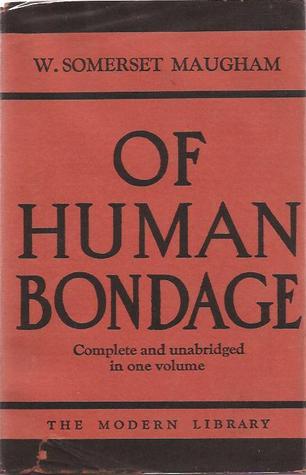 Philip Carey is not unlike a Dickensian hero: born with a club foot and orphaned as a child, he’s raised by his stern vicar uncle in Kent and reluctantly attends boarding school. Much of the book is filled with his post-schooling wanderings and professional shilly-shallying, along with multiple romantic missteps. He studies in Germany, tries to make it as a painter in Paris, and returns to London to train as an accountant and then as a doctor. Each attempted career seems to fail, as does every relationship. Philip reminded me most of David Copperfield, especially after he meets the jolly, Micawber-esque Thorpe Athelny during his hospital internship and becomes friendly with his wife and children.
As is common in Victorian novels, Philip is troubled by his conflicting desires. When it comes to women, he cannot get love to match up with lust. As a youth he loses his virginity to Emily Wilkinson, a woman in her mid-30s, then wants nothing to do with her. A few other dalliances have mixed success, but the novel focuses on Philip’s connection to Mildred Rogers. A café waitress, she’s vain and ill-tempered and acts indifferent to Philip – but is happy for him to spend money on her. He’s disgusted and infatuated all at once: “He did not care if she was heartless, vicious and vulgar, stupid and grasping, he loved her. He would rather have misery with [her] than happiness with [another].” Though Mildred tries to eschew the traditional roles of wife and mother, the Victorian notion of the fallen woman haunts her.
This on-again, off-again romance forms the heart of the book. Both Philip and Mildred are maddening in their own way. Not since Pip (another Philip, interestingly) in Great Expectations have I been so furious at a main character for consistently making the wrong choices, being dazzled by beauty and status and ignoring the more important things in life. Yet the close third-person narration sees so deeply into Philip’s psyche that I could not help but feel sympathy for him, too, cringing over his every failure – especially when stock market losses leave him destitute and he undertakes humiliating (to him) work at a department store. The novel is liberally studded with intimate paragraphs conveying Philip’s thoughts:
He painted with the brain, and he could not help knowing that the only painting worth anything was done with the heart. … [H]e had a terrible fear that he would never be more than second-rate. Was it worth while for that to give up one’s youth, and the gaiety of life, and the manifold chances of being?
Pain and disease and unhappiness weighed down the scale so heavily. What did it all mean? He thought of his own life, the high hopes with which he had entered upon it, the limitations which his body forced upon him, his friendlessness, and the lack of affection which had surrounded his youth. He did not know that he had ever done anything but what seemed best to do, and what a cropper he had come! Other men, with no more advantages than he, succeeded, and others again, with many more, failed. It seemed pure chance. The rain fell alike upon the just and upon the unjust, and for nothing was there a why and a wherefore.
Another humanizing element that especially appealed to me was Philip’s loss of Christian faith. During my study abroad year and especially my master’s year at Leeds, when I wrote a dissertation on women’s loss-of-faith narratives in Victorian fiction, I read a lot of novels about belief and doubt. In Philip’s case, I was interested to see how Maugham portrays what is usually seen as a loss as more of a liberation:
Suddenly he realised that he had lost also that burden of responsibility which made every action of his life a matter of urgent consequence. He could breathe more freely in a lighter air. He was responsible only to himself for the things he did. Freedom! He was his own master at last. From old habit, unconsciously he thanked God that he no longer believed in Him.
Although Philip frequently indulges in self-pity, he also has moments where he wakes up to the wonder of life. These epiphanies of the beauty of London, of the whole world, were among my favorite scenes.
Unusually in a long book, I thought the last 150 pages were the strongest. I struggled to pay attention throughout Philip’s schooling and wearied of the endless negotiations with Mildred, but when Philip is at his lowest point – like the protagonist of Knut Hamsun’s Hunger, not even sure if he’ll find enough to eat – there’s a real intensity to the plot that made this last chunk fly by.
I read a 1930s Modern Library copy from the University of Reading, but consulted Robert Calder’s introduction to the 1992 Penguin Classics edition for background information. It seems the novel was recognizably autobiographical for Maugham, though where a club foot was Philip’s source of shame, for the author it was his stammer (and his sexuality – he married but is known to have been a homosexual).
Like Joyce’s roughly contemporary A Portrait of the Artist as a Young Man, Calder notes, Of Human Bondage fits into the “apprentice novel” genre. Despite being published in 1915, it is set in a recent past so makes no reference to the First World War, though the Boer War plays a background role. I didn’t find the book to be particularly dated; I even discovered that a couple of sayings I might have pegged as later inventions were around in the 1910s: “like it or lump it” and “put that in your pipe and smoke it.”
Of Human Bondage met with a lukewarm critical response in its own time but does seem to be among the more beloved – if obscure – classics nowadays. Calder insists that it “remains Maugham’s most complete statement of the importance of physical and spiritual liberty.”
There have been three film versions – and another is in production this year, apparently. The best known, from 1934, launched the career of Bette Davis, who gave it her all as Mildred Rogers (she was a write-in favorite for the Oscars that year). Overacting, for sure, but her blonde wave and simpering looks were perfect for the role. By contrast, Leslie Howard’s is a fairly subtle Philip. The movie – condensed, amazingly, to just over an hour and a half – focuses on his club foot and his relationship with Mildred; I was disappointed that no attempt was made to reproduce Philip’s introspective monologues through voiceovers.
To my surprise, Calder asserts that Of Human Bondage “has become one of the most widely read of modern novels, particularly by young people, who still find relevance in Philip’s struggle for a free and meaningful life.” It was good enough for Holden Caulfield, after all. It struck me during my reading that two recent novels may have taken inspiration from Maugham: the main character in Esther Freud’s Mr. Mac and Me, set in 1914, has a club foot; and in Hanya Yanagihara’s A Little Life Jude’s shame over his deteriorating physical condition, especially his legs, is reminiscent of Philip’s.
I’m not sure I’ll try anything else by Maugham – how could I when there’s still so much of Dickens and Hardy left to read? – but I’m certainly glad I read this. It’s clear why Berthoud and Elderkin thought Of Human Bondage would be a perfect read for someone in their 30s: it’s infused with the protagonist’s nostalgia for his youth and regret at opportunities not taken and time lost. The novel imagines a world where, even without a god pulling a string, some misfortune seems to be fated. Even so, free will is there, allowing you to recover from failure and try something new that will be truer to yourself in this one and only life.
My rating: 
Four Books that Lasted All of 2015: #1
With this four-part post (one per day for the rest of this week) I think I will finally have caught up on the 2015 reads I needed to review. These four books have daunted me for ages because I spent much of last year with them – one because I wrestled with it (vacillating between admiration and frustration), another because it was a daily bedside book, and the other two because they were long and rewarding yet tough to read more than a bit of at a time. Knowing full well that I won’t do any of them justice, I’ll offer a few thoughts.
Fourth of July Creek by Smith Henderson
“I go into homes all the time and I save children. It’s what I do for a living, you see? And I didn’t save my own daughter.”
 If I take nearly a year over a novel, stopping and starting, that’s usually a bad sign. But I forced myself to finish this one, just like I did with The Orphan-Master’s Son by Adam Johnson. In the end my feelings were roughly similar, too: I appreciated the skill behind Henderson’s writing but never fully warmed to it. This is the story of Pete Snow, a Montana social worker in the early 1980s. His cases are uniformly distressing, but the one that most captivates his attention is Benjamin Pearl, raised in the wilderness by his father Jeremiah, a fundamentalist anarchist who drills holes in coins to show his antipathy to the government.
Since his wife and their teenage daughter Rachel left for Texas, Pete has been adrift in a fog of alcohol and sex, driving obsessively between remote locations in an attempt to save his doomed clients and criminal brother. When Rachel runs away, though, life’s dangers come home to Pete for the first time: “He’d seen so much suffering, but he’d only ever suffered it secondarily. To have it fresh and his own. The scope of it. He’d had no idea. He’d known nothing.” His search for his daughter is what saved the book for me. However, what actually happens to Rachel I found melodramatic, and how it’s narrated – through a third-person rendering of an interview, rather than a you/I back-and-forth – seemed odd.
Indeed, there are unusual narration choices throughout, such as the occasional second-person phrase in reference to Pete. The prose style is by turns fragmentary (as the above lines attest) and expansive, as in this long, alliterative sentence:
Shattered chants and ceaseless invective morph into a nearly simian cacophony of hoots and throaty shrieks as a white cloud of gas composes and insinuates itself into the small crowd that yet churns forward from the rear and backward from the front as the agitators break into two scattering bodies, fanning and choking and wild-eyed, coursing up and down the road.
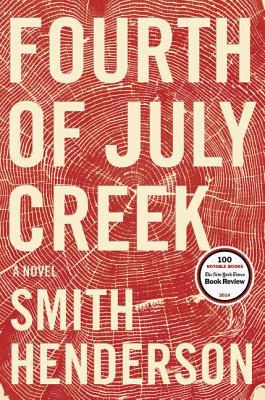
Once again I prefer the American cover. What’s up with that?
Ultimately I found this novel to be very hard work. The one scene I’ll remember most clearly is Pete and the Pearls stumbling on a pile of animals, from a raccoon right up to a black bear, that were all killed by a downed telephone wire. I’d recommend this if you’re a dedicated reader of dirty realism and you accept the violence and the detached writing style that genre tends to involve. If not, you should probably start somewhere else, like with Ron Rash or David Vann.
Ever since Sufjan Stevens’s Carrie and Lowell came out, I can’t help but hear his song “Fourth of July” in my head when I think about this book: “What did you learn from the Tillamook Burn and the Fourth of July? We’re all gonna die.” It’s that oppressive, depressing, even apocalyptic atmosphere I’ll return to when I think about this book. Fourth of July Creek – a real place in Montana – is nowhere I’ll want to revisit.
With thanks to Windmill Books for the free copy, won in a Goodreads giveaway.
My rating: 
Review: Bradstreet Gate by Robin Kirman
Sometimes a book is crushed by the weight of its own hype, with people objecting that the blurb is overblown or even misleading. Bradstreet Gate, the debut novel by Robin Kirman, has a score of 2.77 on Goodreads, the average of over 800 ratings. That’s pretty low. What went wrong? If you ask most people, it’s because the book’s supposed similarity to Donna Tartt’s The Secret History set them up to have their sky-high expectations disappointed.
 Now, I like Donna Tartt as much as the next person: I’ve read her first two novels and have been saving up The Goldfinch for my Christmas read this year. But I don’t idolize her like some do, so I quite enjoyed Bradstreet Gate. You can certainly see why the Secret History connections were made during the marketing process: both novels concern a New England campus murder and the complicated relationships between the various characters involved.
The crime takes place at Harvard in 1997, but the novel opens 10 years later with Georgia Calvin Reece. When she’s approached by a student reporter who wants to write a piece about the ten-year anniversary of Julie Patel’s murder, Georgia is so burnt out with caring for a new baby and a husband who’s dying of cancer that she can’t take the time to engage with her memories. Yet she can’t ignore them either.
In college her closest friends were Charles Flournoy and Alice Kovac, both of whom had crushes on her. She knew Julie only peripherally through a volunteer organization, but she knew the man who was presumed but never proven to have killed her – an ex-military professor and dorm master named Rufus Storrow – all too well. They were having a top-secret affair at the time that Julie was found strangled near Harvard’s Bradstreet Gate.
I enjoyed how Kirman dives into the past to look at the history of the central trio. Georgia was raised by a photographer father who took nude portraits of her. Growing up in New Jersey, Charles felt weak compared to his aggressive father and brother. Alice’s family traded Belgrade for Wisconsin. The novel also zeroes in on a point about four years after the characters’ graduation, when Georgia is traveling in India, Charlie has a high-flying job in New York City, and Alice – perhaps the most interesting character – is in a mental hospital.
We never learn quite as much about Storrow as about the other characters, and that’s deliberate. He’s an almost mythical figure, cleverly described as being like Jay Gatsby:
Storrow had been too perfect a target, after all: too well dressed and too well spoken, with a high Virginia drawl and the sort of fair, delicate good looks that called to mind outdated notions like breeding.
Whatever his faults, Storrow was a good man, Charles believed. He might even turn out to be a great man … There was a tragic element to the man: in his outmoded brand of dignity.
A man like Storrow, so devoted to the perfection of his image; he wouldn’t allow himself to be remembered as a villain, or to be forgotten either.
I hope I won’t disappoint you if I say the book doesn’t reveal who the real murderer is. It’s not that kind of mystery. With its focus on the aftermath of tragedy, this reminded me of Everything I Never Told You by Celeste Ng or Did You Ever Have a Family by Bill Clegg. Kirman’s writing is also slightly reminiscent of Jeffrey Eugenides’s or A.M. Homes’s. I’d definitely read another novel from her. Let’s hope that next time the marketing does it justice.
With thanks to Blogging for Books for the free e-copy.
My rating:
The Seed Collectors & The A to Z of You and Me
The Seed Collectors by Scarlett Thomas
“I have no idea why everyone thinks nature is so benign and glorious and wonderful. All nature is trying to do is kill us as efficiently as possible.”
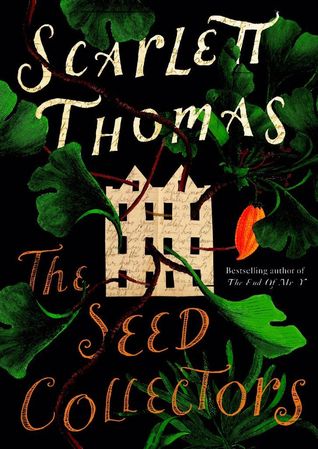 This offbeat novel about obsession, sex and inheritance is set in Kent in 2011 and stars an extended family of botanists. The concept of a family tree has a more than usually literal meaning here given the shared surname is Gardener and most members are named after plants. We have Great-Aunt Oleander, recently deceased; cousin Bryony and her children Holly and Ash; siblings Charlie and Clem (short for Clematis); and half-sister Fleur, who has taken over Oleander’s yoga center, Namaste House. The generation in between was virtually lost, perhaps to a plant-based drug overdose, on a seed collecting expedition to the South Pacific. Oleander has left each motherless child one of these possibly deadly seed pods.
Did I mention the book is saturated with sex? Incest, adultery, illegitimate children, S&M, Internet porn, you name it. But beyond that, the metaphorical language is highly sexualized – bursting with seeds, fertility and genital-like plants. I can’t think when I’ve encountered such oversexed vocabulary since D.H. Lawrence’s Sons and Lovers. Here’s a sampling:
Dave seems to be avoiding the clouds as he works the little plane up into the sky, penetrating it slowly, and really quite gently.
A surprising amount of plants look like dicks.
(of peat) It’s like walking on a giant’s pubes.
All lettuce wants is sex. And violence. Just like all plants. It wants to reproduce, and it wants to kill or damage its rivals so they don’t reproduce.
So many flowers are basically little sex booths.
And she was pulling him towards her, deeper into her, as if he were a flower and she an insect desperate for his cheap, sugary nectar.
Connections between characters morph and take on new dimensions as the book goes on. A few characters are unrealized, such as Fleur, which meant I felt slightly disconnected from them. (My ‘favorite’ in a book stuffed full of unlikable figures was probably Bryony, whose hunger for food, alcohol and shopping seems to be endless.) Likewise, not all the storylines are truly essential, so the book seems aimless for its final third; it definitely could have been shorter and tied together better, perhaps with some flashbacks to the previous generation’s experiences on the island to make the past feel more alive. The spiritual element remains vague, although there is a pleasant touch of magic realism along the way.
Despite these reservations, I truly enjoyed Thomas’s unusual writing. She moves freely between characters’ perspectives but also inserts odd second-person asides asking philosophical questions about wasted time and what is truly important in life. One peculiar little section even imagines the point-of-view of a robin in the garden of Namaste House, with made-up words fit for “The Jabberwocky”: “The man is, as always, incompt and untrig. He sloggers around his rooms in his black and grey ragtails like an elderly magpie.”
I like the range of questions you’re left with as a reader: Is nature malicious? Can we overcome our addictions? How much of who we are is down to our parentage? Does life really just come down to sex? The content of the novel might be reminiscent of A.S. Byatt and Andrea Barrett’s science-infused fiction or The World Before Us by Aislinn Hunter, but the style is totally different. I can’t even think who it reminds me of; it feels pretty one of a kind to me. Luckily this is Thomas’s sixth novel, so there’s plenty more for me to explore.
With thanks to Canongate for the free copy, won in a Goodreads giveaway.
My rating:
The A to Z of You and Me by James Hannah
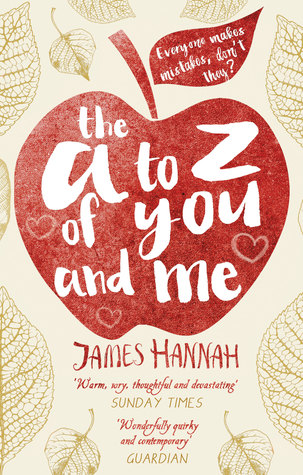 Lying in a hospice bed, 40-year-old Ivo looks back on his life. Even after just four short decades and a modest career at a garden center, he has plenty to regret. Hard partying and drug use exacerbated his diabetes and prompted kidney failure. His lifestyle also led indirectly to his girlfriend, a nursing student named Mia (the “you” whom he often addresses directly), leaving him. He’s estranged from his sister and the friends he’d been close to since school days, especially Mal. How did he mess up so badly and cut himself off so completely that he’s now dying alone? And how much can he put right before he goes?
There’s plenty of affecting writing in Hannah’s debut novel, as in one of my favorite passages: “The sun chooses this moment to radiate through to me, through me. It feels like – it feels like life. I can sense my corrupt blood bubbling and basking beneath the surface.” I also love how Hannah captures the routines of institutional life – the sights, smells and sounds that come to define Ivo’s circumscribed life:
Round the corner now. Noticeboard up on the right, pinned every inch over with flyers and leaflets. The papers at the bottom lift and flutter in the convection of the heater beneath.
I am lost in a world of regular hums, distant beeping, the periodic reheating of the coffee machine in the corridor, and that steady kazoo [of his next-door neighbor’s breathing].
Nurse Sheila and Amber, the daughter of another hospice patient, are great supporting characters. Sheila’s A to Z game, encouraging Ivo to think of a memory attached to body parts starting with each letter of the alphabet, provides a hokey but effective structure. As Ivo’s condition deteriorates and his thoughts are scrambled by morphine, his narration gradually becomes less coherent and more insular. This means that by the time we reach the conclusion (which somehow manages to be both predictable and shocking at the same time), we aren’t sure whether he’s giving a reliable account of events or imagining things.
Ultimately, I felt confused about what Hannah meant for the book to be. Is this Irvine Welsh lite? Or a Rachel Joyce style tear-jerker? It’s similar in setup to The Love Song of Miss Queenie Hennessy, you see, and the remembered relationship with Mia is rather sappy. However, keep in mind that in British English the letter Z is pronounced ‘zed’, so the title doesn’t rhyme, which keeps it from being overly twee. Another barrier to my appreciation of the novel was that I never understood why Ivo was dying. People don’t die of kidney failure nowadays, thanks to dialysis and transplantation. (I have a kidney disease, so I should know!)
I’d recommend this book to fans of Mark Haddon, David Nicholls and Donal Ryan. I’ll follow Hannah’s career and hope he can avoid melodrama and a contrived structure – the two near-pitfalls of this one – in the future.
With thanks to Transworld Books for the free copy, won in a Goodreads giveaway.
My rating: 
Review: Ruins by Peter Kuper
In the past few years I’ve made a conscious effort to get more into graphic novels. In that time I’ve discovered some real gems – highlighted in a previous post entitled “Graphic Novels for Newbies” – and Peter Kuper’s latest book, Ruins, is among my favorites. Kuper is a comics legend: he’s a long-time MAD Magazine illustrator and the author of more than 20 books, as well as a teacher at the School of Visual Arts in Manhattan.
 Ruins appealed to me because of its environmental theme, but I found so much more to love. I previewed it in my last post, “Books as Objects of Beauty,” because it’s a simply gorgeous physical book – what with the embossed title on the cover and spine, the red-edged pages, the built-in ribbon bookmark, and the entomological drawings on the endpapers. Luckily what’s inside is just as special as the packaging.
In essence, this is the bittersweet story of an American couple traveling from Manhattan to Oaxaca, Mexico for a sabbatical year. Samantha hopes to brush up on her Spanish, work on a book about Mexican history and legends, and finally get pregnant. George, recently laid off from his job as an entomologist at the Natural History Museum, is delighted with Oaxaca’s invertebrate life – leafcutter ants, edible grasshoppers, and a pesky scorpion – but not so convinced about having a baby; surely the world is too messed up to bring a new life into?
The novel’s small cast also includes Angelina, their housekeeper; another George, a British bookseller; and Al, a former photojournalist and heavy drinker who joins with our George to document the local teachers’ strike. We learn that Samantha has lived here before and has returned in part to exorcise tragic events from her past. The book’s title thus has many meanings in context: not only the ruined cities Samantha and George visit as tourists and the ruin corrupt Governor Ulises Ruiz Ortiz is currently making of the place, but also the decay of relationships old and new and the decline of the environment.
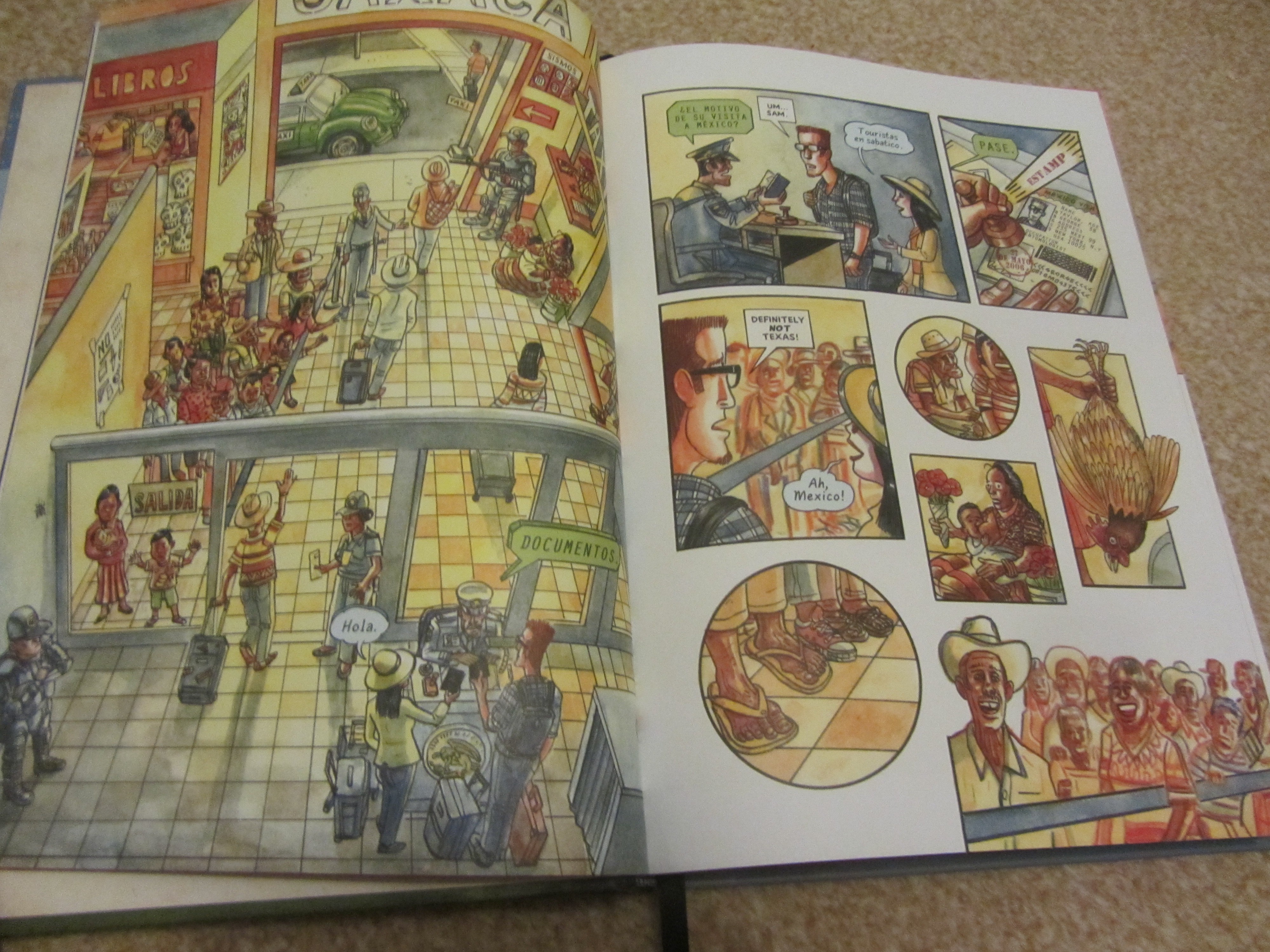
The colorful arrival at Oaxaca Airport.
The environmental agenda comes through in the parallel story of one monarch’s migration. Sections set in Mexico alternate with short interludes showing the butterfly’s journey south from America to Michoacan, Mexico, where monarchs gather en masse in a pine forest. The limited palette of these spreads, in contrast with the vibrant colors of the Oaxaca scenes, is particularly effective: the monarch is generally the only speck of color against a monochrome blue-gray background showing rather dreary American scenes. Tagged in Pennsylvania, the monarch flies over polluted rivers, a nuclear power plant, an abandoned West Virginian mine, the aftermath of Hurricane Katrina, Monsanto tomato pickers, a Texas border arrest, and a Mexican drug deal gone wrong – a symbol of precarious hope in spite of circumstance.
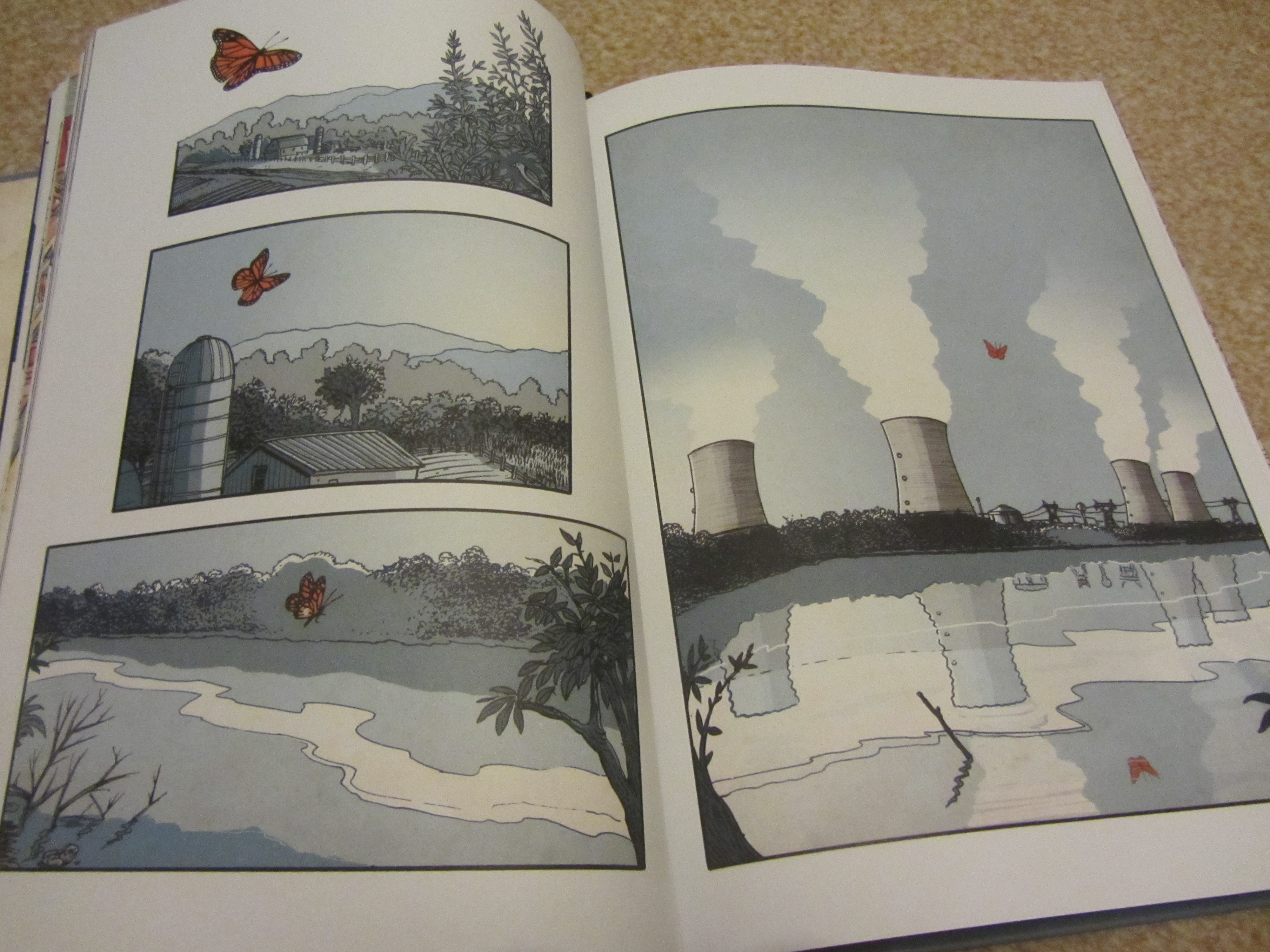
The tagged monarch flying over a polluted scene.
A Mexican folk belief has it that monarchs are the souls of dead children returning. At the end of the book a newly hatched butterfly starts its journey north – but what has become of our human heroes? That’s for readers lucky enough to get their hands on a copy of this wonderful book to find out.
Kuper and his family lived in Oaxaca from 2006 to 2008 and return annually for visits; you can see both familiarity and love in his terrific drawings of the city and its natural surroundings. Just as it tempers monochrome with color, Ruins carefully balances sadness and hope. If you think a graphic novel can’t sustain an involved and satisfying plot, think again. I’d especially recommend this to Barbara Kingsolver fans – the Mexican setting and monarch migration theme tie in with The Lacuna and Flight Behavior, respectively.
With thanks to the publisher, SelfMadeHero, for the free copy.
My rating: 
Review: The Looking-Glass Sisters, Gøhril Gabrielsen
Since discovering Peirene Press, a publisher of novellas in English translation (see my “Small Books Are Good, Too” post for a mini-review of one of their previous titles), I’ve been keen to try more of their little gems. This is the second of four novels from Gøhril Gabrielsen, a Norwegian author who lives in the far north of the country in a region called Finnmark. It’s an isolated place she uses to good effect in this novel about two sisters whose lives change – and not for the better – when one of them gets married.
I reign as queen in my room, in spite of the dust and the dirt. I have the silence, my pen and books, and, not least, I own the hours when Ragna is away.
 Our unnamed narrator is paralyzed from the waist down and keeps to her bed in a home she shares with her older sister, Ragna. Their parents had her late in life and died early, so Ragna has looked after her since they were 19 and 24. They are now in middle age, so for years have rubbed along reasonably well, although there have been small acts of cruelty on either side – for instance, as a child the narrator planted chewing gum in Ragna’s bed so she’d have her luxurious hair cut off, and Ragna stays in the bathroom so long one morning that the narrator, making her tortuous way downstairs on crutches, has an accident in the hallway.
Our unnamed narrator is paralyzed from the waist down and keeps to her bed in a home she shares with her older sister, Ragna. Their parents had her late in life and died early, so Ragna has looked after her since they were 19 and 24. They are now in middle age, so for years have rubbed along reasonably well, although there have been small acts of cruelty on either side – for instance, as a child the narrator planted chewing gum in Ragna’s bed so she’d have her luxurious hair cut off, and Ragna stays in the bathroom so long one morning that the narrator, making her tortuous way downstairs on crutches, has an accident in the hallway.
A short prologue tells us things have gotten worse: Ragna and her husband of less than one year, Johan, now keep the sister locked up in the attic. In the novella’s core section the narrator returns to the previous year, when Ragna and Johan were courting, to track the decline of this strange “little family with pus and pain in our cuts and scratches.” It all starts with her finding a letter Ragna wrote to a nursing home about committing her sister – and replacing it with a sheet of blank paper.
Our discontented narrator has a compulsion to remind everyone of her inconvenient existence: “I’m here. And I’m bloody hungry!” Whenever Ragna and Johan have friends visit, she is sure to make a scene. Her other acts of resistance are largely passive, though: writing snarky messages in the blank pages of encyclopedia volumes, listening on disapprovingly as Ragna and Johan have sex on the other side of the wall, and cursing Johan by burning his hair. Ragna follows suit by pettishly withholding library books and hot meals.
What we have here is essentially a psychological thriller with a claustrophobic domestic setting. Because we see everything from the narrator’s perspective, we share her sense of outrage at how Johan has upset her comfortable life and “sabotaged our sisterly pact.” At the same time, Gabrielsen implants tiny, clever clues that this is an unreliable narrator:
Can it be that I, the helpless one, have bred the anger in her by making myself more pathetic than I am? And can it be that I, in my struggle to gain the inviolable position of victim, have forged and fashioned Ragna the violator?
Furthermore, can it be that I, after years of exaggerated care needs, have robbed her of the ability to think, to create a living, inner life?
I can once more carry on my most precious occupation: lie on the pillows and twist the world exactly as I like.
Ultimately we have to wonder whether the person who has been telling us this whole story might be mentally compromised. How much of her mistreatment and present condition is she imagining? The way Gabrielsen counterbalances inherent trust in a narrator with skepticism as the story proceeds is remarkable. “I am reduced to an observing eye,” the protagonist tells us – and as readers we both see out of that eye and seek an objective outside view. It’s a gently thrilling book I’d recommend to you in the run-up to Halloween.
Peirene issues books in trios: this is part of the “Chance Encounter series: Meeting the Other,” along with Aki Ollikainen’s White Hunger and Raymond Jean’s Reader for Hire.
With thanks to Peirene Press for the free copy.
My rating:
My Salinger Year and Hotel Alpha
My Salinger Year by Joanna Rakoff
“Publishing, books, life. … It seemed possible to get one right. But not all three.”
 I’ve hardly read any Salinger, but that’s okay – neither had Joanna Rakoff until about two-thirds of the way through her year working for the legendary recluse’s literary agency in New York City. One long weekend she gorged on his complete works and found – in a man she’d previously encountered only as a shouting elderly voice on the phone – a kindred spirit.
This was 1996, and Rakoff was 23 years old, living with a boyfriend who didn’t appreciate her in a crummy apartment and harboring secret literary ambitions. On the cusp of the digital world, the Agency still resisted computers. Rakoff did most of her work on a typewriter and read manuscripts from the slush pile, extracting a couple of promising ones and getting a colleague to read her boyfriend Don’s unpublishable novel in turn. She had heavy student loans after graduate studies in London, and could barely afford a daily deli salad for lunch.
Mostly Rakoff spent her time typing form letters to Salinger’s fans, informing correspondents that he had asked not to have his letters forwarded. Believing she might make a difference, she went off-piste and started writing personal replies to some of the more wrenching letters: war veterans, struggling students, and a quiet young man who didn’t know what to do with his emotions. Alas, it backfired: more often than not she’d get an angry response, with the writer objecting to her presuming to take the place of Salinger and dispense life advice.
It’s remarkable how, at a distance of nearly 20 years, Rakoff makes this all seem like it happened yesterday: she adds in just the right amount of what Mary Karr, in The Art of Memoir, calls “carnal detail” to make her story seem timely and believable. The tone is nostalgic but also bittersweet – while it was a precious year, Rakoff also realizes what she could have done better (chiefly, ditching Don sooner).
Especially for female readers, this will instantly take you back to your own immediate post-college days of trying to figure out what life is about and who you wanted to be. “Was it possible, too, that one could be complicated, intellectual, awake to the world, that one could be an artist, and also be rosy and filled with light? Was it possible that one could be all those things and also be happy?”
With thanks to Bloomsbury for my free copy, won in a Facebook giveaway.
My rating:
Hotel Alpha by Mark Watson
 You may be unsurprised to learn there’s a touch of The Grand Budapest Hotel to this one. Hotel founder Howard York, though he sounds an awful lot like an Ayn Rand creation (i.e. Howard Roark, the architect-hero of The Fountainhead), is most like the Ralph Fiennes character. He uses his influence to finagle anything for a guest; “you could believe, sitting here in his castle, that he really did mean to live a couple of centuries and that everything he had built would still be standing around him.” But even he can’t stop tragedy; a fire at the hotel in the 1980s orphaned and blinded a small boy named Chas, who Howard then adopted.
The novel is told in alternating first-person chapters from Chas and Graham, the hotel concierge. Graham reminded me of Stevens in The Remains of the Day: very proper, even uptight, but with a hidden passion. Technology’s advance helps Chas immensely, but makes Graham feel superseded; “I have lived a great part of my own life in homage to my own past,” he acknowledges.
Key events take place between 2001 and 2005, with a historical backdrop including 9/11, the Olympic bid, and the 7/7 bombings. Chas works in PR and is involved with Kathleen, a journalist who’s opposed to the Iraq War. Howard, on the other hand, always supports the winning team and status quo. He is also a man of secrets. Why did Chas’s tutor, Ella, and Graham’s assistant, Agatha, both suddenly leave the hotel for America years ago? It all has to do with the legend of what happened the night of the fire, the truth of which will be exposed in time.
Watson is a stand-up comedian as well as the author of several novels. I like how he shows both the good and bad sides of technology here. My favorite part was Chas’s visit to China with Kathleen; even though he’s mostly stuck in a hotel, he still experiences extreme culture shock.
There are another 100 stories about the Hotel Alpha on the website, eight of which are printed as an appendix to the paperback edition. Much as I liked the main characters (especially Agatha), I didn’t think the two voices were distinctive enough – I wish Watson had incorporated more of the stories’ narrative variety (some first-person and some third-person) into the novel itself.
My rating: 
With thanks to Picador for my free copy, won in a newsletter giveaway.
 Bookish Beck = Rebecca Foster. American transplant to England. Freelance proofreader and book reviewer.
 Bookish Beck