The Smell of Fresh Rain by Barney Shaw
Petrichor: that would be the alternative title for this book about the often-neglected human sense of smell. In avoiding that lovely but obscure word, Barney Shaw is making a specific point: we don’t have an everyday vocabulary for talking about smells; there are specialist terms and concepts, but try to depict an ordinary scent in words and you may struggle.
I had just such an experience myself the other week. We’d bought a jar of Sun-Pat peanut butter at Sainsbury’s that didn’t taste or smell right, but no longer had the receipt to return it to the store. When I contacted the company on Twitter, my attempts to describe the problem were decidedly feeble: we’d bought a “duff jar,” I wrote; it tasted and smelled “off.” If pressed I would perhaps have used the word “stale,” but I had no way of conveying how exactly it didn’t taste or smell right. (Sun-Pat very kindly took my word for it and sent £10 worth of vouchers. The new jars we bought as replacements tasted better but still not the same as before: chances are they’ve recently changed the recipe to be cheaper.)
 I’m intrigued by the related senses of smell and taste in general, so I was delighted to find a whole book on the topic. Shaw, a retired civil servant who served as a private secretary to various government ministers, approaches the topic as an amateur enthusiast rather than a scientist, so his language is never overly technical and he ranges between history, anatomy, literature and even self-help.
Much of the book was researched “on location,” as it were. Shaw travels to Portsmouth to grasp the signature smells of the seaside; visits a hardware store to differentiate the odors of different metals (they release no smell on their own, only in contact with human skin/sweat); returns to his hometown to discover the smells associated with suburban gardens and different types of High Street shops; and sniffs at butcher stalls, pubs, and London Underground trains. With his son, blind from birth and autistic, he sets out to capture “the smell of 3 a.m.” as early-morning market sellers set out their mushrooms and cheeses.
Shaw also travels through time, imagining what it might have smelled like in the mid-nineteenth century or earlier: raw sewage, cooking smoke, animal dung, and laundries and tanneries with their reek of stale urine. Once many of those stinks were eliminated, bad smells became associated with the working classes (as in the work of Maugham and Orwell) or with foreigners, a continuing prejudice that fuels xenophobia. The book also traces the rise of the perfume industry and other artificial smells like scent diffusers and vaping. Shaw is uncomfortable with the idea of natural scents being replaced by synthetic ones, and notes the environmental consequences of our obsession with abolishing body odor: “The price we pay for hygiene and deodorants is in the pollution pumped out by a billion washing machines and … soap, toothpaste and washing powder flowing down to the seas.”
There are fascinating facts on pretty much every page of this book; I won’t bore you by listing them, but will just say that if you’re interested in exploring the connections between smell and memory in life and in literature, in discovering what makes the human sense of smell unique, and in learning some wine-tasting-style tips for describing odors, this is the perfect introduction. I noted a bit of repetition in the book, especially at chapter openings, but that didn’t keep me from being as enthralled with the subject matter as Shaw, a passionate tour guide to the olfactory world, so clearly is.
My rating:
The Smell of Fresh Rain was released in the UK on November 14th. My thanks to Victoria Reed at Icon Books for the free copy for review.
Other books referencing smell/taste that I have read or at least sampled:
- Season to Taste: How I Lost My Sense of Smell and Found My Way by Molly Birnbaum
- Cork Dork: A Wine-Fueled Adventure Among the Obsessive Sommeliers, Big Bottle Hunters, and Rogue Scientists Who Taught Me to Live for Taste by Bianca Bosker
- Parfums: A Catalogue of Remembered Smells by Philippe Claudel
- The Diary of a Nose by Jean-Claude Ellena
- A Smell of Burning: The Story of Epilepsy by Colin Grant
- Perfume: The Story of a Murderer by Patrick Süskind
Other smell-related titles on my TBR:
Nonfiction:
- Fragrant: The Secret Life of Scent by Mandy Aftel
- Taste, Memory: Forgotten Foods, Lost Flavors, and Why They Matter by David Buchanan
- The Perfect Scent: A Year Inside the Perfume Industry in Paris and New York by Chandler Burr
- The Case against Fragrance by Kate Grenville
Fiction:
- A Good Scent from a Strange Mountain and Perfume River by Robert Olen Butler
- The Scent of Water by Elizabeth Goudge
- The Smell of Other People’s Houses by Bonnie-Sue Hitchcock
- The Perfume Collector by Kathleen Tessaro
Jacob’s Room Is Full of Books by Susan Hill
Susan Hill has published dozens of books in multiple genres, but is probably best known for her perennially popular ghost story, The Woman in Black (1983). Apart from that and two suspense novellas, the only book I’d read by her before is Howards End Is on the Landing (2009), a sort of prequel to this work. Both are bookish memoirs animated by the specific challenge to spend more time reading from her shelves and revisiting the books that have meant the most to her in the past. Though not quite a journal, this is set up chronologically and also incorporates notes on the weather, family events and travels, and natural phenomena encountered near her home in Norfolk.
The Virginia Woolf reference in the title is fitting, as Hill realizes she has four shelves’ worth of books about Woolf and her Bloomsbury set. It’s just one of many mini-collections she discovers in her library on regular “de-stocking” drives when she tries to be realistic about what, at age 75, she’s likely to reread or reference in the future. “A book that cannot be returned to again and again, and still yield fresh entertainment and insights, is only half a book,” Hill contends. Some authors who merit frequent rereading for her are Edith Wharton, Muriel Spark, W. Somerset Maugham and Olivia Manning, while other passions had a time limit: she’s gone off E.F. Benson, and no longer reads about Antarctica or medieval theology.
 Hill is unashamedly opinionated, though she at least has the humility to ask what individual taste matters. Her substantial list of no-nos includes fairy tales, science fiction, Ethan Frome, Patricia Highsmith and e-readers, and she seems strangely proud of never having read Jane Eyre. She’s ambivalent about literary festivals and especially about literary prizes: they were a boon to her as a young author, but she was also on the infamous 2011 Booker Prize judging panel, and disapproves of that prize being opened up to American entries.
As well as grumpy pronouncements, this book is full of what seems like name-dropping: encounters with Iris Murdoch, J.B. Priestley, Susan Sontag and the like. (To be fair, the stories about Murdoch and Sontag are rather lovely.) Although aspects of this book rubbed me the wrong way, I appreciated it as a meditation on how books are woven into our lives. I took note of quite a few books I want to look up, and Hill ponders intriguing questions that book clubs might like to think about: Can we ever enjoy books as purely as adults as we did as children, now that we have to “do something” with our reading (e.g. discussing or reviewing)? Is it a lesser achievement to turn one’s own life experiences into fiction than to imagine incidents out of thin air? Will an author unconsciously “catch the style” of any writer they are reading at the time of their own compositions? Is it better to come to a book blind, without having read the blurb or anything else about it?
You’ll applaud; you’ll be tempted to throw the book at the wall (this was me with the early page disparaging May Sarton). Perhaps on consecutive pages. But you certainly won’t be indifferent. And a book that provokes a reaction is a fine thing.
Some favorite lines:
“Cold room, warm bed, good book.”
“I have had fifty-five years of experience but still every book is like walking a tightrope. I might fall off.”
“People say they can never part with a book. I can. As fast as I get one out of the back door, two new ones come in through the front anyway.”
“How many people are there living in the books here? Only take the complete novels of Dickens and add up all the characters in each one and then multiply by … and I already need to lie down. Overall, there must be thousands of imaginary people sharing this house with us.”
“One of the best presents anyone can give you is the name of a writer whose books they believe will be ‘you’ – and they are. Someone you would almost certainly never have found for yourself.”
My rating:
Jacob’s Room Is Full of Books was released in the UK on October 5th. My thanks to Profile Books for the free copy for review.
A Wood of One’s Own by Ruth Pavey
In 1999 Ruth Pavey bought four acres of Somerset scrubland at a land auction. It wasn’t exactly what she’d set out to acquire: it wasn’t a “pretty” field, and traffic was audible from it. But she was pleased to return to her family’s roots in the Somerset Levels area – this “silted place of slow waters, eels, reeds, drainage engineers, buttercups, church towers, quiet” that her father came from, and where she was born – and she fancied planting some trees.
There never was a master plan […] I wanted to open up enough room for trees that might live for centuries […] I also wanted to keep areas of wilderness for the creatures […] And I wanted it to be beautiful. Not immaculate, that was too much to hope for, but, in its own ragged, benign way, beautiful.
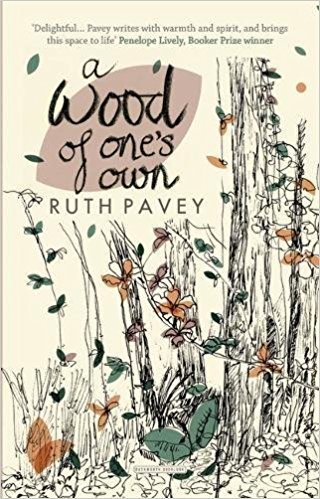 This pleasantly meandering memoir, Pavey’s first book, is an account of nearly two decades spent working alongside nature to restore some of her land to orchard and maintain the rest in good health. The first steps were clear: she had to deal with some fallen willows, find a water source and plan a temporary shelter. Rather than a shed, which would be taken as evidence of permanent residency, she resorted to a “Rollalong,” a mobile metal cabin she could heat just enough to survive nights spent on site. Before long, though, she bought a nearby cottage to serve as her base when she left her London teaching job behind on weekends.
Then came the hard work: after buying trees from nurseries and ordering apple varieties that would fruit quickly, Pavey had to plant it all and pick up enough knowledge about pruning, grafting, squirrel management, canker and so on to keep everything alive. There was always something new to learn, and plenty of surprises – such as the stray llama that visited her neighbor’s orchard. Local history weaves through this story, too: everything from the English Civil War to Cecil Sharp’s collecting of folk songs.
Britain has seen a recent flourishing of hybrid memoirs–nature books by the likes of Helen Macdonald, Mallachy Tallack and Clover Stroud. By comparison, Pavey is not as confiding about her personal life as you might expect. She reveals precious little about herself: she tells us that her mother died when she was young and she was mostly raised by an aunt; she hints at some failed love affairs; in the acknowledgments she mentions a son; from the jacket copy I know she’s the gardening correspondent for the Hampstead & Highgate Express. But that’s it. This really is all about the wood, and apart from serving as an apt Woolf reference the use of “one” in the title is in deliberate opposition to the confessional connotations of “my”.
 Still, I think this book will appeal to readers of modern nature writers like Paul Evans and Mark Cocker – these two are Guardian Country Diarists, and Pavey develops the same healthy habit of sticking to one patch and lovingly monitoring its every development. I was also reminded of Peri McQuay’s memoir of building a home in the woods of Canada.
What struck me most was how this undertaking encourages the long view: “being finished, in the sense of being brought to a satisfactory conclusion, is not something that happens in a garden, an orchard or a wood, however well planned or cultivated,” she writes. It’s an ongoing project, and she avoids nostalgia and melodrama in planning for its future after she’s gone; “I am only there for a while, a twinkling. But [the trees and creatures] … will remain.” This would make a good Christmas present for the dedicated gardener in your life, not least because of the inclusion of Pavey’s lovely black-and-white line drawings.
A Wood of One’s Own was published on September 21st by Duckworth Overlook. My thanks to the publisher for a free copy for review.
My rating:
Two Recommended Nonfiction Reads for October
Two very different but equally enjoyable selections for you this month:
American Wolf: A True Story of Survival and Obsession in the West by Nate Blakeslee
(Coming from Crown on the 17th)
 By the 1920s, wolves had almost been eradicated from the Lower 48 states. In 1995–6, though, two rival packs were brought in from Canada to repopulate Yellowstone National Park. Blakeslee gives a panoramic overview of the reintroduction project and the recurring clashes between hunters and biologists about whether wolves should be a protected species. He keeps his account relatable by focusing on particular family groups of wolves and bringing out the animals’ individual personalities.
One important wolf pack was the Druids, which “were like the Kennedys, American royalty.” O-Six, an alpha female of the third generation so named because she was born in 2006, is one of the main animal characters here, with two central human characters being Rick McIntyre, a long-time National Park Service ranger and wolf expert, and Steven Turnbull (an alias), an elk hunter from Crandall, Wyoming.
The 2011 federal budget snuck in a rider removing wolves from the endangered species list in Montana and Idaho. The same followed for Wyoming, heralding an open hunting season on wolves for the first time in 50 years. Though his sympathies are clear, Blakeslee doesn’t demonize those who killed Yellowstone wolves that strayed beyond the park boundaries. He also emphasizes that the battle over this species reflects a wider struggle “over public land—what it should be used for and who should have the right to decide.”
It’s especially interesting to read about the animals’ behavior: a wolf uncle hanging around to help raise the pups, O-Six fighting off grizzlies near her den, showdowns between packs, and pups hunting mice and ravens for fun.
My rating:
With thanks to the publisher for the free review copy.
Love and Laughter in the Time of Chemotherapy by Manjusha Pawagi
(Coming from Second Story Press on the 10th)
 It’s a rare book that can wring both laughs and (mostly happy) tears out of a cancer ordeal. I read a lot of books about illness, death and dying – subjects I can appreciate aren’t for anyone. Nevertheless, I can heartily recommend this to you for the Everywoman perspective on the cancer experience and rebuilding life on the other side. Pawagi is a family court judge and mother of twin teenagers in Toronto. She was diagnosed with leukemia in April 2014, went through two intensive rounds of chemotherapy, and then had a stem cell transplant from a donor from the South Asian immigrant community six months later.
This is a warts-and-all account of the treatment process – if it hurt like hell, if she wept into her pillow at night, if she felt like crap, she says so. Though not entirely without self-pity, the book transforms such feelings through a wry, atheist’s “why not me?” approach. In the lovely last chapter, the author meets her donor, a young man in New York City, and his relatives two years after her transplant and realizes that she’s unwittingly acquired not just a blood brother but a whole new extended family.
They may be clichés but they’re completely true in this case: this is a heart-warming and life-affirming read, and with any luck will encourage more people to become blood and organ donors. (See also this interview with Pawagi from Foreword Reviews.)
Some favorite lines:
“I want to wake up and be a judge again, not an overgrown diapered baby.”
“Hell is other people…in the hospital bed next to yours.”
My rating:
I read an e-ARC via NetGalley.
I also won an advanced Goodreads giveaway copy of a novel that came out in the States in June and will be released in the UK by Borough Press on the 5th, but I’m not sure it’s one I’d wholeheartedly recommend…
Stephen Florida by Gabe Habash
 You might think of Stephen Florida as an heir to Alexander Portnoy and Holden Caulfield (“I guess I should describe myself. No, I don’t want to do that”). A senior at North Dakota’s Oregsburg College, he’s obsessed with becoming a champion wrestler for the 133 weight class. He’s a loner, and his every attempt at connection with others falters. Stephen acts and speaks like a crazed preacher, and the more he goes off the rails the harder it is to figure out exactly what’s going on and how much you can trust this narrator. This struck me as a very male story that doesn’t have the same crossover appeal as works by John Irving or Chad Harbach. I would have enjoyed a short story or novella about this character and his self-destructive single-mindedness, but spending a whole novel with him creeped me out.
My rating:

Two in-your-face carnivores were on my reading stack at the same time. What are the odds?!
Other October releases I’m planning to read:
- In Shock by Rana Awdish (St. Martin’s, 17th)
- A Glorious Freedom: Older Women Leading Extraordinary Lives by Lisa Congdon (Chronicle Books, 3rd)
- Eco-Dementia [poetry] by Janet Kauffman (Wayne State University Press, 2nd)
- Hug Everyone You Know: A Year of Community, Courage, and Cancer by Antoinette Truglio Martin (She Writes Press, 3rd)
What October books do you have on the docket? Have you already read any that you can recommend?
The Diary of a Bookseller by Shaun Bythell
So you think you’d like to run a bookshop? Here’s a book to tempt and deter you in equal measure. In 2001 Shaun Bythell acquired The Bookshop, the flagship bookstore in Wigtown, the Book Town in Galloway in the southwest of Scotland. Here he gives a one-year snapshot of life at the shop, from February 2014 to February 2015. At the start you can feel the winter chill in the old granite building, and as months pass you sense mounting excitement at preparations for the annual Book Festival (going on now) and the Scottish referendum. It’s a pleasure to spend a vicarious year at the shop. This would make a great bedside book for a bookish type to parcel out 5–10 pages at a time (another Christmas gift idea?).
 Bythell frequently ventures out to buy book collections in auctions and from estates, and occasionally goes fishing with his father or friends. But mostly we see what daily life is like for a bookshop owner. He can’t afford full-time staff, so gets sporadic help from university-age gals; his most “reliable” part-timer is Nicky, a ski suit-wearing, Dumpster-diving Jehovah’s Witness who blithely ignores much of what he asks her to do.
Every entry opens and closes with statistics on the day’s takings and online orders. Profits range from £5 to £500 a day, rising in the summer and peaking around £1200 during the festival. Also listed is the number of customers who make purchases, which represents only one-fifth of daily footfall. Nowadays most bookstores sell online too, and The Bookshop reluctantly partners with Amazon as a marketplace seller. There’s also ABE and eBay; as a last-ditch option, some outfits take books in bulk, even if just to recycle them. Alongside online sales, it’s essential for bookstores to have sidelines. Bythell does video production and sells furniture, antiques and walking sticks carved by “Sandy, the tattooed pagan.”
As with Wendy Welch’s The Little Bookstore of Big Stone Gap, I enjoyed the nitty-gritty details about acquiring and pricing books, especially the serendipitous moments of coming across real treasures, like a book signed by Sir Walter Scott and a 1679 edition of the Decameron with an interesting provenance. The book is also full of quirky customer behavior, the kind of stuff that fills The Bookshop’s Facebook feed. Bythell cultivates a curmudgeonly persona – he once shot a broken Kindle and mounted it on the bookshop wall – and maintains a tone that’s somewhere between George Orwell (excerpts from whose “Bookshop Memories” serve as monthly epigraphs) and Jen Campbell (Weird Things Customers Say in Bookshops et al.). Here’s a few of the best encounters:
a whistling customer with a ponytail and what I can only assume was a hat he’d borrowed from a clown bought a copy of Paolo Coelho’s The Alchemist, I suspect deliberately to undermine my faith in humanity and dampen my spirits further.
A man smelling of TCP [antiseptic] was the only customer in the shop for the first hour of opening, during which time I attempted to put out fresh stock. He had an uncanny ability to be standing in front of every shelf to which I needed access, regardless of the subject or where in the shop the relevant shelves were.
While I was repairing a broken shelf in the crime section, I overheard an elderly customer confusing E. L. James and M. R. James while discussing horror fiction with her friend. She is either going to be pleasantly surprised or deeply shocked when she gets home with the copy of Fifty Shades of Grey she bought.
I’ve been to Hay-on-Wye six times now but haven’t made it to Wigtown yet. It’s high on my bookish wish list. I had two additional reasons for wanting to read this particular book: I’d read Three Things You Need to Know about Rockets, a memoir by Bythell’s former partner, the American Jessica Fox (here known as “Anna”; in her book he’s “Ewan”), about coming to Scotland on a whim and falling in love with a bookshop owner; and I’m awfully fond of The Bookshop Band, a folky husband–wife musical duo who this year relocated from Bath to Wigtown. It was such fun to read about their first time playing in Wigtown and their stay as the inaugural guests/temporary store managers via The Open Book Airbnb project.

Colin Kinnear [CC BY-SA 2.0 (https://creativecommons.org/licenses/by-sa/2.0)%5D, via Wikimedia Commons.
The Book Shop trivia:
- December is by far the quietest month. (“The few people who give second-hand books as gifts for Christmas are usually eccentric” – count me as one of them!)
- Railway books sell best.
- Terry Pratchett, John Buchan, P.G. Wodehouse and E.F. Benson books are also perennial best sellers.
- You’ll be amazed at how many customers try to haggle over prices. It’s a shop, not a rummage sale, for goodness’ sake! I can’t imagine ever having the cheek to offer less than the advertised price.
My rating:
The Diary of a Bookseller was released in the UK on September 28th. My thanks to Profile Books for the free review copy.
Ghent and Amsterdam, and What I Read
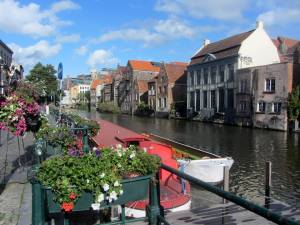
Ghent. Photo by Chris Foster
We got back on Monday from a packed week in Ghent and Amsterdam. Despite the chilly, showery weather and a slightly disappointing Airbnb experience in Ghent, it was a great trip overall. Our charming little B&B apartment in Broek in Waterland, a 20-minute bus ride from Amsterdam, more than made up for the somewhat lackluster accommodation in Belgium and was a perfect base for exploring the area. With our three-day, all-inclusive regional travel passes we were free to hop on as many trams and buses as we wanted.
On Saturday we crammed in lots of Amsterdam’s main attractions: the Rijksmuseum, the Begijnhof cloisters, the Botanical Gardens and the Anne Frank House, interspersed with window shopping, a rainy picnic lunch and an Indonesian takeaway dinner eaten by a canal. I also got to visit a more off-the-beaten-track attraction I’d spotted in our guide book: De Poezenboot or “The Cat Boat,” a home for strays moored on the Singel canal. Alas, the resident kitties were not as friendly as many we met on the rest of the trip, but it was still fun.


The highlight of our Amsterdam stay was the Van Gogh Museum on Sunday morning. It was crowded – everything was; though Ghent was very quiet, Amsterdam doesn’t seem to be into its off season yet, if it even has one – but we took our time and saw every single painting, many of which I’d never come across in reproductions. The galleries are organized in chronological order, so you get to trace Van Gogh’s style and state of mind over the years. Superb.
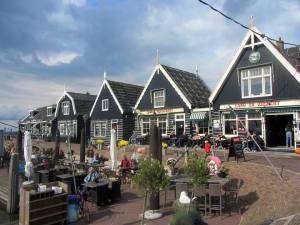
Marken. Photo by Chris Foster
At this point we were just about overwhelmed by the big city atmosphere, so we spent much of the next day and a half in the outlying Dutch towns of Marken and Edam. Flat fields and dykes, cows, cobbled streets and bicycles everywhere – it’s what you’d expect of Holland’s countryside, apart from a surprising dearth of windmills.


Bookish highlights:
- This Ghent University library – I’m presuming it held Special Collections/rare books:


- The American Book Center in Amsterdam:

Photo by Chris Foster
What I read:
 Pnin by Vladimir Nabokov: A comic novel about a Russian professor on an American college campus. While there are indeed shades of Lucky Jim – I certainly laughed out loud at Timofey Pnin’s verbal gaffes and slapstick falls – there’s more going on here. In this episodic narrative spanning 1950–4, Pnin is a figure of fun but also of pathos: from having all his teeth out and entertaining the son his ex-wife had by another man to failing to find and keep a home of his own, he deserves the phrase Nabokov originally thought to use as a title, “My Poor Pnin”.
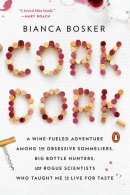 Cork Dork by Bianca Bosker: Bosker gave herself a year and a half to learn everything about wine in hopes of passing the Court of Master Sommeliers exam. Along the way she worked in various New York City restaurants, joined blind tasting clubs and attended an olfactory conference. The challenge included educating her palate, absorbing tons of trivia about growers and production methods, and learning accepted standards for sommelier service. The resulting book is a delightful blend of science, memoir and encounters with people who are deadly serious about wine.
 You Should Have Left by Daniel Kehlmann: And I thought my Airbnb experience was a nightmare? This is a horror novella about a writing retreat gone bad. The narrator is a screenplay writer who’s overdue delivering the sequel to Besties. As he argues with his partner, tries to take care of his daughter and produces fragments of the screenplay, the haunted house in the mountains starts to close in on him. I’ve loved Kehlmann’s work before (especially F), but he couldn’t convince me of the narrator’s state of mind or the peril. I actually found the book unintentionally humorous.
 The Detour by Gerbrand Bakker: A Dutch translator and Emily Dickinson scholar has fled a mistake in her personal life and settled in rural Wales at the foot of Snowdon. “She had left everything behind, everything except the poems. They would have to see her through. She forgot to eat.” On her farmstead is a dwindling flock of geese and, later on, a young man surveying for a new footpath. Amidst her quiet, secret-filled days we also learn of her husband’s attempts to find her back in Amsterdam. Bakker’s writing is subtle and lovely, yet the story never quite took off for me.
 Tulip Fever by Deborah Moggach: If you liked Girl with a Pearl Earring and The Miniaturist, you may also enjoy this atmospheric, art-inspired novel set in the 1630s. (Originally from 1999, it’s recently been adapted into a film.) Sophia, married off to an old merchant, falls in love with Jan van Loos, the painter who comes to do their portrait. If Sophia and Jan are ever to be together, they’ll have to scrape together enough money to plot an elaborate escape. I thought this was rather soap opera-ish most of the way through, though I was satisfied with how things turned out in the end.
Plus other books I had on the go (lots of short works and literature in translation):
 Dangling Man by Saul Bellow
- Diary of a Bookseller by Shaun Bythell
- Madame Bovary by Gustave Flaubert
- The Unseen by Roy Jacobsen
- The Bus Driver Who Wanted to Be God and Other Stories by Etgar Keret
- Notes on a Banana: A Memoir of Food, Love and Manic Depression by David Leite
- The Fact of a Body: A Murder and a Memoir by Alexandria Marzano-Lesnevich
- Honeydew: Stories by Edith Pearlman
- A Girl Walks into a Book: What the Brontës Taught Me about Life, Love, and Women’s Work by Miranda Pennington
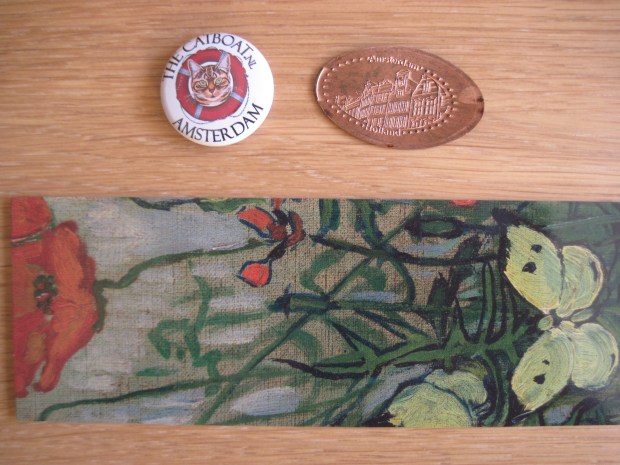
Extremely cheap souvenirs of Amsterdam to add to my collections: a badge, a pressed coin, and a Van Gogh bookmark.
What have you been reading recently?
Do you find that books read ‘on location’ never quite live up to your expectations?
Spinning by Tillie Walden (A Graphic Memoir)
I’m uncomfortable with the term “graphic memoir,” which to me connotes a memoir with graphically violent or sexual content. However, it seems to be accepted parlance nowadays for a graphic novel that’s autobiographical rather than fictional. Tillie Walden’s Spinning is in the same vein as Alison Bechdel’s Fun Home and Craig Thompson’s Blankets: a touching coming-of-age story delivered through the medium of comics.
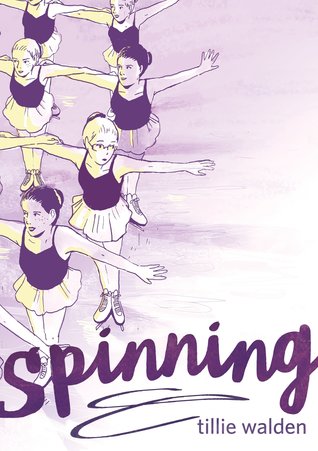 Specifically, this is about the 12 years Walden spent in the competitive figure skating world. She grew up in New Jersey, and when the family moved to Austin, Texas the bullying she’d experienced in her previous school continued. Mornings started at 4 a.m. when she got up for individual skating lessons; after school she had synchronized skating practice at another rink.
These years were full of cello lessons, unrequited crushes and skating competitions she rode to with her friend Lindsay and Lindsay’s mother. The femininity of the skating world – the slicked-back buns and thick make-up; the way every girl was made to look the same – chafed with Walden because she’d known since age five that she was gay. All told, she was disillusioned with what once seemed like her whole life:
Skating changed when I came to Texas. It wasn’t strict or beautiful or energizing any more. Now it just felt dull and exhausting. I couldn’t understand why I should keep skating after it lost all its shine.
Every chapter is named after a different skating move: waltz jump, axel, camel spin, etc. Walden’s drawing style initially reminded me most of This One Summer by Jillian and Mariko Tamaki, which is also about teens finding their way in the world and shares the same mostly purple and gray coloring. Walden’s work is more sketch-like, and also includes yellow on certain pages. The last third or so of the book is the most momentous: between when Walden comes out at 15 and when she gives up skating at 17.
Believe it or not, Walden was born in 1996 and this is her fourth book. She’s already won two Ignatz Awards. I felt this book would have benefited from more hindsight: time to mull over her skating experience and figure out what it all meant. The Author’s note at the end struck me as particularly shallow, like this project was about quick catharsis rather than considered reflection. However, the book’s scope (nearly 400 pages) is impressive, and Walden is adept at capturing the emotional milestones of her early life.
Published in the UK on September 12th. With thanks to Paul Smith of SelfMadeHero – celebrating its 10th anniversary this year – for the free copy for review.
My rating:
Writing for Bliss by Diana Raab
For Diana Raab, writing has been a way of coping with all that life has thrown at her, starting with her grandmother’s suicide and also including her daughter’s drug addiction and two bouts with cancer. She’s written poetry, memoir, and various books on the writer’s craft, with the latest, Writing for Bliss, specifically centered around life writing and mindfulness. In particular, I could see this one being helpful supplementary reading for those who have enjoyed Francine Prose’s Reading like a Writer and Mary Karr’s The Art of Memoir.
 Some keywords Raab emphasizes are patience, journey, healing, and transformation. Writing is often a long process, but it can also be a therapeutic one. It’s important to find a sacred space of one’s own – whether literal like Virginia Woolf’s room of one’s own, or simply a repurposed space that has been made conducive with candles and family photos. Raab encourages would-be memoir writers to look at the patterns in their lives and to focus on writing about moments that are relevant to the story of their personal growth.
As to the nitty-gritty of getting words onto the page, she insists that life writing is just as much about storytelling as fiction is. Fleshing out a story is more important than chronological accuracy, and she advises striving for a mixture of narrative, dialogue, scenes and reflection so that the resulting book does not seem like just a list of facts and events.
Raab also issues warnings. One is about causing offense by revealing family secrets. She suggests consulting the family members you intend to write about beforehand, and later running a rough draft past them for their approval. Another is about the danger of seeking one’s self-worth in publishing. Not all books lead to traditional publication, so it’s better if you write out of love and for yourself, simply because you find fulfillment in creativity.
This is a practical as well as a theoretical guide: 50 writing prompts are dotted through the text, and there’s also an appendix full of more. I’m someone who doesn’t necessarily aspire to write fiction, so I usually skip over such sections in a book about writing, but I think many of these could make a great launch pad for writing a personal essay. The book also ends with a terrific 15-page inventory of further reading, including a list of recommended memoirs.
My rating:
Writing for Bliss was published by Loving Healing Press on September 1st. My thanks to the author for the free e-copy for review.
I’ve hoarded a number of books about writing on my Kindle, including:
- The Hero Is You by Kendra Levin
- Scratch, ed. by Manjula Martin
- Part Wild by Deb Norton
- Process by Sarah Stodola
Have you read any of these? What other books about writing have you read that you can vouch for?
I’ve read a lot of the classics – Dorothea Brande, Stephen King, Anne Lamott et al. – but I’m always interested to hear what similar books people have found to be helpful.
Four Recommended September Releases
Here are four enjoyable books due out this month that I was lucky enough to read early. The first two are memoirs that are linked by a strong theme of mothers and children, though one has a primary topic of mental illness; the third is a quirky bibliomemoir partially written in letters; and the last is an elegant poetry collection. I’ve pulled 150–200-word extracts from my full reviews and hope you’ll be tempted by one or more of these.
Gorilla and the Bird: A Memoir of Madness and a Mother’s Love, by Zack McDermott
(Coming from Little, Brown [USA] and Piatkus [UK] on the 26th)
 As a public defender in New York City, Zack McDermott worked with seemingly crazy people every day at Legal Aid, little knowing that he was on his way to a psychotic break himself. Soon he’d covered the walls of his apartment with marker scrawl and fully taken on his stand-up comedian persona, Myles. Convinced that he was in a Truman Show-style reality show, he ended up half-naked and crying on a subway platform. That’s when police showed up to take him to Bellevue mental hospital.
McDermott takes readers on a wild tour through his life: from growing up with a no-good drug addict father and a Superwoman high school teacher mother in Wichita, Kansas “a baloney sandwich throw from the trailer park” to finally getting medication and developing strategies that would keep his bipolar disorder under control. His sense of pace and ear for dialogue are terrific. Despite the vivid Cuckoo’s Nest-style settings, this book is downright funny where others might turn the subject matter achingly sad. It’s a wonderful memoir and should attract readers who don’t normally read nonfiction. (An explanatory note: “Gorilla” is McDermott’s nickname and “The Bird” is his mother’s; she’s the real hero of this book.)
My rating:
Landslide: True Stories, by Minna Zallman Proctor
(Coming from Catapult on the 19th)
 This gorgeous set of autobiographical essays circles through some of the overarching themes of Proctor’s life: losing her mother, a composer – but only after three bouts with cancer over 15 years; the importance Italy had for both of them, including years spent in Tuscany and her work as a translator; a love for the work of Muriel Spark; their loose connection to Judaism; and the relentless and arbitrary nature of time. She ponders the stories she heard from her mother, and the ones she now tells her children. “We all have totemic stories. The way we choose them—and then choose to tell them—is more important ultimately than the actual events.” Proctor provides a fine model of how to write non-linear memoir that gets to the essence of what matters in life.
Another favorite line:
“I was never good at making stuff up; I’m much more interested in parsing the density, inanity, confusion, and occasional brilliance of life around me.”
My rating:
Dear Fahrenheit 451: Love and Heartbreak in the Stacks, by Annie Spence
(Coming from Flatiron Books on the 26th, and in the UK on Oct. 13th)
Dear Annie Spence,
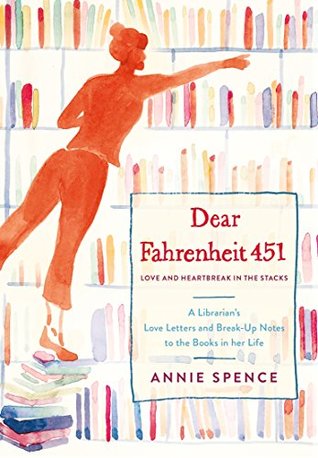 You’re on your way to being the next Nancy Pearl, girlie. Your book recommendations are amazeballs! How have you read so many books I’ve never even heard of?! Thanks to you I’ve added 13 books to my TBR when I’m desperately trying to cull it. Argh!
Anyway, gotta be honest here: I wasn’t digging the snarky, sweary style of the letter section of your book. True, it’s super clever how you use the epistolary format for so many different purposes – to say sayonara to books weeded from your public library’s stock, declare undying love for The Virgin Suicides and other faves, express mixed feelings about books you abandoned or didn’t get the appeal of, etc. – but, I dunno, the chatty, between-girlfriends style was irking me.
But then I got to Part II, where you channel Ms. Pearl and the authors of The Novel Cure with these original suggestions for themed and paired reading. Here’s books to read after making various excuses for not joining a social event, recommended sci-fi and doorstoppers (aka “Worth the Weight”), etc. I freakin’ loved it.
When’s your full-length Book Lust-style thematic recommendations guide coming out??
Happy reading until then!
Bookish Beck
My rating:
Panicle, by Gillian Sze
(Coming from ECW Press on the 19th)
 Gillian Sze is a Montreal poet with five collections to her name. Panicle contains many responses to films, photographs, and other poems, including some classical Chinese verse. Travel and relationships are recurring sources of inspiration, and scenes are often described as if they are being captured by a camera. There are a number of prose paragraphs, including the “Sound No. 1–5” series. As lovely as the writing is, I found few individual poems to latch onto. Two favorites were “Nocturne,” which opens “When I can’t sleep I think of the lupines that grow in the country, their specific palette, a mix of disregard and generosity” [the line breaks are unclear in my Kindle book], and “Dawning.” My favorite lines were “memory is a wicker chair that creaks in the wind” (from “To the Photographer in the Countryside”) and “I age / as it is typically done: slowly / unconsciously / surprisingly” (from the title poem).
My rating:
In case you’re curious, here are some September releases I can’t recommend quite as highly, with links to my Goodreads reviews:
- bone by Yrsa Daley-Ward [poetry]
- Afterglow (a Dog Memoir) by Eileen Myles
- George and Lizzie by Nancy Pearl

Have you read any September releases that you would recommend? Which of these appeal to you?
Some Accidental Thematic Overlaps in My Recent Reading
Five of the books I’ve read recently (most of them while traveling to and from the States) have shared an overarching theme of loss, with mental illness, alcoholism, suicide, and dogs as subsidiary topics running through two or more of them. I hadn’t deliberately chosen these books for their commonalities, so it was uncanny to see the same elements keep popping up. I wanted to come up with some kind of impressively complex Venn diagram to show off these unexpected connections but couldn’t quite manage it, so you’ll have to imagine it instead.
Mental Illness
The Archivist by Martha Cooley
 Matthias Lane is the archivist of the Mason Room, a university collection of rare books and literary papers. One of its treasures is a set of letters that passed between T.S. Eliot and his friend Emily Hale (held at Princeton in real life). Matt is haunted by memories of his late wife, Judith, a poet incarcerated in a mental hospital for over five years. A reckoning comes for Matt when he’s approached by Roberta Spire, a graduate student determined to view the Eliot–Hale letters even though they’re legally sealed until 2020. The more time Matt spends with Roberta, the more similarities start to arise between her and Judith; and between his situation and Eliot’s when the latter also put his wife away in a mental hospital. The novel asks what we owe the dead: whether we conform to their wishes or make our own decisions.
The Summer without Men by Siri Hustvedt
 Thirty years on, poet Mia Fredricksen’s husband Boris asks her for a pause in their marriage so he can explore his feelings for his young French lab assistant. First things first: Mia goes crazy and ends up in a mental hospital for a short time. But then she sucks it up and goes back to her Minnesota hometown to teach poetry writing to teen girls for a summer, getting sucked into a bullying drama. This is a capable if not groundbreaking story of the shifts that occur in a long marriage and the strange things we all do as we face down the possibility of death. There are also wry comments about the unappreciated talents of the female artist. However, compared to the other two novels I’ve read from Hustvedt, this seemed feeble. Still, a quick and enjoyable enough read.
The Dogs of Babel by Carolyn Parkhurst
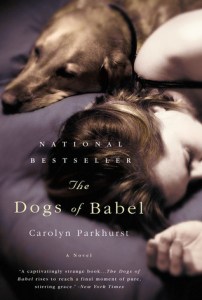 A delicious debut novel intellectual enough to bypass labels like ‘women’s fiction’ and ‘mystery’. One thing that sets it apart is how successfully Parkhurst writes from the perspective of a male narrator, Paul Iverson, who’s been knocked for six by the sudden death of his wife Lexy, a mask designer. While he was at the university where he teaches linguistics, she climbed to the top of the apple tree in their backyard and – what? fell? or jumped? The only ‘witness’ was their Rhodesian Ridgeback, Lorelei; in his grief Paul uses his sabbatical to research efforts to teach dogs to communicate, hoping one day Lorelei might tell all. Woven through are scenes from Paul and Lexy’s courtship and marriage; though Lexy occasionally struggled with her mental health, their dialogue is fun and zippy, like you might hear on The Gilmore Girls.
Suicide
The Archivist by Martha Cooley & The Dogs of Babel by Carolyn Parkhurst


Alcoholism
Don’t Let’s Go to the Dogs Tonight by Alexandra Fuller
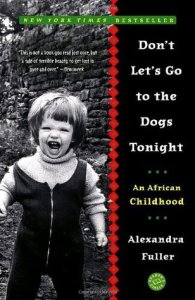 A classic memoir that conjures up all the sights, sounds, smells and feelings of Africa on the cusp of a colonial to postcolonial transition. Fuller’s family were struggling tobacco and cattle farmers in Rhodesia (Zimbabwe), Malawi and Zambia. She had absorbed the notion that white people were there to benevolently shepherd the natives, but came to question it when she met Africans for herself. While giving a sense of the continent’s political shifts, she mostly focuses on her own family: the four-person circus that was Bobo (that’s her), Van (older sister Vanessa), Dad, and Mum (an occasionally hospitalized manic-depressive alcoholic who lost three children) – not to mention an ever-changing menagerie of horses, dogs and other pets. This really takes you away to another place and time, as the best memoirs do, and the plentiful black-and-white photos are a great addition.
Let’s Take the Long Way Home by Gail Caldwell
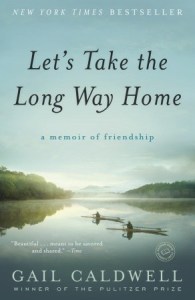 If you loved Ann Patchett’s Truth and Beauty, pick this up immediately. It’s a similar story of best friends: one who dies and one who survives. Caldwell’s best friend was Caroline Knapp (author of Drinking: A Love Story, among other nonfiction), whom she met via puppy ownership in Cambridge, Massachusetts. They were both single and childless, full-time authors with a history of alcoholism. Besides long walks with their dogs, they loved swimming and rowing together. In 2002 Caroline was diagnosed with stage-four lung cancer, inoperable and already metastasized. Despite all their proactive optimism, she was dead a matter of weeks later. In this moving and accessible short memoir, Caldwell drifts through her past, their friendship, Caroline’s illness, and the years of grief that followed the loss of Caroline and then her beloved Samoyed, Clementine, sharing what she learned about bereavement.
Dogs
The Dogs of Babel, Don’t Let’s Go to the Dogs Tonight & Let’s Take the Long Way Home


 Bookish Beck = Rebecca Foster. American transplant to England. Freelance proofreader and book reviewer.
 Bookish Beck