Settling in, aka Organizing My Bookshelves
We moved into our new rental house a week and a half ago. For most of that time my husband has been away in Devon for work, which created the perfect opportunity for me to have free rein in organizing the place – clothes, framed photos, toiletries, desk supplies: yeah, sure, all that; but really, my focus was always on the books.
I thought I had the perfect plan: general fiction in our bedroom; classics and literary reference books in the spare room/office; and the rest in the lounge on a big bookcase divided into one shelf biographies, one shelf nature, one shelf religion, and one shelf travel. This system quickly broke down. For one thing, we actually have three or more shelves’ worth of nature books, more than a shelf each of most other nonfiction genres, and way more fiction than would ever fit on one small Ikea Billy.
The result has been some inevitable dividing and jumbling. Much as I didn’t want to do so, I’ve had to put some books on their sides on top of rows, and I had to double stack the religion shelf. I made three shelves of nature and travel combined, but put the travel guidebooks and the nature field guides in separate places. Fiction ends up scattered in several places, including priority stacks on our bedside tables plus one shelf devoted to novels I mean to get to soon.
Ultimately we’re going to have to get another bookcase, but I’m pretty pleased with the results thus far. Here’s a peek:
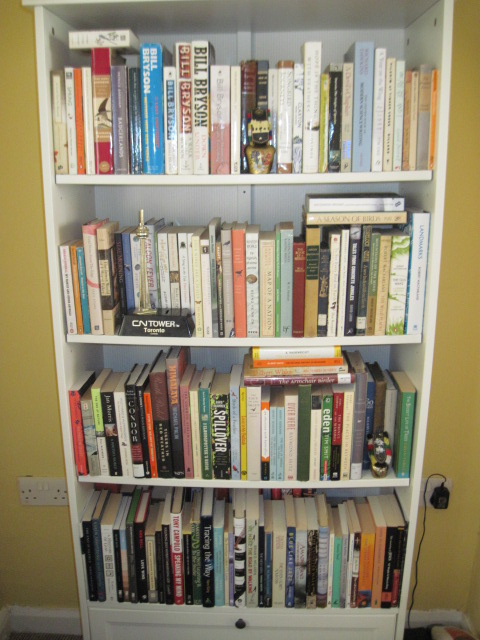
Lounge unit: three shelves of mixed nature and travel (alphabetical by author); one double-stacked shelf of religion.

Bedroom bookcase: general fiction (all but one of which I have read!) with areas on the bottom shelf for oversized graphic novels and science/nature books. On top are various nature field guides.
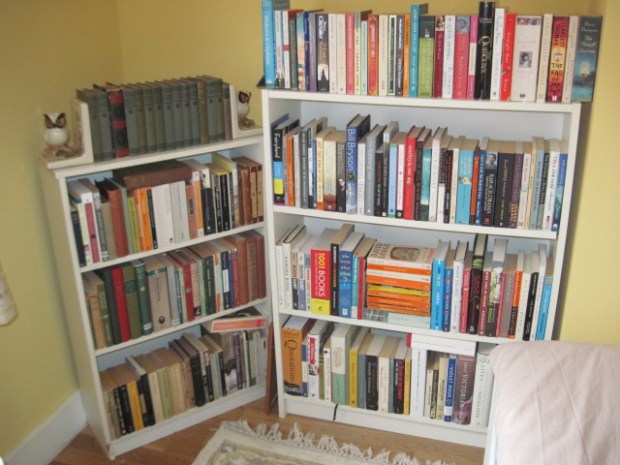
Spare room/office bookcases. Left: classics and poetry (Dickens set on top); right: top shelf of priority fiction, second shelf of biographies, third shelf of literary reference and generally nonfiction (divided by some Penguin paperbacks), and a bottom shelf of more literary reference and biography.

Overflow area (on office desk shelves): travel guides; mixed reference and humor; paperback fiction that doesn’t fit elsewhere.
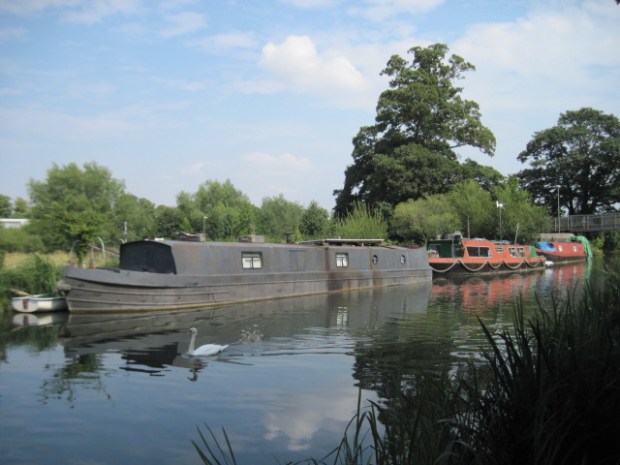
I’ve been enjoying my walks into town along the Kennet & Avon canal. Up until Tuesday we were without Internet at home, so I had to make daily excursions to the lovely public library to do my editing work. It’s great watching life on a canal change: some houseboats seem permanent, while others drift in and out from day to day; the swans and ducks are always on the move, looking out for their next wheaten snack; and every time I walk the tow path I notice something new, like a large stand of hops. Home brew, anyone?
After several years of not having access to our own outdoor space, we now have as much garden as we could ever want. The back door lets out onto a large stone patio, followed by a grassy area with a rotary washing line, a huge combined storage shed and summer house (too warm now, but should be a perfect reading spot next month); an emptied pond, some pear and plum trees and a bench; blackcurrant and raspberry bushes; a second shed (currently inaccessible due to a wasp’s nest); a dilapidated vegetable bed; a compost heap; a cuttings area; more grass; some scrub; and finally the secluded gate onto the canal path. Every time you think you’ve gotten to the end, it just keeps going. At some point it’s going to represent an awful lot of work, but for now I’m just in awe of the space and the sense of freedom.
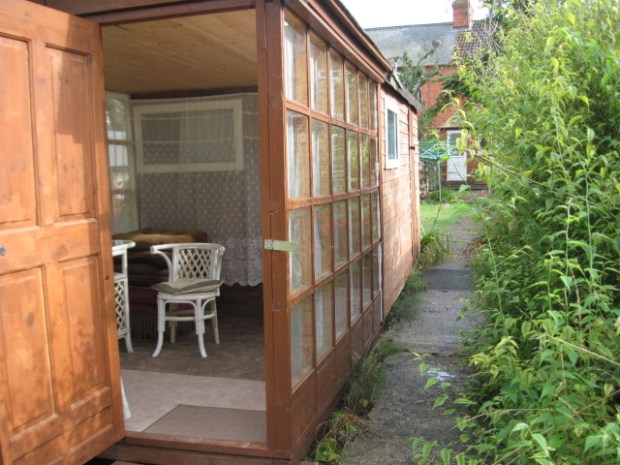
Looking back from the summer house.
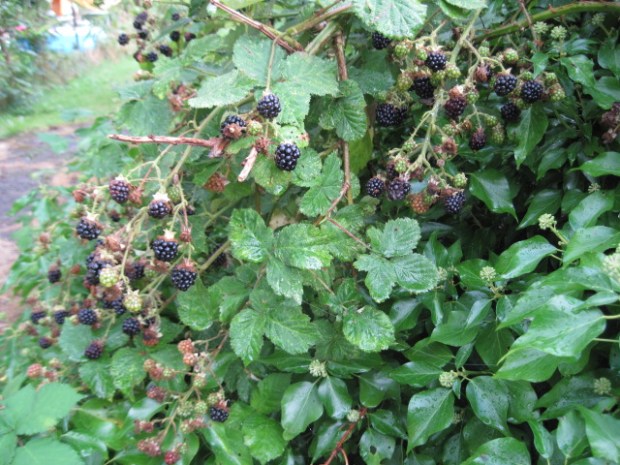
We’re having the mildest of heat waves here in southern England, but the signs of autumn are poking through – especially the ripening fruit you see everywhere. We have lots of ready blackberries in the garden; add to that some foraged plums, pears and apples and we’ll soon have the makings of a hearty crumble with which to welcome our first guests this weekend.
What’s your strategy in organizing your bookshelves?
Does it feel like autumn where you are?
Watch the Movie or Read the Book?
It’s a risky business, adapting a well-loved book into a film. I’m always curious to see how a screenwriter and director will pull it off. The BBC generally does an admirable job with the classics, but contemporary book adaptations can be hit or miss. I’ve racked my brain to think of cases where the movie was much better than the book or vice versa, but to my surprise I’ve found that I can only think of a handful of examples. Most of the time I think the film and book are of about equal merit, whether that’s pretty good or excellent.
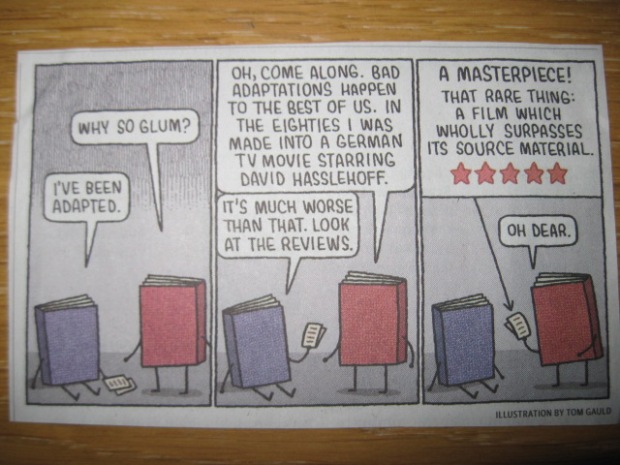
From one of my favorite Guardian cartoonists.
Watch the Movie Instead:
Birdsong [Sebastian Faulks] – Eddie Redmayne, anyone? The book is a slog, but the television miniseries is lovely.
One Day [David Nicholls] – Excellent casting (though Rafe Spall nearly steals the show). Feels less formulaic and mawkish than the novel.
 Father of the Bride and its sequel [Edward Streeter] – The late 1940s/early 1950s books that served as very loose source material are hopelessly dated.
This Is Where I Leave You [Jonathan Tropper] – Again, perfect casting. Less raunchy and more good-natured than the book.
Read the Book Instead:
 Possession [A.S. Byatt] – This is one of my favorite novels of all time. It has a richness of prose and style (letters, poems, etc.) that simply cannot be captured on film. Plus Aaron Eckhart couldn’t act his way out of a paper bag.
Everything Is Illuminated [Jonathan Safran Foer] – The movie’s not bad, but if you want to get a hint of Foer’s virtuosic talent you need to read the novel he wrote at 25.
A Prayer for Owen Meany [John Irving] – The film version, Simon Birch, was so mediocre that Irving wouldn’t let his character’s name be associated with it.
It’s Pretty Much Even:
Decent book and movie: Harry Potter and the Sorcerer’s Stone, The Help, The Hours, Memoirs of a Geisha, Never Let Me Go, The Remains of the Day
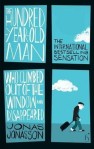 Terrific book and movie: The Fault in Our Stars, The Hundred-Year-Old Man Who Climbed out of the Window and Disappeared (Swedish language), The Orchid Thief / Adaptation (both great but in very different ways!), Tamara Drewe (based on a graphic novel, which itself is based on Far From the Madding Crowd)
If I’m interested in a story, my preference is always to watch the movie before I read the book. If you do it the other way round, you’re likely to be disappointed with the adaptation. Alas, this means that the actors’ and actresses’ faces will be ineradicably linked with the characters in your head when you try to read the book. I consider this a small disadvantage. Reading the book after you’ve already enjoyed the storyline on screen means you get to go deeper with the characters and the plot, since subplots are often eliminated in movie versions.
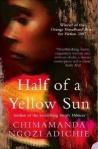 So although I’ve seen the films, I’m still keen to read Half of a Yellow Sun and The Kite Runner. I’m eager to both see and read The English Patient and The Shipping News (which would be my first by Proulx). All four of these I own in paperback. I’m also curious about two war novels being adapted this year, Billy Lynn’s Long Halftime Walk and The Yellow Birds. There’s every chance I’d like these better as movies than I did as books.
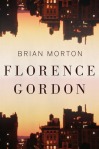 As to books I’m interested in seeing on the big screen, the first one that comes to mind is Kitchens of the Great Midwest by J. Ryan Stradal. It might also be interesting to see how the larger-than-life feminist heroines of Siri Hustvedt’s The Blazing World and Brian Morton’s Florence Gordon would translate for cinema. Can you think of any others?
What film adaptations have impressed or disappointed you recently? Do you watch the movie first, or read the book first?
Music to Read and Write By
I usually can’t read while music is playing; the exception is if we’re on a long car journey – my husband needs to have peppy music playing to keep alert while he’s driving, so I have to find a Kindle book or two that I can zone out with. In day-to-day life, though, I tend to read in silence. If I find myself a little dozy and want to stay awake to get more pages read or edited, my music choices tend to be wordless: a classical compilation, or some instrumental folk. However, here’s another exception: I can read and work very well to Sigur Rós, an Icelandic indie/post-rock group who sing in Icelandic and/or Hopelandic, their invented language. For some reason Jónsi’s ethereal falsetto just washes over me and I can turn off the part of my brain that tries desperately to make English sense out of the words.

Writing is another matter. Unless I urgently need to concentrate – for instance, if I’m writing my first article for a new venue and feeling daunted and inadequate (cough, LARB, cough) – I almost always have music playing. I often turn to albums I know very well: they provide good cheer but aren’t distracting, so make for good background music. My most played tracks of all are from three playlists I made for my sister around the time of her husband’s death. I chose songs that would be meaningful and even uplifting without being in any way sappy. Examples: “The Drugs Don’t Work” (The Verve), “The Heart of Life” (John Mayer), “P.S. You Rock My World” (Eels) and “All Possibilities” (Badly Drawn Boy).
I recently discovered the play count feature on Windows Media Player and had great fun going through and seeing which individual songs and whole albums I’d played the most in the couple of years I’ve used my secondhand laptop. In some cases I was surprised, but most of these artists I could have predicted:
My 17 Most Played Albums:
Fading West, Switchfoot (32 plays)
Flat Earth Diary, Krista Detor (30 plays)
Memory Man, Aqualung (30 plays)
The Take-off and Landing of Everything, Elbow (25 plays)
You Knows It, Folk On (25 plays)
One Wild Life: Soul, Gungor (25 plays)
Barely, Krista Detor (24 plays)
Collapsible Lung, Relient K (24 plays)
Carrie & Lowell, Sufjan Stevens (23 plays)
Sparks, Imogen Heap (20 plays)
Havoc and Bright Lights, Alanis Morissette (17 plays)
Chocolate Paper Suites, Krista Detor (16 plays)
With Love, Rosie Thomas (16 plays)
Ghost Stories, Coldplay (15 plays)
Born and Raised, John Mayer (15 plays)
The Impersonator, Marc Martel (15 plays)
This Earthly Spell, Karine Polwart (15 plays)
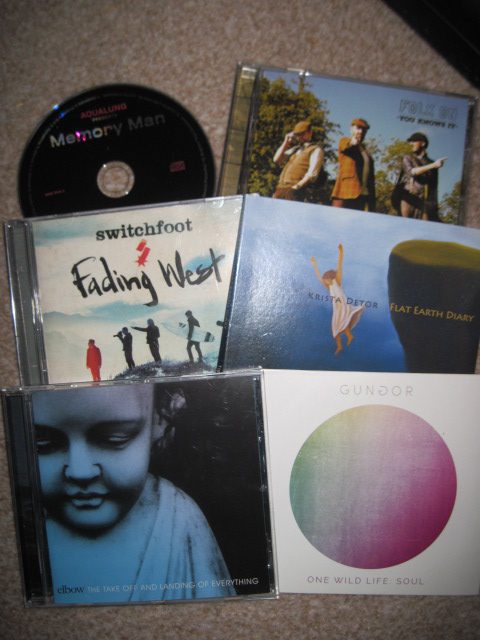
Of course, this mostly just tells you my listening tastes. But I’d like to think these artists hit a good balance of upbeat and mellow, catchy and contemplative. Or just plain daft, in the case of comedy folk trio Folk On. If I’m feeling particularly nostalgic, my inclination might be to play albums that defined the late 1990s or early 2000s for me, from artists like Matchbox 20, Snow Patrol, Coldplay, Sting and The Verve. (Not represented on this list, but I feel like I play them all the time: Bell X1, The Bookshop Band, Duke Special, and The Shins.)
Can you read or write to music? What are some of your favorite albums to work by?
We’re moving on Monday and may be without home Internet access for a week, so I’ll be scheduling a few posts ahead in case I can’t devote much time to blogging.
Bookish Time-Wasting Strategies
Being self-employed has certainly helped me develop better self-motivation and self-discipline, but that doesn’t mean I can’t still procrastinate with the best of them. When I do, though, I try to keep it book-related. Here are ten of my chief time-wasters:
- Requesting advance books via NetGalley and Edelweiss. I really don’t need any more books, but I can’t resist trawling the online listings to see what’s coming out in the next few months. It feels like a special treat to get to read favorite authors’ new books before they’re technically released – I have the new Jonathan Safran Foer, Maria Semple and Alexandra Kleeman books lined up to read soon.
- Checking out The Bookbag’s and Nudge’s offerings for reviewers. The same goes for these: more print ARCs on the pile is the last thing I need, but I simply have to know what they have for reviewers to choose from. Sometimes I come across books I’d never heard of, or ones I thought were only available in America. Still, I am trying to be very choosy about what I volunteer for.
- Browsing Goodreads giveaways. I’m going to sound like a broken record – I seem incapable of resisting free books, wherever they come from. Every few weeks I spend an hour or two occasionally switching over to the Goodreads giveaways page while I’m doing other things online. It takes some persistence to wade through all the rubbish to get to the entries for proper books you’d actually be interested in owning, but it can be worth it. Over the years I’ve won 49 books through Goodreads.
- Catching up on Twitter. I follow a ton of publishers, authors and publicists on Twitter. I am very bad about using the site regularly – I usually only remember to go on it when I have a blog to promote, and otherwise find it rather overwhelming – but when I do I often find information about a bunch of new-to-me books and see competitions to enter. I’ve won a couple of books and tote bags this way.
- Sorting through book-related clippings. I keep a file folder of clippings, mostly from the Guardian, related to books I think I’m likely to read. Every so often I go back through the file to find reviews of books I’ve read in the meantime, recycle ones I’m no longer interested in and so on.
- Rearranging my bedside books. Pretty much the same books have been on my nightstand shelves all year, but I’m constantly adjusting the piles to reflect their level of priority: review books are at the top, in chronological order by deadline; other rough piles are planned sets of reading. I take some glee in arranging these groups – adding a memoir here and a work of historical fiction there – all the while imagining how well they’ll complement each other.
- Organizing my Goodreads shelves. In addition to the standard “to read,” “read,” and “currently reading” shelves, I’ve set up a few dozen customized ones so that it’s easy for me to search my collection by theme. Recently I decided “illness and death” was a bit too broad of a descriptor so set up some more specific categories: “bereavement memoirs,” “cancer memoirs,” “old age,” etc.
- Culling the books on my Kindle. The digital collection is currently at 259 books. Every so often I take a long hard look at the e-books I’ve amassed and force myself to be honest about what I will actually read. If I don’t think I’m likely to read a book within the next year, I delete it. (These are all books I’ve downloaded for free, so it’s not like I’m throwing money away.)
- Looking up prices on webuybooks.co.uk. If you’re based in the UK, you probably already know about this website. I resell a bunch of books via Amazon, but sometimes the going rate is so low that you’re better off selling things as a job lot to WeBuyBooks. Their offer is often reasonable, and they frequently run deals where you can increase it by 10%. You box up the books and they send a courier to collect them from your front door – what could be easier?
- Ticking off books from lists. I don’t actively seek out books from 1001 Books You Must Read before You Die or the Guardian’s “1000 novels everyone must read” lists, but maybe once a year I go back through and tick off the ones I happen to have read recently.
Do you have any bookish time-wasting strategies? Do share!
Book Spine Poetry, Take Two
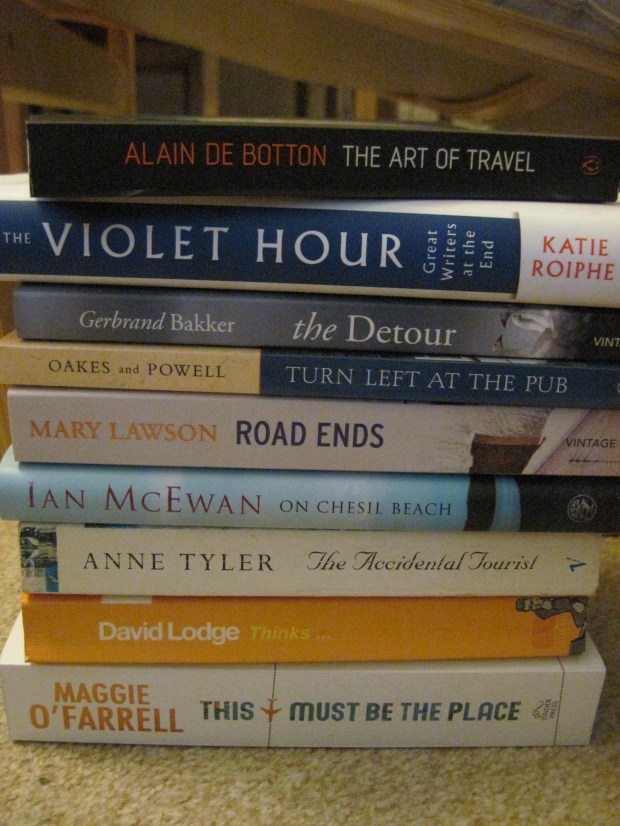
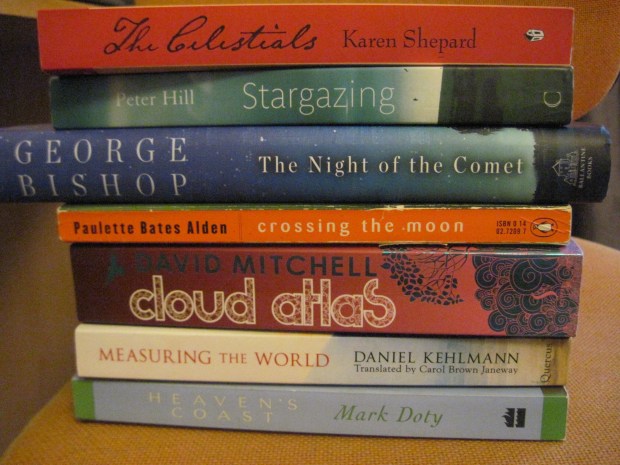
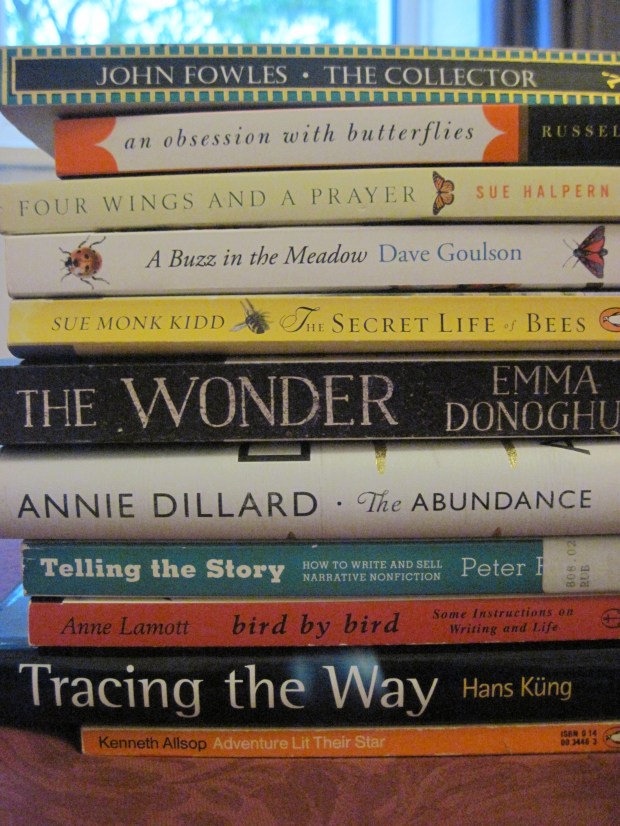
I had so much fun with the last round of book spine poetry, and so many leftover ideas, that I just had to give it another shot. The themes this time include travel, arson, astronomy, natural history and my own little romance. Let me know what you think.
The art of travel
The violet hour,
The detour:
Turn left at the pub,
Road ends
On Chesil Beach.
The accidental tourist
Thinks…
This must be the place.
Casualties
How to set a fire and why:
Out of sheer rage.
An exclusive love;
All passion spent.
Red sky at night:
The blazing world
Scarlet and black.
Home is burning –
Everything must change.

The celestials
Stargazing
The night of the comet
Crossing the moon
Cloud atlas
Measuring the world
Heaven’s coast
The collector
An obsession with butterflies
Four wings and a prayer
A buzz in the meadow
The secret life of bees
The wonder,
The abundance –
Telling the story
Bird by bird
Tracing the way
Adventure lit their star.
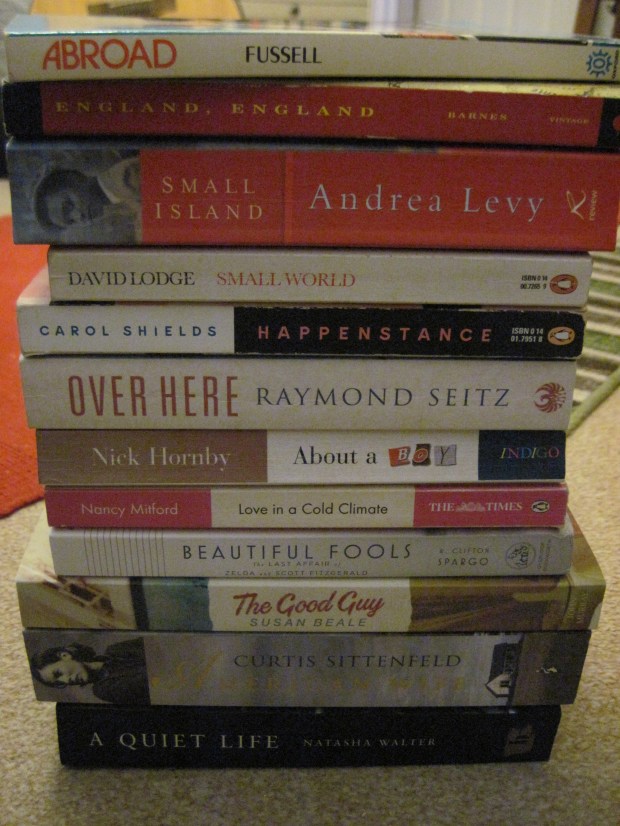
Dedicated to my husband; our ninth anniversary is coming up in just over two weeks.
Abroad
England, England –
Small island,
Small world.
Happenstance:
Over here
About a boy.
Love in a cold climate:
Beautiful fools
(The good guy,
American wife)
A quiet life.
Random Searches that Led People to My Blog
Something quick and lightweight for a Saturday…
One of my favorite things to keep an eye on in WordPress is the “Top Searches” (beneath the Stats table on the Dashboard). I always find it interesting, and often pretty bizarre, what random web searches led people to my blog. Two searches that seem to be perennially popular are for images of women reading and the novel The Girl Who Slept with God. And then there is the handful of slightly dodgy ones…
My blog’s top searches for the past two and a half months:
March 8, 2016: seal morning rowena farre, war & peace 2016 mini series masonic influence, did roman soldiers sodomize jesis?, ann kidd taylor 2015
March 11: orthodox hymns in bbc war and peace, public domain woman reading
April 4: ann kidd taylor wedding, caught again bondage
April 13: rebecca carter london book fair, ice cream driver name in girl who slept with god
April 15: let the empire down goodreads alexandra oliver poet, what is d nature of poetry
April 21: the girl who slept with god review, the penny heart martine bailey, public domain photographs elena ferrante
May 5: picture of ladies and girls reading in public, bookcycle
May 9: beck site female picture hd, barbara pym vicar and widow
May 21: women reading picture
My Life in Book Quotes
I keep an ongoing Word file with details on my year’s reading: books finished with the date, number of pages, and source – similar information to what’s recorded on Goodreads – plus any quotations that particularly stood out to me. It occurred to me that by looking back through these annual book lists for the quotes that meant the most to me I could probably narrate my recent years. So here are the 2015–2016 quotes that tell my story.

Career
“I’m learning that what’s important is not so much what I do to make a living as who I become in the process. … the heroine, when at a juncture, makes her own choice—the nonheroine lets others make it for her.”
(A Year by the Sea: Thoughts of an Unfinished Woman, Joan Anderson)
“The dishes. The dishes! The goddamn dishes! No wonder women don’t succeed.”
(The author’s mother’s explosion in The Year My Mother Came Back, Alice Eve Cohen)
“Success says, What more can I get?
Craft says, Can you believe I get to do this?”
(How to Be Here: A Guide to Creating a Life Worth Living, Rob Bell)
“Amateurs look for inspiration; the rest of us just get up and go to work.”
(Everyman, Philip Roth)
Finding a Home
“In Orcadian, ‘flitting’ means ‘moving house’. I can hear it spoken with a tinge of disapproval or pity: the air-headed English couple who couldn’t settle.”
(The Outrun, Amy Liptrot)
“Where, after we have made the great decision to leave the security of childhood and move on into the vastness of maturity, does anybody ever feel completely at home?”
(A Circle of Quiet, Madeleine L’Engle)
“there is no such thing / as the right route or a clear passage / no matter where you start, / or how you plan it.”
(from “Aneurysm,” Selected Poems, Kate Clanchy)
Life vs. Books
“He had accepted that if you were a bookish person the events in your life took place in your head.”
(Golden Age, Jane Smiley)
“my way of seeing has always been different, shyer. To see the world I’ve always opened a book.”
(The Violet Hour: Great Writers at the End, Katie Roiphe)
“Other people’s lives, and the lives I read about in books, seem richer, mine seems so threadbare.”
(The Past, Tessa Hadley)
Overthinking
“She remembered finding her first white hair somewhere near her thirtieth birthday and it had sent her on a tailspin for half a day. It’s starting, she’d thought then. The follicle that produced that hair is dying. I’ve reached the tipping point and from now on it’s nothing but slow decline.”
(Dog Run Moon: Stories, Callan Wink)
“All the most terrifying Ifs involve people. All the good ones do as well.”
(A Little Life, Hanya Yanagihara)
“I wished then, and still do, that there was something in me also that would march steadily in one road, instead of down here or there or somewhere else, the mind running a net of rabbit-paths that twisted and turned and doubled on themselves, pursued always by the hawk-shadow of doubt.”
(Now in November, Josephine Johnson – to be reviewed here within next couple weeks)
Book Spine Poetry
April is National Poetry Month, so I thought I’d try my hand at some book spine poetry. Thanks to Naomi at Consumed by Ink and Cathy at 746 Books for the fun idea! I have taken the liberty of adding punctuation between some lines, but the book titles themselves appear exactly as on the spines. This has been a fun project to do a bit at a time over the last couple of weeks – it’s always a nice break from my editing and more analytical writing.
Peruse your own shelves or the local library’s and have a go. It’s an easy way to get creative!
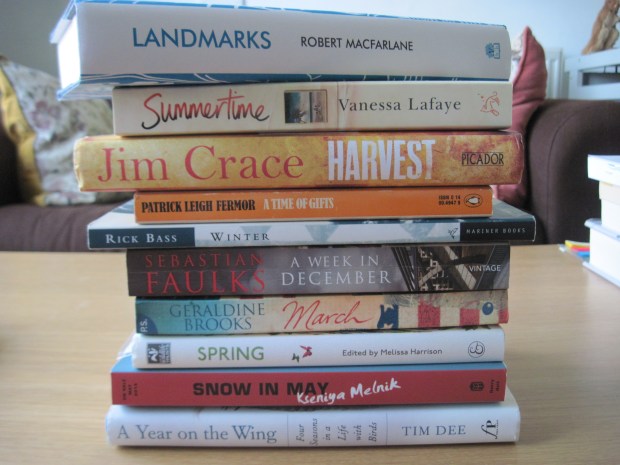
The years go by so fast…
Landmarks
Summertime
Harvest
A time of gifts
Winter
A week in December
March
Spring
Snow in May
A year on the wing
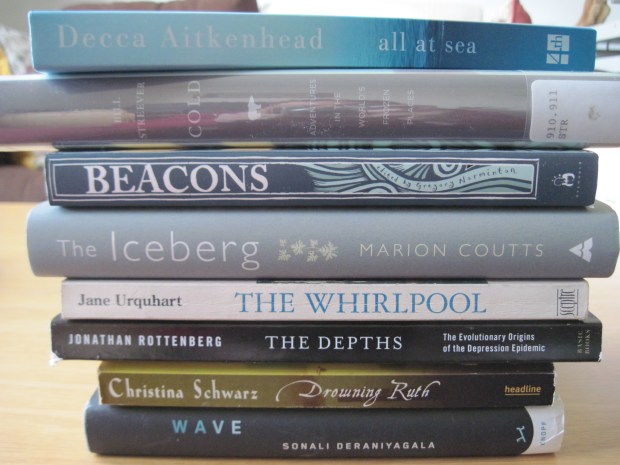
A morbid little number, with a riff on Stevie Smith:
All at sea
Cold beacons:
The iceberg,
The whirlpool,
The depths.
Drowning Ruth,
Wave.
Memento mori:
In fond remembrance of me
How to read a graveyard:
A tour of bones,
Mostly harmless.
Last night on earth?
Nothing to be frightened of.

Thanks to my husband, we have a ton of bird-themed books. The concluding line from Emily Dickinson makes this one a bit of a cheat.
Adventures among birds
To see every bird on earth:
The secret lives of puffins,
Last of the curlews,
The life of the skies.
Rare encounters with ordinary birds:
Songbird journeys,
An eye on the sparrow,
The goldfinch.
Falcon fever:
The armchair birder
Feeding the eagles,
Chasing the wild goose.
Hope is the thing with feathers.

An attempt to lay the groundwork for some progressive theology:
How (not) to speak of God
Jesus among other gods:
Atonement?
Blessed assurance?
Everything is illuminated?
The nice and the good
Crossing to safety?
A new kind of Christianity
The story we find ourselves in.
An unquiet mind
Until I find you.
Love wins;
No man is an island;
We make the road by walking.

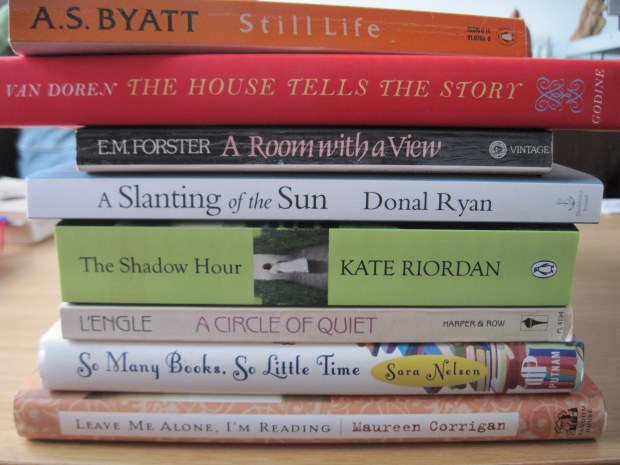
This one’s my favorite – a tribute to my peaceful days spent working from home.
Still life
The house tells the story:
A room with a view
A slanting of the sun
The shadow hour
A circle of quiet.
So many books, so little time;
Leave me alone, I’m reading.
A Book-Themed Concert and Goody Bag
On Saturday my husband and I headed to Hungerford to see The Bookshop Band for the second time. A year and a half ago I first had the chance to see them live at the 2014 Hungerford Literary Festival, when they gave a performance tied in with Rachel Joyce’s release of The Love Song of Miss Queenie Hennessy.
The band formed about five years ago to provide music for author events at their local bookshop, Mr B’s Emporium of Reading Delights in Bath, England. Since then they’ve written somewhere between 120 and 150 songs inspired by books. Their basic genre is indie folk, with plenty of guitar, ukulele and cello as well as a bunch of improvised percussion and three intermingled voices. Depending on the book in question, though, the feel can vary widely, ranging from sweet to bizarre or haunting. Especially when I’ve read the book being sung about, it’s intriguing to see what the musicians have picked up on – often something very different from what I would as a reader and reviewer.
 This year the band (now down to two members) is making an effort to record and release all their songs in 10 albums. I participated in a crowdfunding project so am lucky enough to receive all their new releases in digital format before they’re available as printed CDs. The first album is Curious and Curiouser, the title track of which was inspired by Alice in Wonderland. Other sets of songs are based on A Midsummer Night’s Dream and the steampunk novel The Strange Affair of Spring Heeled Jack by Mark Hodder, while “Once Upon a Time,” a commission for radio, strings together famous first lines from fiction.
My favorite Bookshop Band song (so far) is “Bobo and the Cattle,” inspired by Alexandra Fuller’s Don’t Let’s Go to the Dogs Tonight. Two great ones new to me from Saturday’s performance were “Faith in Weather,” based on Central European fairy tales, and “You Make the Best Plans, Thomas,” about Hilary Mantel’s Bring Up the Bodies.
You can listen to lots of their songs on their Bandcamp page and dozens of videos of their performances are on YouTube and Vimeo (I’ve linked to several above). When performing events they often get the authors to play with them: Louis de Bernières pitched in with mandolin on a song about The Dust that Falls from Dreams, and Yann Martel played glockenspiel while promoting The High Mountains of Portugal.
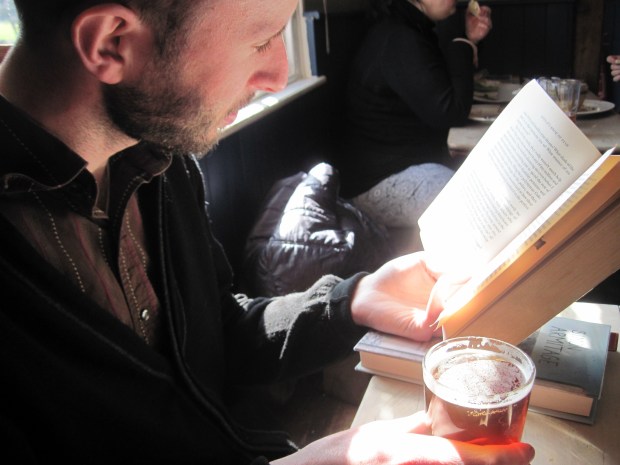
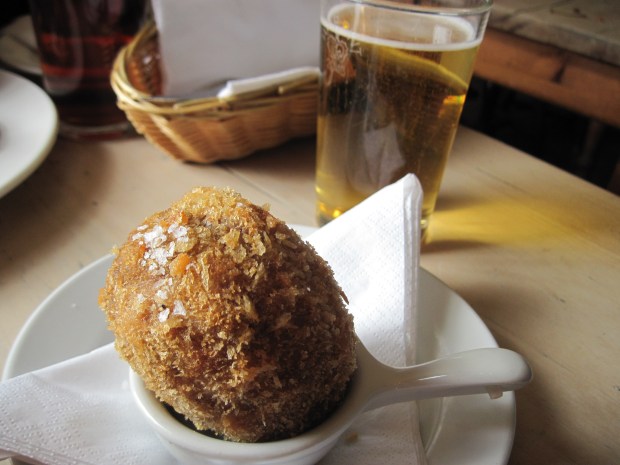
We had started off the day with lunch at a Berkshire country pub, The Pot Kiln, where we didn’t mind the 40-minute wait for food because we had books and half-pints of beer and cider to while away the time over as sunshine poured through the windows. The menu is mostly based around game shot by the chef himself in the fields opposite the pub, so we indulged in a venison and wild boar hot dog and venison Scotch eggs before setting off on a windy several-mile walk near Combe Gibbet and then continuing on to Hungerford.
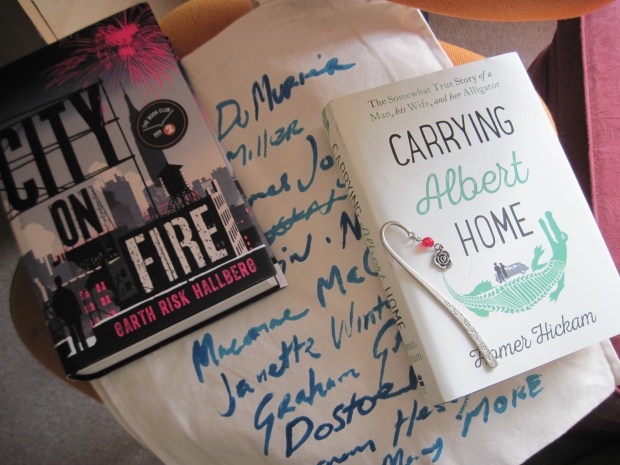
Now for the goody bag: on the venue tables the owner of Hungerford Bookshop had placed a ten-question literary quiz to work on and hand in during the intermission. I was fairly confident on some of my answers, had a guess at the others, and after literally about 45 minutes of wrestling with anagrams finally figured out that “Lobbing Slates” gives the name of novelist Stella Gibbons. We won with 7 out of 10 correct; an elderly lady joked that we’d Googled all the answers, but I pointed out that we don’t own a smartphone between us! Now, I suspect we were actually the only entry, but that doesn’t diminish our accomplishment, right?! I was delighted to win a couple of free books I hadn’t necessarily intended on reading but now certainly will, plus a metal bookmark and a notebook, all in a limited-edition “Books Are My Bag” tote designed by Tracey Emin.
All in all, a fantastic and mostly bookish day out!
If you live in the UK and get the chance, don’t hesitate to go see The Bookshop Band play; they’re touring widely this year.
It’s the One-Year Anniversary!
Today marks one year exactly that I’ve had this blog. In that time I’ve posted 80 times, for an average of 6.67 posts per month. To start with I only managed 2 or 3 posts a month, but from July I picked up the pace and recently I’ve been trying to manage at least twice a week.
My most liked posts were Literary Tourism in Manchester, The Best Fiction of 2015: My Top 15, Final Stats for 2015, and my Early One Morning review.
The posts that generated the most discussion were: “How Many Books Is Too Many? (to be reading at once),” my review of The Novel Cure, and (tied for third) The Best Fiction of 2015 and my review of The Goldfinch.
My most ever views were on December 29th, when I published a list of My Favorite Nonfiction Reads of 2015.
So far I’ve had 3,018 visitors and 5,438 views.
I thought that at some point my ideas would dry up, but I currently have four posts in progress and a three-page Word file full of ideas for more, so as long as people are still interested, I’ll keep going.
Thanks to everyone who has supported me this past year by visiting the site, commenting, re-tweeting, and so on. You make it worthwhile!
Let me know how you like my redesign and new features, and if there’s anything else you’d like to see from this blog.
 Bookish Beck = Rebecca Foster. American transplant to England. Freelance proofreader and book reviewer.
