Bloggers’ Opinions Must Not Be Bought: A Cautionary Tale
I’m leery of accepting self-published work for review. If this is prejudice on my part, it’s not unjustified: I’ve reviewed hundreds of self-published books during my four years of freelance work for Kirkus, Foreword, BlueInk, Publishers Weekly, and The Bookbag, and although I do find the very occasional gem that could hold its own in a traditional market, the overall quality is poor. When self-published authors get in touch via my blog, I usually delete their enquiries immediately. But for some reason I decided to give a second look to a request I received through Goodreads earlier this year. (All identifying details have been removed.)
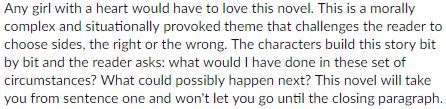
I’ll admit it: the flattery probably helped:
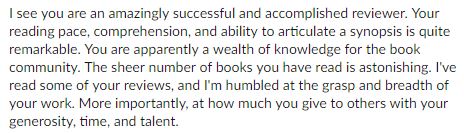
This was for a historical novel that had 4-star reviews from two Goodreads friends whose judgment I trust, so I agreed to have the author send a copy to my parents’ house in the States so that it would be waiting for me there when I arrived for my recent trip. When I opened the box, two alarm bells rang at once. First there was this. Uh oh.

Second of all: the author had taken the trouble of looking up restaurants in my parents’ area and ordered a $60 gift card from one of them to send along with the book parcel. Double uh oh.
I spent weeks wondering what in the world I was going to do about this ethical quandary. I even contacted a Goodreads friend who’d reviewed the book and asked what their experience with the author had been like. The reply was very telling:
I still feel unsettled over my interaction with [name redacted]. I’ve always made it a point not to review unsolicited books. But over a period of several weeks, [they] sent me a number of emails that ranged from flattering to fawning – and always polite and charming. Eventually, I, too, received a $60 gift card to a favorite restaurant that was within blocks of my home. I ended up, I believe, 4 starring [the] book, although the truth is that it was more of a 3-star read. Since reviewing, I have valued my independence – and honesty – and since then, have had the uncomfortable feeling of being “bought”, and for a low price at that.
I cannot tell you what to do. Obviously, I feel as if my own values were compromised. For me, it wasn’t worth what I still believe is a blot on my integrity. If you do decide to review, I’d simply encourage you to be honest because (I learned the hard way) the aftermath isn’t a good feeling.
Well, I’d promised to review the book, so I forced myself to open it, pencil in hand. After I’d corrected 10 problems of punctuation and grammar within the first six pages, I commenced skimming. There were some decent folksy metaphors and a not-half-bad dual narrative of a young woman’s odyssey and a small town’s feuds. But there were also dreadful sex scenes, melodramatic plot turns, and dialogue and slang that didn’t ring true for the time period. If I squinted pretty darn hard, I could see my way to likening the novel to the works of Ron Rash and Daniel Woodrell. But it wasn’t by any means a book I could genuinely recommend.
So when the author checked up a couple of months later to see whether I had gotten the book and what I thought of it, here’s what I replied:

I received the following abject apology, but no helpful information.

To my brief follow-up –

– I received this:
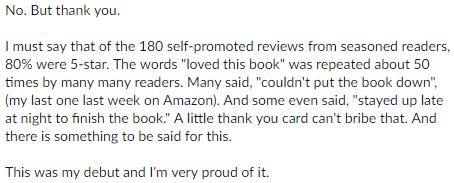
Note the phrase “self-promoted” and the meaningless repetition of “couldn’t put it down!”
And then they went on to disparage me for my age?!

I don’t believe for a minute that this person was ignorant of what they were doing in sending the gift cards. What’s saddest to me is that they have zero interest in getting an honest opinion of the work or hearing constructive criticism that could help them improve. They clearly don’t respect professionals’ estimation, either, or they’d be brave enough to pay for a review from Kirkus or another independent body. Instead, they’ve presumably been ‘paying’ $60 a pop to get fawning but utterly false 5-star reviews. Just imagine how much money they’ve spent on shipping and ‘thank-you gifts’ – easily many thousands of dollars.
And could I really have been the first in 180+ people to express misgivings about what was going on here? How worrying.
I was tempted to be generous and give the novel the briefest of 3-star reviews, perhaps as an addendum to another review on my blog, just so that I could feel justified in keeping the gift card and not have to face a confrontation with the author. But it didn’t feel right. If I want my reviews to have integrity, they have to reflect my honest opinions. As it stands, I have the gift card in an envelope, ready to be returned to the author when I’m in the States for my sister’s wedding next month; the book will most likely get dropped off at a Little Free Library.
If I was a vindictive person, I’d be going on Goodreads and Amazon and giving the book a 1-star review: as a necessary corrective to the bogus 5-star ones, and as a way of exposing this dodgy self-promotional activity. But that would in turn expose all of this person’s readers, including a valued Goodreads friend. And who knows how the author would try to retaliate.
So there you have it. My cautionary tale of a self-published author trying to buy my good opinion. What have I learned? Mostly to be even more wary of self-published work; possibly not to make any promises to review a book until I’ve seen a sample of it. But also to listen to my conscience and, when something is wrong, have the courage to speak out right away.
I’m curious: what would you have done?
Review: How Saints Die by Carmen Marcus
“A story is like a net: you have to make your own; you have to throw the loops just right; you have to be careful what gets in and what gets out, what you catch and what you keep.”
Ten-year-old Ellie Fleck isn’t like the other children in her North Yorkshire town. The daughter of Pete, a grizzled fisherman, and Kate, an Irish Catholic woman who’s in a mental hospital after a presumed suicide attempt, Ellie was raised on stories of selkies and martyrdoms. Superstition infuses her daily life, making her afraid of pool trips with her classmates – it’s bad luck for fishermen to learn to swim – and leading her to expect her dead grandmother’s soul to waft in through an open window on Halloween night.
 What with bullies’ beatings and her teacher Mr. Lockwood’s disapproval, it’s no wonder Ellie misses lots of school, going sea-coaling with her father or running off to the coast alone instead. But with Christmas approaching and Kate due home from the hospital, Ellie’s absences warrant an official visit. Social worker May Fletcher, the mother of Ellie’s new friend Fletch, is also concerned about Ellie’s home life. “How Saints Die,” Ellie and Fletch’s gruesome skit performed as an addendum to the school Nativity play, seems like proof that something is seriously wrong.
This is performance poet Carmen Marcus’s debut novel; from what I can tell it seems partially autobiographical. It powerfully conveys the pull of the sea and the isolation of an unconventional 1980s childhood. The dreamy, hypnotic prose alternates passages from Ellie’s perspective with shorter chapters from the points of view of the adults in her life, including her father, busybody neighbor Mrs. Forster, and May Fletcher. Marcus is equally skilled at the almost stream-of-consciousness passages describing Ellie’s trips to the sea and at humorous one-line descriptions:
Sand and salt in the cut, stinging. Her dad would know what to do. She wants him here, now, to show her. Without him the beach takes her up entirely, the shushshush of the sea and the coarse cackle of the waders at the waters-edge, creakcrackcreakcrackyawyaw; the wind tugging at the shell of her ear. All of it pulling, nipping, cutting at her – snipsnipsnip – and now blood, her edges ragged and wet.
Mrs Forster always smells faintly sweet and acidic like old Christmas cake.
– What are sins?
– They’re like germs but in your thoughts.
It’s easy to get lost in Ellie’s supernatural world of spirits and sea wolves, while the occasional outsider views make it clear just how dangerous some of her notions could be. Like Paula Cocozza’s How to Be Human, this sets up an intriguing contrast between magic realism and madness. The language is full of transformations and fairy tale tropes. I was reminded at times of Amy Sackville’s Orkney and Fiona Melrose’s Midwinter. Although there is perhaps one perilous situation too many at the climax and the resolution is a bit drawn out (and there is also less punctuation than I would like), this is still a strong and absorbing first novel and one I fully expect to see on next year’s Women’s Prize for Fiction longlist.
My rating: 
How Saints Die is published in the UK today, July 13th, by Harvill Secker. My thanks to Louise Court for sending a free copy for review.
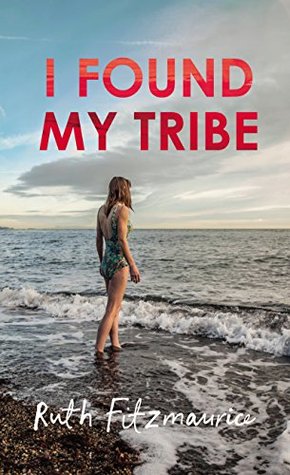
I Found My Tribe by Ruth Fitzmaurice
Ruth Fitzmaurice’s husband, a filmmaker named Simon, was diagnosed with motor neurone disease in 2008. Like Stephen Hawking, he is wheelchair-bound and motionless, communicating only through the mechanical voice of an eye gaze computer.
My husband is a wonder to me but he is hard to find. I search for him in our home. He breathes through a pipe in his throat. He feels everything but cannot move a muscle. I lie on his chest counting mechanical breaths. I hold his hand but he doesn’t hold back. His darting eyes are the only windows left. I won’t stop searching.
Between their five children under the age of 10 (including twins conceived after Simon’s diagnosis), an aggressive basset hound, and Simon’s army of nurses coming and going 24 hours a day, this is one chaotic household. The recurring challenge is to find pockets of stillness – daydreaming, staring at trees outside her window – and to learn what things can bring her back from the brink of despair, again and again.
 Often these are outdoor experiences: a last hurrah of a six-month holiday in Australia, running, and especially plunging into the Irish Sea with her “Tragic Wives’ Swimming Club” – a group that includes her friend Michelle, whose husband is also in a wheelchair after a motorbike crash, and her favorite of Simon’s nurses, Marian, who has a serious car accident.
Rather than a straight chronological narrative, this is a set of brief thematic essays with titles like “Dancing,” “Fear,” “Twins” and “Holidays.” Fitzmaurice’s story is one you piece together through vivid vignettes from her home life. Her prose is generally composed of short, simple phrases; as with Cathy Rentzenbrink’s The Last Act of Love, you can tell there is deep emotion pulsing under the measured sentences. With such huge questions in play – How much can one person take? What would losing one’s mind look like? – there’s no need for added drama, after all. Instead, the author turns to whimsy, toying with the superhero cliché for caregivers and wondering what magic might be at work in her situation.
I was particularly impressed by how Fitzmaurice holds the past and present in her mind, and by how she uses an outsider’s perspective to imagine herself out of her circumstances. At times she uses the third person for these visions of herself as a younger woman newly in love:
The young wife at her kitchen table knows about deep magic. But I know her future. Life is going to push and pull her like a wave. She doesn’t have a choice and neither do I. Come with me, dear girl, sit at my tablecloth. The journey is upon us and to survive it, you can’t just ride the wave, you have to become one. Can we do this? Let’s go. Becoming a wave just might be the deepest magic of them all.
There are so many poignant moments in this book: memories of their determinedly vegetarian wedding; pulling out all the stops for Simon’s fortieth birthday with customized art installations to brighten his view; leaving the marital bed – now a “hospital contraption” – after six years of MND being a part of their lives; a full moon swim with the Tragic Wives on her and Simon’s anniversary. But all the quiet, everyday stuff has power too, especially her interactions with her precocious children, who are confused about why Dadda is like this.
If I had one tiny complaint, it’s that Simon feels like something of a shadowy figure. In flashbacks we get a real sense of his forceful personality, but this new, silent Simon in the wheelchair is a mystery. Only once or twice does she record words he ‘says’ to her via his computer. Perhaps this is inevitable given how locked into himself he’s become. However, he was still capable of becoming the first person with MND to direct a feature film, on location in County Wicklow (My Name Is Emily). He has told his own story elsewhere; in his wife’s telling, their ventures now seem so separate that they rarely appear as equal partners.
It’s my tenth wedding anniversary tomorrow; as I was reading this I kept thinking that, for as much as I complain (to myself) about how hard marriage is, I’ve had it so easy. The stresses a couple face when caregiving of one partner is involved are immense. Fitzmaurice has found herself part of a tribe she probably never wanted to join: the walking wounded, with pain behind their eyes and worry never far from their minds. But in the midst of it she’s also found the band of family and friends who help her pull through each time. Her lovely book – wry, wise, and realistic – will strike a chord with anyone who has faced illness and family tragedy.
My rating:
I Found My Tribe is published in the UK today, July 6th, by Chatto & Windus. My thanks to the publisher for the review copy.
Note: Fitzmaurice got her book deal on the strength of a series of pieces she wrote for the Irish Times. You can read an extract from the book here. Film rights to her story have been sold to Element Pictures; more details are here. A documentary about Simon’s life, It’s Not Yet Dark, based on his memoir of the same title, has recently been released. For more information see here (this article also showcases multiple family photos).
Update: Simon Fitzmaurice died on October 26, 2017, aged 43.
Most Anticipated Releases for the Second Half of 2017
Back in December I previewed some of the books set to be released in 2017 that I was most excited about. Out of those 30 titles, here’s how I fared:
- Read: 16 [Disappointments: 2]
- Currently reading: 1
- Abandoned partway through: 2
- Lost interest in: 4
- Haven’t managed to find yet: 2
- Languishing on my Kindle; I still have vague intentions to read: 5
The latter half of the year promises plenty of big-name releases, such as long-awaited novels from Nicole Krauss and Jennifer Egan and a memoir by Maggie O’Farrell. Here are 24 books that happen to be on my radar for the coming months; this is by no means a full picture.
The descriptions below are adapted from the publisher blurbs on Goodreads, NetGalley or Amazon. Some of these books I already have access to in print or galley form; others I’ll be looking to get hold of. (In chronological order, generally by first publication date.)
July
How Saints Die by Carmen Marcus [July 13, Harvill Secker]: “Ten years old and irrepressibly curious, Ellie lives with her fisherman father, Peter, on the wild North Yorkshire coast. This vivacious and deeply moving novel portrays adult breakdown through the eyes of a child and celebrates the power of stories to shape, nourish and even save us.”
Moving Kings by Joshua Cohen [July 20, Fitzcarraldo Editions]: “Two young Israeli soldiers travel to New York after fighting in the Gaza War and find work as eviction movers. It’s a story of the housing and eviction crisis in poor Black and Hispanic neighborhoods that also shines new light on the world’s oldest conflict in the Middle East.” (print ARC)
August
 Sour Heart by Jenny Zhang [Aug. 1, Lenny]: “Centered on a community of immigrants who have traded their endangered lives as artists in China and Taiwan for the constant struggle of life at the poverty line in 1990s New York City, Zhang’s exhilarating collection examines the many ways that family and history can weigh us down and also lift us up.”
The Education of a Coroner: Lessons in Investigating Death by John Bateson [Aug. 15, Scribner]: “An account of the hair-raising and heartbreaking cases handled by the coroner of Marin County, California throughout his four decades on the job—from high-profile deaths to serial killers, to Golden Gate Bridge suicides.”
The Futilitarians: Our Year of Thinking, Drinking, Grieving, and Reading by Anne Gisleson [Aug. 22, Little, Brown and Company]: “A memoir of friendship and literature chronicling a search for meaning and comfort in great books, and a beautiful path out of grief.” (currently reading via NetGalley)
Midwinter Break by Bernard McLaverty [Aug. 22, W. W. Norton]: “A retired couple fly from their home in Scotland to Amsterdam for a long weekend. … [A] tender, intimate, heart-rending story … a profound examination of human love and how we live together, a chamber piece of real resonance and power.” (to review for BookBrowse)
 I Am, I Am, I Am: Seventeen Brushes with Death by Maggie O’Farrell [Aug. 22, Tinder Press]: “A childhood illness she was not expected to survive. A terrifying encounter on a remote path. A mismanaged labor in an understaffed hospital … 17 encounters at different ages, in different locations, reveal to us a whole life in a series of tense, visceral snapshots.”
What It Means When a Man Falls from the Sky by Lesley Nneka Arimah [Aug. 24, Tinder Press]: “A dazzlingly accomplished debut collection explores the ties that bind parents and children, husbands and wives, lovers and friends to one another and to the places they call home.” (print ARC to review for Shiny New Books)
Madness Is Better than Defeat by Ned Beauman [Aug. 24, Sceptre]: “In 1938, rival expeditions set off for a lost Mayan temple, one intending to shoot a screwball comedy on location, the other to disassemble the temple and ship it to New York. … Showcasing the anarchic humor and boundless imagination of one of the finest writers of his generation.”
Forest Dark by Nicole Krauss [Aug. 24, Harper/Bloomsbury]: “A man in his later years and a woman novelist, each drawn to the Levant on a journey of self-discovery. Bursting with life and humor, this is a profound, mesmerizing novel of metamorphosis and self-realization – of looking beyond all that is visible towards the infinite.” (currently reading via NetGalley)
 My Absolute Darling by Gabriel Tallent [Aug. 29, Riverhead Books/4th Estate] “A brilliant and immersive, all-consuming read about one fourteen-year-old girl’s heart-stopping fight for her own soul. … Shot through with striking language in a fierce natural setting.” (e-ARC to review for the Pittsburgh Post-Gazette)
September
Dinner at the Center of the Earth by Nathan Englander [Sept. 5, Knopf]: “[A] political thriller that unfolds in the highly charged territory of the Israeli-Palestinian conflict and pivots on the complex relationship between a secret prisoner and his guard. … Englander has woven a powerful, intensely suspenseful portrait of a nation riven by insoluble conflict.”
George and Lizzie by Nancy Pearl [Sept. 5, Touchstone]: “[A]n emotionally riveting debut novel about an unlikely marriage at a crossroads. … With pitch-perfect prose and compassion and humor to spare, George and Lizzie is an intimate story of new and past loves, the scars of childhood, and an imperfect marriage at its defining moments.”
 Little Fires Everywhere by Celeste Ng [Sept. 7, Little, Brown]: “In Shaker Heights, a placid, progressive suburb of Cleveland, everything is meticulously planned. … [E]xplores the weight of long-held secrets and the ferocious pull of motherhood-and the danger of believing that planning and following the rules can avert disaster, or heartbreak.”
Afterglow (A Dog Memoir) by Eileen Myles [Sept. 12, Grove Press]: “A probing investigation into the dynamics between pet and pet-owner. Through this lens, we examine Myles’s experiences with intimacy and spirituality, celebrity and politics, alcoholism and recovery, fathers and family history.”
October
From Here to Eternity: Traveling the World to Find the Good Death by Caitlin Doughty [Oct. 3, W. W. Norton]: “Fascinated by our pervasive terror of dead bodies, mortician Caitlin Doughty set out to discover how other cultures care for their dead. Featuring Gorey-esque illustrations by artist Landis Blair.”
Manhattan Beach by Jennifer Egan [Oct. 3, Scribner/Corsair]: “The pace and atmosphere of a noir thriller and a wealth of detail about organized crime … Egan’s first historical novel is a masterpiece, a deft, startling, intimate exploration of a transformative moment in the lives of women and men, America, and the world.”
Dunbar by Edward St. Aubyn [Oct. 3, Hogarth Shakespeare]: “Henry Dunbar, once all-powerful head of a family firm, has handed it over to his two eldest daughters, Abby and Megan. Relations quickly soured. Now imprisoned in a Lake District care home with only an alcoholic comedian as company, Dunbar starts planning his escape.” (print ARC)
 The Diary of a Bookseller by Shaun Bythell [Oct. 5, Profile Books]: “Bythell owns The Bookshop, Wigtown – Scotland’s largest second-hand bookshop. … These wry and hilarious diaries provide an inside look at the trials and tribulations of life in the book trade, from struggles with eccentric customers to wrangles with his own staff.”
In Shock by Rana Awdish [Oct. 17, St. Martin’s]: “Dr. Awdish spent months fighting for her life, enduring consecutive major surgeries and experiencing multiple overlapping organ failures. At each step of the recovery process, she was faced with repeated cavalier behavior from her fellow physicians. … A brave road map for anyone navigating illness.”
American Wolf: A True Story of Survival and Obsession in the West by Nate Blakeslee [Oct. 17, Crown]: “[I]n recent decades, conservationists have brought wolves back to the Rockies, igniting a battle over the very soul of the West. With novelistic detail, Nate Blakeslee tells the gripping story of one of these wolves, alpha female O-Six.” (print ARC)
November
The White Book by Han Kang [Nov. 2, Portobello Books]: “Writing while on a residency in Warsaw, the narrator finds herself haunted by the story of her older sister, who died a mere two hours after birth. A fragmented exploration of white things … the most autobiographical and experimental book to date from [the] South Korean master.”
 Radio Free Vermont: A Fable of Resistance by Bill McKibben [Nov. 7, Blue Rider Press]: “Follows a band of Vermont patriots who decide that their state might be better off as its own republic. … McKibben imagines an eccentric group of activists who carry out their own version of guerrilla warfare … a fictional response to the burgeoning resistance movement.”
Future Home of the Living God by Louise Erdrich [Nov. 14, Harper]: “Evolution has reversed itself, affecting every living creature on earth. … A chilling dystopian novel both provocative and prescient … a moving meditation on female agency, self-determination, biology, and natural rights that speaks to the troubling changes of our time.”
December
(Nothing as of yet…)
Which of these tempt you? What other books from the latter half of 2017 are you most looking forward to?
Three Recommended July Releases
Here are three enjoyable reads due out next month that I was lucky enough to get a hold of early. These are all first books by women authors, with subjects ranging from twentieth-century artists to a parent’s dementia. I’ve pulled 200–250-word extracts from my full reviews and hope you’ll be tempted by one or more of these.
The Velveteen Daughter by Laurel Davis Huber
(Coming on July 11th from She Writes Press)
The name Margery Williams Bianco might not seem familiar, but chances are you remember her classic children’s book, The Velveteen Rabbit. This lovely debut novel is about Margery and her daughter, Pamela Bianco, a painter and child prodigy troubled by mental illness. The main thread of the novel is set on one day in 1944, and the first-person narration alternates between Margery and Pamela, who through memory and imagination drift back through vivid scenes from their lives in Turin, London, Wales, and New York City.
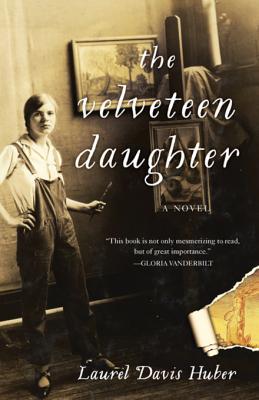 Themes of creativity, mental health and motherhood are nestled in this highly visual book full of cameos by everyone from Pablo Picasso to Eugene O’Neill. I love reading fictional biographies of writers and other creative types, and this one gives such an interesting window onto lesser-known twentieth-century figures. I especially appreciated Huber’s endnotes explaining what was fact (almost everything) and what was fiction here, and her discussion of the letters and archives she used.
As The Velveteen Rabbit teaches, we truly come to life when we are loved, and you can see how for Pamela it was a lifelong struggle to be loved for who she was. The artist’s tortured journey and the mother’s tender worry are equally strong. Had I finished it a few days earlier I would have included this in my write-up of the best books of 2017 so far. It would be a great choice for book clubs, too – a set of questions is even included at the end of the novel.
A favorite line (Pamela describes her mother): “Mam’s eyes are vast almond-shaped seas, liquid navy, flowing with an endless depth of understanding and compassion.”
Readalike: Z: A Novel of Zelda Fitzgerald by Therese Anne Fowler
My thanks to publicist Caitlin Hamilton Summie for granting me early access via NetGalley.
My rating: 
Goodbye, Vitamin by Rachel Khong
(Coming on July 11th from Henry Holt and Co. [USA]; already available from Scribner UK)
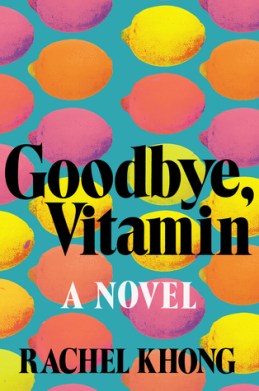 Reeling from a broken engagement, Ruth Young returns to her childhood home in California for a year to help look after her father, who has Alzheimer’s. She tries feeding Howard every half-cracked dementia health cure (cruciferous vegetables are a biggie) and, with his teaching assistant, Theo, maintains the illusion that her father is still fit to teach by gathering graduate students for a non-credit History of California class that meets in empty classrooms and occasionally off-campus – wherever they can be away from the watchful eye of Dean Levin.
As these strategies fail and Howard’s behavior becomes ever more erratic, Ruth realizes the best thing she can do is be a recorder of daily memories, just as Howard was for her when she was a little girl: “Here I am, in lieu of you, collecting the moments” – “Today you…”
This is a delightfully quirky little book, in the same vein as Elizabeth McKenzie’s The Portable Veblen. I marked out a bunch of funny metaphors:
This morning’s [hangover] is a rodent: pesky but manageable.
It was grotesque, the way I kept trying to save that relationship. Like trying to tuck an elephant into pants.
The moon, tonight, looks like a cut zucchini coin.
But you may well read this with a lump in your throat, too. From one Christmas to the next, we see how much changes for this family – a reminder that even though the good times are still worth celebrating, they’re gone before you know it.
Readalike: Not Working by Lisa Owens
My rating:
A Beautiful, Terrible Thing: A Memoir of Marriage and Betrayal by Jen Waite
(Coming on July 11th from Plume Books [USA] and Prentice Hall Press [UK])
 Jen Waite had been in New York City pursuing her dream of becoming an actress for two years when she started working at a restaurant for extra cash. It was here that she met Marco Medina, a handsome Argentinian bar manager, and they fell head-over-heels in love. All the clichés: a green card, a successful business venture, a baby on the way, an idyllic wedding on the beach in Maine. And then the whole thing fell apart. “Marco was always an illusion; the best magic trick I’ve ever seen,” Waite marvels.
She’s written her story up like a thriller, full of gradual revelations and the desire to get even. Chapters alternate between “Before,” when she still had what she thought was the perfect existence, and “After,” when she started to suspect that Marco had a secret life. I use the term “thriller” as a compliment: the dialogue is spot-on and this is a remarkably gripping book given that the title and blurb pretty much give the whole game away. More than that, it’s a fascinating psychological study of the personality of a sociopath and pathological liar. Surviving to tell her story and perhaps train to become a therapist for women who have been in her situation is Waite’s apt revenge.
Readalike: Gone Girl by Gillian Flynn
My rating:
Have you read any July releases that you would recommend?
The Best Books from the First Half of 2017
Believe it or not, but the year is almost half over already. A look back at the “Best of 2017” shelf I’ve started on Goodreads has revealed the eight releases that have stood out most clearly for me so far. All but one of these I have already featured on the blog in some way; links are provided. I’ve also included short excerpts from my reviews to show what makes each of these books so special.
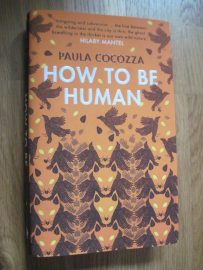 How to Be Human by Paula Cocozza: There’s something gently magical about the way the perspective occasionally shifts to give a fox’s backstory and impressions as a neologism-rich stream. As much as this is about a summer of enchantment and literal brushes with urban wildlife, it’s also about a woman’s life: loneliness, the patterns we get stuck in, and those unlooked-for experiences that might just liberate us. Cocozza sets up such intriguing contradictions between the domestic and the savage, the humdrum and the unpredictable.
 Swimming Lessons by Claire Fuller: This isn’t a happy family story. It’s full of betrayals and sadness, of failures to connect and communicate. Yet it’s beautifully written, with all its scenes and dialogue just right, and it’s pulsing with emotion. One theme is how there can be different interpretations of the same events even within a small family. The novel is particularly strong on atmosphere, reminding me of Iris Murdoch’s The Sea, The Sea and Diane Setterfield’s The Thirteenth Tale. Fuller also manages her complex structure very well.
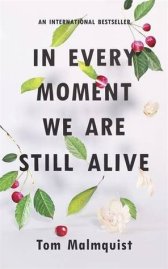 In Every Moment We Are Still Alive by Tom Malmquist: Malmquist does an extraordinary job of depicting his protagonist’s bewilderment at the sudden loss of his partner and his new life as a single father. While it’s being marketed as a novel, this reads more like a stylized memoir. Similar to Karl Ove Knausgaard’s books, it features the author as the central character and narrator, and the story of grief it tells is a highly personal one. This is a book I fully expect to see on next year’s Wellcome Book Prize shortlist.
 My Life with Bob by Pamela Paul: I’ve found a new favorite bibliomemoir. Whether she was hoarding castoffs from her bookstore job, obsessing about ticking off everything in the Norton Anthology, despairing that she’d run out of reading material in a remote yurt in China, or fretting that her new husband took a fundamentally different approach to the works of Thomas Mann, Paul (editor of the New York Times Book Review) always looks beyond the books themselves to ask what they say about her. Just the sort of book I wish I had written.
 My Jewish Year by Abigail Pogrebin: This bighearted, open-minded book strikes me as a perfect model for how any person of faith should engage with their tradition: not just offering lip service and grudgingly showing up to a few services a year, but knowing what you believe and practice, and why. From September 2014 to September 2015, Pogrebin celebrated all the holidays in the Jewish calendar. I was consistently impressed by how she draws thematic connections and locates the resonance of religious ritual in her daily life.
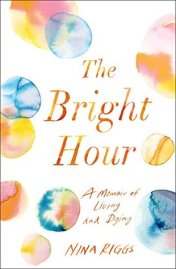 The Bright Hour by Nina Riggs: Beautiful prose enhances this literary and philosophical approach to terminal cancer. Riggs was a great-great-great-granddaughter of Ralph Waldo Emerson, and she quotes from her ancestor’s essays as well as from Michel de Montaigne’s philosophy of life to put things in perspective. She’s an expert at capturing the moments that make life alternately euphoric and unbearable – sometimes both at once. A wonderful book, so wry and honest, with a voice that reminds me of Anne Lamott and Elizabeth McCracken.
 Fragile Lives by Stephen Westaby: This is a vivid, compassionate set of stories culled from the author’s long career in heart surgery. Westaby conveys a keen sense of the adrenaline rush a surgeon gets while operating with the Grim Reaper looking on. I am not a little envious of all that he has achieved: not just saving the occasional life despite his high-mortality field – as if that weren’t enough – but also pioneering various artificial heart solutions and a tracheal bypass tube that’s named after him.
 The Animators by Kayla Rae Whitaker: Though it seems lighthearted on the surface, there’s a lot of meat to this story of the long friendship between two female animators. The cartooning world and the Kentucky–New York City dichotomy together feel like a brand new setting for a literary tragicomedy. I appreciated how Whitaker contrasts the women’s public and private personas and imagines their professional legacy. Plus I love a good road trip narrative, and this novel has two.
And here’s five more 4.5- or 5-star books that I read this year but were not published in 2017:
Days Without End by Sebastian Barry
Homegoing by Yaa Gyasi
When Breath Becomes Air by Paul Kalanithi
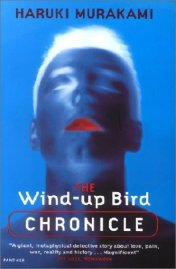
The Wind-Up Bird Chronicle by Haruki Murakami
To Say Nothing of the Dog by Connie Willis
What are some of the best books you’ve read so far this year?
What 2017 releases do I need to catch up on right away?
Summer Reads: The Women of the Castle and The Nest
What do you look for in your summer reading? Terms like “beach read” tend to connote light, frothy stories—especially from genres like romance, mystery, and chick lit—but for me a summer read is any book that happens to be totally absorbing, whatever its length. These two novels I recently read are perfect for the summer because you can sink right into them. Whether a trio of widows in postwar Germany or a dysfunctional family in modern-day New York City, the characters and setting come fully to life and tempt you to settle in on a sofa or a beach towel and stay for a while.
The Women of the Castle by Jessica Shattuck
Like Virginia Baily’s Early One Morning and Caroline Lea’s When the Sky Fell Apart, this is a female-centered World War II story that focuses on a lesser-known aspect of history. The main characters are three German women, Marianne, Benita and Ania, who were aligned with different sides in the Nazism vs. Resistance conflict but have all suffered grave losses. These widows band together to raise their children at Burg von Lingenfels, the dilapidated ancestral castle of Marianne’s late husband’s family, but as the years pass regrets and unburied secrets start to come between them.
 Apart from a short prologue from 1938 and a final section that jumps ahead to 1991, the novel is mainly set in 1945–50. I appreciated the look at postwar Germany, a period you rarely encounter in fiction. Refugees, rape victims, and Russian soldiers are everywhere, while American propaganda heaps shame on Germans for supporting Hitler. As with Barbara Yelin’s Irmina, though, there’s an acknowledgment here that it was never a clear-cut matter of pure evil or utter ignorance; “They had known but not known,” is how Shattuck puts it.
What is most intriguing to watch are the shifting relationships between the three main characters. Marianne, as the widow of one of the conspirators in the plot to assassinate Hitler, feels a compulsion to rescue her fellow widows from work camps and to keep the history of the Resistance alive. When her friends disappoint her—Benita falls in love with a former Nazi officer; Ania admits to a past she’d rather forget—Marianne doesn’t know how to absorb the shocks without judgment. A black-and-white thinker, she has trouble seeing life’s gray areas. Only in her old age is she finally able to realize that people are not simply “good or bad, true or false. They have been laid bare, a collection of choices and circumstances.”
You might think that all the WWII stories have been told by now, yet this novel feels fresh and revelatory. I found it both melancholy and hopeful, with strong characters and a haunting atmosphere:
The next week, a heatwave settled over Burg Lingenfels, a shaggy animal brushing against the hills, panting along the river, quieting the birds and making the castle sweat. The ditches were alive with milkweed, nettles, and creeping phlox. In the warmth, the forest looked soft and dense, a black lump against blue sky.
My rating:
The Women of the Castle was released in the UK by Zaffre, an imprint of Bonnier Publishing, on May 18th. My thanks to Imogen Sebba for the free copy for review.
The Nest by Cynthia D’Aprix Sweeney
Leo Plumb has really blown it this time. He’s had problems with drugs and womanizing before, but this time he got behind the wheel of a car after his cousin’s wedding reception with coke and alcohol in his system and a nineteen-year-old waitress, Matilda Rodriguez, at his side. Matilda is injured in the ensuing accident, and after her hefty payout it looks like the four Plumb siblings’ collective trust fund, “the nest,” will be severely diminished.
 They’re all counting on this money: Melody to send her twin daughters to a good college; Jack to save his floundering antiques business; and Bea to keep her afloat until she can write a long-delayed novel to follow up on the success of her “Archie” short stories (based on a figure suspiciously similar to Leo).
The short chapters switch between the siblings as they tweak their plans for the future. The novel also spends time with Melody’s twins, Nora and Louise, who at 16 are just figuring out what they want from their lives; and with Matilda and her new friend Vinnie as they cope with permanent injuries. All of these characters feel like real people who might be in your neighborhood or your extended family. I especially liked Stephanie, the old girlfriend Leo returns to after his wife finally kicks him out.
In places this reminded me of Ann Patchett’s Commonwealth, Delia Ephron’s Siracusa, and especially Hannah Rothschild’s The Improbability of Love due to a subplot about a stolen sculpture. There’s a rather silly set piece involving the sculpture later on; leaving that aside, I thought this was a compelling story about what happens when the truth comes out and we must readjust our expectations. Realistic rather than rosy, this is a novel about letting go. A nest is, of course, also a home, so for as much as this seems to be about money, it is really more about family and how we reclaim our notion of home after a major upheaval.
My rating: 
The Nest was released in paperback in the UK by The Borough Press on June 1st. My thanks to Emilie Chambeyron for the free copy for review.
Library Checkout: June 2017
I’ve mostly been reading my own books, review books, and stuff on Kindle during and since my America trip, so I haven’t actually completed any library books in June. However, I have several on the go at the moment, so next month should look a bit more impressive!
CURRENTLY READING
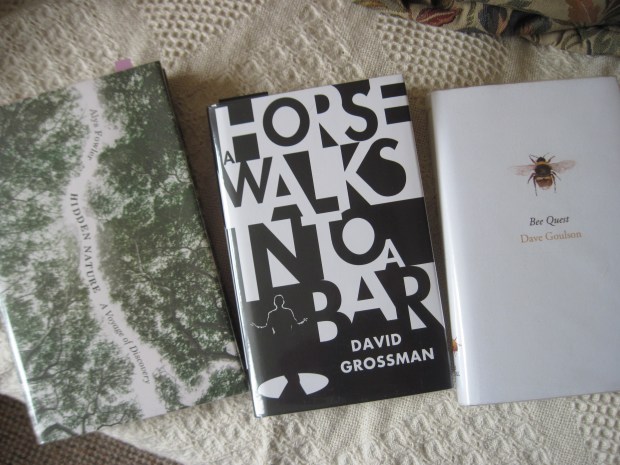
- Hidden Nature: A Voyage of Discovery by Alys Fowler
- Bee Quest: In Search of Rare Bees by Dave Goulson
- A Horse Walks into a Bar by David Grossman
CHECKED OUT, TO BE READ
- Human Acts by Han Kang
- White Tears by Hari Kunzru
- Signs for Lost Children by Sarah Moss

RETURNED UNFINISHED
- Between the World and Me, Ta-Nehisi Coates [AMERICA]
RETURNED UNREAD
Requested by someone else:
- Island Home: A Landscape Memoir by Tim Winton
Lost interest:
- Multitudes: Eleven Stories by Lucy Caldwell
- What Belongs to You by Garth Greenwell
- Gerontius by James Hamilton-Paterson
- Tiny Beautiful Things by Cheryl Strayed [AMERICA]
(Hosted by Charleen of It’s a Portable Magic.)
Have you been taking advantage of your local libraries? What appeals from my lists?
First Encounter: Maggie Nelson
Maggie Nelson is the author of four volumes of poetry and five wide-ranging works of nonfiction that delve into the nature of violence and sexuality. From what I’d heard about her writing, I knew to expect an important and unconventional thinker with a distinctive, lyrical style. As of early June, Vintage has made some of her backlist, including The Red Parts: Autobiography of a Trial and Bluets, available for the first time in the UK.
I read The Red Parts for The Bookbag. Here’s an excerpt from my full review:
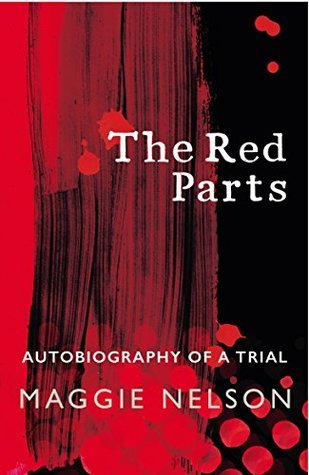 Nelson’s aunt was murdered in Michigan in 1969. Thirty-five years later, just as Nelson had completed writing a poetry collection about her, the case was reopened when new DNA evidence emerged. Most authors would quickly zero in on the trial itself, giving a blow-by-blow of the lawyers’ questioning and witnesses’ statements. Although Nelson does document important developments in the month-long trial, and describes autopsy photographs in blunt detail, her account is much more diffuse than one might expect. Interspersed with Jane’s history are other dark memories: Nelson’s father’s sudden death, her sister’s wild years, aborted love affairs. The title phrase tangentially refers to the words of Jesus in the New Testament, traditionally printed in red, so it has a sort of dual meaning: this is a (futile) search for the gospel truth about her aunt’s death, and also a conscious dive into the parts of life that frighten us. This fluid, engrossing narrative is no ordinary true crime story, but a meditative reflection on loss and identity.
My rating: 
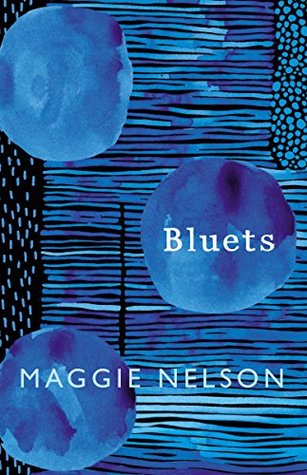 Bluets is a fragmentary record of Nelson’s arbitrary obsession with the color blue. It’s composed of 240 short numbered essays of about a paragraph each; some are just one or two sentences. At one point Nelson refers to these as “propositions,” but really they are more like metaphorical musings. Blue takes on so many meanings: with the connotation of “depressed”, it applies to her loneliness and sense of loss after the breakdown of a relationship (she continues addressing her former partner as “you” here) and a friend’s serious accident:
Loneliness is solitude with a problem. Can blue solve the problem, or can it at least keep me company within it?
Mostly I have felt myself becoming a servant of sadness. I am still looking for the beauty in that.
Then there’s blues music (Billie Holiday), seedy sex (“blue movies”), Joan Mitchell’s 1973 abstract painting Les Bluets, Novalis’ blue flower (which gives the title to a Penelope Fitzgerald novel), and so on. Nelson likens herself to a male bowerbird lining her nest with blue – sometimes literally, as with the collection of “blue amulets” that she keeps on a windowsill so sunlight can pass through the glass and illuminate the stones. I recalled that Sarah Perry lists Bluets as one inspiration for The Essex Serpent, in which the character Stella is fascinated with the color blue and keeps a similar trove of trinkets.
Bluets is a difficult work to characterize, but it seems closest in style to Jenny Offill’s Dept. of Speculation, which is also built on loosely linked aphorisms. The problem with books like these is that individual lines may stand out as profound but don’t contribute to an overall story line or argument. Moreover, Nelson’s forthrightness about sex, which edges towards crassness and feels out of place in this dreamily academic text, took me some getting used to.
Two more favorite lines:
I walked around Brooklyn and noticed that the faded periwinkle of the abandoned Mobil gas station on the corner was suddenly blooming.
If I were today on my deathbed, I would name my love of the color blue and making love with you as two of the sweetest sensations I knew on this earth.
My rating: 
Many thanks to Cat Mitchell of Penguin Random House for the free review copy.
The Red Parts was the more straightforward and satisfying read of this pair, but Bluets is certainly an original and artful bedside book. I would certainly read more by Nelson; I’m particularly interested in The Argonauts (2015), a memoir about forming her unconventional family – her partner, Harry Dodge, is transgender.
Have you read anything by Maggie Nelson? Do her books appeal?
Chastleton House (It Even Has a Bookshop)
I’ve been off my blogging game ever since we got back from America, but I hope to remedy that soon. I have a blog post planned for every day of the coming week, including some reviews, my monthly Library Checkout, a few recommendations for July releases, and a look back at the best books from the first half of the year.
Today I’m easing myself back into blogging with a mini profile of the National Trust historic manor we visited yesterday, Chastleton House in Oxfordshire (but it’s nearer the Gloucestershire border – very much Cotswolds country).

Photo by Chris Foster.
My brother-in-law sent us a voucher for free entry into any NT property, but my eye was drawn to this one in particular because I saw that there’s a secondhand bookshop in the stables. Compared to other historic houses, this one feels a lot less fusty. It’s been preserved as it was when the NT acquired it in 1991, so instead of reconstructed seventeenth-century rooms you get them as they were last used by later tenants. There are cracks in the plasterwork, cobwebs in the corners, and lots of stuff everywhere. But as a result, it seems less like part of the corporate fold; even the “Do Not Touch” signs are handwritten.


Chastleton has a literary claim to fame of which I was unaware before our visit: it was a filming location for the 2015 BBC adaptation of Hilary Mantel’s Wolf Hall. (Never mind that it was built in 1607–12, well after the Tudor history that novel is meant to portray.) Another interesting historical nugget: this is where the rules of croquet were codified in the 1860s, and there are still croquet lawns there today. Our visit happened to coincide with a special lawn games weekend, so we learned how to play croquet properly and my husband proceeded to trounce me.


Of course, I availed myself of a few bargain books from the secondhand stall.
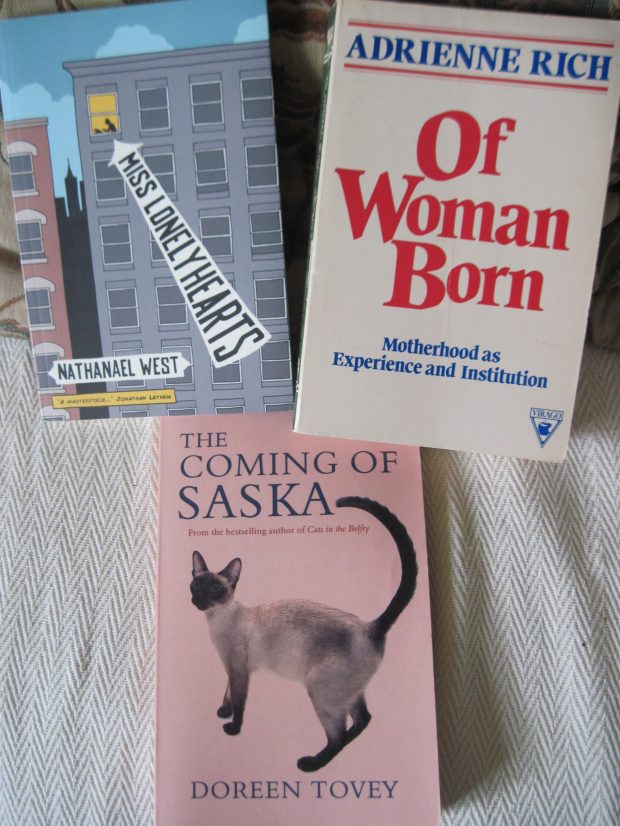 We also had tea and cake from a charity sale in the next-door churchyard. After dinner back home, in the evening we decided to walk 10 minutes down the road to our local event space for a folk concert featuring The Willows, with Gareth Lee and Annie Baylis supporting. We’ve been to three gigs at this former village hall so far this year; with tickets just £10 each and the venue so close, why not?! Each time we have heard absolutely excellent live folk music, with tinges of everything from Americana to electronica.
All together, a smashing day out.
 Bookish Beck = Rebecca Foster. American transplant to England. Freelance proofreader and book reviewer.
 Bookish Beck