Six “Love” Books for Valentine’s Day
Starting in mid-January I began surveying my shelves, library stack and Kindle for books with “love” in the title. Here are the six I had time to try; I didn’t get to Alain de Botton’s The Course of Love on my Kindle, nor my paperback copies of Iris Murdoch’s The Sacred and Profane Love Machine and Nancy Horan’s Loving Frank.
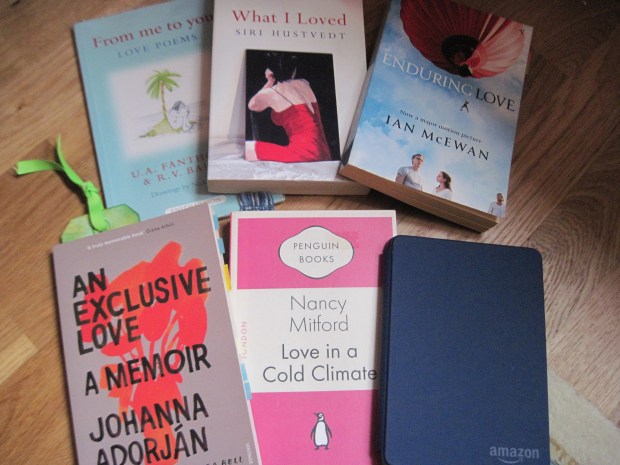
You’ll notice that a number of the books I’ve read aren’t that optimistic about love; in several cases the use of the word in the title even seems to be ironic. As Lady Montdore exclaims in Love in a Cold Climate, “Love indeed – whoever invented love ought to be shot.” So I can’t offer them as particularly romantic choices. But let’s start positively, with some pleasantly out-of-the-ordinary love poems.
From Me to You: Love Poems, U.A. Fanthorpe and R.V. Bailey
 Ursula Fanthorpe and Rosie Bailey met as English teachers at the same Cheltenham school in their late twenties and were partners for nearly 40 years. None of the poems in this short volume are attributed, though I recognized a few from Fanthorpe’s Collected Poems. They’re not particularly distinguished as poetry, but I appreciated the simple, unsentimental examples of what makes up everyday life with a partner: “There is a kind of love called maintenance, / Which stores the WD40 and knows when to use it; // Which checks the insurance, and doesn’t forget / The milkman” (“Atlas”) and “I’m working on a meal you haven’t had to imagine, / A house cleaned to the rafters” (“Dear Valentine”). [Public library]
What I Loved, Siri Hustvedt
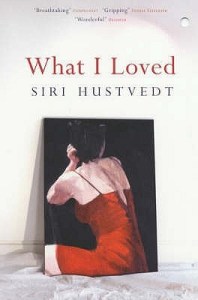 This 2003 novel could just as well have been titled “What I Lost,” which might be truer to its elegiac tone. Narrated by Professor Leo Hertzberg and set between the 1970s and 1990s, it’s about two New York City couples – academics and artists – and the losses they suffer over the years. With themes of modern art, perspective, memory, separation and varieties of mental illness, it asks to what extent we can ever know other people or use replacements to fill the gaps left by who and what is missing. Read it if you’ve enjoyed The Suicide of Claire Bishop by Carmiel Banasky, other books by Siri Hustvedt, or anything by Howard Norman. My favorite lines about love were “I often thought of our marriage as one long conversation” and “love thrives on a certain kind of distance … it requires an awed separateness to continue.” [Charity shop]
Love in a Cold Climate, Nancy Mitford
 I didn’t realize this 1949 novel is a sequel to The Pursuit of Love, so it took a while to figure out who all the characters were. Fanny Logan is a cousin orbiting around Lord and Lady Montdore and their daughter Polly Hampton, all recently returned from some years in India. Fanny marries an Oxford don, while Polly shocks everyone by eloping with her uncle by marriage, “Boy” Dougdale, a recent widower once known as the “Lecherous Lecturer” for interfering with little girls. (This hint of pedophilia is carelessly tossed off in a way no writer would get away with today.) Meanwhile, the heir to the Hampton estate, an effeminate chap named Cedric, comes over from Canada for a visit and wins Lady Montdore over. This amusing picture of aristocratic life in the 1930s marvels at who we love and why. [Bookbarn International]
Enduring Love, Ian McEwan
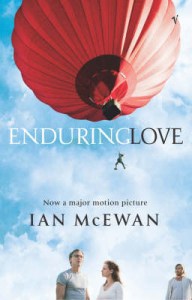 Interesting to consider this as a precursor to Saturday: both have a scientist as the protagonist and get progressively darker through a slightly contrived stalker plot. Enduring Love opens, famously, with a ballooning accident that leaves its witnesses questioning whether they couldn’t have done more to prevent it. Freelance science journalist Joe Rose – on a picnic with his partner, Keats scholar Clarissa, at the time – was one of those who rushed to help, as was Jed Parry, a young Christian zealot who fixates on Joe. He seems to think that by loving Joe, a committed atheist, he can bring him to God. In turn, Joe’s obsession with Jed’s harassment campaign drives Clarissa away. It’s a deliciously creepy read that contrasts rationality with religion and inquires into what types of love are built to last. [Charity shop]
An Exclusive Love: A Memoir, Johanna Adorján
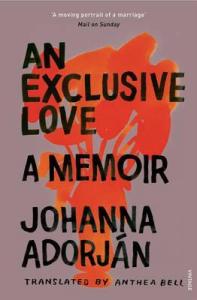 The author’s grandparents, Hungarian Holocaust survivors who moved to Denmark as refugees, committed suicide together on October 13, 1991. Her grandfather, an orthopedic surgeon who had been in an Austrian concentration camp, was terminally ill and his wife was determined not to live a day without him. This short, elegant memoir alternates Adorján’s imagined reconstruction of her grandparents’ last day with an account of their life together, drawn from family memories and interviews with those who knew them. She wonders whether, like Primo Levi and Arthur Koestler, theirs was a typically Jewish failure to fit in wherever they went, and/or a particularly Hungarian melancholy. “The answer is their great love,” the newspaper report of their death insisted. [Waterstones clearance]
Note: That striking cover is by Leanne Shapton.
And another nonfiction selection that I didn’t make it all the way through:
A Book about Love, Jonah Lehrer
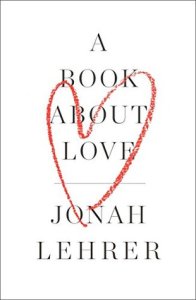 (Abandoned at 31%.) Although I can see why he starts where he does, Lehrer’s early focus on attachment and attunement – two psychological theories of how babies learn to relate affectionately to others – means the book gets bogged down in studies performed on mice and/or children and feels more like a parenting book than anything else. (If that’s what you’re after, read All Joy and No Fun.) A glance at the table of contents suggests the rest of the book will go into marriage, divorce and how love changes over time, but I couldn’t be bothered to stick around. That said, Lehrer’s popular science writing is clear and engaging, and with the heartfelt mea culpa at the start of this book I couldn’t hold a grudge about his earlier plagiarism scandal. [Kindle book from NetGalley.]
No overtly heartwarming love stories in that selection, then, but are there any you fancy reading anyway? Have you read any “love” titles recently?
See also: The Guardian’s list of Top 10 Authentic Romances.
Review & Giveaway: Hame by Annalena McAfee
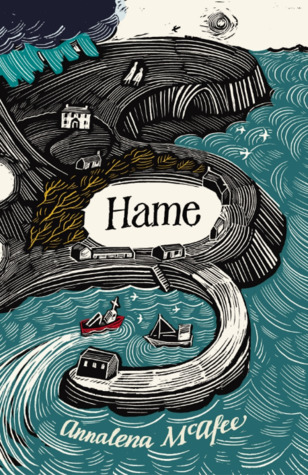 As I mentioned on Tuesday, I previously knew of Annalena McAfee only as Mrs. Ian McEwan, though she has a distinguished literary background: she founded the Guardian Review and edited it for six years, was Arts and Literary Editor of the Financial Times, and is the author of multiple children’s books and one previous novel for adults, The Spoiler (2011).
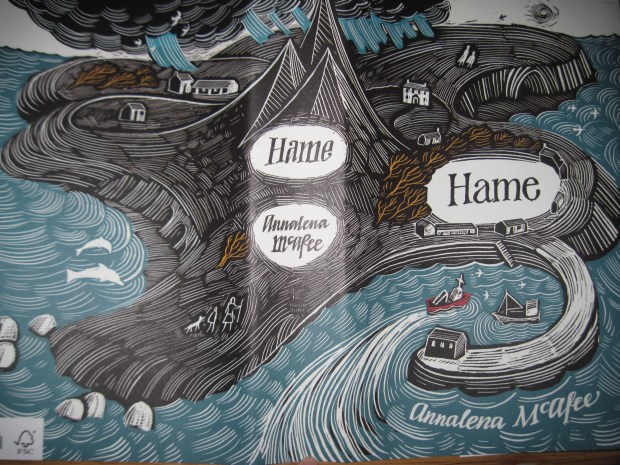
Well, anyone who reads Hame will be saying “Ian who?” as this is on such a grand scale compared to anything McEwan has ever attempted. The subtitle, “The Fascaray Archives,” gives an idea of how thorough McAfee means to be: the life of fictional poet Grigor McWatt is her way into everything that forms the Scottish identity. Her invented island of Fascaray is a carefully constructed microcosm of Scotland from ancient times to today. I loved the little glimpses of recent history, like the referendum on independence and a Donald Trump figure, billionaire “Archie Tupper,” bulldozing an environmentally sensitive area to build his new golf course (this really happened, in Aberdeenshire in 2012).
Narrator Mhairi McPhail arrives on Fascaray in August 2014, her nine-year-old daughter Agnes in tow. She’s here to oversee the opening of a new museum, edit a seven-volume edition of McWatt’s magnum opus, The Fascaray Compendium (a 70-year journal detailing the island’s history, language, flora, fauna and customs), and complete a critical biography of the poet. Over the next four months she often questions the feasibility of her multi-strand project. She also frets about her split from Marco, whom she left back in New York City after their separate infidelities. And her rootlessness – she’s Canadian via Scotland but has spent a lot of time in the States, giving her a mixed-up heritage and accent – is a constant niggle.
Mhairi’s narrative sections share space with excerpts from her biography of McWatt and extracts from McWatt’s own writing: The Fascaray Compendium, newspaper columns, letters to on-again, off-again lover Lilias Hogg, and Scots translations of famous poets from Blake to Yeats. We learn of key events from the island’s history through Mhairi’s biography and McWatt’s prose, including ongoing tension between lairds and crofters, Finnverinnity House being used as a Special Ops training school during World War II, a lifeboat lost in a gale in the 1970s, and the way the fishing industry is now ceding to hydroelectric power.
The balance between the alternating elements isn’t quite right – sections from Mhairi’s contemporary diary seem to get shorter as the novel goes along, such that it feels like there’s not enough narrative to anchor the book. Faced with yet more Scots poetry and vocabulary lists, or passages from Mhairi’s dry biography, it’s mighty tempting to skim.
That’s a shame, as the novel contains some truly lovely writing, particularly in McWatt’s nature observations:
In July and August, on rare days of startling and sustained heat, dragonflies as blue as the cloudless skies shimmer over cushions of moss by the burn while the midges, who abhor direct sunlight, are nowhere to be seen. Out to sea, somnolent groups of whales pass like cortèges of cruise ships and around them dolphins and porpoises joyously arc and dip as if stitching the ocean’s silken canopy of turquoise, gentian and cobalt.
For centuries male Fascaradians have sailed in the autumn, at the time of the ripe barley and the fruiting buckthorn, to hunt the plump young solan geese or gannets – the guga – near their nesting sites on the uninhabited rock pinnacles of Plodda and Grodda. No true Fascaradian can suffer vertigo since the scaling of these granite towers is done without the aid of mountaineers’ crampons or picks.
“Hame” means home in Scots – like in McWatt’s claim to fame, the folk-pop song “Hame tae Fascaray” – and themes of home and identity are strong here. The novel asks to what extent identity is bound up with a particular country and language, and whether we can craft our own selves. Must the place you come from always be the same as the home you choose? I could relate to Mhairi’s feeling that there’s nowhere she belongs, whether she’s in the bustle of New York or “marooned on a patch of damp peat floating in the North Sea.”
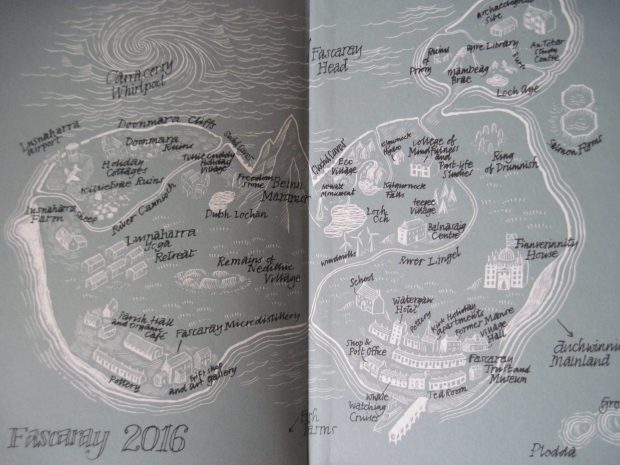
A map of the island from the inside of the back cover.
Although the blend of elements initially made me think that this would resemble A.S. Byatt’s Possession, it’s actually more like Rachel Cantor’s Good on Paper, which similarly stars a scholar who’s a single parent to a precocious daughter. In places I was also reminded of the work of Scarlett Thomas, Sara Maitland and Sarah Moss, and there’s even an echo of Robert Macfarlane’s Landmarks in the inventories of dialect words.
If you’ve done much traveling in Scotland, an added pleasure of the novel is trying to spot places you’ve been. (I thought I could see traces of Stromness, Orkney; indeed, McWatt reminded me most of Orcadian poet George Mackay Brown.) The comprehensive, archival approach didn’t completely win me over, but I was impressed by the book’s scope and its affectionate portrait of a beloved country. McAfee is of Scots-Irish parentage herself, and you can tell this is a true labor of love, and a cogent tribute.
Hame was published by Harvill Secker on February 9th. With thanks to Anna Redman for sending a free copy for review.
My rating:
Giveaway Announcement!
I was accidentally sent two copies of Hame, so I am giving one away to a reader. Alas, this giveaway will have to be UK-only – the book is a hardback of nearly 600 pages, so would be prohibitively expensive to send abroad.
If you’re interested in winning a copy, simply leave a comment to that effect below. The competition will be open through the end of Friday the 17th and I will choose a winner at random on Saturday the 18th, to be announced via the comments and a personal e-mail.
Good luck!
Literary Power Couples: An Inventory
With Valentine’s Day on the way, I’ve been reading a bunch of books with “Love” in the title to round up in a mini-reviews post next week. One of them was What I Loved by Siri Hustvedt – my second taste of her brilliant fiction after The Blazing World. Yet I’ve not tried a one of her husband Paul Auster’s books. There’s no particular reason for that; I’ve even had his New York Trilogy out from the library in the past, but never got around to reading it.
How about some other literary power couples? Here’s some that came to mind, along with an inventory of what I’ve read from each half. It’s pretty even for the first two couples, but in most of the other cases there’s a clear winner.
Zadie Smith: 5
Nick Laird: 5 (= ALL)
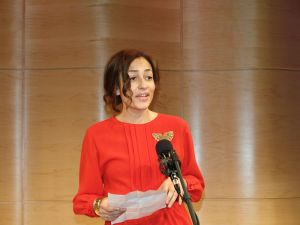
Zadie Smith in 2011. By David Shankbone (CC BY 3.0 (http://creativecommons.org/licenses/by/3.0) via Wikimedia Commons.
I’ve read all of Zadie Smith’s work apart from NW; I only got a few pages into it when it first came out, but I’m determined to try again someday. To my surprise, I’ve read everything her husband Nick Laird has ever published, which includes three poetry collections and two fairly undistinguished ‘lad lit’ novels. I’m pleased to see that his new novel Modern Gods, coming out on June 27th, is about two sisters and looks like a stab at proper literary fiction.
Jonathan Safran Foer: 4 (= ALL)
Nicole Krauss: 3 (= ALL)
Alas, they’re now an ex-couple. In any case, they’re both on the fairly short list of authors I’d read anything by. Foer has published three novels and the nonfiction polemic Eating Animals. Krauss, too, has three novels to her name, but a new one is long overdue after the slight disappointment of 2010’s Great House.
Margaret Drabble: 5
Michael Holroyd: 0
Michael Holroyd is a biographer and general nonfiction dabbler. I have a few of his books on my TBR but don’t feel much compulsion to seek them out. By contrast, I’ve read four novels and a memoir by Margaret Drabble and am likely to devour more of her fiction in the future.

Margaret Drabble in 2011. By summonedbyfells [CC BY 2.0 (http://creativecommons.org/licenses/by/2.0)%5D via Wikimedia Commons.
Claire Tomalin: 2
Michael Frayn: 1
Claire Tomalin’s masterful biographies of Charles Dickens and Thomas Hardy are pillars of my nonfiction collection, and I have her books on Nelly Ternan and Samuel Pepys on the shelf to read as well. From her husband, celebrated playwright Michael Frayn, however, I’ve only read the comic novel Skios. It is very funny indeed, though, about a case of mistaken identity at an academic conference on a Greek island.
Plus a few I only recently found out about:
Ian McEwan: 7 (+ an 8th in progress)
Annalena McAfee: 1 (I’ll be reviewing her novel Hame here on Thursday)
Katie Kitamura: 1 (I just finished A Separation yesterday)
Hari Kunzru: 0
Madeleine Thien: 1 (Do Not Say We Have Nothing)
Rawi Hage: 0
Afterwards I consulted the lists of literary power couples on Flavorwire and The Huffington Post and came up with a few more that had slipped my mind:
Michael Chabon: 1
Ayelet Waldman: 0
I loved Moonglow and am keen to try Michael Chabon’s other novels, but I also have a couple of his wife Ayelet Waldman’s books on my TBR.
Dave Eggers: 5
Vendela Vida: 0
I’ve read a decent proportion of Dave Eggers’s books, fiction and nonfiction, but don’t know anything by his wife and The Believer co-founder Vendela Vida.
David Foster Wallace: 2
Mary Karr: 1
I didn’t even know they were briefly a couple. From Wallace I’ve read the essay collection Consider the Lobster and the commencement address This Is Water. I’ve definitely got to get hold of Karr’s memoirs, having so far only read her book about memoir (The Art of Memoir).
And some classics:
Ted Hughes: 1 (Crow)
Sylvia Plath: 0
F. Scott Fitzgerald: 2 (The Great Gatsby and Tender Is the Night)
Zelda Fitzgerald: 0
![F. Scott and Zelda Fitzgerald in 1921. By Kenneth Melvin Wright (Minnesota Historical Society) [Public domain], via Wikimedia Commons.](https://bookishbeck.com/wp-content/uploads/2017/02/f_scott_fitzgerald_and_wife_zelda_september_1921.jpg?w=208&h=300)
F. Scott and Zelda Fitzgerald in 1921. By Kenneth Melvin Wright (Minnesota Historical Society) [Public domain], via Wikimedia Commons.
How have you fared with these or other literary power couples? Do you generally gravitate towards one or the other from a pair?
My (Tiny) Collection of Signed Copies
The other day I discovered a pencil-written recipe in the back of a secondhand book I got for Christmas. It got me thinking about handwriting in books: signatures, inscriptions, previous owners’ names, marginalia, and so on. If I can find enough examples of all those in my personal library, I might turn this into a low-key series. For now, though, I’ve rounded up my signed copies for a little photo gallery.
I’ve never placed particular value on owning signed copies of books. I’m just as likely to resell a signed book or give it away to a friend as I am a standard copy. The signed books I do have on my shelves are usually a result of having gone to an author event and figuring I may as well stick around for the signing. A few were totally accidental in secondhand purchases.
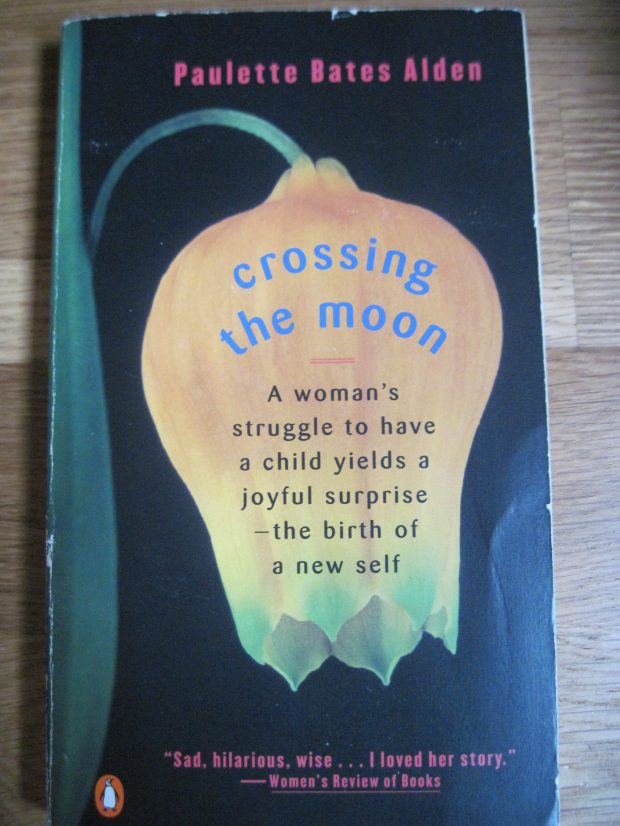
Though I’ve had personal correspondence with Paulette Bates Alden and love the three books of hers that I’ve read, this signature is entirely coincidental, in a used copy from Amazon. Shame on Patti for getting rid of it after Paulette’s book club visit in 2000!

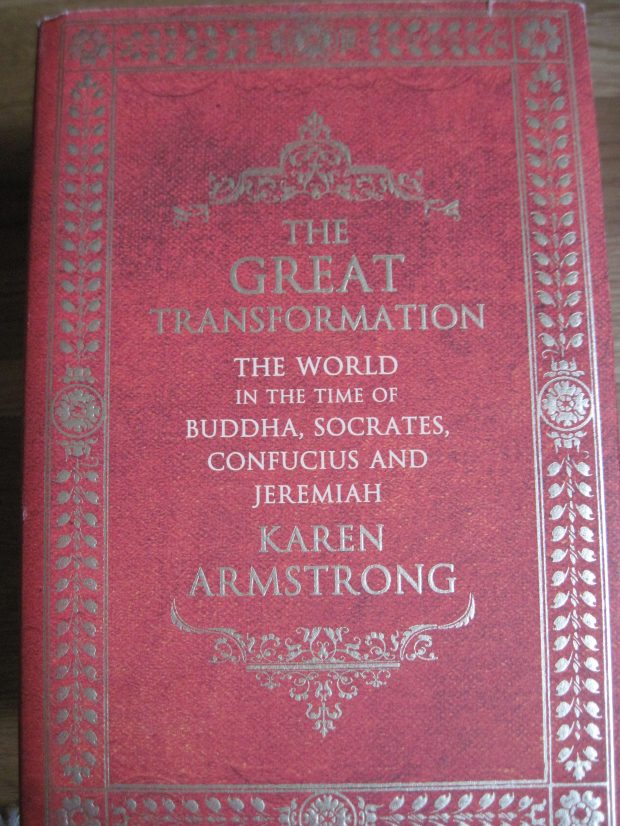
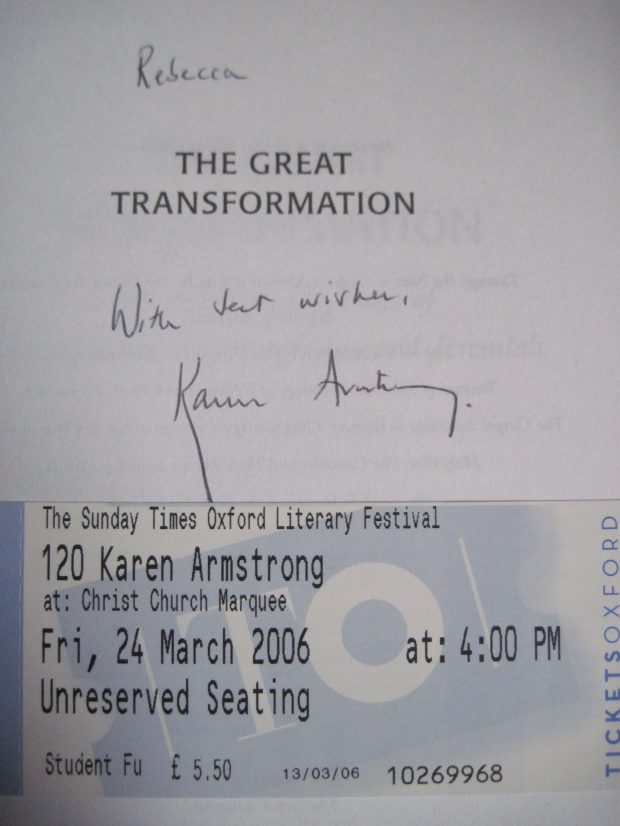
I love Karen Armstrong’s work, especially her two memoirs about deciding not to be a nun, and A History of God. I’ve seen her speak twice and am always impressed by her clear reasoning. (Tell you a secret, though: I couldn’t get through this particular book.)
While my husband worked at Royal Holloway we saw Alain de Botton speak at the Runnymede Literary Festival and I had him sign a copy of my favorite of his books.


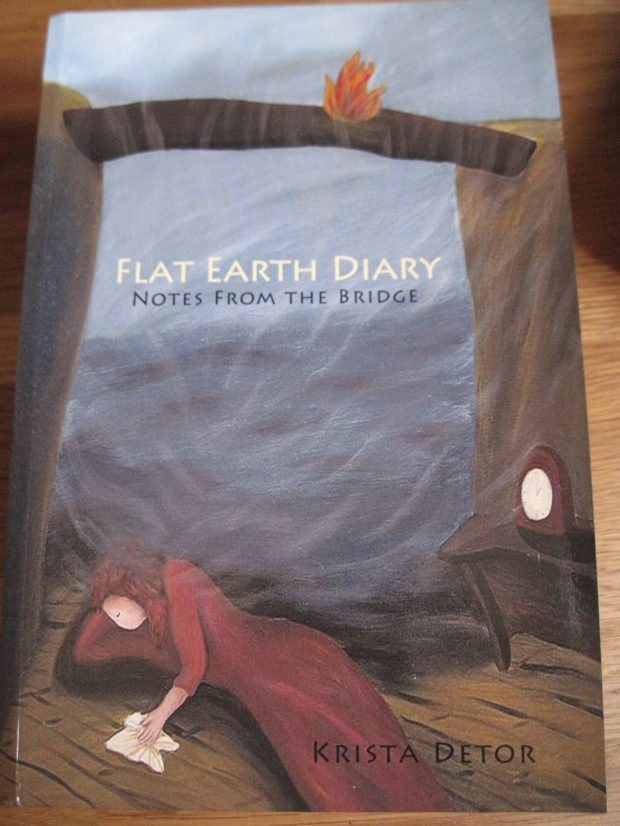
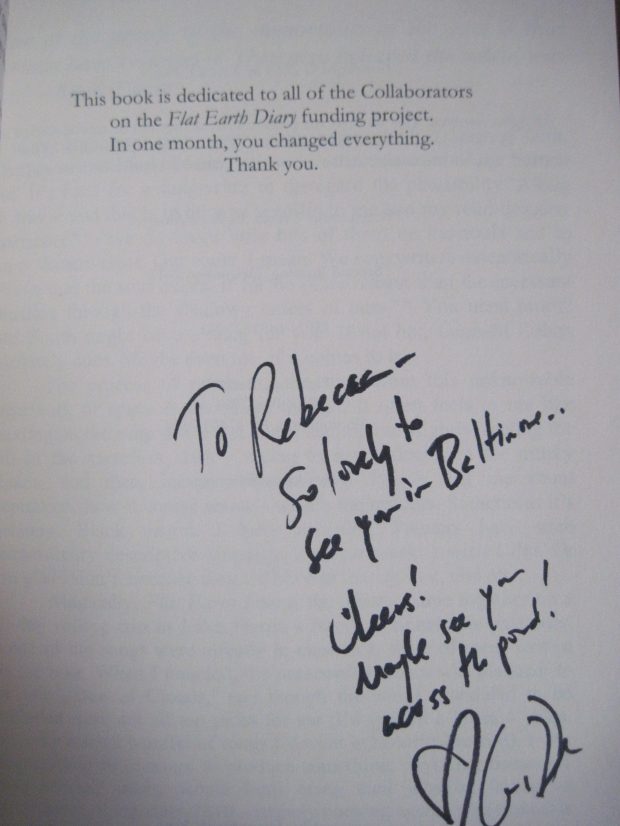
Krista Detor is one of our favorite singer-songwriters. We’ll be seeing her play for the fourth time in March. Luckily for us (but unluckily for the world, and for her coffers), this folk songstress from Indiana is unknown enough to play folk clubs and house concerts on both sides of the Atlantic. She wrote a book documenting the creative process behind her next-to-last album; when I saw her in Maryland she signed it with “Maybe see you across the pond!”
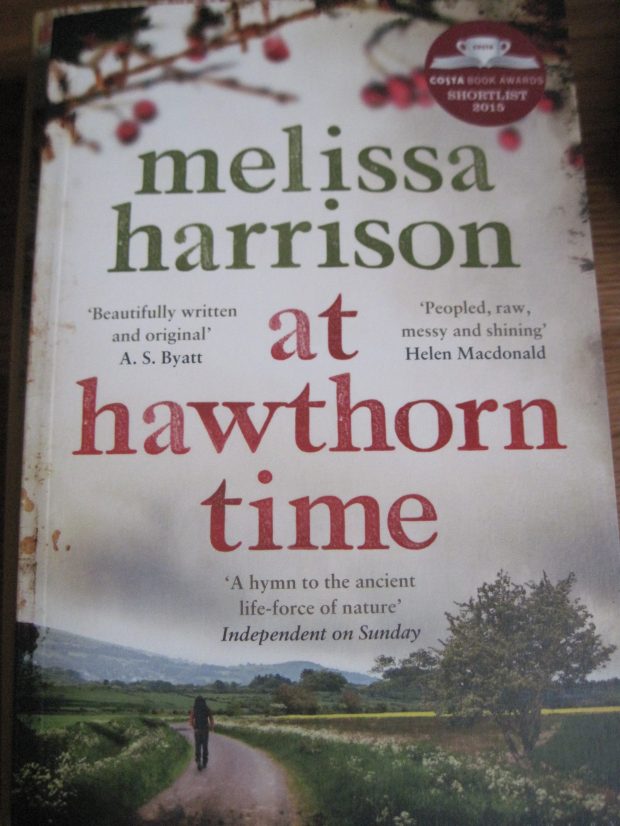
I have yet to read one of Melissa Harrison’s books, though I’m interested in her novels and her book on British weather. However, she edited the Seasons anthologies issued by the Wildlife Trusts last year – two of which my husband’s writing appeared in. When she spoke on the University of Reading campus about notions of the countryside in literature, my husband went along to meet her and bought a paperback of her second novel for her to sign.

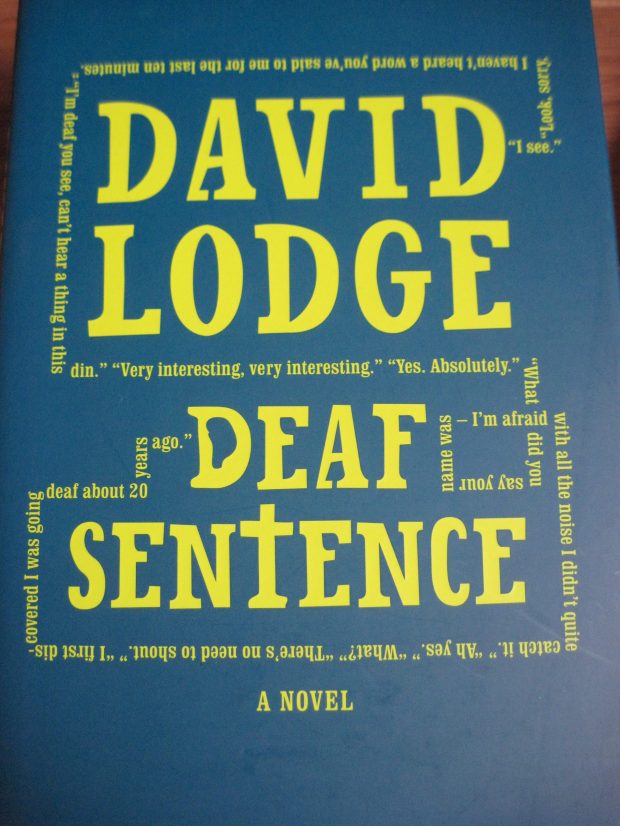
I’ve seen David Lodge speak twice, both times at the London Review Bookshop. He’s one of my favorite authors ever but, alas, isn’t all that funny or personable live; his autobiography is similarly humorless compared to his novels. Deaf Sentence was a return to his usual comic style after his first stab at historical fiction (Author, Author, about Henry James’s later life). The second time I saw him he was promoting A Man of Parts, which again imagines the inner life of a famous author – this time H.G. Wells.

An obscene bargain from Amazon that just happened to be signed. I’m looking forward to starting this one soon: books about book are (almost) always such a cozy delight.

-
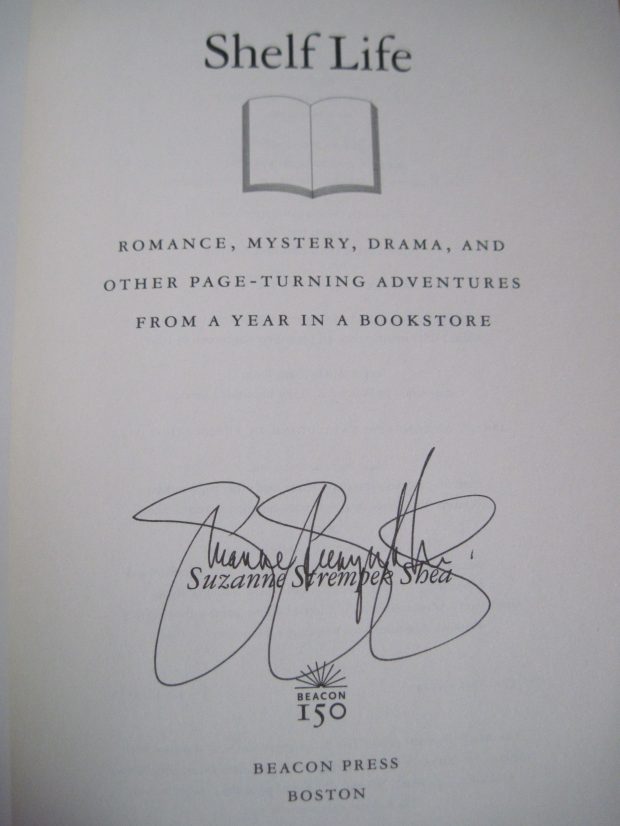
- You can tell she enjoys her S’s.
Plus three signed copies languishing in boxes in America:
- Blue Shoe by Anne Lamott: I love Lamott’s nonfiction but have never tried one of her novels. I found this one at a library book sale, going for $1; I guess nobody noticed the signature.
- The Sixteenth of June by Maya Lang: I originally read the book via NetGalley, but it quickly became a favorite. After she saw my five-star review, Maya asked me to help her out with word-of-mouth promotion and was kind enough to send me a signed copy as thanks.
- The Life of D.H. Lawrence: An Illustrated Biography by Keith M. Sagar: Sagar was one of the keynote speakers at the D.H. Lawrence Society of North America conference I attended in the summer of 2005.
Do you deliberately buy signed copies? What are some of the jewels in your collection?
A Book for Every Occasion?
Yesterday I signed up for a six-week yoga course at the local wellbeing center. This is something I’ve been meaning to do for at least two years. Now that I’ve finally made myself commit to it, of course I’m thinking twice: going out on a Tuesday evening in the cold, dark and quite possibly wet – what was I thinking?! What will I wear? Will I have to talk to other people? Will they be nice? Will they be better than me? It’s like high school all over again.
So, naturally, last night I started reading this:
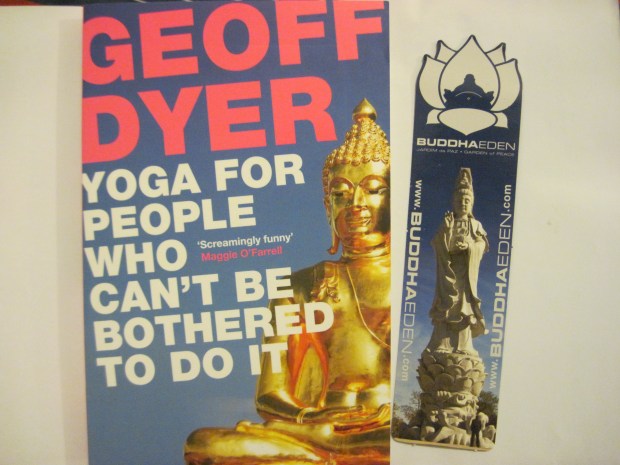
This was a Christmas gift from my wish list. With an appropriate bookmark I found at the library where I worked in London.
It’s actually a book of disparate travel essays, with the first about a stay in Louisiana that coincided with Mardi Gras in the early 1990s. But Geoff Dyer is one of those amazingly talented authors I’d read on pretty much any topic. I’ll probably skip ahead to the title essay and then make my way through the rest of the book.
Alas, I don’t think there’s a specific book that can console me for failing to get tickets to see John Mayer in London in May and wasting several hours of this morning in the stressful attempt, followed by much disappointed lethargy. (We were similarly unsuccessful with U2 recently, but did manage to secure seats to see Sigur Rós play London in September.)
When’s the last time you found a surprisingly relevant book on your shelf?
Postscript: The next day John Mayer announced a second London show, and this time we got tickets 🙂
4 Reasons to Love Kayla Rae Whitaker’s The Animators
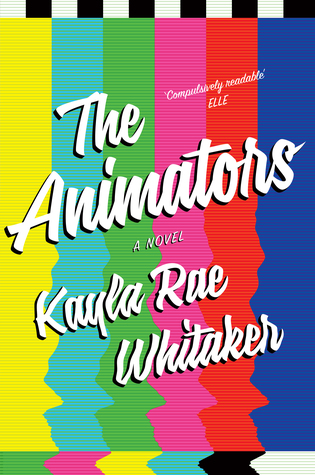 I have way too much to say about this terrific debut novel, and there’s every danger of me slipping into plot summary because, though it seems lighthearted on the surface, there’s a lot of meat to this story of the long friendship between two female animators. So I’m going to adapt a format that has worked well for other bloggers (e.g. Carolyn at Rosemary and Reading Glasses) and pull out four reasons why you must be sure not to miss this book.
- Bosom Friends. Have you ever had, or longed for, what Anne Shirley calls a “bosom friend”? If so, you’ll love watching the friendship develop between narrator Sharon Kisses and her business partner, Mel Vaught. In many ways they are opposites. Lanky, blonde Mel is a loud, charismatic lesbian who uses drugs and alcohol to fuel a manic pace of life. She’s the life of every party. Sharon, on the other hand, is a curvy brunette and neurotic introvert who’s always falling in love with men but never achieving real relationships. They meet in Professor McIntosh’s Introduction to Sketch class at a small college and a decade later are still working together. They win acclaim for their first full-length animated feature, Nashville Combat, based on Mel’s dysfunctional upbringing in the Central Florida swamps. But they see each other through some really low lows, too, like the death of Mel’s mother and Sharon’s punishing recovery from a stroke at the age of 32.
She was the first person to see me as I had always wanted to be seen. It was enough to indebt me to her forever.
- The Value of Work. Kayla Rae Whitaker was inspired by her childhood obsession with dark, quirky cartoons like Beavis and Butthead and Ren and Stimpy. Books about artists sometimes present the work as magically fully-formed, rather than showing the arduous process behind it. Here, though, you track Mel and Sharon’s next film from a set of rough sketches in a secret notebook to a polished comic, following it through storyboarding, filling-in and final edits. It’s a year of all-nighters, poor diet and substance abuse. But work – especially the autobiographical projects these characters create – is also saving. Even when it seems the well has run dry, creativity always resurges. I also appreciated how the novel contrasts the women’s public and private personas and imagines their professional legacy.
The work will always be with you, will come back to you if it leaves, and you will return to it to find that you have, in fact, gotten better, gotten sharper. It happens to you while you are asleep inside.
- Road Trips and Rednecks. I love a good road trip narrative, and this novel has two. First there’s the drive down to Florida for Mel to identify her mother, and then there’s Sharon’s sheepish return to her hometown of Faulkner, Kentucky. Here’s where the book really takes off. The sharp, sassy dialogue sparkles throughout, but the scenes with Sharon’s mom and sister are particularly hilarious. What’s more, the contrast between the American heartland and the flashy New York City life Mel and Sharon have built works brilliantly. Although in the Kentucky section Whitaker portrays some obese Americans you’d be tempted to call white trash, she never resorts to cruel hillbilly stereotypes. The author herself is from rural eastern Kentucky and paints the place in a tender light. She even makes Louisville – where the friends go to meet up with Sharon’s old neighbor and first crush, Teddy Caudill – sound like quite an appealing tourist destination!
I used it to hate it here. How could I have possibly hated this? This is me. I sprang from this place.
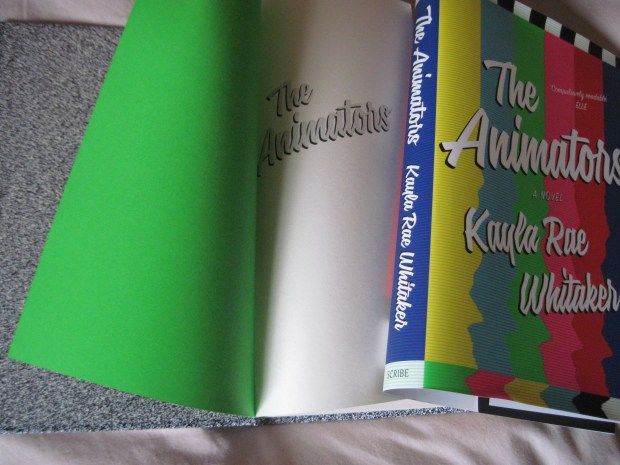
I love the attention to detail evident in the book design, especially the black-and-white TV fuzz of the covers under the dust jacket, and the pop of neon green on the inside of the endpapers.
- Open Your Trunk. This is a mantra arising from Mel and Sharon’s second movie, Irrefutable Love, which is autobiographical for Sharon this time – revolving around a traumatic incident from her shared past with Teddy, her string of crushes, and her stroke recovery. One powerful message of the novel is that you can’t move on in life unless you confront the crap that’s happened to you. As humorous as it is, it’s also a weighty book in this respect. It has three pivot points, moments so grim and surprising that I could hardly believe Whitaker dared to put them in. (The first is Sharon’s stroke; the others I won’t spoil.) This means the ending is not the super-happy one I might have wanted, but it’s realistic.
Anything that makes you in that way, anything that makes you hurt and hungry in that way, is worth investigating. … When you take the things that happen to you, the things that make you who are, and you use them, you own them.
I thought the timeline could be a little tighter and the novel was unnecessarily crass in places. For me, the road trips were the best bits and the rest never quite matched up. But this is still bound to be one of my top novels of the year. I think every reader will see him/herself in Sharon, and we all know a Mel; for some it might be the other way around. Like A Little Life and even The Essex Serpent, this asks how friendship and work can carry us through. Meanwhile, the cartooning world and the Kentucky–New York City dichotomy together feel like a brand new setting for a literary tragicomedy.
An early favorite for 2017. Don’t miss it.
The Animators was published by Random House and Scribe UK on January 31st. My thanks to Sophie Leeds of Scribe for sending a free copy for review.
My rating: 
Library Checkout: January 2017
I’ve been doing pretty well with my goal of reading mostly books that I own, but have also managed to squeeze in a handful from public and university libraries. Next month may well be full of library reads, though – I went a little wild with the free reservations! I’ve added in ratings and links to any reviews for books I haven’t already featured on the blog in some way.
LIBRARY BOOKS READ
- Love of Country: A Hebridean Journey by Madeleine Bunting
- Safest by Michael Donaghy [poetry]
- Blackout: Remembering the Things I Drank to Forget by Sarah Hepola
- The Church Mice at Christmas by Graham Oakley
- Falling Awake by Alice Oswald [poetry]

- Quartet in Autumn by Barbara Pym
- Say Something Back by Denise Riley [poetry]
- To Say Nothing of the Dog by Connie Willis
LIBRARY BOOKS SKIMMED
- Rainy Brain, Sunny Brain: The New Science of Optimism and Pessimism by Elaine Fox
- Fresh India: 130 Quick, Easy and Delicious Vegetarian Recipes for Every Day by Meera Sodha
CURRENTLY READING
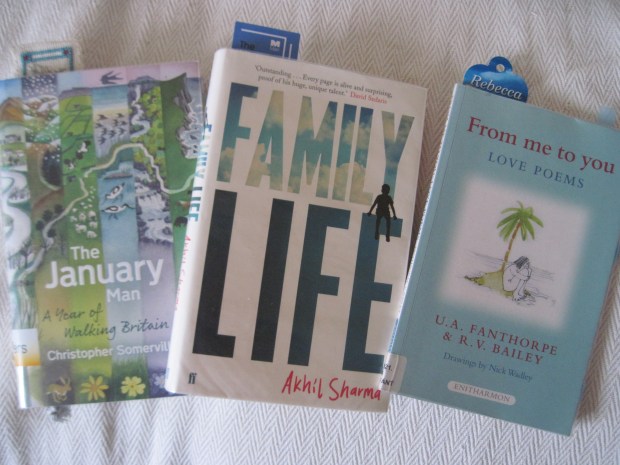
- From Me to You: Love Poems by U.A. Fanthorpe and R.V. Bailey
- Family Life by Akhil Sharma
- The January Man: A Year of Walking Britain by Christopher Somerville
CHECKED OUT, TO BE READ
- Pondlife: A Swimmer’s Journal by Al Alvarez
- Short and Sweet: 101 Very Short Poems, edited by Simon Armitage
- The Unexpected Professor: An Oxford Life in Books by John Carey
- The Tell-Tale Heart by Jill Dawson
- Nonsense by Christopher Reid [poetry]
IN THE RESERVATION QUEUE
- Go Lean Vegan: The Revolutionary 30-Day Diet Plan to Lose Weight and Feel Great by Christine Bailey
- Swimming Lessons by Claire Fuller
- Quick and Easy Thai Recipes by Jean-Pierre Gabriel
- The Owl at the Window: A Memoir of Loss and Hope by Carl Gorham
- A Smell of Burning: The Story of Epilepsy by Colin Grant
- Bad Dreams and Other Stories by Tessa Hadley
- The Good People by Hannah Kent
- Where Poppies Blow: The British Soldier, Nature, the Great War by John Lewis-Stempel
- The No Spend Year: How I Spent Less and Lived More by Michelle McGagh
- Reading Allowed: True Stories and Curious Incidents from a Provincial Library by Chris Paling
- A Beginner’s Guide to Losing Your Mind: Survival Techniques for Staying Sane by Emily Reynolds
- The Best of Adam Sharp by Graeme Simsion
RETURNED UNREAD
- Talk to the Tail: Adventures in Cat Ownership and Beyond by Tom Cox: A glance at the table of contents revealed that most of the essays were not about cats. Rip-off!
- Sunshine by Melissa Lee-Houghton: This was also on the Costa Poetry Award shortlist, so I picked it up from a display at the same time I got the Oswald and Riley. I flicked through and it didn’t seem like it would be for me.
- Woods etc by Alice Oswald: I tried this just before Falling Awake (see above) and didn’t make it past the first few pages.
Have you been taking advantage of your local libraries? What appeals from my lists?
Better Late than Never: City on Fire
I aim to read one book of 500+ pages in each month of 2017. My first Doorstopper of the Month is City on Fire, the 2015 debut novel from Garth Risk Hallberg. It’s common knowledge that Hallberg earned a six-figure advance for this 911-page evocation of a revolutionary time in New York City. When it was first published I didn’t think I had the fortitude to tackle it and had in mind to wait for the inevitable miniseries instead, but when I won a copy in a goodie bag from Hungerford Bookshop I decided to go for it. I started the novel just after Christmas and finished it a few days ago, so like Donna Tartt’s The Goldfinch it took me roughly a month to read because I had many other books on the go at the same time.
 Opening on Christmas Eve 1976 and peaking with the July 1977 blackout, the novel brings its diverse cast together through a shooting in Central Park. Insider traders, the aimless second generation of some of the city’s wealthiest aristocrats, anarchist punk rockers, an African-American schoolteacher, a journalist and his Vietnamese neighbor, a fireworks manufacturer, a policeman crippled by childhood polio – the characters fill in the broad canvas of the city, everywhere from Wall Street boardrooms to drug dens.
The real achievement is not how Hallberg draws each character but how he fits them all together. The closest comparison I can make is with one of Dickens’s long novels, say David Copperfield, where, especially as you approach the conclusion, you get surprising meet-ups of figures from different realms of life. The relaxed chronology reaches back to the 1950s and forward to 2003 to give hints of where these people came from and what fate holds for them.
City on Fire might sound like a crime drama – I can see a miniseries working in a manner comparable to The Wire – and the mystery of who shot Samantha Cicciaro does indeed last from about page 80 to page 800-something. But finding out who shot her and why (or why investment bankers would be funding a posse of anarchists, or who pushed a journalist into the river) is something of an anticlimax. The journey is the point, and the city is the real star, even though it’s described with a kind of affectionate disdain in the passages that follow:
The stench of the basement level reached him even here, like hot-dog water mixed with roofing tar and left in an alley to rot
The park on New Year’s Day had been a blasted whiteness, or a series of them, hemmed in by black trees like sheets snagged on barbed wire.
It seemed impossible that he’d chosen to live here, at a latitude where spring was a semantic variation on winter, in a grid whose rigid geometry only a Greek or a builder of prisons could love, in a city that made its own gravy when it rained. Taxis continued to stream toward the tunnel, like the damned toward a Boschian hellmouth. Screaming people staggered past below. Impossible, that he now footed the rent entire, two hundred bucks monthly for the privilege of pressing his cheek to the window and still not being able to see spectacular Midtown views. Impossible, that the cinderblock planter on the fire escape could ever have produced flowers.
Or wasn’t this city really the sum of every little selfishness, every ignorance, every act of laziness and mistrust and unkindness ever committed by anybody who lived there, as well as of everything she personally had loved?
Mercer Goodman, Jenny Nguyen and Richard Groskoph were my three favorite characters, and I might have liked to see more of each of them. I also felt that the book as a whole was quite baggy, and the six Interludes that separate the seven large sections, remarkable as they are (especially an entire fanzine, complete with photographs, comics and handwritten articles), weren’t strictly necessary.

It’s definitely a chunkster. For the longest while it felt like I wasn’t making a dent.
Still, I couldn’t help but be impressed by Hallberg’s ambition, and on the sentence level the novel is always well wrought and surprising, with especially lovely last lines that are like a benediction. Though it’s mostly set in the 1970s, this never feels dated; in fact, I thought it thoroughly relevant for our time: “even now they’re writing over history, finding ways to tell you what you just saw doesn’t exist. The big, bad anarchic city, people looting, ooga-booga. Better to trust the developers and the cops.”
I won’t pretend that a 900+-page book isn’t a massive undertaking, and I have some trusted bloggers and Goodreads friends who gave up on this after 250 or 450 pages. So I can’t promise you that you’ll think it’s worth the effort, though for me it was. A modern twist on the Dickensian state-of-society novel, it’s one I’d recommend to fans of Jonathan Franzen, Bill Clegg and Jennifer Egan.
My rating:
Classics of the Month: Hardy and Sackville-West
This is the first post in a new monthly series intended to encourage myself to read more of the classics I own. In January I read two works of classic literature: Under the Greenwood Tree by Thomas Hardy and No Signposts in the Sea by Vita Sackville-West.
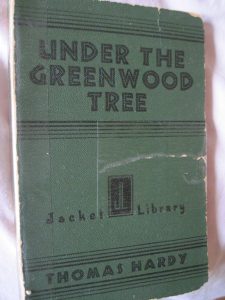
My battered Jacket Library edition.
Between college and grad school I read Hardy’s five major novels, but it’s probably been ten years or more since I tried a new one. Far from the Madding Crowd is one of my favorite books of all time, so I couldn’t help but compare Under the Greenwood Tree* to it – unfavorably, alas – as I was reading.
Greenwood was Hardy’s second novel, published in 1872. That’s just two years before Madding Crowd, and the two are quite similar in a few ways: the main female character is a conceited flirt who has to decide between three potential suitors; the supporting cast is made up of “rustics” who speak in country dialect; and the Dorset setting, including the landscape, weather and traditional activities, is a strong presence in its own right.
But where Bathsheba Everdene, though periodically maddening, is ultimately a sympathetic figure, Greenwood’s Fancy Day is a character I could never warm to. As the new schoolteacher and organist in Mellstock village, she puts on airs and imagines she’s too good for Dick Dewy, a salt-of-the-earth peddler. She’s also incurably vain. “Yes, I must wear the hat, dear Dicky, because I ought to wear a hat, you know,” she says, even though Dick calls the hat “Rather too coquettish.”
A bare-bones summary of the novel makes it sound more entertaining than it actually is: A set of country musicians (the “Mellstock Quire”) learns their services are no longer required at the local church; they are to be replaced by an organ. The novel opens on Christmas Eve and in the early chapters proceeds by way of caroling, cider drinking and dances. It’s rather jolly, but where is it all going? Then, once the plot takes over, Fancy’s weighing up of the wooing attentions of Dick, Mr. Shiner and Parson Maybold soon grows tedious.
Whereas the passages about the rustics are brief, welcome interludes in Madding Crowd, here they are nearly constant and start to feel overpowering. “You are charmed on condition that you accept Hardy’s condescension towards his characters,” Claire Tomalin observes in Thomas Hardy: The Time-Torn Man. They are harmless folk, but their rural way of life will soon be superseded. The novel is set a generation back, in about the 1840s, so has an elegiac tone to it, and Hardy’s subtitles suggest he was trying to freeze an image of a bygone time.
Fancy’s directives for her wedding reception make clear the divide between old and new:
The propriety of every one was intense by reason of the influence of Fancy, who, as an additional precaution in this direction, had strictly charged her father and the tranter [Dick’s father] to carefully avoid saying ‘thee’ and ‘thou’ in their conversation, on the plea that those ancient words sounded so very humiliating to persons of newer taste; also that they were never to be seen drawing the back of the hand across the mouth after drinking—a local English custom of extraordinary antiquity, but stated by Fancy to be decidedly dying out among the upper classes of society.
This is a pleasant enough book, and at just 160 or so pages goes by fairly quickly, yet I found myself losing interest at many points and often could not bear to read more than one short chapter at a time. At this rate, will I ever get to decidedly minor Hardy novels like The Hand of Ethelberta, The Trumpet-Major, A Pair of Blue Eyes, and A Laodicean?

*“Under the greenwood tree” is a line from Shakespeare’s As You Like It.
Favorite unrelated line: “Clar’nets were not made for the service of the Lard; you can see it by looking at ’em.”
No Signposts in the Sea (1961) is my second taste of Sackville-West’s fiction (after All Passion Spent). It was her last novel, published just one year before her death, and was inspired by world cruises she and her husband, Harold Nicolson, took in later life. She was at this point already ill with the cancer that would kill her, though it was as yet undiagnosed.
That context goes a long way towards explaining the preoccupations of No Signposts, set on board a cruise ship and narrated by fifty-year-old Edmund Carr, a journalist who has been told by his doctor that he has just a few months to live. He’s embarked on the voyage to be close to the woman he loves, forty-year-old war widow Laura Drysdale. She has no idea that he’s ill, and as the weeks pass and they share tender moments – dinner on shore at an island based on Macao, a lightning storm viewed from her private balcony – he dares to hope that she might return his feelings but still doesn’t tell her about his imminent death, even as she makes tentative plans for excursions they might take once they’re back in London.
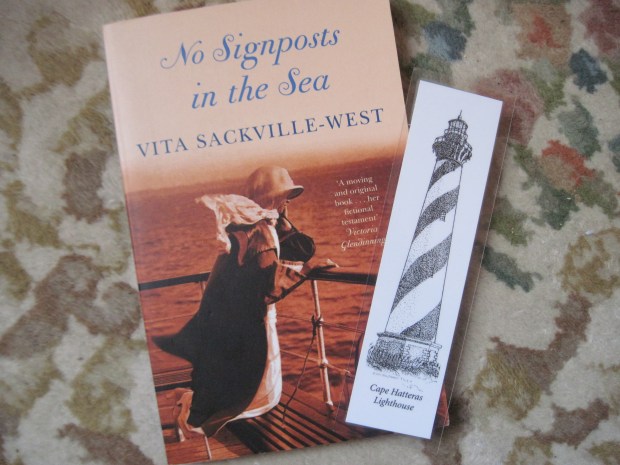
The novel is presented as Edmund’s diary, found after his eventual death. It’s full of his solitary musings but also his conversations with Laura, who is refreshingly unconventional in her approach to relationships:
I can’t abide the Mr. and Mrs. Noah attitude towards marriage; the animals went in two by two, forever stuck together with glue. I resent it as much for other people as I should for myself. It seems to me a degradation of individual dignity.
She also tells a story about a lesbian couple she knows who are aging happily together; it feels a bit out of place, but its inclusion is striking given Sackville-West’s history of lesbian relationships.
I’d recommend this short novel to anyone who’s looking for a quick women’s classic with plenty to say about what matters in life.

Next month: I’ve never read George Orwell’s Nineteen Eighty-Four and it seems to be having something of a resurgence in popularity at the moment, so perhaps now is the time?
 Bookish Beck = Rebecca Foster. American transplant to England. Freelance proofreader and book reviewer.
 Bookish Beck