Giveaway: Hitler’s Forgotten Children
Tomorrow Elliott & Thompson are releasing the paperback edition of Hitler’s Forgotten Children by Ingrid von Oelhafen and Tim Tate, a powerful first-person account from a child of the Lebensborn: the Nazis’ program to create an Aryan master race.
The publisher has kindly offered a free copy to one of my readers.
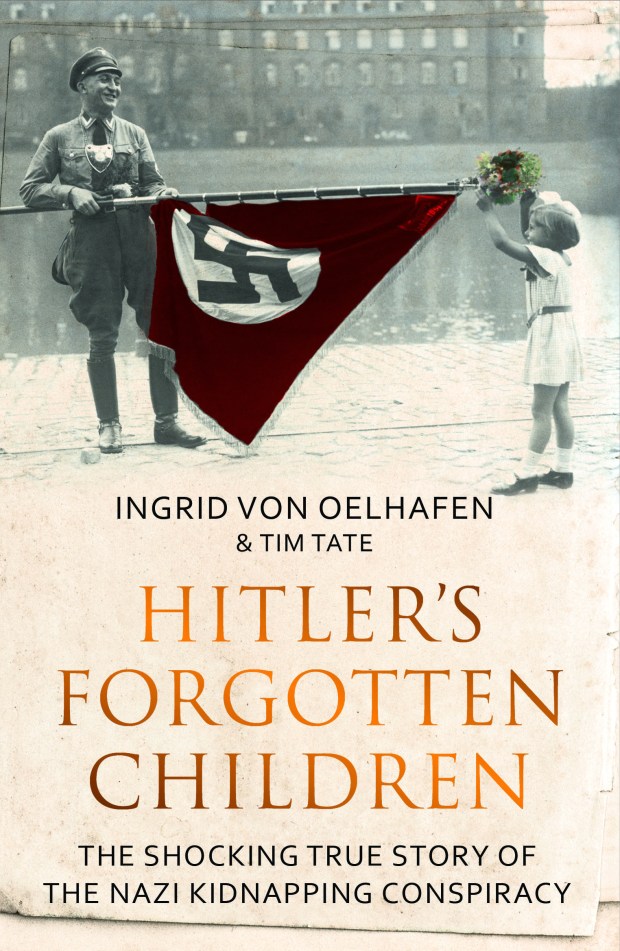
Here’s a bit more information about the book, adapted from the press release:
Forcibly adopted into a Nazi family as part of the Lebensborn program, Ingrid’s heartbreaking story is a quest for identity and an important historical document touching on the untold stories of thousands like her.
By the 1940s, Himmler’s breeding program had failed to provide adequate numbers of ‘racially pure and healthy’ children, so Lebensborn sought to boost the flagging German population by sinister means. Children in the occupied territories were examined and any exhibiting ‘Aryan’ qualities were forcibly taken from their parents to be raised by the regime.
In 1942 Erika, a baby girl from Yugoslavia, was examined by the Nazi occupiers, declared an ‘Aryan’ and removed from her mother. Her true identity erased, she became Ingrid von Oelhafen. Later, as Ingrid began to uncover her true identity, the full scale of the Lebensborn scheme became clear – including the kidnapping of up to half a million babies like her, and the deliberate murder of children born into the program who were deemed ‘substandard’.
We learn of Ingrid’s subsequent troubled childhood in Germany; first during the war, then a harrowing escape from the GDR, time in children’s homes and the shock of discovering as a teenager that she was adopted. Later, the search for the truth took her to Nuremberg Trials records and, ultimately, back to Yugoslavia, where she discovered the full story: the Nazis substituted ‘Ingrid’ with another child who was raised as ‘Erika’ by her family.
And here’s an exclusive extract:
Cilli, German-occupied Yugoslavia, 3–7 August 1942
The schoolyard was crowded. Hundreds of women – young and old – clutched the hands of their children and found what space they could in the packed courtyard. Nearby, Wehrmacht soldiers, rifles slung over their shoulders, looked on as the families slowly drifted in from towns and villages across the area. These women had been summoned by their new German masters, ordered to bring their children to the school for ‘medical tests’. Upon arrival they were arrested and told to wait. Otto Lurker, commander of the police and security services for the region, watched relaxed and impassive – his hands resting comfortably in his pockets – as the yard filled with families. Once, Lurker had been Hitler’s gaoler: now he was the Führer’s leading henchman in Lower Styria. He held the rank of SS-Standartenführer – the paramilitary equivalent of a full colonel in the army – but that summer’s morning he was casually dressed in a two-piece civilian suit.
Among them was a family from the nearby village of Sauerbrunn. Johann Matko came from a family of known partisans: his brother, Ignaz, had been one of those lined up and shot against the wall of Cilli prison in July. Johann had been dragged off to Mauthausen concentration camp. After seven months in the camp he was allowed to return home to his wife, Helena, and their three children: eight-year-old Tanja, her brother Ludvig – then six – and nine-month-old baby Erika. When all the families were accounted for, an order was given to separate them into three groups – one each for the children, the women, and the men.
Under Lurker’s direction the soldiers moved in and pulled children from the grasp of their mothers; a local photographer, Josip Pelikan, recorded the harrowing scene for the Reich’s obsessive archivists. His rolls of film captured the fear and alarm of women and children alike: his shots included scores of toddlers held in low pens of straw inside the school buildings. As the mothers waited outside, Nazi officials began a cursory examination of the children.
Working with charts and clipboards, they painstakingly noted each child’s facial and physical characteristics. These, though, were not ‘medical tests’ as any doctor would know them: instead they were crude assessments of ‘racial value’ which assigned each youngster to one of four categories. Those who met Himmler’s strict criteria for what a child of true German blood should look like were placed in Category 1 or 2: this formally registered them as potentially useful additions to the Reich population.
By contrast, any hint or trace of Slavic features – and certainly any sign of ‘Jewish heritage’– consigned a child to the lowest racial status of Categories 3 and 4. Thus branded as Untermensch, their value was no more than future slave labour for the Nazi state. By the following day this rudimentary sifting had finished. Those children deemed racially worthless were handed back to their families. But 430 other youngsters, from young babies to twelve-year-old boys and girls, were taken away by their captors. Marshalled by nurses from the German Red Cross, they were packed into trains and transported across the Yugoslavian border to an Umsiedlungslager – or transit camp – at Frohnleiten, near the Austrian town of Graz.
They did not stay long in this holding centre. By September 1942, a further selection had been made – this time by trained ‘race assessors’ from one of the myriad organisations established by Himmler to preserve and strengthen the pool of ‘good blood’. Noses were measured and compared to the official ideal length and shape; lips, teeth, hips and genitals were likewise prodded, poked and photographed to sort the genetically precious human wheat from the less-valuable chaff.
This finer, more rigorous sieving re-assigned the captives within the four racial categories. Older children newly listed in Categories 3 or 4 were shipped off to re-education camps across Bavaria in the heartland of Nazi Germany. The best of the younger ones in the top two categories would – in time – be handed over to a secretive project run by the Reichsführer himself. Its name was Lebensborn and among the infants assigned to its care was nine-month-old Erika Matko.
If you’re interested in winning a paperback copy of Hitler’s Forgotten Children, simply leave a comment to that effect below. The competition will be open through the end of Friday the 12th and I will choose a winner at random on Saturday the 13th (announced via the comments and a personal e-mail). Sorry, U.K. entries only. Good luck!
I was delighted to be asked to participate in the paperback release blog tour. See below for details of where other reviews and features will be appearing soon.
Gauguin Gets the Graphic Novel Treatment
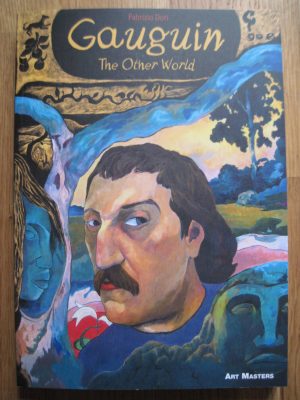 Fabrizio Dori’s Gauguin: The Other World is the third graphic novel I’ve reviewed from SelfMadeHero’s “Art Masters” series, after Munch and Vincent. Like those previous volumes, it delivers salient snippets of biography alongside drawings that cleverly echo the subject’s artistic style. Here the focus is on the last 12 years of Paul Gauguin’s life (1848–1903), which were largely spent in the South Pacific.
The book opens with a macro, cosmic view – the myth of the origin of Tahiti and a prophecy of fully clothed, soulless men arriving in a great canoe – before zeroing in on Gauguin’s arrival in June 1891. Although he returned to Europe in 1893–5, Tahiti and the Marquesas Islands would be his final homes. This is all covered in a whirlwind Chapter 1 that ends by, Christmas Carol-like, introducing a Spirit (as pictured in his 1892 painting Manaó Tupapaù (Spirit of the Dead Watching)) who will lead Gauguin – in a morphine haze on his deathbed in 1903 – and readers on a tour through his past.
Gauguin grew up in Peru and Paris, and at age 17 joined the crew of a merchant marine vessel to South America and the West Indies. Back in Paris, he tried to make a living as a stockbroker and salesman while developing as a self-taught artist. He married Mette, a Danish woman, but left her and their children behind in Copenhagen when he departed for Tahiti. The paintings he sent back were unprofitable, and she soon came to curse his career choice.
The locals called Gauguin “the man who makes men” for his skill in portraiture, but also “the woman man” because he wore his hair long. He moved from Papeete, Tahiti’s European-style colonial town, to a cabin in the woods to become more like a savage, and also explored the ghost-haunted island interior. Teura came to live with him as his muse and his lover.
The book is full of wonderful colors and spooky imagery. The palette shifts to suit the mood: dusky blue and purple for the nighttime visit of the Spirit, contrasting with lush greens, pinks and orange for other island scenes and simple ocher and black for the sequences where Gauguin is justifying his decisions. The black-robed, hollow-faced Spirit reminded me of similar figures imagined by Ingmar Bergman and Hayao Miyazaki – could these film directors have been inspired by Gauguin’s Polynesian emissary of death?
Overall this struck me as a very original and atmospheric way of delivering a life story. Although the font is a little bit difficult to read and I ultimately preferred the art to the narration, they still combine to build a portrait of a brazen genius who shunned conventional duties to pursue his art and cultivate the primitive tradition in new ways. Gauguin ends with a short sequence set in Paris in 1907, as Pablo Picasso, fired up by a Gauguin retrospective show, declares, “We must break with formal beauty. We must be savages.”
I appreciated this brief peek into the future, as well as the five-page appendix of critical and biographical information on Gauguin contributed by art critic Céline Delavaux. What I said about Vincent holds true here too: I’d recommend this to anyone with an interest in the lives of artists, whether you think you’re a fan of graphic novels or not. It will be particularly intriguing to see how Dori’s vision of Gauguin compares to that in W. Somerset Maugham’s The Moon and Sixpence, which I plan to start soon.
With thanks to Paul Smith of SelfMadeHero – celebrating its 10th anniversary this year – for the review copy. Translated from the French by Edward Gauvin.
My rating: 
Library Checkout: April 2017

Worst. News. Ever. As of the start of this month, my library system charges 50 pence for each reservation. I can see my library use going downhill quickly. Now that I can’t reserve anything that’s on loan, on order, or at a smaller branch library unless I pay that fee, I’ll largely be limited to what’s on shelf at my local library, including the bestseller shelf (two-week loans; no renewals). I’m lucky this wasn’t introduced until after I’d gotten hold of all the Wellcome Prize shortlist books. It’s probably for the best, as it may force me to read more of the books I actually own (such as all those books we bought in Hay-on-Wye), as well as my dozens of advanced review copies from NetGalley and Edelweiss.
I’ve added in ratings and links to any reviews for books I haven’t already featured on the blog in some way.
LIBRARY BOOKS READ
- The Universal Home Doctor by Simon Armitage [poetry]

- Still Alice by Lisa Genova

- When Breath Becomes Air by Paul Kalanithi [a reread]

- The Tidal Zone by Sarah Moss
- The Wind-Up Bird Chronicle by Haruki Murakami
- Jackself by Jacob Polley [poetry]
- Lincoln in the Bardo by George Saunders

SKIMMED ONLY
- The Rebecca Rioter: A Story of Killay Life by Amy Dillwyn
- How to Survive a Plague: The Story of How Activists and Scientists Tamed AIDS by David France
- Moranifesto by Caitlin Moran

- The Gene by Siddhartha Mukherjee

CURRENTLY READING
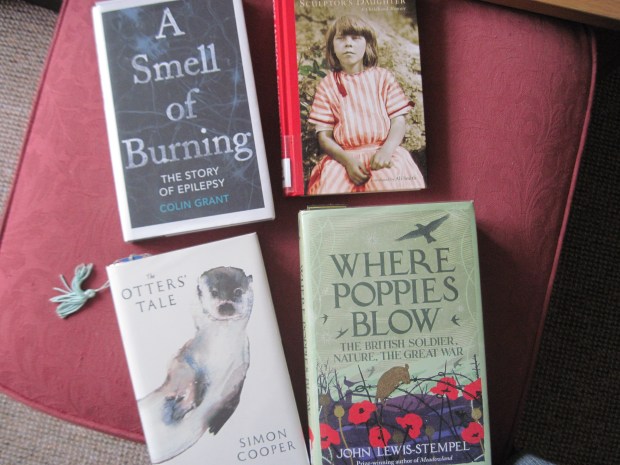
- The Otters’ Tale by Simon Cooper
- A Smell of Burning: The Story of Epilepsy by Colin Grant
- Sculptor’s Daughter: A Childhood Memoir by Tove Jansson
CURRENTLY SKIMMING
- Where Poppies Blow: The British Soldier, Nature, the Great War by John Lewis-Stempel
CHECKED OUT, TO BE READ
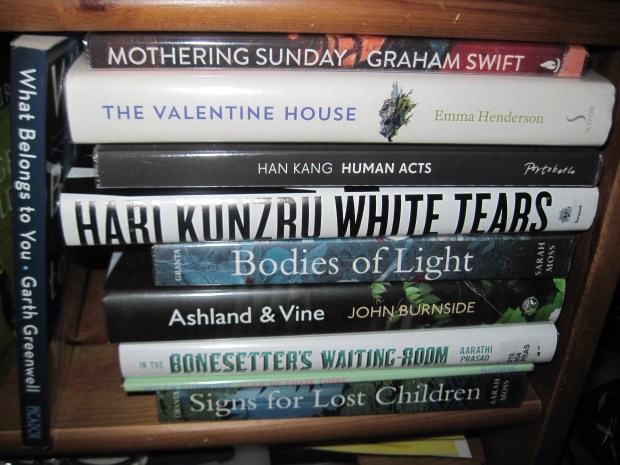
- Ashland & Vine by John Burnside
- Glad of These Times by Helen Dunmore [poetry]
- What Belongs to You by Garth Greenwell
- The Valentine House by Emma Henderson
- Human Acts by Han Kang
- White Tears by Hari Kunzru
- Bodies of Light by Sarah Moss
- Signs for Lost Children by Sarah Moss
- Gerontius by James Hamilton-Paterson – My husband’s currently reading this one, so it’s not in the photo
- In the Bonesetter’s Waiting-Room: Travels through Indian Medicine by Aarathi Prasad
- The Rough Guide to Amsterdam – My husband’s been accepted to speak at a conference in Ghent, Belgium in September; we fancy stopping in Amsterdam on the way. (I’ve never been.)
- Mothering Sunday by Graham Swift
ON HOLD, TO BE CHECKED OUT
(By chance I snuck in a few requests at the end of March, before the charge came into effect.)
- Gizelle’s Bucket List: My Life with a Very Large Dog by Lauren Fern Watt
IN THE RESERVATION QUEUE
- Hidden Nature by Alys Fowler
- Augustown by Kei Miller
RETURNED UNFINISHED
- Outline by Rachel Cusk (I read the first 66 pages but felt no impetus to continue. Her style just doesn’t connect with me.)
RETURNED UNREAD
- The Owl at the Window: A Memoir of Loss and Hope by Carl Gorham
- Finn Family Moomintroll by Tove Jansson (both requested by other borrowers)
Hosted by Charleen of It’s a Portable Magic.
Have you been taking advantage of your local libraries? What appeals from my lists?
Finding a Home in Nature: Singing Meadow by Peri McQuay
For 30 years Peri McQuay and her family lived in the idyllic 700-strong village of Westport in Eastern Ontario. Her husband, Barry, was the park supervisor at Foley Mountain Conservation Area, the subject of her first nature-themed memoir, The View from Foley Mountain (1995), and they lived on site amid its 800 acres. The constant push to engage in fundraising gradually made it a less pleasant place to live and work, so as Barry’s retirement neared they knew it was time to find a new home of their own. That quest is the subject of her third book, Singing Meadow: The Adventure of Creating a Country Home.
McQuay fantasized about a farmhouse surrounded by 50–100 acres of their own land, but was aware that their limited finances might not stretch to match their dreams. Long before they found their home they were buying little items for it, like an acorn door knocker that functioned as a reassuring totem object during the long, discouraging process of looking at houses. Over the course of two years, McQuay and her husband viewed more than 80 properties! Two pieces of advice they received turned out to be prescient: their loquacious real estate agent opined that “the house you end up in won’t be the one you set out to find,” and a woman in the doctor’s office waiting room counseled her, “don’t try too hard. It’ll happen when it’s time.”
 In the end, they fell in love with a plot of land with a water meadow that was home to herons and beavers. With no handyman skills, they never thought they’d embark on building a home of their own. And as it turned out, finding the land was the easy bit, as opposed to the nitty-gritty details of designing what they wanted and meeting with builders who could make it a reality. But as they planted trees and looked ahead to their move in a year’s time, they were already forming a relationship with this place before the house was ever built, learning “the hard lessons of patience and possibility.”
Woven through the book are short flashbacks to other challenging times in McQuay’s life: having chronic fatigue syndrome in her 40s, her mother’s death a few years earlier, and a terrible ice storm at the park that left them without power for 17 days and caused damage to the forest that it might take 30 years to recover from. What all of these situations, as well as looking for a home, have in common is that they forced the author to take the long view, recognizing the healing effects of time rather than the tantalizing option of quick fixes.
I’ve never owned a home, but I’ve lived in 10 properties in the last 10 years. A lot of that nomadism has been foisted upon us rather than chosen, so I could relate to McQuay’s frustration throughout the property search, as well as her feelings of being uprooted – that “the very stuff of my life was being dismantled.” I can also see the wisdom of choosing the place that feeds your soul rather than the one that seems most convenient. She remembers one of the first properties she and Barry rented as a married couple: it was an old place with an outhouse and no running hot water, but they filled it with laughter and music and felt at peace there. It was infinitely better than any soulless town apartment they might have resorted to.
The book ends with a bit of a shocker, one of two moments that brought a lump to my throat. It’s a surprisingly bittersweet turn after what’s gone before, but it’s realistic and serves as a reminder that life is an ongoing story with sad moments we can’t prepare for.
Overall, this memoir reminds me most of Michael Pollan’s A Place of My Own (which appears in McQuay’s bibliography) and May Sarton’s journals, in which the search for a long-term home in Maine is a major element. Although this will appeal to people who like reading about women’s lives and transitions, I would particularly recommend it to readers of nature writing as the book is full of lovely passages like these:
It was bliss visiting the trees and caring for them. Each one was precious. Across the meadow I could see the black, white and yellow nesting bobolink plus an unidentifiable bird with a square seed-eating beak perched on a cattail. A crow flew by, checking to see what I was doing, then a blue jay. In the distance the newly returned yellow warbler was calling “witchetty witchetty.” Over and over, I needed to keep saying that I felt deep down, richly happy in the meadow. In the glassy eye of the pond, water was burbling up in such a powerful spilling-over that it chuckled musically. Indeed, while there was such a flow only the boldest, largest minnows could swim strongly enough to approach the rushing source.
Now I was walking slowly down to the water meadow, hearing the strange, quarrelsome-sounding talk of herons beginning another season here. I was teaching myself how to be aware every moment of every step so I could keep walking longer on this rough land. With any luck, this beloved place would be my last home. And, after the unignorable message of recent fierce summers, I was here to bear witness, to stand with the great maples, beeches, and oaks through whatever might come, to accompany with whatever grace I could for as long as I could sustain it. Living here, this was who I wanted to be—an old woman vanishing into the light.
I’m keen to get hold of McQuay’s other two books as well. Her work makes for very pleasant, meditative reading.
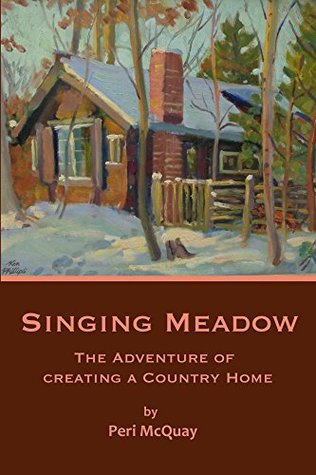
Note: The front cover is an oil painting of Peri’s childhood home by her artist father, Ken Phillips.
Singing Meadow: The Adventure of Creating a Country Home was published by Wintergreen Studios Press in 2016. My thanks to the author for sending a PDF copy for review.
My rating:
Failing at Classics of the Month
I’ve attempted two Dickens novels in the last five years, and left both unfinished. I at least got about 200 pages into Dombey and Son in 2012 before I gave up, but my recent attempts to get past the first couple of chapters in Our Mutual Friend have been utterly unsuccessful. I finally gave myself permission to set it aside at page 41 – and I didn’t even read all of that; I’d started skimming in a last-ditch attempt to get myself hooked by the story. Have I lost my Dickens mojo? Do I not have sufficient patience to read Victorian triple-deckers anymore? I truly hope this is just a phase and I’ll be able to get back into Dickens someday. I certainly intend to read his whole oeuvre eventually, even the obscure ones.
So I don’t have a classic for April, nor a true doorstopper (I’ve classified David France’s How to Survive a Plague as such – a bit of a cheat since I only skimmed it). Instead what I have to offer are a modern classic and a graphic adaptation of another Dickens novel.
On the Black Hill by Bruce Chatwin, which I mostly read during our trip to Hay-on-Wye earlier in the month, is worthy of being called a modern classic. It has echoes of D.H. Lawrence and especially Thomas Hardy, and it’s a pleasantly offbeat look at the developments of the twentieth century as seen through the lives of Welsh identical twins Benjamin and Lewis Jones. Opening in the 1980s, when the brothers are eccentric old gents sleeping side by side in their late parents’ bed, the book then retreats to the beginning: at the turn of the last century ornery Amos Jones fell for an educated rector’s daughter and their volatile relationship played out at The Vision farm. One son was caught up in the First World War, one had love affairs; neither “ever strayed further than Hereford.” Through sickness, community scandal, and the rise and fall of fortunes, they remain wedded to Welsh village life.

“The Vision” farm is in the background to the right.
I especially loved Chatwin’s descriptions of the natural world (he’d visited Radnorshire as a boy and considered it a kind of spiritual home), and the glimpses he gives into the twins’ preternatural closeness:
Lewis and Benjamin gambolled ahead, put up grouse, played finger-football with rabbit-droppings, peered over the precipice onto the backs of kestrels and ravens and, every now and then, crept off into the bracken, and hid. They liked to pretend they were lost in a forest, like the Twins in Grimms’ fairy-tale, and that each stalk of bracken was the trunk of a forest tree. … They lay on their backs and gazed on the clouds that crossed the fretted patches of sky … they would press their foreheads together, each twin losing himself in the other’s grey eye.
(Clearance book from Blackwell’s in Oxford. )
 The David Copperfield graphic novel by Jacqueline Morley (illustrated by Penko Gelev) is part of the Graffex series of graphic novel literary retellings issued by Salariya Book Company. It’s remarkably faithful to Dickens’s original, with just a bit of condensing in terms of the plot and a few secondary characters cut out or greatly reduced in importance. Although this is no substitute for reading David Copperfield itself (my favorite book), I could see it being useful for high school or college students who need a quick recap of what happens when preparing for a quiz or essay. The three main young females are amusingly similar and idealized, but all the other characters’ looks are true to the novel’s descriptions (and previous adaptations). The end matter – a brief biography of Dickens, commentary on the novel, a timeline of stage and screen versions – is particularly helpful, though in the chronology of Dickens’s works they forgot Dombey and Son!

(Remainder copy from Addyman Books in Hay-on-Wye. )
Next month: I’ve pulled out a couple of short (~210 pages each) classics from the shelf. I recently read a graphic novel about Gauguin that I’ll be reviewing on Monday, so I fancy following it up with W. Somerset Maugham’s The Moon and Sixpence, which is said to be based on Gauguin’s life. It’ll be only my second Maugham after Of Human Bondage, which I loved in 2015. Anna of the Five Towns will be my first taste of Arnold Bennett’s fiction (though I’ve read his Literary Taste).
Four Recommended May Releases
Here are four enjoyable books due out next month that I was lucky enough to read early. The first two are memoirs, the third is an audacious poetry book by an author new to me, and the last is the sophomore novel from an author I’ve loved before. I’ve pulled 250-word extracts from my full reviews and hope you’ll be tempted by one or more of these.
Last Things: A Graphic Memoir of Loss and Love by Marissa Moss
(Coming from Conari Press on May 1st [USA]; June 8th in UK)
 “You’re not aware of last things,” Moss, a children’s book author/illustrator, writes in this wrenching memoir of losing her husband to ALS. We look forward to and celebrate all of life’s firsts, but we never know until afterwards when we’ve experienced a last. The author’s husband, Harvey Stahl, was a medieval art historian working on a book about Louis IX’s prayer book. ALS is always a devastating diagnosis, but Harvey had the particularly severe bulbar variety, and his lungs were quick to succumb. His battery-powered ventilator led to many scares – one time Moss had to plug him into the wall at a gas station and rush home for a spare battery – and he also underwent an emergency tracheotomy surgery.
This is an emotionally draining read. It’s distressing to see how, instead of drawing closer and relying on each other, Marisa and Harvey drifted apart. Harvey pushed everyone away and focused on finishing his book and returning to his academic duties. He refused to accept his limitations and resisted necessary medical interventions. Meanwhile, Moss struggled with the unwanted role of caregiver while trying not to neglect her children and her own career.
I’ve read several nonfiction books about ALS now. Compared to the other two, Moss gets the tone just right. She’s a reliable witness to a medical and bureaucratic nightmare. At the distance of years, though, she writes about the experience without bitterness. I can see this graphic novel being especially helpful to older teens with a terminally ill parent.
My rating:
My Life with Bob: Flawed Heroine Keeps Book of Books, Plot Ensues by Pamela Paul
(Coming from Henry Holt on May 2nd [USA]; June 13th in UK)
 I hold books about books to high standards and won’t stand for the slightest hint of plot summary, filler or spoilers. It’s all too easy for an author to concentrate on certain, often obscure books that mean a lot to him/her, dissecting the plots without conveying a sense of the wider appeal. The trick is to find the universal in the particular, and vice versa.
Pamela Paul, editor of the New York Times Book Review, does this absolutely perfectly. In 1988, as a high school junior, she started keeping track of her reading in a simple notebook she dubbed “Bob,” her Book of Books. In this memoir she delves into Bob to explain how her reading both reflected and shaped her character. The focus is unfailingly on books’ interplay with her life, such that each one mentioned more than earns its place.
A page from my 2007 reading diary. Lots of mid-faith-crisis religion titles there. Starting in 2009, I think, I’ve kept this information in an annual computer file instead.
So whether she was hoarding castoffs from her bookstore job, obsessing about ticking off everything in the Norton Anthology, despairing that she’d run out of reading material in a remote yurt in China, or fretting that her husband took a fundamentally different approach to the works of Thomas Mann, Paul always looks beyond the books themselves to interrogate what they say about herself.
This is the sort of book I wish I had written. If you have even the slightest fondness for books about books, you won’t want to miss this one. I’ve found a new favorite bibliomemoir, and an early entry on the Best of 2017 list.
My rating: 
Nature Poem by Tommy Pico
(Coming on May 9th from Tin House Books)
 Tommy “Teebs” Pico is a Native American from the Kumeyaay nation and grew up on the Viejas Indian reservation. This funny, sexy, politically aware multi-part poem was written as a collective rebuttal to the kind of line he often gets in gay bars, something along the lines of ‘oh, you’re an Indian poet, so you must write about nature?’ Au contraire: Pico’s comfort zone is the urban, the pop cultural, and the technologically up-to-date – his poems are full of textspeak (“yr,” “bc” for because, “rn” for right now, “NDN” for Indian), an affectation that would ordinarily bother me but that I tolerated here because of Pico’s irrepressible sass: “I wd give a wedgie to a sacred mountain and gladly piss on the grass of / the park of poetic form / while no one’s lookin.”
Some more favorite lines:
“How do statues become more galvanizing than refugees / is not something I wd include in a nature poem.”
“Knowing the moon is inescapable tonight / and the tuft of yr chest against my shoulder blades— / This is a kind of nature I would write a poem about.”
“I can’t write a nature poem bc English is some Stockholm shit, makes me complicit in my tribe’s erasure”
“It’s hard to unhook the heavy marble Nature from the chain around yr neck / when history is stolen like water. // Reclamation suggests social / capital”
My rating:
The Awkward Age by Francesca Segal
(Coming on May 4th from Chatto & Windus [UK] and May 16th from Riverhead Books [USA])
 I adored Segal’s first novel, The Innocents, a sophisticated remake of Edith Wharton’s The Age of Innocence set in a contemporary Jewish community in London. I wasn’t as fond of this second book, but in her study of an unusual blended family the characterization is nearly as strong as in her debut. Julia Alden lost her husband to cancer five years ago. A second chance at happiness came when James Fuller, a divorced American obstetrician, came to her for piano lessons. He soon moved into Julia and sixteen-year-old Gwen’s northwest London home, and his seventeen-year-old son, Nathan, away at boarding school, came on weekends.
Julia is as ill at ease with Nathan as James is with Gwen, and the kids seem to hate each other. That is until, on a trip to Boston for Thanksgiving with James’s ex, Gwen and Nathan fall for each other. Awkward is one way of putting it. They’re not technically step-siblings as James and Julia aren’t married, but it doesn’t sit right with the adults, and it will have unexpected consequences.
The first third or so of the book was my favorite, comparable to Jonathan Safran Foer or Jonathan Franzen. Before long the romantic comedy atmosphere tips into YA melodrama, but for me the book was saved by a few things: a balance of generations, with Gwen’s grandparents a delightful background presence; the eye to the past, whether it be Gwen’s late father or the occasional Jewish ritual; the Anglo-American element; and a realistic ending.
My rating:
Have you read any May releases that you would recommend? Which of these do you fancy?
The Wellcome Book Prize 2017 Awards Ceremony
Yesterday evening’s Wellcome Book Prize announcement was my first time attending a literary prize awards ceremony. Despite my nerves going in, there was quite a relaxed atmosphere (I felt almost overdressed in my H&M dress) and it was no different to any party where one struggles to make small talk – except that here all the talk was of books!
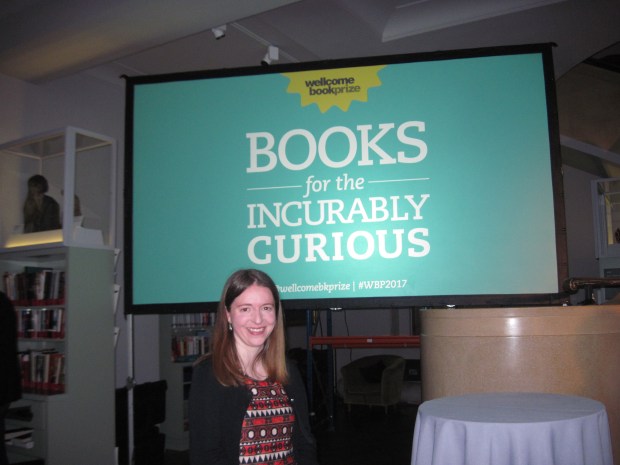
The new high-ceilinged Reading Room at the Wellcome Library (across from London’s Euston station) was a suitably swanky setting, with the unusual collection of health-themed books surrounded by an equally odd set of curios, such as death masks, paintings showing medical conditions, and a columnar red dress designed to resemble a neural tube. There was even a jazz duo playing.


It was especially lovely to meet up with Clare (A Little Blog of Books) and Ruby (My Booking Great Blog) and compare notes on book blogging while nursing a flute of prosecco and some superlative canapés. We also indulged in some subtle celebrity spotting – or, at least, the sort of authors and public figures I consider celebrities: Ned Beauman, Sarah Churchwell, A.C. Grayling, Cathy Rentzenbrink, and Suzanne O’Sullivan, last year’s Wellcome Prize winner. Three of the shortlisted authors were also present.
About 45 minutes into the event, the official proceedings began. Crime writer Val McDermid, the chair of this year’s judging panel, gave introductory remarks about the Prize and the attributes they were looking for when assessing the 140 books in the running this year. She said they were in search of books that went beyond the superficial and revealed more layers upon each rereading – as by now they’ve read the shortlisted books three times.
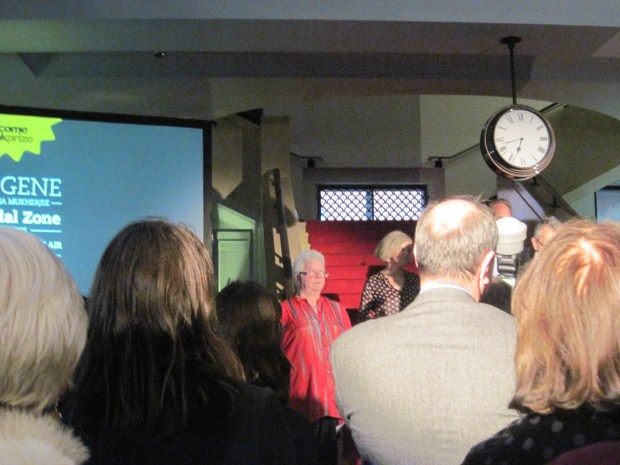
Chair of judges Val McDermid in center; fellow judge and BBC Radio books editor Di Spiers to her left.
Each of the judges then came to the podium to explain what they had all admired about a particular shortlisted book before presenting the author or author’s representative (editor, publisher or, in the case of Paul Kalanithi, his younger brother Jeevan, over from America) with flowers. When McDermid returned to the microphone to announce the winner, she started off by speaking of a book that combined two stories, the medical and the personal. Hmm, this might describe at least four or five of the books from the shortlist, I thought. Could it be When Breath Becomes Air, our shadow panel favorite? Or The Tidal Zone, our runner-up?
Within seconds the wait was over and we learned the actual winner was Mend the Living by Maylis de Kerangal. There was a pleased roar from the room, but also plenty of blinks and head shakes of surprise, I think. De Kerangal gave a few words of thanks, especially to the U.K. translator and publisher who made this edition of her book possible. This was the first work in translation to win the Wellcome Book Prize, and only the second novel (after Turn of Mind by Alice LaPlante in 2011).
Clare and I stuck around for another hour and were unexpectedly asked for book recommendations by a member of the Wellcome legal team who was kind enough to take an interest in us as book bloggers. She confessed that since uni she doesn’t read much anymore, but said that at school she enjoyed Jane Austen and she’s recently read Elena Ferrante’s books. Based on that rather thin history, we suggested she try Zadie Smith, and I also spoke up for Yaa Gyasi’s Homegoing.
On the way out we were given terrific bookish swag bags! Mine contained a paperback reissue copy of The Tidal Zone, a Wellcome Prize bookmark and commemorative booklet, and a blank notebook featuring optician’s glass eyes.

I can’t see such London events ever being frequent for me, especially given the cost of travel in from Newbury, but if a similar opportunity arises again I won’t hesitate to take advantage of it, especially if it means putting faces to names from the U.K. blogging community.
And the Winner Is…
I’m just back from London, where I saw the Wellcome Book Prize 2017 announced in the course of an awards ceremony held at the Wellcome Collection. It was an enjoyable evening; I needn’t have been so nervous. And it was lovely to meet two fellow bloggers.
 I’ll post a full write-up tomorrow, but for now I will just convey the news, to those who may not have heard yet, that the winner of this year’s Wellcome Book Prize is Mend the Living by Maylis de Kerangal. This was quite a shock to many of us in attendance. I hope it won’t sound ungracious if I say it was the collective least favorite of the shadow panel. But keep in mind that that’s relative: it was a strong set of six very different books, each worth reading.
Wellcome Book Prize Shadow Panel Decision
It’s been a whirlwind five weeks as we on the shadow panel have made our way through the six books shortlisted for the Wellcome Book Prize 2017. The list is strong and varied: an account of the AIDS crisis, a posthumous memoir by a neurosurgeon, a thorough history of genetics, an introduction to the microbial world, and novels about a donor heart and an ordinary family’s encounter with unexpected illness. All have been well worth engaging with, but when it came to decision time we had a pretty clear winner: When Breath Becomes Air by Paul Kalanithi. (With Sarah Moss’s The Tidal Zone a fairly close second.)


“I realized that the questions intersecting life, death, and meaning, questions that all people face at some point, usually arise in a medical context.” ~Paul Kalanithi
I first read this book a year and a half ago; when I picked it back up on Friday, I thought I’d give it just a quick skim to remind myself why I loved it. Before I knew it I’d read 50 pages, and I finished it last night in the car on the way back from a family party, clutching my dinky phone as a flashlight, awash in tears once again. (To put this in perspective: I almost never reread books. My last rereading was of several Dickens novels for my master’s in 2005–6.)
What struck me most on my second reading is how Kalanithi, even in his brief life, saw both sides of the medical experience (as the U.K. book cover portrays so well). He was the harried neurosurgery resident making life and death decisions and marveling at the workings of the brain; in a trice he was the patient with terminal lung cancer wondering how to make the most of his remaining time with his family.

Yet in both roles his question was always “What makes human life meaningful?” – a quest that kept him shuttling between science, literature and religion. In eloquent prose and with frequent scriptural allusions, this short, technically unfinished book narrates Kalanithi’s past (his growing-up years and medical training), present (undergoing cancer treatment but ultimately facing death) and future (the legacy he leaves behind, including his daughter).
Looking back once again at the guidelines for the Wellcome Book Prize (“At some point, medicine touches all our lives. Books that find stories in those brushes with medicine are ones that add new meaning to what it means to be human”), When Breath Becomes Air stands out as a perfect exemplar. In her blog review, Ruby writes, “This book looks death right in the eye and doesn’t seek to rationalise it, explain it, avoid it. It deals with it head on.” In his Nudge review Paul calls the book “equally heart breaking and full of love … a painfully honest account of a short, but intense life.”
My thanks, once again, to the other members of the shadow panel: Paul Cheney, GrrlScientist, Ruby Jhita and Amy Pirt.
Tomorrow evening the winner of the Wellcome Book Prize 2017 will be announced at an awards ceremony at the Wellcome Collection in London. As thanks for my participation in the blog tour, I’ve been invited to attend. Small talk and networking are very much outside of my comfort zone, but I couldn’t pass up this opportunity and hope to at the very least meet one or two fellow bloggers. I’ll post very quickly when I get home from the ceremony tomorrow night to announce the winner, and promise a longer write-up of the event sometime on Tuesday.
Polishing off the Wellcome Prize Shortlist: How to Survive a Plague
Spanning from the summer of 1981, when the New York Times first broke the story about a rare cancer observed in homosexuals, to 1996, when protease inhibitors came onto the market and offered HIV sufferers a new lease on life, How to Survive a Plague is a comprehensive history of the AIDS crisis. Especially in its early chapters, it reads like a fascinating medical mystery – though we already know the answers, the book skillfully captures the ignorance and terror that reigned for so many years as people sought to understand what Gay-Related Immune Deficiency (GRID, the original name for AIDS) was and how it was transmitted.
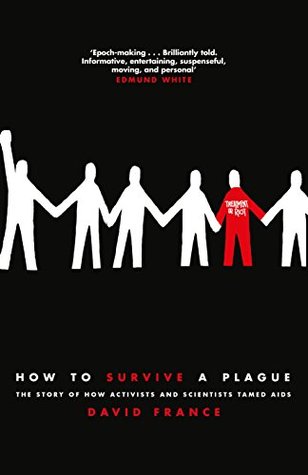 As a journalist and a gay man, David France was right in the thick of the crisis when he moved to Manhattan in 1981. He lost friends and lovers to AIDS, and had his own health scares, too – once, on assignment in war-torn Central America, he developed what he thought was a Kaposi’s sarcoma lesion but turned out to be a sign of amoebic infection.
Throughout the 1980s the number of HIV cases roughly doubled each year; media coverage was intense but often alarmist. Undertakers refused to deal with AIDS victims, and Jerry Falwell and his ilk spoke of a gay conspiracy taking over America. Far too slowly, research advanced to cope with the crisis. France gives details of the medical trials and presidential commissions that kept AIDS at the forefront of the national conscience, generally thanks to patient advocacy groups like ACT UP (AIDS Coalition to Unleash Power) and PWA (People with AIDS – more proactive terminology than victims or patients).
The book reminds me most of Sheri Fink’s Five Days in Memorial, another social history with a vast scope and a large cast of characters; here there are about 25 doctors, researchers and activists, many of them based in New York City, who keep recurring. For instance, there’s Joe Sonnabend, an infectious diseases expert who specialized in treating gay men for venereal diseases; Larry Kramer, who wrote an angry novel about fellow homosexuals yet tried to lead the response; and Richard Berkowitz, a former sex worker who co-wrote How to Have Sex in an Epidemic, a safe sex guide that encouraged a surge in condom use.
I rather underestimated the reading load the Wellcome shortlist would create for me; I ended up getting bogged down in this 500+-page book’s level of detail and only succeeded in skimming it. I think that for someone without a personal stake in the story of AIDS, watching the 2012 documentary film of the same title that spawned the book would be an easier way to absorb copious information and keep track of all the individuals and organizations involved.
Nonetheless, I can certainly affirm the importance of a landmark book like this one. When I surveyed critical opinion on it for Bookmarks magazine, I noticed many comparisons to Randy Shilts’s 1987 And the Band Played On, but while that book was written in medias res and deliberately vilified a French-Canadian flight attendant named Gaëtan Dugas who was linked with multiple AIDS cases in North America, How to Survive a Plague benefits from two decades of hindsight and reflects a mixture of journalistic objectivity and personal grief.
It’s sobering to remember the scale of the AIDS epidemic: 100,000 Americans had died of it by 1991. As one HIV-positive ACT UP activist cried out to Bill Clinton, then a Democratic candidate, at a campaign event, “Bill, we’re dying of neglect!” France’s book really brings home how traumatic these years were for a whole country, but especially for homosexuals. He describes the relief of knowing that effective medical treatment was finally in the pipeline, but also the lingering effects of shame, bitterness, and fear.
Nobody left those years uncorrupted by what they’d witnessed, not only the mass deaths—100,000 lost in New York City alone, snatched from tightly drawn social circles—but also the foul truths that a microscopic virus had revealed about American culture: politicians who welcomed the plague as proof of God’s will, doctors who refused the victims medical care, clergymen and often even parents themselves who withheld all but a shiver of grief. Such betrayal would be impossible to forget in the subsequent years.
My rating:
My gut feeling: France has written a definitive history of the AIDS crisis in the United States. It’s a cautionary tale that must not be forgotten. While not among my personal favorites from the shortlist, it would be a worthy winner.
More reviews:
Clare’s at A Little Blog of Books
 Bookish Beck = Rebecca Foster. American transplant to England. Freelance proofreader and book reviewer.
