Books in Brief: Five I Loved Recently
Why We Write about Ourselves: Twenty Memoirists on Why They Expose Themselves (and Others) in the Name of Literature
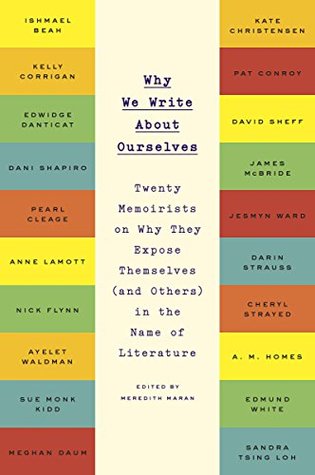 (Edited by Meredith Maran)
A great collection of first-person pieces from memoir authors, charting their individual journeys into autobiographical writing and giving their top tips. Opinions vary as to whether you have to get the approval of the people who appear in your work – some think that’s essential; others simply change the names and get on with it. Sometimes this has led to fallout within families. One thing everyone agrees on, though, is that a memoir has to be as carefully crafted as any novel, with a clear narrative arc and distinctive dialogue and scenes. My favorite pieces were from Kate Christensen, Edwidge Danticat and Darin Strauss.
Can’t We Talk about Something More Pleasant?
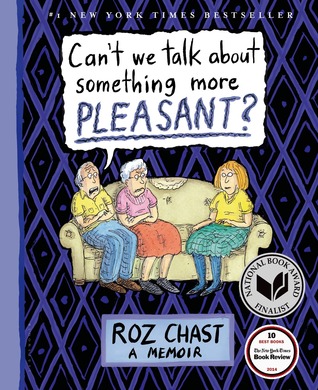 (By Roz Chast)
Memoir + graphic novel = graphic memoir. This one’s about her parents’ aging, senility and death yet still manages to be laugh-out-loud funny. It also includes photos of her parents’ apartment filled with ancient stuff they’d hoarded and a touching series of sketches she made of her mother while she was dying. This and Fun Home are the two best graphic memoirs I’ve read. A favorite line, uttered when her mother bounced back temporarily from hospice care: “Where, in the five Stages of Death, is EAT TUNA SANDWICH?!?!?”
Best Food Writing 2015
(Edited by Holly Hughes)
 “Food is intimate. We take it into our bodies. When we gather at the table with friends and family, we’re gathering to affirm something.” The title doesn’t lie – these essays are terrific. There wasn’t a single one I didn’t find interesting, whether the topic was lab meat; seeking out the perfect burger, Bolognese sauce or gumbo; particular chefs or restaurants; food fads; starting a simple meatball supper club; or feeding picky kids. A couple favorites were “Finding Home at Taco Bell” by John DeVore and “The One Ingredient that Has Sustained Me during Bouts of Leukemia” by Jim Shahin. This series has been running since 2000, but this is the first time I’ve picked up one of the books. I’ll be looking out for it again next year.
 The Longest Night
(By Andria Williams)
Utterly absorbing historical fiction. What with the remote setting and the threat of Cold War or nuclear fallout, this is reminiscent of The Last Pilot and The Wives of Los Alamos, but more engaging than either of those. You may also see hints of Richard Yates or even Tom Perrotta’s Little Children in the story of a marriage strained to the breaking point. Each character is fully explored and the early 1960s atmosphere is completely convincing. A great debut and an author I’d like to hear more from.
Your Heart Is a Muscle the Size of a Fist
(By Sunil Yapa)
 A hard-hitting novel with an unforgettably resonant title, this is set at the 1999 Seattle WTO protest. Yapa explores the motivations and backstories of activists, police officers, and delegates as the day deteriorates into violence. The novel flows pretty much effortlessly. Yapa’s writing style is closest to Smith Henderson’s (Fourth of July Creek): short, verbless sentences alternate with long, lyrical ones; there’s plenty of repetition and rhetorical questions, but it remains accessible rather than overblown. This fine debut novel is about cultivating the natural compassion in your heart even while under the threat of the fist.
My rating for all: 
Of Human Bondage: Finally Caught Up from 2015
When it came to it, it isn’t me
was all he seemed to learn
from all his diligent forays outward.
(from “It Isn’t Me” by James Lasdun)
I chose to read this doorstopper from 1915 because it appeared in The Novel Cure on a list entitled “The Ten Best Novels for Thirty-Somethings.” By happy accident, I was also reading it throughout its centenary year. My knowledge of W. Somerset Maugham’s work was limited – I had seen the 2006 film version of The Painted Veil but never read anything by him – so I had no clear idea of what to expect. I was pleased to encounter a narrative rich with psychological insight and traces of the Victorian novel.
 Philip Carey is not unlike a Dickensian hero: born with a club foot and orphaned as a child, he’s raised by his stern vicar uncle in Kent and reluctantly attends boarding school. Much of the book is filled with his post-schooling wanderings and professional shilly-shallying, along with multiple romantic missteps. He studies in Germany, tries to make it as a painter in Paris, and returns to London to train as an accountant and then as a doctor. Each attempted career seems to fail, as does every relationship. Philip reminded me most of David Copperfield, especially after he meets the jolly, Micawber-esque Thorpe Athelny during his hospital internship and becomes friendly with his wife and children.
As is common in Victorian novels, Philip is troubled by his conflicting desires. When it comes to women, he cannot get love to match up with lust. As a youth he loses his virginity to Emily Wilkinson, a woman in her mid-30s, then wants nothing to do with her. A few other dalliances have mixed success, but the novel focuses on Philip’s connection to Mildred Rogers. A café waitress, she’s vain and ill-tempered and acts indifferent to Philip – but is happy for him to spend money on her. He’s disgusted and infatuated all at once: “He did not care if she was heartless, vicious and vulgar, stupid and grasping, he loved her. He would rather have misery with [her] than happiness with [another].” Though Mildred tries to eschew the traditional roles of wife and mother, the Victorian notion of the fallen woman haunts her.
This on-again, off-again romance forms the heart of the book. Both Philip and Mildred are maddening in their own way. Not since Pip (another Philip, interestingly) in Great Expectations have I been so furious at a main character for consistently making the wrong choices, being dazzled by beauty and status and ignoring the more important things in life. Yet the close third-person narration sees so deeply into Philip’s psyche that I could not help but feel sympathy for him, too, cringing over his every failure – especially when stock market losses leave him destitute and he undertakes humiliating (to him) work at a department store. The novel is liberally studded with intimate paragraphs conveying Philip’s thoughts:
He painted with the brain, and he could not help knowing that the only painting worth anything was done with the heart. … [H]e had a terrible fear that he would never be more than second-rate. Was it worth while for that to give up one’s youth, and the gaiety of life, and the manifold chances of being?
Pain and disease and unhappiness weighed down the scale so heavily. What did it all mean? He thought of his own life, the high hopes with which he had entered upon it, the limitations which his body forced upon him, his friendlessness, and the lack of affection which had surrounded his youth. He did not know that he had ever done anything but what seemed best to do, and what a cropper he had come! Other men, with no more advantages than he, succeeded, and others again, with many more, failed. It seemed pure chance. The rain fell alike upon the just and upon the unjust, and for nothing was there a why and a wherefore.
Another humanizing element that especially appealed to me was Philip’s loss of Christian faith. During my study abroad year and especially my master’s year at Leeds, when I wrote a dissertation on women’s loss-of-faith narratives in Victorian fiction, I read a lot of novels about belief and doubt. In Philip’s case, I was interested to see how Maugham portrays what is usually seen as a loss as more of a liberation:
Suddenly he realised that he had lost also that burden of responsibility which made every action of his life a matter of urgent consequence. He could breathe more freely in a lighter air. He was responsible only to himself for the things he did. Freedom! He was his own master at last. From old habit, unconsciously he thanked God that he no longer believed in Him.
Although Philip frequently indulges in self-pity, he also has moments where he wakes up to the wonder of life. These epiphanies of the beauty of London, of the whole world, were among my favorite scenes.
Unusually in a long book, I thought the last 150 pages were the strongest. I struggled to pay attention throughout Philip’s schooling and wearied of the endless negotiations with Mildred, but when Philip is at his lowest point – like the protagonist of Knut Hamsun’s Hunger, not even sure if he’ll find enough to eat – there’s a real intensity to the plot that made this last chunk fly by.
I read a 1930s Modern Library copy from the University of Reading, but consulted Robert Calder’s introduction to the 1992 Penguin Classics edition for background information. It seems the novel was recognizably autobiographical for Maugham, though where a club foot was Philip’s source of shame, for the author it was his stammer (and his sexuality – he married but is known to have been a homosexual).
Like Joyce’s roughly contemporary A Portrait of the Artist as a Young Man, Calder notes, Of Human Bondage fits into the “apprentice novel” genre. Despite being published in 1915, it is set in a recent past so makes no reference to the First World War, though the Boer War plays a background role. I didn’t find the book to be particularly dated; I even discovered that a couple of sayings I might have pegged as later inventions were around in the 1910s: “like it or lump it” and “put that in your pipe and smoke it.”
Of Human Bondage met with a lukewarm critical response in its own time but does seem to be among the more beloved – if obscure – classics nowadays. Calder insists that it “remains Maugham’s most complete statement of the importance of physical and spiritual liberty.”
There have been three film versions – and another is in production this year, apparently. The best known, from 1934, launched the career of Bette Davis, who gave it her all as Mildred Rogers (she was a write-in favorite for the Oscars that year). Overacting, for sure, but her blonde wave and simpering looks were perfect for the role. By contrast, Leslie Howard’s is a fairly subtle Philip. The movie – condensed, amazingly, to just over an hour and a half – focuses on his club foot and his relationship with Mildred; I was disappointed that no attempt was made to reproduce Philip’s introspective monologues through voiceovers.
To my surprise, Calder asserts that Of Human Bondage “has become one of the most widely read of modern novels, particularly by young people, who still find relevance in Philip’s struggle for a free and meaningful life.” It was good enough for Holden Caulfield, after all. It struck me during my reading that two recent novels may have taken inspiration from Maugham: the main character in Esther Freud’s Mr. Mac and Me, set in 1914, has a club foot; and in Hanya Yanagihara’s A Little Life Jude’s shame over his deteriorating physical condition, especially his legs, is reminiscent of Philip’s.
I’m not sure I’ll try anything else by Maugham – how could I when there’s still so much of Dickens and Hardy left to read? – but I’m certainly glad I read this. It’s clear why Berthoud and Elderkin thought Of Human Bondage would be a perfect read for someone in their 30s: it’s infused with the protagonist’s nostalgia for his youth and regret at opportunities not taken and time lost. The novel imagines a world where, even without a god pulling a string, some misfortune seems to be fated. Even so, free will is there, allowing you to recover from failure and try something new that will be truer to yourself in this one and only life.
My rating: 
Love, Sex, Death & Words: Catch-up Book #3
 Love, Sex, Death & Words: Surprising Tales from a Year in Literature was my bedside book for 2015. It’s composed of 366 daily entries compiled by John Sutherland, one of my favorite commentators on books, and Stephen Fender. Each entry zeroes in on an event from literary history corresponding to that calendar date. The events range enormously in terms of time period, setting and theme. Births, deaths, anniversaries, Nobel prizes awarded to authors you’ve never heard of, publication dates – this has it all.
A few of my favorite random pieces were: “12 July – The end of blasphemy” (the last successful blasphemy charge was made against a work of literature in 1977: a poem in Gay News that implied Jesus was homosexual and imagines a Roman soldier sodomizing his corpse); “20 August – England’s finest naturalist–novelist is buried” (introducing me to Richard Jefferies, about whom I knew next to nothing); “19 November – After a sound night’s sleep at the Willard Hotel, Washington, D.C., Julia Ward Howe wakes early in the dawn with the words of ‘The Battle Hymn of the Republic’ in her head”; and “9 December – Peanuts gets its first of many outings on television.”
Bits of what I read here kept tying in with my reading and writing assignments over the course of the year. Several mini-essays about the Nobel Prize inspired me to write a BookBrowse backstory article about literary prizes named after people (such as Alfred Nobel). A piece about Alexander Pope’s relationship with his doctor, John Arbuthnot, struck me for its similarity to Jude’s friendship with Andy in Hanya Yanagihara’s A Little Life – “Pope was of necessity closer to his physician than any other human being.”
There are also humorous little comments about the writing life dotted through, like “None but a blockhead, [Samuel] Johnson said, writes for anything but money.” I can feel better about my work ethic after reading about Edgar Wallace, creator of King Kong, who “hated the labor of actually writing” so much that between dictation sessions he brewed a pot of tea every half hour and smoked 80 cigarettes a day. I chuckled at this analogy: “Harold Bloom … is to literary criticism what Einstein was to physics” (for learned yet readable literary criticism, I’d take John Sutherland any day). And I even learned a new word: “pathographesis” is writing inspired by illness – one of my favorite autobiographical subgenres.
Like The Novel Cure, this would make an ideal gift for any bibliophile. Entries are only a page or a page and a half, so even the busiest literature lover will have time to fit them in. Over the course of a year, you’ll take away your own personalized cache of literary nuggets, and still get to keep the book on the shelf for future reference when birthdays and holidays get you thinking “now, what else happened on this day?”
My rating:
Have you read any “daily devotional” type books for literature lovers? Let me know if there’s any you’d recommend.
Airmail: Books that Lasted All of 2015 #2
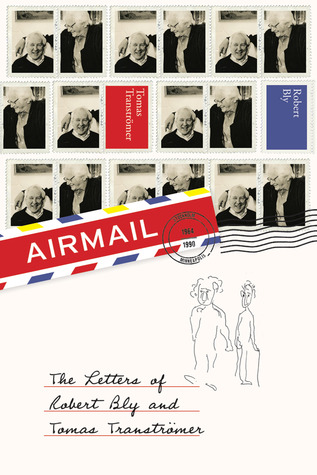 Airmail: The Letters of Robert Bly and Tomas Tranströmer was my first-ever Goodreads giveaway win. Way back in the summer of 2013, the good people of Graywolf Press spent a small fortune to send this tremendous book all the way from Minnesota to my tiny then-house on the outskirts of Reading, England. It took me an unconscionably long time first to pick it up, then to read it, and finally to review it. But here we are.
This is the first time I’d read a literary correspondence, and I absolutely loved it. I knew very little about either poet before picking this up, though I recognized Bly as the translator of the copy of Knut Hamsun’s Hunger I had read a few years back. The two first corresponded in 1964 when Tranströmer requested a copy of the poetry journal The Sixties from Bly’s small press. At this point Tranströmer was already an established poet in his native Sweden, but in decades to come Bly was responsible for making his reputation in English translation.
“Friendships have their rhythms and seasons, fat times and lean times,” editor Thomas R. Smith writes in his introduction. One of the pleasures of this book is watching a friendship develop, as salutations go from “Dear Mr. Tranströmer” and “Best wishes” to “Your friend” and “With deep fondness always.”
Their relationship was both professional and personal: they translated each other’s poems into their respective languages so discussed intricacies of meaning as well as publication details and reading tours, but they also visited each other and became ever deeper confidants through deaths in the family and Bly’s painful divorce. They also commiserate over the debacle of the Vietnam War (as a protestor Bly was once arrested alongside Dr. Spock and Allen Ginsberg) and the Nixon–Reagan affronts to liberalism.
These letters sparkle with humor, especially from Tranströmer, who paints a Micawber-ish picture of his impecunious family, initially supported through his day job as a psychologist at a boys’ prison. My impression of him was of an impish joker.
Our shortage of money is comical—toward the end of the month we go around and shake all our old clothes in the hope that a stray coin might fall out.
We drank some champagne, which makes you think very clearly—my head turned into an aquarium with goldfish who were mumbling sentences of Marcus Aurelius.
Bly’s a witty sort, too:
I’ll send you the most insulting review I’ve ever gotten—it’s wonderful, he objects to everything about me except the size of my shoes!
I carefully set aside these free days which are known as Introvert Days, and are to be spent in solitary anxious, obstinate, confused ectomorph brooding.
Forgive my new typewriter—its mother was frightened by a Latin manuscript, and it doesn’t believe in pauses…
You don’t have to have any interest in poetry to read this with enjoyment. In fact, I didn’t care for most of the poem extracts. In the 1960s and 70s, at least – the heyday for the letters – they both wrote free verse poems that alternate matter-of-fact observations with abstractions. Lacking in sound techniques, they struck me as flat and artless. They weren’t to my taste apart from this one stanza of Tranströmer’s that instantly jumped out to me:
Two truths approach each other. One comes from inside, the other from outside, and where they meet we have a chance to catch sight of ourselves. (from “Preludes”)
However, Bly, at least, became “positively form-mad” in his later years; “[I] now have to eat all my words praising free verse as the only food conceivable for true Christian folk,” he wrote in 1981. He even created his own form, the “ramage” of 85 syllables. Perhaps I’ll like their later work better – I’m game for trying a full collection from each of them.
For anyone interested in the nitty-gritty of translation, there are many fascinating passages here where the poets wrestle with vocabulary and nuances. “Poems are best when there are incredible mysteries in them,” Bly declares, and all the more difficult to retain that mystery as they passed back and forth between Swedish and English. “I think it was something unexplainable, something water-like or flowing in our approach to poetry that made our translations of each other full of feeling even with occasional mistakes,” Bly wrote to their Swedish editor.
These selected letters continue through 1990, when Tranströmer had a stroke and their correspondence inevitably declined. Tomas Tranströmer would go on to win the Nobel Prize in 2011 and died in March 2015. Robert Bly is still going at age 89 and has recently been the subject of a biopic. Stealing Sugar from the Castle, a volume of his new and selected poems, was published in 2013.
After this I’d be keen to try out more authors’ correspondence volumes. I love letters whether they appear in epistolary fiction or in nonfiction, and here they form a touching picture of a friendship that sustained their writers for decades. In 1978 Bly wrote: “Thank you for receiving my grief and my uncertainties and my shadowy complications without running out the door.” That’s the mark of a true friend.
With thanks to Graywolf Press for the free copy, won in a Goodreads giveaway.
My rating:
Four Books that Lasted All of 2015: #1
With this four-part post (one per day for the rest of this week) I think I will finally have caught up on the 2015 reads I needed to review. These four books have daunted me for ages because I spent much of last year with them – one because I wrestled with it (vacillating between admiration and frustration), another because it was a daily bedside book, and the other two because they were long and rewarding yet tough to read more than a bit of at a time. Knowing full well that I won’t do any of them justice, I’ll offer a few thoughts.
Fourth of July Creek by Smith Henderson
“I go into homes all the time and I save children. It’s what I do for a living, you see? And I didn’t save my own daughter.”
 If I take nearly a year over a novel, stopping and starting, that’s usually a bad sign. But I forced myself to finish this one, just like I did with The Orphan-Master’s Son by Adam Johnson. In the end my feelings were roughly similar, too: I appreciated the skill behind Henderson’s writing but never fully warmed to it. This is the story of Pete Snow, a Montana social worker in the early 1980s. His cases are uniformly distressing, but the one that most captivates his attention is Benjamin Pearl, raised in the wilderness by his father Jeremiah, a fundamentalist anarchist who drills holes in coins to show his antipathy to the government.
Since his wife and their teenage daughter Rachel left for Texas, Pete has been adrift in a fog of alcohol and sex, driving obsessively between remote locations in an attempt to save his doomed clients and criminal brother. When Rachel runs away, though, life’s dangers come home to Pete for the first time: “He’d seen so much suffering, but he’d only ever suffered it secondarily. To have it fresh and his own. The scope of it. He’d had no idea. He’d known nothing.” His search for his daughter is what saved the book for me. However, what actually happens to Rachel I found melodramatic, and how it’s narrated – through a third-person rendering of an interview, rather than a you/I back-and-forth – seemed odd.
Indeed, there are unusual narration choices throughout, such as the occasional second-person phrase in reference to Pete. The prose style is by turns fragmentary (as the above lines attest) and expansive, as in this long, alliterative sentence:
Shattered chants and ceaseless invective morph into a nearly simian cacophony of hoots and throaty shrieks as a white cloud of gas composes and insinuates itself into the small crowd that yet churns forward from the rear and backward from the front as the agitators break into two scattering bodies, fanning and choking and wild-eyed, coursing up and down the road.
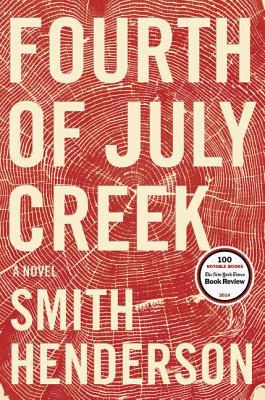
Once again I prefer the American cover. What’s up with that?
Ultimately I found this novel to be very hard work. The one scene I’ll remember most clearly is Pete and the Pearls stumbling on a pile of animals, from a raccoon right up to a black bear, that were all killed by a downed telephone wire. I’d recommend this if you’re a dedicated reader of dirty realism and you accept the violence and the detached writing style that genre tends to involve. If not, you should probably start somewhere else, like with Ron Rash or David Vann.
Ever since Sufjan Stevens’s Carrie and Lowell came out, I can’t help but hear his song “Fourth of July” in my head when I think about this book: “What did you learn from the Tillamook Burn and the Fourth of July? We’re all gonna die.” It’s that oppressive, depressing, even apocalyptic atmosphere I’ll return to when I think about this book. Fourth of July Creek – a real place in Montana – is nowhere I’ll want to revisit.
With thanks to Windmill Books for the free copy, won in a Goodreads giveaway.
My rating: 
The Novel Cure—Bibliotherapy in Action
A good book, read at the right moment, should leave you uplifted, inspired, energized and eager for more. With so many books to choose from, what’s the point of reading even one more that leaves you cold?
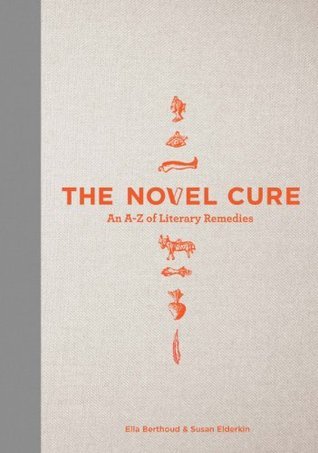
I’ve mentioned my interest in bibliotherapy before. Well, for anyone new to the concept or interested in finding out more, The Novel Cure by Ella Berthoud and Susan Elderkin, two of the bibliotherapists at London’s School of Life, is an accessible introduction. Subtitled “An A–Z of Literary Remedies,” this is a learned and at times tongue-in-cheek book of advice about what fiction to read if you’re suffering from any sort of malady – physical, psychological, or imagined.
 The alphabetical format and “see also” asides make it more like a cross-referenced encyclopedia than a book to read straight through, though I tried it both ways. Initially I flipped through at random, letting one entry take me to another related one and so on, but after a while I went back to the start and caught up on unread entries to finish within a year.
“It helps enormously at times of stress to read about other people who are going through similar things; watching how other people cope or fail to cope will make you feel less alone and give you strength,” the authors write to introduce the “cancer, caring for someone with” entry. I found this to be true when my sister lost her husband to cancer last year. She had never been a reader – apart from celebrity magazines – but in the past year she’s read nearly 90 books, many of them memoirs about illness and bereavement. Books are how I’ve always made sense of the world, so it’s been incredibly gratifying to see her turn to them as well. There are plenty of recommendations I’ll pass on to her from this book, especially “death of a loved one” (After You’d Gone by Maggie O’Farrell and Extremely Loud and Incredibly Close by Jonathan Safran Foer) and “widowed, being” (The Same Sea by Amos Oz and Major Pettigrew’s Last Stand by Helen Simonson).
You’ll be amazed at the range of conditions and circumstances for which the book offers prescriptions. Newly retired? “Bucolic and tranquil, The Enigma of Arrival [by V.S. Naipaul] will encourage you to take stock of your life and enjoy the unfolding of new possibilities.” Workaholic? “Immerse your desiccated soul in something very simple, very rustic, very small. We suggest [Thomas] Hardy’s gentlest, most innocent novel, Under the Greenwood Tree.” Two sections that felt particularly relevant to me as a vertically challenged freelancer were “short, being” and “tax return, fear of doing.” Meanwhile I’ll be pointing my husband to “baldness,” “flying, fear of,” “stress” and “tinnitus” (poor chap). But some of these entries surely resulted from the authors thinking “hey, here’s a great book we have to mention,” and then coming up with a category to fit it into, like “determinedly chasing after a woman even when she’s a nun” for In the Skin of a Lion by Michael Ondaatje.

I think I prefer this U.S. cover.
Indeed, there’s a certain levity to this book that I think some reviewers have missed. These aren’t all entirely serious suggestions, though they are all worthwhile books. I especially liked the sections where the authors incorporate pastiche of the book in question. A piece recommending Pamela by Samuel Richardson is in the form of an old-fashioned letter, for example, while “single, being” apes Bridget Jones’s diary entries. They even imitate certain authors’ prose style, as in “Who poses questions without question marks and observes the subtle changes in the light with exquisite brevity.” Answer: J.P. Donleavy, apparently.
The book is also a great source of top ten lists (I’m working through their novels for thirty-somethings) and advice for how to deal with reading crises (e.g. “busy to read, being too” and “giving up halfway through, tendency to”). My only criticism of the book – and this is one I level against many examples from the ‘books about books’ genre – is that there’s a fair bit of plot summary, sometimes so much so that it puts me off reading a book rather than whets my appetite for it.
It’s a bit belated (or early) for suggesting this as a Christmas gift for a book lover, but perhaps you can hand it over as a birthday gift or an anytime present – even to yourself. I got my copy on Amazon for £4, quite a bargain for a book I’ll be returning to again and again over the years.
My rating:
Do you agree that novels have the power to cure, or at least help with, problems?
Library Checkout: January 2016
I’ve been back in the UK for a few weeks now and in my leisure reading have been trying to focus on the books I already own (especially giveaway books I feel obligated to review) plus a priority list of library reads.
(Thanks to Shannon at River City Reading for the great blog idea and template! Check out her blog for other link-ups.)
LIBRARY BOOKS READ
- Can’t We Talk about Something More Pleasant? by Roz Chast [one-week loan from University of Reading library; already returned]
- Glitter and Glue: A memoir by Kelly Corrigan
- How to Connect with Nature by Tristan Gooley [from the School of Life series]
- Reasons to Stay Alive by Matt Haig
- Swithering by Robin Robertson [poetry]
LIBRARY BOOKS CURRENTLY READING
- The Zookeeper’s Wife by Diane Ackerman
- Persepolis by Marjane Satrapi [graphic novel]
- Early Warning by Jane Smiley
CHECKED OUT, TO BE READ
- The Human Age: The World Shaped by Us by Diane Ackerman
- Walking Away by Simon Armitage
- History of a Suicide: My Sister’s Unfinished Life by Jill Bialosky
- Bibliotherapy with Bereaved Children by Eileen H. Jones [will probably only skim]
- Rising Ground: A Search for the Spirit of Place by Philip Marsden
- The Book of Aron by Jim Shepard
Plus, it’s time to redouble our efforts at planning a Europe trip for early summer:
- Travellers Sweden
- Lonely Planet guide to Germany
ON REQUEST
My Brilliant Friend, Elena Ferrante [I’m 8th in the queue, so I’ll be waiting a while!]
Have you been taking advantage of your local libraries? What were some of your best recent reads?
More Specific 2016 Goals
Following up on the handful of low-key resolutions I made at the start of the month, I can report that three of my volunteer reviewing positions plus a paid one all seem to have come to a natural end, so that frees me up a little more to seek out big-name opportunities and focus on reading more of the unread books in my own collection plus library copies of books by the authors I’m most keen to try.
Now that nearly one twelfth of this ‘new’ year has passed, I feel like it’s time to set some more specific goals for 2016.
Blogging
Be more strategic about which books I review in full on here. So far it’s just been a random smattering of books I requested online or through publishers. Overall, I don’t feel like I have a clear rationale for which books I feature here and which ones I just respond to via Goodreads. Perhaps I’ll focus on notable reading experiences I feel like drawing attention to (like The Goldfinch recently), or target some pre-release literary fiction to help create buzz.
Start writing more concise reviews. The task of writing just two sentences about my top books from 2015 got me thinking that sometimes less might be more. (See Shannon’s Twitter-length reviews!) Ironically, though, dumping a whole bunch of thoughts about a book can feel easier and less time-consuming than crafting one tight paragraph. As Blaise Pascal said, “I have only made this letter longer because I have not had the time to make it shorter.”
Redesign this blog and get lots of advice from other book bloggers on how to develop it. It’s my one-year anniversary coming up in March and I want to think about what direction to take the site in. I feel like I need to find a niche rather than just post at random.
Update my social media profiles and pictures. In some cases I’m still using photos taken of me nearly three years ago. Not that I’ve changed too much in appearance since then, but I might as well stay current!
Leisure Reading
Make it through my backlog of giveaway books. In the photo below, the books on the left I won through Goodreads giveaways, and the pile on the right I won through various other giveaways, usually through Twitter or publisher newsletters.

Although there is no strict compulsion to review the books you win, it’s an informal obligation I’d like to honor. Before too many months go by, then, I’d like to read and review them all. That’ll help me meet the next goal…
Get down to 100 or fewer unread books in the flat by the end of the year. Although this seems like an achievable goal, it does mean getting through about 100 of the books we own, on top of any review books that come up throughout the year, not to mention my Kindle backlog from NetGalley and Edelweiss (so I am definitely NOT counting those in the 100!).
Weed our bookshelves. Alas, it’s looking like we’re going to be moving again in August, so before then it would be great if I could reduce our overflow areas so that everything can fit on our four matching bookcases with little or no double-stacking. I’ll start by picking out the books I’ve already read and don’t think I’ll read or refer to again. Which brings me to a related goal…
Start a Little Free Library or make another arrangement for giving away proof copies. Advanced copies technically should not be resold, so ones I don’t want to keep I tend to give away to friends and family or to a thrift store if they don’t too obviously look like proofs (i.e. they have a finished cover and don’t say “Proof copy” in enormous letters). I figure if a charity shop can get £1 for the copy, why not? It’s a perfectly good, readable book. However, I should really come up with a better solution. If not an LFL, then maybe I could arrange to keep a giveaway box outside a charity shop or at the train station wherever we next live.
Career
Take control of my e-mail inboxes. There are currently over 11,000 messages in my personal account and nearly 1,100 in my professional account. I attribute this partly to sentimentality and partly to fear of deleting something important I might need to reference later.
Find a way to incorporate exercise into my workday. I really, really need a treadmill desk. Or any piece of exercise equipment with a ledge that would hold a Kindle or laptop. That way I could continue reading and writing so that working out wouldn’t feel like lost time. Otherwise I am far too sedentary in my normal life.

Apropos of nothing, but always worth remembering.
What are some of your updated goals for 2016 – reading-related or otherwise?
Images of Women Reading
I was going back through the 2015 miniature calendar my in-laws gave me for Christmas last year, “The Reading Woman,” and thought to myself what a strange set of images it featured. Perhaps the manufacturers were scraping the bottom of the barrel, because I had not seen a single one of these paintings before, and some were downright hideous. Even some that were aesthetically pleasing were ideologically a little weird: the women tend to look either vapid or downright unpleasant. This got me thinking about how reading women have often been portrayed in the history of art.
Bored; so rich she doesn’t know what to do with herself but read? Reading seems to be but one small step away from pure idleness.
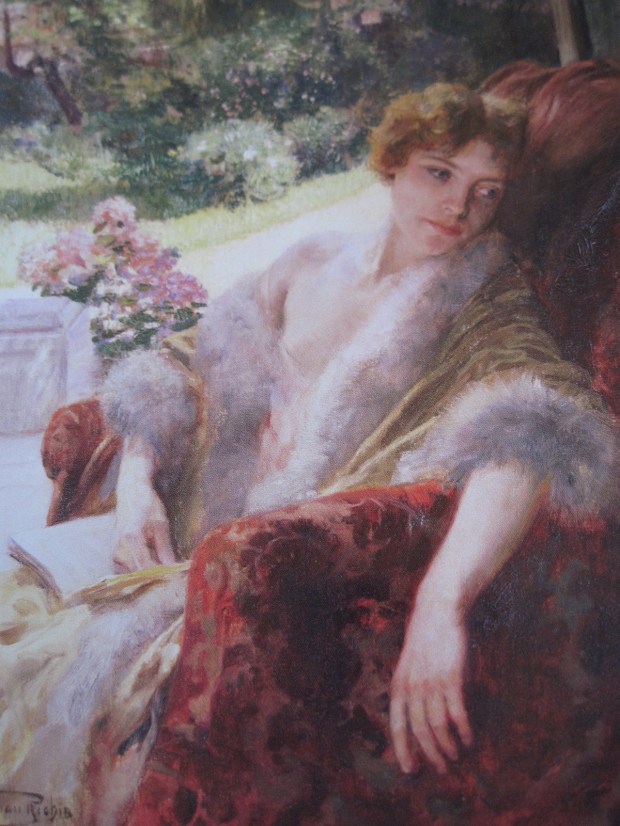
Portrait of a Woman in a Fur Wrap, Herman Richir (Belgian)
Ditto, except it’s a girl reading picture books. I don’t admire art this abstract.

Girl in Pink, c. 1906, Samuel John Peploe (Scottish)
These next two women could only be described as unfortunate-looking, if not masculine. Perhaps people worried that too much reading would rob women of their natural femininity?

Woman Reading, 1913, Rik Wouters (Belgian)
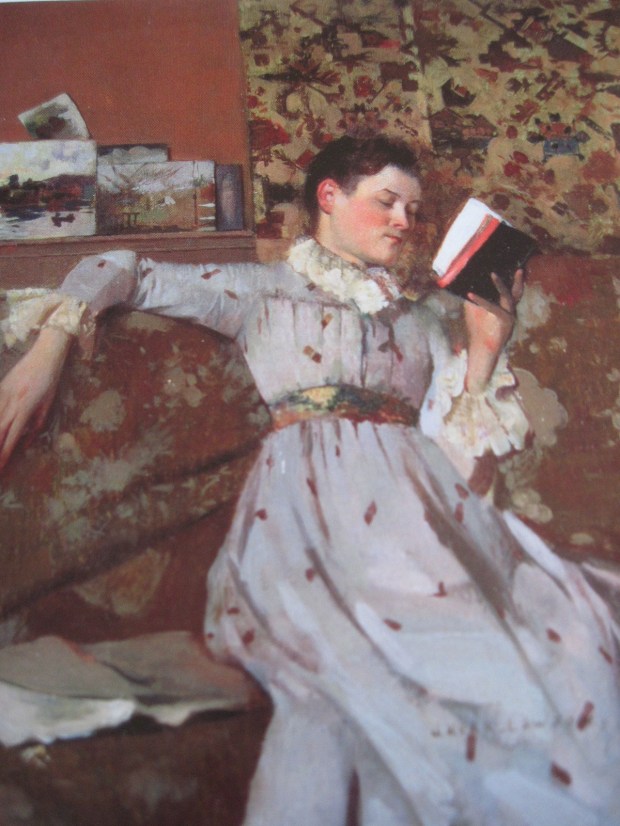
Caterina Reading a Book, c. 1888, James Kerr-Lawson (Scottish)
Here’s a sweet one. The subject seems pensive, even troubled. Is it by what she’s reading, or is the book her temporary solace from life? I love the colors and the faint echo of the Pre-Raphaelite style. Interesting also to see that it’s by a female painter – all these others have been male visions.
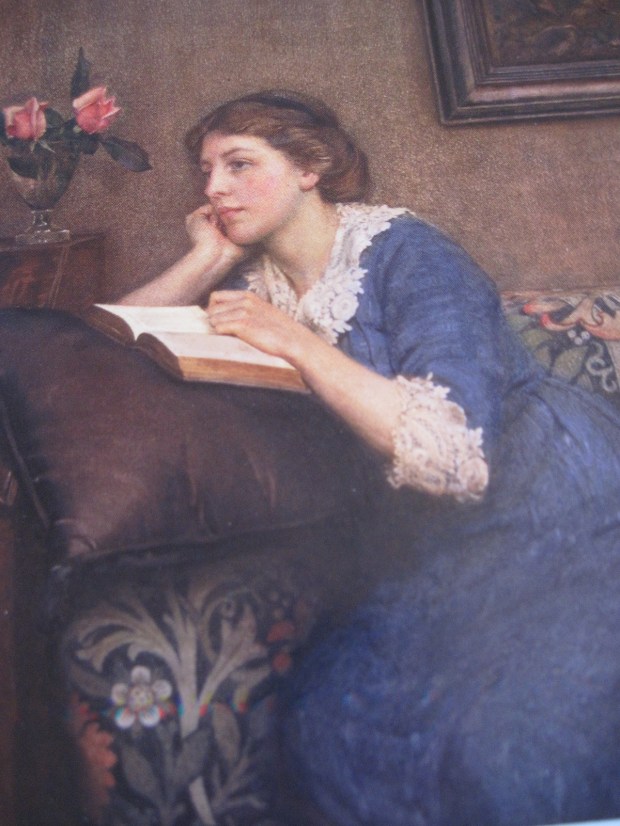
Portrait of Winifred Roberts, c. 1913, Eleanor Fortescue-Brickdale
Now this one I really love. The hues and textures in this Renoir-esque painting are soft and inviting, and the subject is looking straight at the painter with a confident, almost flirtatious air. She’s no stick-in-the-mud who’s picked up a book because she has nothing better to do. It’s no wonder this was chosen as the calendar’s cover image.
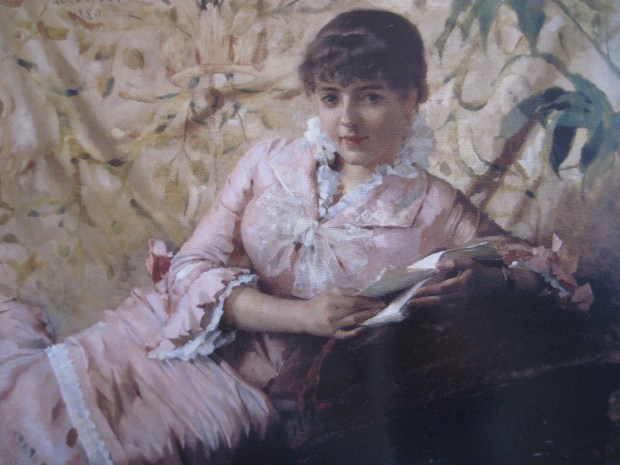
Parisienne Reading, 1880, Albert Gustaf Aristides Edelfelt (Finnish)
Beyond the calendar, a couple of reading women paintings I’ve always liked are by Sir John Lavery and Mary Cassatt. In the former I appreciate how the book cover matches the subject’s lips, and how she seems absorbed without being inaccessible.
![Miss Auras, c. 1900, Sir John Lavery [Public domain, via Wikimedia Commons]](https://commons.wikimedia.org/wiki/File:Lavery_Maiss_Auras.jpg)
Miss Auras, c. 1900, Sir John Lavery [Public domain, via Wikimedia Commons]
![Woman Reading in a Garden, 1880, Mary Cassatt [Public domain, via Wikimedia Commons]](https://commons.wikimedia.org/wiki/File:Mary_Cassatt_Woman_Reading_in_a_Garden.jpg)
Woman Reading in a Garden, 1880, Mary Cassatt [Public domain, via Wikimedia Commons]
Two of the most common images of women reading (you see these turning up as users’ avatars on Goodreads all the time) are by Jean-Honoré Fragonard and Gustav Adolph Hennig. I think they’re so popular because of the warm shades, the straightforward composition, and the subject’s apparent indifference to being watched. These are plucky heroines you feel you can relate to.
![A Young Girl Reading, c. 1770, Jean-Honoré Fragonard [Public domain, via Wikimedia Commons]](https://commons.wikimedia.org/wiki/File:Fragonard,_The_Reader.jpg)
A Young Girl Reading, c. 1770, Jean-Honoré Fragonard [Public domain, via Wikimedia Commons]
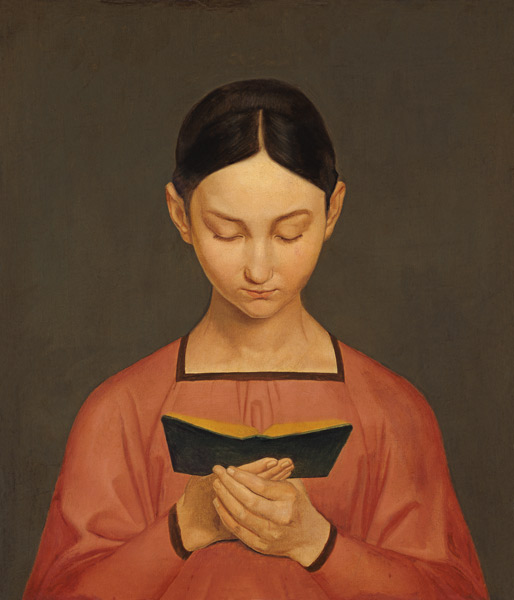
Lesendes Mädchen, 1828, Gustav Adolph Hennig
Do you have any favorite – or least favorite – paintings of women reading?
Reviews Roundup, December–January
It’s been a slow period for reviewing; I was mostly focusing on ongoing projects and year-end lists, and didn’t take the time to review a lot of the books I borrowed from libraries while in the States visiting family. Enjoy the respite! And I promise more productivity next month. There’s a rating (below each description) and a taster so you can decide whether to read more.
Fig Tree Books
 Everyman by Philip Roth: It has now been about three years since Philip Roth, then 79, famously announced his retirement from fiction writing. In a look back over Roth’s career—spanning half a century and 30 books—Everyman (2006) might fade into the background, especially given the book’s novella length. But to overlook it would be a mistake: This is a near-perfect fable about the life we build through decades of small choices and the death that is always lying in wait, whether we feel ready or not.
(Have a look around at the great work this publisher does in highlighting the American Jewish Experience; for instance, they released Safekeeping by Jessamyn Hope, which I loved this past summer.)
Foreword Reviews
 A Smile at Twilight by Robert Loyst and Wayne Yetman: Loyst gives a candid account of the joys and difficulties of helping to care for Poppy, an Alzheimer’s patient he met through a Toronto-based “Seniors Helping Seniors” organization. It’s an appealing “opposites attract”/“odd couple” scenario: Poppy was a perfectionist with a foul mouth and a withering glare of disapproval, while Loyst describes himself as “more of a take-it-as-it-comes type of guy.” Those who have family members or friends struggling with dementia will probably benefit most from the memoir, but readers of Still Alice might enjoy trying a real-life story.
I also post reviews of most of my casual reading and skimming on Goodreads.
My Name is Lucy Barton by Elizabeth Strout: Lucy Barton is in the hospital for nine weeks following an appendectomy. The novel zeroes in on the five days her mother comes to stay by her bedside, a pinnacle in their often difficult relationship. For a short book, this packs a lot in: an artist’s development, the course of a marriage, poverty and class distinctions. Lucy grew up in rural Illinois, where words like “cheap” and “trash” could easily have been applied to her family. I read this in one sitting on a plane ride and found it to be a powerful portrayal of the small connections that stand out in a life.
 Eligible: A modern retelling of Pride and Prejudice by Curtis Sittenfeld: Pride and Prejudice transplanted to Cincinnati in 2013? That might sound like a stretch, but Sittenfeld pretty much pulls it off. The characters and underlying plot are virtually identical to the original, with just a few tweaks here and there. What Sittenfeld does update are the particular scenes and situations, as well as the cultural norms and sexual practices. My main problem is how slavishly Sittenfeld replicates Austen’s third-person voice and vocabulary. Sittenfeld is the queen of first-person female narration; this is the first time in my memory that she has attempted an omniscient voice. To me it felt like the book was crying out to be told from Lizzy’s perspective. Releases April 19th.
 Bookish Beck = Rebecca Foster. American transplant to England. Freelance proofreader and book reviewer.
