Fourth Blog Anniversary
I launched my blog four years ago today. Is that ages, or no time at all? Like I said last year, it feels like something I’ve been doing forever, and yet there are bloggers out there who are coming up on a decade or more of online writing about books.

By Incabell [CC BY-SA 4.0 (https://creativecommons.org/licenses/by-sa/4.0)%5D.
This is my 542nd post, so the statistics tell me that I’ve been keeping up an average of just over 2.5 posts a week. Although I sometimes worry about overwhelming readers with ‘too many’ posts, I keep in mind that a) no one is obliged to read everything I post, b) a frequently updated blog is a thriving blog, and c) it only matters that it’s a manageable pace for me.
In the last year or so, I’ve gotten more involved in buddy reads and monthly challenges (things like Reading Ireland Month, 20 Books of Summer, R.I.P., Margaret Atwood Reading Month, and Novellas and Nonfiction in November); I’ve continued to take part in literary prize shadow panels and attend literary events when I can. I’ve hosted the Library Checkout for nearly a year and a half now and there are a few bloggers who join in occasionally (more are always welcome!). The posts I most enjoy putting together are write-ups of my travels, and seasonal and thematic roundups, which are generally good excuses to read backlist books from my own shelves instead of getting my head turned by new releases.
Some statistics from the past year:
 My four most viewed posts were:
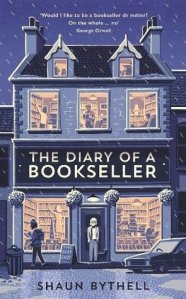
The Diary of a Bookseller by Shaun Bythell
Clock Dance by Anne Tyler: Well…
Mixed Feelings about Elena Ferrante
I got the most likes in December 2018, and the most unique visitors and comments in August.
 My four favorite posts I wrote in the past year were:
A Trip to Wigtown, Scotland’s Book Town
Painful but Necessary: Culling Books, Etc.
Why We Sleep … And Why Can’t I Wake Up?
A President’s Day Reading Special (No Trump in Sight)
Thanks to everyone who has supported me this past year, and/or all four years, by visiting the site, commenting, re-tweeting, and so on. You’re the best!
Iris Murdoch Readalong: The Sacred and Profane Love Machine (1974)
A later Murdoch – her sixteenth novel – and not one I knew anything about beforehand. In terms of atmosphere, characters and themes, it struck me as a cross between A Severed Head and The Nice and the Good. Like the former, it feels like a play with a few recurring sets: Hood House, where the Gavenders (Blaise, Harriet and David) live; their next-door neighbor Montague Small’s house; and the apartment where Blaise keeps his mistress, Emily McHugh, and their eight-year-old son Luca. A sizeable dramatis personae radiates out from the central love triangle: lodgers, neighbors, other family members, mutual friends and quite a few dogs.

Blaise is a psychoanalyst but considers himself a charlatan because he has no medical degree; he’s considering returning to his studies to rectify that. Harriet reminded me of Kate from The Nice and the Good: a cheerful, only mildly unfulfilled matriarch who is determined to choreograph much of what happens around her. (“She wanted simply to feel the controls firmly in her hands. She wanted to be the recognizer, the authorizer, the welcomer-in, the one who made things respectable and made them real by her cognizance of them.”) Their son David, 16, looks like a Pre-Raphaelite god and is often disgusted by fleshly reality. Montague writes successful but formulaic detective novels and is mourning his wife’s recent death.
I loved how on first introduction to most characters we hear about the dreams from which they’ve just awoken, involving mermaids, cats, dogs and a monster with a severed head. “Dreams are rather marvellous, aren’t they,” David remarks to Monty. “They can be beautiful in a special way like nothing else. Even awful things in dreams have style.” Scenes often open with dreams that feel so real to the characters that they could fool readers into belief.
Blaise knows he can’t sustain his double life, especially after Luca stows away in his car on a couple of occasions to see Hood House. When he confesses to Harriet via a letter, she seems to handle things very well. In fact, she almost glows with self-righteous pride over how reasonably she’s been responding. But both she and Emily end up resentful. Why should Blaise ‘win’ by keeping his wife and his mistress? “You must feel like the Sultan of Turkey,” Emily taunts him. “You’ve got us both. You’ve got away with it.” Here starts a lot of back-and-forth, will-they-won’t-they that gets somewhat tedious. Throughout I noticed overlong sections of internal monologue and narrator commentary on relationships.
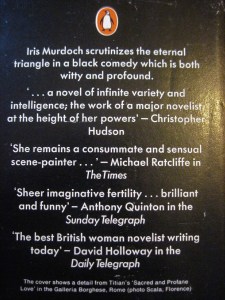 There’s a misperception, I think, that Murdoch wrote books in which not much happens, simply because her canvas can be small and domestically oriented. However, this is undoubtedly an eventful novel, including a Shocking Incident that Liz warned about. Foreshadowing had alerted me that someone was going to die, but it wasn’t who or how I thought. When it comes to it, Murdoch is utterly matter-of-fact: “[X] had perished”.
One of the pleasures of reading a Murdoch novel is seeing how she reworks the same sorts of situations and subjects. (Liz has written a terrific review set in the context of Murdoch’s whole body of work.) Here I enjoyed tracing the mother–son relationships – at least three of them, two of which are quite similar: smothering and almost erotic. Harriet later tries to subsume Luca into the family, too. I also looked out for the recurring Murdochian enchanter figure: first Blaise, for whom psychiatry is all about power, and then Harriet.
I hugely enjoyed the first 100 pages or more of the book, but engaged with it less and less as it went on. Ultimately, it falls somewhere in the middle for me among the Murdochs I’ve read. Here’s my ranking of the nine novels I’ve read so far, with links to my reviews:
Favorite: The Bell
The Sea, The Sea
The Sacred and Profane Love Machine
The Black Prince
Least favorite: An Accidental Rose
My rating: 
A favorite passage (this is Monty on the perils of working from home!): “If I had an ordinary job to do I’d have to get on with it. Being self-employed I can brood all day. It’s undignified and bad.”
This is the last of the Murdoch paperbacks I bought as a bargain bundle from Oxfam Books some years ago. I’ll leave it a while – perhaps a year – and then try some earlier Murdochs I’ve been tempted by during Liz’s Iris Murdoch readalong project, such as The Unicorn.
A Retrospective of 2018’s Events, Reading Projects and Themes
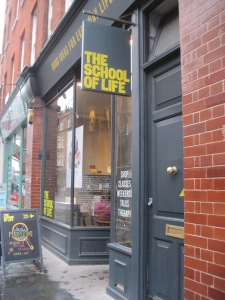 In January I had the tremendous opportunity to have a free personalized bibliotherapy appointment with Ella Berthoud at the School of Life in London. I’ve since read three of her prescriptions plus parts of a few others, but I still have several more awaiting me in the early days of 2019, and will plan to report back at some point on what I got out of all of them.
In March to April I ran a Wellcome Book Prize shadow panel for the second time. This year it was much more successful; I plan to do it again next year, too. (I actually proffered myself as an official judge for next year’s prize and got a very kind but entirely noncommittal e-mail back from the chairwoman, which I will have to take as victory enough.)
 Early April saw us visiting Wigtown, Scotland’s book town, for the first time. It was a terrific trip, but thus far I have not been all that successful at reading the 13 books that I bought! (Just two and a quarter so far.)
I reviewed three novels for Liz Dexter’s Iris Murdoch Readalong project: A Severed Head in March, The Italian Girl in June, and The Nice and the Good in September. In February I’ll pop back in with one more paperback that I own, The Sacred and Profane Love Machine. November was Margaret Atwood Reading Month, hosted by Marcie of Buried in Print and Naomi of Consumed by Ink, and provided me with a good excuse to read her first two novels.
 I did some “buddy reads” for the first time: Andrea Levy’s Small Island with Canadian blogger friends, including Marcie and Naomi; and West With the Night with Laila of Big Reading Life and Late Nights on Air with Naomi as well as Penny of Literary Hoarders during 20 Books of Summer, which I took part in for the first time. In May my mother and I read W. Somerset Maugham’s The Painted Veil and shared reading notes via e-mail. (A planned buddy read of The Left Hand of Darkness with Annabel and Laura was, alas, a fail.)
Besides the official Wellcome Book Prize blog tour in April, I participated in another 11 blog tours, averaging out at one a month. I’m going to scale back on these next year because I have too often found, after I accepted, that the book was a dud and I had to just run an extract because I could see I wasn’t going to get through it and write a review.
I joined my neighborhood book club in September and have attended every month since then. Our first four selections were Ladder of Years by Anne Tyler, The Gracekeepers by Kirsty Logan, Noonday by Pat Barker, and Number 11 by Jonathan Coe. I’d already read the Logan and Coe years ago and didn’t fancy rereading them, so wasn’t able to participate as much in those months, but was still glad to go along for the socializing. My husband even read the Coe and came to December’s meeting (was it just for the mince pies and mulled wine?!). We’ve set our first four reads for 2019 – the three below, in order from left to right, plus Ernest Hemingway’s The Garden of Eden, which I’ll borrow from the university library.

 In October I won tickets to see a production of Angela Carter’s Wise Children at the Old Vic in London. Just a few weeks later I won tickets to see Barbara Kingsolver in conversation about Unsheltered at the Southbank Centre. I don’t often make it into London, so it was a treat to have bookish reasons to go and blogging friends to meet up with (Clare of A Little Blog of Books joined me for both, and Laura T. was also at the Kingsolver event).
November was mostly devoted to novellas, for the third year in a row. Although I didn’t officially participate in Nonfiction November, I still enjoyed coming up with some fiction/nonfiction pairings and an “expert’s” list of women’s religious memoirs.
My husband wrote pretty much his entire PhD thesis this year and on Friday the 14th had his graduation ceremony. I was the moral support / proofreader / preparer of simple meals during the months when he was in the throes of writing up, so I will consider myself as sharing in the accomplishment. Congratulations, Dr. Foster!
This month and into January I’ll be reading the last few nominees for the National Book Critics Circle’s John Leonard Prize.

When the list of finalists was released, I was relieved to see I’d already read four out of seven (and three of those were ones I’d nominated); the other three – the Adjei-Brenyah and Brinkley stories and There There – were books I was keen to read but hadn’t managed to get hold of. About 80 of us NBCC members are reading the shortlist and voting for the best first book of the year by January 8th. Plus I’m technically up for an NBCC prize myself, in that I nominated myself (that’s how it works) for the 2018 Nona Balakian Citation for Excellence in Reviewing and sent in an application with five of my best reviews from the year.
The Ones that Got Away
 Two posts I planned but never got around to putting together would have commemorated the 50th anniversary of Thomas Merton’s death (I own several of his books but am most interested in reading The Seven-Storey Mountain, which celebrated its 70th birthday in October) and the 40th anniversary of the publication of The Snow Leopard by the late Peter Matthiessen. Perhaps I’ll try these authors for the first time next year instead.
Final Book Serendipity Incidents
In the second half of the year I started keeping track of all my weird reading coincidences, posting about them on Twitter or Instagram before collecting them into a blog post a couple months ago. Here are a few that popped up since then or recalled earlier reads from the year:
- Two protagonists named Willa: Anne Tyler’s Clock Dance and Barbara Kingsolver’s Unsheltered
- Two novels featuring bog people: Anne Youngson’s Meet Me at the Museum and Sarah Moss’s Ghost Wall
- Two dogs named Flash: Ben Crane’s Blood Ties and Andrew Marshall’s The Power of Dog
- Multiple sclerosis is an element in Christian Donlan’s The Unmapped Mind: A Memoir of Neurology, Incurable Disease and Learning How to Live, Jennifer Richardson’s Americashire and Michelle Obama’s Becoming (her father had it)
- The ideas of Freud are mentioned in a 1910s setting in Nancy Horan’s Loving Frank, Annabel Abbs’s Frieda and Daniel Mason’s The Winter Soldier
- Mermaids (or ‘mermaids’) and/or mermen appear in Imogen Hermes Gowar’s The Mermaid and Mrs Hancock, Melissa Broder’s The Pisces, Daniel Mason’s The Winter Soldier, and a series of poems in Miriam Darlington’s Windfall
- Bohemian writer dies young of tuberculosis (or similar) in novels about their wives: Annabel Abbs’s Frieda (D.H. Lawrence) and Nancy Horan’s Under the Wide and Starry Sky (Robert Louis Stevenson)
- Two books that mention the Indonesian practice of keeping dead relatives as mummies and bringing them out on occasion for ritual celebrations: From Here to Eternity by Caitlin Doughty and The Hot Young Widows Club by Nora McInerny
- Two books that include a trip to Lourdes for healing: Heal Me by Julia Buckley and Constellations by Sinéad Gleeson
- Two books that mention the irony of some of the most well-loved modern Christmas songs being written by Jews: In Mid-Air by Adam Gopnik and Christmas Days by Jeanette Winterson
Surprise Themes from My Year’s Reading
A few of these make sense – cults fit with my interest in narratives of religious experience, and it doesn’t take a psychologist to see that my relationship with my father has been an ongoing issue in recent years (I wonder how the numbers would compare for books about mothers?) – but most are completely random.
I decided a theme had to show up at least three times to make the list. Some topics I enjoyed so much I’ll keep reading about them next year. Within a category the books are in rough chronological order of my reading, and I include skims, DNFs and books in progress.
 Fathers (absent/difficult) + fatherhood in general: Educated by Tara Westover, And When Did You Last See Your Father? by Blake Morrison, The Italian Teacher by Tom Rachman, In the Days of Rain by Rebecca Stott, Implosion by Elizabeth W. Garber, Little Women by Louisa May Alcott & March by Geraldine Brooks, The Unmapped Mind by Christian Donlan, Never Mind and Bad News by Edward St. Aubyn, The Reading Promise by Alice Ozma, How to Build a Boat by Jonathan Gornall, Lake Success by Gary Shteyngart, Normal People by Sally Rooney, Rosie by Rose Tremain, My Father and Myself by J.R. Ackerley, Everything Under by Daisy Johnson, Ghost Wall by Sarah Moss, Surfacing by Margaret Atwood, Heart Berries by Terese Marie Mailhot, Blood Ties by Ben Crane, To Throw Away Unopened by Viv Albertine, Small Fry by Lisa Brennan-Jobs
Addiction: The Leavers by Lisa Ko, Mayhem by Sigrid Rausing, The Only Story by Julian Barnes, The Small Door of Your Death by Sheryl St. Germain, Writing and Madness in a Time of Terror by Afarin Majidi, Marlena by Julie Buntin, Ninety Days by Bill Clegg, Bad News by Edward St. Aubyn, Pretend I’m Dead by Jen Beagin, Heart Berries by Terese Marie Mailhot
 Greenland: A Wilder Time by William E. Glassley, This Cold Heaven by Gretel Ehrlich, Miss Smilla’s Feeling for Snow by Peter Høeg, On Balance by Sinéad Morrissey (the poem “Whitelessness”), Cold Earth by Sarah Moss, Crimson by Niviaq Korneliussen, The Library of Ice by Nancy Campbell
Cults: Educated by Tara Westover, Harmony by Carolyn Parkhurst, In the Days of Rain by Rebecca Stott, The Incendiaries by R.O. Kwon, A River Could Be a Tree by Angela Himsel
Trees: Ladders to Heaven by Mike Shanahan, The Overstory by Richard Powers, The Man Who Planted Trees by Jean Giono, The Wood and The Secret Life of the Oak by John Lewis-Stempel
 Flying: Skybound by Rebecca Loncraine, West With the Night by Beryl Markham, Going Solo by Roald Dahl, Skyfaring by Mark Vanhoenacker
The Anglo experience in Africa: Free Woman: Life, Love and Doris Lessing by Lara Feigel, Leaving Before the Rains Come by Alexandra Fuller, West With the Night by Beryl Markham, Going Solo by Roald Dahl
Korean-American women: The Incendiaries by R.O. Kwon, If You Leave Me by Crystal Hana Kim, All You Can Ever Know by Nicole Chung, Famous Adopted People by Alice Stephens, Digging to America by Anne Tyler
 New Zealand: The Garden Party and Other Stories by Katherine Mansfield, To the Is-Land by Janet Frame, Dunedin by Shena Mackay
Life in the White House: Living History by Hillary Rodham Clinton, All the Presidents’ Pastries by Roland Mesnier, Becoming by Michelle Obama
Lighthouses: Stargazing: Memoirs of a Young Lighthouse Keeper by Peter Hill, The Bird Artist by Howard Norman, Under the Wide and Starry Sky by Nancy Horan (about Robert Louis Stevenson, whose family built lighthouses)

More lighthouse books ready for next year.
Butterflies: Four Wings and a Prayer by Sue Halpern, Magdalena Mountain by Robert Michael Pyle, Mama Amazonica by Pascale Petit

More butterfly books ready for next year.
What were some of the highlights of your bookish year?
What odd coincidences and recurring themes have you spotted in your year’s reading?
October Reading Plans: R.I.P. and More
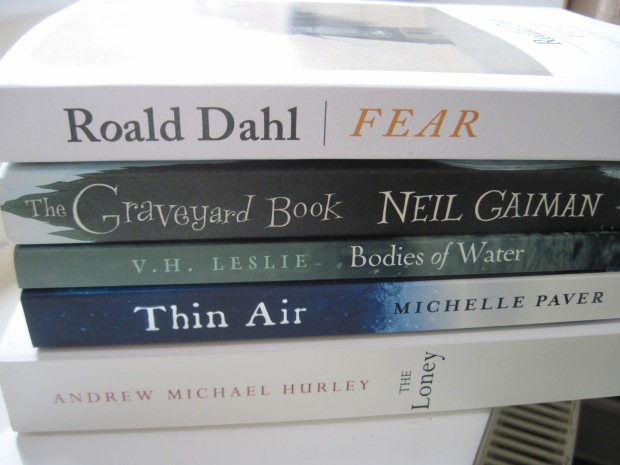
For the first time I’m joining in with the R.I.P. challenge (that’s “Readers Imbibing Peril,” if you’re unfamiliar) – a spur to read the dark fantasy, mystery, thriller, horror and suspense books I own during the month of October. None of these are go-to genres for me, but I do have some books that fit the bill. To start me off, I set aside this pile early in September. I’m not sure how many I’ll get through, so I’m not committing to a particular number.
Several of my review books for the month also happen to be appropriate, beginning with one of my current reads, Little by Edward Carey, a delightfully macabre historical novel about the real-life girl who became Madame Tussaud of waxworks fame. I hope to review it here soon. I also have Deborah Harkness’s latest and an upcoming fable by A.L. Kennedy. Continuing last month’s focus on short stories, I’m going to start on Aimee Bender’s 2013 volume soon; it might just be fantastical enough to count towards the challenge.
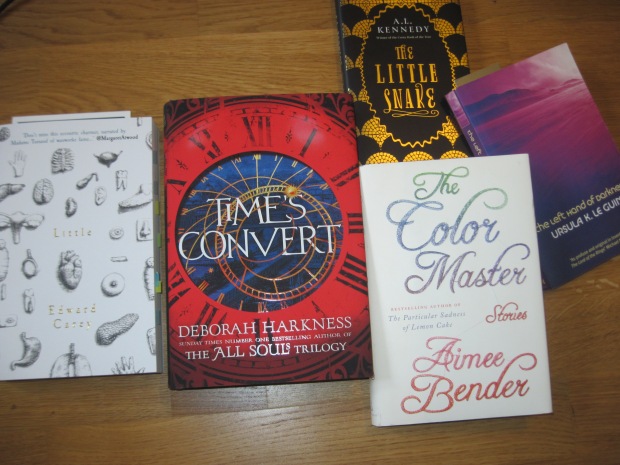
I’ve never read anything by the late Ursula K. Le Guin, so Annabel, Laura and I are embarking on a buddy read of The Left Hand of Darkness this month, too.
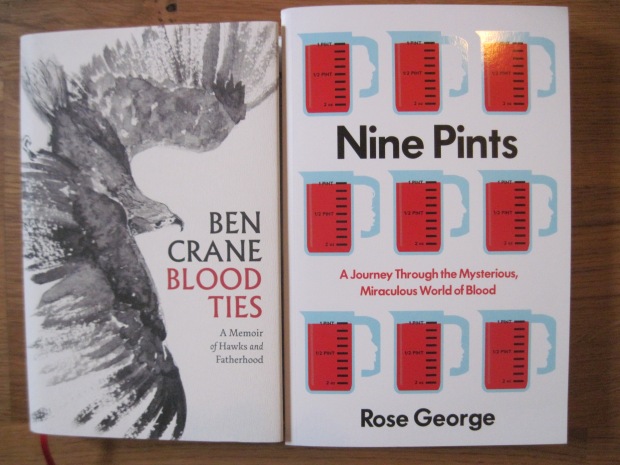
And then I may cheat and add in these two ‘blood-y’ nonfiction books since I’m going to be reading them soon anyway.
My other goal is to read more of the print books I’ve acquired over the past year, including some of 2017’s birthday and Christmas hauls and the books I bought at Bookbarn and in Wigtown. My birthday is coming up in the middle of the month, so it would be good to start chipping away at these stacks before the new acquisitions pile up much more!
I got a head start on a month of spooky reading with Sarah Perry’s new Gothic tale, Melmoth. It seems to have been equally inspired by Charles Robert Maturin’s 1820 novel Melmoth the Wanderer and by Perry’s time in Prague as a UNESCO World City of Literature Writer in Residence. The action opens in Prague in 2016 as Helen Franklin, a translator, runs into her distressed friend Dr. Karel Pražan one December night. An aged fellow scholar, Josef Hoffman, has been found dead in the National Library, where Helen and Karel first met. Karel is now in possession of the man’s leather document file, which contains accounts of his Holocaust-era family history and of his investigations into the Melmoth legend. She was one of the women at Jesus’s empty tomb but denied the resurrection and so was cursed to wander the Earth ever after. As Hoffman explains, “she is lonely, with an eternal loneliness” and “she comes to those at the lowest ebb of life.”
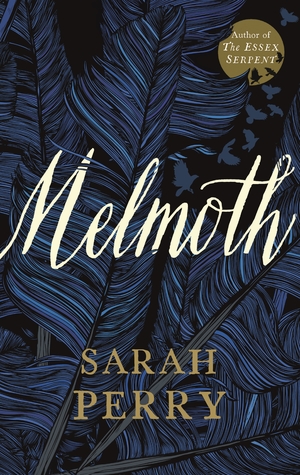 Is this just a tale used to scare children? In any case, it resonates with Helen, who exiled herself to Prague 20 years ago to escape guilt over a terrible decision. For most of the book we get only brief glimpses into Helen’s private life, like when she peeks into the under-the-bed shoebox where she keeps relics of the life she left behind. We do eventually learn what she ran away from, but by then I was so weary of dull found documents, irritating direct reader address (“Look! It is evening now … Reader, witness, here is what you see”), and toothless Gothic tropes that the reveal was barely worth hanging around for. Alas, I found the whole thing pretty melodramatic and silly, and not in the least bit frightening.
I truly loved The Essex Serpent ( ), but I think Perry is one of those authors where I will need to skip every other release and just read the even numbers; After Me Comes the Flood, her first, was one of my lowest-rated books ever (
 ). I recall that when I saw her speak at Bloxham Festival of Faith and Literature in 2016 Perry revealed that Novel #4 will be a contemporary courtroom drama. I’ll try again with that one.
My rating: 
Melmoth is released in the UK today, October 2nd. My thanks to Serpent’s Tail for a proof copy for review. It comes out in the USA from Custom House on the 16th. Sarah Perry has written an interesting article about being on strong pain medication while writing Melmoth.
Will you be reading anything scary in the month ahead? Can you recommend any of the books I have coming up?
My Patchy Experience with Book Clubs
I know that a number of you have long-term, faithful book clubs. Boy, am I envious! You might find it surprising that I’ve only ever been in one traditional book club, and it wasn’t a resounding success. Partway through my time working for King’s College, London, an acquaintance from another library branch started the club. A group of five to eight of us from Library Services aimed to meet after work one evening a month at a Southbank venue or a staff room to discuss our latest pick. By poring over old e-mails and my Goodreads library, I’ve managed to remember 10 of the books we read between November 2011 and June 2013:
- Do Androids Dream of Electric Sheep?, Philip K. Dick [classic science fiction]
- The Little Shadows, Marina Endicott [Canadian historical fiction]
- A Spot of Bother, Mark Haddon [contemporary fiction]
- The Talented Mr. Ripley, Patricia Highsmith [classic suspense]
- The Vintner’s Luck, Elizabeth Knox [bizarre historical fiction/magic realism]
- What Was Lost, Catherine O’Flynn [contemporary fiction]
- Franny and Zooey, J.D. Salinger [classic short fiction]
- The Rabbi’s Cat, Joann Sfar [graphic novel in translation]
- Girl Meets Boy, Ali Smith [an update of Greek myth]
- Angel, Elizabeth Taylor [an obscure English classic]
That may well be the complete list. Although I was a member for 20 months until I quit to go freelance, we often only managed to meet every other month because we couldn’t find a mutually convenient free evening or no one had read the book in time. I was consistently frustrated that – even when our selections were only about 200 pages long – I was often one of the only people to have read the whole book.
Overall, the quality of books we chose struck me as mediocre: I rated half of these books 2 stars, and the rest 3 stars. (I think I was a harsher rater then, but it’s not a good sign, is it?) Perhaps this is part of the inevitable compromising that goes with book clubs, though: You humor other people in their choices and hope they’ll be kind about yours? My suggestion, for the record, was the pretty dismal Little Shadows, for which I got a free set of book club copies to review for Booktime magazine. But I also voted in favor of most of the above list.
Looking back, I am at least impressed by how varied our selections were. People were interested in trying out different genres, so we ranged from historical fiction to sci-fi, and even managed a graphic novel. But when we did get together for discussion there was far too much gossipy chat about work, and when we finally got around to the book itself the examination rarely went deeper than “I liked it” or “I hated all the characters.”
If it was profound analysis I was after, I got that during the years I volunteered at Greenbelt, an annual summer arts festival with a progressive Christian slant. I eagerly read the eclectic set of three books the literature coordinator chose for book club meetings in 2010 – Star of the Morning: The Extraordinary Life of Lady Hester Stanhope by Kirsten Ellis, The First Person and Other Stories by Ali Smith, and The Bridge of San Luis Rey by Thornton Wilder – and then as a literature volunteer for the next three years I read and prepared copious notes and questions about our festival “Big Read.” We did Exile by Richard North Patterson in 2011, Dark Eden by Chris Beckett in 2012 and So Many Ways to Begin by Chris Beckett in 2013, and each time I offered to chair the book club meetings.
Unfortunately, due at least in part to logistical considerations, these were run in the way many festival events are: a panel of two to five talking heads with microphones was at the front of the tent, sometimes on a raised dais, while the audience of whatever size sat towards the back. This created a disconnect between the “experts” and the participants, and with the exception of the McGregor meeting I don’t recall much audience input. I’ve mostly blanked out the events – as I tend to for anything that entails public speaking and nervous preparation for something you can’t control – but I was pleased to be involved and I should probably make more of this on my CV. It wasn’t your average book club setting, that’s for sure.
In recent years the closest thing I’ve had to a book club has been online buddy reading. The shadow panels for the Wellcome Book Prize and Sunday Times Young Writer of the Year Award fall into this category, as do online readalongs I’ve done for several Iris Murdoch novels and for C.S. Lewis’s Mere Christianity with various female family members. A few of us book bloggers chatted about Andrea Levy’s Small Island in an online document earlier this year, and my mom and I e-mailed back and forth while reading W. Somerset Maugham’s The Painted Veil in May. I’m also doing my last three of the #20BooksofSummer as online buddy reads, checking in occasionally on Twitter.
Of course, there are some inherent limitations to this kind of discussion – people read at different paces and don’t want to spoil the plot for others, and at some point the back-and-forth fizzles out – but it’s always been easier for me to organize my thoughts in writing, so I likely feel more comfortable contributing than I might in an in-person meeting.
This is all context for my decision to join my neighborhood book club next month. The club arose some months back out of our community’s Facebook group, a helpful resource run by a go-getting lady a few doors down from us. So far it’s turning out to be a small group of thirty- and fortysomething women who alternate meetings at each other’s houses, and the name they’ve chosen gives an idea of the tone: “Books, Booze and Banter.”
I made the mistake of not getting involved right at the start; I wanted to hang back and see what kind of books they’d choose. This means I wasn’t part of the early process of putting titles in a hat, so I’ve looked on snobbishly for several months as they lurched between crime and women’s fiction, genres I generally avoid. (Still, there were actually a couple books I might have joined them for had I not been in America and had they been readily available at the public library.) For many people a book club selection will be the only book they get through that month, so I can understand how they’d want it to be something ‘readable’ that they’d be happy to pick up anyway. Even though statistically I read 27 books a month, I’m still jealously protective of my reading time; I want everything I read to be worthwhile.
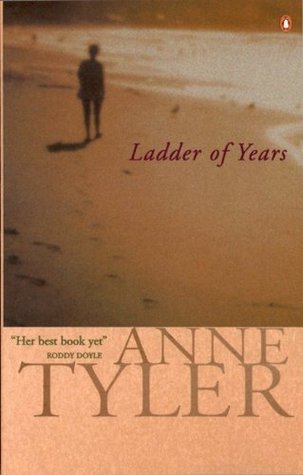 So for September I managed to steer the group away from a poorly received historical novel of over 400 pages and the new Joël Dicker and onto Ladder of Years by Anne Tyler, which the bookstore chain Waterstones has been promoting heavily as one of their books of the month. I already had a charity shop copy in hand and the others liked the sound of it, so we’re all set for September 12th! Future months’ literary fiction choices look promising, too, so provided I enjoy the discussion and the camaraderie I plan to stick with it: a backlist Pat Barker novel I’ve not read, and Kirsty Logan and Jonathan Coe novels I’ve read before and won’t reread but will remind myself about briefly before the meetings.
I’m out of practice with this book club thing. My mother tells me that I have a lot to contribute but that I must also be open to what I’ll learn from other people – even if I don’t expect to. So I don’t want to set myself up as some kind of expert. In fact, I probably won’t even mention that I’m a freelance book reviewer and book blogger. Mostly I’m hoping to find some friendly faces around the neighborhood, because even though we’ve lived here just over two years I still only know a handful of names and keep myself to myself as I work from home. Even if I have to read books I wouldn’t normally, it’ll be worth it to meet more people.
 Bookish Beck = Rebecca Foster. American transplant to England. Freelance proofreader and book reviewer.
