March Releases by Emily Haworth-Booth, Roz Morris, Catherine Redford & Joann Sfar
Autofiction about beloved animals and ambivalence over motherhood, a witty memoir of house-hunting in the South of England, a poetry collection reflecting on bereavement and queer parenthood, and a graphic novel adaptation of a 20th-century classic: I had a real variety this month.
Mare by Emily Haworth-Booth
Is the entire novel built around a pun? The French for mother, mère, is a homophone for mare. Like Motherhood by Sheila Heti, this is a work of autofiction that circles the question of becoming a mother and posits the writing life and other relationships as partial substitutes for parenthood. But yes, there is also a literal horse. The narrator lives in London with her husband and scrapes together a living by teaching creative writing on Zoom and writing children’s books. They’ve recently lost their dearly loved dog and are friendly with the neighbours whose garden they share and whose noise they hear the other side of a wall – so much so that she thinks of the two girls as “not-my-daughter” and “also-not-my-daughter.” The narrator is contracted to write a book about plastics for children but can’t seem to land on the right tone somewhere between alarm and false cheer. Approaching age 40, she’s finally coming to terms with the fact that she won’t be a mother due to premature ovarian failure.
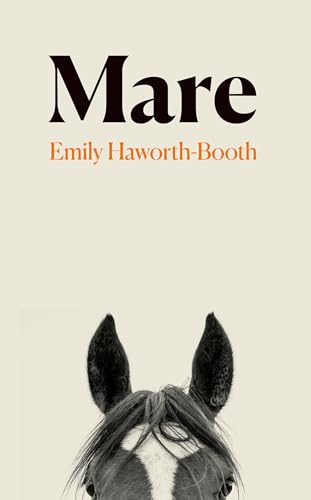 Into all this comes the love of a horse. She finds a stable two miles away and spends three days a week there riding and tending to a black and white mare. As a child she’d been horse-crazy, so this isn’t “a new feeling … but a resurgence. Deeply familiar. Lust and tenderness and hope mingled.” Time with the horse reminds her to be present, to live in her body despite its flaws, to take joy in the everyday. “Being with the horse has come to feel more and more like an exercise in metaphor.”
Haworth-Booth makes caring for an animal analogous with motherhood, but doesn’t stop at easy symbolism. The mare might stand in for female fear and vulnerability, but is also flesh and blood. Cultivating bodily bonds with other creatures is part of how we find purpose when life is threatened by chronic illness and climate breakdown.
This is Haworth-Booth’s adult debut and I hope it will be submitted for next year’s McKitterick Prize. Its wry honesty appealed to me, as did the narrator’s interactions with her mother (who forwards her “Childfree and fabulous” e-newsletters) and not-my-daughter, who share her interest in horses. There’s also the meta angle of the narrator assembling an “H folder” that eventually becomes this book. Hard to tell in my Kindle file, but some passages seem to be aligned like poetry. “The boundaries are blurring … this is the age of the non-binary, the hybrid, … the uncategorisable,” the narrator says to her students. “What about a collection of thoughts themed around a subject, themed around, for example, a horse?” I can see how some would find this insufferable, but it really worked for me. (Read via NetGalley)
Turn Right at the Rainbow: A Memoir of Househunting, Happenstance and Home by Roz Morris
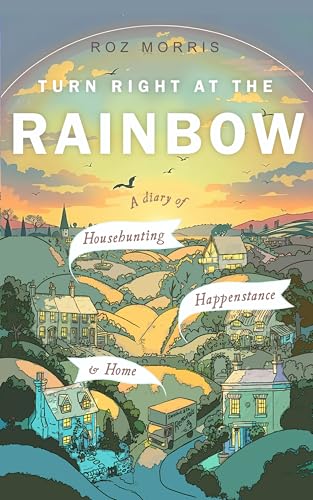 Now that we’re four years on from the purchase of our first property, I can read about house-hunting without finding it too depressing! When Morris and her husband Dave decided to move out of London, securing a buyer for their house was a cinch, but finding a new place that they loved as much as their home of twenty-plus years seemed like an insurmountable challenge. She wrings much humour from the process by comparing house viewings with first dates – as in a romcom, you’re always looking out for “The One,” but all the potential suitors have various issues – and employing jokey nicknames (“the Rusty Tractor house,” “The Aardvark House”), and a financial shorthand of arms and legs.
Estate agents, potential buyers, and sellers alike are maddening in their quirks. There are so many inexplicable features in otherwise normal suburban Surrey properties: more toilets than bedrooms, giant air-conditioning units, a long bench that looks like it belongs in a bus station waiting room, and so on. In between details of the search, Morris remembers her upbringing in mining country made famous by Alan Garner and how she and Dave met and made a life together as childfree writers. This is a warm and funny read whose short chapters fly by, but it also made me ponder what is essential in a home. Though I was mildly taken aback by the ending, I came to think of it as fitting, in a T.S. Eliot knowing the place for the first time sort of way.
With thanks to the author for the free e-copy for review. (Published by Spark Furnace.)
The Way the Water Held Me by Catherine Redford
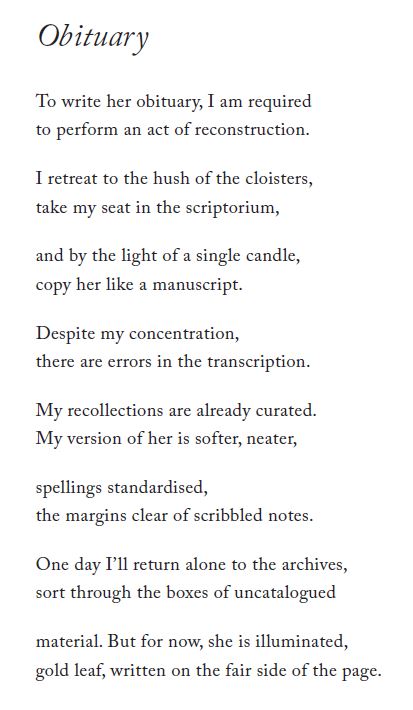
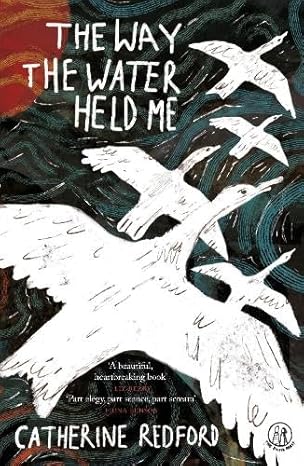 This isn’t your average bereavement story: Redford was only 35 and had a young child at the time that her wife died of cancer. We don’t hear so much about being widowed early, or in a same-sex partnership. Redford interrogates the expectations of widowhood (“If not Victoria, I can be Jackie O”) through biographical poems about Mary Shelley’s writings in the wake of Percy Bysshe Shelley’s untimely death. There’s a found/collage poem pieced together from one of Shelley’s letters; others quote from her Frankenstein and The Last Man. Elsewhere, Redford alludes to Woolf, Wordsworth and Wuthering Heights. Redford recalls feeling bombarded by people’s sympathy (“The flowers arrive like a tsunami”) and having no idea how to respond when asked how she’s doing. She relives moments from their carefree courtship days, lists the elements of “Her Last Day,” and documents the rituals that enshrine memory. I loved the archival vocabulary of “Obituary” (below) and how belongings left behind take on outsize significance: “I cross-examine every page of her notebooks, lay out the contents / of each drawer in a crescent on the floor as if they are grave goods // selected for her journey to the afterlife” (from “Circles”). The alliteration and nature (especially seaside) imagery were just right for me. From the hardest of circumstances came something tender and lovely.
With thanks to The Emma Press for the advanced e-copy for review.
The Little Prince by Antoine de Saint-Exupéry (1943)
Graphic novel adaptation by Joann Sfar (2008); colours by Brigitte Findakly
[Translated from French by Sarah Ardizzone, 2010]
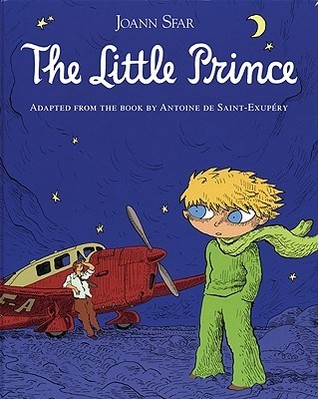 Reading The Little Prince in the original French was a long-term project in my high school French curriculum. I can still remember snippets such as “Dessine-moi un mouton” (“Draw me a sheep”) and apprivoiser (to tame) – it was good for learning such random vocabulary words. You are probably familiar with this fable of a pilot who crashes in the desert and meets a strange, possibly alien boy and talks with him about his interplanetary journeys as well as a flower, a snake, a fox, and so on. Before he landed on earth, he alighted on six other planets where he met a king, a vain man, a drunk, a businessman, a lamplighter, and a geographer, all of whom appeared to be trapped in destructive patterns of their own making.
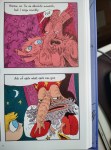
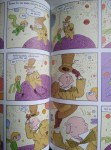
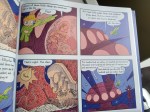
I had a few issues. The main one is that, these days, the story falls for me in the same category as other intolerably twee stuff like Jonathan Livingston Seagull and The Boy, the Mole, the Fox and the Horse. Granted, “You can only see clearly with the heart. What matters is invisible to the eye” is profound in its simplicity. But much of the rest had me rolling my eyes. As for the adaptation, why was it deemed necessary? The original The Little Prince is illustrated. Plus the drawing style is rather grotesque. (I don’t remember this from the only other book I’ve read by Sfar, The Rabbi’s Cat.) I guess the idea was to contrast the boy’s innocence and blue-pool eyes with the essential ugliness of much of what he encounters. But what’s with most of the planets’ residents having noses like penises? (Unsolicited review copy from SelfMadeHero)
My Patchy Experience with Book Clubs
I know that a number of you have long-term, faithful book clubs. Boy, am I envious! You might find it surprising that I’ve only ever been in one traditional book club, and it wasn’t a resounding success. Partway through my time working for King’s College, London, an acquaintance from another library branch started the club. A group of five to eight of us from Library Services aimed to meet after work one evening a month at a Southbank venue or a staff room to discuss our latest pick. By poring over old e-mails and my Goodreads library, I’ve managed to remember 10 of the books we read between November 2011 and June 2013:
- Do Androids Dream of Electric Sheep?, Philip K. Dick [classic science fiction]
- The Little Shadows, Marina Endicott [Canadian historical fiction]
- A Spot of Bother, Mark Haddon [contemporary fiction]
- The Talented Mr. Ripley, Patricia Highsmith [classic suspense]
- The Vintner’s Luck, Elizabeth Knox [bizarre historical fiction/magic realism]
- What Was Lost, Catherine O’Flynn [contemporary fiction]
- Franny and Zooey, J.D. Salinger [classic short fiction]
- The Rabbi’s Cat, Joann Sfar [graphic novel in translation]
- Girl Meets Boy, Ali Smith [an update of Greek myth]
- Angel, Elizabeth Taylor [an obscure English classic]
That may well be the complete list. Although I was a member for 20 months until I quit to go freelance, we often only managed to meet every other month because we couldn’t find a mutually convenient free evening or no one had read the book in time. I was consistently frustrated that – even when our selections were only about 200 pages long – I was often one of the only people to have read the whole book.
Overall, the quality of books we chose struck me as mediocre: I rated half of these books 2 stars, and the rest 3 stars. (I think I was a harsher rater then, but it’s not a good sign, is it?) Perhaps this is part of the inevitable compromising that goes with book clubs, though: You humor other people in their choices and hope they’ll be kind about yours? My suggestion, for the record, was the pretty dismal Little Shadows, for which I got a free set of book club copies to review for Booktime magazine. But I also voted in favor of most of the above list.
Looking back, I am at least impressed by how varied our selections were. People were interested in trying out different genres, so we ranged from historical fiction to sci-fi, and even managed a graphic novel. But when we did get together for discussion there was far too much gossipy chat about work, and when we finally got around to the book itself the examination rarely went deeper than “I liked it” or “I hated all the characters.”
If it was profound analysis I was after, I got that during the years I volunteered at Greenbelt, an annual summer arts festival with a progressive Christian slant. I eagerly read the eclectic set of three books the literature coordinator chose for book club meetings in 2010 – Star of the Morning: The Extraordinary Life of Lady Hester Stanhope by Kirsten Ellis, The First Person and Other Stories by Ali Smith, and The Bridge of San Luis Rey by Thornton Wilder – and then as a literature volunteer for the next three years I read and prepared copious notes and questions about our festival “Big Read.” We did Exile by Richard North Patterson in 2011, Dark Eden by Chris Beckett in 2012 and So Many Ways to Begin by Chris Beckett in 2013, and each time I offered to chair the book club meetings.
Unfortunately, due at least in part to logistical considerations, these were run in the way many festival events are: a panel of two to five talking heads with microphones was at the front of the tent, sometimes on a raised dais, while the audience of whatever size sat towards the back. This created a disconnect between the “experts” and the participants, and with the exception of the McGregor meeting I don’t recall much audience input. I’ve mostly blanked out the events – as I tend to for anything that entails public speaking and nervous preparation for something you can’t control – but I was pleased to be involved and I should probably make more of this on my CV. It wasn’t your average book club setting, that’s for sure.
In recent years the closest thing I’ve had to a book club has been online buddy reading. The shadow panels for the Wellcome Book Prize and Sunday Times Young Writer of the Year Award fall into this category, as do online readalongs I’ve done for several Iris Murdoch novels and for C.S. Lewis’s Mere Christianity with various female family members. A few of us book bloggers chatted about Andrea Levy’s Small Island in an online document earlier this year, and my mom and I e-mailed back and forth while reading W. Somerset Maugham’s The Painted Veil in May. I’m also doing my last three of the #20BooksofSummer as online buddy reads, checking in occasionally on Twitter.
Of course, there are some inherent limitations to this kind of discussion – people read at different paces and don’t want to spoil the plot for others, and at some point the back-and-forth fizzles out – but it’s always been easier for me to organize my thoughts in writing, so I likely feel more comfortable contributing than I might in an in-person meeting.
This is all context for my decision to join my neighborhood book club next month. The club arose some months back out of our community’s Facebook group, a helpful resource run by a go-getting lady a few doors down from us. So far it’s turning out to be a small group of thirty- and fortysomething women who alternate meetings at each other’s houses, and the name they’ve chosen gives an idea of the tone: “Books, Booze and Banter.”
I made the mistake of not getting involved right at the start; I wanted to hang back and see what kind of books they’d choose. This means I wasn’t part of the early process of putting titles in a hat, so I’ve looked on snobbishly for several months as they lurched between crime and women’s fiction, genres I generally avoid. (Still, there were actually a couple books I might have joined them for had I not been in America and had they been readily available at the public library.) For many people a book club selection will be the only book they get through that month, so I can understand how they’d want it to be something ‘readable’ that they’d be happy to pick up anyway. Even though statistically I read 27 books a month, I’m still jealously protective of my reading time; I want everything I read to be worthwhile.
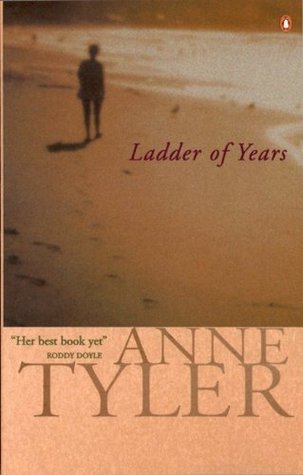 So for September I managed to steer the group away from a poorly received historical novel of over 400 pages and the new Joël Dicker and onto Ladder of Years by Anne Tyler, which the bookstore chain Waterstones has been promoting heavily as one of their books of the month. I already had a charity shop copy in hand and the others liked the sound of it, so we’re all set for September 12th! Future months’ literary fiction choices look promising, too, so provided I enjoy the discussion and the camaraderie I plan to stick with it: a backlist Pat Barker novel I’ve not read, and Kirsty Logan and Jonathan Coe novels I’ve read before and won’t reread but will remind myself about briefly before the meetings.
I’m out of practice with this book club thing. My mother tells me that I have a lot to contribute but that I must also be open to what I’ll learn from other people – even if I don’t expect to. So I don’t want to set myself up as some kind of expert. In fact, I probably won’t even mention that I’m a freelance book reviewer and book blogger. Mostly I’m hoping to find some friendly faces around the neighborhood, because even though we’ve lived here just over two years I still only know a handful of names and keep myself to myself as I work from home. Even if I have to read books I wouldn’t normally, it’ll be worth it to meet more people.
 Bookish Beck = Rebecca Foster. American transplant to England. Freelance proofreader and book reviewer.
