Four Recent Review Books: Aidt, Brackenbury, Duclos & Zidrou
Four February–March releases: A shape-shifting bereavement memoir; a poet’s selected works, infused with nature and history; a novel set among expatriates in Shanghai; and a graphic novel about a romance at the watershed of age 60 – you can’t say I don’t read a variety of books! I’m particularly pleased that two of these four are in translation. All: 

When Death Takes Something from You Give It Back: Carl’s Book by Naja Marie Aidt
[Translated from the Danish by Denise Newman]
 In March 2015 Aidt got a call telling her that her second of four sons, Carl Emil, was dead. The 25-year-old experienced drug-induced psychosis after taking some mushrooms that he and his friend had grown in their flat and, naked, jumped out of his fifth-floor Copenhagen window. In italicized sections she cycles back to the moment she was notified, each time adding on a few more harrowing details about Carl’s accident and the condition she found him in. The rest of the text is a collage of fragments: memories, dreams, dictionary definitions, journal entries, and quotations from the patron saints of bereavement (C.S. Lewis and Joan Didion) and poets who lost children, such as Stéphane Mallarmé.
The playful disregard for chronology and the variety of fonts, typefaces and sizes are a way of circumventing the feeling that grief has made words lose their meaning forever. David Grossman, whose son died during his service in the Israeli army, does a similar thing in Falling Out of Time, which, although it is fiction, blends poetry and dialogue in an attempt to voice the unspeakable. Han Kang’s The White Book and Yiyun Li’s Where Reasons End are two other comparable precursors.

A representative passage:
“no language possible language died with my child could not be artistic could not be art did not want to be fucking art I vomit over art over syntax write like a child main clauses searching everything I write is a declaration I hate writing don’t want to write any more”
With thanks to Quercus Books for the free copy for review.
Gallop: Selected Poems by Alison Brackenbury
 I first encountered Alison Brackenbury’s poetry through her reading as part of the 2016 “Nature Matters” conference in Cambridge. From four generations of Lincolnshire shepherds, Brackenbury writes about history, nature, country life (especially horses, as you might guess from the title and cover) and everyday joys and regrets. A Collected/Selected Poems volume is often difficult to assess as a whole because there can be such a variety of style and content; while that is certainly true here in terms of the poems’ length and rhyme schemes, the tone and themes are broadly similar throughout. I connected most to her middle period. Her first and last lines are especially honed.
Highlights include “The Wood at Semmering” (“This is a dismal wood. We missed our train.”), “Half-day” (“Will she lift / Her face from cloth’s slow steam: will she find out / Ironing is duty; summer is a gift?”), “Hill Mist” (“I am too fond of mist, which is blind / without tenderness”), “On the Road” (the bravery of a roadkill squirrel), “Epigrams” (being in the sandwich generation), “The Card” (“Divorce comes close to death”), “Cycles” (“Would I go back?”), “The Jane Austen Reader” (“Welcome to the truth. Miss Bingley married Darcy”), “On the Aerial” (a starling’s many songs), and “Dickens: a daydream.”

A wee poem that’s perfect for this time of year. (I can see sparrows in a forsythia bush from my office window.)
Some favorite lines:
“we are love’s strange seabirds. We dive there, still.” (from “The Divers’ Death”)
“Ancestors are not in our blood, but our heads: / we make history.” (from “Robert Brackenbury”)
With thanks to Carcanet Press for the free copy for review.
Besotted by Melissa Duclos
 Sasha is soon to leave Shanghai, her departure hastened by the collapse of her relationship with Liz, whom she hired to work at her international school because she had no teaching experience or Chinese – and maybe because she signed her cover letter “Besottedly,” thinking it meant drunkenly. Even before Liz arrived, Sasha built romantic fantasies around her, thinking she’d show her the ropes and give her a spare room to live in. All went according to plan – the erstwhile straight Liz even ended up in Sasha’s bed – until it all fell apart.
The novel is set over one school year and shows the main characters exploring the expat community, which primarily involves going to happy hours. Liz starts language exchange sessions at Starbucks with a Chinese guy, Sam, and both women try to ignore the unwanted advances of their acquaintance Dorian, an architect. Little misunderstandings and betrayals go a long way towards rearranging these relationships, while delicate flashbacks fill in the women’s lives before China.
There were a couple of narrative decisions here that didn’t entirely work for me: Sasha narrates the whole book, even scenes she isn’t present for; and there is persistent personification of abstractions like Loneliness and Love. But the descriptions of the city and of expat life are terrific, and the wistful picture of a romance that starts off sweet but soon sours is convincing.
A favorite passage:
“Shanghai had found its own identity since then: a glittering capitalist heart, hardened into a diamond and barely hidden beneath its drab, brown communist cloak. … Constantly under construction, Shanghai was a place to reinvent yourself.”
Full disclosure: Melissa and I worked together on Bookkaholic web magazine, and are Facebook friends. She sent me a free proof copy for review.
Blossoms in Autumn by Zidrou and Aimée de Jongh
[Translated from the French by Matt Madden]
 The French-language title, translated literally, is The Programmed Obsolescence of Our Feelings. (Talk about highfalutin!) Both that and the English title defy the notion that we become less capable of true love and growth the older we are – as will be dramatized through the story of a later-life romance between the two main characters. Ulysses Varennes, a 59-year-old widower who retired early from his career as a mover, hates books (gasp!) because moving boxes of them ruined his back (he even refuses to read them!). Mediterranea Solenza, coming up on 62, was a nude model in her prime and is now a cheesemaker. At the book’s opening she has just laid her mother to rest, and her affair with Ulysses serves as a chance at a new life that somehow counterbalances the loss.


We come to understand these characters through the sadness of their past but also through their hopeful future, both encompassed by the metaphor of a Homeric journey (Ulysses, get it?). Indeed, the book takes an unusual turn I never would have expected; if it beggars belief, it is at least touching. Zidrou is a Belgian comics writer and Aimée de Jongh is a Dutch-born illustrator. She portrays these ageing bodies sensitively but realistically, retreating into an appropriately impressionistic style for the spreads that show their actual lovemaking. In a nice touch, the first two words and last two words of the book are exactly the same.
With thanks to SelfMadeHero for the free copy for review.
Would you be interested in reading one or more of these?
Recent Poetry Reads
I love interspersing poetry with my other reading, and this year it seems like I’m getting to more of it than ever. Although I try to have a poetry collection on the go at all times, I still consider myself a novice and enjoy discovering new-to-me poets. However, I know many readers who totally avoid poetry because they assume they won’t understand it or it would feel too much like hard work.
Sinking into poems is certainly a very different experience from opening up a novel or a nonfiction narrative. Often I read parts of a poem two or three times – to make sure I’ve taken it in properly, or just to savor the language. I try to hear the lines aloud in my head so I can appreciate the sonic techniques at work, whether rhyming or alliteration. Reading or listening to poetry engages a different part of the brain, and it may be best to experience it in something of a dreamlike state.
I hope you’ll find a book or two that appeals from the selection below.
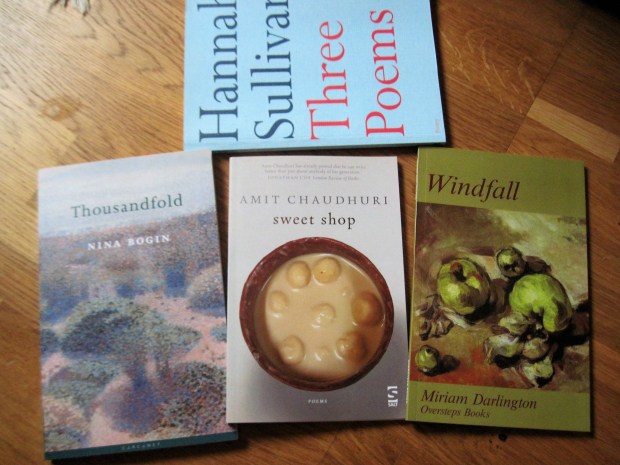
Thousandfold by Nina Bogin (2019)
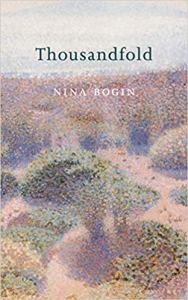 This is a lovely collection whose poems devote equal time to interactions with nature and encounters with friends and family. Birds – along with their eggs and feathers – are a frequent presence. Often a particular object will serve as a totem as the poet remembers the most important people in her life: her father’s sheepskin coat, her grandmother’s pink bathrobe, and the slippers her late husband shuffled around in – a sign of how diminished he’d become due to dementia. Elsewhere Bogin greets a new granddaughter and gives thanks for the comforting presence of her cat. Gentle rhymes and half-rhymes lend a playful or incantatory nature. I’d recommend this to fans of Linda Pastan.
My rating:
Thousandfold will be published by Carcanet Press on January 31st. My thanks to the publisher for the free copy for review.
Sweet Shop by Amit Chaudhuri (2019)
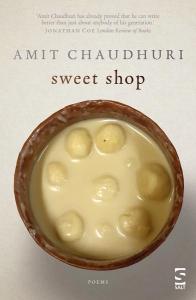 I was previously unfamiliar with Chaudhuri’s work, and unfortunately this insubstantial book about his beloved Indian places and foods hasn’t lured me into trying any more. The one poem I liked best was “Creek Row,” about a Calcutta lane used as a shortcut: “you are a thin, short-lived, / decaying corridor” and an “oesophageal aperture”. I also liked, as stand-alone lines go, “Refugees are periodic / like daffodils.” Nothing else stood out for me in terms of language, sound or theme. Poetry is so subjective; all I can say is that some poets will click with you and others don’t. In any case, the atmosphere is similar to what I found in Korma, Kheer and Kismet: Five Seasons in Old Delhi by Pamela Timms.
My rating: 
My thanks to Salt Publishing for the free copy for review.
Windfall by Miriam Darlington (2008)
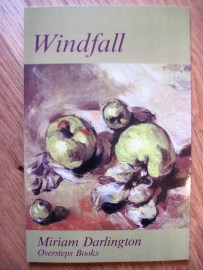 Before I picked this up from the bookstall at the New Networks for Nature conference in November, I had no idea that Darlington had written poetry before she turned to nature writing (Otter Country and Owl Sense). These poems are rooted in the everyday: flipping pancakes, sitting down to coffee, tending a garden, smiling at a dog. Multiple poems link food and erotic pleasure; others make nature the source of exaltation. I loved her descriptions of a heron (“a standing stone / perched in silt / a wrap of grey plumage”) and a blackbird (“the first bird / a glockenspiel in C / an improvisation on morning / a blue string of notes”), Lots of allusions and delicious alliteration. Pick this up if you’re missing Mary Oliver.
My rating: 
A Responsibility to Awe by Rebecca Elson (2018)
 Elson, an astronomer who worked on the Hubble Space Telescope, died of breast cancer; this is a reprint of her posthumous 2001 publication. Along with a set of completed poems, the volume includes an autobiographical essay and extracts from her notebooks. Her impending mortality has a subtle presence in the book. I focused on the finished poems, which take their metaphors from physics (“Dark Matter”), mathematics (“Inventing Zero”) and evolution (indeed, “Evolution” was my favorite). In the essay that closes the book, Elson remembers long summers of fieldwork and road trips across Canada with her geologist father (I was reminded of Margaret Atwood’s Cat’s Eye), and traces her academic career as she bounced between the United States and Great Britain.
My rating: 
My thanks to Carcanet Press for the free copy for review.
These next two were on the Costa Prize for Poetry shortlist, along with Hannah Sullivan’s Three Poems, which was one of my top poetry collections of 2018 and recently won the T. S. Eliot Prize. I first encountered the work of all three poets at last year’s Faber Spring Party.
Us by Zaffar Kunial (2018)
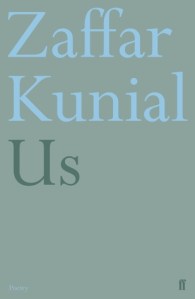 Many of these poems are about split loyalties and a composite identity – Kunial’s father was Kashmiri and his mother English – and what the languages we use say about us. He also writes about unexpectedly developing a love for literature, and devotes one poem to Jane Austen and another to Shakespeare. My favorites were “Self Portrait as Bottom,” about doing a DNA test (“O I am translated. / The speech of numbers. / Here’s me in them / and them in me. … What could be more prosaic? / I am split. 50% Europe. / 50% Asia.”), and the title poem, a plea for understanding and common ground.
My rating:
Soho by Richard Scott (2018)
 When I saw him live, Scott read two of the amazingly intimate poems from this upcoming collection. One, “cover-boys,” is about top-shelf gay porn and what became of the models; the other, “museum,” is, on the face of it, about mutilated sculptures of male bodies in the Athens archaeological museum, but also, more generally, about “the vulnerability of / queer bodies.” If you appreciate the erotic verse of Mark Doty and Andrew McMillan, you need to pick this one up immediately. Scott channels Verlaine in a central section of gritty love poems and Whitman in the final, multi-part “Oh My Soho!”
My rating:
Don’t Call Us Dead by Danez Smith (2017)
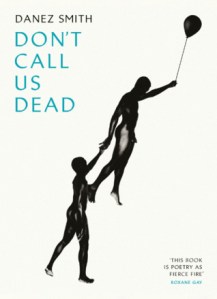 Like Claudia Rankine’s Citizen, this is a book whose aims I can admire even though I didn’t particularly enjoy reading it. It’s about being black and queer in an America where both those identifiers are dangerous, where guns and HIV are omnipresent threats. “reader, what does it / feel like to be safe? white?” Smith asks. “when i was born, i was born a bull’s-eye.” The narrator and many of the other characters are bruised and bloody, with blood used literally but also metaphorically for kinship and sexual encounters. By turns tender and biting, exultant and uncomfortable, these poems are undeniably striking, and a necessary wake-up call for readers who may never have considered the author’s perspective.
My rating:
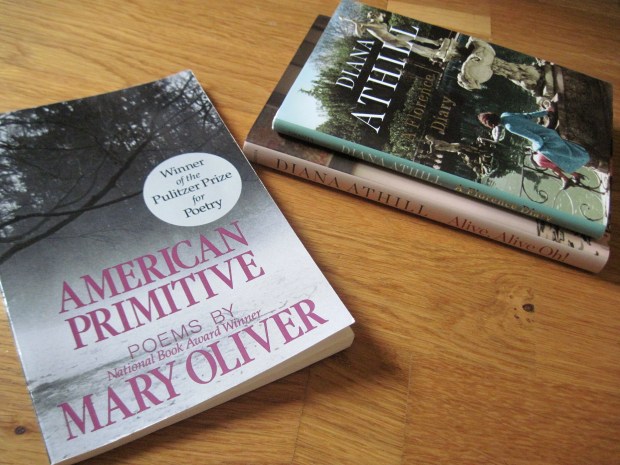
Up next: This Pulitzer-winning collection from the late Mary Oliver, whose work I’ve had mixed success with before (Dream Work is by far her best that I’ve read so far). We lost two great authors within a week! RIP Diana Athill, too, who was 101.
Any recent poetry reads you can recommend to me?
New Networks for Nature 2018
This past weekend was my fourth time attending part of Nature Matters, the annual New Networks for Nature conference. I’ve written about it here a couple of times, once when there was a particular focus on nature poetry and another time when it was held in Cambridge. This year it was back in Stamford for a last time for the 10th anniversary. Next year: York.
What’s so special about the conference is its interdisciplinary nature: visual artists, poets, musicians, writers, politicians, academics and conservationists alike attend and present. So although the event might seem geared more towards my biologist husband, there’s always plenty to interest me, too. The roster is a who’s who of British nature writing: Mark Avery, Tim Birkhead, Mark Cocker, Mary Colwell, Miriam Darlington, Richard Kerridge, Peter Marren, Michael McCarthy, Stephen Moss, Adam Nicolson, Katharine Norbury, Ruth Padel, Laurence Rose and Mike Toms were all there this year. I also appreciate the atmosphere of friendly disagreement about what nature is and how best to go about conserving it.
I attended on Friday, a jam-packed day of sessions that began with Bob Gibbons presenting on the flowers and wildlife of Transylvania, a landscape and culture that are still almost medieval in character. Then Jeremy Mynott interviewed Mark Cocker about his latest book, Our Place: Can We Save Britain’s Wildlife before It Is Too Late? I’ve read other Cocker books, but not this one yet. Its main point seems to be that the country’s environmental organizations need to work together. Individuals and NGOs are doing passionate and wonderful things towards nature conservation, Cocker said, but overall “we ain’t getting there.” Bad news doesn’t sell, though, he noted: his book has sold just 6,000 copies compared to 30,000 for Wilding, Isabella Tree’s story of the rewilding success at Knepp.
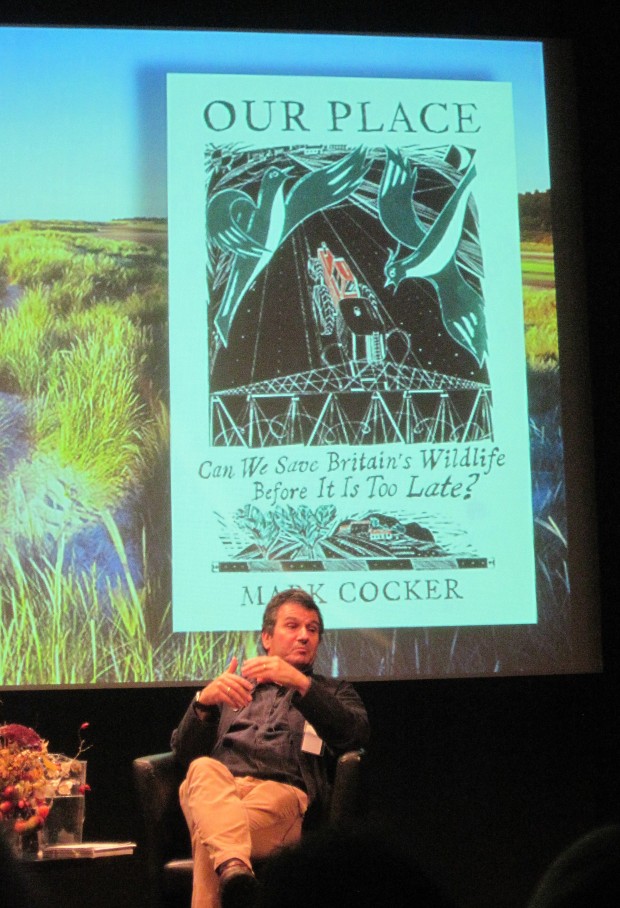
Mark Cocker
Cocker refused to define nature in a one-sentence soundbite, but argued that we have to consider ourselves a part of it rather than thinking about it as a victim ‘out there’ (the closest he came to a definition was “the totality of the system we are a part of”). “Our responsibility, terrifyingly, is unending,” he said – every time you open a new plastic toothbrush, you can’t forget that the old one you throw away will effectively be around forever. Our Place isn’t just composed of polemic, though: it’s structured around six beloved landscapes and finds moments of transcendence in being out in nature. You find hope by walking out the door, feeling the wind on your face and hearing the starling singing, Cocker remarked. He closed by reading a description from the book of the north Norfolk coast.
Either side of lunch were panels on how social media (mostly Twitter, plus smartphone apps) can serve nature and the role that poetry might play in environmental activism, with a brief interlude from visual artist Derek Robertson, who responded to the refugee crisis by traveling to Calais and Jordan and painting human figures alongside migratory birds. In the poetry session I especially enjoyed hearing from Ben Smith, a University of Plymouth lecturer and poet with a debut novel coming out in April 2019 (Doggerland, from Fourth Estate). He recently collaborated with Dr. Lee de Mora on a set of poems inspired by the Earth System Model, which provides the data for the International Panel on Climate Change. Climate modeling might seem an odd subject for poetry, but it provides excellent metaphors for failure and hope in “Spinning Up,” “Data Sets” and “Alternate Histories.”
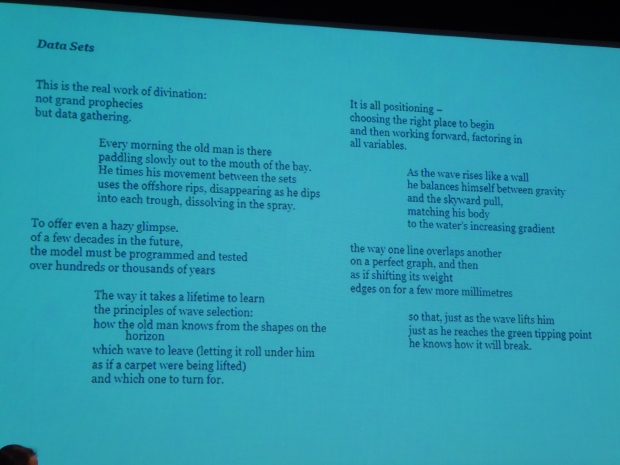
Ben Smith’s poem links unlikely subjects: surfing and climate modeling. Photo by Chris Foster.
Birmingham lecturer Isabel Galleymore, whose debut collection Significant Other is coming out from Carcanet Press in March, talked about how she uses the tropes of love poetry (praise, intimacy, pursuit and loss) when writing about environmental crisis. This shift in her focus began at university when she studied Wordsworth through an ecocritical lens, she said. Jos Smith and Luke Thompson were the other two poets on a panel chaired by Matt Howard. Howard quoted Keats – “We hate poetry that has a design on us” – and asked the poets for reactions. Smith agreed that polemic and poetry don’t mix well, yet said it’s good to have a reason for writing. He thinks it’s best when you can hold two or more ideas in play at a time.
After tea and a marvelous cake spread, it was time for a marathon of three sessions in a row, starting with three short presentations on seabirds: one by a researcher, one by a nature reserve manager, and one by a young artist who produced Chinese-style scroll paintings of the guillemot breeding colonies on Skomer and exhibited them in Sheffield Cathedral.
Next up was a highlight of the weekend: Green Party MP Caroline Lucas and Labour peer Baroness Barbara Young conversed with Michael McCarthy on the topic “Can Conventional Politics Save the Environment?” Both decried short-term thinking, the influence of corporations and the media, and government departments not working together. No one was ever elected on the promise of “less,” McCarthy suggested, but in reply Lucas talked about redefining terms: less of what? more of what? If we think in terms of quality of life, things like green energy and the sharing economy will become more appealing. She also believes that more people care about green issues than we think, but, e.g., a London mum might speak out about air quality without ever using the word “environment.” Baroness Young concluded that “adversarial politics, flip-flopping between parties, isn’t working” and we must get beyond it, at the local level if nothing else. That rang true for me for American politics, too.
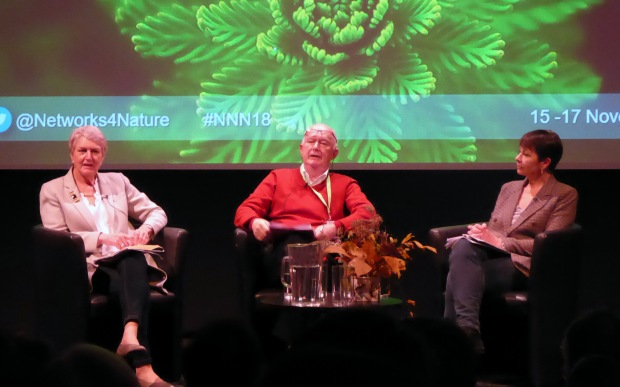
Young, McCarthy and Lucas. Photo by Chris Foster.
Before the day ended with a drinks reception, we were treated to a completely different presentation by Lloyd Buck, who raises and trains birds, mostly for television footage. So, for instance, the greylag geese flying in formation alongside the boat in David Attenborough’s 2012 Sixty Years in the Wild TV special had imprinted on Lloyd’s wife, Rose. Buck spoke about bonding with birds of very different personalities, and introduced the audience to five starlings (who appeared in Poldark), a peregrine, a gyrfalcon, a golden eagle, and Bran the raven, who showed his intelligence by solving several puzzles to find hidden chunks of meat.


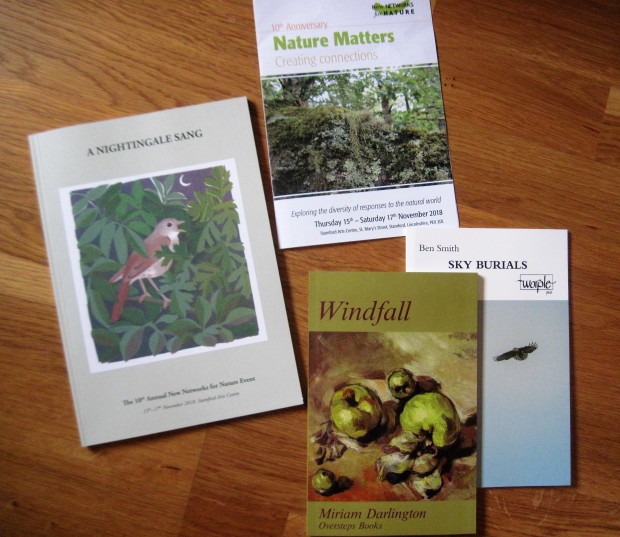
I purchased two books of poetry from the bookstall – I had no idea Darlington had written poetry before her nature books – and the conference brochure itself is a wonderful 75-page collection of recent artwork and short nature writing pieces, including most of the presenters but also Patrick Barkham, Tim Dee, Paul Evans, Philip Hoare, Richard Mabey, Helen Macdonald and Chris Packham – a keynote speaker announced for next year. I’ve been skipping through the booklet and have most enjoyed the pieces by Melissa Harrison and Helen Scales so far. Altogether, an inspiring and worthwhile weekend.
 Bookish Beck = Rebecca Foster. American transplant to England. Freelance proofreader and book reviewer.
