Review: Darke by Rick Gekoski
Dr. James Darke, the narrator of rare-book dealer Rick Gekoski’s debut novel, is of the same lineage as titular antiheroes like Hendrik Groen and Fredrik Backman’s Ove, or J. Mendelssohn, protagonist of the title novella in Colum McCann’s Thirteen Ways of Looking: an aging widower and curmudgeon with an unforgettable voice.
As Darke begins, this retired English teacher is literally sealing himself off from the world. He hires a handyman to take out the door’s built-in letterbox, change the locks and install a high-tech peephole; he has all his mail redirected to an old colleague, George; he changes his e-mail address; and he compiles a thorough list of service providers who will come to him – everything from grocery deliveries to a doctor. Now, with any luck, he won’t need to set foot outside his London home while he writes this “coming-of-old-age book.”
 For eight months Darke stays in self-imposed exile, his solitude broken only by visits from Bronya, a Bulgarian cleaner who engages him in discussions of his beloved Dickens. Although he’s only sixty-something, Darke sounds like a much older man, complaining of constipation and vision problems and launching a vendetta against the annoying neighbor dog. Ignoring the pile of adamant letters George guiltily delivers on behalf of Darke’s daughter, Lucy, he keeps up his very particular habits and rituals (I loved the steps of making coffee with an espresso-maker) and gives himself over to memories of life with Suzy.
The novel is tripartite: In Part I we meet Darke and get accustomed to his angry, hypercritical voice. In Part II we descend into a no-holds-barred account of his wife Suzy’s death from lung cancer. She’s another wonderful character: pessimistic, ungraceful and utterly foul-mouthed. Here Darke unleashes the full extent of his bitterness. He mocks the approach, advocated by Joan Didion (“that poor Joan D’Idiot,” he calls her!), of turning to sages of the past for comfort, instead insisting that literature – including W.B. Yeats, T.S. Eliot and all the rest – was of no use to him in the face of his wife’s impending death:
We don’t have God, so we have literature, with its associated proverbs and allegories, its received wisdom. We quote and genuflect and defer and pay homage, as if in a holy sanctuary. But just as God failed us, so too will reading. We will turn against it as certainly, and rightly, as we did against Him. Nobody, and nothing, can explain life for us.
Luckily, Part III is something of a reprieve, as Darke starts to come out of his temporary retreat and resume life. He has a rental car delivered and sets out for Oxford, where he revisits his and Suzy’s old university haunts and hesitantly reopens a connection with Lucy and her young son, Rudy.
Sebastian Barry astutely notes the novel’s debt to Dante, but the component parts of the Divine Comedy are reordered, with the purgatory of the house-bound months broken by the hellish narrative of Suzy’s dying, which is then lifted by Darke’s return to life.
Each section has a different tone and is enjoyable in its own way, but for me there was no getting around the fact that Part I is the most entertaining. I was surprised to read in the Acknowledgments that Gekoski toned down this first dose of Darke considerably, on the advice of his wife and his literary agent; I think he could have hammed him up a fair bit more. Also, Lucy didn’t ring true for me as a character, which detracted from what’s meant to be an alternately volatile and poignant relationship; I preferred Darke’s scenes with Bronya.
In any case, the novel makes great metaphorical use of light and darkness. Not so subtle, maybe, but it works:
witnessing a protracted and horrible death infects the soul, the images implant themselves, root and flourish, you can never look at yourself or others in the innocent light – you are tarnished, uncleanably darkened.
And of course, look to literature and you find nothing but “shitslingers – Kahlil Gibran, Mr Tolstoy, the dreaded Eliot – all of them. Just wandering in the dark with flashlights.”
With lots of memorable scenes and turns of phrase, Darke is a rewarding glance at loss, literature and the sometimes futile search for salvation. It’s inspiring to see Gekoski, an American-born academic and literary critic (he’s been dubbed the Bill Bryson of the book world), turn his hand to fiction at age 71. I knew of him through his nonfiction, including Outside of a Dog: A Bibliomemoir, which I read in 2010, and have also enjoyed a couple of his articles that nicely presage this novel, on the subjects of reading through grief and turning against print books. I hope you’ll give his work a try.
Darke was published in the UK on February 2nd. With thanks to Becca Nice and Jamie Norman of Canongate for the free copy for review.
My rating: 
Better Late than Never: City on Fire
I aim to read one book of 500+ pages in each month of 2017. My first Doorstopper of the Month is City on Fire, the 2015 debut novel from Garth Risk Hallberg. It’s common knowledge that Hallberg earned a six-figure advance for this 911-page evocation of a revolutionary time in New York City. When it was first published I didn’t think I had the fortitude to tackle it and had in mind to wait for the inevitable miniseries instead, but when I won a copy in a goodie bag from Hungerford Bookshop I decided to go for it. I started the novel just after Christmas and finished it a few days ago, so like Donna Tartt’s The Goldfinch it took me roughly a month to read because I had many other books on the go at the same time.
 Opening on Christmas Eve 1976 and peaking with the July 1977 blackout, the novel brings its diverse cast together through a shooting in Central Park. Insider traders, the aimless second generation of some of the city’s wealthiest aristocrats, anarchist punk rockers, an African-American schoolteacher, a journalist and his Vietnamese neighbor, a fireworks manufacturer, a policeman crippled by childhood polio – the characters fill in the broad canvas of the city, everywhere from Wall Street boardrooms to drug dens.
The real achievement is not how Hallberg draws each character but how he fits them all together. The closest comparison I can make is with one of Dickens’s long novels, say David Copperfield, where, especially as you approach the conclusion, you get surprising meet-ups of figures from different realms of life. The relaxed chronology reaches back to the 1950s and forward to 2003 to give hints of where these people came from and what fate holds for them.
City on Fire might sound like a crime drama – I can see a miniseries working in a manner comparable to The Wire – and the mystery of who shot Samantha Cicciaro does indeed last from about page 80 to page 800-something. But finding out who shot her and why (or why investment bankers would be funding a posse of anarchists, or who pushed a journalist into the river) is something of an anticlimax. The journey is the point, and the city is the real star, even though it’s described with a kind of affectionate disdain in the passages that follow:
The stench of the basement level reached him even here, like hot-dog water mixed with roofing tar and left in an alley to rot
The park on New Year’s Day had been a blasted whiteness, or a series of them, hemmed in by black trees like sheets snagged on barbed wire.
It seemed impossible that he’d chosen to live here, at a latitude where spring was a semantic variation on winter, in a grid whose rigid geometry only a Greek or a builder of prisons could love, in a city that made its own gravy when it rained. Taxis continued to stream toward the tunnel, like the damned toward a Boschian hellmouth. Screaming people staggered past below. Impossible, that he now footed the rent entire, two hundred bucks monthly for the privilege of pressing his cheek to the window and still not being able to see spectacular Midtown views. Impossible, that the cinderblock planter on the fire escape could ever have produced flowers.
Or wasn’t this city really the sum of every little selfishness, every ignorance, every act of laziness and mistrust and unkindness ever committed by anybody who lived there, as well as of everything she personally had loved?
Mercer Goodman, Jenny Nguyen and Richard Groskoph were my three favorite characters, and I might have liked to see more of each of them. I also felt that the book as a whole was quite baggy, and the six Interludes that separate the seven large sections, remarkable as they are (especially an entire fanzine, complete with photographs, comics and handwritten articles), weren’t strictly necessary.

It’s definitely a chunkster. For the longest while it felt like I wasn’t making a dent.
Still, I couldn’t help but be impressed by Hallberg’s ambition, and on the sentence level the novel is always well wrought and surprising, with especially lovely last lines that are like a benediction. Though it’s mostly set in the 1970s, this never feels dated; in fact, I thought it thoroughly relevant for our time: “even now they’re writing over history, finding ways to tell you what you just saw doesn’t exist. The big, bad anarchic city, people looting, ooga-booga. Better to trust the developers and the cops.”
I won’t pretend that a 900+-page book isn’t a massive undertaking, and I have some trusted bloggers and Goodreads friends who gave up on this after 250 or 450 pages. So I can’t promise you that you’ll think it’s worth the effort, though for me it was. A modern twist on the Dickensian state-of-society novel, it’s one I’d recommend to fans of Jonathan Franzen, Bill Clegg and Jennifer Egan.
My rating:
Reading Goals for 2017
I’ve set just a few modest goals for the coming year’s reading:
- As always, I’d like to focus on reading more of the books I actually own. I went around and did an inventory of unread books in the house and came up with 221. That could easily fill two-thirds or more of next year, yet I know I’m unlikely to cut down on my library borrowing or NetGalley and Edelweiss requests. I think the strategy will be to always have two of my own books on the go at all times, one fiction and one nonfiction, no matter how many other public library or Kindle books I’m reading.
- Some of the books I most want to tackle have 500+ pages. I wonder if I have enough really long books to sustain a Doorstopper of the Month feature? To get a head start on this goal, this past week I started City on Fire by Garth Risk Hallberg and Titus Groan by Mervyn Peake. Also on the shelf are A Suitable Boy, This Thing of Darkness, An Instance of the Fingerpost, Until I Find You, and a few chunky biographies; I’m also sure to get some long books from the library and NetGalley.
-

The classics bookcase.
I read very few classics in 2016, just a couple short books by Jerome K. Jerome, a Stefan Zweig novella, Tender Is the Night, and two rediscovered 1930s works from the Apollo Classics series. So that’s something to rectify in 2017. Three classics from the list of “Books to Read in Your 30s” in The Novel Cure are calling to me, and it’s also high time I read some more Dickens (maybe I’ll finally return to Dombey and Son?), Trollope (at least The Warden, if not more of the Barsetshire series), Brontë (Anne, in this case) and Woolf (The Voyage Out). Maybe I’ll also start a Classic of the Month feature?
Regarding my career…
I’d like to replace some of my individual book reviewing with longer articles. For instance, this past year Foreword magazine invited me to write three articles surveying new and upcoming books in various genres: young adult, climate change and middle grade. It’s more rewarding (and remunerative) to prioritize full-length articles.
Regarding the blog…
I’d love to get involved in more blog tours and collaborative challenges. I also hope to continue maintaining a balance between straightforward reviews/lists and different stuff, whether that’s travel reports or more introspective pieces. My dream is still to judge a literary prize, even if that’s just as part of a shadow panel.
What are some of your goals for 2017 – reading-related or otherwise?
Tomorrow: Some final statistics on my reading for the year.
An Anthology for the Coming Winter
“the short dark days of winter
dear to me
as a bully to his mother.”
~from “Skulking,” a poem from Helen Dunmore’s The Malarkey
After more than ten years here, I still struggle with English winters. It’s not that they’re colder than what I grew up experiencing on America’s east coast. In terms of temperatures, snowfall and ice buildup, there’s no real comparison. I keenly remember the winter of 2004, when the wind-chill was about 10° F and all the fountains in Washington, D.C. froze solid.
But English winters have particularly disheartening qualities: they’re overwhelmingly dark, bone-seepingly wet, and seemingly endless. I’ll never forget when, in my first-ever winter in England (during my study abroad year in 2003), I looked out a University of Reading library window around 3:00 in the afternoon and realized the sun was setting behind the trees.
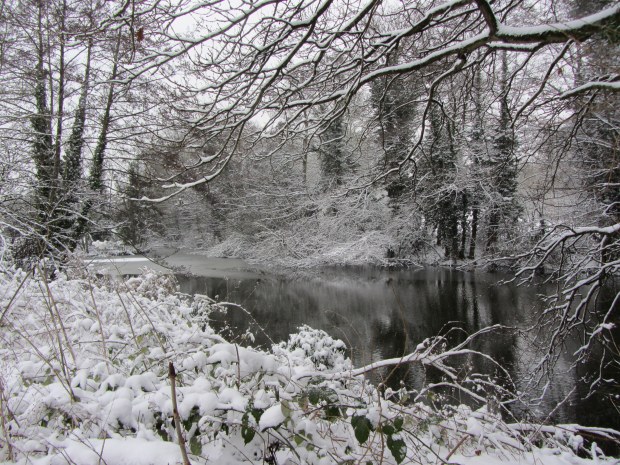
A snowy day on the University of Reading campus (Whiteknights Lake). Photo by Chris Foster.
All these years later, I still find that dim mid-afternoon light depressing, and the damp cold nearly intolerable. In our study abroad information packet we were warned that British interiors are kept 10 degrees cooler than American ones. But because we’re both thrifty and environmentally conscious, our house is significantly colder. Most of the time I’ll wear four to seven layers and huddle under blankets rather than turn on the heat – why warm a whole house for one person and one cat? I’m not entirely joking when I say to my husband that I wish I could hibernate from roughly November to April. Just wake me up for Christmas.
Ahhhhhh, Christmas, which the English do wonderfully – much better than Americans, in my opinion. Carol services, dense dried fruit desserts, booze in and with everything, a gentler tinge to the commercialism, plus maybe some nostalgic Dickensian tint I’m giving it all in my mind. I’ve had some wonderful Christmases here over the past 12 years.
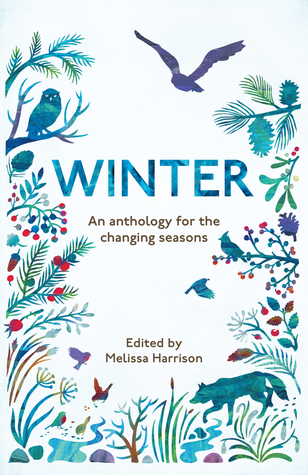 So I’m ambivalent about winter, and was interested to see how the authors collected in Melissa Harrison’s final seasonal anthology would explore its inherent contradictions. I especially appreciated the views of outsiders. Jini Reddy, a Quebec native, calls British winters “a long, grey sigh or a drawn-out ache.” In two of my favorite pieces, Christina McLeish and Nakul Krishna – from Australia and India, respectively – compare the warm, sunny winters they experienced in their homelands with their early experiences in Britain. McLeish remembers finding a disembodied badger paw on a frosty day during one of her first winters in England, while Krishna tells of a time he spent dogsitting in Oxford when all the students were on break. His decorous, timeless prose reminded me of J.R. Ackerley’s.
The series is in support of the Wildlife Trusts, and a key message of this volume in particular is that nature is always there to be experienced – even in what feels like a dead time of year. Kate Blincoe observes an urban starling murmuration in an essay that nicely blends the lofty and the earthy; Nicola Chester takes a wintry beach walk and documents what she finds in the strandline, such as goose barnacles; Joseph Addison celebrates the pleasures of a winter garden; Patrick Barkham examines the ways butterfly life* continues through the winter, usually as eggs; and Richard Adams (author of Watership Down) insists, “Wild flowers are like pubs. There are generally one or two open somewhere, if only you look hard enough.”
As in the other volumes, Harrison has chosen a lovely mixture of older and contemporary pieces. Occasional passages from Gilbert White and Thomas Furly Forster on the timing of natural phenomena help create a sense of chronological progression, from November through to February. The contemporary nature writing scene is represented by previously published material from Robert Macfarlane and Kathleen Jamie. Classic literature is here in the opening of Charles Dickens’s Bleak House and the Great Frost passage from Virginia Woolf’s Orlando. There are also excerpts from Coleridge’s diary and freed slave Olaudah Equiano’s account of seeing snow for the first time. In general, this volume is better at including diverse voices, like the final piece from Anita Sethi on her family’s unlikely garden in Manchester.
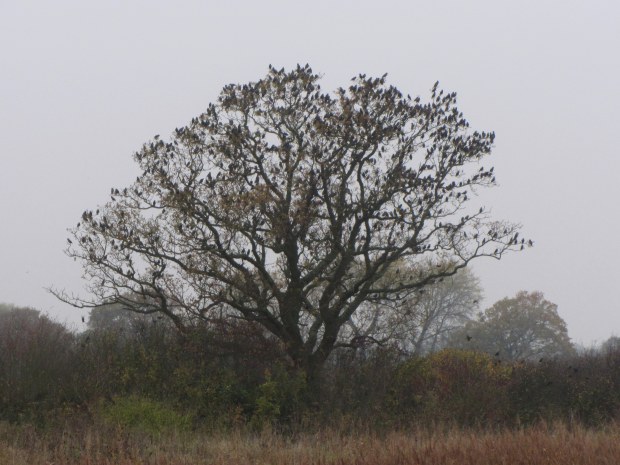
A starling roost at Otmoor RSPB Reserve in Oxfordshire. Photo by Chris Foster.
Christmas doesn’t really appear here; it’s a book about the natural year rather than the cultural year. But another event does, very powerfully: In another of my top few pieces, Jon Dunn (who authored my favorite piece in Autumn) tells how the overpowering darkness of a Shetland winter is broken by the defiant Up Helly Aa festival, in which the residents dress up as Vikings and ceremonially burn a longboat. Life goes on, no matter how bleak everything seems. That’s an important thing to keep in mind after all the troubling events of 2016.
*My husband’s piece, positioned between John Fowles’s and Richard Jeffries’s, is also about the surprising insect life that can be discovered in the winter.
My review of Summer.
My review of Autumn.
[I came late to the series so will be reading, but not reviewing, Spring next year.]
More beautiful lines to treasure:
- “Claws of grey rain break to rake through a gold half-light and the squall moves like a huge aerial jellyfish, obscuring then revealing this wreckers’ coast of muted blue headlands. Swirling white snowflakes move against a grey mass, turning Lundy Island into a Turner painting.” (Nicola Chester)
- “I am the garnet shock / of rosehip on frost / the robin’s titian flare.” (Julian Beach)
- “the tower blocks are advent calendars, / every curtain pulled to reveal a snow-blurred face.” (Liz Berry)
- “A whole year of concerns, worries and squabbles sloughed off in a bone-chilling baptism of copper water.” (Matt Gaw)
- “Two hundred jackdaws drape the skeleton of the winter beech like jet beads around the neck of a Victorian mourner.” (Jane Adams)
With thanks to Jennie Condell at Elliott & Thompson for the free copy for review.
My rating: 
Landmark Books from My Early Life
I initially wanted to title this post “Books that Changed My Life,” but soon realized it would probably be more accurate to speak about them as the books that have shaped my life as a keen reader and meant the most to me as the years have passed.
In making this list I was inspired by a book I recently finished, Kate Gross’s memoir Late Fragments, which finishes with a bibliography of books that influenced her during different periods of her life. Gross, who died of colon cancer at age 36 in 2014, divides her reading life into five distinct, whimsically named eras: “With my back to the radiator” (childhood), “The grub years” (adolescence), “Emerging from the cocoon” (early adulthood), “The woman in the arena” (career life) and “End of life book club.”
I’ll do a follow-up post on the key books from my twenties next month, but for now I want to focus on the books that defined my growing-up and teen years.
What Bewick’s Birds was for Jane Eyre, my parents’ book on flower arranging was for me. I couldn’t tell you the title or author, but I think this green fabric covered tome with its glossy pages and lush full-color photographs was the origin of my love of books as physical objects. I must have spent hours paging through the illustrations and breathing in the new-book aroma. I’ve been a book sniffer ever since.
 I can’t recall many of the individual picture books my mother read with me when I was little, but one that does stand out in my memory is Miss Rumphius by Barbara Cooney, about an eccentric woman who goes about planting lupines. Again, it’s a gorgeous book filled with flowers – you’d think I might have become a botanist!
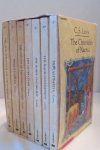 C.S. Lewis’s The Chronicles of Narnia were the first books I ever read by myself, starting at age five. It took me years to get to the allegory-heavy The Last Battle, but I read the other volumes over and over, even after the PBS television movies came out. The Silver Chair was always my favorite, but I’m sure I must have read the first three books 10 or 20 times each.
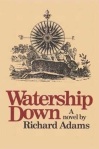 Richard Adams’s Watership Down was the first book I ever borrowed from the adult section of the public library, at age nine. Crossing the big open lobby of the Silver Spring, Maryland library from the children’s room to the imposing stacks of Adult Fiction was like a rite of passage; when I emerged clutching the fat plastic-covered hardback I felt a little bit like a rebel but mostly just pretty darn proud of myself. I inhaled the several hundred pages of this bunny epic and for years afterwards considered it my favorite book.
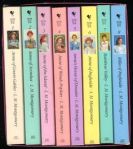 Nowadays I don’t like to commit to series, but as a kid I couldn’t get enough of them: after Narnia, I devoured the Babysitter’s Club and Saddle Club books, the Anastasia Krupnik books, and so on. Whenever I found an author I loved I dutifully read everything they’d written. The Anne of Green Gables series by L.M. Montgomery, in particular, accompanied me through my early teen years. I think I saw the CBC/PBS television miniseries starring Megan Follows first and read the books afterwards. Bereft once the eight-book cycle was over, I read the much darker Emily trilogy, but it just couldn’t live up to the Anne books.
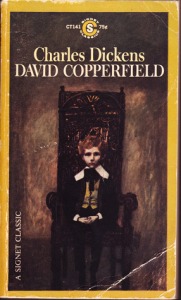 My first foray into the realm of heavy-duty classics was Charles Dickens’s David Copperfield at age 14. I bought a battered secondhand paperback from a library sale and was immediately entranced, from the first line onwards: “Whether I shall turn out to be the hero of my own life, or whether that station will be held by anybody else, these pages must show.” No doubt the idea of discovering my own potential heroism was what drew me in, but I loved everything about this novel: the rich panorama of nineteenth-century life, the vibrant secondary characters, the under-the-surface humor you had to work a little bit to understand, and the sweet second-chance romance. This was the start of my love affair with Victorian literature. I’ve read it three times since then. If ever asked for my favorite book, this is what I name.
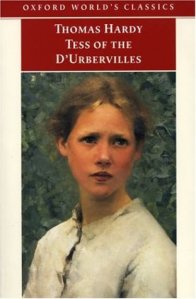 It wasn’t my first Hardy novel (that was Far from the Madding Crowd, another all-time favorite), but Tess of the D’Urbervilles is most memorable for the circumstances in which I read it. At age 19 I accompanied my sister, who’d won a singing contest on local radio, to the Season 2 finale of American Idol in Hollywood. If you were a loyal viewer, you might recall that this was the showdown between Ruben Studdard and Clay Aiken, on whom I had a hopeless crush – it later emerged that he’s gay. I read Tess on the flight to Los Angeles. Stranger pairings have been known, I’m sure, but I’ll never forget that disconnect between bleak England (where I hadn’t yet been at that point) and the sunny entertainment capital.
What are some of the books that meant the most to you in your early years?
Discover Some Shiny New Books
If you haven’t already come across it, let me commend to you the UK-based web magazine Shiny New Books. It’s been around for two years now and has just released Issue #10. Each installment is stuffed full of terrific reviews and features. I suggest setting aside a bit of time each day for a week or two, say a half-hour tea break, to browse what the site has to offer. It specifically highlights what’s been recently published or reprinted in the UK, so in some cases these will be books that are already available in North America; in others these will be sneak previews of books not yet published there. You’re sure to find plenty that appeals.
I’m proud to be part of the stellar (if I do say so myself) team of SNB reviewers. Somehow I just kept volunteering for things and ended up with – whoops! – a whole five pieces in this latest issue: four reviews (two fiction, one nonfiction, and one classic reprint) and an interview. Two of the novels were fantastic, among my best reads of the year so far, while the other two books were worthwhile, even very good in places. Here are tasters of my reviews; click on a title to read the whole thing – and then spend some good time browsing the site.
Sweetbitter by Stephanie Danler
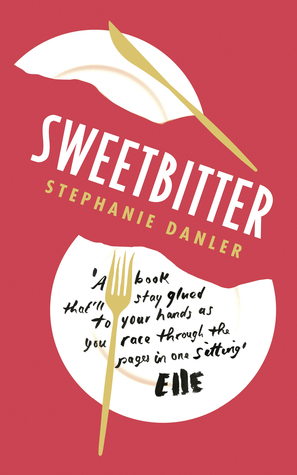 Twenty-two-year-old Tess arrives in New York City by car in June 2006. Two days later she interviews at a restaurant in Union Square and gets a job as a backwaiter and barista. Camaraderie makes the restaurant not just bearable but a kind of substitute home. Tess is most fascinated by two colleagues who stand apart from the crowd: Simone, the resident wine know-it-all, and bartender Jake. Try as she might, Tess can’t work out the dynamic between them. To mirror her one-year taste apprenticeship, the book is broken into four seasonal parts, headed by short sections in the second person or first-person plural. Everything about this novel is utterly assured: the narration, the characterization, the prose style, the plot, the timing. It’s hard to believe that Danler is a debut author rather than a seasoned professional. It captures the intensity and idealism of youth yet injects a hint of nostalgia. I’m willing to go out on a limb and call Sweetbitter my favorite novel of 2016.
My rating: 
I also interviewed Stephanie Danler over e-mail.
My Son, My Son by Howard Spring
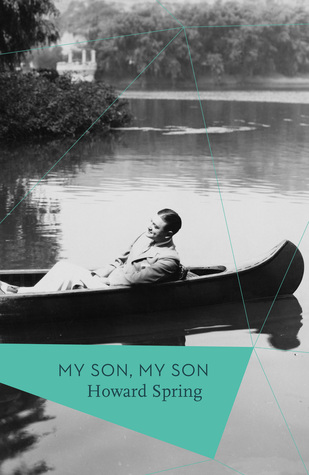 My Son, My Son opens in working-class Manchester in the 1870s and stretches through the aftermath of World War I. Like a Dickensian urchin, William Essex escapes his humble situation thanks to a kind benefactor and becomes a writer. His best friend is Dermot O’Riorden, a fervid Irish Republican. William’s and Dermot’s are roughly parallel tracks. Their sons’ lives, however, are a different matter. Oliver Essex and Rory O’Riorden are born on the same day, and it’s clear at once that both fathers intend to live vicariously through their sons. My Son, My Son struck me as an unusual window onto World War I, a subject I’ve otherwise wearied of in fiction. A straight line could be drawn between Great Expectations, Maugham’s Of Human Bondage, My Son, My Son, and The Goldfinch: all four feature a simultaneously sympathetic and enraging protagonist who overcomes family difficulties to dream of fame and fortune. No mere period or local interest piece, this is a book for the ages.
My rating: 
The Sellout by Paul Beatty
 This is such an outrageous racial satire that I kept asking myself how Beatty got away with it. Not only did he get away with it, he won a National Book Critics Circle Award. The novel opens at the U.S. Supreme Court, where the narrator has been summoned to defend himself against a grievous but entirely true accusation: he has reinstituted slavery and segregation in his hometown of Dickens, California. All the old stereotypes of African Americans are here, many of them represented by Hominy Jenkins. This reminded me most of Ishmael Reed’s satires and, oddly enough, Julian Barnes’s England, England, which similarly attempts to distill an entire culture and history into a limited space and time. The plot is downright silly in places, but the shock value keeps you reading. Even so, after the incendiary humor of the first third, the satire wears a bit thin. I yearned for more of an introspective Bildungsroman, which there are indeed hints of.
My rating: 
The Abundance by Annie Dillard
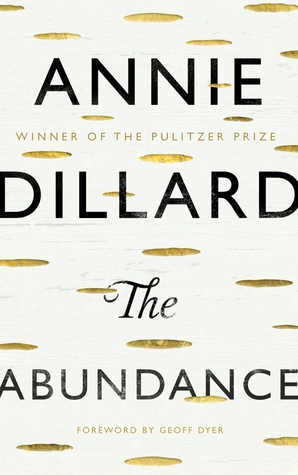 Dillard was raised a Christian in Pittsburgh, Pennsylvania, but her writing expresses an open spirituality rather than any specific faith. For readers who are reasonably familiar with her work, the selection given here might be a little disappointing. Why reread 60 pages from Pilgrim at Tinker Creek, I thought, when I have a copy of it up on the shelf? Rather than reading long, downright strange portions of For the Time Being and Teaching a Stone to Talk, why not go find whole copies to read (which might help with understanding them in context)? None of Dillard’s poetry or fiction has been included, and the most recent piece, “This Is the Life,” from Image magazine, is from 2002. I wish there could have been more fresh material as an enticement for existing fans. However, this will serve as a perfect introduction for readers who are new to Dillard’s work and want a taste of the different nonfiction genres she treats so eloquently and mysteriously.
My rating: 
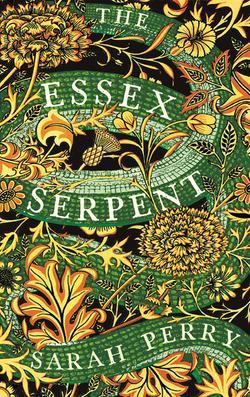
The Essex Serpent by Sarah Perry
This exquisite work of historical fiction explores the gaps – narrower than one might think – between science and superstition and between friendship and romantic love. The Essex Serpent was a real-life legend from the latter half of the seventeenth century, but Perry’s second novel has fear of the sea creature re-infecting Aldwinter, her invented Essex village, in the 1890s. Mysterious deaths and disappearances are automatically attributed to the Serpent who dwells in the depths of the Blackwater. This atmosphere of paranoia triggers some schoolgirls to erupt in frenzied delusions as in The Crucible. It is unclear whether the Church should tolerate a source of mystery or dismiss it all as nonsense – after all, there’s a winged serpent carved onto one of the pews at the parish church.
 In a domestic counterpart to all these supernatural goings-on, we gain entry into two middle-class households. Cora Seaborne’s abusive husband, Michael, has recently died of throat cancer, leaving her to raise their odd (autistic, I wondered?) eleven-year-old son Francis on her own. She has an amateur interest in fossils to rival Mary Anning’s, so when she hears of a cache near Colchester she leaves London for Essex, bringing along Frankie and her companion, Martha. Mutual friends put her in touch with Will Ransome, the vicar of Aldwinter, sure that he and his family – consumptive wife Stella and children Joanna, James and John – will be able to show her around the coast.
Despite an inauspicious first meeting, which sees Cora and Will, still unknown to each other, hauling a drowning sheep out of a lake, theirs soon becomes a close, easy friendship. Cora feels she can speak her mind about the faith she lost and the new marvels she finds in nature:
I had faith, the sort I think you might be born with, but I’ve seen what it does and I traded it in. It’s a sort of blindness, or a choice to be mad – to turn your back on everything new and wonderful – not to see that there’s no fewer miracles in the microscope than in the gospels!
She holds her own in cerebral debates with Will as he deplores his parishioners’ fantasies about the Serpent. Is there really such a big difference between his faith – “all strangeness and mystery – all blood, and brimstone,” Cora teases – and the Serpent legend? In seeming contradiction to his career path, Will is more suspicious than many of the other characters of things he doesn’t understand and can’t explain away, like hypnosis and a Fata Morgana.
The novel’s nuanced treatment of faith and doubt is enhanced by references to Victorian science, including fossil hunting and early medical procedures. Dr. Luke Garrett, Michael’s surgeon, is one of Cora’s best friends back in London; she calls him “The Imp.” In one of the most striking passages of the entire book, he performs rudimentary heart surgery on the young victim of a stab wound. Perry fills in the novel’s background with a plethora of apt Victorian themes, including housing reform and London crime. For a book of 440 pages, it has a large cast and a fairly epic scope. Although there are places where subplots and minor characters might have been expanded upon, Perry wisely refrains from stuffing the novel with evidence of her research. Indeed, it’s a restrained book overall, yet breaks out into effusiveness in just the right places, as in Stella’s mystical adoration of the color blue.
Descriptive passages and the letters passing between the characters give a clear sense of the months passing, yet there is also something timelessly English about the narrative – Dickensian in places (Our Mutual Friend) and Hardyesque in others (Far from the Madding Crowd). I especially loved this picture of the June countryside:
Essex has her bride’s gown on: there’s cow parsley frothing by the road and daisies on the common, and the hawthorn’s dressed in white; wheat and barley fatten in the fields, and bindweed decks the hedges.
Cross this cozy pastoral vision with the Gothic nature of the Serpent craze and you get quite a unique atmosphere. The vague, unexplained sense of menace didn’t work for me at all in Perry’s previous novel, After Me Comes the Flood, but here it’s just right.
It was no doubt true in the late Victorian period that “men and women can’t be friends because the sex part always gets in the way” (as famously declared in When Harry Met Sally). No one is sure what to make of a sexually available, self-assured female like Cora. The different kinds of Greek love, from philia to eros, keep shading into each other here. Like the water that forms the book’s metaphorical substrate, the relationships ebb and flow. Yet there’s no denigrating any connection as just friendship; in fact, friendship is enough to rescue one character from suicide. Like Hanya Yanagihara’s A Little Life, the novel asks whether love is ever enough to save us – and gives a considerably more optimistic answer.

My proof copy didn’t have quite such a gorgeous cover but did come intriguingly wrapped in snakeskin ribbon…
The fact that I have an MA in Victorian literature means I’m drawn to Victorian-set novels but also highly critical about their authenticity. While reading this, though, I thoroughly believed that I was in 1890. Moreover, Perry adroitly illuminates the situation of the independent “New Woman” and the quandary of science versus religion (which were the joint subjects of my dissertation: women’s faith and doubt narratives in Victorian fiction).
I’m delighted, especially having seen Perry speak at Bloxham Festival in February (see my write-up for more on her background and the inspirations behind this novel), to have liked The Essex Serpent three times as much as her debut. It has an elegant, evocative writing style reminiscent of A.S. Byatt and Penelope Fitzgerald. Something holds me back from the full 5 stars – too diffuse? Too much staying on the surface of things? Not quite intimate enough, especially about Cora’s inner life? – but I still declare myself mightily impressed. The Essex Serpent counts as one of my favorite novels of 2016 so far. You can see why Serpent’s Tail (how perfect is her publisher’s name?!) rushed this one into publication a few weeks early. Expect to see it on the Booker Prize shortlist and any other award list you care to mention.
With thanks to Anna-Marie Fitzgerald at Serpent’s Tail for the free review copy.
My rating:
Bloxham Festival of Faith and Literature
Bloxham Festival of Faith and Literature, “a literary festival with a theological slant,” has been running since 2011, but this past weekend marked the first time I managed to attend a few Saturday sessions. It was held at Oxfordshire’s very posh Bloxham School (sample course schedule: Mandarin, riding, and Shakespeare on Film). The theme for this year being “All the World’s a Stage,” all the events were given Shakespeare lines as titles. Hey, even the free chocolate bars from the Meaningful Chocolate Company were tailored to the Shakespeare theme!
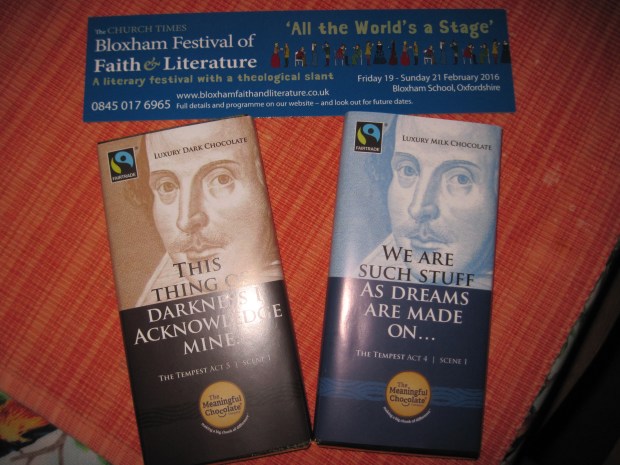
The morning began with an interview with Sarah Perry. Now, I have to admit that I didn’t really get on with her first novel, After Me Comes the Flood. Still, I was intrigued by how she incorporates biblical themes and her religious background in her fiction, so I thought I’d give it a go. Perry herself wasn’t at all as I expected her to be. I’d only ever seen one tiny press photo, in which she had a somewhat tomboyish haircut and had a demurely downcast gaze. So I was pleasantly surprised to find she was voluble, learned, and confident; in a black lacey dress and with loosely pinned hair, she resembled a modern Gibson Girl with a Gothic twist.
Interviewed by the editor of the Church Times newspaper, Perry spoke a bit about her upcoming novel, The Essex Serpent (to be published in the UK by Serpent’s Tail on June 18th), set in 1890s London and an invented village on the Essex marshes. In keeping with the talk’s title, “I would not wish any companion in the world but you,” the book is about friendship, specifically that between a vicar and a widowed amateur naturalist. Inspired by her own relationship with her (male) best friend and by intimate ‘love letters’ she found that passed between friends (like St. Paul to the Philippians and D.H. Lawrence to Jack Murray, or Montaigne writing about his best friend), the novel seeks the goodness in its characters.
The two readings Perry gave were lush, Dickensian descriptions of the City under rain and a drunken man going for a dip in the marsh and seeing what appears to be a sea creature. Perry was surprised when her debut novel was described as Gothic, but she’s embraced the label now: her third book, currently in progress, is full-on Gothic horror. What links all of her work, she thinks, is the Gothic notion of the thing lurking over the shoulder. For Perry, that ever-present threat is Reformation theology: the idea that man is born in sin and deserves damnation. During her Strict Baptist upbringing (which she, not coincidentally, describes as being like living in the 1890s), she was cut off from contemporary culture and influenced primarily by the King James Bible and Foxe’s Book of Martyrs.
Perry spent a short time as a missionary in the Philippines and was a biblical fundamentalist until age 25, when she and her husband (whom she met at 13 and married at 20) left the church. Stepping outside of that limiting community was the impetus she needed to start writing; although she had had stories looping around her head since the age of four, she had rarely written anything down. She completed a creative writing MA and PhD, all while working full time at the Inns of Court.
 After Me Comes the Flood was rejected by 14 publishers; even her viva examiners, who passed her without corrections, were “ungracious,” she remarked. What it comes down to, she thinks, is simply that no one liked the book or knew what to make of it. It seemed unmarketable because it didn’t fit into a particular genre. At this point I was sheepishly keeping my head down, glad that Perry couldn’t possibly know about my largely unfavorable review in Third Way magazine. I confess that my reaction was roughly similar to the general consensus: “Not quite an allegory, [the book] still suffers from that genre’s pitfalls, such as one-dimensional characters,” I wrote.
A glowing Guardian review from poet John Burnside was enough to give Perry confidence to keep going as a novelist, and – having taken forever over writing her first book, an experience she likens to like pulling teeth because she had no idea what she was doing and could rarely overcome her natural laziness – she went on to write The Essex Serpent within just 10 months. And I’m glad she did, because this new book sounds right up my alley.
It will be interesting to see how she imagines a platonic friendship between the sexes in a historical setting, and the Dickensian and Gothic touches, even from the little taster I got, were delicious. I was especially intrigued to learn about her research into the friendship ‘triangle’ (betrayal! early death! forgiveness!) between William Ewart Gladstone, Alfred Tennyson, and Arthur Henry Hallam. Perry said she thinks the tide may be turning, that friendships rather than romantic love could be starting to dominate fiction; perhaps Hanya Yanagihara’s A Little Life from last year would be a good example.
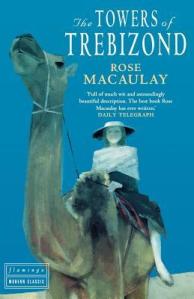
 In the other sessions I attended, a group of clergy revealed the shortlist for the £10,000 Michael Ramsey Prize for theology (to my surprise, I’d read one of the nominees, Unapologetic by Francis Spufford) and panelists introduced a forthcoming anthology of essays on Anglican women novelists from Charlotte Brontë onwards (to be published by Bloomsbury in January 2018). Jane Williams, wife of former archbishop Rowan Williams, will contribute a chapter on Barbara Pym, who obviously loved the Church but also sits at an anthropological distance to poke gentle fun at it. Her novels sound like great fun. Judith Maltby, one of the editors, convinced me that I need to read Rose Macauley’s The Towers of Trebizond (1956), while co-editor Alison Shell made the case for P.D. James’s late inclusion.
 Chaired by contemporary Anglican novelist Catherine Fox, the panel noted two common threads in many of the featured novelists: detective fiction and humor. The striking number of crime novelists (including Dorothy L. Sayers and Ellis Peters), Shell suggested, one might attribute to an Anglican license to moralize or a preoccupation with ‘last things’. Humor, meanwhile, seems to arise from the little hypocrisies inherent to religious life and to the fact that liturgical seriousness can often tilt into comedy. Other repeated themes include the sacraments, the role of the spinster, and class – the clergy are often educated but poor. I came away with a list of authors to try; many of their works are available through Virago reprints.
All in all, it was a terrific, thought-provoking experience for me – a perfect mixture of literature and theology, and a great way to spend a blustery February Saturday.
Better Late than Never: The Goldfinch
And the painting, above his head, was the still point where it all hinged: dreams and signs, past and future, luck and fate. There wasn’t a single meaning. There were many meanings. It was a riddle expanding out and out and out.
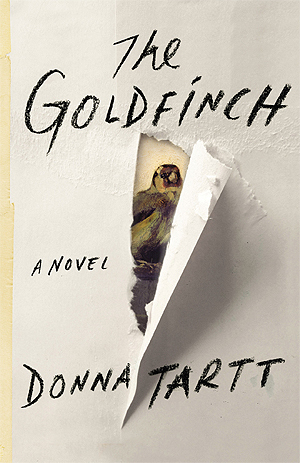 My pristine paperback copy of Donna Tartt’s The Goldfinch cost all of £1 at a used bookshop in Henley. Talk about entertainment value for money! Although it took me nearly a month to read, starting with Christmas week, it was more gripping than that timeframe seems to suggest. I read it under a pair of cats in the bitter-cold first week of a Pennsylvania January, then tucked it under my arm for airport queues (no way would it fit in my overstuffed carry-on bag) and finally finished it during my first week of bouncing back from transatlantic jetlag. Somehow Theo Decker’s fictional travels – from New York to Las Vegas and back; to Amsterdam and home again – blended with my sense of having been on a literal journey with the book to make this one of my most memorable reading experiences in years.
That’s not to say that the book was flawless. In fact, I found the first 200 pages or so pretty slow. You almost certainly know the basics of the plot already, but if not, glance away from the rest of this paragraph. Theo, 13, is separated from his mother during a terrorist attack on a New York City museum. Among the dying he encounters an older man – guardian of the pretty red-haired girl Theo had been checking out just moments before – who gives him a ring and tells him to go to Hobart and Blackwell antiques. But this is not the only souvenir Theo takes from his ordeal; he also steals the little Dutch masterpiece by Fabritius that appears on the book’s cover. Stumbling around the streets of New York, the shell-shocked Theo undoubtedly resembles a 9/11 victim. As the years pass, he is moved from guardian to guardian, but a few things remain constant: his memory of his mother, his obsession with the painting, and his love for Pippa, that red-haired girl who, like him, was among the survivors.
The aftermath of the attack was the most tedious section for me. It felt like it took forever for Theo’s future to be set in motion, and I thought if I heard him complain of how his head was killing him one more time I might just scream. It’s when Theo gets to Vegas, and specifically when he meets Boris, that the book really takes off. Boris is simply a terrific character. He’s lived all over and has a mixed-up accent that’s part Australian with heavy Slavic overtones. Like Theo, he has an unreliable father who is often too drunk to care what his kid is doing. This leaves the two young teens free to do whatever they want, usually something classified as illegal. Indeed, there’s a lot of drug use in this book, described in the kind of detail that makes you wonder what Tartt was up to during her years at Bennington.
As a young man Theo, back in New York, joins Hobie (of Hobart and Blackwell) in selling antiques both genuine and ersatz, and reconnects with an old friend’s family in a surprising manner. The story of what becomes of the painting was in danger of turning into a clichéd crime caper, yet Tartt manages to transform it into a richly philosophical interrogation of the nature of fate. Theo’s intimate first-person narration makes him the heir first of Dickensian orphans and later of the kind of tortured antiheroes you’d find in a nineteenth-century Russian novel: “I had the queasy sense of my own life … as a patternless and transient burst of energy, a fizz of biological static just as random as the street lamps flashing past.”
Similar to my experience with Of Human Bondage, I found that the latter part of the novel was the best. The last 200 pages are not only the most addictive plot-wise but also the most introspective; all my Post-It flags congregate here. It’s also full of the best examples of Tartt’s distinctive prose. The best way I can describe it is to say it’s like brush strokes: especially in the scenes set in Amsterdam, she’s creating a still life with words. Often this is through sentences listing images, in phrases separated by commas. Here’s a few examples:
Floodlit window. Mortuary glow from the cold case. Beyond the fog-condensed glass, trickling with water, winged sprays of orchids quivered in the fan’s draft: ghost-white, lunar, angelic.
Out on the street: holiday splendor and delirium. Reflections danced and shimmered on black water: laced arcades above the street, garlands of light on the canal boats.
Medieval city: crooked streets, lights draped on bridges and shining off rain-peppered canals, melting in the drizzle. Infinity of anonymous shops, twinkling window displays, lingerie and garter belts, kitchen utensils arrayed like surgical instruments, foreign words everywhere…
Such sentence construction shouldn’t work, yet it does. I’ve never been one to fawn over Donna Tartt, but this is writing I can really appreciate.
[I did take issue with some of the punctuation in the novel, though whether that’s down to Tartt, her editor or the UK publication team I couldn’t say. Take, for instance, this description of a station clerk: “a broad, fair, middle aged woman, pillowy at the bosom and impersonally genial like a procuress in a second rate genre painting.” Another solid allusion to Dutch art, but missing two hyphens if you ask me.]
The Goldfinch contains multitudes. It’s the Dickensian coming-of-age tale of a hero much like David Copperfield who’s “possessed of a heart that can’t be trusted.” It’s a realist record of criminal escapades. It’s a story of unrequited love. It’s a convincing first-hand picture of anxiety, addiction and regret. It has a great road trip, an endearing small dog, and a last line that rivals The Great Gatsby’s (I’ll leave you to experience it for yourself). It’s a meditation on time, fate and the purpose of art. It’s not perfect, and yet I – even as someone who pretty much never rereads books – can imagine reading this again in the future and gleaning more with hindsight. That makes it worthy of one of my rare 5-star recommendations.
Caring too much for objects can destroy you. Only—if you care for a thing enough, it takes on a life of its own, doesn’t it? And isn’t the whole point of things—beautiful things—that they connect you to some larger beauty? Those first images that crack your heart wide open and you spend the rest of your life chasing, or trying to recapture, in one way or another?
My rating:
Of Human Bondage: Finally Caught Up from 2015
When it came to it, it isn’t me
was all he seemed to learn
from all his diligent forays outward.
(from “It Isn’t Me” by James Lasdun)
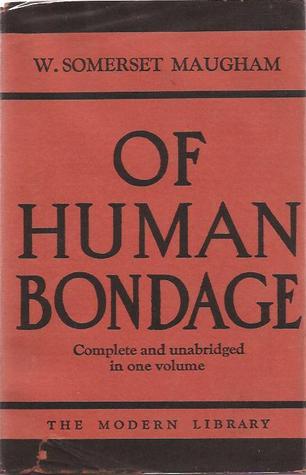
I chose to read this doorstopper from 1915 because it appeared in The Novel Cure on a list entitled “The Ten Best Novels for Thirty-Somethings.” By happy accident, I was also reading it throughout its centenary year. My knowledge of W. Somerset Maugham’s work was limited – I had seen the 2006 film version of The Painted Veil but never read anything by him – so I had no clear idea of what to expect. I was pleased to encounter a narrative rich with psychological insight and traces of the Victorian novel.
 Philip Carey is not unlike a Dickensian hero: born with a club foot and orphaned as a child, he’s raised by his stern vicar uncle in Kent and reluctantly attends boarding school. Much of the book is filled with his post-schooling wanderings and professional shilly-shallying, along with multiple romantic missteps. He studies in Germany, tries to make it as a painter in Paris, and returns to London to train as an accountant and then as a doctor. Each attempted career seems to fail, as does every relationship. Philip reminded me most of David Copperfield, especially after he meets the jolly, Micawber-esque Thorpe Athelny during his hospital internship and becomes friendly with his wife and children.
As is common in Victorian novels, Philip is troubled by his conflicting desires. When it comes to women, he cannot get love to match up with lust. As a youth he loses his virginity to Emily Wilkinson, a woman in her mid-30s, then wants nothing to do with her. A few other dalliances have mixed success, but the novel focuses on Philip’s connection to Mildred Rogers. A café waitress, she’s vain and ill-tempered and acts indifferent to Philip – but is happy for him to spend money on her. He’s disgusted and infatuated all at once: “He did not care if she was heartless, vicious and vulgar, stupid and grasping, he loved her. He would rather have misery with [her] than happiness with [another].” Though Mildred tries to eschew the traditional roles of wife and mother, the Victorian notion of the fallen woman haunts her.
This on-again, off-again romance forms the heart of the book. Both Philip and Mildred are maddening in their own way. Not since Pip (another Philip, interestingly) in Great Expectations have I been so furious at a main character for consistently making the wrong choices, being dazzled by beauty and status and ignoring the more important things in life. Yet the close third-person narration sees so deeply into Philip’s psyche that I could not help but feel sympathy for him, too, cringing over his every failure – especially when stock market losses leave him destitute and he undertakes humiliating (to him) work at a department store. The novel is liberally studded with intimate paragraphs conveying Philip’s thoughts:
He painted with the brain, and he could not help knowing that the only painting worth anything was done with the heart. … [H]e had a terrible fear that he would never be more than second-rate. Was it worth while for that to give up one’s youth, and the gaiety of life, and the manifold chances of being?
Pain and disease and unhappiness weighed down the scale so heavily. What did it all mean? He thought of his own life, the high hopes with which he had entered upon it, the limitations which his body forced upon him, his friendlessness, and the lack of affection which had surrounded his youth. He did not know that he had ever done anything but what seemed best to do, and what a cropper he had come! Other men, with no more advantages than he, succeeded, and others again, with many more, failed. It seemed pure chance. The rain fell alike upon the just and upon the unjust, and for nothing was there a why and a wherefore.
Another humanizing element that especially appealed to me was Philip’s loss of Christian faith. During my study abroad year and especially my master’s year at Leeds, when I wrote a dissertation on women’s loss-of-faith narratives in Victorian fiction, I read a lot of novels about belief and doubt. In Philip’s case, I was interested to see how Maugham portrays what is usually seen as a loss as more of a liberation:
Suddenly he realised that he had lost also that burden of responsibility which made every action of his life a matter of urgent consequence. He could breathe more freely in a lighter air. He was responsible only to himself for the things he did. Freedom! He was his own master at last. From old habit, unconsciously he thanked God that he no longer believed in Him.
Although Philip frequently indulges in self-pity, he also has moments where he wakes up to the wonder of life. These epiphanies of the beauty of London, of the whole world, were among my favorite scenes.
Unusually in a long book, I thought the last 150 pages were the strongest. I struggled to pay attention throughout Philip’s schooling and wearied of the endless negotiations with Mildred, but when Philip is at his lowest point – like the protagonist of Knut Hamsun’s Hunger, not even sure if he’ll find enough to eat – there’s a real intensity to the plot that made this last chunk fly by.
I read a 1930s Modern Library copy from the University of Reading, but consulted Robert Calder’s introduction to the 1992 Penguin Classics edition for background information. It seems the novel was recognizably autobiographical for Maugham, though where a club foot was Philip’s source of shame, for the author it was his stammer (and his sexuality – he married but is known to have been a homosexual).
Like Joyce’s roughly contemporary A Portrait of the Artist as a Young Man, Calder notes, Of Human Bondage fits into the “apprentice novel” genre. Despite being published in 1915, it is set in a recent past so makes no reference to the First World War, though the Boer War plays a background role. I didn’t find the book to be particularly dated; I even discovered that a couple of sayings I might have pegged as later inventions were around in the 1910s: “like it or lump it” and “put that in your pipe and smoke it.”
Of Human Bondage met with a lukewarm critical response in its own time but does seem to be among the more beloved – if obscure – classics nowadays. Calder insists that it “remains Maugham’s most complete statement of the importance of physical and spiritual liberty.”
There have been three film versions – and another is in production this year, apparently. The best known, from 1934, launched the career of Bette Davis, who gave it her all as Mildred Rogers (she was a write-in favorite for the Oscars that year). Overacting, for sure, but her blonde wave and simpering looks were perfect for the role. By contrast, Leslie Howard’s is a fairly subtle Philip. The movie – condensed, amazingly, to just over an hour and a half – focuses on his club foot and his relationship with Mildred; I was disappointed that no attempt was made to reproduce Philip’s introspective monologues through voiceovers.
To my surprise, Calder asserts that Of Human Bondage “has become one of the most widely read of modern novels, particularly by young people, who still find relevance in Philip’s struggle for a free and meaningful life.” It was good enough for Holden Caulfield, after all. It struck me during my reading that two recent novels may have taken inspiration from Maugham: the main character in Esther Freud’s Mr. Mac and Me, set in 1914, has a club foot; and in Hanya Yanagihara’s A Little Life Jude’s shame over his deteriorating physical condition, especially his legs, is reminiscent of Philip’s.
I’m not sure I’ll try anything else by Maugham – how could I when there’s still so much of Dickens and Hardy left to read? – but I’m certainly glad I read this. It’s clear why Berthoud and Elderkin thought Of Human Bondage would be a perfect read for someone in their 30s: it’s infused with the protagonist’s nostalgia for his youth and regret at opportunities not taken and time lost. The novel imagines a world where, even without a god pulling a string, some misfortune seems to be fated. Even so, free will is there, allowing you to recover from failure and try something new that will be truer to yourself in this one and only life.
My rating: 
 Bookish Beck = Rebecca Foster. American transplant to England. Freelance proofreader and book reviewer.
 Bookish Beck