Love and Lust: Four Books for Valentine’s Day
Got any romantic plans for the morrow? I’ll be having my first of six evening yoga classes at our local Waitrose (was a more middle-class phrase ever written?!), but I’ve been promised a nice dinner with dessert on my return.
Like last year, I’ve been reading a few books with “love” in the title – plus one featuring “lust” this time – in advance of the day and can report back on what I’ve gleaned. Nothing particularly optimistic about marriage or true love, I’m afraid.

Lust in Translation: Infidelity from Tokyo to Tennessee by Pamela Druckerman (2007)
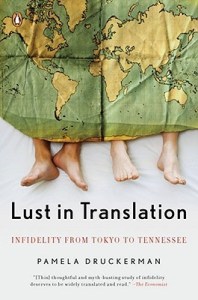 Druckerman travels from France (where she lives) to the United States, Russia, Japan, South Africa, Indonesia and China, interviewing professionals and anonymous adulterers and pondering what makes people cheat and what difference country of origin makes. Boiling it down, people in poor countries, even in parts of Africa where AIDS is a huge threat, are more likely to have multiple sexual partners than those in wealthy countries. Statistically speaking, there’s also a slight bias towards adultery in warmer countries. However, some factors that you might expect to have a big effect on the adultery rate, like religiosity (e.g. America vs. France), actually hardly do. What does differ is the level of guilt experienced over infidelity and its concomitant offense, lying. In places like France and Japan she discovers more of a don’t-ask-don’t-tell attitude: as long as the straying partner is discreet enough not to be caught, the other turns a blind eye.
Travel-based quest narratives like this usually have a personal element that helps to anchor a book. The other direction Druckerman might have taken would be a straightforward academic study, which her journalistic tone wouldn’t suit. Because this book hovers between genres/levels of discourse, it didn’t quite work for me, but if you think you might find the subject matter interesting it’s at least worth skimming.
A representative line:
“The pursuit of happiness, or true love, is one of the most salient stories that Americans use to justify affairs and overcome their moral qualms about cheating.”
My rating: 
Loving Frank by Nancy Horan (2007)
 Even if you don’t have any particular interest in architect Frank Lloyd Wright, this carefully crafted and lovingly written historical novel is well worth reading. Mamah (“May-muh”) Borthwick Cheney and her husband Edwin hired Wright to design their suburban Chicago home in 1903, and in 1907 she and Wright embarked on an affair. The novel covers roughly the next seven years of their lives, and is particularly illuminating about relationships, the rights of women and the morality code of the time. Through Mamah’s eyes Horan shows just why this affair was irresistible: “Frank Lloyd Wright was a life force. He seemed to fill whatever space he occupied with a pulsing energy that was spiritual, sexual, and intellectual all at once.” But in the eyes of the public, and of their families, it was a selfish choice that left her two children adrift. Beside Mamah, Catherine Wright was held up as a paragon of fidelity, waiting patiently for Frank to come back to her and their seven children.
If you think you are at all likely to read this book, DO NOT GOOGLE Mamah Borthwick Cheney, or Frank Lloyd Wright’s life in these years. I’m now keen to compare this with T.C. Boyle’s The Women, which is about Catherine, Mamah and two other important female figures in Frank Lloyd Wright’s life.
A representative passage:
“Does that mean I have to play this hand to the bitter end, full of regret? Knowing I might have had the happiest life imaginable with the one man I love more than any other I have ever known?”
My rating: 
I Love Dick by Chris Kraus (1997)
 This is one of the stranger novels I’ve ever read. It’s December 1994 and failed filmmaker Chris Kraus, 39, and her husband, 56-year-old professor Sylvère Lotringer, spend a night at the home of Dick, one of his California colleagues, to mark the end of Sylvère’s sabbatical. When they wake up the next morning Dick is gone, but he’s made a huge impression on Chris. She decides she and Dick have had something like D.H. Lawrence’s ‘sex in the head’, and becomes obsessed with him. Chris and Sylvère address reams of letters and journal entries to Dick. Some they send and some they don’t; Dick is a total blank, which allows the couple to build fantasies around him. It’s a chance for Chris to reimagine a life that’s gotten away from her and regain her voice.
I preferred Part 1, which I found quite funny. Kraus lost me a bit in Part 2, with a trip to Guatemala plus random exhibits and performance art. I think the whole thing would have been more effective at novella length. But it’s intriguing how it blends fact and fiction (Dick Hebdige is a real person, and apparently not happy about the invasion of his privacy) and adapts the epistolary form. An afterword by Joan Hawkins notes the similarity to Dangerous Liaisons, in which a couple exchange letters about a seduction plot.
A representative passage:
“Dear Dick,
No woman is an island-ess. We fall in love in hope of anchoring ourselves to someone else, to keep from falling,
Love,
Chris”
My rating:
The Pursuit of Love by Nancy Mitford (1945)
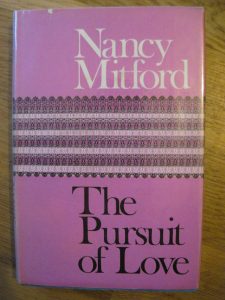 Last year I unwittingly read the 1949 sequel, Love in a Cold Climate, first. I rather enjoyed that one, but somehow wasn’t in the mood for Mitford this time around, and ended up just skimming this one. Once again Fanny traces the love life of one of her posh cousins. This time it’s Linda Radlett, whose two marriages – to a Conservative and a Communist – are doomed to failure. Then she finds her true love, too late. I liked the ball scene, and the image of Uncle Matthew using his bloodhounds to hunt down his children. Mitford mixes the lighthearted and the caustic in an amusing way. The last two pages of this novel turn particularly nasty, though, which made me wonder how people can call this a comfort read.
A representative passage:
“What we would never admit was the possibility of lovers after marriage. We were looking for real love, and that could only come once in a lifetime; it hurried to consecration, and thereafter never wavered. Husbands, we knew, were not always faithful, this we must be prepared for, we must understand and forgive.”
My rating:
Have you read anything love-ly lately?
Five Things I Loved about the BBC War & Peace Miniseries
As soon as I got back from the States in January, my husband and I rushed to catch up on the BBC’s War & Peace miniseries. It’s the latest costume drama from screenwriter Andrew Davies, who is behind many favorite literary adaptations, including Bleak House (2005). I enjoyed War & Peace much more than I expected to given my utter unfamiliarity with Russian literature. I can’t comment on how well the miniseries captures Tolstoy’s plot or tone; my response is just that of a literature lover who appreciates gripping television. (My understanding is that this has already shown in North America too, on various networks, but for those who haven’t watched it and still plan to, I’ll avoid spoilers in what follows.)
![Natasha Rostova's first ball, Leonid Pasternak [Public domain], via Wikimedia Commons.](https://commons.wikimedia.org/wiki/File:%D0%A0%D0%BE%D1%81%D1%82%D0%BE%D0%B2%D0%B0_%D0%BF%D0%B0%D1%81%D1%82%D0%B5%D1%80%D0%BD%D0%B0%D0%BA.jpeg)
Natasha Rostova’s First Ball, Leonid Pasternak [Public domain], via Wikimedia Commons.
2. The superb casting. At first it seemed strange to see Paul Dano, an indie movie favorite, in a TV role, but I quickly saw why he was just right for the part of earnest, indecisive Count Pierre Bezukhov. An illegitimate son who wants to live a meaningful life but keeps falling into dissolute behavior, Pierre unexpectedly inherits his father’s fortune and marries the wrong woman, yet turns personal disappointment to the good when he devotes himself to serving his fellow man through the Masons. With his little smile, deliberate speech and round glasses, Dano is perfect.
Initially Lily James, as Natasha Rostova, seems to be just like her bubbly, flirtatious Downton Abbey character, Lady Rose, but suffering and regret chasten her. I also loved Jim Broadbent as irascible Prince Nikolai Bolkonsky and Adrian Edmondson (especially with his fez and other assorted headgear) as the Micawber-ish Count Ilya Rostov. Callum Turner and Tuppence Middleton as Anatole Kuragin and Hélène Kuragina are a skeevy, scheming brother-and-sister pair worthy of Dangerous Liaisons.
3. The authentic settings. The series was filmed on location in Latvia, Lithuania, and Russia, including at the Catherine Palace outside St. Petersburg. It makes a difference to know this wasn’t shot in a London studio; the dachas, Orthodox churches and snowy vistas are all genuine.
4. The action scenes. The CGI crowd shots are unconvincing, but the up-close battle scenes are excellent: bombs, bayonets, amputations and all. Seeing one battle, Borodin, partially from Pierre’s viewpoint is an especially effective way of contrasting civilian life with soldiers’ daily reality.
5. The philosophical depth. I should have known what I was in for from a Russian novel, but I was startled afresh each time a character paused to stare death in the face or to question what his or her life was heading towards and consider how to change course. There are beautifully symbolic moments of forgiveness between separated sweethearts or former rivals. Another highlight is when Pierre, the rich count temporarily laid low, connects with a peasant and his dog. He even learns how to eat mindfully.
Now for something I didn’t like: with the mixture of cut-glass British and toned-down American accents, you’d be forgiven for thinking this takes place in an English-speaking country. It takes characters singing folk songs in Russian, wearing bearskin hats and participating in Orthodox rituals to remind you that, oh yeah, this is Russia. I’m not saying I wish the actors had all spoken in heavy Slavic accents, but especially after an extended period in a refined drawing room, it can be jolting to see onion domes and Cossack uniforms.
I’m not sure if I’ll ever read War & Peace; I have a feeling that, like Moby-Dick (an assigned book I never made it all the way through in college), it could have done with an editor. Even though I adore Tolstoy’s storyline and characters, I don’t think I’d have patience for long passages of historical exposition. Moreover, Philip Hensher (in a Guardian reader’s guide) thinks War & Peace has the worst opening and closing lines in literature. Actually reading the Russian masters can wait for another time.
For now, I’m happy to have seen this top-notch adaptation. In just six hours of television, Davies and director Tom Harper brought an epic world classic into vibrant life, full of romance, betrayal, sacrifice and redemption.
My rating: 
If you’ve already seen War & Peace and are interested in reading more about it, this appreciation piece by Clive James in the Guardian is great (but spoilers abound). See also this interview with Andrew Davies.
Have you seen the miniseries? If so, what did you think? I’m particularly interested to hear how it matched up to the book if any of you are familiar with both.
 Bookish Beck = Rebecca Foster. American transplant to England. Freelance proofreader and book reviewer.
 Bookish Beck