Spring Reading, Part II: Helen Bain, Stephen King & Ivan Turgenev
When I posted for the first day of spring, I noted that it was already like early summer in the UK. Today it feels like summer is here to stay. After an April with just 18% of normal rainfall, our pond is looking half-empty. It was a surprisingly chilly mid-May, but really hot weather (low 30s C / high 80s F) is moving in just in time for the bank holiday weekend. Myriad insects find a haven in our lush, unmowed garden full of trees, wildflowers and so-called weeds. Benny is closely supervised on his three or four daily walks in this garden jungle. I love to see swifts wheeling through the sky, but I’d happily sacrifice the sun to get some more rain.
My three selections for this batch of seasonal reading are an excellent forthcoming novel about Sylvia Plath, a historical novella that’s become well known through the movie version, and obscure Russian classics about infatuations that end in heartbreak.
The Daffodil Days by Helen Bain
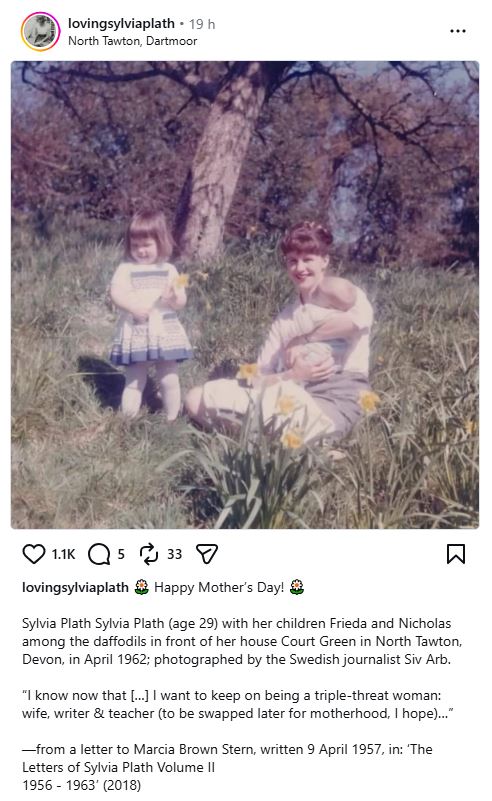
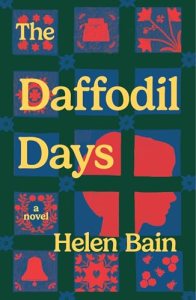 (A quick preview as my full review will be published on Shelf Awareness next month.) A bit of background: Ted Hughes and Sylvia Plath moved from London to Court Green, a thatched house with two and a half acres of land in North Tawton, Devon (southwest England) in August 1961. They had separated and each moved into lodgings in London – her with their two children – by December 1962, with Plath vowing to return to her beloved house and garden in the spring. Instead, she died by suicide in February 1963. This debut novel covers much of the last 18 months of Plath’s life, but in an inventive way: 16 linked short stories – each from the perspective of a different writer friend, family member, or local acquaintance – illuminate Plath’s personality and state of mind through the interactions they have with her. It’s everyone from her midwife to a washing machine salesman. We learn not just about Plath but also the norms of the time, e.g. through young women she meets at a dress shop and in a BBC recording studio. There are also glimpses into her literary milieu through a visit from Al Alvarez and reminiscences from the Kanes and Merwins. The title refers to her garden’s daffodils, so bountiful that she sells them, which strikes her neighbours as a typically American act of crass gumption. The really genius thing about this structure is that the vignettes go backward in time, so we aren’t approaching her inevitable end but anticipating her prime. Bain’s prose reminds me of Tessa Hadley and Andrew Miller. (Edelweiss)
Rita Hayworth and Shawshank Redemption by Stephen King (1982)
 This novella was published in Different Seasons under the heading “Hope Springs Eternal.” You probably know the story better through the 1994 film The Shawshank Redemption.
“They found him guilty, and brother, if Maine had the death penalty, he would have done the airdance before that spring’s crocuses poked their heads out of the dirt.”
Andy Dufresne was wrongfully imprisoned for the murder of his wife and her lover in 1947. While he bides his time until the workings of justice or his own spectacular efforts can get him free, he makes himself useful as the prison librarian and an unofficial financial advisor (he was a banker back in the real world). He fights back against attempted sexual assaults, too. The narrator, Red, can get anyone anything on the black market, and Andy has made two very specific requests over the years: a rock hammer to continue his geology hobby, and a poster of Rita Hayworth to hang in his cell – replaced in turn, as years stretch into nearly three decades, by Marilyn Monroe, Jayne Mansfield, Raquel Welch, and Linda Ronstadt. All along, the hope of there being a life away from this place keeps Andy, and Red, going. Even though I knew what happened thanks to the movie, this was a quick, amusing, and heartening read. I’ll probably go on to read the other three in the omnibus. (Little Free Library) 
The Torrents of Spring (& First Love & “Mumu”) by Ivan Turgenev (1871; 1860; 1854)
[Translated from Russian by Constance Garnett]
 I’ve found Turgenev to be a particularly readable Russian master whose novels are short and accessible enough as to not be daunting (unlike Dostoevsky, Tolstoy and the like, who I’ve never attempted). I had a bit of confusion over this on, not realising my download included the novella First Love and the short story “Mumu” as well, so The Torrents of Spring ended sooner than I expected. It’s said to be highly autobiographical, but I haven’t looked into the links with Turgenev’s life. Twenty-two-year-old landowner Dimitri Sanin is in Frankfurt as part of a world tour. By chance, he rescues young Emil from a swoon and meets his family of Italian confectioners. Captivated by Emil’s sister Gemma’s simple beauty, he fights a duel to defend her honour and gets her to give up her tedious German fiancé for him. His plan is to stay and remotely sell his estate (complete with serfs) to a fellow Russian abroad – the wife of Polozov, a man he happens to know from childhood. But, as in Dangerous Liaisons, Maria Nikolaevna is a seductive schemer who steals his gaze away from Gemma just because she can. This was a gently Hardyesque tragicomedy about what’s fated versus the decisions and weaknesses that change everything. Turgenev explores what happens when money, love and lust don’t align, and leaves us with the aura of inevitable regret.
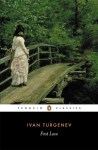 The other two stories share that theme of capricious women. In First Love, sixteen-year-old Vladimir Petrovich is one of many suitors vying for the affections of his next-door neighbour, the young princess Zinaïda. He’s so smitten that when she says jump, he basically asks how high (and it ends up being 15 feet down from a wall). There’s an unexpected twist in this one that makes you question the young man’s family dynamic. The message can be summed up by the advice he’s given by another suitor: “The great thing is to lead a normal life, and not be the slave of your passions.” I was interested to note in both novellas that French is spoken as a marker of the upper classes.
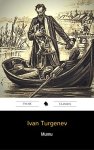 “Mumu” started off promising, but I should know by now that when an animal is a central character in a classic work, it’s not going to go well. Mumu is a spaniel rescued by Gerasim, a giant deaf-mute man who labours on an old woman’s estate. His mistress observes that he’s sweet on Tatiana the laundress and quashes that budding relationship, at which point Mumu enters his life as a sort of replacement. Mumu is utterly devoted to him and suspicious of anyone else – including the mistress, who soon makes it her mission to silence the barking dog. It’s all disappointingly conventional and I wished it could have been otherwise, but I guess Turgenev, like so many other 19th-century authors – Dickens, Flaubert – felt duty-bound to keep women and peasants in their place.
  (Project Gutenberg)
20 Books of Summer, 8: Au Revoir, Tristesse by Viv Groskop
This is a substitute I picked out as a potential (now belated) #ParisinJuly2025 contribution. There’s been little time for writing over the past week while we’ve been hosting my sister and brother-in-law. Their whirlwind trip was shortened by a day due to a cancelled flight from the States, but we managed to pack in a lot, including a two-night mini-break down in Devon.

Reminiscent of Something to Declare by Julian Barnes and How Proust Can Change Your Life by Alain de Botton, this is a lighthearted tour through a dozen great works of French literature and the lessons they might offer modern readers on how to live well. Ever since her school days of studying French and spending every family holiday in France, Groskop has been obsessed with the language and culture. In most of the chapters, she undertakes a rereading of a novel she first read as a teenager or Cambridge student, marveling at how much more she gets out of it with greater life experience.
 Although her choices are indisputable classics, she acknowledges they can only ever be an incomplete and biased selection, unfortunately all white and largely male, though she opens with Bonjour Tristesse and also includes Colette and Duras novels. I’d only read three of her dozen, in translation: along with the Sagan, Dangerous Liaisons and Madame Bovary (as well as other books by two of the additional authors), but it didn’t make much difference whether I was familiar with a plot or not. So long as one is not allergic to spoilers, it’s possible to enjoy these miniature essays’ witty combination of literary criticism, biographical information, self-help messaging, and a bit of autobiographical context.
The male writers tended to be syphilitic workaholics – Balzac is reputed to have drunk 50 cups of coffee per day to sustain his output – while the women flouted social conventions by drinking, taking much younger (and/or female) lovers and driving recklessly. While the subtitle promises “Lessons in Happiness,” from Hugo to Camus these are in fact pretty miserable narratives in which, as was especially common in the 19th century, protagonists are punished for ambition or transgressions, or never reach contentment because of self-delusion.
In boiling down each plot to one line of advice for a chapter title, Groskop’s tone alternates between earnest (“Our greatest weaknesses conceal our greatest strengths” = Cyrano de Bergerac) and tongue in cheek (“Social climbing rarely pays off, but you’ll probably want to do it anyway” = Le Rouge et le Noir). She describes the works with genuine affection and clearly believes they are still worth reading, yet isn’t afraid to question those aspects that have aged less well. Controversially, she suggests being selective with Proust’s mammoth oeuvre: “skim-read, rereading the passages you fall in love with and discarding the rest.” She also surveys how the stories live on through adaptations. Of the new-to-me, I’m most drawn to Bel-Ami but also fancy La Cousine Bette. This was a delight I wouldn’t hesitate to recommend to fellow Francophiles. (New purchase – remainder from Hay Cinema Bookshop) 

Six Degrees of Separation: From Fleishman Is in Trouble to Shotgun Lovesongs
I’ve not participated in Kate’s Six Degrees of Separation meme before, although I’d seen it around on other people’s blogs. I think all this time I’d misunderstood, assuming that you had to go from the start point to one particular end point. Instead, bloggers are given one book to start with and then have free rein to link it to six other books in whatever ways. Most of the fun is in seeing the different directions and destinations people choose. I am always drawing connections between books I read and noting coincidences (e.g., my occasional Book Serendipity posts), so this is a perfect meme for me! I’m very late in posting this month – for a while I was stuck on link #4 – but next month I’ll be right on it.

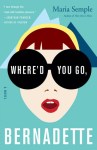
#1 Fleishman Is in Trouble by Taffy Brodesser-Akner: I didn’t care for this debut novel about a crumbling marriage and upper-middle-class angst in contemporary New York City. A major plot point is the mother going missing, just like in Where’d You Go, Bernadette by Maria Semple, a very pleasing epistolary novel I read in 2013.

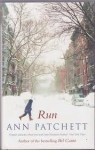 #2 There’s also an absent Bernadette in Run by Ann Patchett (2007), which opens with a killer line: “Bernadette had been dead two weeks when her sisters showed up in Doyle’s living room asking for the statue back.” (Alas, I abandoned the novel after 80 pages; it has a lot of interesting elements, but they don’t seem to fit together in the same book.)
#3 Ann Patchett wrote for Seventeen magazine for nine years. Before she ever published a novel, Meg Wolitzer was a winner of Seventeen’s fiction contest. Wolitzer’s The Wife (2003), my current book club read in advance of our March meeting, is a bitingly funny novel narrated by a woman trapped in a support role to her supposedly genius writer husband.
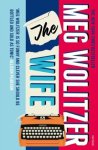

#4 I’ve heard great things about the recent film version of The Wife, which has Glenn Close as Joan Castleman. Close also stars as the Marquise de Merteuil in Dangerous Liaisons (1988). The 1782 Choderlos de Laclos novel was one of the texts we focused on in one of my freshman college courses, Screening Literature. For our final projects, we compared a few film adaptations. My group got Cruel Intentions (1999), a teen flick that provided one of Reese Witherspoon’s breakout roles.
#5 Witherspoon is giving Oprah a run for her money with her Hello Sunshine book club, which has chosen some terrific stuff. I happen to have read nine of her picks so far, and of those I particularly enjoyed Daisy Jones and the Six by Taylor Jenkins Reid.
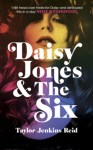

#6 Daisy is said to have been inspired by the personal and professional complications of the band Fleetwood Mac. The musical roman à clef element isn’t necessary to understanding the novel, but is fun to ponder. In the same way, Shotgun Lovesongs by Nickolas Butler features a musician modeled after singer/songwriter Bon Iver. I adored Shotgun Lovesongs and have a review of it coming out as part of Friday’s post, so consider this your teaser…
And there we have it! My first ever #6Degrees of Separation.
Have you read any of my selections? Are you tempted by any you didn’t know before?
Love and Lust: Four Books for Valentine’s Day
Got any romantic plans for the morrow? I’ll be having my first of six evening yoga classes at our local Waitrose (was a more middle-class phrase ever written?!), but I’ve been promised a nice dinner with dessert on my return.
Like last year, I’ve been reading a few books with “love” in the title – plus one featuring “lust” this time – in advance of the day and can report back on what I’ve gleaned. Nothing particularly optimistic about marriage or true love, I’m afraid.

Lust in Translation: Infidelity from Tokyo to Tennessee by Pamela Druckerman (2007)
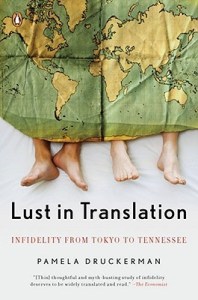 Druckerman travels from France (where she lives) to the United States, Russia, Japan, South Africa, Indonesia and China, interviewing professionals and anonymous adulterers and pondering what makes people cheat and what difference country of origin makes. Boiling it down, people in poor countries, even in parts of Africa where AIDS is a huge threat, are more likely to have multiple sexual partners than those in wealthy countries. Statistically speaking, there’s also a slight bias towards adultery in warmer countries. However, some factors that you might expect to have a big effect on the adultery rate, like religiosity (e.g. America vs. France), actually hardly do. What does differ is the level of guilt experienced over infidelity and its concomitant offense, lying. In places like France and Japan she discovers more of a don’t-ask-don’t-tell attitude: as long as the straying partner is discreet enough not to be caught, the other turns a blind eye.
Travel-based quest narratives like this usually have a personal element that helps to anchor a book. The other direction Druckerman might have taken would be a straightforward academic study, which her journalistic tone wouldn’t suit. Because this book hovers between genres/levels of discourse, it didn’t quite work for me, but if you think you might find the subject matter interesting it’s at least worth skimming.
A representative line:
“The pursuit of happiness, or true love, is one of the most salient stories that Americans use to justify affairs and overcome their moral qualms about cheating.”
My rating: 
Loving Frank by Nancy Horan (2007)
 Even if you don’t have any particular interest in architect Frank Lloyd Wright, this carefully crafted and lovingly written historical novel is well worth reading. Mamah (“May-muh”) Borthwick Cheney and her husband Edwin hired Wright to design their suburban Chicago home in 1903, and in 1907 she and Wright embarked on an affair. The novel covers roughly the next seven years of their lives, and is particularly illuminating about relationships, the rights of women and the morality code of the time. Through Mamah’s eyes Horan shows just why this affair was irresistible: “Frank Lloyd Wright was a life force. He seemed to fill whatever space he occupied with a pulsing energy that was spiritual, sexual, and intellectual all at once.” But in the eyes of the public, and of their families, it was a selfish choice that left her two children adrift. Beside Mamah, Catherine Wright was held up as a paragon of fidelity, waiting patiently for Frank to come back to her and their seven children.
If you think you are at all likely to read this book, DO NOT GOOGLE Mamah Borthwick Cheney, or Frank Lloyd Wright’s life in these years. I’m now keen to compare this with T.C. Boyle’s The Women, which is about Catherine, Mamah and two other important female figures in Frank Lloyd Wright’s life.
A representative passage:
“Does that mean I have to play this hand to the bitter end, full of regret? Knowing I might have had the happiest life imaginable with the one man I love more than any other I have ever known?”
My rating: 
I Love Dick by Chris Kraus (1997)
 This is one of the stranger novels I’ve ever read. It’s December 1994 and failed filmmaker Chris Kraus, 39, and her husband, 56-year-old professor Sylvère Lotringer, spend a night at the home of Dick, one of his California colleagues, to mark the end of Sylvère’s sabbatical. When they wake up the next morning Dick is gone, but he’s made a huge impression on Chris. She decides she and Dick have had something like D.H. Lawrence’s ‘sex in the head’, and becomes obsessed with him. Chris and Sylvère address reams of letters and journal entries to Dick. Some they send and some they don’t; Dick is a total blank, which allows the couple to build fantasies around him. It’s a chance for Chris to reimagine a life that’s gotten away from her and regain her voice.
I preferred Part 1, which I found quite funny. Kraus lost me a bit in Part 2, with a trip to Guatemala plus random exhibits and performance art. I think the whole thing would have been more effective at novella length. But it’s intriguing how it blends fact and fiction (Dick Hebdige is a real person, and apparently not happy about the invasion of his privacy) and adapts the epistolary form. An afterword by Joan Hawkins notes the similarity to Dangerous Liaisons, in which a couple exchange letters about a seduction plot.
A representative passage:
“Dear Dick,
No woman is an island-ess. We fall in love in hope of anchoring ourselves to someone else, to keep from falling,
Love,
Chris”
My rating:
The Pursuit of Love by Nancy Mitford (1945)
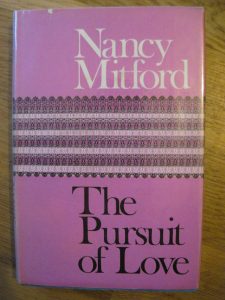 Last year I unwittingly read the 1949 sequel, Love in a Cold Climate, first. I rather enjoyed that one, but somehow wasn’t in the mood for Mitford this time around, and ended up just skimming this one. Once again Fanny traces the love life of one of her posh cousins. This time it’s Linda Radlett, whose two marriages – to a Conservative and a Communist – are doomed to failure. Then she finds her true love, too late. I liked the ball scene, and the image of Uncle Matthew using his bloodhounds to hunt down his children. Mitford mixes the lighthearted and the caustic in an amusing way. The last two pages of this novel turn particularly nasty, though, which made me wonder how people can call this a comfort read.
A representative passage:
“What we would never admit was the possibility of lovers after marriage. We were looking for real love, and that could only come once in a lifetime; it hurried to consecration, and thereafter never wavered. Husbands, we knew, were not always faithful, this we must be prepared for, we must understand and forgive.”
My rating:
 Bookish Beck = Rebecca Foster. American transplant to England. Freelance proofreader and book reviewer.
