Three on a Theme: English Gardeners (Bradbury, Laing and Mabey)
These three 2024 releases share a passion for gardening – but not the old-fashioned model of bending nature to one’s will to create aesthetically pleasing landscapes. Instead, the authors are also concerned with sustainability and want to do the right thing in a time of climate crisis (all three mention the 2022 drought, which saw the first 40 °C day being recorded in the UK). They seek to strike a balance between human interference and letting a site go wild, and they are cognizant of the wider political implications of having a plot of land of one’s own. All three were borrowed from the public library. #LoveYourLibrary
One Garden against the World: In Search of Hope in a Changing Climate by Kate Bradbury
Bradbury is Wildlife Editor of BBC Gardeners’ World Magazine and makes television appearances in the UK. She’s owned her suburban Brighton home for four years and has tried to turn its front and back gardens into havens, however small, for wildlife. The book covers April 2022 to June 2023, spotlighting the drought summer. “It’s about a little garden in south Portslade and one terrified, angry gardener.” Month by month, present-tense chapters form not quite a diary, but a record of what she’s planting, pruning, relocating, and so on. There is also a species profile at the end of each chapter, usually of an insect (as in the latest Dave Goulson book) – she’s especially concerned that she’s seeing fewer, yet she’s worried for local birds, trees and hedgehogs, too.
Often, she takes matters into her own hands. She plucks caterpillars from vegetation in the path of strimmers in the park and raises them at home; protects her garden’s robins from predators and provides enough food so they can nest and raise five fledglings; undertakes to figure out where her pond’s amphibians have come from; rescues hedgehogs; and bravely writes to neighbours who have scaffolding up (for roof repairs, etc.) beseeching them to put up swift boxes while they’re at it. Sometimes it works: a pub being refurbished by new owners happily puts up sparrow boxes when she tells them the birds have always nested in crevices in the building. Sometimes it doesn’t; people ignore her letters and she can’t seem to help but take it personally.
For individuals, it’s all too easy to be overtaken by anxiety, helplessness and despair, and Bradbury acknowledges that collective action and solidarity are vital. “I am reminded, once again, that it’s the community that will save these trees, not me. I’m reminded that community is everything.” She bands together with other environmentally minded people to resist a local development, educate the public about hedgehogs through talks, and oppose “Drone Bastard,” who flies drones at seagulls nesting on rooftops (not strictly illegal; disappointingly, their complaint doesn’t get anywhere with the police, RSPB or RSPCA).

Along the way, there are a few insights into the author’s personal life. She lives with her partner Emma and dog Tosca and accesses wild walks even right on the edge of a city in the Downs. Separate visits to her divorced parents are chances for more nature spotting – in Suffolk to see her father, she hears her first curlew and lapwings – but also involve some sadness, as her mother has aphasia and fatigue after a stroke.
Nearly every day of the chronology seems to bring more bad news for nature. “It’s hard, sometimes,” she admits, “trying to enjoy natural, wonderful events, trying to keep the clawing sense of unease at bay”. She is staunch in her fond stance: “I will love it, with all my heart, whatever has managed to remain, whatever is left.” And she models through her own amazingly biodiverse garden the ways we can extend refuge to other creatures if we throw out that pointless notion of ‘tidiness.’ “The UK’s 30 million gardens represent 30 million opportunities to create green spaces that hold on to water and carbon, create shade, grow food and provide habitats for wildlife that might otherwise not survive.” Reading this made me feel less guilty about the feral tangle of buddleia, ragwort, hemp agrimony and bindweed overtaking the parts of our back garden that aren’t given over to meadow, pond and hedge. Every time I venture back there I see tons of insects and spiders, and that’s all that matters.
My main critique is that one year would have been adequate, cutting the book to 250 pages rather than 300 and ensuring less repetition while still being a representative time period. But Bradbury is impressive for her vigilance and resolve. Some might say that she takes herself and life too seriously, but it’s really more that she’s aware of the scale of destruction already experienced and realistic about what we stand to lose. 
The Garden Against Time: In Search of a Common Paradise by Olivia Laing
I consider Laing one of our most important public thinkers. I saw her introduce the book via the online Edinburgh Book Festival event “In Search of Eden,” in which she appeared on screen and was interviewed by JC Niala. Laing explained that this is not a totally new topic for her as she has been involved in environmental activism and in herbalism. But in 2020, when she and her much older husband bought a house in Suffolk – the first home she has owned after a life of renting – she started restoring its walled garden, which had been created in the 1960s by Mark Rumary. For a year, she watched and waited to see what would happen in the garden, only removing obvious weeds. This coincided with lockdown, so visits to gardens and archives were limited; she focused more on the creation of her own garden and travelling through literature. A two-year diary resulted, in seven notebooks.
Niala observed that the structure of the book, with interludes set in the Suffolk garden, means that the reader has a place to come back to between the deep dives into history. Why make a garden? she asked Laing. Beauty, pleasure, activity: these would be pat answers, Laing insisted. Instead, as with all her books, the reason is the impulse to make complicated structures. Repetitive tasks can be soothing; “the drudgery can be compelling as well.”
Laing spoke of a garden as both refuge and resistance, a mix of wild and cultivated. In this context, Derek Jarman’s Dungeness garden was a “wellspring of inspiration” for her, “a riposte to a toxic atmosphere” of nuclear power and the AIDS crisis (Rumary, like Jarman, was gay). It’s hard to tell where the beach ends and his garden begins, she noted, and she tried to make her garden similarly porous by kicking a hole in the door so frogs could get in. She hopes it will be both vulnerable and robust, a biodiversity hotspot. With Niala, she discussed the idea of a garden as a return to innocence. We have a “tarnished Eden” due to climate change, and we have to do what we can to reverse that.
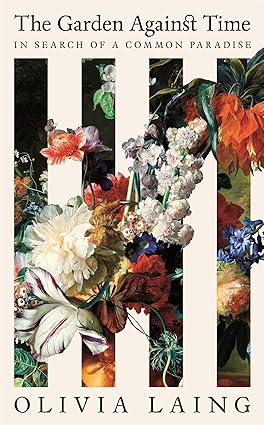
The event was brilliant – just the level of detail I wanted, with Laing flitting between subjects and issuing amazingly intelligent soundbites. The book, though, seemed like page after page about Milton (Paradise Lost) and Iris Origo or the Italian Renaissance. I liked it best when it stayed personal to her family and garden project. There are incredible lyric passages, but just stringing together floral species’ names – though they’re lovely and almost incantatory – isn’t art; it also shuts out those of us who don’t know plants, who aren’t natural gardeners. I wasn’t about to Google every plant I didn’t know (though I did for a few). Also, I have read a lot about Derek Jarman in particular. So my reaction was admiration rather than full engagement, and I only gave the book a light skim in the end. It is striking, though, how she makes this subject political by drawing in equality of access and the climate crisis. (Shortlisted for the Kirkus Prize and the Wainwright Prize.) 
Some memorable lines:
“A garden is a time capsule, as well as a portal out of time.”
“A garden is a balancing act, which can take the form of collaboration or outright war. This tension between the world as it is and the world as humans desire it to be is at the heart of the climate crisis, and as such the garden can be a place of rehearsal too, of experimenting with this relationship in new and perhaps less harmful ways.”
“the garden had become a counter to chaos on a personal as well as a political level”
“the more sinister legacy of Eden: the fantasy of perpetual abundance”
The Accidental Garden: Gardens, Wilderness and the Space in Between by Richard Mabey
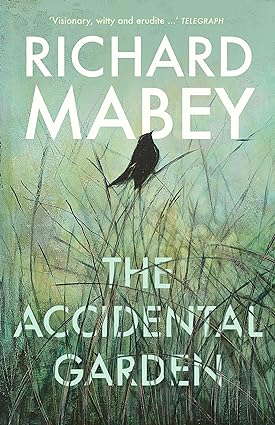 Mabey gives a day-to-day description of a recent year on his two-acre Norfolk property, but also an overview of the past 20 years of change – which of course pretty much always equates to decline. He muses on wildflowers, growing a meadow and hedgerow, bird behaviour, butterfly numbers, and the weather becoming more erratic and extreme. What he sees at home is a reflection of what is going on in the world at large. “It would be glib to suggest that the immeasurably complex problems of a whole world are mirrored in the small confrontations and challenges of the garden. But maybe the mindset needed for both is the same: the generosity to reset the power balance between ourselves and the natural world.” He seeks to create “a fusion garden” of native and immigrant species, trying to intervene as little as possible. The goal is to tend the land responsibly and leave it better off than he found it. As with the Laing, I found many good passages, but overall I felt this was thin – perhaps reflecting his age and loss of mobility – or maybe a swan song. Again, I just skimmed, even though it’s only 160 pages.
Some memorable lines:
“being Earth’s creatures ourselves, we too have a right to a niche. So in our garden we’ve had more modest ambitions, for ‘parallel development’ you might say, and a sense of neighbourliness with our fellow organisms.”
“We feel embattled at times, and that we should try to make some sort of small refuge, a natural oasis.”
“A garden, with its complex interactions between humans and nature, is often seen as a metaphor for the wider world. But if so, is our plot a microcosm of this troubled arena or a refuge from it?”
You might think I would have been more satisfied by Mabey’s contemplative bent, or Laing’s wealth of literary and historical allusions. It turns out that when it comes to gardening, Bradbury’s practical approach was what I was after. But you may gravitate to any of these, depending on whether you want something for the hands, intellect or memory.
Edinburgh Book Festival 2024 (Online): Richard Holloway’s On Reflection
Thanks to Kate for making me aware that the Edinburgh Book Festival was running in hybrid format this year, allowing people hundreds or thousands of miles away to participate. It felt like a return to the good old days of coronavirus lockdown – yes, I know it was very bad for very many people, but one consolation, especially for a thrifty introvert like me, was the chance to attend a plethora of literary and musical events online without leaving my sofa. I donated to live-stream two talks, one by Olivia Laing last week (more on that in an upcoming post on three recent gardening-themed reads) and this one by Richard Holloway on Sunday.
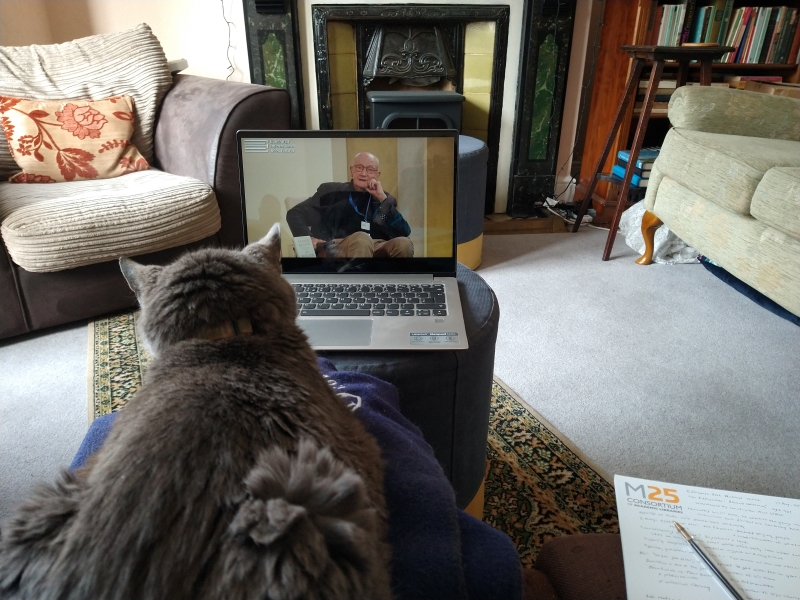
Alfie was rapt, too, of course.
I’ve reviewed several of his books here before (The Way of the Cross, Waiting for the Last Bus and The Heart of Things) and it would be fair to call him one of my most-admired spiritual gurus. At age ninety, he is not just lucid but quick-witted and naughty (I wasn’t expecting two F-bombs from a former bishop). While I have not read his latest book, On Reflection, it sounds like it’s quite similar to The Heart of Things: composed of memories and philosophical musings, with lashings of 20th-century poetry and Scottish history.
Interviewer Alan Little, a broadcaster who is stepping down as Festival chair after a decade, drew Holloway out on topics including faith, poetry, the Scottish reformation, and mortality. Little joked, “as you get older, you’re supposed to get more set in your ways!” while Holloway appears to become ever more liberal. He referred to himself as a “non-believing Christian” who is still steeped in religious culture and language but has adopted a “serene, gracious agnosticism,” which is “as much as the universe affords us.”
Holloway recently reread his first book and, while he admired that young man’s enthusiasm, he disliked the hectoring tone. The opposite of faith isn’t doubt, he remarked, but certainty. Two things prompted him to leave the ministry: the Church’s hatred of gay people and its subordination of women. His guiding principle is simple (reminiscent of Jan Morris’s): let’s be kind to each other and look after one another while we’re here. More existentially, he frames it as: let’s live as if life has meaning, even though he’s not sure that it does. In fact, he theorizes that religion arose from death, because we are the only species that is aware of our mortality and we can’t bear the thought of nothingness.
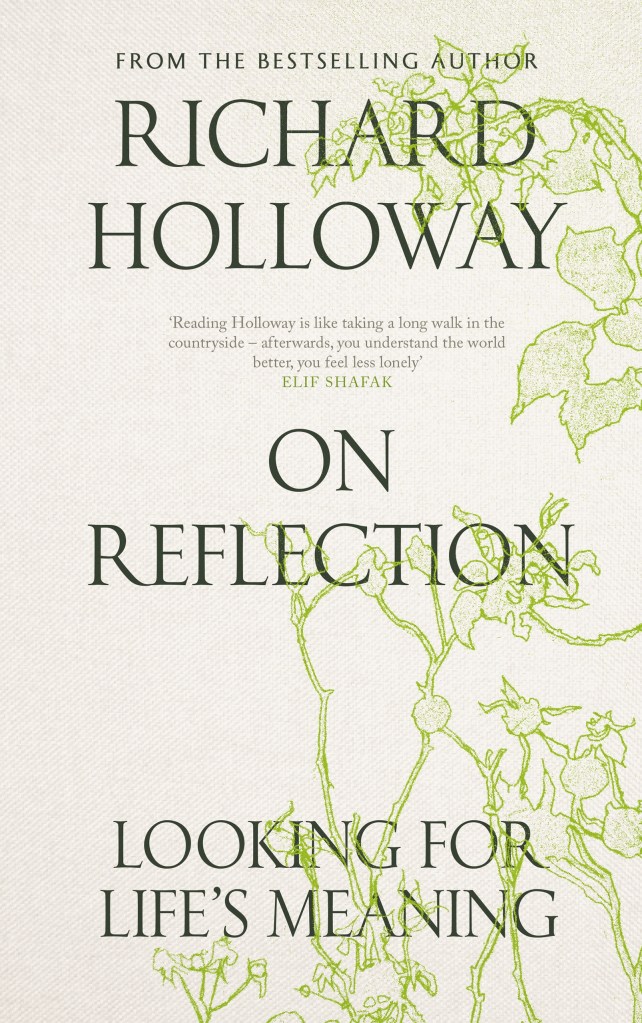
Holloway seems to live and breathe poetry. He expressed his love for W. H. Auden, whom he described as almost “priestly” in his brokenness, struggles, mysticism, and doing of good by stealth (he cared for war orphans and left them money at his death). Although I sometimes feel that Holloway is overly reliant on quotation in his recent books, I appreciate his fervour for poetry. His summation of what it does for him rang true for me as well: “poetry feeds me because it notices things in a particular way.” He added, “at its best, religion is a kind of realized poetry,” exclaiming, if only we could value it as such and not turn it into doctrine.
I wasn’t as interested in the discussion of John Knox and Scottish Presbyterianism, but obviously it was appropriate for the Edinburgh setting. Holloway said that it saddens him that Scotland is losing “the kirk” – as a tradition and in the form of buildings, many of which stand derelict. He read a long passage about Knox’s unfortunate hatred of images (his movement removed or concealed all sacred paintings) and how that rejection comes from the desert religions, which associate emptiness with otherness and the Transcendent.
During the Q&A time, one audience member said that he was heading to a Handel performance next, and hoped for a transcendent experience – but, he asked, being agnostic like Holloway, “what will I transcend to?” The two men seemed to agree that the experience itself is enough. Culture as transmitted by learning is the most distinctive thing about humans, Holloway observed, and Little also spoke passionately about the arts’ role in reconciliation. Several times, Holloway expressed his enduring wonder at the fact that there is something instead of nothing. It still staggers him not just that we’re here, but that we are capable of pondering the meaning of our own existence through events such as this one. That humility, even after his many decades as a respected public thinker, was beautiful to see.
 Bookish Beck = Rebecca Foster. American transplant to England. Freelance proofreader and book reviewer.
 Bookish Beck