Incidents of Book Serendipity
Since May I’ve been posting my occasional reading coincidences on Twitter and/or Instagram. This is when two or more books that I’m reading at the same time or in quick succession have something pretty bizarre in common. Because I have so many books on the go at once – usually between 10 and 20 – I guess I’m more prone to such serendipitous incidents. What’s the weirdest one you’ve had lately? (The following are in rough chronological order.)
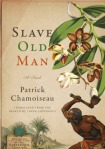
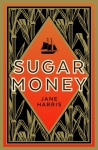
- Two historical novels set (partially) among the slaves of Martinique and featuring snippets of Creole (Patrick Chamoiseau’s Slave Old Man and Jane Harris’s Sugar Money)
- A book about epilepsy and a conductor’s memoir, followed by a novel with a conductor character and another who has seizures (Suzanne O’Sullivan’s Brainstorm and Lev Parikian’s Why Do Birds Suddenly Disappear? to Caoilinn Hughes’s Orchid & the Wasp)
- Two characters mistake pregnancy for cholera (in Alexandra Fuller’s Leaving Before the Rains Come and W. Somerset Maugham’s The Painted Veil)
 Two characters are reading Ursula K. Le Guin’s The Left Hand of Darkness (in Lily Brooks-Dalton’s Good Morning, Midnight and Julie Buntin’s Marlena) … I’ve since tried again with Le Guin’s book myself, but it’s so dry I can only bear to skim it.
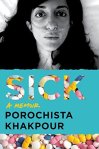
- Two memoirs by Iranian-American novelists with mental health and drug use issues (Porochista Khakpour’s Sick and Afarin Majidi’s Writing and Madness in a Time of Terror)

- References to the blasé response to Martin Luther King’s assassination in North Carolina (in Paulette Bates Alden’s Crossing the Moon and David Sedaris’s Calypso)
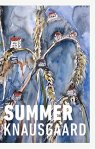
- The Police lyrics (in Less by Andrew Sean Greer and Summer by Karl Ove Knausgaard [a whole essay called “Sting”])

- Salmon croquettes mentioned in Less by Andrew Sean Greer and An American Marriage by Tayari Jones
 I’m reading Beryl Markham’s West with the Night … and then Glynnis MacNicol picks that very book up to read on a plane in No One Tells You This
- Starting two books with the word “Ladder” in the title, one right after the other: Ladders to Heaven by Mike Shanahan and Ladder of Years by Anne Tyler (followed just a couple of weeks later by A Ladder to the Sky by John Boyne!)


 Two books set in Dunedin, New Zealand, one right after the other – I planned it that way, BUT both have a character called Myrtle (To the Is-Land by Janet Frame and Dunedin by Shena Mackay). Then I encountered Harold Gillies, the father of plastic surgery, in Jim McCaul’s Face to Face, and guess what? He was from Dunedin!
- Then I was skimming Louisa Young’s You Left Early and she mentioned that her grandmother was a sculptor who worked with Gillies on prostheses, which was the inspiration for her WWI novel, My Dear I Wanted to Tell You.
- Two novels featuring drug addicts (Pretend I’m Dead by Jen Beagin and Bad News by Edward St. Aubyn)
- The same Wallace Stevens lines that appear as an epigraph to Barbara Kingsolver’s Unsheltered are mentioned in Elaine Pagels’s Why Religion? – “After the final no there comes a yes / And on that yes the future world depends.”

 “Twinkle, Twinkle, Little Star” is mentioned in Little by Edward Carey and Marilla of Green Gables by Sarah McCoy
- Reading Nine Pints, Rose George’s book about blood, at the same time as Deborah Harkness’s Time’s Convert, which is partially about vampires; in this it takes 90 days for a human to become fully vampirized – the same time it takes to be cured of an addiction according to the memoir Ninety Days by Bill Clegg.
The Life of Madame Tussaud: Little by Edward Carey
There is a state between life and death: it’s called the waxworks.
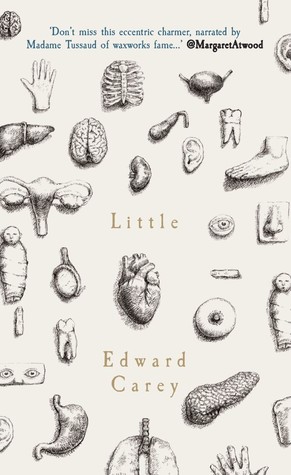 Apparently the 4th was Super Thursday: 544 books were published in the UK as part of the autumn rush leading up to Christmas. I’ve read just one of those multitudinous releases so far, but what a corker it was. Little is Edward Carey’s deliciously macabre novel about Madame Tussaud, who starts life as Anne Marie Grosholtz in Switzerland in 1761 and loses both parents by the age of six. Known as Marie, she soon picks up the nickname “Little” at the studio where she helps Dr. Philip Curtius make wax anatomical models. When the indebted Curtius flees to Paris, Marie goes with him as his servant. Along with their landlady, a tailor’s widow named Charlotte Picot, and her son Edmond, they form a makeshift family and a successful business, making wax heads and then dressing them in wigs and clothes to create whole figures of (in)famous citizens to display in their new quarters, a former monkey house.
In the years to come Marie occupies an uncomfortable in-between position: she’s treated like a servant but never paid, and though she’s fond of Curtius and falls in love with Edmond she’s made to understand that she’s not their equal. However, her fortunes change when Princess Élisabeth, on an unannounced visit to the Cabinet of Dr. Curtius, is impressed with Marie’s art and anatomy skills and invites her to be her sculpture tutor at Versailles. Marie and the young royal make wax models of local peasants’ ailments so they can pray for them. By the time Marie returns to the monkey house, the Revolution is in full swing and there’s widespread hunger not just for wax heads in cabinets, but for real decapitated ones. It will take cunning and luck for Marie and her odd little family to survive the years of upheaval.

(For a look inside the book, go to https://www.book2look.com/book/H8skBPiuJ9.)
The grimy picture of eighteenth-century Paris reminded me of Pure by Andrew Miller, and I often thought of Dickens as I was reading. Little starts off most like David Copperfield: a first-person “I am born”-style account with each chapter headed by a pithy summary. The characters have exaggerated physical features and recurring verbal tics, and there is an unmistakable message that whether a royal or a lowly servant we are all the same inside. Of course, as that pivotal July 14th approaches, the Dickensian echo is more along the lines of A Tale of Two Cities.
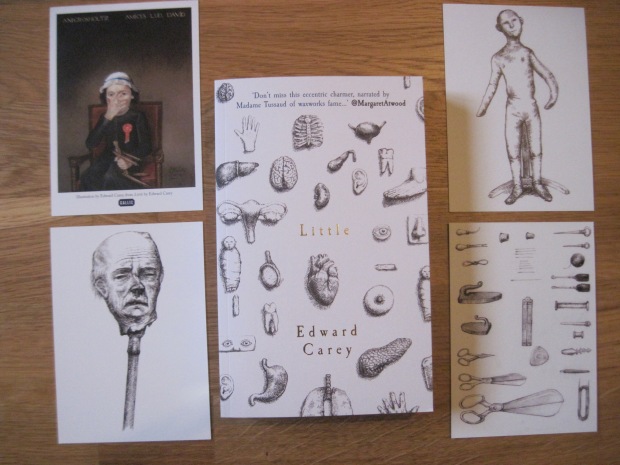
I think the novel would benefit from a more suggestive title and could stand to be a bit shorter, but it’s still a delightful piece of historical fiction and another hit from Gallic Books, responsible for two of my other favorite reads of the year so far, Salt Creek and The Life and Loves of Lena Gaunt. Part of the joy of reading it is encountering Carey’s slightly grotesque black-and-white illustrations, dozens of which appear through the text; you can see a few more of them on the postcards that accompanied my review copy.
In fact, I’ll sheepishly admit that before I read this I had Edward Carey confused for Edward Gorey, who was known for his ghoulish black-and-white drawings. Carey, an English playwright and novelist whose previous books include the Iremonger Trilogy, is married to Elizabeth McCracken and teaches at the University of Austin, Texas. After university he worked as a steward at Madame Tussaud’s in London, which is how he first came across her story. It’s an unforgettable one.
My rating: 
With thanks to the publisher for the free copy for review.
October Reading Plans: R.I.P. and More
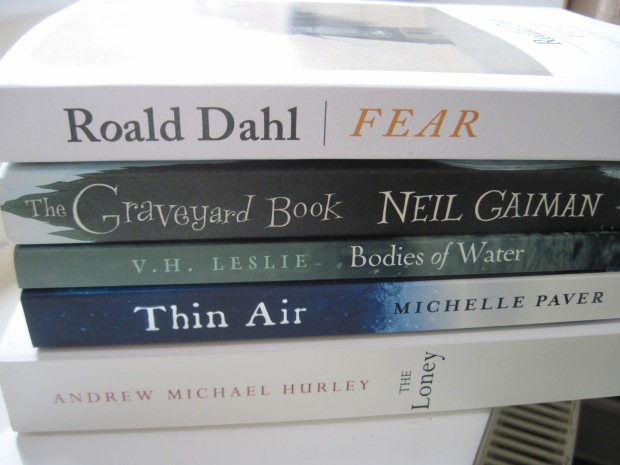
For the first time I’m joining in with the R.I.P. challenge (that’s “Readers Imbibing Peril,” if you’re unfamiliar) – a spur to read the dark fantasy, mystery, thriller, horror and suspense books I own during the month of October. None of these are go-to genres for me, but I do have some books that fit the bill. To start me off, I set aside this pile early in September. I’m not sure how many I’ll get through, so I’m not committing to a particular number.
Several of my review books for the month also happen to be appropriate, beginning with one of my current reads, Little by Edward Carey, a delightfully macabre historical novel about the real-life girl who became Madame Tussaud of waxworks fame. I hope to review it here soon. I also have Deborah Harkness’s latest and an upcoming fable by A.L. Kennedy. Continuing last month’s focus on short stories, I’m going to start on Aimee Bender’s 2013 volume soon; it might just be fantastical enough to count towards the challenge.
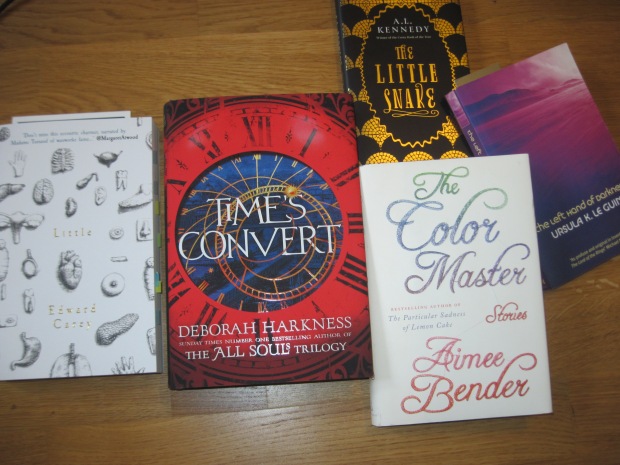
I’ve never read anything by the late Ursula K. Le Guin, so Annabel, Laura and I are embarking on a buddy read of The Left Hand of Darkness this month, too.
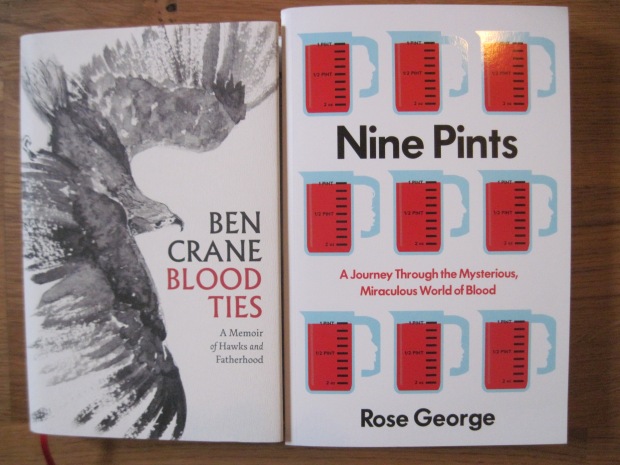
And then I may cheat and add in these two ‘blood-y’ nonfiction books since I’m going to be reading them soon anyway.
My other goal is to read more of the print books I’ve acquired over the past year, including some of 2017’s birthday and Christmas hauls and the books I bought at Bookbarn and in Wigtown. My birthday is coming up in the middle of the month, so it would be good to start chipping away at these stacks before the new acquisitions pile up much more!
I got a head start on a month of spooky reading with Sarah Perry’s new Gothic tale, Melmoth. It seems to have been equally inspired by Charles Robert Maturin’s 1820 novel Melmoth the Wanderer and by Perry’s time in Prague as a UNESCO World City of Literature Writer in Residence. The action opens in Prague in 2016 as Helen Franklin, a translator, runs into her distressed friend Dr. Karel Pražan one December night. An aged fellow scholar, Josef Hoffman, has been found dead in the National Library, where Helen and Karel first met. Karel is now in possession of the man’s leather document file, which contains accounts of his Holocaust-era family history and of his investigations into the Melmoth legend. She was one of the women at Jesus’s empty tomb but denied the resurrection and so was cursed to wander the Earth ever after. As Hoffman explains, “she is lonely, with an eternal loneliness” and “she comes to those at the lowest ebb of life.”
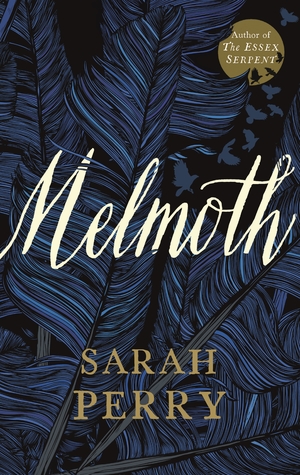 Is this just a tale used to scare children? In any case, it resonates with Helen, who exiled herself to Prague 20 years ago to escape guilt over a terrible decision. For most of the book we get only brief glimpses into Helen’s private life, like when she peeks into the under-the-bed shoebox where she keeps relics of the life she left behind. We do eventually learn what she ran away from, but by then I was so weary of dull found documents, irritating direct reader address (“Look! It is evening now … Reader, witness, here is what you see”), and toothless Gothic tropes that the reveal was barely worth hanging around for. Alas, I found the whole thing pretty melodramatic and silly, and not in the least bit frightening.
I truly loved The Essex Serpent (), but I think Perry is one of those authors where I will need to skip every other release and just read the even numbers; After Me Comes the Flood, her first, was one of my lowest-rated books ever ( ). I recall that when I saw her speak at Bloxham Festival of Faith and Literature in 2016 Perry revealed that Novel #4 will be a contemporary courtroom drama. I’ll try again with that one.
My rating: 
Melmoth is released in the UK today, October 2nd. My thanks to Serpent’s Tail for a proof copy for review. It comes out in the USA from Custom House on the 16th. Sarah Perry has written an interesting article about being on strong pain medication while writing Melmoth.
 Bookish Beck = Rebecca Foster. American transplant to England. Freelance proofreader and book reviewer.
 Bookish Beck