Three on a Theme: Tiger Novels (Polly Clark, Tania James, Téa Obreht)
I was sent Loot for review, picked The Tiger’s Wife – a reread for me – as our February book club book, and then couldn’t resist making it a trio with Tiger as it was also a good excuse to pick up a book that had sat on my shelves unread for several years. In all three, the tiger is an emblem of wildness and mystery – and often of danger, too (“you must rid us of this devil in his fiery pajamas,” the village priest begs the hunter in The Tiger’s Wife).
Tiger by Polly Clark (2019)
 I was fully engaged with the 150 or so pages of Part I, which is narrated by Dr Frieda Bloom, a zookeeper knowledgeable about and fascinated by bonobos. She’s also a morphine addict who continues to justify using at work (not to mention stealing from the veterinary supplies) until she is caught and fired. It’s all in response to a random act of violence: a man attacked her outside a Tube station late one night and she was lucky to have survived the head injury. In ignominy, she moves from a prestigious research institute to a rundown local zoo where the star new acquisition is an injured tiger named Luna. She develops an amazing rapport with Luna, even spending time in the enclosure with her. Meanwhile, the macho behaviour of her colleague Gabriel makes it seem like Frieda could be a victim again at any time.
But then we jump back in time and to the Russian taiga to meet, through third-person segments, a conservationist who hears about a mighty Siberian tigress, and a mother and daughter who encounter her for themselves. This turns out to be “the Countess,” Luna’s mother, and Frieda, a few years on now, travels to Russia herself to bring back one of Luna’s cubs. The focus, as the title signals, is on the tiger herself, but my interest was only ever in Frieda, and it was a little confusing how quickly she switches allegiance from primates to tigers. More first-person narration might have kept me engaged, or maybe a different order to the sections? Anything to keep me latching onto Frieda and missing her for most of the book. (Instagram giveaway win) 
Loot by Tania James (2023)
A halfhearted skim. It’s a shame that when I was offered this for review I didn’t remember I’d read something by Tania James before. The Tusk that Did the Damage, from 2016, is a composite picture of the state of wildlife conservation in India told from three perspectives: an elephant named The Gravedigger, a poacher, and a documentary filmmaker. That was a book I had to force myself through because of the lacklustre storytelling and character development, and I found the same here. Historical fiction can be tedious when it assumes that an unusual setting and intriguing incident are enough to maintain reader interest. Abbas, a woodcarver, is only 17 when he is taken to the sultan’s palace to be apprenticed to a French clockmaker. Together, they create the real-life automaton known as Tippoo’s Tiger and held at the V&A Museum. When the automaton is plundered, Abbas sets out on a quest to rescue it. I never warmed to any of the characters here, even though du Leze’s adopted daughter Jehanne is a promising one. If it’s automata that intrigue you, read The Weather Woman instead. 

[Now on the Carol Shields Prize for Fiction longlist]
With thanks to Harvill Secker for the free copy for review.
The Tiger’s Wife by Téa Obreht (2011)
What I remembered: a wartime Eastern European (Bosnian?) story that incorporated legends.
What I rediscovered:
Natalia, a medical worker in a war-ravaged country, learns of her grandfather’s death away from home. The only one who knew the secret of his cancer, she sneaks away from an orphanage vaccination program to reclaim his personal effects, hoping they’ll reveal something about why he went on this final trip. Something is missing from his belongings: his beloved copy of The Jungle Book, which sparked a lifelong fascination with tigers. When war broke out mid-century and a tiger escaped from the zoo, he was nine years old. He and the butcher’s wife, a pregnant, deaf-mute Muslim woman with whom he communicated by scratching images in the dirt, were thrilled by the tiger’s nocturnal skulking rather than frightened like the rest of the villagers. Her outcast status led people to ignore the fact that she was a victim of domestic violence and to spin tales about her unnatural connection with the tiger, spreading rumours about the child she was carrying (“The Tiger’s Wife”).
 In the years to come, during Natalia’s grandfather’s career as a doctor, he had several encounters with Gavran Gailé, “The Deathless Man,” a troubadour who seemed, vampire- or zombie-like, to survive every attempt on his life. In service to his uncle, Gavran Gailé read people’s coffee grounds to inform them of their impending death, but his own cup was bare and unbreakable. Natalia’s grandfather, a man of science, didn’t believe Gavran Gailé’s claims and agreed to a wager. Gavran Gailé would walk into a lake, tied up in chains attached to cement blocks, and pull on a rope when he started drowning. His pledge was his cup; the doctor’s was The Jungle Book, his most treasured possession. But as promised, Gavran Gailé spent an hour underwater and emerged from the lake none the worse the wear.
Natalia knows her grandfather’s final journey must have been to meet The Deathless Man, who collected on his pledge. She’ll have her own encounter with him before the end.
This is a demanding read, in that there are not a lot of orienting details and the several storylines surge in and out through flashbacks and oral storytelling. It takes effort and commitment to keep reading in the hope that everything will come together. This was a flop for my book club in that only three people had read it so we decided it wasn’t worth meeting. One who did finish it commented that it felt like three separate stories, and I see what she means. Obreht could certainly have made the links and chronology more obvious. Instead, each chapter is such a honed and self-contained narrative, often focused on a different peripheral character, that the book almost reads like a set of linked short stories. On this reread I was absolutely entranced, especially by the sections about The Deathless Man. I had forgotten the medical element, which of course I loved.
It can be depressing looking back at amateur reviews I wrote in my pre-freelancing days because I have not notably advanced since then. This response I wrote when I read the brand-new book in 2011 is allusive, opinionated, and admirably absent of dull plot summary. Could I do any better now if I tried? (Though I think I maybe misunderstood the ending back then.)
Had I reread this sooner, it would have been tough to choose between it and Larry’s Party, my ultimate selection, for the Women’s Prize Winners 25th anniversary reader vote. Were I to vote again today, I’d join Laura in choosing The Tiger’s Wife instead. (Public library)
My original rating (2011): 
My rating now: 
Eleanor recently reviewed it, too.
There was a clear winner here: The Tiger’s Wife!
See also Laura’s fab series on tiger novels from her old blog. This is the first post and there are more listed in the right-hand sidebar.
I searched my Goodreads library for others I’ve read and the only books she didn’t cover were Nick Harkaway’s Tigerman, a disappointment after Angelmaker; and (nonfiction) Margaux Fragoso’s Tiger, Tiger (title from a William Blake line), a memoir of childhood sexual abuse, and Ruth Padel’s Tigers in Red Weather, a travelogue – it happens to share a title with Liza Klausmann’s novel, which is likewise named after a line in the Wallace Stevens poem “Disillusionment of Ten O’Clock.”
The 2024 Releases I’ve Read So Far
I happen to have read eight pre-release books so far, all of them for paid review; mostly for Shelf Awareness, with one for Foreword. (I also have proof copies of upcoming novels by Tania James, Margot Livesey, Sigrid Nunez and Sarah Perry on the shelf, but haven’t managed to start on them yet.) I’ve given review excerpts, links where available, and ratings below to try to pique your interest. Early in January I’ll follow up with a list of my dozen Most Anticipated titles for the coming year.
My top recommendations so far:
(in alphabetical order)
 Theophanies by Sarah Ghazal Ali [Jan. 16, Alice James Books]: In this poised debut collection by a Muslim poet, spiritual enlightenment is a female, embodied experience, mediated by matriarchs. Ali’s ambivalence towards faith is clear in alliteration-laden verse that recalls Kaveh Akbar’s. Wordplay, floral metaphors, and multiple ghazals make for dazzling language.
 Grief Is for People by Sloane Crosley [Feb. 27, MCD]: A bereavement memoir like no other. Heart-wrenching yet witty, it bears a unique structure and offers fascinating glimpses into the New York City publishing world. Crosley’s apartment was burgled exactly a month before the suicide of her best friend and former boss. Investigating the stolen goods in parallel serves as a displacement activity for her.
 Behind You Is the Sea by Susan Muaddi Darraj [Jan. 16, HarperVia]: Darraj’s second novel-in-stories is a sparkling composite portrait of a Palestinian American community in Baltimore. Across nine stellar linked stories, she explores the complex relationships between characters divided by—or connected despite—class, language, and traditional values. The book depicts the variety of immigrant and second-generation experience, especially women’s.
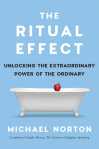 The Ritual Effect by Michael Norton [April 9, Scribner]: Many use the words “habit” and “ritual” interchangeably, but the Harvard Business School behavioral scientist argues convincingly that they are very different. While a habit is an automatic, routine action, rituals are “emotional catalysts that energize, inspire, and elevate us.” He presents an engaging and commonsense précis of his research, making a strong case for rituals’ importance in the personal and professional spheres as people mark milestones, form relationships, or simply “savor the experiences of everyday life.”
Other 2024 releases I’ve read:
(in publication date order)
 House Cat by Paul Barbera [Jan. 2, Thames & Hudson]: The Australian photographer Paul Barbera’s lavish art book showcases eye-catching architecture and the pets inhabiting these stylish spaces. Whether in a Revolutionary War-era restoration or a modernist show home, these cats preside with a befitting dignity. (Shelf Awareness review forthcoming)
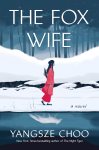 The Fox Wife by Yangsze Choo [Feb. 13, Henry Holt/Quercus]: Choo’s third novel is steeped in Chinese folklore, like her previous work, this time with a focus on tantalizing stories related to foxes, which were often worshiped at village shrines in China. Two tandem searches ramp up the level of suspense: in the winter of 1908 in Manchuria, in northeast China, a detective investigates a series of unexplained deaths; at the same time, a fox-woman masquerading as a servant plots vengeance against the man who murdered her child.
 The Only Way Through Is Out by Suzette Mullen [Feb. 13, University of Wisconsin Press]: A candid, inspirational memoir traces the events leading to her midlife acceptance of her lesbian identity and explores the aftermath of her decision to leave her marriage and build “a life where I would choose desire over safety.” The book ends on a perfect note as Mullen attends her first Pride festival aged 56. “It’s never too late” is the triumphant final line. (Foreword review forthcoming)
 36 Ways of Writing a Vietnamese Poem by Nam Le [March 5, Knopf]: A fearless poetry debut prioritizes language and voice to explore inherited wartime trauma and expose anti-Asian racism. Each poem is titled after a rhetorical strategy or analytical mode. Anaphora is one sonic technique used to emphasize the points. Language and race are intertwined. This is a prophet’s fervent truth-telling. High-concept and unapologetic, this collection from a Dylan Thomas Prize winner pulsates. (Shelf Awareness review forthcoming)
Currently reading:
(in release date order; all for Shelf Awareness review)
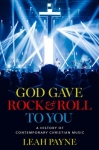 God Gave Rock and Roll to You: A History of Contemporary Christian Music by Leah Payne [Jan. 4, Oxford University Press]: “traces the history and trajectory of CCM in America and, in the process, demonstrates how the industry, its artists, and its fans shaped—and continue to shape—conservative, (mostly) white, evangelical Protestantism.”
 Raised by Wolves: Fifty Poets on Fifty Poems, A Graywolf Anthology [Jan. 23, Graywolf Press]: “Graywolf poets have selected fifty poems by Graywolf poets, offering insightful prose reflections on their selections. What arises is a choral arrangement of voices and lineages across decades, languages, styles, and divergences, inspiring a shared vision for the future.”
 The Paris Novel by Ruth Reichl [April 30, Random House]: “When her estranged mother dies, Stella is left with an unusual gift: a one-way plane ticket, and a note reading ‘Go to Paris’. But Stella is hardly cut out for adventure … When her boss encourages her to take time off, Stella resigns herself to honoring her mother’s last wishes.”
Will you look out for one or more of these?
Any other 2024 reads you can recommend?
That’s it for me until later next week when I start in on my year-end round-ups (DNFs, miscellaneous superlatives, books of the year, and final statistics). Merry Christmas!
Summer Fishing in Lapland by Juhani Karila (Blog Tour)
What a madcap adventure, set at the ends of the Earth. Though Elina Ylijaako’s father’s family home is in Lapland, when she travels up there from further south in Finland each summer she feels like an outsider. She has to run the gauntlet of weird locals in her mission to catch an enchanted pike from the mosquito-surrounded pond. The novel is set over five days – the length of time she has to be successful in her quest.
The stakes couldn’t be higher, but several legendary creatures are ranged against Elina: a knacky (some kind of water sprite?), a frakus, a raskel. All of them seem more mischievous than dangerous, but you never can tell. As in fairy tales, there are alliances and tricks and betrayals to come.
 In the meantime, a female police detective named Janatuinen is newly arrived in town. Sections devoted to her, and flashbacks to Elina’s relationship with a school friend and first love interest, Jousia, widen the frame.
And then a rumour of further fantastical combatants, with the mayor possessed by a wraith that makes him ravenous all the time. Elina has to defeat the knacky and catch the pike, all while serving as bait for the locals’ broader plan to entrap the wraith…
I think Summer Fishing in Lapland may be only the fourth Finnish novel I’ve encountered, after Mr. Darwin’s Gardener by Kristina Carlson, The Year of the Hare by Arto Paasilinna, and Land of Snow and Ashes by Petra Rautiainen; it had the most in common with the Paasilinna, in terms of sheer oddness.
This is journalist Karila’s debut, first published in 2019. It’s been a bestseller in its native Finland. The press materials compared the work to Murakami, which was a draw. In the end I found it rather silly, but those more comfortable with fantasy may feel differently.
I did love the place descriptions, including some lovely incidental nature writing and unexpected metaphors: “Thick, dark clouds like the burnt bottom of a rice pudding were gathering there.” Is a summer trip to Lapland for you?
(Translated from the Finnish by Lola Rogers.)
With thanks to Pushkin Press for the proof copy for review.
I was happy to close out the blog tour for Summer Fishing in Lapland. See below for where other reviews have appeared, including Annabel’s, which is significantly more enthusiastic!

Two Mother–Daughter Author Pairs for Mother’s Day
This coming Sunday is Mother’s Day in the USA. (Mothering Sunday generally falls in March here in the UK, so every year I have to buy a card early to send to my mother back in the States, but I still associate Mother’s Day with May.) Earlier in the year I got over halfway through a Goodreads giveaway book, Beyond the Pale by Emily Urquhart, before I realized its author was the daughter of a Canadian novelist I’d read before, Jane Urquhart. That got me thinking about other mother–daughter pairs that might be on my shelves. I found one in the form of Sue Monk Kidd’s The Secret Life of Bees plus an advance e-copy of her daughter Ann Kidd Taylor’s upcoming debut novel, The Shark Club. (I’ve previously reviewed their joint memoir, Traveling with Pomegranates.) And, as a bonus, I have a mini-review of Graham Swift’s novella Mothering Sunday: A Romance.
The Whirlpool, Jane Urquhart
 From 1986, this was Urquhart’s first novel. Overall it reminded me of A. S. Byatt (especially The Virgin in the Garden) and John Fowles’s The French Lieutenant’s Woman. Set in 1889 on the Canadian side of Niagara Falls, it features characters who, each in their separate ways, are stuck in the past and obsessed with death and its symbolic stand-in, the whirlpool. Maud Grady, the local undertaker’s widow, takes possession of the corpses of those who’ve tried to swim the Falls. Her creepy young son starts off mute and becomes an expert mimic. Major David McDougal is fixated on the War of 1812, while his wife Fleda camps out in a tent reading Victorian poetry, especially Robert Browning, and awaiting a house that may never be built. Local poet Patrick sees Fleda from afar and develops romanticized ideas about her.
Each of these narratives is entertaining, but I was less convinced by their intersections – except for the brilliant scenes when Patrick and Maud’s son engage in wordplay. In particular, I was unsure what the prologue and epilogue (in which Robert Browning, dying in Venice, is visited by images of Shelley’s death by drowning) were meant to add. This is the second Urquhart novel I’ve read, after Sanctuary Line. I admire her writing but her plots don’t always come together. However, I’m sure to try more of her work: I have a copy of Away on the shelf, and Changing Heaven (1990) sounds unmissable – it features the ghost of Emily Brontë! [Bought from a Lambeth charity shop for 20p.]
My rating:
Beyond the Pale: Folklore, Family and the Mystery of Our Hidden Genes, Emily Urquhart
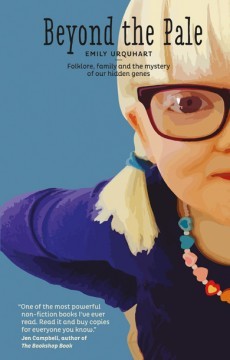 In December 2010, the author’s first child, Sadie, was born with white hair. It took weeks to confirm that Sadie had albinism, a genetic condition associated with extreme light sensitivity and poor eyesight. A Canadian folklorist, Urquhart is well placed to trace the legends that have arisen about albinos through time and across the world, ranging from the Dead Sea Scroll story of Noah being born with blinding white skin and hair to the enduring superstition that accounts for African albinos being maimed or killed to use their body parts in folk medicine.
She attends a NOAH (America’s National Organization for Albinism and Hypopigmentation) conference, discovers potential evidence of a family history of albinism, and even makes a pilgrimage to Tanzania to meet some victims. It’s all written up in as engaging present-tense narrative of coming to terms with disability: to start with Urquhart is annoyed at people reassuring her “it could be worse,” but by the end she’s ever so slightly disappointed to learn that her second child, a boy, will not be an albino like his sister. [Goodreads giveaway copy]
My rating:
The Secret Life of Bees, Sue Monk Kidd
 It’s hard to believe it was 15 years ago that this debut novel was an It book, and harder to believe that I’d never managed to get around to it until now. However, in some ways it felt familiar because I’d read a fair bit of background via Kidd’s chapter in Why We Write about Ourselves and Traveling with Pomegranates, in which she and her daughter explored the Black Madonna tradition in Europe.
It joins unusual elements you wouldn’t expect to find in fiction – beekeeping and the divine feminine – with more well-trodden territory: the Civil Rights movement in the South in the 1960s, unhappy family relationships, secrets, and a teenage girl’s coming of age. Fourteen-year-old Lily is an appealing narrator who runs away from her memories of her mother’s death and her angry father, peach farmer T. Ray. You can’t help but fall in love with the rest of her new African-American, matriarchal clan, including their housekeeper, Rosaleen, who scandalizes the town by registering to vote, and the bee-keeping Boatwright sisters, August, June, and May, who give Lily and Rosaleen refuge when they skip town.
Although this crams in a lot of happenings and emotional ups and downs, it’s a charming story that draws you into the brutal heat of a South Carolina summer and keeps you hoping Lily will forgive herself and slip into the rhythms of a purposeful life of sisterhood. [Secondhand purchase in America]
A favorite line: “The way people lived their lives, settling for grits and cow shit, made me sick.”
My rating:
The Shark Club, Ann Kidd Taylor
 Dr. Maeve Donnelly loves sharks even though she was bitten by one as a child. She’s now a leading researcher with a Florida conservancy and travels around the world to gather data. Her professional life goes from strength to strength, but her personal life is another matter. Aged 30, she’s smarting from a broken engagement to her childhood sweetheart, Daniel, and isn’t ready to open her heart to Nicholas, a British colleague going through a divorce.
Things get complicated when Daniel returns to their southwest Florida island to work as the chef at her grandmother’s hotel – with his six-year-old daughter in tow. Maeve is soon taken with precocious Hazel, who founds the title club (pledge: “With this fin, I do swear. To love sharks even when they bite. When they lose their teeth, I will find them. When I catch one, I will let it go”), but isn’t sure she can pick up where she left off with Daniel. Meanwhile, evidence has surfaced of a local shark finning operation, and she’s determined to get to the bottom of it.
This is a little bit romance and a little bit mystery, and Taylor brings the Florida Keys setting to vibrant life. It took a while to suspend disbelief about Maeve’s background – an orphan and a twin and a shark bite survivor and a kid brought up in a hotel? – but I enjoyed the sweet yet unpredictable story line. Nothing earth-shattering, but great light reading for a summer day at the beach. Releases June 6th from Viking. [Edelweiss download]
My rating:
Mothering Sunday: A Romance, Graham Swift
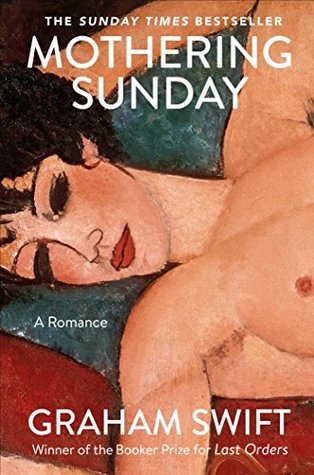 If you’re expecting a cozy tale of maternal love, let the Modigliani nude on the U.K. cover wipe that notion out of your mind. Part of me was impressed by Swift’s compact picture of one sexy, fateful day in 1924 and the reverberations it had for a budding writer even decades later. Interesting class connotations, too. But another part of me thought, isn’t this what you would get if Ian McEwan directed a middling episode of Downton Abbey? It has undeniable similarities to Atonement and On Chesil Beach, after all, and unlike those novels it’s repetitive; it keeps cycling round to restate its main events and points. There’s some good lines, but overall this felt like a strong short story stretched out to try to achieve book length. [Library read]
My rating: 
 Bookish Beck = Rebecca Foster. American transplant to England. Freelance proofreader and book reviewer.
 Bookish Beck