Victorian-Themed Novels by Annie Elliot and Livi Michael (#ReadIndies)
I’m going back to my roots as a Victorianist (I completed an MA in Victorian Literature at the University of Leeds in 2006) with these two new novels, the one about Charles Dickens’s turbulent marriage and the other about the real-life inspiration for Elizabeth Gaskell’s Ruth. Both redress the balance of Victorian literature by placing women at the centre of the action, and both were comfortably in the 200–300-page range: turns out that’s how I like my Victoriana these days; none of your triple-decker nonsense.
Mr & Mrs Charles Dickens: Her Story by Annie Elliot
I used to proclaim Dickens my favourite author yet haven’t managed to read one of his novels in 15+ years; I seem to be allergic to all that verbiage. He managed to write all those millions of words thanks to his increasing status and wealth, but also thanks to his long-suffering wife, Catherine. Kate sacrificed her health and ambitions to bear and raise his nine children (along with one who died) and – along with sisters and servants – keep a house calm and quiet enough to enable his work.
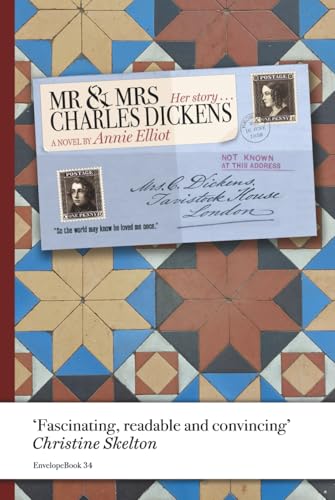 On her deathbed, Kate begged her daughter to give her love letters from Charles to the British Museum “so the world may know he loved me once.” Annie Elliot has used that phrase as the tagline for her absorbing and vigilantly researched debut novel. The structure perfectly mimics romantic illusions ceding to disenchantment. The framing story is set on 10 June 1870 – the day Kate, the estranged wife, learns of Charles’s death. Sections alternate between the bereaved Kate’s fragile state of mind (depicted in the third person) and first-person flashbacks to their relationship, from first meeting in 1834 to infamous separation in 1858.
It’s all narrated in the present tense, which creates an eternal now: nothing can be dated when it’s all happening at once for Kate. To start with, the Dickens marriage seems to be based on real love and physical passion. But before long it’s clear that he’s using Kate as ego boost and sexual outlet. She walks on eggshells lest anything shake his confidence. While the death of their baby daughter Dora nearly breaks her, he keeps up a frenzy of writing, travel, property acquisition, and new ventures such as public speaking and the theatre. And, of course, it’s through dramatics that he meets young Nelly Ternan and finds his excuse to push Kate aside.
Though much of this material was familiar to me from Claire Tomalin’s biographies as well as Gaynor Arnold’s novel about Kate, Girl in a Blue Dress, I appreciated the recreation of Kate’s perspective, the glimpses of their children’s lives, and the flashes of humour such as the proliferation of Pickwick memorabilia and a visit from Hans Christian Andersen. This is – yes, still – a necessary corrective to Dickens’s image as the dutiful husband and paterfamilias. And such a beautifully presented book, too. I wish Elliot well for next year’s McKitterick Prize race.
To be published on 1 March. With thanks to the author and EnvelopeBooks for the free copy for review.
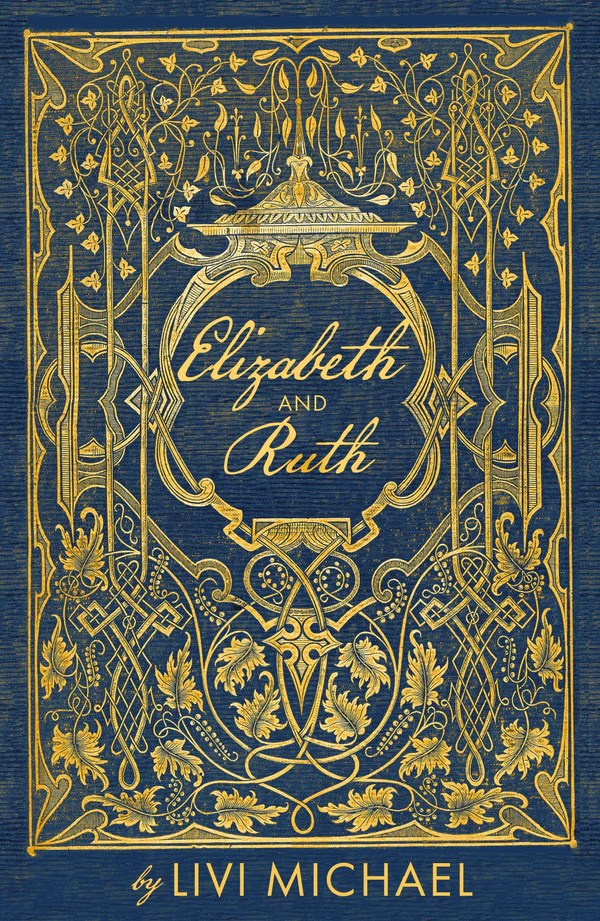
Elizabeth and Ruth by Livi Michael
The Manchester of 1849 is a sordid complex of sweatshops, brothels and workhouses – if you’re Pasley, an Irish teenager abandoned by her mother and shunted from one bad situation to another. Or the Manchester of 1849 is a rarefied colloquium of forward-thinking authors, ministers and politicians – if you’re Elizabeth Gaskell, who’s been revealed as the mind behind the anonymously published sensation Mary Barton.
The two worlds collide when Elizabeth visits Pasley at the New Bailey Prison. She feels for this young woman who’s been a victim of deception, trafficking, and rape and narrowly escaped death by suicide only to end up imprisoned for theft when she made a desperate bid for freedom. There’s only so much that Pasley can bear to tell Mrs Gaskell on these short visits, though; her past would shock a preacher’s wife. Through euphemisms and evasions, Pasley is able to convey that she was taken advantage of by a doctor. Elizabeth suspects that there was a baby, but only readers know the whole truth.
Chapters alternate between Elizabeth’s experience – in an omniscient third person cleverly reminiscent of Victorian prose – and Pasley’s first-person recollections. Elizabeth wants to follow through on her do-gooder reputation and truly help Pasley, who reminds her of her own infant and pregnancy losses. Achieving justice for the girl would be a bonus. All she knows to do is use her pen to change hearts and minds, as she has before (including for Dickens’s magazine) to draw attention to the plight of the poor. Thus, Ruth was born.
This is a riveting and touching novel about the rigidity of convention and the limits of compassion. Livi Michael is a prolific author of whom I’d not heard before Salt sent me this surprise, perfectly suited parcel. Her vivid scenes bring the two-tiered Manchester society to life and reminded me of my visit to the Gaskell House in 2015. My only small complaint would be that the blurb makes it sound as if Gaskell’s correspondence with Dickens will be a central element, when in fact it only appears once, two-thirds of the way through, with one cameo appearance by Dickens right at the end. He’s the better-known author, but after reading this you’ll agree that Gaskell was the subtler, more elegant chronicler.
Published on 9 February. With thanks to Salt Publishing for the proof copy for review.
Six Degrees of Separation: From a Redhead to a Blue Dress

This month we begin with Redhead by the Side of the Road (2020). (See Kate’s opening post.) Anne Tyler’s lackluster latest somehow got longlisted for the Booker Prize. Still, I’m a solid Tyler fan and I’m taking advantage of Liz’s readalong to get to the books of hers that I own but haven’t read yet. Currently reading: The Clock Winder (1972).
#1 Sorry to break it to you if you haven’t read the book yet, but the title refers not to a person with red hair but to a fire hydrant: Micah, a typically useless Tyler antihero, makes this visual mistake commonly when he’s out running without his glasses on.
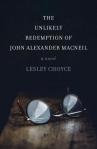 The Unlikely Redemption of John Alexander MacNeil by Lesley Choyce (2017) is beloved of a couple of Canadian book blogger friends, including Naomi (here’s her review). I came across it on my Goodreads TBR the other day and the blurb caught my eye. An old man starts doing peculiar things, like picking up a hitchhiker … except that it’s actually a neighbour’s mailbox. This reminded me of Micah’s folly, not least because of the glasses on the cover.
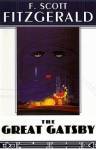
 #2 One of the key images in The Great Gatsby (1925) is of the eyes of optician Dr. T. J. Eckleburg peering out from an old billboard. They’re explicitly equated to the eyes of God looking down on the immoral lifestyle of characters blinded by the pursuit of money and happiness. Gatsby was our neighbourhood book club choice this month. Whether we’d read it multiple times before (it was my third read) or not at all, we found a lot to talk about – and two members took the opportunity to dress up in vintage 1920s fashions for the Zoom meeting!
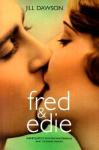 #3 Although those bespectacled eyes appeared on the copy I read in high school, the book group set cover featured a couple of 1920s figures: a woman on the front cover and a man on the back. They look rather like a young Scott and Zelda Fitzgerald, but I can’t find evidence that it’s an original photograph. In any case, I thought the image looked awfully familiar, and finally located it as the cover of Fred & Edie by Jill Dawson (2000), which is set in 1922 and was inspired by a true crime. In a sensational trial, Edith Thompson and her lover, Freddy Bywaters, were found guilty of murdering Edith’s husband and the pair were executed the following year. Cathy’s review whetted my appetite to read it.
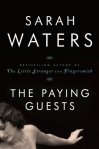 #4 Also featuring a murder committed in 1922 is The Paying Guests by Sarah Waters (2014). I will say no more – not least because I don’t fully remember what happens, though I have a vague sense that it is quite similar in plot to the Dawson – except that this was a stand-out from Waters. (My review for BookBrowse.)
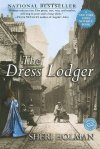 #5 “Paying guests” was an old-fashioned euphemism used by people who didn’t like to admit they had lodgers. Another random recent find on my virtual TBR was The Dress Lodger by Sheri Holman (2000), which is about a 15-year-old prostitute trying to provide for herself and her disabled baby boy during a cholera epidemic in Sunderland, England in 1831. Victorian pastiches can go either way for me, but when they’re good I adore them. There are enough positive friend reviews of this on Goodreads for me to keep it on the list: it sounds reminiscent of The Crimson Petal and the White, and the epidemic theme sure is relevant.
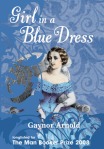 #6 The blue dress on the cover led me to Girl in a Blue Dress by Gaynor Arnold (2008), a novel about Charles Dickens’s longsuffering wife, Catherine. (Though the central pair are given different names, it’s very clear who they’re based on.) I’m a sucker for any book about Dickens. Like Redhead, this was longlisted for the Booker Prize.
This month I’ve gone round to a different primary colour, by way of a classic and much historical fiction (with 1920s settings aplenty, and lots of marcelled hair!).
Where will your chain take you? Join us for #6Degrees of Separation! (Hosted on the first Saturday of each month by Kate W. of Books Are My Favourite and Best.) Next month’s starting point is Phosphorescence by Julia Baird.
Have you read any of my selections? Are you tempted by any you didn’t know before?
 Bookish Beck = Rebecca Foster. American transplant to England. Freelance proofreader and book reviewer.
 Bookish Beck