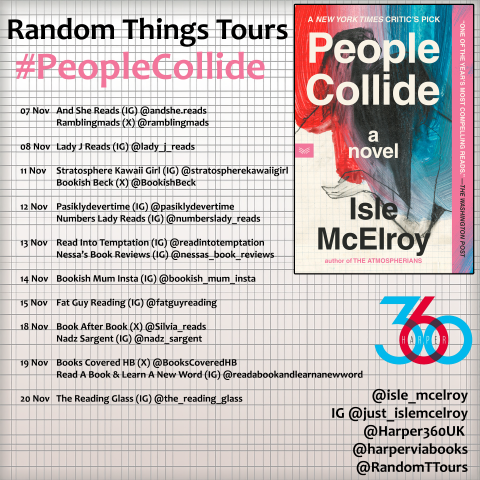
People Collide by Isle McElroy (Blog Tour)
People Collide (2023), nonbinary author Isle McElroy’s second novel, is a body swap story that explores the experiences and gender expectations of a heterosexual couple when they switch places. It’s not so much magic realism as a what-if experiment. Eli wakes up one morning in his wife Elizabeth’s body in their “pie slice of an apartment” in southern Bulgaria, where they moved for her government-sponsored teaching position. At first, finding himself alone, he thinks she’s disappeared and goes to the school to ask after her. The staff and students there, seeing him as Elizabeth, think they’re witnessing some kind of mental breakdown and send ‘her’ home. One of them is gone, yes, but it’s Elizabeth – in Eli’s body.
Both sets of parents get involved in the missing person case and, when a credit card purchase indicates Elizabeth is in Paris, Eli sets off after her. He is an apt narrator because he sees himself as malleable and inessential: “I wasn’t a person but a protean blob, intellectually and emotionally gelatinous, shaped by whatever surrounded me; “I could never shake the sense that I was, for [Elizabeth], like a supplementary arm grafted onto the center of her stomach.” He comes from a rough family background, has a history of disordered eating, and doesn’t have a career, so is mildly resentful of Elizabeth’s. She’s also an aspiring novelist and her solitary work takes priority while he cooks the meals and grades her students’ papers.

The couple already pushed against gender stereotypes, then, but it is still a revelation to Elizabeth how differently she is treated as a male. “I can’t name a single thing I don’t like about it. Everything’s become so much easier for me in your body,” she says to Eli when they finally meet up in Paris. There follows an arresting seven-page sex scene as they experience a familiar act anew in their partner’s body. “All that had changed was perspective.” But interactions with the partner’s parents assume primacy in much of the rest of the book.
This novel has an intriguing premise that offered a lot of potential, but it doesn’t really go anywhere with it. The sex scene actually struck me as the most interesting part, showing how being in a different body would help one understand desire. Beyond that, it feels like a stale rumination on passing as female (Elizabeth schooling Eli about menstruation and how to respond to her parents’ news about extended family) and women not being taken seriously in the arts (a lecture by a Rachel Cusk-like writer in the final chapter). I also couldn’t account for two unusual authorial decisions: Eli is caught up in a Parisian terrorist attack, but nothing results. Was it to shake things up at the one-third point, for want of a better idea? I also questioned the late shift to Elizabeth’s mother’s narration. Introducing a new first-person narrator, especially so close to the end, feels like cheating, or admitting defeat if there’s something important that Eli can’t witness. The author is skilled at creating backstory and getting characters from here to there. But in figuring out how the central incident would play out, the narrative falls short. Ultimately, I would have preferred this at short story length, where suggestion would be enough and more could have been left to the imagination.
With thanks to Anne Cater of Random Things Tours and HarperVia for the free copy for review.
Buy People Collide from Bookshop.org [affiliate link]
I was delighted to be part of the blog tour for People Collide. See below for details of where other reviews have appeared or will appear soon.
Three on a Theme: Trans Poetry for National Poetry Day
Today is National Poetry Day here in the UK. Alfie and I spent part of the chilly early morning reading from Pádraig Ó Tuama’s super Poetry Unbound, an anthology of 50 poems to which he’s devoted personal introductions and exploratory essays. He describes poetry as “like a flame: helping us find our way, keeping us warm.”

Poetry Unbound is also the name of his popular podcast; both were recommended to me by Sara Beth West, my fellow Shelf Awareness reviewer, in this interview we collaborated on back in April (National Poetry Month in the USA) about reading and reviewing poetry. I’ve been a keen reader of contemporary poetry for 15 years or so, but in the 3.5 years that I’ve been writing for Shelf I’ve really ramped up. Most months, I review a couple poetry collections for that site, and another one or more on here.
Two of my Shelf poetry reviews from the past 10 months highlight the trans experience; when I recently happened to read another collection by a trans woman, I decided to gather them together as a trio. All three pair the personal – a wrestling over identity – with the political, voicing protest at mistreatment.
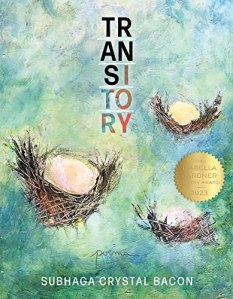
Transitory by Subhaga Crystal Bacon (2023)
In her Isabella Gardner Award-winning fourth collection, queer poet Subhaga Crystal Bacon commemorates the 46 trans and gender-nonconforming people murdered in the United States and Puerto Rico in 2020—an “epidemic of violence” that coincided with the Covid-19 pandemic.
 The book arose from a workshop Bacon attended on writing “formal poems of social protest.” Among the forms employed here are acrostics and erasures performed on news articles—ironically appropriate for reversing trans erasure. She devotes one elegy to each hate-crime victim, titling it with their name and age as well as the location and date of the killing, and sifting through key details of their life and death. Often, trans people are misgendered or deadnamed in prison, by ambulance staff, or after death, so a crucial element of the tributes is remembering them all by chosen name and gender.
The statistics Bacon conveys are heartbreaking: “The average life expectancy of a Black trans woman is 35 years of age”; “Half of Black trans women spend time in jail”; “Trans people are anywhere/ between eleven and forty percent/ of the homeless population.” She also draws on her own experience of gender nonconformity: “A little butch./ A little femme.” She recalls of visiting drag bars in the 1980s: “We were all/ trying on gender.” And she vows: “No one can say a life is not right./ I have room for you in me.” Her poetic memorial is a valuable exercise in empathy.
Published by BOA Editions. Reprinted with permission from Shelf Awareness.
I was interested to note that the below poets initially published under both female and male, new and dead names, as shown on the book covers. However, a look at social media makes it clear that the trans women are now going exclusively by female names.
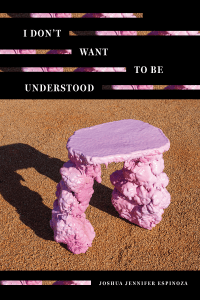
I Don’t Want to Be Understood by Jennifer Espinoza (2024)
In Espinoza’s undaunted fourth poetry collection, transgender identity allows for reinvention but also entails fear of physical and legislative violence.
 Two poems, both entitled “Airport Ritual,” articulate panic during a security pat-down on the way to visit family. In the first, a woman quells her apprehension by imagining a surreal outcome: her genitals expand infinitely, “tearing through her clothes and revealing an amorphous blob of cosmic energy.” In the second, the speaker chants the reassuring mantra, “I am not afraid.” “Makeup Ritual” vacillates between feminism and conformity; “I don’t even leave the house unless/ I’ve had time to build a world on my face/ and make myself palatable/ for public consumption.” Makeup is “your armor,” Espinoza writes in “You’re Going to Die Today,” as she describes the terror she feels toward the negative attention she receives when she walks her dog without wearing it. The murders of trans people lead the speaker to picture her own in “Game Animal.” Violence can be less literal and more insidious, but just as harmful, as in a reference to “the day the government announced another plan to strip a few/ more basic rights from trans people.”
Words build into stanzas, prose paragraphs, a zigzag line, or cross-hatching. Espinoza likens the body to a vessel for traumatic memories: “time is a body full of damage// that is constantly trying to forget.” Alliteration and repetition construct litanies of rejection but, ultimately, of hope: “When I call myself a woman I am praying.”
Published by Alice James Books. Reprinted with permission from Shelf Awareness.
Transgenesis by Ava Winter (2024)
“The body is holy / and is made holy in its changing.”
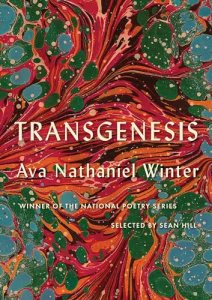 Winter’s debut full-length collection, selected by Sean Hill for the National Poetry Series, reckons with Jewishness as much as with gender identity. The second half of the title references any beginning, but specifically the scriptural account of creation and the lives of the matriarchs and patriarchs of the Abrahamic faiths. Poems are entitled “Torah Study” and “Midrash” (whence the above quote), and two extended sections, “Archived Light” and “Playing with the Jew,” reflect on Polish paternal family members’ arrival at Auschwitz and the dubious practice of selling Holocaust and Nazi memorabilia as antiques. Pharmaceuticals and fashion alike are tokens of transformation –
Let me greet now,
with warm embrace,
the small blue tablets
I place beneath my tongue each morning.
Oh estradiol,
daily reminder
of what our bodies
have always known:
the many forms of beauty that might be made
flesh by desire, by chance, by animal action.
(from “Transgenesis”)
The first time I wore a dress in public without a hint of irony—a Max Mara wrap adorned with Japanese lilies that framed my shoulders perfectly—I was still thin but also thickly bearded and men on the train whispered to me in a conspiratorial tone, as if they hoped the dress were a joke I might let them in on.
(from “WWII SS Wiking Division Badge, $55”)
– and faith grants affirmation that “there is beauty in such queer and fruitless bodies,” as the title poem insists, with reference to the saris (nonbinary person) acknowledged by the Talmudic rabbis. “Lament with Cello Accompaniment” provides an achingly gorgeous end to the collection:
I do not choose the sound of the song
In my mouth, the fading taste of what I still live through, but I choose this future, as I bury a name defined by grief, as I enter the silence where my voice will take shape.
Winter teaches English and Women’s and Gender Studies at the University of Nebraska–Lincoln. I’ll look out for more of her work.
Published by Milkweed Editions. (Read via Edelweiss)
More trans poetry I have read:
A Kingdom of Love & Eleanor Among the Saints by Rachel Mann
By nonbinary/gender-nonconforming poets, I have also read:
Surge by Jay Bernard
Like a Tree, Walking by Vahni Capildeo
Some Integrity by Padraig Regan
Don’t Call Us Dead by Danez Smith
Divisible by Itself and One by Kae Tempest
Binded by H Warren
Extra goodies for National Poetry Day:
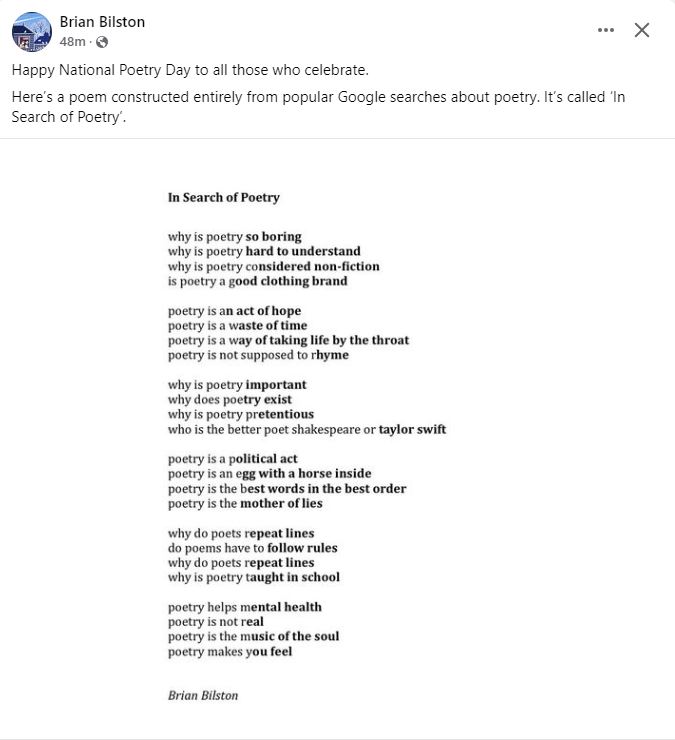
Follow Brian Bilston to add a bit of joy to your feed.
Editor Rosie Storey Hilton announces a poetry anthology Saraband are going to be releasing later this month, Green Verse: Poems for our Planet. I’ll hope to review it soon.
Two poems that have been taking the top of my head off recently (in Emily Dickinson’s phrasing), from Poetry Unbound (left) and Seamus Heaney’s Field Work:


The Wellcome Book Prize 2019 Longlist: Reactions & Shadow Panel Reading Strategy
The 2019 Wellcome Book Prize longlist was announced on Tuesday. From the prize’s website, you can click on any of these 12 books’ covers, titles or authors to get more information about them.
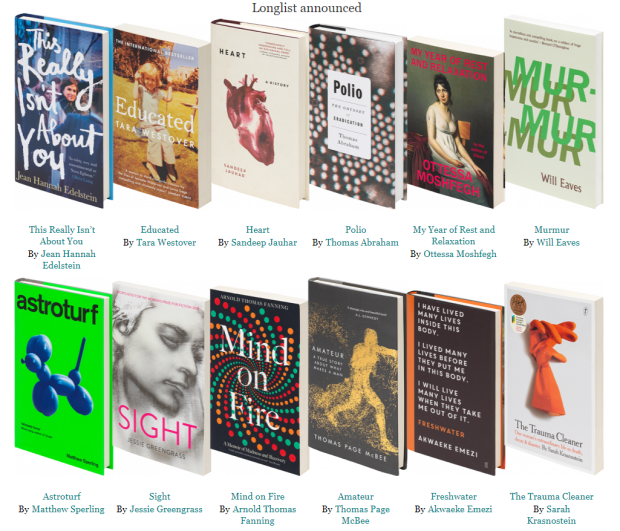
This year marks the 10th anniversary of the prize. As always, it’s a strong and varied set of nominees, with an overall focus on gender and mental health. Here are some initial thoughts (see also Laura’s thorough rundown of the 12 nominees):

- I correctly predicted just two, Sight by Jessie Greengrass and Heart: A History by Sandeep Jauhar, but had read another three: This Really Isn’t About You by Jean Hannah Edelstein, Amateur by Thomas Page McBee, and Educated by Tara Westover (reviewed for BookBrowse).
- I’m particularly delighted to see Edelstein on the longlist as her book was one of my runners-up from last year and deserves more attention.
- I’m not personally a huge fan of the Greengrass or McBee books, but can certainly see why the judges thought them worthy of inclusion.
- Though it’s a brilliant memoir, I never would have thought to put Educated on my potential Wellcome list. However, the more I think about it, the more health elements it has: her father’s possible bipolar disorder, her brother’s brain damage, her survivalist family’s rejection of modern medicine, her mother’s career in midwifery and herbalism, and her own mental breakdown at Cambridge.
- Books I knew about and was keen to read but hadn’t thought of in conjunction with the prize: The Trauma Cleaner by Sarah Krasnostein and My Year of Rest and Relaxation by Ottessa Moshfegh.
- Novels I had heard of but wasn’t necessarily interested in beforehand: Murmur by Will Eaves and Freshwater by Akwaeke Emezi. I went to get Freshwater from the library the afternoon of the longlist announcement and am now 60 pages in. I’d be tempted to call it this year’s Stay with Me except that the magic realist elements are much stronger here, reminding me of what I know about work by Chigozie Obioma and Ben Okri. The novel is narrated in the first person plural by a pair of (gods? demons? spirits?) inhabiting Ada’s head.
- And lastly, there are a few books I had never even heard of: Polio: The Odyssey of Eradication by Thomas Abraham, Mind on Fire: A Memoir of Madness and Recovery by Arnold Thomas Fanning, and Astroturf by Matthew Sperling. I’m keen on the Fanning but not so much on the other two. Polio will likely make it to the shortlist as this year’s answer to The Vaccine Race; if it does, I’ll read it then.

Some statistics on this year’s longlist, courtesy of a press release sent by Midas PR:
- Five novels (two more than last year – I think we can see the influence of novelist Elif Shafak), five memoirs, one biography, and one further nonfiction title
- Six debut authors
- Six titles from independent publishers (Canongate, CB Editions, Faber & Faber, Oneworld, Hurst Publishers, and The Text Publishing Company)
- Most of the authors are British or American, while Fanning is Irish (Emezi is Nigerian-American, Jauhar is Indian-American, and Krasnostein is Australian-American).
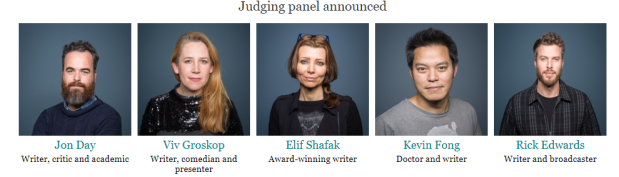
Chair of judges Elif Shafak writes: “In a world that remains sadly divided into echo chambers and mental ghettoes, this prize is unique in its ability to connect various disciplines: medicine, health, literature, art and science. Reading and discussing at length all the books on our list has been fascinating from the very start. We now have a wonderful longlist, of which we are all very proud. Although it sure won’t be easy to choose the shortlist, and then, finally, the winner, I am thrilled about and truly grateful for this fascinating journey through stories, ideas, ground-breaking research and revolutionary knowledge.”
We of the shadow panel have divided up the longlist titles between us as follows (though we may well each get hold of and read more of the books, simply out of personal interest) and will post reviews on our blogs within the next five weeks.
Amateur: A true story about what makes a man by Thomas Page McBee – LAURA
Astroturf by Matthew Sperling – PAUL
Educated by Tara Westover – CLARE
Freshwater by Akwaeke Emezi – REBECCA
Heart: A history by Sandeep Jauhar – LAURA
Mind on Fire: A memoir of madness and recovery by Arnold Thomas Fanning – REBECCA
Murmur by Will Eaves – PAUL
My Year of Rest and Relaxation by Ottessa Moshfegh – CLARE
Polio: The odyssey of eradication by Thomas Abraham – ANNABEL
[Sight by Jessie Greengrass – 4 of us have read this; I’ll post a composite of our thoughts]
The Trauma Cleaner: One woman’s extraordinary life in death, decay and disaster by Sarah Krasnostein – ANNABEL
This Really Isn’t About You by Jean Hannah Edelstein – LAURA
The Wellcome Book Prize shortlist will be announced on Tuesday, March 19th, and the winner will be revealed on Wednesday, May 1st.
We plan to choose our own shortlist to announce on Friday, March 15th. Follow along here and on Halfman, Halfbook, Annabookbel, A Little Blog of Books, and Dr. Laura Tisdall for reviews and predictions.
Are there any books on here that you’d like to read?
Two Records of Bodily Transformation: Amateur and Shapeshifters
Amateur: A True Story about What Makes a Man, Thomas Page McBee
 Thomas Page McBee was the first transgender man to box at Madison Square Garden. In his second memoir, which arose from a Quartz article entitled “Why Men Fight,” he recounts the training leading up to his charity match and ponders whether aggression is a natural male trait. McBee grew up in a small town outside Pittsburgh with a stepfather who sexually abused him from age four. In 2011 he started the testosterone injections that would begin his gender transformation. During the years that followed, other men seemed to pick fights with him fairly often, and he was unsure what to do about it. Finally, in 2015, the Manhattan editor decided to confront the belligerent male stereotype by starting boxing training.
What I most appreciated were the author’s observations of how others have related to him since his transition. He notices that he’s taken more seriously at work as a man, and that he can be an object of fear – when jogging behind a woman at night, for instance. One of the most eye-opening moments of the book is when he realizes that he’s been talking over his own sister. Thankfully, McBee is sensitive enough to stop and change, recognizing that kindness and vulnerability are not faults but attributes any person should be proud of.
I have a feeling I would have preferred his previous memoir, Man Alive, which sounds like it has more about the transition itself. Jonathan Eig’s biography of Muhammad Ali is one of the best books I’ve read this year, and in comparison I didn’t find the boxing writing here very interesting. Likewise, this pales beside two similar but more perceptive books I’ve read that have been hugely influential on my own understanding of gender identity: Conundrum by Jan Morris and The Argonauts by Maggie Nelson.
My rating: 
Amateur was published in the UK by Canongate on August 2nd. My thanks to the publisher for the free copy for review.
Shapeshifters: On Medicine and Human Change by Gavin Francis
 Gavin Francis is a physician with a practice near Edinburgh. His latest book is like a taster course in medical topics. The overarching theme is the modifications the body undergoes, so there are chapters on, for example, body-building, tattoos, puberty, prosthetic limbs, dementia and menopause. Over his years in general practice Francis has gotten to know his patients’ stories and seen them change, for better or worse. These anecdotes of transformation are one source for his book, but he also applies insight from history, mythology, literature, etymology and more. So in a chapter on conception he discusses the Virgin Mary myth, Leonardo da Vinci’s fetal diagrams, the physiological changes pregnant women experience, and the case of a patient, Hannah, who had three difficult, surprise pregnancies in quick succession.
We are all in the process of various transformations, Francis argues, whether by choice or involuntarily. (I decided on the link with McBee because of a chapter on sex changes.) I was less convinced by the author’s inclusion of temporary, reversible changes such as sleep, hallucinations, jet lag and laughter. And while each chapter is finely wrought, I felt some sort of chronological or anatomical order was necessary to give the book more focus. All the same, I suspect this will be a strong contender for next year’s Wellcome Book Prize because of its broad relevance to human health and its compassionate picture of bodies in flux.
My rating: 
Shapeshifters was published by the Wellcome Collection/Profile Books on May 2nd. My thanks to the publisher for the proof copy for review.
 Bookish Beck = Rebecca Foster. American transplant to England. Freelance proofreader and book reviewer.
 Bookish Beck