Four Recommended May Releases
Here are four enjoyable books due out next month that I was lucky enough to read early. The first two are memoirs, the third is an audacious poetry book by an author new to me, and the last is the sophomore novel from an author I’ve loved before. I’ve pulled 250-word extracts from my full reviews and hope you’ll be tempted by one or more of these.
Last Things: A Graphic Memoir of Loss and Love by Marissa Moss
(Coming from Conari Press on May 1st [USA]; June 8th in UK)
 “You’re not aware of last things,” Moss, a children’s book author/illustrator, writes in this wrenching memoir of losing her husband to ALS. We look forward to and celebrate all of life’s firsts, but we never know until afterwards when we’ve experienced a last. The author’s husband, Harvey Stahl, was a medieval art historian working on a book about Louis IX’s prayer book. ALS is always a devastating diagnosis, but Harvey had the particularly severe bulbar variety, and his lungs were quick to succumb. His battery-powered ventilator led to many scares – one time Moss had to plug him into the wall at a gas station and rush home for a spare battery – and he also underwent an emergency tracheotomy surgery.
This is an emotionally draining read. It’s distressing to see how, instead of drawing closer and relying on each other, Marisa and Harvey drifted apart. Harvey pushed everyone away and focused on finishing his book and returning to his academic duties. He refused to accept his limitations and resisted necessary medical interventions. Meanwhile, Moss struggled with the unwanted role of caregiver while trying not to neglect her children and her own career.
I’ve read several nonfiction books about ALS now. Compared to the other two, Moss gets the tone just right. She’s a reliable witness to a medical and bureaucratic nightmare. At the distance of years, though, she writes about the experience without bitterness. I can see this graphic novel being especially helpful to older teens with a terminally ill parent.
My rating: 
My Life with Bob: Flawed Heroine Keeps Book of Books, Plot Ensues by Pamela Paul
(Coming from Henry Holt on May 2nd [USA]; June 13th in UK)
 I hold books about books to high standards and won’t stand for the slightest hint of plot summary, filler or spoilers. It’s all too easy for an author to concentrate on certain, often obscure books that mean a lot to him/her, dissecting the plots without conveying a sense of the wider appeal. The trick is to find the universal in the particular, and vice versa.
Pamela Paul, editor of the New York Times Book Review, does this absolutely perfectly. In 1988, as a high school junior, she started keeping track of her reading in a simple notebook she dubbed “Bob,” her Book of Books. In this memoir she delves into Bob to explain how her reading both reflected and shaped her character. The focus is unfailingly on books’ interplay with her life, such that each one mentioned more than earns its place.
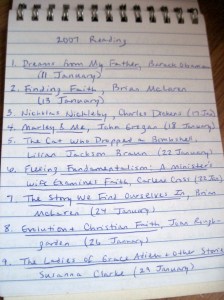
A page from my 2007 reading diary. Lots of mid-faith-crisis religion titles there. Starting in 2009, I think, I’ve kept this information in an annual computer file instead.
So whether she was hoarding castoffs from her bookstore job, obsessing about ticking off everything in the Norton Anthology, despairing that she’d run out of reading material in a remote yurt in China, or fretting that her husband took a fundamentally different approach to the works of Thomas Mann, Paul always looks beyond the books themselves to interrogate what they say about herself.
This is the sort of book I wish I had written. If you have even the slightest fondness for books about books, you won’t want to miss this one. I’ve found a new favorite bibliomemoir, and an early entry on the Best of 2017 list.
My rating: 
Nature Poem by Tommy Pico
(Coming on May 9th from Tin House Books)
 Tommy “Teebs” Pico is a Native American from the Kumeyaay nation and grew up on the Viejas Indian reservation. This funny, sexy, politically aware multi-part poem was written as a collective rebuttal to the kind of line he often gets in gay bars, something along the lines of ‘oh, you’re an Indian poet, so you must write about nature?’ Au contraire: Pico’s comfort zone is the urban, the pop cultural, and the technologically up-to-date – his poems are full of textspeak (“yr,” “bc” for because, “rn” for right now, “NDN” for Indian), an affectation that would ordinarily bother me but that I tolerated here because of Pico’s irrepressible sass: “I wd give a wedgie to a sacred mountain and gladly piss on the grass of / the park of poetic form / while no one’s lookin.”
Some more favorite lines:
“How do statues become more galvanizing than refugees / is not something I wd include in a nature poem.”
“Knowing the moon is inescapable tonight / and the tuft of yr chest against my shoulder blades— / This is a kind of nature I would write a poem about.”
“I can’t write a nature poem bc English is some Stockholm shit, makes me complicit in my tribe’s erasure”
“It’s hard to unhook the heavy marble Nature from the chain around yr neck / when history is stolen like water. // Reclamation suggests social / capital”
My rating: 
The Awkward Age by Francesca Segal
(Coming on May 4th from Chatto & Windus [UK] and May 16th from Riverhead Books [USA])
 I adored Segal’s first novel, The Innocents, a sophisticated remake of Edith Wharton’s The Age of Innocence set in a contemporary Jewish community in London. I wasn’t as fond of this second book, but in her study of an unusual blended family the characterization is nearly as strong as in her debut. Julia Alden lost her husband to cancer five years ago. A second chance at happiness came when James Fuller, a divorced American obstetrician, came to her for piano lessons. He soon moved into Julia and sixteen-year-old Gwen’s northwest London home, and his seventeen-year-old son, Nathan, away at boarding school, came on weekends.
Julia is as ill at ease with Nathan as James is with Gwen, and the kids seem to hate each other. That is until, on a trip to Boston for Thanksgiving with James’s ex, Gwen and Nathan fall for each other. Awkward is one way of putting it. They’re not technically step-siblings as James and Julia aren’t married, but it doesn’t sit right with the adults, and it will have unexpected consequences.
The first third or so of the book was my favorite, comparable to Jonathan Safran Foer or Jonathan Franzen. Before long the romantic comedy atmosphere tips into YA melodrama, but for me the book was saved by a few things: a balance of generations, with Gwen’s grandparents a delightful background presence; the eye to the past, whether it be Gwen’s late father or the occasional Jewish ritual; the Anglo-American element; and a realistic ending.
My rating:
Have you read any May releases that you would recommend? Which of these do you fancy?
Graphic Novels for Newbies
Following on from last week’s article on quick reads…
I sometimes wonder if counting graphic novels on my year lists is a bit like cheating, since some are little more than comic books. However, the majority of graphic novels I read have a definite storyline and more words on a page than your average comic. When I worked in London I took advantage of the extensive public library holdings there and tried out a lot of graphic novelists’ work that was new to me. Some of my favorites are Alison Bechdel, Posy Simmonds, Audrey Niffenegger and Joe Sacco. As it happens, I’ve never officially reviewed graphic novels (nor do I own any), but here’s a handful I’ve enjoyed, along with my reading notes:
 Fun Home: A Family Tragicomic by Alison Bechdel
This memoir in graphic novel form is super. Bechdel puts the ‘fun’ in both dysfunctional family and funeral home – the family business her father inherited in small-town Pennsylvania. All through her 1970s upbringing, as Alison grew up coveting men’s shirts and feeling strange quivers of suspicion when she encountered the word “lesbian” in the dictionary, her father was leading a double life, sleeping with the younger men who babysat his kids or helped out with his twin passions of gardening and home renovation.
In an ironic sequence of events, the coming-out letter Alison sent home from college was followed just weeks later by her mother’s revelation of her father’s homosexual indiscretions and their upcoming divorce, and then no more than a few months later by her father’s sudden death. Bruce Bechdel was run down by a Sunbeam Bread truck as he was crossing the road with an armload of cleared brush from a property he was renovating. Was it suicide, or just a horribly arbitrary accident? (The Sunbeam Bread detail sure makes one cringe.) In any case, it was a “mort imbécile,” just as Camus characterized any death by automobile.
Bechdel traces the hints of queerness in her family, the moments when she and her father saw into each other and recognized something familiar. She also muses on the family as a group of frustrated and isolated artists each striving, unfulfilled, towards perfection. This is a thoughtful, powerful memoir, and no less so for being told through a comic strip.
(Bechdel’s Are You My Mother? was also on my BookTrib list of mother–daughter memoirs to read for Mother’s Day.)
 Blankets by Craig Thompson
This sweet, autobiographical coming-of-age story in graphic novel form is not quite as likable and quick-witted as Fun Home, but it has similar themes such as sexual awakening and the difficulty of understanding one’s parents. Blankets are a linking metaphor: the quilt Craig’s first love, Raina, makes for him; huddling in the same bed with his little brother Phil for warmth during freezing Wisconsin winters; and playing ‘storm at sea’ with the covers.
There’s also an interesting loss-of-faith element to the narrative. Craig is brought up in your average Midwestern fundamentalist Evangelical church and attends youth group, camp, etc. (where he meets Raina); the pastor even wants him to consider going into the ministry, but he doesn’t fit in here – even in the Christian subculture he’s forced into a fringe group of outsiders. Writing and drawing are acts of self-creation and self-preservation. He wants to find a way to use his drawing for good but no one seems to see a value in it. Thus everything, or nothing in particular, leads him to reject his faith when he gets to college.
How satisfying it is to leave a mark on a blank surface. To make a map of my movement – no matter how temporary.
The drawings are lush and bold (though even more so in Thompson’s Habibi). [SPOILERS ahead!] I appreciated how Thompson denies the satisfaction of a happy ending to Craig and Raina’s love story; it’s more realistic this way, recognizing that high school sweethearts rarely stay together. As Raina says, “everything ENDS…everything DEGENERATES, CRUMBLES – so why bother getting started in the first place?” And yet the beauty and power in memory of young love remains, thus Thompson’s rhapsodizing here.
 Mrs Weber’s Omnibus by Posy Simmonds
[a collection of her comics for the Guardian]
As with the Garfield cartoons, you get to see the development of Simmonds’s style and the characters, as well as the march of fashion over the period 1977–1993. Very clever skewering of middle class liberal values and political correctness gone mad: the characters (especially polytechnic sociology lecturer George, in the Department of Liberal Studies, and children’s book author Wendy Weber) espouse these values, but their actions don’t always live up to the tolerance they preach. Here are some of the themes:
- 1980s politics: reactionary against Thatcherism; youth unemployment and purposelessness; income inequality; economic and social injustice
- Hypocrisy, avoiding unpleasant truths, compromising youthful ideals
- Middle vs. upper-middle / upper class: second homes, private education
- Place of women: the irony that stay-at-home motherhood is idealized and the difficulties of working motherhood denied (women – liberated to do what?)
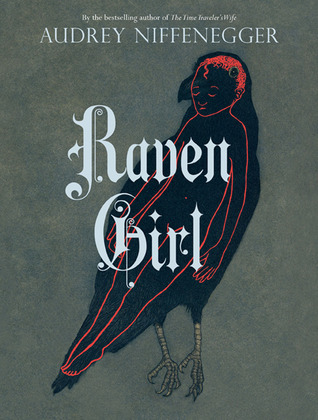 Raven Girl by Audrey Niffenegger
A lovely and simple fairy tale, with classical plot elements like transformation and true love transcending all boundaries. In a quaint English setting, a country postman is tasked with delivering a letter to an address he’s never seen before:
Dripping Rock
Raven’s Nest
2 Flat Drab Manor
East Underwhelm, Otherworld
EE1 LH9 [postcode = East of East, Lower Heights]
Here the postman meets a young raven fallen out of her nest, takes her home to mend her and they fall in love. Even when her wing heals and she can fly, she chooses to stay with him. Their daughter is a mixed creature; she can only croak, but she has no wings and so is raised as a human child. At university she meets a plastic surgeon who can create human-animal chimeras; she begs him to make her wings – a mixture of science and magic. It involves bloody surgery and painful recovery, but in the end she has the wings she’s always felt were hers. Her identity is described in terms very much like Jan Morris’s in Conundrum, when describing her sex change and her knowledge that she was really a girl: “My mother is a raven and my father is a postman, but I feel that truly I should have been a raven.”
Like Niffenegger’s other work, there’s an ever so slightly uncomfortable blend of sinister/grotesque elements with charming, innocuous magic.
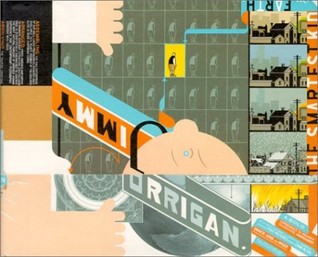 Jimmy Corrigan, the Smartest Kid on Earth by Chris Ware
This is probably the most peculiar graphic novel I’ve ever read. It’s the story of Jimmy Corrigan, a sad-sack workaholic who, at 36, has no friends apart from his mother, who constantly telephones him. One day he gets a letter from the father he’s never met, asking him to come meet him. And so Jimmy gets on a plane from Chicago out to suburban Michigan. Corrigan is one of those unfortunate-looking fellows who has a potato for a head and a wispy comb-over, and could be anywhere between 30 and 60; he looked little different as a child in the flashback scenes – somewhat like Charlie Brown, also in his depression, diffidence and inability to speak to women.
I much preferred the historical interludes looking at his grandfather (another Jimmy) and his years growing up in Chicago with the World’s Fair under construction. I also liked the more random additions such as patterns for cutting and folding your own model village or business cards with ‘scenic views’ of today’s Waukosha, MI on them.
Parental (verbal) abuse and neglect is a recurring theme, as are bullying from peers, car accidents, and Superman. There’s also an uncomfortable amount of imagined violence – either homicide or suicide.
Also recommended:
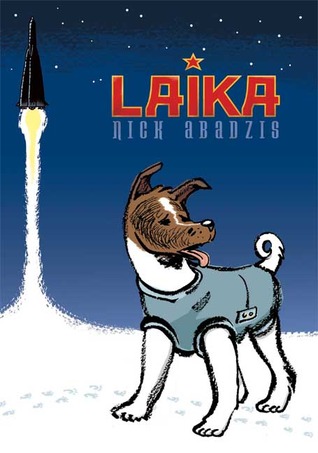 Laika by Nick Abadzis
Palestine by Joe Sacco
Couch Fiction by Philippa Perry
Days of the Bagnold Summer by Joff Winterhart
Do you read graphic novels? What are some of your favorites?
 Bookish Beck = Rebecca Foster. American transplant to England. Freelance proofreader and book reviewer.
