(Goodbye to) Winter Reads by Sylvia Plath (#ReadIndies) & Kathleen Winter
The sunshine, temperatures and flora suggest that spring is here to stay, though I wouldn’t be surprised by a return of the cold and wet in March. We live in the wrong part of the UK for snow lovers; we didn’t get any snow this winter, apart from some early-morning flurries one day when I was fast asleep. My seasonal reading consisted of a lesser-known posthumous poetry collection, a record of a sea voyage past Greenland, and a silly children’s book.
Winter Trees by Sylvia Plath (1971)
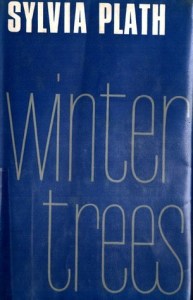 A prefatory note from Ted Hughes explains that these poems “are all out of the batch from which the Ariel poems were more or less arbitrarily chosen and they were all composed in the last nine months of Sylvia Plath’s life.” Ariel is much the stronger collection. There are only 19 poems here; the final one, “Three Women,” is more of a play (subtitled “A Poem for Three Voices”) set on a maternity ward. Motherhood is a central concern throughout. There’s harsh, unpleasant language around womanhood in general. The opening title poem is a marvel of artistic imagery, assonance and internal rhyme, but also contains a metaphor that made me cringe: “Knowing neither abortions nor bitchery, / Truer than women, / They seed so effortlessly!”


That paints motherhood as hard won, as “Childless Woman” reinforces by turning purposeless menstruation into a horror story with its vocabulary of “a child’s shriek” — “Spiderlike” — “Uttering nothing but blood— / Taste it, dark red!” — “My funeral” — “the mouths of corpses”. Plath was certainly ambivalent about babies (“Thalidomide” is particularly frightening) but I bristled at childlessness being linked with living only for oneself. Then again, pretty much everything – men, God, travel, animals – is portrayed negatively here. “Winter Trees” is the single poem I’d anthologize. (University library) 
Published by Faber, so counts for #ReadIndies
Boundless: Adventures in the Northwest Passage by Kathleen Winter (2015)
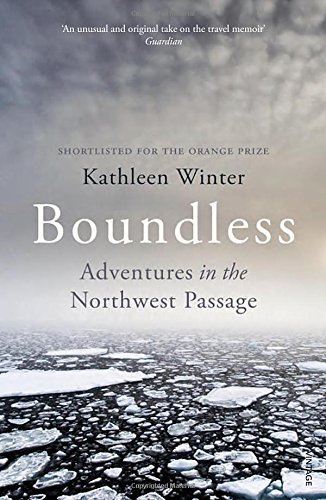 I read this excellent travel book slowly, over most of the winter, including during that surreal period when He Who Shall Not Be Named was threatening to annex Greenland. Winter was invited to be a writer-in-residence aboard an icebreaker travelling through the Northwest Passage, past southwest Greenland and threading between the islands of the Canadian Arctic. She was prepared: a friend had taught her that the only thing to say in these sorts of lucky, unexpected scenarios is “My bags are already packed.” Her ‘getaway bag’ of two pairs of underwear, a T-shirt, a pair of jeans, and a LBD wasn’t exactly Arctic-ready, but she still had a head start. She adds an old concertina and worn hiking boots that resemble “lobes of some mushroom cracked off the bole of an old warrior tree.”
It’s not a long or gruelling trip, so there’s not much of the bellyaching that bores me in trekking books. Winter is interested in everything: birds, folk music, Indigenous arts and crafts, her fellow passengers’ stories, the infamous lost Arctic expeditions, and her family’s history in England and Canada. She collects her scraps of notes in a Ziploc, and that’s what this book is – a grab bag. Winter is enthusiastic yet prioritizes quiet epiphanies about the sacredness of land and creatures over thrills – though their vessel does get stranded on rocks and requires a Coast Guard rescue. It would be interesting to reread her Orange Prize-shortlisted novel about an intersex person, Annabel. (If you hanker to go deeper about Greenland, read This Cold Heaven by Gretel Ehrlich and Miss Smilla’s Feeling for Snow by Peter Høeg.) (Secondhand – Bas Books) 
& A bonus children’s book:
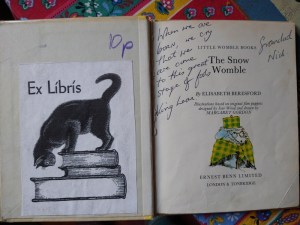
 The Snow Womble by Elisabeth Beresford; illus. Margaret Gordon (1975) – I thought this would be a cute one to read even though I’m unfamiliar with the Wombles. But it’s just a one-note extended joke about the creatures not being able to tell their snowman version of Great-Uncle Bulgaria apart from the real one. The best thing about reading this was the frontispiece’s juxtaposition of elements: the computer-printed bookplate, the nominal secondhand price (withdrawn from London Borough of Sutton Public Libraries), and the wholly inappropriate inscription Grandad Nick chose from King Lear! (Little Free Library)
October Books: Ballard, Czarnecki, Moss, Oliver, Ostriker, Steed & More
Apparently October is THE biggest month of the year for new releases. A sterling set came my way this year, including two beautiful novella-length memoirs, a luxuriantly illustrated work dedicated to an everyday bird species, two very different but equally elegant poetry collections, and a book of offbeat comics. Time and concentration only allow for a paragraph or so on each, but I hope that gives a flavour of the contents and will pique interest in the ones that suit you best. Plus I excerpt and link to my BookBrowse review of a poignant story of sisters and mental illness, and my Shelf Awareness review of a fantastic graphic novel adaptation.
Bound: A Memoir of Making and Remaking by Maddie Ballard
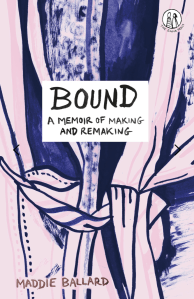 This collection of micro-essays considers sewing and much more. Each piece is headed by a pattern name and list of materials that Ballard made into an article of clothing for herself or for someone else. Among the minutiae of the craft, she slips in so many threads: about her mixed Chinese heritage and her relationship with her grandmother, about the environmental and financial benefits of making one’s own clothing, and especially about the upheaval of her twenties: the pandemic, a break-up, leaving a job to go back to school, finding roommates. I can barely mend a sock and I’m clueless when it comes to fashion, yet I can appreciate how sewing blends comfort and creativity. Ballard presents it as a meditative act of self-care:
I lower the needle and the world recedes. The process of sewing a garment – printing the pattern, tracing and cutting, sewing the first and the second and the fiftieth seam – is a lesson in taking your time.
Like gardening, sewing is an investment in the future – in what sort of person your future self will be, and how she will feel about her body, and what she will want to wear.
Similar to two other very short works of nonfiction I’ve read from The Emma Press, How Kyoto Breaks Your Heart by Florentyna Leow and Tiny Moons by Nina Mingya Powles (Ballard, too, is from New Zealand), this is a graceful, enriching book about a young woman making her way in the world and figuring out what is essential to her sense of home and identity. I commend it whether or not you have any particular interest in handicraft.
With thanks to The Emma Press for the free copy for review.
Encounters with Inscriptions: A Memoir Exploring Books Gifted by Parents by Kristin Czarnecki
When Kristin Czarnecki got in touch to offer a copy of her bibliomemoir about revisiting the books her late parents gifted her, I was instantly intrigued but couldn’t have known in advance how perfect it would be for me. Niche it might seem, but it combines several of my reading interests: bereavement, books about books, relationships with parents (especially a mother) and literary travels.
 The book starts, aptly, with childhood. A volume of Shel Silverstein poetry and A Child’s Christmas in Wales serve as perfect vehicles for the memories of how her parents passed on their love of literature and created family holiday rituals. Thereafter, the chapters are not strictly chronological but thematic. A work of women’s history opens up her mother’s involvement in the feminist movement; reading a Thomas Merton book reveals why his thinking was so important to her Catholic father. The interplay of literary criticism, cultural commentary and personal significance is especially effective in pieces on Alice Munro and Flannery O’Connor. A Virginia Woolf biography points to Czarnecki’s academic specialism and a cookbook to how food embodies memories.
It seems fitting to be reviewing this on the second anniversary of my mother’s death. The afterword, which follows on from the philosophical encouragement of a chapter on the Rubaiyat of Omar Khayyam, exhorts readers to cherish loved ones while we can – and be grateful for the tokens they leave behind. I had told Kristin about books my parents inscribed to me, as well as the journals I inherited from my mother. But I didn’t know there would be other specific connections between us, too, such as being childfree and hopeless in the kitchen. (Also, I have family in South Bend, Indiana, where she’s from, and our mothers were born in the first week of August.) All that to say, I felt that I found a kindred spirit in this lovely book, which is one of the nicest things that happens through reading.
With thanks to the author for the advanced e-copy for review.
The Starling: A Biography by Stephen Moss
 Moss has written a whole series of accessible bird species monographs suitable for nature buffs; this is the sixth. (I’ve not read the others, just Moss’s Wild Hares and Hummingbirds and Skylarks with Rosie, but we do have a copy of The Robin on the shelf that I’ve earmarked for Christmas.) The choice of the term ‘biography’ indicates the meeting of a comprehensive aim and intimate detail. The book conveys much anatomical and historical information about the starling’s relatives, habits, and worldwide spread, yet is only 187 pages – and plenty of those feature relevant paintings and photographs, too. It’s well known that starlings were introduced to Anglophone countries as part of misguided “acclimatisation” projects that we would now dub cultural imperialism. In the USA and elsewhere, the bird is still considered common. But with the industrialisation of agriculture, starlings are actually having less breeding success and thus are in decline.
Overall, the style of the book is dry and slightly workmanlike. However, when he’s recounting murmurations he’s seen in Somerset or read about, Moss’s enthusiasm lifts it into something special. Autumn dusk is a great time to start watching out for starling gatherings. I love observing and listening to the starlings just in the treetops and aerials of my neighbourhood, but we do also have a small local murmuration that I try to catch at least a few times in the season. Here’s how he describes their magic: “At a time when, both as a society and as individuals, we are less and less in touch with the natural world, attending this fleeting but memorable event is a way we can reconnect, regain our primal sense of wonder – and still be home in time for tea.”
With thanks to Square Peg, an imprint of Vintage (Penguin Random House) for the free copy for review.
The Alcestis Machine by Carolyn Oliver
 Carolyn is a blogger friend whose first collection, Inside the Storm I Want to Touch the Tremble, was on my Best Books of 2022 list. Her second is again characterized by precise vocabulary and crystalline imagery, often related to etymology, book history, or pigments (“You and I are marginalia shadowed / by a careless hand, we are gall-soaked vellum / invisible appetites consume.”). Astronomy and technology are a counterpoint, juxtaposing the ancient and the cutting-edge. I loved the language of sea creatures in “Strange Attractor” and the oblique approach to the passage of time (“Three popes ago, you and I”). The repeated three-word opening “In another life” gives a sense of many worlds, e.g., “In another life I’m a florist sometimes accused of inappropriate gravity.” Prose poems relay childhood memories. Love poems are tantalizing and utterly original: “If I promise not to describe the moon, will you / come with me a ways further into the night? / We’ll wash the forest floor / of ash and find a fairy ring / half-eaten, muted crescent bereft of power.” And alliteration never fails to win me over: “Tonight, snow tumbles over sophomores and starlings” and “the pillars in the water make a pillory not a pier”. Some of the collection remained cryptic for me; there was a bit less that grabbed me emotionally. But it’s still stirring work. And how flabbergasted was I to spot my name in the Acknowledgments? (Read via Edelweiss)
The Holy & Broken Bliss: Poems in Plague Time by Alicia Ostriker
“The words of an old woman shuffling the cards of her own decline the decline
of her husband the decline of her nation her plague-smitten world”
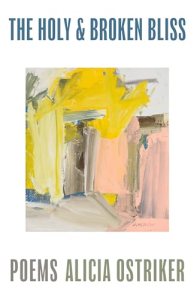 Out of pandemic isolation come new rituals: watching days and seasons pass, fighting for her own health but mostly her husband’s, and lamenting public displays of hate. Lines feel stark with honesty; some poems are just haiku length. Elsewhere, repetition and alliteration create a wistful tone. Jewish scripture and mysticism are the source of much of the language and outlook. Music and nature, too, promise the transcendent. Simple and remarkable. Here’s a stanza about late autumn:
It is almost winter and still
as I walk to the clinic the gingkos
sing their seraphic air
as if there is no tomorrow
With thanks to Alice James Books for the advanced e-copy for review.
Forces of Nature by Edward Steed
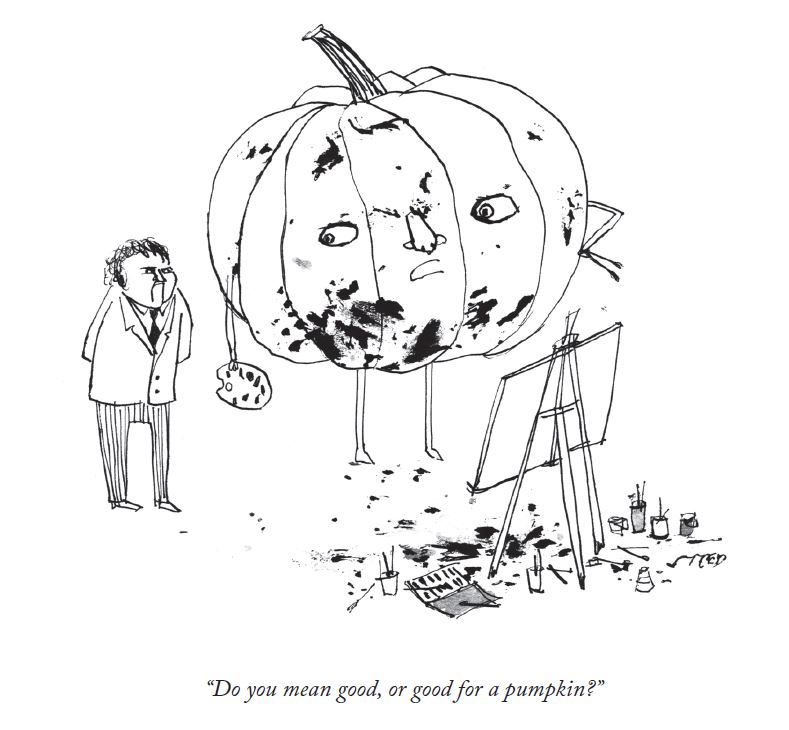
 Steed is a longtime New Yorker cartoonist who produces single panels. This means there is no story progression (as in a graphic novel), just what you see on one page. Some of the comics are wordless; many scenes are visual gags which, to be entirely honest, I didn’t always grasp. Steed’s recurring characters are unhappy couples, exiles on desert islands, and dumb cops or criminals. His style is deliberately simplistic: the people not much more advanced than stick figures and the animals especially sketchy. There are multiple attempted prison breaks and satirical depictions of God and the Garden of Eden. Many of the setups are contrived, and the tone can be absurd or prickly, even shading into gruesome. These comics weren’t altogether my cup of tea, though I did get a laugh out of a few of them (a seasonal example is below). Endorsed if you fancy a cross between Edward Gorey and The Book of Bunny Suicides.
With thanks to Drawn & Quarterly for the e-copy for review.
Reviewed for BookBrowse:
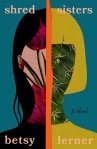 Shred Sisters by Betsy Lerner – “No one will love you more or hurt you more than a sister” is a wry aphorism that appears late in Lerner’s debut novel. Over the course of two decades, there is much heartache for the Shred family, but also moments of joy. Ultimately, a sisterly bond endures despite secrets, betrayals, and intermittent estrangement. Through her psychologically astute portrait of Olivia (“Ollie”) and Amy Shred, Lerner captures the lasting effects that mental illness can have on not just an individual, but an entire family.
Reviewed for Shelf Awareness:
 The Worst Journey in the World, Volume 1: Making Our Easting Down: The Graphic Novel by Sarah Airriess – The thrilling opening to a cinematically vivid adaptation of Apsley Cherry-Garrard’s 1922 memoir. He was an assistant zoologist on Robert Falcon Scott’s 1910-13 Terra Nova expedition to the South Pole. Even before the ship entered the pack ice, the journey was perilous. The book resembles a full-color storyboard for a Disney-style maritime adventure film. There is jolly camaraderie as the men sing sea shanties to boost morale. The second volume can’t arrive soon enough.
10 Days in the USA and What I Read (Plus a Book Haul)
On October 29th, I went to an evening drinks party at a neighbour’s house around the corner. A friend asked me about whether the UK or the USA is “home” and I replied that the States feels less and less like home every time I go, that the culture and politics are ever more foreign to me and the UK’s more progressive society is where I belong. I even made an offhand comment to the effect of: once my mother passed, I didn’t think I’d fly back there often, if at all. I was thinking about 5–10 years into the future; instead, a few hours after I got home from the party, we were awoken by the middle-of-the-night phone call saying my mother had suffered a nonrecoverable brain bleed. The next day she was gone.
I haven’t reflected a lot on the irony of that timing, probably because it feels like too much, but it turns out I was completely wrong: in fact, I’m now returning to the States more often. With our mom gone and our dad not really in our lives, my sister and I have gotten closer. Since October I’ve flown back twice and she’s visited here once. There are 7.5 years between us and we’ve always been at different stages of life, with separate preoccupations and priorities; I was also lazy and let my mom be the go-between, passing family news back and forth. Now there’s a sense that we are all we have, and we have to stick together.


So it was doubly important for me to be there for my sister’s graduation from nursing school last week. If we follow each other on Facebook or Instagram, you will have already seen that she finished at the top of her cohort and was one of just two students recognized for academic excellence out of the college’s over 200 graduates – and all of this while raising four children and coping with the disruption of Mom’s death seven months ago. There were many times when she thought she would have to pause or give up her studies, but she persisted and will start work as a hospice nurse soon. We’re all as proud as could be, on our mom’s behalf, too.
The trip was a mixture of celebratory moments and sad duties. We started the process of going through our mom’s belongings and culling what we can, but the files, photos and mementoes are the real challenge and had to wait for another time. There were dozens of books I’d given her for birthdays and holidays, mostly by her favourite gentle writers – Gerald Durrell, Jan Karon, Gervase Phinn – invariably annotated with her name, the date and occasion. I looked back through them and then let them go.


Between my two suitcases I managed to bring back the rest of her first box of journals (there are 150 of them in total, spanning 1989 to 2022), and I’m halfway through #4 at the moment. We moved out of my first home when I was nine, and I don’t have a lot of vivid memories of those early years. But as I read her record of everyday life it’s like I’m right back in those rooms. I get new glimpses of myself, my dad, my sister, but especially of her – not as my mother, but as a whole person. As a child I never realized she was depressed: distressed about her job situation, worried over conflicts with her siblings and my sister, coping with ill health (she was later diagnosed with fibromyalgia) and resisting ageing. For as strong as her Christian faith was, she was really struggling in ways I couldn’t appreciate then.

I hope that later journals will introduce hindsight, now that she’s not around to give a more circumspect view. In any case, they’re an incredible legacy, a chance for me to relive much of my life that I otherwise would only remember in fragments through photographs, and perhaps have a preview of what I can expect from the course of our shared kidney disease.
What I Read
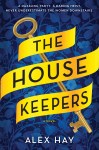 The Housekeepers by Alex Hay – A historical heist novel with shades of Downton Abbey, this comes out in July. Reviewed for Shelf Awareness.

Cowboys Are My Weakness by Pam Houston – Terrific: stark, sexy stories about women who live out West and love cowboys and hunters (as well as dogs and horses). Ten of the stories are in the first person, voiced by women in their twenties and thirties who are looking for romance and adventure and anxiously pondering motherhood (“by the time you get to be thirty, freedom has circled back on itself to mean something totally different from what it did at twenty-one”). The remaining two are in the second person, which I always enjoy. The occasional Montana setting reminded me of stories I’ve read by Maile Meloy and Maggie Shipstead, while the relationship studies made me think of Amy Bloom’s work. 

The Harpy by Megan Hunter – Read for Literary Wives club. Review coming up on Monday. 

The Lake Shore Limited by Sue Miller – A solid set of narratives alternating between the POVs of four characters whose lives converge around a play inspired by the playwright’s loss of her boyfriend on one of the hijacked planes on 9/11. Her mixed feelings about him towards the end of his life and about being shackled to his legacy as his ‘widow’ reverberate in other sections: one about the lead actor, whose wife has ALS; and one about a widower the playwright is being set up with on a date. Fitting for a book about a play, the scenes feel very visual. A little underpowered, but subtlety is to be expected from a Miller novel. She, Anne Tyler and Elizabeth Berg write easy reads with substance, just the kind of book I want to take on an airplane, as indeed I did with this one. I read the first 2/3 on my travel day (although with the 9/11 theme this maybe wasn’t the best choice!).
 For apposite plane reading, I also started Fly Girl by Ann Hood, her memoir of being a TWA flight attendant in the 1970s, the waning glory days of air travel. I’ve read 10 or so of Hood’s books before from various genres, but lost interest in the minutiae of her job applications and interviews. Another writer would probably have made a bigger deal of the inherent sexism of the profession, too. I read 30%.
 Hello Beautiful by Ann Napolitano – I knew I wanted to read this even before it was Oprah’s 100th book club pick. It’s a family story spanning three decades and focusing on the Padavanos, a working-class Italian American Chicago clan with four daughters: Julia, Sylvie, and twins Cecilia and Emeline. Julia meets melancholy basketball player William Waters while at Northwestern in the late 1970s and they marry and have a daughter; Sylvie, a budding librarian, makes out with boys in the stacks until her great romance comes along; Cecilia is an artist and Emeline loves babies and manages a nursery. More than once a character think of their collective story as a “soap opera,” and there’s plenty of melodrama here – an out-of-wedlock pregnancy, estrangements, a suicide attempt, a coming out, stealing another’s man – as well as far-fetched coincidences, including the two major deaths falling on the same day as a birth and a reconciliation.
There is such warmth and intensity to the telling, and brave reckoning with mental illness, prejudice and trauma, that I excused flaws such as dwelling overly much in characters’ heads through close third person narration, to the detriment of scenes and dialogue. I love sister stories in general, and the subtle echoes of Leaves of Grass and Little Women (the connections aren’t one to one and you’re kept guessing for most of the book who will be the Beth) add heft. I especially appreciated how a late parent is still remembered in daily life after 30 years have passed. This is, believe it or not, the second basketball novel I’ve loved this year, after Tell the Rest by Lucy Jane Bledsoe.
I always try to choose thematically appropriate reads, so I also started:
 Circling My Mother by Mary Gordon – A memoir she began after her nonagenarian mother’s death with dementia. Intriguingly, the structure is not chronological but topic by topic, built around key relationships: so far I’ve read “My Mother and Her Bosses” and “My Mother: Words and Music.”
Grave by Allison C. Meier – My sister and I made a day trip up to my mother’s grave for the first time since her burial. She has a beautiful spot in a rural cemetery dating back to the 1780s, but it’s in full sun and very dry, so we tried to cheer up the dusty plot with some extra topsoil and grass seed, marigolds, and a butterfly flag.


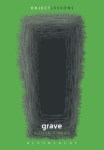 Meier is a cemetery tour guide in Brooklyn, where she lives. In the third of the e-book I’ve read so far, she looks at American burial customs, the lack of respect for Black and Native American burial sites, and the rise of garden cemeteries such as Mount Auburn in Cambridge, Massachusetts. I’ve been reading death-themed books for over a decade and have delighted in exploring cemeteries (including Mount Auburn, as part of my New England honeymoon) for even longer, so this is right up my street and one of the better Object Lessons monographs.
What I Bought
I traded in most of my mother’s books at 2nd & Charles and Wonder Book and Video but, no surprise, promptly spent the store credit on more secondhand books. Thanks to clearance shelves at both stores, I only had to chip in another $12.25 for the below haul, which also covered two Dollar Tree purchases (I felt bad for Susan Minot having signed editions end up remaindered!). Some tried and true authors here, as well as novelties to test out, with a bunch of short stories and novellas to read later in the year.


Ex Libris x 2: Who Wears It Better, Anne Fadiman or Michiko Kakutani?
When I heard about the new book by Michiko Kakutani, former chief book critic of the New York Times, I rushed to put it on my wish list – though I ended up accessing it via the library instead. I also felt a hankering to reread Anne Fadiman’s essay collection by the same title, so I ordered myself a secondhand copy earlier this year. Both books are by (more or less) famous New York City bibliophiles and take old-fashioned bookplate designs as an inspiration. Here’s how the two fared in a head-to-head battle.
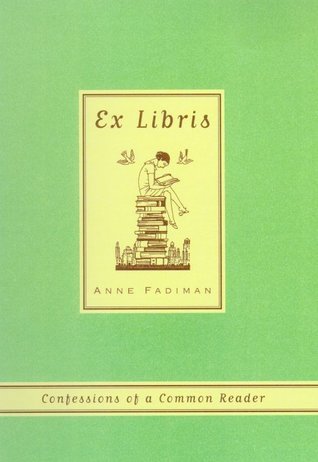
Ex Libris: Confessions of a Common Reader by Anne Fadiman (1998)
Like many a bibliophile, I have a soft spot for books about books. However, I’m also a real stickler about them, because all too often they make common mistakes: they’re too generic or too obscure in their points of reference, they slip into plot summary and include spoilers, or they alienate the reader by presenting the author as being on another echelon.
Fadiman, though, is a very relatable narrator in these expanded versions of 18 essays originally written for publication in Civilization, the Library of Congress magazine published from 1994 to 2000. (Can you imagine, your own bookish column in which you could write whatever you like?!) Her father was the well-known intellectual Clifton Fadiman. Theirs was a family of book-obsessed, vocabulary-loving, trivia-spouting readers, and she was also crafting her own with her husband and two young children.
 I saw my family – especially my mother and me – in a number of these pieces: in “The Joy of Sesquipedalians,” about the love of obscure words and word games played on a board or along with the TV (I was a spelling bee champion, and we’re all Scrabble fiends to a greater or lesser extent), in “Insert a Caret [Inset a Carrot],” about compulsive proofreading, in “The Catalogical Imperative,” about a build-up of print catalogues and the different selves one can imagine using the products therein, and in “Secondhand Prose,” about collecting used books.
There’s one respect in which I differ from the Fadiman family, though. Tom Mole’s The Secret Life of Books had reminded me of Fadiman’s division of readers into “courtly” and “carnal” lovers of books: the courtly ones keep a book pristine, while the carnal ones use and abuse them however they wish. She introduces this piece with an episode from a family trip to Copenhagen when she was a teenager. Her brother left a book open, facedown, on the bedside table at their hotel and the next day they found that the chambermaid had carefully put a marker at the right page, closed the book, and set a note on top reading, “Sir, you must never do that to a book.” I wholeheartedly agree. While I always say “your books, your rules” to other readers, I would have to suppress a cringe if I witnessed dog-earing, reading in the bath, cracking the spine, tearing out pages, doodling in the margins, and so on.
What I can get on board with, though, is the love of books as both narratives and physical objects. In the former camp, you get essays on books about polar exploration, sonnets, outdated guides to femininity, food literature, and reading aloud. On the latter, you’ll hear about her New York City apartment groaning with books absorbed from her husband’s and father’s collections, the good and bad of inscriptions, and Prime Minister William Gladstone’s tips for storing books.
Two essays have not aged well: one on a beloved pen (though she acknowledges that this was already multiply outdated by that time, by the typewriter and then by the computer she now uses for composition) and especially one on the quandary of gender-neutral pronouns (as opposed to “every man for himself” types of constructions) – nowadays we have no qualms about employing “them” for the unknown and the nonbinary.
My favorite essay overall was “You Are There,” about the special joy of reading on location. Additional irony points for Joe Biden being mentioned in the piece on plagiarism! I’d read this from a library some years before. I enjoyed it just as much the second time around, and certain essays will reward additional future rereadings, too.
My original rating (c. 2008):
My rating now:
Ex Libris: 100+ Books to Read and Reread by Michiko Kakutani (2020)
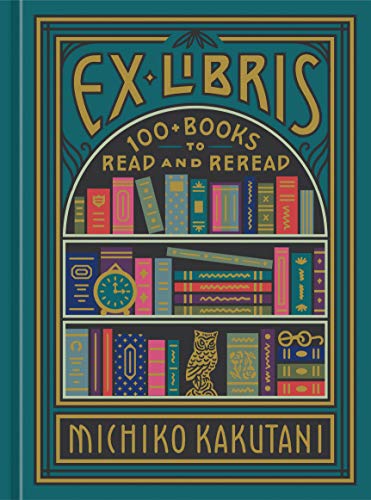
In my more morbid moments, when I imagine how I would approach the remainder of my life if I knew that I was going to die young of a terminal illness, I think about self-publishing a selection of my best blog posts and book reviews. A personal greatest hits, if you would, and anyone could forgive the self-indulgence because, hey, she’s probably going to die soon. But then I open a book like this and realize that a collection of book reviews can actually be pretty tedious, even when written by one of the greats.
“Like all lists and anthologies, the selections here are subjective and decidedly arbitrary,” Kakutani warns in her introduction. What this means in practice is that: a) if I’d read a particular book, I didn’t need to read a ~1000-word review of it; b) if I hadn’t read the book but wanted to, I avoided the essay in fear of spoilers (e.g. she does reveal some specific incidents from Mary Karr’s The Liars’ Club, which I have on the shelf and was looking forward to; I’ll just wait until I’ve forgotten); and c) if I hadn’t read the book and didn’t want to (there is LOTS of history and politics here, with plenty of Trump jabs shoehorned in; you do know her only previous book was a diatribe against Trump, right?), I wasn’t interested. So, while there were a few pieces I appreciated, such as one on the enduring appeal of The Great Gatsby, which I recently read a third time for book club, not many caught my eye as I skimmed the book.
In any case, it’s not a book for reading all the way through but one for having on the coffee table to read the occasional essay. It is gorgeously put together, what with Dana Tanamachi’s illustrations in the style of vintage bookplates, so would still be a lovely reference book to have around. Think of it as a collection of amuse-bouches to whet your appetite to read the books you’ve always meant to pick up but haven’t managed yet (for me, that would be As I Lay Dying and Mason & Dixon). See Susan’s more judicious review here.
My rating:
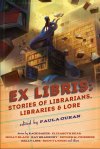 I found plenty of other books on Goodreads with the title Ex Libris, such as this one, a compendium of library-themed fantasy and science fiction stories. (Yes, really.)
Have you read one of these? Which did you prefer?
Personal Inscriptions, Etc. in Books
A couple of months ago we finally rescued the last boxes (we think) of our possessions out of my in-laws’ attic and storage cupboard…only five years after we moved out! As I was sorting through a box of my husband’s childhood books, I found a couple that he had won through school prizes – both of which seem to prefigure his love of British wildlife, and badgers in particular.


We also found another book he accidentally inherited from his school when the library burned down – along with the Gerald Durrell memoir and a paperback copy of Animal Farm, that makes three books that never made it back to the school even after they rebuilt. Oops!


I gave some thought to the other personal inscriptions in our book collection. Although we don’t have all that many examples in total, my mother (whom I generally call “Marm”) is the queen of inscriptions: you can count on her to write the date, the occasion, and a heartfelt message inside the front cover of any book she gives as a gift. It’s terribly sweet.


I got the Betty Crocker cookbook as a birthday present just as I was setting off for my Master’s year in Leeds – the first time I ever had to cook for myself. Over the last 11.5 years it’s gotten a lot of use, as the missing fragments of the ring binder show.


Another cookbook with some sentimental value to us is Delia Smith’s Complete Illustrated Cookery Course – a classic of English cuisine that we got as a wedding present. It’s extra special as the giver, my husband’s Auntie Joan (not actually an aunt, but a first cousin once removed or something like that), passed away earlier this year.
Do you like writing and/or receiving personal inscriptions in books?
Marginalia, Bookmarks, Etc. Found in Books
 In two of the books I currently have on the go, items found in books are a key element. First there’s Swimming Lessons in Claire Fuller, in which one strand of the narrative is told via a series of letters Ingrid hid in various thematically relevant books from her husband’s overflowing collection before she disappeared 12 years ago.
I’ve also been skimming Reading Allowed, novelist Chris Paling’s book of mildly amusing anecdotes from his time working in a public library. As little interludes he records the items he’s found being used as bookmarks in library volumes: a postcard, a shopping list, a meal plan, a CV, and so on.
In my years working in bookshops and libraries I found lots of proper bookmarks left behind in books; this photo shows the ones I’ve kept (others I’ve given away, recycled or donated to the library basket).

This doesn’t account for all the train tickets, receipts, newspaper clippings, etc. that were serving as makeshift bookmarks. The strangest thing I think I ever found in a book was an old-fashioned faux pearl-topped hatpin marking a place in a copy of Elizabeth Barrett Browning’s collected poems.
And then there are the written messages I’ve found in books: other people’s bookplates (I especially like the one that appears in the front of each volume of my 1919 Chapman & Hall set of the complete works of Dickens – such an enviable reward for good attendance!);


a heartfelt message of friendship in the copy of May Sarton’s The Fur Person I got free from Book Thing of Baltimore;

a young lady’s thoughts strewn across the selected poems of Ted Hughes;

and a dead-simple recipe for a tropical fruit drink pencilled on the back cover of Patricia Volk’s memoir, Stuffed.

For me, the random objects and messages you might find are all part of the fun of buying secondhand books.
 Bookish Beck = Rebecca Foster. American transplant to England. Freelance proofreader and book reviewer.
 Bookish Beck
Random Blog Searches and Spam Comments
I should have another batch of summer books read and reviewed by Friday. To fill in until then, I’ve resuscitated a recurring post template that I haven’t used in over three years, looking at the random searches that have led people to my blog. (Previously surveyed in May 2016, October 2016 and June 2017.)
I keep a record of the most interesting or bizarre blog searches that show up on my dashboard. Some recent favorites are below. I may not have the dirt on a new Donna Tartt release, but some of those who came with an inquiring mind will have found answers to their questions on my site.
(Spelling and punctuation are unedited throughout!)
2018
June 23: heart surgery vs brain surgery, elderberry cordial nancy Mitford
September 8: eve schaub rag rug
October 9: i hate elena ferrante
December 20: shaun bythell partner
December 27: philip carey leg
February 8: julia buckley journalist friend with a witchdoctor
March 30: was mel love with sharon animators
April 17: parker fiske – eleanor roosevelt’s cousin
May 31: is donna tartt writing another novel after the goldfinch
September 10: reservoir 13 who did it
October 22: sample inscription in cookbook for a bride
2019
March 19: the heart’s invisible furies spoilers, culling books
2020
January 19: vikram paralkar night theatre stinks, is megan phelps roper a jehovahs witness
March 30: miochel faber interview, did shaun bythell marry jess ica fox, why did mary give thatcher a gift in the novel unsheltered
April 17: bitter orange symbolism, books under 50 pages, cystic fibrosis stevenson helen, nuts in may louis macneice
April 28: essays on comparing the novels empire falls by richard russo and cat’s eye by margaret wood
July 6: christianne ritter aurhor what became of her and her husband
Lots of curiosity about Shaun Bythell’s romantic history – my review of The Diary of a Bookseller continues to be one of my most-viewed posts. I think my favorite search, though, is “i hate elena ferrante” (hate is too strong a word, but I do remain indifferent to her charms).
I regularly check my spam folder because, every once in a while, a regular commenter’s message goes astray there and I’d hate to miss anything genuine.
In the last month I’ve noticed hundreds of spam comments on my blog, all containing identical Spanish-language text (“Muchas gracias. ?Como puedo iniciar sesion?”) and usually appearing on one of four particular posts.
Any ideas about how I can get the Spanish spam to go away?