Reading Wales Month: Tishani Doshi & Ruth Janette Ruck (#ReadingWales25)
It’s my first time participating in Reading Wales Month, hosted this year by Karen of BookerTalk. I happened to be reading a collection by a Welsh-Gujarati poet, and added a Welsh hill farming memoir to my stack so I could review two books towards this challenge.

A God at the Door by Tishani Doshi (2021)
 I discovered Doshi through the phenomenal Girls Are Coming out of the Woods, which I reviewed for Wasafiri literary magazine. This fourth collection is just as rich in long, forthright feminist and political poems. Violence against women is a theme that crops up again and again in her work, as in “Every Unbearable Thing”: “this is not / a poem against longing / but against the kind of one-way / desire that herds you into a / dead-end alley”. The arresting title of the sestina “We Will Not Kill You. We’ll Just Shoot You in the Vagina” is something the former Philippines president Rodrigo Duterte said in 2018 in reference to female communist rebels. Doshi links femicide and ecocide with “A Possible Explanation as to Why We Mutilate Women & Trees, which Tries to End on a Note of Hope”. Her poem titles are often striking and tell stories in and of themselves. Several made me laugh, such as “Advice for Pliny the Elder, Big Daddy of Mansplainers,” which is shaped like a menstrual cup.
In defiance of those who would destroy it, Doshi affirms the primacy of the body. The joyfully absurd “In a Dream I Give Birth to a Sumo Wrestler” ends with the lines “How easy to forget / that all we have are these bodies. That all of this, all of this is holy.” Poems are inspired by Emily Dickinson and Frida Kahlo as well as by real events that provoke outrage. The clever folktale-like pair “Microeconomics” and “Macroeconomics” contrasts a woman dutifully growing peas and trying to get ahead with exploitative situations: “One man sits on another if he can. … One man goes / into the mines for another man to sparkle.” I also found many wise words on grief. Doshi is a treasure. (Secondhand – Green Ink Booksellers, Hay-on-Wye) 
Place of Stones by Ruth Janette Ruck (1961)
“Farming is rather like the theatre—whatever happens the show must go on.”
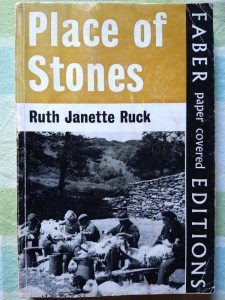 I reviewed Ruck’s Along Came a Llama several years ago when it was re-released by Faber. This was the first of her three memoirs about life at Carneddi (which means “place of stones”), the hill farm in North Wales that she and her family took over in the 1950s. After college, Ruck trained at a farm on the Isle of Wight and later completed an apprenticeship at Oathill Farm, Oxfordshire under George Henderson, who seems to have been something of a celebrity farmer back then (he contributes a brief but complimentary foreword). By age 20 she was in full charge of Carneddi, where they kept sheep, cattle and fowl. Many of their neighbours had Welsh as a first or only language. At that time, farmers were eligible for government grants. Ruck put in an intensive hen-rearing barn and started growing strawberries and rearing turkeys for Christmas.
Even when things were going well, it was a hand-to-mouth existence and storms or illness could set everything back. The Rucks renovated a nearby cottage to serve as a holiday let. Another windfall came in the bizarre form of a nearby film shoot by Twentieth Century Fox (The Inn of the Sixth Happiness, starring Ingrid Bergman). Mountainous North Wales stood in for China, and the film crew hired Ruck as a driver and, like many locals, as an occasional extra. This book was light and mildly entertaining, though probably more detailed about everyday farm work and projects than I needed. I was reminded again of Doreen Tovey, especially in the passage about Topsy the pet black sheep, but also this time of Betty Macdonald (The Egg and I) and Janet White (The Sheep Stell). (Secondhand – Lions bookshop, Alnwick) 
On Trying to Keep Still (Post-Northumberland Holiday)
What’s the point of going on vacation? Expanding your cultural horizons, seeing new things and places, treating yourself to fun experiences you don’t have in the everyday, and relaxing could all be good answers. Relaxation isn’t our strong suit when we go away; we often return from a holiday wishing that we had a few recovery days before resuming work. Some combination of developing a bad cold in the last few days of the trip, coming back to non-stop rain, worrying about our cat’s ongoing health issues, and my husband already having a manically busy start to the term has left me feeling like staying put for the foreseeable.
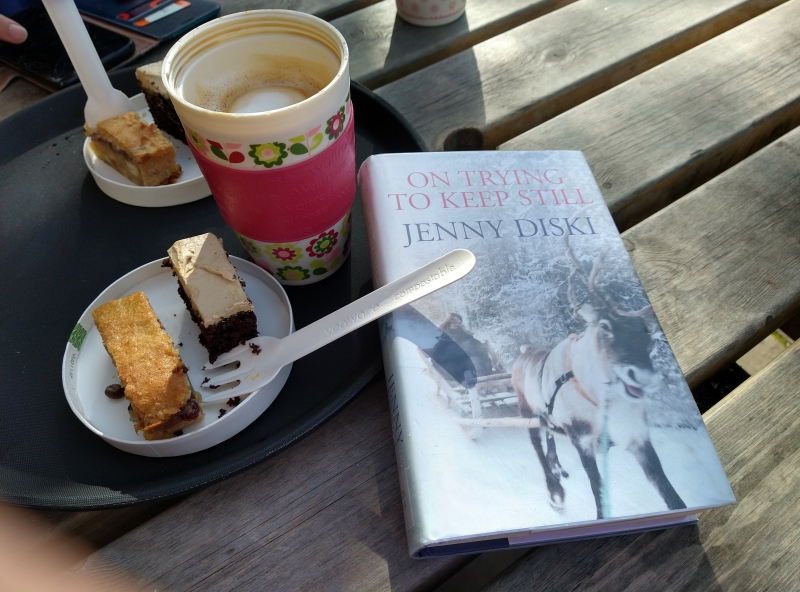
Apt reading for a coffee stop on Lindisfarne.
Jenny Diski understood that. Her collection of travel pieces, On Trying to Keep Still, was the one book I read in its entirety on our trip (along with parts of novels, poetry collections and many, many short story volumes). Essays and short stories were perfect reading for a public transport trip: ideal for taking out on a train or bus and reading one or a few. I’d earmarked the Diski for 20 Books of Summer but found a better setting for it after all. A couple of pieces touch on her traumatic childhood and time spent in a mental hospital as a teenager, which I vaguely remembered from her other autobiographical work. The essay “On Anatomy,” which doesn’t really fit with the others but may have been my favourite, matter-of-factly recounts her rape at 14, and her midlife diagnosis of Freiberg’s disease. Her doctor’s dismissive response to her debilitating foot pain was her first experience of age-related discrimination.
Diski expresses how troubled she is to have become known as a travel writer – through the two books of hers I’d previously read, Skating to Antarctica and Stranger on a Train – because, for the most part, she much prefers to stay at home and do nothing. Ironically, she ends up writing a travel feature on Lapland for the Observer, even though what she actually proposed was spending a few days in the polar dark. But the paper talked her into undertaking all sorts of uncomfortable adventures like a reindeer-drawn sleigh ride and sleeping in a tent – and this for someone who specifically hated being cold.
This is the stuff of Part Three. In Part One, she speaks at a book festival in New Zealand and resists the compulsion to skydive; in the long Part Two, she courts solitude by renting a cottage on a Somerset farm for two months. She holes up with a mini-library of silence- and seclusion-themed reads and shows her face only often enough so the owner won’t fret about her. (It took me a little while to work out that the farmer was Janet White, author of The Sheep Stell – quite a neat connection. Diski also lived with Doris Lessing as a teenager.) Here, too, Diski is delighted to eschew outings and exercise and just stay in comfort. The fact that she brought pristine Prada hiking boots tells you she’s no outdoorswoman. By the book’s end, she’s concluded it’s best to save the money and effort and just research or imagine your way to places instead. Tongue-in-cheek advice, perhaps, but the tone of cheerful indolence appealed to me. (Secondhand – Awesomebooks.com) 
Sprinting to make buses, hours-long bone-shaking rides, heavy luggage: we were out of practice at using public transport, sure, but the rigours of this trip were a bit much for me. It can’t just be age, though at nearly 41 I do long for my own bed on any stay away from home. It’s partly a matter of accepting that chronic illness means I will have limitations. Much as we wanted to do the right thing by not driving, travelling by car is so much more practical and comfortable. Trips to the Continent may still be doable by train as European services seem reliable. But within the UK? Unless it’s a short city break, I’m not sure.
All that said, we did have a nice time. Our cottage in Berwick-upon-Tweed was spacious and we had unexpectedly glorious weather for daytrips to Bamburgh Castle, the Farne islands and Lindisfarne, Alnwick and Alnmouth, and especially the fishing town of Dunbar in Scotland. If you ever find yourself in Berwick, do walk the medieval walls (plus try a charcuterie platter at Atelier wine bar, sample the sweet or savoury offerings at Northern Soul Kitchen, and find time for a drink or two at The Curfew micro-pub). Speaking of drinks, we also enjoyed our time with friends in York, not least an afternoon at the annual beer festival.


Bookishness included a return trip to Barter Books, where my store credit got me a free book and badge; Berwick’s Berrydin Books and Slightly Foxed, as well as several charity shops; the “Books by the Sea” Little Free Library network; and the John Muir birthplace museum and trail in Dunbar. Muir was a forefather of modern environmentalism involved in the inception of the U.S. national parks system. I’ll have to seek out his memoir of childhood.


My modest book haul (compared to our previous trip to Northumberland, anyway) of 12 books is testament to great restraint; had we been traveling by car, I probably would have acquired more books at each stop. I majored on short story collections and novella-length works. And I’ve started reading several already!


Other reading experiences, on a rail replacement bus and on the nearly empty Bamburgh and Dunbar beaches:


If you had to choose, would it be far-flung adventuring or the comforts of home?
One Book Leads to Another (Including Shepherds’ Memoirs)
Reading about a particular topic, time period or type of character often leads me to want to read more about the same thing. This isn’t the same as what I call “book serendipity,” when such connections happen purely coincidentally; instead, it’s a deliberate way of following a thread of interest further. I keep meaning to read more about lighthouses, butterflies and Virginia Woolf, for instance. Some attempts are more successful than others, though.
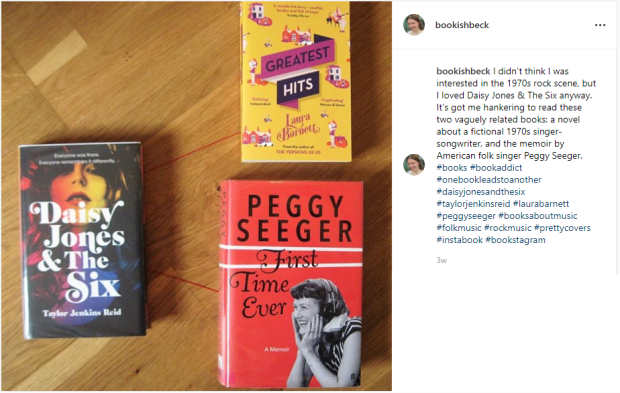
Alas, I had to return the Peggy Seeger memoir to the library unread because it was requested after me, and I haven’t found the immediate spur to pick up Greatest Hits yet.
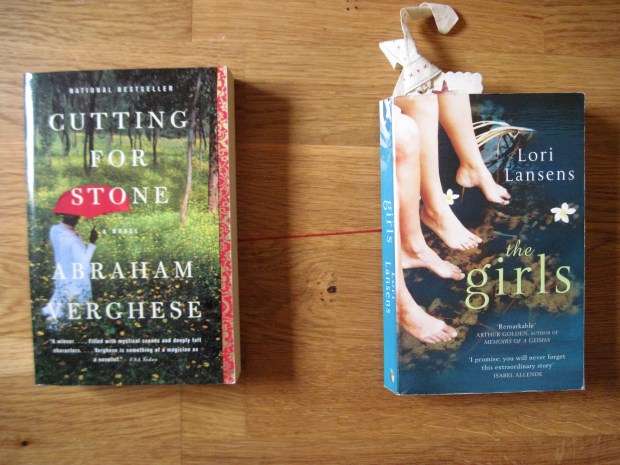
However, soon after I finished one novel about conjoined twins, Abraham Verghese’s Cutting for Stone, I launched straight into another one, Lori Lansens’ The Girls. I’m halfway through and it’s great so far. (Another I’d recommend is Chang and Eng by Darin Strauss, about the original “Siamese twins.”)
This spring I realized that I’d read four and a bit shepherds’ memoirs in 17 months, which is quite the concentration considering I’m not a countryside gal. Here’s how I’d rank the five:
#1: A Farmer’s Diary: A Year at High House Farm by Sally Urwin
 Urwin is a charming guide to a year in the life of her working farm in Northumberland. Just don’t make the mistake of dismissing her as “the farmer’s wife.” She may only be 4 foot 10 (her Twitter handle is @pintsizedfarmer and her biography describes her as “(probably) the shortest farmer in England”), but her struggles to find attractive waterproofs don’t stop her from putting in hard labor to tend to the daily needs of a 200-strong flock of sheep.
From mating the ewes to preparing the next year’s lambs for market, we see the whole cycle once through and about to start again. Lambing is a fraught couple of months that form the heart of the book, but there are plenty of other challenges, including stolen sheep, fallen trees, and constant financial concerns that lead to a petition to the Royal Agricultural Benevolent Institution for help paying the gas bill and keeping food on the table for their two kids.
Despite the year’s setbacks, Urwin has an indomitable spirit and writes in a chatty, chin-up style that reflects the book’s origin in blog posts from 2017 to 2018. She gets a lot of comic mileage out of her yo-yo dieting, the many escapades of Candy the fat pony, and quirky English traditions like the village fete. I enjoy reading about people’s daily habits through a diary, and all the better when it’s a lifestyle that’s totally foreign to me. 
#2: The Sheep Stell by Janet White
 First published in 1991, The Sheep Stell taps into a widespread feeling that we have become cut off from the natural world and that existing in communion with animals is a healthier lifestyle. White’s pleasantly nostalgic memoir tells of finding contentment in the countryside, first on her own and later with a dearly loved family. It is both an evocative picture of a life adapted to seasonal rhythms and an arresting account of the casual sexism – and even violence – White experienced in a traditionally male vocation when she emigrated to New Zealand in 1953. From solitary youthful adventures that recall Gerald Durrell’s and Patrick Leigh Fermor’s to a more settled domestic life with animals reminiscent of the writings of James Herriot and Doreen Tovey, White’s story is unfailingly enjoyable. (I reviewed it for the Times Literary Supplement last year.)
#3: On Sheep: Diary of a Swedish Shepherd by Axel Lindén
(translated from the Swedish by Frank Perry)
 Axel Lindén left his hipster Stockholm existence behind to take on his parents’ rural collective. On Sheep documents two years in his life as a shepherd aspiring to self-sufficiency and a small-scale model of food production. The diary entries range from a couple of words (“Silage; wet”) to several pages, and tend to cluster around busy times on the farm. The author expresses genuine concern for the sheep’s wellbeing. However, he cannily avoids anthropomorphism, insisting that his loyalty must be to the whole flock rather than to individual animals. The brevity and selectiveness of the diary keep the everyday tasks from becoming tiresome. Instead, the rural routines are comforting, even humbling.
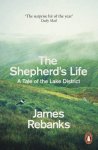 #4: The Shepherd’s Life by James Rebanks
My husband valued this more as a memoir than as a cultural document; the opposite was true for me. As a memoir it’s fairly unexceptional, but it’s valuable as a picture of a rare and dwindling way of life in the British countryside. 
#5: Heida: A Shepherd at the Edge of the World by Steinunn Sigurðardóttir
(translated from the Icelandic by Philip Roughton)
 DNF after 53 pages. I was offered a proof copy by the publisher on Twitter. I thought it would be interesting to hear about a female Icelandic shepherd who was a model before taking over her family farm and then reluctantly went into politics to try to block a hydroelectric power station on her land. Unfortunately, though, the book is scattered and barely competently written. It doesn’t help that the proof is error-strewn. [This mini-review has been corrected to reflect the fact that, unlike what is printed on the proof copy, the sole author is Steinunn Sigurðardóttir, who has written the book as if from Heiða Ásgeirsdóttir’s perspective.]
What’s the last major reading theme you’ve had?
Can I tempt you with a sheep-herding memoir?
We’re off to America tomorrow for two weeks for a holiday plus family time and a college friend’s wedding. While I won’t be particularly communicative on others’ blogs or social media, I’m scheduling a few blogs per week that we’re away. Back on June 3rd – just in time for the start of 20 Books of Summer!

Here’s the stack of books I’ve packed – with plenty more waiting for me over there and my Kindle providing some 400 backups.
Dubiously Thematic Easter Reading
In 2015 and 2017 I came up with some appropriately theological reading recommendations for Easter. This year I’m going for a more tongue-in-cheek approach, as befits the unfortunate conjunction of Easter with April Fools’ Day.
Currently reading or reviewing:
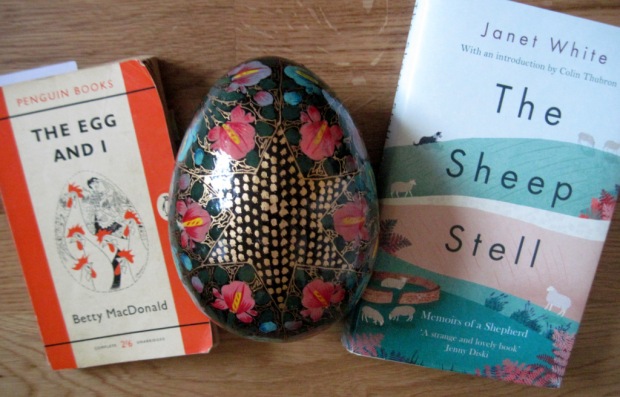
The Egg and I by Betty MacDonald
I bought this on a whim from a local charity shop, based on the title, cover and blurb. I’m about one-third of the way through so far. MacDonald and her husband started a chicken farm in a mountainous area of the Pacific Northwest in the 1940s. Her account of her failure to become the perfect farm wife is rather hilarious. My only hesitation is about her terrible snobbishness towards rednecks and “Indians.”


A representative passage: “Gathering eggs would be like one continual Easter morning if the hens would just be obliging and get off the nests. Co-operation, however, is not a chickenly characteristic and so at egg-gathering time every nest was overflowing with hen, feet planted, and a shoot-if-you-must-this-old-grey-head look in her eye.”
The Sheep Stell by Janet White
 I’m reviewing this reissued memoir for the TLS. It’s a delightful story of finding contentment in the countryside, whether on her own or with family. White, now in her eighties, has been a shepherd for six decades in the British Isles and in New Zealand. While there’s some darker material here about being stalked by a spurned suitor, the tone is mostly lighthearted. I’d recommend it to anyone who’s enjoyed books by Gerald Durrell, James Herriot and Doreen Tovey.
Representative passages: “Shepherding is a strange mixture of tremendous physical work alternating with periods of calm, quiet indolence.” & “A dare, a dream and a challenge. I could have hunted the whole world over and never in a lifetime found anywhere so right: warm, high, pastoral and severed by the sea.”
Read recently:
The Trouble with Goats and Sheep by Joanna Cannon
 Mrs. Creasy disappears one Monday in June 1976, and ten-year-old Grace Bennett and her friend Tilly are determined to figure out what happened. I have a weakness for precocious child detectives (from Harriet the Spy to Flavia de Luce), so I enjoyed Grace’s first-person sections, but it always feels like cheating to me when an author realizes they can’t reveal everything from a child’s perspective so add in third-person narration and flashbacks. These fill in the various neighbors’ sad stories and tell of a rather shocking act of vigilante justice they together undertook nine years ago.
Sheep are a metaphor here for herd behavior and a sense of belonging, but also for good versus evil. Grace and Tilly become obsessed with a Bible passage the vicar reads about Jesus separating the sheep from the goats. But how can he, or they, know who’s truly righteous? As Grace says, “I think that’s the trouble, it’s not always that easy to tell the difference.” It’s a simplistic message about acknowledging the complexity of other lives and situations rather than being judgmental, and matches the undemanding prose.
Reminiscent of Rachel Joyce, but not as good.
My rating:
Vita Nova by Louise Glück
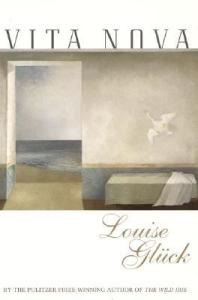 My first collection from the prolific Pulitzer winner. Some of the poems are built around self-interrogation, with a question and answer format; several reflect on the myth of Orpheus and Eurydice. The first and last poems are both entitled “Vita Nova,” while another in the middle is called “The New Life.” I enjoyed the language of spring in the first “Vita Nova” and in “The Nest,” but I was unconvinced by much of what Glück writes about love and self-knowledge, some of it very clichéd indeed, e.g. “I found the years of the climb upward / difficult, filled with anxiety” (from “Descent to the Valley”) and “My life took me many places, / many of them very dark” (from “The Mystery”).
Best lines about spring:
“The spring of the year; young men buying tickets for the ferryboats. / Laughter, because the air is full of apple blossoms.” (from “Vita Nova”)
“Spring / descended. Or should one say / rose? … yellow-green of forsythia, the Commons / planted with new grass— // the new / protected always” (from “Ellsworth Avenue”)
My rating:
Plucked off the shelf for their dubious thematic significance!

To Rise Again at a Decent Hour by Joshua Ferris
Animal, Vegetable, Miracle by Barbara Kingsolver
Wise Blood by Flannery O’Connor
So You’ve Been Publicly Shamed by Jon Ronson
The Resurrection of Joan Ashby by Cherise Wolas
Happy Easter to all those who mark it, and have a good week. I have a few review-based posts scheduled for while we’re in Wigtown, a trip I hope to report on next Monday, when I will also attempt to catch up on blogs and comments.
 Bookish Beck = Rebecca Foster. American transplant to England. Freelance proofreader and book reviewer.
 Bookish Beck