Short Stories in September, Part III: Butler, Costello, MacLaverty, Washington
Today I have a third set of terrific and varied short story collections. Between this, my Part I and Part II posts, and a bonus review I have coming up on Friday, I’ve gotten through 12 volumes of stories this month. This feels like a great showing for me because I don’t naturally gravitate to short stories and have to force myself to make a special effort to read them every September; otherwise, they tend to languish unread on my shelves and TBR.
From science fiction and horror tales set in alternate worlds to gritty slices of real life in Texas via two sets of quiet Irish relationship studies, this quartet of books showcases a range of tones and genres but fairly straightforward story structures and points of view. This was such a strong batch, I had to wonder why I never call myself a short story fan. All: 
Bloodchild and Other Stories by Octavia E. Butler (2005)
 My first R.I.P. selection and one I can heartily recommend – even if you’re normally wary of dystopias, horror and science fiction. Butler makes these genres accessible by peopling her plots with relatable protagonists and carefully accounting for their bizarre predicaments without wasting time on extraneous world-building. The way in which she explores very human issues alongside the existence of alien beings reminds me of Mary Doria Russell’s The Sparrow, another of my rare forays into sci fi.
Along with the original five stories Butler published in 1970s and 1980s magazines and anthologies, this second edition contains two essays on her writing process and two new stories that date to 2003. In “Bloodchild,” a small band of humans live on another planet ruled by the Tlic, which sound like giant spiders or scorpions. Gan learns he is expected to play his part by being a surrogate for T’Gatoi’s eggs, but is haunted by what he’s heard this process involves. In a brief afterword (one is included with each piece here), Butler explains that the story arose from her terror of botflies, which she knew she might encounter in the Peruvian Amazon, and that she has always faced what scares her through her writing.
My other favorite story was “The Evening and the Morning and the Night,” about a subclass of people afflicted with Duryea-Gode disease. A cruel side effect of a parent’s cancer treatment, the illness compels sufferers to self-harm and they are often confined to asylums. Lynn and Alan visit his mother in one such institution and see what their future might hold. “Speech Sounds” and “Amnesty” reminded me most of the Parable novels, with the latter’s Noah a leader figure similar to Lauren. After an apocalyptic event, people must adapt and cooperate to survive. I appreciated how the two essays value persistence – more so than talent or inspiration – as the key to success as a writer. This was my fourth book by Butler and I don’t see why I shouldn’t keep going and read her whole oeuvre. (University library)

The China Factory by Mary Costello (2012)
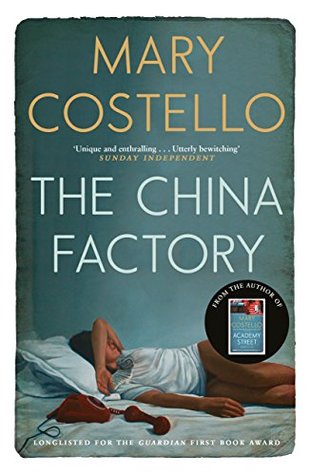 Academy Street is a near-perfect novella and I also enjoyed The River Capture, so I wanted to complete the set by reading Costello’s first book. Its dozen understated stories are about Irish men and women the course of whose lives are altered by chance meetings, surprise liaisons, or not-quite-affairs that needle them ever after with the could-have-been. The mood of gentle melancholy would suit a chilly moonlight drive along the coast road to Howth. In the opening title story, a teenage girl rides to her work sponging clay cups with an oddball named Gus. Others can’t get past things like his body odour, but when there’s a crisis at the factory she sees his calm authority save the day. Elsewhere, a gardener rushes his employer to the hospital, a woman attends her ex-husband’s funeral, and a school inspector becomes obsessed with one of the young teachers he observes.
Three favourites: In “And Who Will Pay Charon?” a man learns that, after he rejected Suzanne, she was hideously attacked in London. When she returns to the town as an old woman, he wonders what he might have done differently. “The Astral Plane” concerns a woman who strikes up a long-distance e-mail correspondence with a man from New York who picked up a book she left behind in a library. How will their intellectual affair translate into the corporeal world? The final story, “The Sewing Room,” reminded me most of Academy Street and could be a novel all of its own, as a schoolteacher and amateur fashion designer prepares for her retirement party and remembers the child she gave up for adoption. (Secondhand, gifted)
Blank Pages and Other Stories by Bernard MacLaverty (2021)
 I knew from The Great Profundo that I liked MacLaverty’s stories, and I also enjoyed his latest novel, Midwinter Break, so I was delighted to hear news of a new collection. A number of the longer stories are set at turning points in twentieth-century history. In 1940, a mother is desperate to hear word of her soldier son; in 1971 Belfast, officers search a woman’s house. Two of the historical stories appealed to me for their medical elements: “The End of Days,” set in Vienna in 1918, dramatizes Egon Schiele’s fight with Spanish flu, while “Blackthorns” gives a lovely picture of how early antibiotics promoted miraculous recovery. In the title story, a cat is all a writer has left to remind him of his late wife. “Wandering” has a woman out looking for her dementia-addled mother. “The Dust Gatherer” muses on the fate of an old piano. Elderly parents and music recur, establishing filaments of thematic connection.
Three favourites: In “Glasshouses,” a man temporarily misplaces his grandchildren in the botanical gardens; “The Fairly Good Samaritan” is the fable of a jolly drunk who calls an ambulance for his poorly neighbour – but not before polishing off her brandy; and in the gorgeous “Sounds and Sweet Airs” a young woman’s harp music enthrals the passengers on a ferry.
With thanks to Jonathan Cape for the free copy for review.
Lot: Stories by Bryan Washington (2019)
 The musical equivalent of Lot might be a mixtape played on a boombox or blasted from an open-top Corvette while touring the streets of Houston, Texas. Most of this Dylan Thomas Prize-winning linked collection follows Nic, a mixed-race Black/Latino boy who works in the family restaurant. As his family situation realigns – his father leaves, his older brother Javi enlists, his sister Jan has a baby – he’s trying to come to terms with his homosexuality and wondering if this gentrifying city suits him anymore. But he knows he’ll take himself wherever he goes, and as the book closes with “Elgin” (the most similar in mood and setup to Washington’s debut novel, Memorial) he’s thinking of taking a chance on love.
Drug dealers, careworn immigrants and prostitutes: Even the toughest guys have tender hearts in these stories. Eleven of 13 stories are in the first person. Where the narration isn’t Nic’s, it’s usually the collective voice of the neighbourhood boys. As far as I can tell, most of the story titles refer to Houston sites: particular addresses or neighbourhoods, or more vague locations. Like in Memorial, there are no speech marks. Washington’s prose is earthy and slang-filled. The matter-of-fact phrasing made me laugh: “He knocked her up in the usual way. For six minutes it looked like he’d stick around”; “He’d been staying there since the Great Thanksgiving Rupture, back when his brother’d found the dick pic in his pillowcase.” With the melting pot of cultures, the restaurant setting, and the sharp humour, this reminded me of Elaine Castillo’s America Is Not the Heart.
Three favourites: In “Shepherd,” the narrator emulates a glamorous cousin from Jamaica; “Bayou” is completely different from the rest, telling the urban legend of a “chupacubra” (a mythical creature like a coyote); “Waugh,” the longest story and one of just two told in the third person, is about a brothel’s worth of male sex workers and their pimp. Its final page is devastating. Despite their bravado, Washington’s characters are as vulnerable as Brandon Taylor’s. I think of these two young gay African American writers as being similar at root even though their style and approach are so very different. (New purchase)
A side note: I’m wondering how an author chooses primarily first person or third person POVs for short stories. MacLaverty and Taylor write exclusively in an omniscient third person; Washington and Eley Williams almost always plump for the first person. (Here, Butler was about half and half and Costello only used first person in three stories.) Is the third person seen as more impartial and commanding – a more elevated form of fiction? Is first person more immediate, informal and natural, but also perhaps too easy? I wouldn’t say I prefer one or the other (not in my novels, either); it all depends on the execution. Notably, none of this year’s stories were in the second person or employed experimental structures.
Two more collections I’m reading are spilling across into October for R.I.P., but will I keep up the short story habit after that? I still have a shelf full of unread story collections, and I have my eye on My Monticello, which I got from NetGalley…
Four February Releases: Napolitano, Offill, Smyth, Sprackland
Much as I’d like to review books in advance of their release dates, that doesn’t seem to be how things are going this year. I hope readers will find it useful to learn about recent releases they might have missed. This month I’m featuring a post-plane crash scenario, a reflection on modern anxieties, an essay about the human–birds relationship, and a meditation on graveyards.
Dear Edward by Ann Napolitano
(Published by Penguin/Viking on the 20th; came out in USA from Dial Press last month)
 June 2013: a plane leaves Newark Airport for Los Angeles, carrying 192 passengers. Five hours after takeoff, it crashes in the flatlands of northern Colorado, a victim to stormy weather and pilot error. Only 12-year-old Edward Adler is found alive in the wreckage. In alternating storylines, Napolitano follows a select set of passengers (the relocating Adler family, an ailing tycoon, a Wall Street playboy, an Afghanistan veteran, a Filipina clairvoyant, a pregnant woman visiting her boyfriend) in their final hours, probing their backstories to give their soon-to-end lives context (and meaning?), and traces the first six years of the crash’s aftermath for Edward.
While this is an expansive and compassionate novel that takes seriously the effects of trauma and the difficulty of accepting random suffering, I found that I dreaded returning to the plane every other chapter – I have to take regular long-haul flights to see my family, and while I don’t fear flying, I also don’t need anything that elicits catastrophist thinking. I would read something else by Napolitano (she’s written a novel about Flannery O’Connor, for instance), but I can’t imagine ever wanting to open this up again.
I picked up a proof copy at a Penguin Influencers event.
Weather by Jenny Offill
(Published by Knopf [USA] on the 11th and Granta [UK] on the 13th)
 Could there be a more perfect book for 2020? A blunt, unromanticized but wickedly funny novel about how eco-anxiety permeates everyday life, Weather is written in the same aphoristic style as Offill’s Dept. of Speculation but has a more substantial story to tell. Lizzie Benson is married with a young son and works in a New York City university library. She takes on an informal second job as PA to Sylvia, her former professor, who runs a podcast on environmental issues and travels to speaking engagements.
Set either side of Trump’s election, the novel amplifies many voices prophesying doom, from environmentalists to Bible-thumpers (like Lizzie’s mother) to those who aren’t sure they’ll even make it past tomorrow (like her brother, a highly unstable ex-addict who’s having a baby with his girlfriend). It’s a wonder it doesn’t end up feeling depressing. Lizzie’s sardonic narration is an ideal way of capturing relatable feelings of anger and helplessness, cringing fear and desperate hope. Don’t expect to come away with your worries soothed, though there is some comfort to be found in the feeling that we’re all in this together.
Favorite lines:
“Young person worry: What if nothing I do matters? Old person worry: What if everything I do does?”
“Once sadness was considered one of the deadly sins, but this was later changed to sloth. (Two strikes then.)”
“My husband is reading the Stoics before breakfast. That can’t be good, can it?”
I read an e-ARC via Edelweiss.
An Indifference of Birds by Richard Smyth
(Published by Uniformbooks on the 14th)
 Birds have witnessed the whole of human history, sometimes profiting from our behavior – our waste products provide them with food, our buildings can be handy nesting and hunting platforms, and our unintentional wastelands and demilitarized zones turn into nature reserves – but more often suffering incidental damage. That’s not even considering our misguided species introductions and the extinctions we’ve precipitated. Eighty percent of bird species are now endangered. For as minimal as the human fossil record will be, we have a lot to answer for.
From past to future, archaeology to reintroduction and de-extinction projects, this is a wide-ranging essay that still comes in at under 100 pages. It’s a valuable shift in perspective from human-centric to bird’s-eye view. The prose is not at all what I’ve come to expect from nature writing (earnest, deliberately lyrical); it’s more rhetorical and inventive, a bit arch but still passionate – David Foster Wallace meets Virginia Woolf? The last six paragraphs, especially, soar into sublimity. A niche book, but definitely recommended for bird-lovers.
Favorite lines:
“They must see us, watch us, from the same calculating perspective as they did two million years ago. We’re still galumphing heavy-footed through the edgelands, causing havoc, small life scattering wherever we tread.”
“Wild things lease these places from a capricious landlord. They’re yours, we say, until we need them back.”
I pre-ordered my copy directly from the publisher.
These Silent Mansions: A life in graveyards by Jean Sprackland
(Published by Jonathan Cape on the 6th)
 I’m a big fan of Sprackland’s beachcombing memoir, Strands, and have also read some of her poetry. Familiarity with her previous work plus a love for graveyards induced me to request a copy of her new book. In it she returns to the towns and cities she has known, wanders through their graveyards, and researches and imagines her way into the stories of the dead. For instance, she finds the secret burial place of persecuted Catholics in Lancashire, learns about a wrecked slave ship in a Devon cove, and laments two dead children whose bodies were sold for dissections in 1890s Oxford. She also remarks on the shifts in her own life, including the fact that she now attends more funerals than weddings, and the displacement involved in cremation – there is no site she can visit to commune with her late mother.
I most enjoyed the book’s general observations: granite is the most prized headstone material, most graves go unvisited after 15 years, and a third of Britons believe in angels despite the country’s overall decline in religious belief. I also liked Sprackland’s list of graveyard charms she has seen. While I applaud any book that aims to get people thinking and talking about death, I got rather lost in the historical particulars of this one.
Favorite lines:
“This is the paradox at the heart of our human efforts to remember and memorialise: the wish to last forever, and the knowledge that we are doomed to fail.”
“Life, under such a conscious effort of remembering, sometimes resembles a series of clumsy jump-cuts rather than one continuous narrative.”
My thanks to the publisher for the free copy for review.
What recent releases can you recommend?
Late in the Day by Tessa Hadley & Improvement by Joan Silber
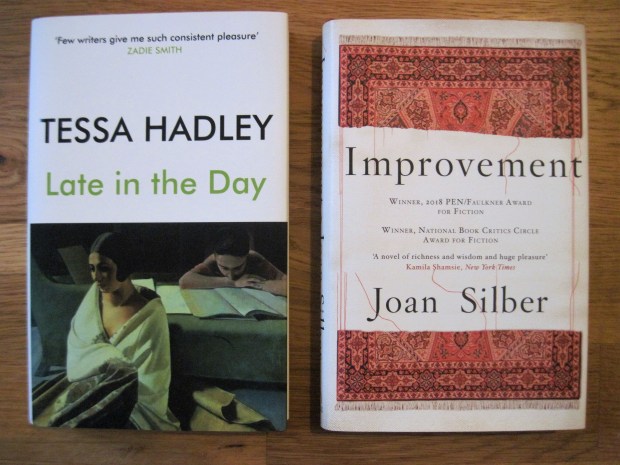
Late in the Day by Tessa Hadley (2019)
Two London couples: Christine and Alex, and Lydia and Zachary. They’ve known each other for decades, and their affiliations have changed in major, even ironic ways. It was Lydia who was initially infatuated with Alex when he taught both her and Christine, and Christine and Zachary who dated for a time. But this is how things ultimately fell out, each marriage resulting in one daughter. Christine with Alex; Lydia with Zachary.

The cover image is Raja (1925) by Felice Casorati.
Except now Zachary is dead. The phone call comes in the novel’s very first sentence. How Lydia and her friends – not to mention her daughter, Grace, who’s studying art in Glasgow – will cope with the loss, and rearrange what was once such a comfortable quadrilateral, is the ostensible subject of the rest of the book. There’s a funeral to plan and a future for Lydia to construct. But the problem, for me, is that every other chapter hosts a seemingly endless flashback to the couples’ backstory. Apart from an odd, titillating moment when the four nearly let down their guard together, these sections don’t reveal an awful lot.
This is my sixth book by Tessa Hadley. Her eye is always sharp on how families work, how relationships fall apart, and how memories form and linger as we age. She’s also a master of third-person omniscience, moving effortlessly between characters’ perspectives. The writing here is exquisite; there’s no question about that. I especially love the descriptive passages, full of so much sensual detail that you can imagine yourself right into a scene:
A breeze fanned the newspaper on the table, the smells of a city summer were wafted through the open window: tar and car exhaust, the bitter-green of the flowering privet hedge. Police horses went past in the broad street, their hooves clip-clopping conversationally alongside the voices of the women who rode them; the stables were nearby.
Her perception was a skin stretched taut, prickling with response to each change in the light outside as it ran through the drama of its sunset performance at the end of the street, in a mass of gilded pink cloud. When eventually the copper beech was only a silhouette cut out against the blue of the last light, Christine pulled down the blinds, put on all the lamps, turned her awareness inwards.
Despite the fine prose, I found the past strand of this novel tedious. If you’re new to Hadley, I’d recommend starting with Clever Girl and/or Bad Dreams and Other Stories.
Late in the Day was published in the UK by Jonathan Cape on February 14th, and in the USA by Harper on January 15th. My thanks to the publisher for the free copy for review.
Improvement by Joan Silber (2017)
I’ve been thinking a lot about linked short story collections, having written a brief article about them for BookBrowse to accompany my review of Carrianne Leung’s That Time I Loved You (those who contributed ideas on Twitter, thank you!). I find them easier to read than the average short story volume because there are fewer characters and settings to keep track of, and you get the fun of tracing unexpected connections between characters. Improvement didn’t quite work for me in that way, mostly because you can tell that it started as one short story, “About My Aunt”: now the untitled first chapter, it is, as you might guess, a solid stand-alone narrative about Reyna and her aunt Kiki. It was originally published in Tin House and collected in The Best American Short Stories 2015.
 I was most interested in Kiki, a terrific character with a completely unsuitable name. Her marriage to a Turk failed – but hey, at least she got a great rug out of it, as well as the fun but temporary challenge of third-world life. (“For a hardheaded person, she had let herself be flung about by the winds of love, and she wasn’t sorry either.”) Back in New York City she directs a house-cleaning agency and babysits for Reyna’s four-year-old son, Oliver. Tattooed Reyna’s African-American boyfriend, Boyd, is in prison for three months for selling pot; when he gets out he comes up with the bright idea of smuggling cigarettes between Virginia and New York to profit from the tax difference. He asks Reyna to make one of the pick-ups, but she chickens out at the last minute. Boyd’s friend Claude drives instead, and is killed instantly in a crash.
Part II reaches into the lives of some of the minor characters on the fringes: Claude; Teddy, the truck driver who was the other party in the car accident; Osman, Kiki’s ex-husband; a trio of Germans who passed through their Turkish town in the summer of 1977 with smuggled antiquities in their possession; and so on. For me, these narratives were too diffuse and didn’t hang together as a novel. I had hoped to enjoy this more since it won the National Book Critics Circle Award for Fiction and Silber is one of those writer’s writers you always hear about but never get to read. I found her voice similar to Anne Tyler’s or perhaps Julia Glass’s, but I’m not sure I’d try another book by her.
Improvement was published by Allen & Unwin on February 7th. It came out in the USA from Counterpoint Press in 2017. My thanks to the publisher for the free copy for review.
Bottom line for both:
Subtle, sophisticated but underwhelming. 
Three Books that Originated on the Radio
As the end of the year approaches and I try to get through a final handful of review books, I’m looking for ways to combine posts. It may seem like a fairly arbitrary connection, but all three of these books originated as essays or short stories that were aired on British radio. I never listen to the radio so I miss out on these projects the first time around, but I’ve been interested to note how short forms and conversational styles lend themselves to oral performance.
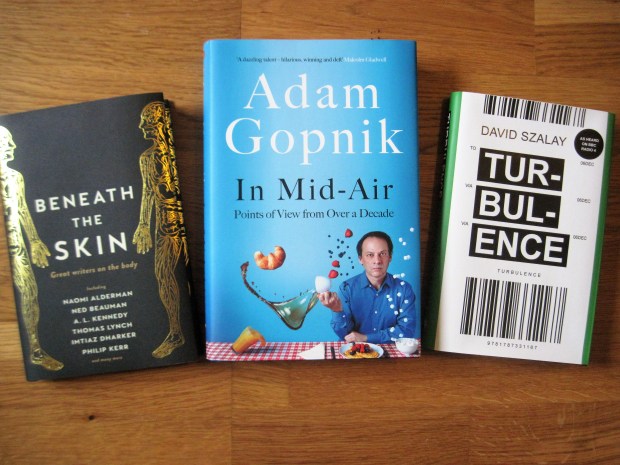
Beneath the Skin: Great Writers on the Body
These 15 pieces were commissioned for the BBC Radio 3 series “A Body of Essays.” Thomas Lynch, a small-town American undertaker and wonderful, unjustly obscure writer, opens and closes the volume. In his introduction he remarks – appropriately as Christmas draws near – that “We are an incarnate species”: we experience the world only through our bodies, which are made of disparate parts that work together as a whole. This project considers single organs by turn “in hopes that by knowing the part we might better know the whole of our predicament and condition.”
 Naomi Alderman, musing on the intestines, draws metaphorical connections between food, sex and death, and gives thanks that digestion and excretion are involuntary processes we don’t have to give any thought. Ned Beauman reports on misconceptions about the appendix as he frets about the odds of his bursting while he’s in America without health insurance. The late Philip Kerr describes the checkered history of the lobotomy, which used to reduce patients to a vegetative state but can now quite effectively treat epilepsy.
The pieces incorporate anatomical knowledge, medical history, current research, cultural connections, and sometimes observation of a hospital procedure. These threads are elegantly woven together, as in Patrick McGuinness’s essay on the ear, which skips between Hamlet’s father’s death, the secretive delight of mining for earwax, Beethoven’s ear trumpet, and what we know about in utero sounds.
 Most authors chose a particular organ because of its importance to their own health. Christina Patterson’s acne was so bad she went to the UK’s top skin specialist for PUVA light treatments, Mark Ravenhill had his gallbladder removed in an emergency surgery, and Daljit Nagra’s asthma led his parents to engage Sikh faith healers for his lungs. Two of my favorite chapters were by William Fiennes, whose extreme Crohn’s disease caused him to have a colostomy bag for two years in his early twenties, and poet Kayo Chingonyi, who has always been ashamed to admit that his parents both died of complications of HIV in Zambia. Such personal connections add poignancy to what could have been information dumps.
As is usual for essay collections, my interest varied somewhat. I had my hopes too high so was disappointed with a scattered piece on the kidneys. But the overall quality is terrific. If you enjoy medical reads to any extent, I recommend this as a bedside book to read occasionally.
Some favorite lines:
“It’s a strange and shifting thing – this sense I have that I am my body, of which some bits are essential and some expendable.” (Mark Ravenhill)
“There are things we only think about when they go wrong: the fan belt, the combi boiler, the bowel.” (William Fiennes)
“Like most of us, I take my body for granted. I live in the most complex, intricate machine and as long as it wakes up in the morning, and goes to bed at night, I am uninterested in its inner workings.” (Chibundu Onuzo, “Thyroid”)
My rating: 
Beneath the Skin was published by the Wellcome Collection imprint of Profile Books on October 25th. My thanks to the publisher for a free copy for review.
In Mid-Air by Adam Gopnik
New Yorker writer Gopnik contributed to BBC Radio 4’s A Point of View for over a decade. These essays date from 2012 to 2017 and are grouped into three loosely thematic sections on family, culture and politics. Gopnik self-deprecatingly sees himself as “offering measured ambivalences on everything.” As an American who was raised in Canada and has lived in Paris and spent significant time in London, he has a refreshingly cosmopolitan outlook and can appreciate the nuances in different countries’ identities. At the same time, he brings out what’s universal: being annoying to one’s teenage children, gauging the passing of time by family members’ changes, the desire to die with dignity (remembering his father-in-law’s death at age 95), and lessons in a happy marriage from Charles and Emma Darwin – he boils it down to lust, laughter and loyalty.
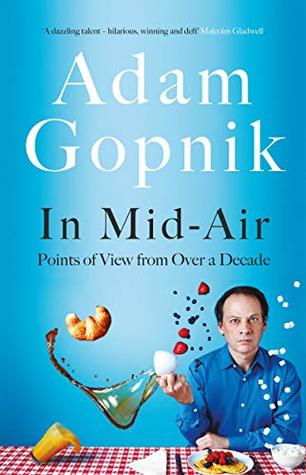 During the weeks that I spent with these essays I was frequently reminded of Jan Morris’s In My Mind’s Eye, which casts a similarly twinkling eye over the absurdities of modern life and the aging body. Gopnik endures shingles and shrugs over his funny last name (“drunken lout” in Russian) and short stature. He mostly ignores Twitter and decries our dependence on smartphones. As he’s never learned to drive, he’s amused by the idea of self-driving cars.
My favorite pieces were on significantly more trivial matters, though: the irony of famous Christmas songs being written by Jews, and a satire on society’s addiction to DVD box sets. Other arts references vary from the Beatles and Bob Dylan’s Nobel Prize to Cubism and literary festivals. It’s a quirky blend of high and low culture here. Bizarrely, Gopnik has recently written an oratorio on Alan Turing and a musical about a New York City restaurant.
The author is an unabashed liberal who prizes pluralism above all else but warns how fragile it is. In the final section he prophesies catastrophe under Trump and, afterwards, can only say that at least his election puts lesser issues into perspective. I valued the diagnosis of American insularity and British inwardness – this particular essay was written in 2013 but seems all the more relevant post-Brexit. This was my fifth book from Gopnik. While I didn’t engage with every essay and would have liked them to be chronological so there was a mix of topics all the way through, it was a pleasant and often thought-provoking read.
Some favorite lines:
“Watching the people we love die bit by bit is the hardest thing life demands until we recall that watching the people we love die bit by bit is in a certain sense what life simply is. It just usually takes more time for the bits to go by.”
“We should never believe that people who differ from us about how we ought to spend public money want to commit genocide or end democracy, and we should stop ourselves from saying so, even in the pixellated heat of internet argument. But when we see the three serpents of militarism, nationalism and hatred of difference we should never be afraid to call them out, loudly, by name”
My rating: 
In Mid-Air was published by riverrun, a new Quercus imprint, on October 18th. My thanks to the publisher for a free copy for review.
Turbulence by David Szalay
These 12 linked short stories, commissioned for BBC Radio 4, focus on travel and interconnectedness. Each is headed by a shorthand route from one airport to another, and at the destination we set out with a new main character who has crossed paths with the previous one. For instance, in “YYZ – SEA” the writer Marion Mackenzie has to cancel a scheduled interview when her daughter Annie goes into labor. There’s bad news about the baby, and when Marion steps away from the hospital to get Annie a few necessaries from a supermarket and is approached by a pair of kind fans, one of whom teaches Marion’s work back in Hong Kong, she’s overcome at the moment of grace-filled connection. In the next story we journey back to Hong Kong with the teacher, Jackie, and enter into her dilemma over whether to stay with her husband or leave him for the doctor she’s been having an affair with.
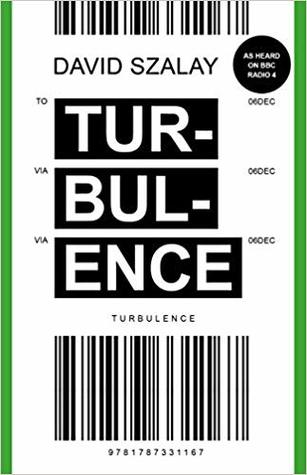 As he ushers readers around the world, Szalay invites us to marvel at how quickly life changes and how – improbable as it may seem – we can have a real impact on people we may only meet once. There’s a strong contrast between impersonal and intimate spaces: airplane cabins and hotel rooms versus the private places where relationships start or end. The title applies to the characters’ tumultuous lives as much as to the flight conditions. They experience illness, infidelity, domestic violence, homophobia and more, but they don’t stay mired in their situations; there’s always a sense of motion and possibility, that things will change one way or another.
My favorite story was “DOH – BUD,” in which Ursula goes to visit her daughter Miri and gains a new appreciation for Miri’s fiancé, Moussa, a Syrian refugee. I also liked how the book goes full circle, with the family from the final story overlapping with that of the first. Though a few of the individual stories are forgettable, I enjoyed this more than Szalay’s Booker-shortlisted All that Man Is, another globe-trotting set of linked stories.
Like Beneath the Skin, this acknowledges the many parts making up the whole of humanity; like In Mid-Air, it encourages a diversity of opinion and experience rather than narrow-mindedness. Maybe the three books had more in common than I first thought?
A favorite line:
“In fact it was hard to understand quite what an insignificant speck this aeroplane was, in terms of the size of the ocean it was flying over, in terms of the quantity of emptiness which surrounded it on all sides.”
My rating:
Turbulence is published by Jonathan Cape today, December 6th. My thanks to the publisher for a free copy for review.
 Bookish Beck = Rebecca Foster. American transplant to England. Freelance proofreader and book reviewer.
 Bookish Beck