August Releases: Bright Fear, Uprooting, The Farmer’s Wife, Windswept
This month I have three memoirs by women, all based on a connection to land – whether gardening, farming or crofting – and a sophomore poetry collection that engages with themes of pandemic anxiety as well as crossing cultural and gender boundaries.
My August highlight:
Bright Fear by Mary Jean Chan
Chan’s Flèche was my favourite poetry collection of 2019. Their follow-up returns to many of the same foundational subjects: race, family, language and sexuality. But this time, the pandemic is a lens through which all is filtered. This is particularly evident in Part I, “Grief Lessons.” “London, 2020” and “Hong Kong, 2003,” on facing pages, contrast Covid-19 with SARS, the major threat when they were a teenager. People have always made assumptions about them based on their appearance or speech. At a time when Asian heritage merited extra suspicion, English was both a means of frank expression and a source of ambivalence:
“At times, English feels like the best kind of evening light. On other days, English becomes something harder, like a white shield.” (from “In the Beginning Was the Word”)
“my Chinese / face struck like the glow of a torch on a white question: / why is your English so good, the compliment uncertain / of itself.” (from “Sestina”)
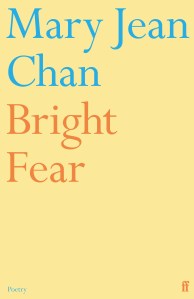 At the centre of the book, “Ars Poetica,” a multi-part collage incorporating lines from other poets, forms a kind of autobiography in verse. Chan also questions the lines between genres, wondering whether to label their work poetry, nonfiction or fiction (“The novel feels like a springer spaniel running off-/leash the poem a warm basket it returns to always”).
The poems’ structure varies, with paragraphs and stanzas of different lengths and placement on the page (including, in one instance, a goblet shape). The enjambment, as you can see in lines I’ve quoted above and below, is noteworthy. Part III, “Field Notes on a Family,” reflects on the pressures of being an only child whose mother would prefer to pretend lives alone rather than with a female partner. The book ends with hope that Chan might be able to be open about their identity. The title references the paradoxical nature of the sublime, beautifully captured via the alliteration that closes “Circles”: “a commotion of coots convincing / me to withstand the quotidian tug-/of-war between terror and love.”
Although Flèche still has the edge for me, this is another excellent work I would recommend even to those wary of poetry. 
Some more favourite lines, from “Ars Poetica”:
“What my mother taught me was how
to revere the light language emitted.”
“Home, my therapist suggests, is where
you don’t have to explain yourself.”
With thanks to Faber for the free copy for review.
Three land-based memoirs:
(All:  )
)
Uprooting: From the Caribbean to the Countryside – Finding Home in an English Country Garden by Marchelle Farrell
 This Nan Shepherd Prize-winning memoir shares Chan’s attention to pandemic-era restrictions and how they prompt ruminations about identity and belonging. Farrell is from Trinidad but came to the UK as a student and has stayed, working as a psychiatrist and then becoming a wife and mother. Just before Covid hit, she moved to the outskirts of Bath and started rejuvenating her home’s large and neglected garden. Under thematic headings that also correspond to the four seasons, chapters are named after different plants she discovered or deliberately cultivated. The peace she finds in her garden helps her to preserve her mental health even though, with the deaths of George Floyd and so many other Black people, she is always painfully aware of her fragile status as a woman of colour, and sometimes feels trapped in the confining routines of homeschooling. I enjoyed the exploration of postcolonial family history and the descriptions of landscapes large and small but often found Farrell’s metaphors and psychological connections obvious or strained.
With thanks to Canongate for the free copy for review.
The Farmer’s Wife: My Life in Days by Helen Rebanks
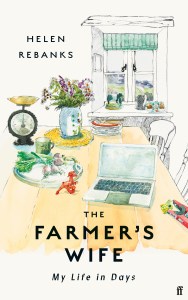 I fancied a sideways look at James Rebanks (The Shepherd’s Life and Wainwright Prize winner English Pastoral) and his regenerative farming project in the Lake District. (My husband spotted their dale from a mountaintop on holiday earlier in the month.) Helen Rebanks is a third-generation farmer’s wife and food and family are the most important things to her. One gets the sense that she has felt looked down on for only ever wanting to be a wife and mother. Her memoir, its recollections structured to metaphorically fall into a typical day, is primarily a defence of the life she has chosen, and secondarily a recipe-stuffed manifesto for eating simple, quality home cooking. (She paints processed food as the enemy.)
Growing up, Rebanks started cooking for her family early on, and got a job in a café as a teenager; her mother ran their farm home as a B&B but was forgetful to the point of being neglectful. She met James at 17 and accompanied him to Oxford, where they must have been the only student couple cooking and eating proper food. This period, when she was working an office job, baking cakes for a café, and mourning the devastating foot-and-mouth disease epidemic from a distance, is most memorable. Stories from travels, her wedding, and the births of her four children are pleasant enough, yet there’s nothing to make these experiences, or the telling of them, stand out. I wouldn’t make any of the dishes; most you could find a recipe for anywhere. Eleanor Crow’s black-and-white illustrations are lovely, though.
With thanks to Faber for the free copy for review.
Windswept: Life, Nature and Deep Time in the Scottish Highlands by Annie Worsley
 I’d come across Worsley in the Wildlife Trusts’ Seasons anthologies. For a decade she has lived on Red River Croft, in a little-known pocket of northwest Scotland. In word pictures as much as in the colour photographs that illustrate this volume, she depicts it as a wild land shaped mostly by natural forces – also, sometimes, manmade. From one September to the next, she documents wildlife spectacles and the influence of weather patterns. Chronic illness sometimes limited her daily walks to the fence at the cliff-top. (But what a view from there!) There is more here about local history and ecology than any but the keenest Scotland-phile may be interested to read. Worsley also touches on her upbringing in polluted Lancashire, and her former academic career and fieldwork in Papua New Guinea. Her descriptions are full of colours and alliteration, though perhaps a little wordy: “Pale-gold autumnal days are spliced by fickle and feisty bouts of turbulent weather. … Sunrises and sunsets may pour with cinnabar and henna; dawn and dusk can ripple with crimson and purple.” The kind of writing I could appreciate for the length of an essay but not a whole book.
With thanks to William Collins for the free copy for review.
Would you read one or more of these?
Four February Releases: Napolitano, Offill, Smyth, Sprackland
Much as I’d like to review books in advance of their release dates, that doesn’t seem to be how things are going this year. I hope readers will find it useful to learn about recent releases they might have missed. This month I’m featuring a post-plane crash scenario, a reflection on modern anxieties, an essay about the human–birds relationship, and a meditation on graveyards.
Dear Edward by Ann Napolitano
(Published by Penguin/Viking on the 20th; came out in USA from Dial Press last month)
 June 2013: a plane leaves Newark Airport for Los Angeles, carrying 192 passengers. Five hours after takeoff, it crashes in the flatlands of northern Colorado, a victim to stormy weather and pilot error. Only 12-year-old Edward Adler is found alive in the wreckage. In alternating storylines, Napolitano follows a select set of passengers (the relocating Adler family, an ailing tycoon, a Wall Street playboy, an Afghanistan veteran, a Filipina clairvoyant, a pregnant woman visiting her boyfriend) in their final hours, probing their backstories to give their soon-to-end lives context (and meaning?), and traces the first six years of the crash’s aftermath for Edward.
While this is an expansive and compassionate novel that takes seriously the effects of trauma and the difficulty of accepting random suffering, I found that I dreaded returning to the plane every other chapter – I have to take regular long-haul flights to see my family, and while I don’t fear flying, I also don’t need anything that elicits catastrophist thinking. I would read something else by Napolitano (she’s written a novel about Flannery O’Connor, for instance), but I can’t imagine ever wanting to open this up again.
I picked up a proof copy at a Penguin Influencers event.
Weather by Jenny Offill
(Published by Knopf [USA] on the 11th and Granta [UK] on the 13th)
 Could there be a more perfect book for 2020? A blunt, unromanticized but wickedly funny novel about how eco-anxiety permeates everyday life, Weather is written in the same aphoristic style as Offill’s Dept. of Speculation but has a more substantial story to tell. Lizzie Benson is married with a young son and works in a New York City university library. She takes on an informal second job as PA to Sylvia, her former professor, who runs a podcast on environmental issues and travels to speaking engagements.
Set either side of Trump’s election, the novel amplifies many voices prophesying doom, from environmentalists to Bible-thumpers (like Lizzie’s mother) to those who aren’t sure they’ll even make it past tomorrow (like her brother, a highly unstable ex-addict who’s having a baby with his girlfriend). It’s a wonder it doesn’t end up feeling depressing. Lizzie’s sardonic narration is an ideal way of capturing relatable feelings of anger and helplessness, cringing fear and desperate hope. Don’t expect to come away with your worries soothed, though there is some comfort to be found in the feeling that we’re all in this together.
Favorite lines:
“Young person worry: What if nothing I do matters? Old person worry: What if everything I do does?”
“Once sadness was considered one of the deadly sins, but this was later changed to sloth. (Two strikes then.)”
“My husband is reading the Stoics before breakfast. That can’t be good, can it?”
I read an e-ARC via Edelweiss.
An Indifference of Birds by Richard Smyth
(Published by Uniformbooks on the 14th)
 Birds have witnessed the whole of human history, sometimes profiting from our behavior – our waste products provide them with food, our buildings can be handy nesting and hunting platforms, and our unintentional wastelands and demilitarized zones turn into nature reserves – but more often suffering incidental damage. That’s not even considering our misguided species introductions and the extinctions we’ve precipitated. Eighty percent of bird species are now endangered. For as minimal as the human fossil record will be, we have a lot to answer for.
From past to future, archaeology to reintroduction and de-extinction projects, this is a wide-ranging essay that still comes in at under 100 pages. It’s a valuable shift in perspective from human-centric to bird’s-eye view. The prose is not at all what I’ve come to expect from nature writing (earnest, deliberately lyrical); it’s more rhetorical and inventive, a bit arch but still passionate – David Foster Wallace meets Virginia Woolf? The last six paragraphs, especially, soar into sublimity. A niche book, but definitely recommended for bird-lovers.
Favorite lines:
“They must see us, watch us, from the same calculating perspective as they did two million years ago. We’re still galumphing heavy-footed through the edgelands, causing havoc, small life scattering wherever we tread.”
“Wild things lease these places from a capricious landlord. They’re yours, we say, until we need them back.”
I pre-ordered my copy directly from the publisher.
These Silent Mansions: A life in graveyards by Jean Sprackland
(Published by Jonathan Cape on the 6th)
 I’m a big fan of Sprackland’s beachcombing memoir, Strands, and have also read some of her poetry. Familiarity with her previous work plus a love for graveyards induced me to request a copy of her new book. In it she returns to the towns and cities she has known, wanders through their graveyards, and researches and imagines her way into the stories of the dead. For instance, she finds the secret burial place of persecuted Catholics in Lancashire, learns about a wrecked slave ship in a Devon cove, and laments two dead children whose bodies were sold for dissections in 1890s Oxford. She also remarks on the shifts in her own life, including the fact that she now attends more funerals than weddings, and the displacement involved in cremation – there is no site she can visit to commune with her late mother.
I most enjoyed the book’s general observations: granite is the most prized headstone material, most graves go unvisited after 15 years, and a third of Britons believe in angels despite the country’s overall decline in religious belief. I also liked Sprackland’s list of graveyard charms she has seen. While I applaud any book that aims to get people thinking and talking about death, I got rather lost in the historical particulars of this one.
Favorite lines:
“This is the paradox at the heart of our human efforts to remember and memorialise: the wish to last forever, and the knowledge that we are doomed to fail.”
“Life, under such a conscious effort of remembering, sometimes resembles a series of clumsy jump-cuts rather than one continuous narrative.”
My thanks to the publisher for the free copy for review.
What recent releases can you recommend?
Memoirs by Casey Gerald and Catherine Simpson
These two memoirs may be very different in terms of the setting (Texas and Yale versus rural Lancashire) and particulars, but I’m reviewing them together because they are both about dysfunctional families and the extent to which external circumstances determine how others see us – and how we view ourselves.
There Will Be No Miracles Here: A Memoir from the Dark Side of the American Dream by Casey Gerald (2018)
The title comes from a seventeenth-century sign in a French village that was intended to get the God-dazzled peasants back to work. For Gerald it’s a somewhat tongue-in-cheek reminder that his life, even if he has made good after an unpromising beginning, is not some American dream or fairytale. It’s more complicated than that. Still, there’s no sugar-coating his family issues. His father missed his tenth birthday party because he was next door with dope fiends; his bipolar mother was in the psych ward while his father was in jail, and then disappeared for several years. Gerald and his older sister, a college dropout, got an apartment and set their own lax rules. In the meantime, he was coming to terms with the fact that he was gay and trying to reconcile his newfound sexual identity with his Christian faith.
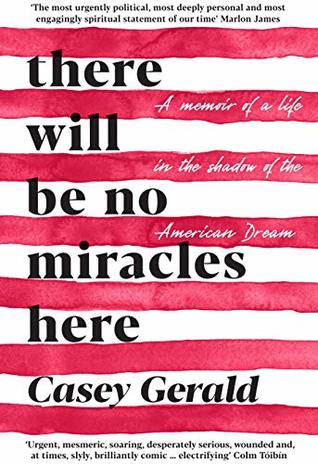 In spite of it all, Gerald shone academically and athletically. He was his Texas high school’s valedictorian and followed his father into a thriving college football career – at Yale, where he accidentally fell into leadership via a Men of Color council across the Ivy League schools. It wasn’t until he got to Yale that it even occurred to him that he was poor. (I was reminded of the moment in Michelle Obama’s memoir when she got to Princeton and experienced being a minority for the first time.) As he neared graduation, he decided to go into investment banking “simply because I did not have any money and none of my people had any money.” Back in Texas after a year in a Washington, D.C. think tank, he even considered a run for Congress under the slogan “We can dream again.”
I loved the prologue, which has the 12-year-old Gerald cowering with his church congregation on the last night of 1999, in fear of being left behind at the end of the world. I think I expected religion to continue as a stronger theme throughout the book. The style wasn’t really what I imagined either: it’s a coy combination of reader address, stream-of-consciousness memories, and remembered speech in italics that often set me skimming. Whereas landmark events like his mother’s departure are left impressionistic, football games and the inner workings of Yale’s societies are described in great detail. Scenes in the classroom and with boyfriends, though still occasionally tedious, at least feel more relevant.
Gerald proudly calls himself a “faggot” and is going for a kind of sassy, folksy charm here. For me the tone only landed sometimes. Mostly I appreciated his alertness to how others (often wrongly) perceived him – a great instance of this is when he meets George W. Bush in 2007 and tells him the bare bones of his story, only for Dubya to later twist it into an example in a speech. The memoir tails off into a rather odd and sudden ending, and overall I wasn’t sure it had enough to say to fill close to 400 pages. Perhaps Gerald could have waited another 10 years? As a more successful take on similar themes, I’d recommend the memoir-in-essays Live Through This: Surviving the Intersections of Sexuality, God, and Race by Clay Cane.
My rating: 
There Will Be No Miracles Here was hand-picked by Colm Tóibín for publication by Tuskar Rock Press, a new imprint of Serpent’s Tail, on January 10th. It was published in the USA by Riverhead Books in October 2018. My thanks to the UK publisher for the free copy for review.
When I Had a Little Sister: The Story of a Farming Family that Never Spoke by Catherine Simpson (2019)
On December 7, 2013, Simpson’s younger sister, Tricia, was found dead by their 87-year-old father at the family farmhouse where she lived in Lancashire. She was 46 and had been receiving daily mental health visits for her bipolar disorder, but the family had never been notified about a previous suicide attempt just three weeks before. Simpson excavates her family history to ask how things could have gotten so bad that they didn’t realize that Tricia’s depression had reached suicidal levels.
Simpson’s grandparents – her grandfather a World War I veteran – moved into the property in 1925, so by this time there was literally generations’ worth of stuff to clear out. “I ask myself now: is it possible to dispose of a person’s effects with dignity?” Simpson frets. As she and her father sifted through antique furniture, gadgets and craft supplies, she recalls the previous death in the family: her mother’s from non-Hodgkin’s lymphoma seven years before. Growing up on a cattle farm in the 1970s, the three daughters were expected to be practical and unsentimental; there was never any discussion of emotions, and they got the sense that their overworked, unfulfilled mother would rather they weren’t around at all. In this context, it was hard for Tricia to cope with everyday challenges like struggling with schoolwork and the death of a beloved cousin. She started smoking at 12 and went on antidepressants at 19.
 Simpson started writing this family memoir on a fellowship at Hawthornden Castle in February 2016. The first step of her project was to read all of Tricia’s diaries, from age 14 on. There were happy experiences, like six months as a nanny in Vienna and a travel grant to a kibbutz in Israel. There were also unwelcome surprises, like a 1981 suicide note – from when Tricia was just 15. Simpson had never realized just how prone her little sister was to all-or-nothing thinking. She dove headlong into short-lived relationships and, when they failed, feared she would never find love again. Over the years Tricia grew increasingly paranoid, believing she was being watched on the farm and her sisters were plotting to sell the property and leave her with nothing. One time she even locked her parents in to keep them safe.
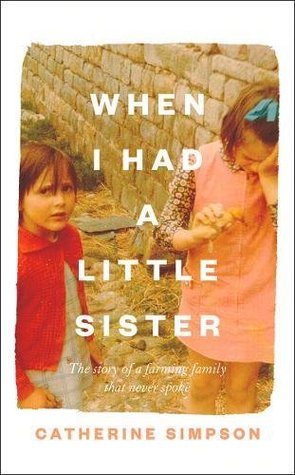
Although the subtitle is melodramatic, it conveys all that went unsaid in this family: not just sadness, but also love and tenderness. The cover image shows Simpson crying over a dead duckling; Tricia is at the left, her look of consternation startlingly intense for a three-year-old. “It’s only a duck. There’s plenty more where that came from” was their father’s hardhearted response. There are many other family photographs printed in black and white throughout the text; Tricia loved fashion, and is stunning in her glamour shots. While the book is probably overlong, I was absorbed in the family’s story, keen to see how Simpson would reconstruct events through objects, photographs and journals. (My sister is a Tricia, too.) Recommended to readers of Jill Bialosky’s History of a Suicide and Clover Stroud’s The Wild Other.
My rating:
When I Had a Little Sister will be published by Fourth Estate on February 7th. My thanks to the publisher for an early proof copy for review.
 Bookish Beck = Rebecca Foster. American transplant to England. Freelance proofreader and book reviewer.
 Bookish Beck