Review Catch-Up: Herreros, Onyebuchi and Tookey
Quick snapshot reviews as I work through a backlog.
One each today from fiction, nonfiction and poetry: a graphic novel about the life of Georgia O’Keeffe, a personal response to Chimamanda Ngozi Adichie’s Americanah, and a beautiful collection of place-centric verse.
Georgia O’Keeffe by Maria Herreros (2021; 2022)
[Translated from the Spanish by Lawrence Schimel]
 This is the latest in SelfMadeHero’s “Art Masters” series (I’ve also reviewed Gauguin, Munch and Vincent). Madrid-based illustrator Herreros renders O’Keeffe’s life story in an abstract style that feels in keeping with the artist’s own. The book opens in 1915 with O’Keeffe still living in her family home in Virginia and working as an art teacher. Before she ever meets Alfred Stieglitz, she is fascinated by his photography. They fall in love at a distance via a correspondence and later live together in New York City. Their relationship ebbs as she spends more and more time in New Mexico, a desert landscape that inspires many of her most famous paintings. Much of the narrative is provided by O’Keeffe’s own letters (with idiosyncrasies retained); the additional summary text is unfortunately generic, and the urge to cover many years leads to skating over long periods. Still, the erotic attention to detail and the focus on the subject’s dedication to independence made it worthwhile.

With thanks to SelfMadeHero for the free copy for review.
(S)kinfolk: Chimamanda Ngozi Adichie’s Americanah by Tochi Onyebuchi (2021)
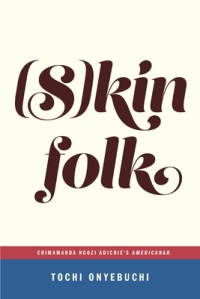 I’ve reviewed six previous releases from Fiction Advocate’s “Afterwords” series (on Blood Meridian, Fun Home, and The Year of Magical Thinking; My Struggle and Wild; and Middlesex). In these short monographs, “acclaimed writers investigate the contemporary classics,” weaving literary criticism into memoir as beloved works reverberate through their lives. Onyebuchi, a Nigerian American author of YA dystopian fiction, chose one of my favourite reads of recent years: Americanah. When he read the novel as a lawyer in training, it was the first time he sensed recognition of his own experiences in literature. He saw his immigrant mother’s situation, the collective triumph of Obama’s election, and his (re)discovery of Black beauty and spaces. Like Ifemelu: he was an outsider to African American identity and had to learn it gradually; and he makes a return trip to Nigeria at the end. I enjoyed this central thread but engaged less with asides about a 2013 visit to the West Bank (for a prisoners’ rights organization) and Frantz Fanon’s work on Algeria.
With thanks to Fiction Advocate for the free e-copy for review.
In the Quaker Hotel by Helen Tookey (2022)
 Tookey’s third collection brings its variety of settings – an austere hotel, Merseyside beaches and woods, the fields and trees of Southern France (via Van Gogh’s paintings), Nova Scotia (she completed a two-week residency at the Elizabeth Bishop House in 2019) – to life as vibrantly as any novel or film could. In recent weeks I’ve taken to pulling out my e-reader as I walk home along the canal path from library volunteering, and this was a perfect companion read for the sunny waterway stroll, especially the poem “Track.” Whether in stanzas, couplets or prose paragraphs, the verse is populated by meticulous images and crystalline musings.
not a loss
something like a clarifying
becoming something you can’t name
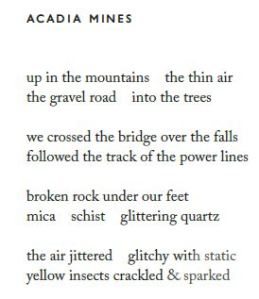
There are evanescent encounters (“Leapfrog”) and deep time (“Natural History”); playing with language (“Concession à Perpetuité”) and erasures (“Pool / Other Body”). You’ll find alliteration and ampersands (a trend in contemporary poetry?), close observation of nature, and no trace of cliché. Below are the opening stanzas of a couple of poems to give a flavour:

With thanks to Carcanet Press for the free e-copy for review.
Would you be interested in reading one or more of these?
 Bookish Beck = Rebecca Foster. American transplant to England. Freelance proofreader and book reviewer.
 Bookish Beck