A Spate of Swimming Memoirs
In the first four months of this year, I got my hands on no fewer than four swimming memoirs. For the upcoming July/August issue of Foreword Reviews magazine I’ve reviewed Floating: A Life Regained by Joe Minihane, in which the author recreates the late nature writer Roger Deakin’s wild swimming journeys from Waterlog (1999) in an attempt to overcome anxiety; I have Leap In by Alexandra Heminsley on my Kindle; and I read roughly the first 60 pages of a library copy of Al Álvarez’s 2013 Pondlife: A Swimmer’s Journal.
For now, I’m featuring Turning by Jessica J. Lee, which has strong similarities to these other memoirs – especially Minihane’s – but is its own beautifully reflective personal story. The book arose from Lee’s resolution, when she was 28 and in Berlin on a research placement for her dissertation in environmental history, to swim in 52 local lakes – a year’s worth – no matter the weather. At the time she blogged about her “52 Lakes Project” for Slow Travel Berlin, and kept friends and family up to date through social media as well. Her focus would be on the former East German region of Brandenburg, which has Berlin at its center and was first popularized by Theodor Fontane’s 1862 travel book.
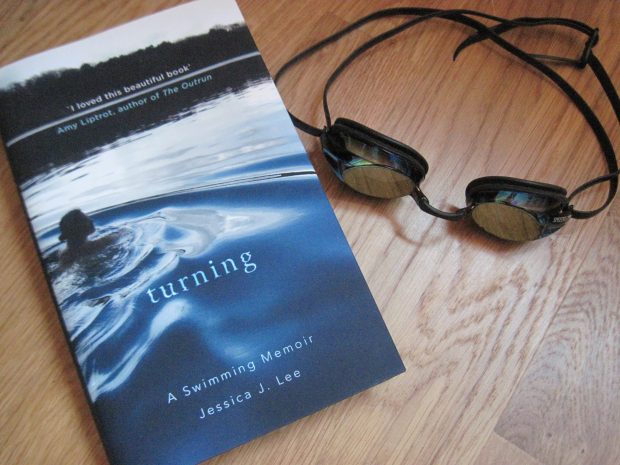
Lee traveled to the lakes under her own steam, using trains and her bicycle; occasionally she took friends with her, but most often she was alone, which became a chance to cultivate solitude – not the same as loneliness. The challenge entailed all kinds of practical difficulties like bike trouble, getting lost, and a dead phone battery, but gradually it became routine and held less fear for her. On summer days she could manage multiple lakes in a day, and even small encounters with Germans gave her a newfound sense of belonging.
Within chapters, the memoir gracefully alternates pieces of the author’s past with her lake travels. With a father from Wales and a mother from Taiwan, Lee grew up in Ontario and spent summers in Florida. She remembers taking YMCA swimming lessons alongside her mother, and swimming in Canadian lakes. Back then the water usually intimidated her, but over the years her feelings have changed:
Water feels different in each place. The water I grew up with was hard, cutting, and when I go back to visit it now, I feel it in my ears when I dive in. something different, more like rock. The lake a whetted blade. The water in Berlin has a softness to it. Maybe it’s the sand, buffing the edges off the water like splinters from a beam. It slips over you like a blanket. There’s a safety in this feeling. In the lakes here, there is a feeling of enclosure and security that Canada can’t replicate. And it shouldn’t – the pelagic vastness there is entirely its own, and I’ve learned to love that too.
Swimming fulfills many functions for Lee. It served variously as necessary discipline after going mildly off the rails in young adulthood (drinking, smoking pot and having an abortion during college; a short-lived marriage in her early twenties); as a way of bouncing back from depression when her planned life in London didn’t pan out and a budding relationship failed; and as a way of being in touch with the turning seasons and coming to know the German landscape intimately. Symbolically, of course, it’s also a baptism into a new life.
Yet I had to wonder if there was also something masochistic about this pursuit, especially in the winter months. On the back cover there’s a photograph of Lee using a hammer to chip out a path through the ice so she can do her minimum of 45 strokes. (No wetsuit!) As spring came, ironically, the water felt almost too warm to her. She had learned to master the timing of a winter swim: “Between pain and numbness there’s a brightness, a crisp, heightened sensation in the cold: that’s the place to swim through. When it ends, when numbness arrives, it’s time to get out.”
The end of Lee’s year-long project is bittersweet, but she’s consoled by the fact that she didn’t have to leave her ordinary life in order to complete it. It was a companion alongside the frantic last-minute work on her dissertation and it never got in the way of her relationships; on the contrary, it strengthened certain friendships. And with Berlin looking like her home for the foreseeable future, she’s committed to seeking out more lakes, too.
There are a lot of year quest books out there, but this one never feels formulaic because there’s such a fluid intermingling of past and present. As memoirs go, it is somewhat like Amy Liptrot’s The Outrun – but much better. It’s also comparable to Angela Palm’s Riverine, with a watery metaphor at the heart to reflect the author’s conception of life as a meandering route. Unlike the other swimming memoirs I’ve sampled, I can recommend this one to a general reader with no particular interest in wild swimming or any other sport. It’s for you if you enjoy reading about the ebb and flow of women’s lives.
In the stillness of the lakes, the border between nature and culture is thinned. Swimming takes place at this border, as if constantly searching for home. Water is a place in which I don’t belong, but where I find myself nonetheless. Out of my culture, out of my depth.
There is more space inside than I can imagine, more hope and possibility than I’d known. Feeling as clear as the day, as deep as the lake.
Turning: A Swimming Memoir was published in the UK by Virago on May 4th. My thanks to the publisher for sending a free copy for review.
My rating: 
Finding a Home in Nature: Singing Meadow by Peri McQuay
For 30 years Peri McQuay and her family lived in the idyllic 700-strong village of Westport in Eastern Ontario. Her husband, Barry, was the park supervisor at Foley Mountain Conservation Area, the subject of her first nature-themed memoir, The View from Foley Mountain (1995), and they lived on site amid its 800 acres. The constant push to engage in fundraising gradually made it a less pleasant place to live and work, so as Barry’s retirement neared they knew it was time to find a new home of their own. That quest is the subject of her third book, Singing Meadow: The Adventure of Creating a Country Home.
McQuay fantasized about a farmhouse surrounded by 50–100 acres of their own land, but was aware that their limited finances might not stretch to match their dreams. Long before they found their home they were buying little items for it, like an acorn door knocker that functioned as a reassuring totem object during the long, discouraging process of looking at houses. Over the course of two years, McQuay and her husband viewed more than 80 properties! Two pieces of advice they received turned out to be prescient: their loquacious real estate agent opined that “the house you end up in won’t be the one you set out to find,” and a woman in the doctor’s office waiting room counseled her, “don’t try too hard. It’ll happen when it’s time.”
 In the end, they fell in love with a plot of land with a water meadow that was home to herons and beavers. With no handyman skills, they never thought they’d embark on building a home of their own. And as it turned out, finding the land was the easy bit, as opposed to the nitty-gritty details of designing what they wanted and meeting with builders who could make it a reality. But as they planted trees and looked ahead to their move in a year’s time, they were already forming a relationship with this place before the house was ever built, learning “the hard lessons of patience and possibility.”
Woven through the book are short flashbacks to other challenging times in McQuay’s life: having chronic fatigue syndrome in her 40s, her mother’s death a few years earlier, and a terrible ice storm at the park that left them without power for 17 days and caused damage to the forest that it might take 30 years to recover from. What all of these situations, as well as looking for a home, have in common is that they forced the author to take the long view, recognizing the healing effects of time rather than the tantalizing option of quick fixes.
I’ve never owned a home, but I’ve lived in 10 properties in the last 10 years. A lot of that nomadism has been foisted upon us rather than chosen, so I could relate to McQuay’s frustration throughout the property search, as well as her feelings of being uprooted – that “the very stuff of my life was being dismantled.” I can also see the wisdom of choosing the place that feeds your soul rather than the one that seems most convenient. She remembers one of the first properties she and Barry rented as a married couple: it was an old place with an outhouse and no running hot water, but they filled it with laughter and music and felt at peace there. It was infinitely better than any soulless town apartment they might have resorted to.
The book ends with a bit of a shocker, one of two moments that brought a lump to my throat. It’s a surprisingly bittersweet turn after what’s gone before, but it’s realistic and serves as a reminder that life is an ongoing story with sad moments we can’t prepare for.
Overall, this memoir reminds me most of Michael Pollan’s A Place of My Own (which appears in McQuay’s bibliography) and May Sarton’s journals, in which the search for a long-term home in Maine is a major element. Although this will appeal to people who like reading about women’s lives and transitions, I would particularly recommend it to readers of nature writing as the book is full of lovely passages like these:
It was bliss visiting the trees and caring for them. Each one was precious. Across the meadow I could see the black, white and yellow nesting bobolink plus an unidentifiable bird with a square seed-eating beak perched on a cattail. A crow flew by, checking to see what I was doing, then a blue jay. In the distance the newly returned yellow warbler was calling “witchetty witchetty.” Over and over, I needed to keep saying that I felt deep down, richly happy in the meadow. In the glassy eye of the pond, water was burbling up in such a powerful spilling-over that it chuckled musically. Indeed, while there was such a flow only the boldest, largest minnows could swim strongly enough to approach the rushing source.
Now I was walking slowly down to the water meadow, hearing the strange, quarrelsome-sounding talk of herons beginning another season here. I was teaching myself how to be aware every moment of every step so I could keep walking longer on this rough land. With any luck, this beloved place would be my last home. And, after the unignorable message of recent fierce summers, I was here to bear witness, to stand with the great maples, beeches, and oaks through whatever might come, to accompany with whatever grace I could for as long as I could sustain it. Living here, this was who I wanted to be—an old woman vanishing into the light.
I’m keen to get hold of McQuay’s other two books as well. Her work makes for very pleasant, meditative reading.
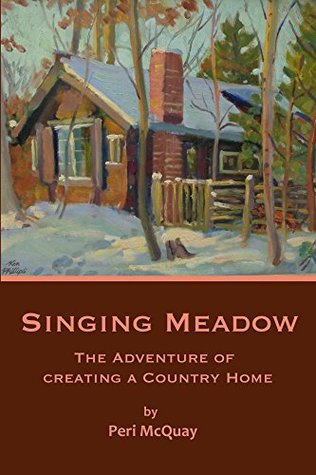
Note: The front cover is an oil painting of Peri’s childhood home by her artist father, Ken Phillips.
Singing Meadow: The Adventure of Creating a Country Home was published by Wintergreen Studios Press in 2016. My thanks to the author for sending a PDF copy for review.
My rating: 
Blog Tour: Two Voices, One Story
“[B]eing an adoptive parent is like parenting in Technicolor: everything is just a little more intense. This means the highs can be really high, but it also means that the lows are going to be really low. You have to prepare yourself.”
~Sharon Roszia, quoted in A Book about Love, by Jonah Lehrer
Two Voices, One Story is a mother–daughter memoir that splits narration duties between Elaine Rizzo and Amy Masters, the now-teenage daughter she adopted from China in 1999. Elaine’s sections provide the main thread of their story, while Amy’s passages, generally shorter and printed in italics, chime in to give her perspective on various events and relationships that have been important in her life.
 Elaine is forthright about her infertility and the miscarriage that led to her decision to adopt. In the late 1990s, China’s one-child policy was still in place, but it was the severe flooding of the Yangtze River that led directly to Amy’s adoption. Thousands died and millions more were displaced. Given the context, it’s not so surprising that baby Amy was left outside a welfare center. She was given the Chinese name Tong Fang – “Copper Child.”
For me the highlight of the book was Elaine and Lee’s trip to China to pick up Amy. Although they were nervous and disoriented, they experienced the kindness of strangers and responded with compassion of their own, taking along extra toiletries and clothes of different sizes and leaving the surplus with the care center. Amy had bronchitis, one more worry on top of all the paperwork and red tape they had to go through to finalize the adoption.
Back in England, Amy had some behavioral problems that were likely vestiges of her time at the orphanage. She hated noise, especially thunderstorms; she hit herself and others; and she often woke up screaming. Private schooling ensured she wouldn’t get left behind, and there were many happy times with extended family and holidays to Australia and the west coast of Wales, where Elaine and Amy would later settle with Elaine’s second husband.
But life wasn’t always rosy: Amy was strong-willed and uncooperative – perhaps nothing out of the ordinary for a teenager, but still a challenge for her parents. Elaine recalls a social worker telling them “that very often adoptive parents don’t feel like they have the right to tell their child off, or that they think they shouldn’t say or do anything which might upset the child, because they are trying to compensate for what has happened prior to the adoption.”
Lengthy commuting to her job back in England and years-long house renovations demanded much of Elaine’s attention, yet she remained alert to what was going on with Amy. Unfortunately, in her teen years Amy experienced racism from a few schoolmates, including abusive Facebook messages that drove the family to contact the police. Amy herself, though, always comes across as easygoing about being different: “Every Christmas we used to do a Nativity show and I remember being an angel first and then one of the kings, which I suppose was the right role for me because I really do come from the East.”
Even though this is a very quick read, my interest waxed and waned. The telling can be clichéd and sentimental, and I felt too much space was given to banal details that added little to an understanding of the central mother–daughter relationship. This self-published book has a very appealing cover but needs another look from an experienced editor who could fix the fairly frequent typos and punctuation issues and cut out the bullet points (nine pages’ worth) and speech tics like “I will also say…” and “I have to comment…”
I would certainly recommend this book to those who have a personal experience of or interest in adoption, particularly from overseas (for a fictional take on adoption from China, you might also try The Fortunes by Peter Ho Davies, The Red Thread by Ann Hood, and This Must Be the Place by Maggie O’Farrell), as well as to anyone wondering how to parent or educate a child who is in some way different.
I’ll end with some lovely words from Amy:
when my Chinese mum left me outside the gates of the welfare center almost eighteen years ago now, because there was nothing left for me in Tongling, she must have had the desperate hope that I would find a happy life with people who loved me. I can only say that her wish did come true.
My rating: 
Two Voices, One Story will be published by Clink Street Publishing on March 21st. Thanks to Rachel Gilbey of Authoright Marketing & Publicity for arranging my free copy for review.
I was pleased to participate in the blog tour for Two Voices, One Story.
Novellas in November
Taking a lead from Laura over at Reading in Bed, I’ve trawled my shelves and my current library pile for some blissfully short books. For this challenge I limited myself to books with fewer than 150 pages and came up with four fiction books and two ‘nonfiction novellas’.
The Library of Unrequited Love by Sophie Divry
[92 pages]
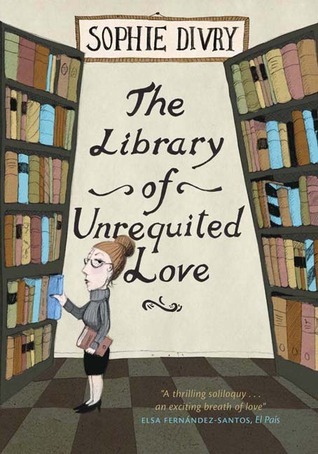 This one-sitting read is a monologue by an embittered librarian who arrives one morning to discover a patron has been locked into the basement overnight—a captive audience. Responsible for Geography, she hopes for a promotion to History, her favorite subject. Alas, no one seems to appreciate this library as a bastion of learning anymore; they only come for DVDs and a place to keep warm. That is, except for Martin, a young PhD researcher who’s caught her eye. But he doesn’t even seem to notice she exists. In one uninterrupted paragraph, this celebrates all that books do for us but suggests that they still can’t fix a broken heart.
My verdict: There are lots of great one-liners about the value of books (“You’re never alone if you live surrounded by books”), but overall it’s a somewhat aimless little experiment and not particularly well translated. 
The All of It by Jeannette Haien
[145 pages]
 When this won the Sue Kaufman Prize for First Fiction in 1987, the author was in her sixties. It’s since been championed by Ann Patchett, who contributed a Foreword to this 2011 edition. Father Declan de Loughry, fishing for salmon, reflects on the recent death of parishioner Kevin Dennehy. Before he died, Kevin admitted that he and Enda were never properly married. Yet Enda begs the priest to approve a death notice calling Kevin her “beloved husband,” promising she’ll then explain “the all of it” – the very good reason they never married. As she tells her full story, which occupies the bulk of the novella, Father Declan tries to strike a balance between the moral high ground and human compassion.
My verdict: Enda’s initial confession on page 27 is explosive, but the rest of this quiet book doesn’t ever live up to it. I was reminded of Mary Costello’s Academy Street, a more successful short book about an Irish life.
Favorite passage: “One thing I’ve learned, Father—that in this life it’s best to keep the then and the now and the what’s-to-be as close together in your thoughts as you can. It’s when you let gaps creep in, when you separate out the intervals and dwell on them, that you can’t bear the sorrow.”
Thirteen Ways of Looking by Colum McCann
[143 pages]
 This starts off as the simple story of J. Mendelssohn, an octogenarian who wakes up on a snowy morning in his New York City apartment, contemplating his past – Lithuanian/Polish ancestry, work as a judge and marriage to Eileen, whom he met as a boy in Dublin – and planning to meet his son at a restaurant for lunch. But all of a sudden it turns into a murder mystery on page 24: “Later the homicide detectives will be surprised…” In 13 sections headed by epigraphs from the Wallace Stevens poem “Thirteen Ways of Looking at a Blackbird,” McCann flits through Mendelssohn’s thoughts and flips between the events preceding and immediately following the murder. A late interrogation scene is particularly strong – “unlike our poetry, we like our murders to be fully solved.”
My verdict: This is the first I’ve read from McCann, and it’s terrific. He stuffs so much plot and characterization into not many pages. Mendelssohn’s thought life is rich with allusions and wordplay. I was particularly intrigued to read about the autobiographical overlap in the Author’s Note. I haven’t yet read the short stories included in the volume, but for the novella on its own it’s  .
.
As We Are Now by May Sarton
[134 pages]
 On the surface this is similar to a novel I reviewed earlier in the month, The Secret Diary of Hendrik Groen, 83¼ Years Old. But where spunky Hendrik determines to outwit his care home’s sullen staff, Sarton’s narrator, seventy-six-year-old Caroline Spencer, has given in. A retired high school math teacher, she’s landed in a New England old folks’ home because during her recovery from a heart attack she failed to get along with her brother’s younger wife. She finds kindred spirits in Standish Flint, a tough old farmer, and Reverend Thornhill, but her growing confusion and the home’s pretty appalling conditions drive her to despair.
My verdict: This is enjoyable for the unreliable narrator and the twist ending, but overall it struck me as rather melodramatic. However, I appreciated a lot of Caro’s sentiments.
Favorite passages: “Am I senile, I wonder? The trouble is that old age is not interesting until one gets there, a foreign country with an unknown language to the young, and even to the middle-aged. I wish now that I had found out more about it.” & “And what is left of you? A lapis lazuli pin, a faded rose petal, once pink, slipped into the pages of this copybook.”
And two short works of nonfiction:
Excerpts from a Family Medical Dictionary by Rebecca Brown
[113 pages]
 Brown is a novelist from Seattle. This is an account of her mother’s death from what sounds like stomach cancer. The disease progressed quickly and her mother died at home, under hospice care, in New Mexico in 1997. As the title suggests, the brief thematic chapters are arranged around vocabulary words like “anemia” and “metastasis.” My favorite chapters were about washing: her mother’s habit of reading while taking long baths, and the ways Brown and her sister tried to care for their mother’s disintegrating body, including a plan to prepare the corpse themselves. Clinical descriptions of vomiting alternate with magical thinking to accompany her mother’s hallucinations: “You’re packed, Mom, but all of us aren’t going, just you. But you’ve got everything you need.”
My verdict: Brown covers a lot of emotional ground in a very few pages, but I prefer my medical/bereavement memoirs to have more of a narrative and more detail than “when she died it was not peacefully or easy, it was hard.”
Ruined by Reading: A Life in Books by Lynne Sharon Schwartz
[119 pages]
 This 1996 memoir was sparked by reading a quote from a Chinese Buddhist in a New York Times article: he suggested that reading is dangerous as it imposes others’ ideas on you and doesn’t allow you to use your own mind freely. Schwartz, of course, begs to differ. As a novelist, reading has been her lifeline. She looks back at her childhood reading and her pretentious college student opinions on Franz Kafka and Henry James, and explains that she lets serendipity guide her reading choices nowadays, rather than a strict TBR list: “reading at random – letting desire lead – feels like the most faithful kind.”
My verdict: It’s a bibliomemoir; I should have loved it. Instead I thought it unstructured and thin. There are some great lines dotted through, but I wasn’t very interested in the examples she focuses on. Five pages about a children’s book by Eleanor Farjeon? Yawn! 
Favorite passages: “Like the bodies of dancers or athletes, the minds of readers are genuinely happy and self-possessed only when cavorting around, doing their stretches and leaps and jumps to the tune of words.” & “How are we to spend our lives, anyway? That is the real question. We read to seek the answer, and the search itself – the task of a lifetime – becomes the answer.”
Have you read any of these? Which one takes your fancy?
How do you feel about novellas in general?
Books in Brief: Five I Loved Recently
Novels narrated by an octogenarian and an unborn child; memoirs about connection with nature and escaping an abusive relationship; and a strong poetry collection that includes some everyday epics: these five wildly different books are all 4-star reads I can highly recommend.
The Secret Diary of Hendrik Groen, 83¼ Years Old
 In this anonymous Dutch novel in diary form, Hendrik Groen provides a full reckoning of how 2013 went down in his Amsterdam old folks’ care home. He and five friends form the “Old But Not Dead” club and take turns planning exciting weekly outings. Much comic relief is provided by his incorrigibly tippling friend, Evert, and the arrival of Eefje makes late-life romance seem like a possibility for Hendrik. However, there’s no getting around physical decay: between them these friends suffer from incontinence, dementia, diabetic amputations and a stroke. By the time 2014 rolls around, their number will be reduced by one. Yet this is a tremendously witty and warm-hearted book, despite Hendrik’s sad family history. It’s definitely one for fans of A Man Called Ove – but I liked this more. A sequel from 85-year-old Hendrik came out this year in Dutch; I’ll be looking forward to the English translation.
The Moth Snowstorm: Nature and Joy
By Michael McCarthy
 An environmental journalist for the UK’s Independent, McCarthy offers a personal view of how the erstwhile abundance of the natural world has experienced a dramatic thinning, even just in England in his lifetime. He gives both statistical and anecdotal evidence for that decline; as a case study he discusses the construction of a sea wall at Saemangeum in South Korea, responsible for decimating a precious estuary habitat for shorebirds. As if to balance his pessimism about the state of the world, McCarthy remembers singular natural encounters that filled him with joy and wonder – first discovering birdwatching as a lad near Liverpool, seeing a morpho butterfly in South America – but also annual displays that rekindle his love of life: the winter solstice, the arrival of cuckoos, and bluebells. This memoir is more sentimental than I expected from an English author, but I admire his passion and openness.
Nutshell
By Ian McEwan
 My seventh McEwan novel and one of his strongest. Within the first few pages, I was utterly captivated and convinced by the voice of this contemporary, in utero Hamlet. Provided you suspend disbelief a bit to accept he can see/hear/surmise everything that happens – the most tedious passages are those where McEwan tries to give more precise justification for his narrator’s observations – the plot really works. Not even born and already a snob with an advanced vocabulary and a taste for fine wine, this fetus is a delight to spend time with. His captive state pairs perfectly with Hamlet’s existential despair, but also makes him (and us as readers) part of the conspiracy: even as he wants justice for his father, he has to hope his mother and uncle will get away with their crime; his whole future depends on it.
Favorite line: “I have lungs but not air to shout a warning or weep with shame at my impotence.”
How Snow Falls
By Craig Raine
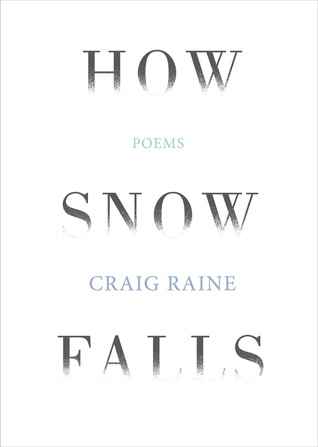 One of the few best poetry collections I’ve read this year. It contains nary a dud and is a good one to sink your teeth into – it’s composed of just 20 poems, but several are in-depth epics drawn from everyday life and death. Two elegies, to a dead mother and a former lover, are particularly strong. I loved the mixture of clinical and whimsical vocabulary in “I Remember My Mother” as the poet charts the transformation from person to corpse. “Rashomon” is another stand-out, commissioned as an opera and inspired by the short story “In a Grove” by Ryūnosuke Akutagawa. In couplets with a flexible rhyme scheme, the poem alternates the perspectives of a bandit, a captive husband, his raped wife, and the woodcutter who becomes an unwilling observer. Alliteration is noteworthy throughout the collection, but here produces one of my favorite lines: “Sweet cedar chips were spurting in the gloom like sparks.”
Land of Enchantment
By Leigh Stein
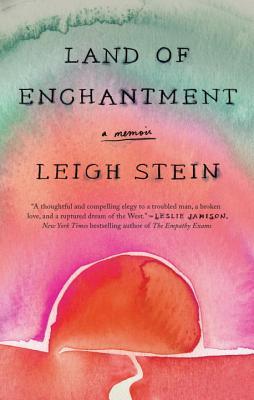 Stein tells of her abusive relationship with Jason, a reckless younger man with whom she moved to New Mexico. The memoir mostly toggles between their shaky attempt at a functional relationship in 2007 and learning about his death in a motorcycle accident in 2011. Even though they’d drifted apart, Jason’s memory still had power over her. Breaking free from him meant growing up at last and taking responsibility for her future. You might call this a feminist coming-of-age narrative, though that makes it sound more strident and formulaic than it actually is. I admired the skipping around in time, and especially a late chapter in the second person. I also enjoyed how New Mexico provides a metaphorical as well as a literal setting; Stein weaves in references to Georgia O’Keeffe’s art and letters to put into context her own search to become a self-sufficient artist.
Have you read any of these? Which one takes your fancy?
Mini Reviews Roundup for the Summer
Here’s a quick look at some of the book reviews I’ve had published elsewhere on the web over the past few months, with a taster so you can decide whether to read more by clicking on the link. These are all 4-star reads I can highly recommend.
The Bookbag
Trio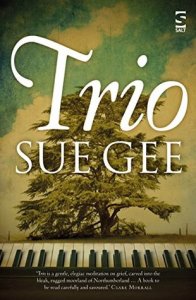 by Sue Gee: Sue Gee’s tenth novel is a sensitive portrait of life’s transience and the things that give us purpose. In the late 1930s, a widowed history teacher in Northumberland finds a new lease on life when he falls for one of the members of a local trio of musicians. My favorite passages of the book are descriptive ones, often comprised of short, evocative phrases; I also loved the banter between the musicians. The novel has a reasonably simple plot. We delve into the past to discover each main character’s backstory and some unexpected romantic entanglements, but in the 1930s storyline there aren’t a lot of subplots to distract from the main action. I was reminded in places of Downton Abbey: the grand hall and its village surroundings, the build-up to war, the characters you come to love and cheer for. [Thanks to Elle for piquing my interest in this one.]
How to Set a Fire and Why by Jesse Ball: Lucia Stanton is a cynical 14-year-old misfit who lives with her elderly aunt in a garage. At first she only supports the idea of arson, but events draw her into getting personally involved. This is one of those fairly rare novels that stand out immediately for the first-person voice. Lucia reminded me of Holden Caulfield or of Mim Malone from David Arnold’s Mosquitoland. She’s like a cynical philosopher. For as heartbreaking as her family history is, she was always either making me laugh or impressing me with her wisdom. Although this is his sixth novel, I hadn’t heard much about Jesse Ball prior to picking it up. His skill at creating the interior world of a troubled 14-year-old girl leads me to believe that the rest of his work would be well worth a look.
BookBrowse
[Non-subscribers can read excerpts of my reviews]
Imagine Me Gone by Adam Haslett: Mental illness plagues two generations of an Anglo-American family in Haslett’s moving second novel. Narration duties are split between the five members: father John, mother Margaret, and siblings Alec, Michael, and Celia. By giving each main character a first-person voice, Haslett offers readers a full picture of how mental illness takes a toll not only on sufferers but also on those who love and care for them. John’s descriptions of what mental illness is like are among the most striking passages in the book. Michael’s sections are wonderfully humorous, a nice counterbalance to some of the aching sadness. The multiple points of view fit together beautifully in this four-decade family symphony, although I sometimes felt that Celia was one main character too many – her story doesn’t contribute very much to the whole. A powerful read for fans of family stories.
Dinner with Edward by Isabel Vincent: In this heartwarming memoir, a journalist tells how friendship with an elderly gentleman rekindled her appetite for life. New to NYC and with a faltering marriage, Isabel received an unusual request from her friend Valerie: Would she look in on Valerie’s father, Edward? In his nineties, he’d recently been widowed and Valerie was worried about him losing the will to live. If he could have a guest to cook for and entertain, it might give him a new sense of purpose. As it turned out, it was a transformative friendship for the author as much as for Edward. Each chapter opens with a mouth-watering menu. Although Edward is now deceased, when we see him for the final time, he is still alive and well. This is a nice way to leave things – rather than with a funeral, which might have altered the overall tone.
Nudge
Ruby by Cynthia Bond: When Ruby Bell returns to Liberty Township, her east Texas hometown, in 1964, her fellow black folk turn her into a victim of derision. The churchgoing men of the town get the idea that they can use her body however they want. In part this is because her mental health is deteriorating, and the more she struggles to stifle traumatic memories the stranger she acts. The only one who continues to see Ruby as a human being rather than a demon or a subhuman object is Ephram Jennings. I found their relationship, reminiscent of that between Sethe and Paul D. in Toni Morrison’s Beloved, very touching. The novel moves fluidly between the past and present to give all of the central characters’ backstories – most of them unremittingly tragic. As difficult as some of the later scenes are to take, you feel entranced into continuing because of the touches of magic realism. Out of the darkness Bond weaves enchanting language and scenes. I highly recommend this to fans of Ayana Mathis’s The Twelve Tribes of Hattie and Angela Flournoy’s The Turner House.
The Hatred of Poetry by Ben Lerner: This fluid essay asks how poetry navigates between the personal and the universal. Socrates famously wanted to ban poets, fearing poetry might be turned to revolutionary purposes. Lerner wonders whether poetry still has a political role. Whitman’s goal was to create a new American verse style. But was it realistic for him to think that he could speak for everyone? The same might be asked about the poets who read at presidential inaugurations. Can different races and genders speak to and for each other, or is it only white males who are assumed to be able to pronounce on humanity’s behalf? Those are some of the questions addressed in this conversational yet unabashedly highbrow essay. Lerner’s points of reference range from Keats and Dickinson to Claudia Rankine, with ample quotations and astute commentary.
Pittsburgh Post-Gazette
Before the Fall by Noah Hawley: The key is in the title: perhaps playing on the theological implications of “the Fall” and Scott and JJ’s “salvation” from a plane crash, the novel toggles between build-up and aftermath. Disasters bring disparate people together to make superb fictional setups. Crucially, Hawley doesn’t make the mistake of conflating characters under easy labels like “victims” and “survivors.” Instead, he renders them all individuals with complete backstories. Some of their potted histories are relevant, while others throw up red herrings in the ensuing enquiry. Readers’ task is to weigh up what is happenstance and what is destiny. This lies somewhere on the continuum between crime and literary fiction; if it’s not quite Jonathan Franzen, nor is it Robert Ludlum. It’s a pretty much ideal summer vacation read – though you might think twice about taking it on a plane.
Books in Brief: Five I Enjoyed Recently
Lab Girl
By Hope Jahren
This memoir puts so many things together that it shouldn’t work, yet somehow – delightfully – does. With witty anecdotes and recreated dialogue, Jahren tells about her Minnesota upbringing, crossing the country to take up geobiology/botany academic posts in Atlanta, Baltimore and Hawaii, her long-time platonic relationship with eccentric lab partner Bill, and zany road trips for conferences and field work. On the serious side, she writes about how bipolar disorder complicated work life, marriage and motherhood. Add to that the interspersed chapters illuminating aspects of plant biology and you get a truly varied and intricate narrative. What Jahren does best is simply convey what it is like to have true passion for your work, a rare thing. You don’t have to be a science type to enjoy this book. All that’s required is curiosity about how others live. Jahren might even inspire you to go plant a tree.
My rating: 
 It’s Okay to Laugh (Crying Is Cool, Too)
By Nora McInerny Purmort
Purmort was hit by a triple whammy of loss: within weeks of miscarrying her second child, both her father and her husband were dead of cancer. After a seizure revealed his brain tumor, she and Aaron got engaged on his hospital bed and went through fertility treatment to have their son. All in all they got three years together, after which the Minneapolis-based author founded what she calls the “Hot Widows Club.” She’s only about my age but, as she puts it, has “been through some shit.” The book is in the form of short essays, a lot like blog entries, that tread the fine line between heartbreak and humor. I might have preferred a bit more of a narrative; I wearied of open letters and lists. The book is best where she eases up on self-deprecating jokes and pop culture references and just tells her story, so much of which resonates with my sister’s experience. As soon as I finished the book, I ordered her a copy.
My rating: 
My Heart Can’t Even Believe It: A Story of Science, Love, and Down Syndrome
 By Amy Silverman
When her younger daughter Sophie was born with Down’s syndrome in 2003, Silverman had no idea what to expect. The long-time Arizona journalist put her investigative skills to work, finding out everything she could about the discovery of Down’s and the history of how patients have been treated down the decades. In addition, she delves into the foundation of the Special Olympics (which had a connection with the Kennedy family) and its alternatives, and – not being a “support group kinda girl,” the other sources of encouragement she finds, especially through fellow bloggers. A significant portion of the book is about finding the best schools for Sophie – information that may well be not just U.S.-specific but particular to Arizona, where charter schools are popular. Still, what comes through is Silverman’s fierce love for her daughter and her insistence that every person with Down’s is an individual.
My rating:
 How to Ruin Everything: Essays
By George Watsky
Watsky is a slam poet and rap/hip hop artist from San Francisco. These essays about his misadventures reminded me most of Lauren Weedman (Miss Fortune) and John Jeremiah Sullivan (Pulphead). My favorite pieces were “Tusk,” on smuggling a narwhal tusk from Canada to the States to be his roommate’s great-aunt June’s hundredth birthday present, and “The White Whale,” about his unreliable tour bus. Others see him moving from a crumbling Boston college house to the heart of Hollywood deadbeat territory, traveling through India, fishing in Alaska, trying to attract older women, and reflecting on a childhood love of baseball. In the other stand-out essay, a more serious one, he reveals his experience of epilepsy and weaves in the history of its diagnosis and treatment. Also remarkable was a mention of Pauly Shore, a personage I haven’t thought about in, oh, I don’t know, a decade?
My rating:
Only in Naples: Lessons in Food and Famiglia from My Italian Mother-in-Law
 By Katherine Wilson
This is just the kind of book I would want to write about my experience studying abroad in England and eventually settling here. Of course, Wilson had it harder: she had to conduct her romance with Salvatore Avallone, relate to her future in-laws, and start a career all in a different language. But there were consolation prizes, chief among them the food. A lot of the best anecdotes revolve around Italian cuisine, like Salva’s mother Raffaella sending food down to her daughter in the apartment below via the elevator, or his uncle catching octopi with his one arm. I loved the colorful Italian and Neapolitan dialect expressions Wilson dots around, and as a fellow expat it was interesting to see what her non-negotiable American imports are (we all have our own list, I’m sure): wall-to-wall carpeting, air conditioning, a garbage disposal, and peanut butter – I’m with her on that last one, anyway.
My rating:
(For each one, read my full Goodreads review by clicking on the title link.)
Have you read any of these? Which one takes your fancy?
Note: I’m traveling until the 24th so won’t be responding to comments right away, but will be sure to catch up soon after I’m back. I always welcome your thoughts!
Looking for Community: Oliver Balch’s Under the Tump
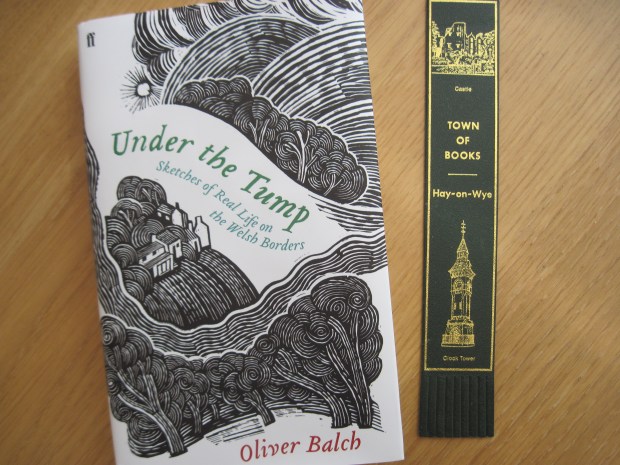
My eagle eye for anything related to Hay-on-Wye led me to this book, a memoir of sorts about moving to the Welsh Borders in the search for a sense of community. Journalist Oliver Balch and his wife had previously lived in London and then started a family while living in Argentina. Although they loved the vibrancy and social opportunities of city life, when they moved back to the UK in 2012 they were in search of something different:
I fancied living somewhere with open skies and fresh air; somewhere I could strap on my walking boots and head out for a hike; somewhere alive to the sound of birdsong rather than bus exhausts. I envisioned the same for the boys. Growing up in wellies and with dirty knees. Weekend camping trips. Swimming in the river.
But it was more than just the natural scenery that drew him to the England–Wales border town of Clyro. “I liked the idea of finding a place where I could truly belong. It would be good to be on the inside for once, to be a thread or stitch in the social fabric.” It was John Updike, of all people, who inspired him to seek out small-town life. “For a writer, it’s good to live between a widow and a plumber,” Updike wrote – to be surrounded by different, ordinary people and get to know your neighbors in an old-fashioned but still desirable way.
After the family settled in at Pottery Cottage, another of Balch’s guiding spirits was Reverend Francis Kilvert, curate of Clyro from 1865 to 1872. He’s known today for the diary he started keeping in 1870. As he went around visiting, he made pen portraits of his parishioners, often summing people up through one apt phrase of Dickensian description. In a sense, Balch is trying to do the same thing with these sketches of his new community members. Meanwhile, he weaves in biographical information about Kilvert in much the same way that Helen Macdonald does about T.H. White in H is for Hawk.
![Francis Kilvert [Public domain], via Wikimedia Commons.](https://commons.wikimedia.org/wiki/File:Francis_Kilvert.jpg)
Francis Kilvert [Public domain], via Wikimedia Commons.
The Wye is at its nearest to the east, huddled in the dip between two rippled fields of honeyed wheat and brilliant yellow rapeseed, its emerald-green waters rushing fast above the reeds. … Burrowed among the trees above its far bank stands Hay, a blue-grey patchwork of tiled rooftops amid a swathe of sylvan green. Poking above the tree canopy is the castle … And then beyond, of course, the barren bouldery bulk of the Black Mountains. Implacably wild. Their beauty hard, unremitting, almost brutish in their bluntness.
Balch starts trying to fit in by joining the regular drinkers at the Rhydspence Inn, an old-fashioned pub, on Wednesday nights. He’s closest with Tony, a farmer, and subsequently observes the Young Farmers group. In other chapters he profiles the unconventional, hippie types drawn to the area, like the owners of Hay’s fair trade shop; and the locals and shopkeepers involved in the Thursday market. He also sits in on some community planning meetings and learns about a recent anti-supermarket campaign. The Town Council and the “Hay Together” interest group are often at odds, he learns. A Chamber of Commerce meeting turns into an argument about renovating the Castle, one of Hay’s chief landmarks.
![Hay Castle (a partial ruin) with the outdoor 'honesty bookshop' below. Michael Graham [CC BY-SA 2.0], via Wikimedia Commons.](https://commons.wikimedia.org/wiki/File:Hay_Castle_-_geograph.org.uk_-_1452325.jpg)
Hay Castle (a partial ruin) with the outdoor ‘honesty bookshop’ below. Michael Graham [CC BY-SA 2.0], via Wikimedia Commons.
Part of me is elated that the outside world has landed on our doorstep. For a brief window in late spring, everywhere I turn there are urbanites like me. … Simultaneously, part of me recoils. … I feel invaded. Some traitorous wretch has spilled word of our rural haven and now legions of out-of-towners have arrived, overrunning the place with their unmuddied cars and city manners.
Even in the decade that I’ve been visiting, I can recognize some of the processes Balch pinpoints – essentially evidence of gentrification going on in Hay and the surrounding area. Under the ownership of an American female entrepreneur, for instance, Booth’s Bookshop has been transformed from a falling-down jumble sale into a well-presented independent bookstore with a posh café. Some of the locals Balch meets are delighted with the changes, while others feel that the snobs are taking over and driving up prices for regular folk.
If I was a bit disappointed with this book, it’s because I didn’t fully heed the subtitle – “Sketches of Real Life on the Welsh Borders.” It’s not meant to be a chronological narrative of Balch’s time in Clyro but a thematic tour, with some common threads running through. This means that, depending on the reader, certain chapters will probably seem much more interesting than others. So the best part of “The Young Farmers” chapter, for me, was a description of a cow doing a messy poo (“the most splendid jet of steaming gravy-colored excrement”); otherwise I found it entirely tedious.
![The view from the Castle, looking back over the town towards the hills. By Schuy (Own work) [CC BY-SA 4.0-3.0-2.5-2.0-1.0], via Wikimedia Commons.](https://commons.wikimedia.org/wiki/File:Hay.jpg)
The view from the Castle, looking back over the town towards the hills. By Schuy (Own work) [CC BY-SA 4.0-3.0-2.5-2.0-1.0], via Wikimedia Commons.
With thanks to Faber & Faber for the free copy.
My rating:
Further reading:
- Other books that reference Hay-on-Wye:
- Reading in Bed by Sue Gee opens at the Hay Festival.
- In The Red House by Mark Haddon, a dysfunctional family vacations in the countryside near Hay.
- In Next Life Might Be Kinder by Howard Norman, the main female character is from Hay.
- One of the settings in The Rise and Fall of Great Powers by Tom Rachman is a bookstore in a small Welsh village. (Okay, not quite Hay.)
- Plus one from the TBR: in The Bookman’s Tale by Charlie Lovett, an antiquarian bookseller browsing in a shop in Hay finds a book that sets him off on a quest.
Books in Brief: Five I Loved Recently
The Human Age: The World Shaped by Us
By Diane Ackerman
 A perfect tonic to books like The Sixth Extinction, this is an intriguing and inspiring look at how some of the world’s brightest minds are working to mitigate the negative impacts we have had on the environment and improve human life through technology. As in David R. Boyd’s The Optimistic Environmentalist, Ackerman highlights some innovative programs that are working to improve the environment. Part 1 is the weakest – most of us are already all too aware of how we’ve trashed nature – but the book gets stronger as it goes on. My favorite chapters were the last five, about 3D printing, bionic body parts and human–animal hybrids created for medical use, and how epigenetics and the microbial life we all harbor might influence our personality and behavior more than we think.
My rating:
I Will Find You
By Joanna Connors
 Connors was a young reporter running late for an assignment for the Cleveland Plain-Dealer when she was raped in an empty theatre on the Case Western campus. Using present-tense narration, she makes the events of 1984 feel as if they happened yesterday. It wasn’t until 2005 that Connors, about to send her daughter off to college, felt the urge to go public about her experience. “I will find you,” her rapist had warned her as he released her from the theatre, but she turned the words back on him, locating his family and learning everything she could about what made him a repeat criminal. She never uses this to explain away what he did, but it gives her the necessary compassion to visit the man’s grave. This is an excellent work of reconstruction and investigative reporting.
My rating:
One of Us: The Story of a Massacre and Its Aftermath
By Åsne Seierstad
 An utterly engrossing account of Anders Behring Breivik’s July 22, 2011 attacks on an Oslo government building (8 dead) and the political youth camp on the island of Utøya (69 killed). Over half of this hefty tome is prologue: Breivik’s life story, plus occasional chapters giving engaging portraits of his teenage victims. The massacre itself, along with initial interrogations and identification of the dead, takes up two long chapters totaling about 100 pages – best devoured in one big gulp when you’re feeling strong. It’s hard to read, but brilliantly rendered. Anyone with an interest in psychology or criminology will find the insights into Breivik’s personality fascinating. This is a book about love and empathy: what they can achieve; what happens when they are absent. It shows how wide the ripples of one person’s actions can be, but also how deep individual motivation goes. All wrapped up in a gripping true crime narrative. Doubtless one of the best books I will read this year.
My rating: 
Cold: Adventures in the World’s Frozen Places
By Bill Streever
 “Cold is a part of day-to-day life, but we often isolate ourselves from it, hiding in overheated houses and retreating to overheated climates, all without understanding what we so eagerly avoid.” In 12 chapters spanning one year, Streever covers every topic related to the cold that you could imagine: polar exploration, temperature scales, extreme weather events (especially the School Children’s Blizzard of 1888 and the “Year without Summer,” 1815), ice ages, cryogenics technology, and on and on. There’s also a travel element, with Streever regularly recording where he is and what the temperature is, starting in his home turf of Anchorage, Alaska. My favorite chapters were February and March, about the development of refrigeration and air conditioning and cold-weather apparel, respectively.
My rating:
A Series of Catastrophes and Miracles
By Mary Elizabeth Williams
 “SPOILER: I lived,” the Salon journalist begins her bittersweet memoir of having Stage 4 metastatic melanoma. In August 2010 she had a several-millimeter scab on her head surgically removed. When the cancer came back a year and a half later, this time in her lungs as well as on her back, she had the extreme good luck of qualifying for an immunotherapy trial that straight up cured her. It’s an encouraging story you don’t often hear in a cancer memoir. On the other hand, her father-in-law’s esophageal cancer and her best friend Debbie’s ovarian cancer simply went from bad to worse. As the title suggests, Williams’s tone vacillates between despair and hope, but her writing is always wry and conversational.
My rating:
(For each one, read my full Goodreads review by clicking on the title link.)
Have you read any of these? Which one takes your fancy?
Books in Brief: Five I Loved Recently
 The Zookeeper’s Wife
By Diane Ackerman
A different sort of Holocaust story, set at Warsaw Zoo in the years surrounding World War II. Even after Nazis dismantled their zoo and killed many of the larger animals, Jan and Antonina Żabiński stayed at their home and used the zoo’s premises for storing explosives and ammunition for Jan’s work in the Polish resistance as well as sheltering “Guests,” Jews passing through. This is a gripping narrative of survival against the odds, with the added pleasure of the kind of animal antics you’d find in a Gerald Durrell book. Their son Ryszard kept as pets a badger who bathed sitting back in the tub like a person and an arctic hare who stole cured meats like “a fat, furry thug.” Much of the book is based on Antonina’s journals, but I wish there had been more direct quotes from it and less in the way of reconstruction.
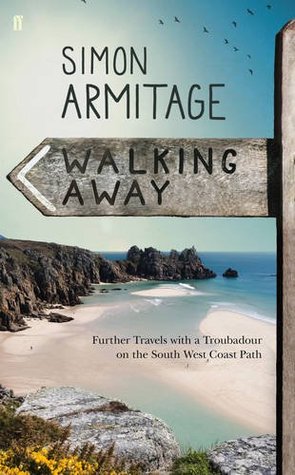 Walking Away: Further Travels with a Troubadour on the South West Coast Path
By Simon Armitage
As a sequel to Walking Home, the account of his 2010 trek along the Pennine Way, Armitage walked much of England’s South West Coast Path in August–September 2013. As before, he relied on the hospitality of acquaintances and strangers to put him up along the way and transport his enormous suitcase for him so he could walk about 10 miles a day to his next poetry reading. Emulating a modern-day troubadour, Armitage passed around a sock at the end of readings for donations (though the list of other stuff people left in the sock, with which he closes the book, is quite amusing). Along the way he meets all kinds of odd folk and muses on the landscape and the distressing amounts of seaside rubbish. His self-deprecating style reminded me of Bill Bryson. A pleasant ramble of a travel book.
 Winter World: The Ingenuity of Animal Survival
By Bernd Heinrich
This great seasonal read carefully pitches science to the level of the layman. Heinrich, an emeritus professor of biology at the University of Vermont, surveys various strategies animals use for surviving the winter: caching food, huddling together, hibernating or entering torpor, and lowering their body temperature – even to the point where 50% of their body water is ice, as with hibernating frogs. He carries out ever so slightly gruesome experiments that make him sound like a lovably nutty professor:
To find out how quickly a fully feathered kinglet loses body heat, I experimentally heated a dead kinglet and then measured its cooling rate. … I do not know how many seeds a chipmunk usually packs into each of its two pouches—I easily inserted sixty black sunflower seeds through the mouth into just one pouch of a roadkill.
His passion for knowledge carries through in his writing. I came away with a fresh sense of wonder for how species are adapted to their environments: “Much that animals have evolved to do would have seemed impossible to us, if experience has not taught us otherwise.”
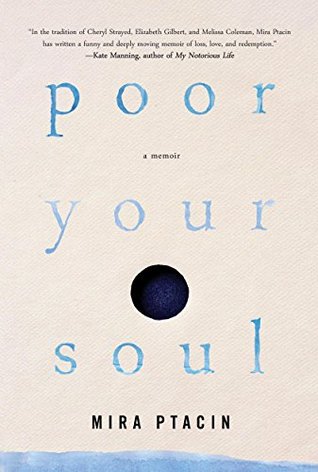 Poor Your Soul
By Mira Ptacin
Ptacin’s memoir is based around two losses: that of her brother, in a collision with a drunk driver; and that of a pregnancy in 2008. She skips back and forth in time to examine the numb aftermath of trauma as well as the fresh pain of actually going through it. In places I felt Ptacin sacrificed the literary quality hindsight might have allowed, prioritizing instead the somewhat clichéd thoughts and responses she had in the moment. Still, I loved so much about this book, especially her memories of growing up in the cereal capital of America and the account of her mother coming to America from Poland. Her mother is a terrific character, and it’s her half-warning, half-commiserative phrase that gives the novel its title (not a typo, as you might be forgiven for thinking): a kind of Slavic “I pity the fool.”
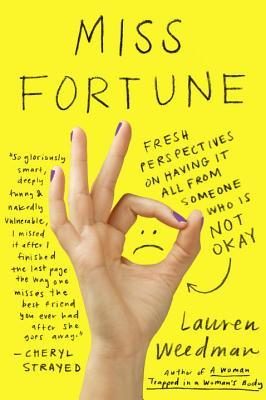 Miss Fortune: Fresh Perspectives on Having It All from Someone Who Is Not Okay
By Lauren Weedman
Weedman is a playwright and minor celebrity who’s worked on The Daily Show, Hung and Looking. This is a truly funny set of essays about marriage (from beginning to end), motherhood, working life and everything in between. Self-deprecatingly, she focuses on ridiculous situations she’s gotten herself into, like the world’s unsexiest threesome and an accidental gang symbol tattoo. Amid the laughs are some serious reflections on being adopted and figuring out how to be a responsible stepmother. With a warning that parts can be pretty raunchy, I’d recommend this to fans of David Sedaris and Bossypants.
 Bookish Beck = Rebecca Foster. American transplant to England. Freelance proofreader and book reviewer.
 Bookish Beck