#NonFicNov Catch-Up 2: Abbs, Hattrick, Powles, DAD Anthology, Santhouse
I’m sneaking in with five more review books on the final day of Nonfiction November, after a first catch-up earlier on in the month. Today I have a sprightly travel book based on the journeys of female writers and artists, a probing account of repeated chronic illness in the family, an anthology of essays showcasing the breadth of fatherhood experiences, a lyrical memoir-in-essays exploring racial identity, and a psychiatrist’s case studies of how the mind influences what the body feels. My apologies to the publishers for the brief responses.
Windswept: Walking in the footsteps of remarkable women by Annabel Abbs
 After a fall landed her in hospital with a cracked skull, Abbs couldn’t wait to roam again and vowed all her future holidays would be walking ones. What time she had for pleasure reading while raising children was devoted to travel books; looking at her stacks, she realized they were all by men. Her challenge to self was to find the women and recreate their journeys. I was drawn to this because I’d enjoyed Abbs’s novel about Frieda Lawrence and knew she was the subject of the first chapter here. During research for Frieda, Abbs omitted the Lawrences’ six-week honeymoon in the German mountains, so now she makes it a family cycling holiday, imitating Frieda’s experience by walking in a skirt and sunbathing nude. Other chapters follow Welsh painter Gwen John in Bordeaux, Nan Shepherd in Scotland, Georgia O’Keeffe in the American Southwest, and so on. Questions of risk and compulsion recur as Abbs asks how these women sought to achieve liberation. The interplay between biographical information and travel narrative is carefully controlled, but somehow this never quite came together for me in the way that, for instance, Sara Wheeler’s O My America! did.
(Two Roads, June 2021.) With thanks to the publisher for the free copy for review.
Ill Feelings by Alice Hattrick
 “My mother and I have symptoms of illness without any known cause,” Hattrick writes. When they showed signs of the ME/CFS their mother had suffered from since 1995, it was assumed there was imitation going on – that a “shared hysterical language” was fuelling their continued infirmity. It didn’t help that both looked well, so could pass as normal despite debilitating fatigue. Into their own family’s story, Hattrick weaves the lives and writings of chronically ill women such as Elizabeth Barrett Browning (see my review of Fiona Sampson’s biography, Two-Way Mirror), Alice James and Virginia Woolf. All these figures knew that what Hattrick calls “crip time” is different: more elastic; about survival rather than achievement.
The book searches desultorily for answers – could this have something to do with Giardiasis at age two? – but ultimately rests in mystery. ME/CFS patients rarely experience magical recovery, instead exhibiting repeated cycles of illness and being ‘well enough’. Hattrick also briefly considers long Covid as another form of postviral syndrome. My mother had fibromyalgia for years, so I’m always interested to read more about related illnesses. Earlier in the year I read Tracie White’s Waiting for Superman, and this also reminded me of Suzanne O’Sullivan’s books, though it’s literary and discursive rather than scientific.
(Fitzcarraldo Editions, August 2021.) With thanks to the publisher for the free copy for review.
Small Bodies of Water by Nina Mingya Powles
 I loved Powles’s bite-size food memoir, Tiny Moons. She won the inaugural Nan Shepherd Prize for underrepresented voices in nature writing for this work in progress, and I was eager to read more of her autobiographical essays. Watery metaphors are appropriate for a poet’s fluid narrative about moving between countries and identities. Powles grew up in a mixed-race household in New Zealand with a Malaysian Chinese mother and a white father, and now lives in London after time spent in Shanghai. Water has been her element ever since she learned to swim in a pool in Borneo, where her grandfather was a scholar of freshwater fish.
The book travels between hemispheres, seasons and languages, and once again food is a major point of reference. “I am the best at being alone when cooking and eating a soft-boiled egg,” she writes. Many of the essays are in short fragments – dated, numbered or titled. A foodstuff or water body (like the ponds at Hampstead Heath) might serve as a link: A kōwhai tree, on which the unofficial national flower of New Zealand grows, when encountered in London, collapses the miles between one home and another. Looking back months later (given I failed to take notes), this evades my grasp; it’s subtle, slippery but admirable.
(Canongate, August 2021.) With thanks to the publisher for the free copy for review.
DAD: Untold Stories of Fatherhood, Love, Mental Health and Masculinity, edited by Elliott Rae
 Music.Football.Fatherhood, a British equivalent of Mumsnet, brings dads together in conversation. These 20 essays by ordinary fathers run the gamut of parenting experiences: postnatal depression, divorce, single parenthood, a child with autism, and much more. We’re used to childbirth being talked about by women, but rarely by their partners, especially things like miscarriage, stillbirth and trauma. I’ve already written on Michael Johnson-Ellis’s essay on surrogacy; I also found particularly insightful R.P. Falconer’s piece on trying to be the best father he can be despite not having a particularly good role model in his own absent father, and Sam Draper’s on breaking the mould as a stay-at-home dad (“the bar for expectations regarding fathers is low, very low”) – I never understood how parental leave works in the UK before reading this. The book is full of genial and relatable stories and half or more of its authors are non-white. It could do with more rigorous editing to get the grammar and writing style up to the standard of traditionally published work, but even for someone like me who is not in the target audience it was an enjoyable set of everyday voices.
(Music.Football.Fatherhood, June 2021.) With thanks for the free copy for review.
Head First: A Psychiatrist’s Stories of Mind and Body by Alastair Santhouse
 Santhouse is a consultant psychiatrist at London’s Guy’s and Maudsley hospitals. This book was an interesting follow-up to Ill Feelings (above) in that the author draws an important distinction between illness as a subjective experience and disease as an objective medical reality. Like Abdul-Ghaaliq Lalkhen does in Pain, Santhouse adopts a biopsychosocial approach: “to focus solely on the scientific and neglect he social aspects of illness is a mistake that we continue to make,” he says. Using a patchwork of anonymous case studies, he delves into topics like depression, altruism, obesity, self-diagnosis, medical mysteries, evidence-based medicine, and preparation for death. A discussion of CFS again echoes the Hattrick. He brings the picture up to date with a final chapter on Covid-19. I’ve read so many doctors’ memoirs that this one didn’t stand out for me at all, but those less familiar with the subject matter could find it a good introduction to some ins and outs of mind–body medicine.
(Atlantic Books, July 2021.) With thanks to the publicist for the free copy for review.
Would you be interested in reading one or more of these?
Natural Causes by Barbara Ehrenreich & Human Errors by Nathan Lents
Two recent books about our flawed bodies and the ultimate pointlessness of trying to control them…
Natural Causes: Life, Death and the Illusion of Control by Barbara Ehrenreich
 A decade ago, Barbara Ehrenreich discovered a startling paradox through a Scientific American article: the immune system assists the growth and spread of tumors, including in breast cancer, which she had in 2000. It was an epiphany for her, confirming that no matter how hard we try with diet, exercise and early diagnosis, there’s only so much we can do to preserve our health; “not everything is potentially within our control, not even our own bodies and minds.” I love Ehrenreich’s Smile or Die (alternate title: Bright-Sided), which is what I call an anti-self-help book refuting the supposed health benefits of positive thinking. In that book I felt like her skeptical approach was fully warranted, and I could sympathize with her frustration – nay, outrage – when people tried to suggest she’d attracted her cancer and limited her chances of survival through her pessimism.
However, Natural Causes is so relentlessly negative and so selective in the evidence it provides that, even though it’s sure to be considered for next year’s Wellcome Book Prize longlist, I would be unlikely to recommend it. In the first chapter, “Midlife Revolt,” which has been excerpted at Literary Hub and is worth reading, Ehrenreich writes of her decision to give up routine medical screening after a false positive mammogram caused undue stress. She decided once she passed 70 she was old enough to die without accepting a “medicalized life.” Moreover, she believes there’s an epidemic of “overdiagnosis,” especially in the USA, where there can be a profit motive behind testing. (This is certainly not the case in the UK, where the NHS doesn’t pester me about getting cervical smear tests to line any pockets; no, it’s about saving taxpayers money by catching cancer early and thus minimizing treatment costs.)
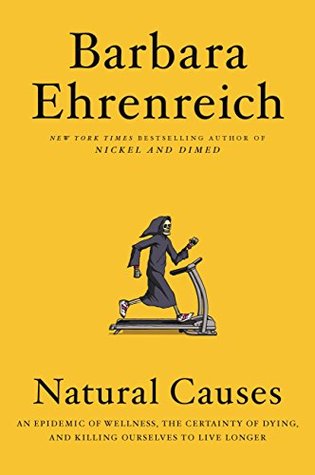
I love the U.S. cover. (Note the different subtitle.)
Ehrenreich goes on to argue that many medical procedures are simply rituals to establish patient trust, that cancer screening is invasive and ineffective, that there is little evidence that meditation does any good, and that fitness has become a collective obsession that probably doesn’t help us live any longer. It’s uncomfortable to hear her dismiss early detection techniques as worthless; no one whose doctor found cancer in the early stages would agree. The author also seems unwilling to confront her own personal prejudices (e.g. against yoga).
Although she uses plenty of statistics to back up her points, these usually come from newspapers and websites rather than peer-reviewed journals; only in two chapters about how macrophages ‘betray’ the body by abetting cancer does she consult the scientific literature, in keeping with her PhD in cellular immunology. Her most bizarre example of how our bodies aren’t evolutionarily fit for purpose is copious menstruation. Overall, the book is a strange mixture of hard science, social science, and, in later chapters, philosophy, as Ehrenreich asks about the nature of the self and the soul and what survives of us after death. As usual, her work is very readable, but this doesn’t match up to many other mind/body books I’ve read.
Favorite lines:
“The only cure for bad science is more science, which has to include both statistical analysis and some recognition that the patient is not ‘just a statistic,’ but a conscious, intelligent agent, just as the doctor is.”
“The objection raised over and over to any proposed expansion of health insurance was, in so many words: Why should I contribute to the care of those degenerates who choose to smoke and eat cheeseburgers? … we persist in subjecting anyone who dies at a seemingly untimely age to a kind of bio-moral autopsy: Did she smoke? Drink excessively? Eat too much fat and not enough fiber? Can she, in other words, be blamed for her own death?”
My rating: 
Natural Causes was published in the UK by Granta on April 12th. My thanks to the publisher for the free copy for review.
Human Errors: A Panorama of Our Glitches, from Pointless Bones to Broken Genes by Nathan H. Lents
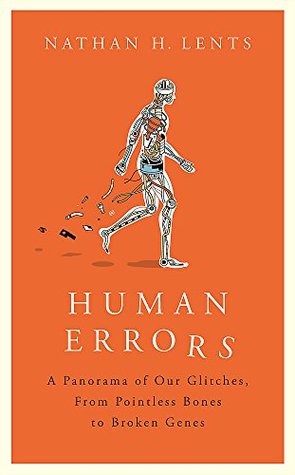 Lents is a biology professor at John Jay College, City University of New York, and in this, his second book, he explores the ways in which the human body is flawed. These errors come in three categories: adaptations to the way the world was for early humans (to take advantage of once-scarce nutrients, we gain weight quickly – but lose it only with difficulty); incomplete adaptations (our knees are still not fit for upright walking); and the basic limitations of our evolution (inefficient systems such as the throat handling both breath and food, and the recurrent laryngeal nerve being three times longer than necessary because it loops around the aorta). Consider that myopia rates are 30% or higher, the retina faces backward, sinuses drain upwards, there are 100+ autoimmune diseases, we have redundant bones in our wrist and ankle, and we can’t produce most of the vitamins we need. Put simply, we’re not a designer’s ideal. And yet this all makes a lot of sense for an evolved species.
My favorite chapter was on the inefficiencies of human reproduction compared to that of other mammals. Infertility and miscarriage rates are notably high, and gestation is shorter than it really needs to be: because otherwise their heads would get too big to pass through the birth canal, all babies are effectively born premature, so are helpless for much longer than other newborn mammals. I also especially liked the short section on cancer, which would eventually get us all if we only lived long enough. As it is, “evolution has struck an uneasy balance with cancer. Mutations cause cancer, which kills individuals, but it also brings diversity and innovation, which is good for the population.”
Lents writes in a good conversational style and usually avoids oversimplifying the science. In places his book reminded me of Kathryn Schulz’s Being Wrong and Mark O’Connell’s To Be a Machine. It’s a wry and gentle treatment of human weakness; the content never turns depressing or bitter. Recommended for all curious readers of popular science.
Favorite lines:
“While lithopedions [“stone babies”] and abdominal pregnancies are quite rare, they are also 100 percent the result of poor design. Any reasonable plumber would have attached the fallopian tube to the ovary, thereby preventing tragic and often fatal mishaps like these.”
“to call our immune system perfectly designed would be equally inaccurate. There are millions of people who once happily walked this planet only to meet their demise because their bodies simply self-sabotaged. When bodies fight themselves, there can be no winner.”
My rating: 
Human Errors was published in the UK by Weidenfeld & Nicolson on May 3rd. My thanks to the publisher for the free copy for review.
Two Books about Mind–Body Medicine
Two of my library reads from this month were about different aspects of mind–body medicine. I expected them to overlap more than they did, actually, and hoped that the second might serve as a sort of well-written rebuttal to the first, but in the end they stayed in different camps: the first is about psychosomatic illness and psychiatric treatment, while the second is about the placebo effect and how alternative and holistic treatment strategies might be complementary to orthodox medical approaches. Both gave me a lot to think about.
It’s All in Your Head: Stories from the Frontline of Psychosomatic Illness
By Suzanne O’Sullivan
 O’Sullivan is a UK-based neurology consultant. I picked this up on a whim because I knew it had won the Wellcome Book Prize, as well as the Royal Society of Biology General Book Prize. The conditions she writes about go by many names: psychosomatic illnesses, conversion disorders, or functional conditions. In every case the patients have normal neurological test results – they do not have epilepsy or nerve damage, for instance – but still suffer from seizures or lose the use of limb(s). Their symptoms have an emotional origin instead. Many of her patients are outraged by referral to a psychiatrist, as if they’re being told they’re making it all up, but it’s actually a holistic approach: acknowledging the influence the mind has on how we feel.
Along with cases from her own career, the author writes about early doctors who developed the science of conversion disorders, including Jean-Martin Charcot and Sigmund Freud. I read the book very quickly, almost compulsively; these are fascinating stories for anyone who’s interested in medical mysteries. That’s in spite of the fact that O’Sullivan does not strike me as a natural storyteller: her accounts of patients’ cases are often no more than just one thing after another, and in reports of her own conversations with patients she comes across as robotic and not always very compassionate. Ultimately I believe she does empathize with those with psychosomatic illnesses – otherwise she wouldn’t have written a whole book to illuminate their plight – but it would have taken the writing skill of someone like Atul Gawande for this to be a better book. I’m somewhat surprised it won a major prize.
Note: Chapter 7 tackles CFS/ME/fibromyalgia. These are controversial fatigue disorders, and O’Sullivan is aware that even mentioning them in a book about psychosomatic illnesses is “foolhardy to say the least.” I don’t think what she actually has to say about these conditions is offensive, though (and I say that as someone whose mother struggled with fibromyalgia for years). She allows that there may be physical triggers, but that emotional wellbeing and traumatic experiences or regular stress cannot be overlooked.
Chew on this: “More than seventy per cent of patients with dissociative seizures and chronic fatigue syndrome are women.” The author’s best guess as to why this is? “On the face of it, women turn their distress inward and men turn it outward.”
My rating: 
Cure: A Journey into the Science of Mind over Body
By Jo Marchant
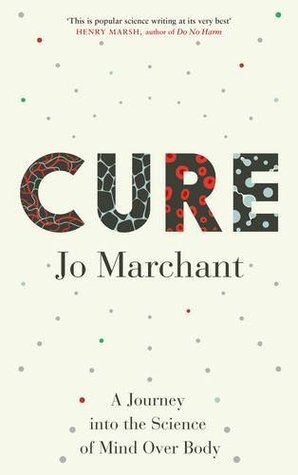 In this absorbing and well-written work of popular science, Marchant, a journalist with a PhD in genetics and medical microbiology, investigates instances where the mind seems to contribute to medical improvement: the use of placebos in transplant recipients, hypnosis for IBS patients, virtual reality to help burn victims manage pain, and the remarkable differences that social connection, a sense of purpose, meditation and empathic conversation all make. On the other hand, she shows how stress and trauma in early life can set (usually poor) people up for ill health in later years. She also travels everywhere from Boston to Lourdes to meet patients and medical practitioners, and even occasionally proffers herself as a guinea pig.
A relentless scientist, Marchant is skeptical of any claims for which there is no hard evidence, so when she acknowledges that there’s something to these unusual treatments, you know you can believe her. As Jeremy Howick of the Centre for Evidence-Based Medicine, Oxford puts it, “I think it’s more important to know that something works, than how it works.” I finished the book feeling intrigued and hopeful about what this might all mean for the future of medicine. The problem, though, is that most medical trials are funded by big pharmaceutical companies, which won’t be supportive of non-traditional methods or holistic approaches.
My rating: 
 Bookish Beck = Rebecca Foster. American transplant to England. Freelance proofreader and book reviewer.
 Bookish Beck