September Recommendations: Boyer, Doughty, Jamie, Patchett
For this second half of the year I chose just 15 of the new releases I was most excited about. Limiting myself in that way has been helpful for focusing the mind: I’ve already read six of my most anticipated books, I’m currently reading another, and I have several more awaiting me. Had I chosen 30 or more titles, I would likely be feeling overwhelmed by now, but as it is I have a good chance of actually getting to all these books before the end of the year. These September releases, while very different – their topics range from cancer and dead bodies to archaeological digs and family inheritance – all lived up to my expectations: 
The Undying: Pain, Vulnerability, Mortality, Medicine, Art, Time, Dreams, Data, Exhaustion, Cancer, and Care by Anne Boyer
(Coming from Farrar, Straus and Giroux [USA] on the 17th and Allen Lane [UK] on October 3rd)
In 2014, Boyer, then a 41-year-old poet and professor at the Kansas City Art Institute (and a single mother) was diagnosed with triple-negative breast cancer. The book’s subtitle gives you clues to the sort of practical and emotional territory that’s covered here. Although she survived this highly aggressive cancer, she was not unscathed: the chemotherapy she had is so toxic it leads to lasting nerve damage and a brain fog that hasn’t completely lifted.
 All the more impressive, then, that Boyer has been able to put together this ferociously intellectual response to American cancer culture. Her frame of reference ranges from ancient Greece – Aelius Aristides, who lived in a temple, hoping the gods would reveal the cure to his wasting illness via dreams, becomes an offbeat hero for her – to recent breast cancer vloggers. She is scathing on vapid pink-ribbon cheerleading that doesn’t substantially improve breast cancer patients’ lives, and on profit-making healthcare schemes that inevitably discriminate against poor women of color and send people home from the hospital within a day or two of a double mastectomy. Through her own experience, she reflects on the pressure women are under to be brave, to be optimistic, to go to work as normal, and to look as beautiful as ever when they are in excruciating pain and beyond exhaustion.
Impossible to avoid comparisons to Susan Sontag’s Illness as Metaphor, but this book has a personal power I don’t remember finding in Sontag’s more detached, academic-level work. Boyer sees herself as one in a long lineage of women writing about their cancer – from Fanny Burney to Audre Lorde – and probes the limits of language when describing pain. I was reminded of another terrific, adjacent book from this year, Constellations by Sinéad Gleeson, especially where Boyer describes her imagined 10-part pain scale (Gleeson has a set of 20 poems based on the McGill Pain Index).
I could quote excellent passages all day, but here are a few that stood out to me:
“People with breast cancer are supposed to be ourselves as we were before, but also better and stronger and at the same time heart-wrenchingly worse. We are supposed to keep our unhappiness to ourselves but donate our courage to everyone.”
“The moral failure of breast cancer is not in the people who die: it is in the world that makes them sick, bankrupts them for a cure that also makes them sick, then blames them for their own deaths.”
“If suffering is like a poem, I want mine to be lurid, righteous, and goth.”
My thanks to FSG for the proof copy for review.
Will My Cat Eat My Eyeballs?: Big Questions from Tiny Mortals about Death by Caitlin Doughty
(Coming from W.W. Norton [USA] on the 10th and W&N [UK] on the 19th)
 This is the third book by the millennial mortician, and I’ve taken perverse glee in reading them all. Smoke Gets in Your Eyes explains cremation and combats misconceptions about death; From Here to Eternity surveys death rituals from around the world. This new book seems to be aimed at (morbid) children, but for me it was more like one of those New Scientist books (Why Don’t Penguins’ Feet Freeze?) or Why Do Men Have Nipples?
Some of the questions are more serious than others, but with her usual punning wit and pop culture references Doughty gives biologically sound answers to them all. For instance, she explains what might happen to a corpse in space, why the hair and fingernails of a cadaver appear to keep growing, and why the quantity of ashes from a cremation is about the same no matter the dead person’s girth (all the fat burns away; what would make your ashes weigh more is being taller and thus having longer bones). I was most interested in the chapter on why conjoined twins generally die at roughly the same time.
 Doughty also discusses laws relating to the dead, such as “abuse of corpse” regulations and whether or not deaths at a property have to be reported to potential buyers (it depends on what state or country you live in); and what happens in countries that are literally running out of space for burials. In highly population-dense places like Singapore, but also in countries such as Germany, one is considered to ‘rent’ grave space, which is then recycled after 15 years and the previous set of remains cremated. Or graves might get stacked vertically.
This is good fun, and features lots of cartoonishly gruesome black-and-white illustrations by Dianné Ruz. If you’ve got a particularly curious niece or nephew who might appreciate a dark sense of humor, this would make a good Christmas gift for one who is an older child or young teen.
My thanks to W&N for the free copy for review.
Surfacing by Kathleen Jamie
(Coming from Sort Of Books [UK] on the 19th and Penguin Books [USA] on the 24th)
I’m a big fan of Kathleen Jamie’s work, prose and poetry. Like her two previous essay collections, Sightlines and Findings, both of which I read in 2012, this fuses autobiography with nature and travel writing – two genres that are too often dominated by males. Jamie has a particular interest in birds, islands, archaeology and the oddities of the human body, all subjects that intrigue me, too.
 The bulk of Surfacing is given over to three long pieces set in Alaska, Orkney and Tibet. She was drawn to Quinhagak, Alaska, a village that’s about the farthest you can go before crossing the Bering Sea into Russia, by her fascination with the whaling artifacts found along the UK’s east coast. Here she helped out on a summer archaeological dig and learned about the language and culture of the Yup’ik people. Alarmingly, the ground here should have been frozen most of the way to the surface, forcing the crew to wear thermals; instead, the ice was a half-meter down, and Jamie found that she never needed her cold-weather gear.
On Westray, Orkney (hey, I’ve been there!), there was also evidence of environmental degradation in the form of rapid erosion. This Neolithic site, comparable to the better-known Skara Brae, leads Jamie to think about deep time and whether we’re actually much better off than people in the Bronze Age were. Prehistory fits the zeitgeist, as seen in two entries from the recent Wainwright Prize shortlist: Time Song by Julia Blackburn and Underland by Robert Macfarlane. It’s a necessary corrective to the kind of short-term thinking that has gotten us into environmental crisis.
A cancer biopsy coincides with a dream memory of being bitten by a Tibetan dog, prompting Jamie to get out her notebook from a trip to China/Tibet some 30 years ago. Xiahe was technically in China but ethnically and culturally Tibetan, and so the best they could manage at that time since Tibet was closed to foreigners. There’s an amazing amount of detail in this essay given how much time has passed, but her photos as well as her notebook must have helped with the reconstruction.
The depth and engagement of the long essays are admirable, yet I often connected more with the few-page pieces on experiencing a cave, spotting an eagle or getting lost in a forest. Jamie has made the interesting choice of delivering a lot of the memoir fragments in the second person. My favorite piece of all is “Elders,” which in just five pages charts her father’s decline and death and marks her own passage into unknown territory: grown children and no parents; what might her life look like now?
There is beautiful nature writing to be found in this volume, as you might expect, but also relatable words on the human condition:
What are you doing here anyway, in the woods? … You wanted to think about all the horror. The everyday news … No, not to think about it exactly but consider what to do with the weight of it all, the knowing … You are not lost, just melodramatic. The path is at your feet, see? Now carry on.
My thanks to Sort Of Books for the free copy for review.
The Dutch House by Ann Patchett
(Coming from Bloomsbury [UK] and Harper [USA] on the 24th)
Maeve and Danny Conroy are an inseparable brother-and-sister pair. Their mother left when Danny was little, so his older sister played a maternal role, too. And when their father dies, they become like Hansel and Gretel (or Cinderella and her little brother): cast out into the wilds by an evil stepmother who takes possession of the only home they’ve ever known, a suburban Philadelphia mansion built on the proceeds of the VanHoebeeks’ cigarette empire.
 It’s interesting to see Patchett take on a male perspective in this novel; she does it utterly convincingly. I also loved the medical threads running through: Maeve is diagnosed with diabetes as a teenager, and Danny spends many years in medical training even though his only ambition is to follow in his father’s footsteps as a property developer. There was a stretch in the middle of the book – something like 46% to 58% – when I was really bored with Danny’s dithering (‘but I don’t want to be a doctor … but I don’t want to marry Celeste’), and the chronology is unnecessarily complicated by flashbacks, though this is, I think, meant to convey Danny’s desultory composition of his memoirs.
In the end I didn’t like this quite as much as Commonwealth, but it’s a memorable exploration of family secrets and memories. As the decades pass you see how what happened to Maeve and Danny has been turned into myth: a story they repeat to themselves about how they were usurped, until this narrative has more power than the reality. Readers, meanwhile, are invited to question the people and places we base our security on, and to imagine what it would mean to forgive and forget and start living in a different way.
Patchett is always so good on the psychology of complicated families, and her sharp prose never fails to hit the nail on the head. The Goldfinch comes to mind as a readalike – not least because of the significance of a piece of art: the cover depicts a painting made of Maeve when she was 10 – as well as Nick Hornby’s How to Be Good.
I read an electronic proof copy via Edelweiss.
Have you read any September releases that you would recommend? Which of these tempt you?
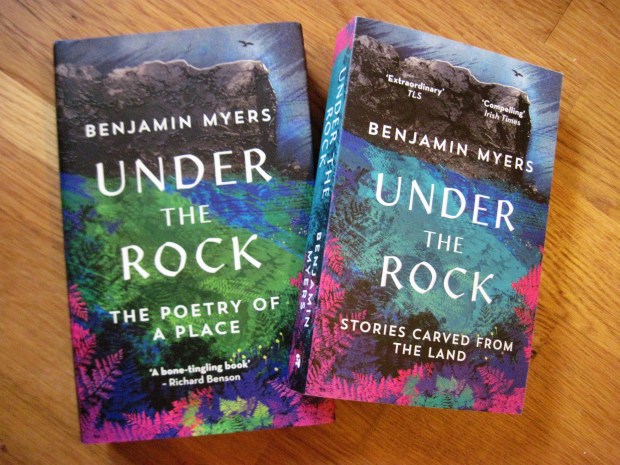
Under the Rock by Benjamin Myers: Paperback Giveaway
Benjamin Myers’s Under the Rock was my nonfiction book of 2018, so I’m delighted to be kicking off the blog tour for its paperback release on the 25th (with a new subtitle, “Stories Carved from the Land”). I’m reprinting my Shiny New Books review below, with permission, and on behalf of Elliott & Thompson I am also hosting a giveaway of a copy of the paperback. Leave a comment saying that you’d like to win and I will choose one entry at random at the end of the day on Tuesday the 30th. (Sorry, UK only.)
My review:
Benjamin Myers has been having a bit of a moment. In 2017 Bluemoose Books published his fifth novel, The Gallows Pole, which went on to win the Roger Deakin Award and the Walter Scott Prize for Historical Fiction and is now on its fourth printing. This taste of fame has brought renewed attention to his earlier work, including Beastings (2014), recipient of the Northern Writers’ Award. I’ve been interested in Myers’s work ever since I read an extract from the then-unpublished The Gallows Pole in Autumn, the Wildlife Trusts anthology edited by Melissa Harrison, but this is the first of his books that I’ve managed to read.
“Unremarkable places are made remarkable by the minds that map them,” Myers writes, and that is certainly true of Scout Rock, a landmark overlooking Mytholmroyd, near where the author lives in the Calder Valley of West Yorkshire. When he moved up there from London over a decade ago, he and his wife lived in a rental cottage built in 1640. He approached his new patch with admirable curiosity, and supplemented the observations he made from his study window with frequent long walks with his dog, Heathcliff (“Walking is writing with your feet”), and research into the history of the area. The result is a divagating, lyrical book that ranges from geology to true crime but has an underlying autobiographical vein.
Ted Hughes was born nearby, the Brontës not that much further away, and Hebden Bridge, in particular, has become a bastion of avant-garde artists and musicians. Myers also gets plenty of mileage out of his eccentric neighbours and postman. It’s a town that seems to attract oddballs and renegades, from the vigilantes who poisoned the fishing hole to an overdose victim who turns up beneath a stand of Himalayan balsam. A strange preponderance of criminals has come from the region, too, including sexual offenders like Jimmy Savile and serial killers such as the Yorkshire Ripper and Harold Shipman (‘Doctor Death’).
On his walks Myers discovers the old town tip, still full of junk that won’t biodegrade for hundreds more years, and finds traces of the asbestos that was dumped by Acre Mill, creating a national scandal. This isn’t old-style nature writing in search of a few remaining unspoiled places. Instead, it’s part of a growing literary interest in the ‘edgelands’ between settlement and the wild – places where the human impact is undeniable but nature is creeping back in. (Other recent examples would be Common Ground by Rob Cowen, Landfill by Tim Dee, Edgelands by Paul Farley and Michael Symmons Roberts, and Outskirts by John Grindrod.)
Under the Rock gives a keen sense of the seasons’ change and the seemingly inevitable melancholy that accompanies bad weather. A winter of non-stop rain left Myers nigh on delirious with flu; Storm Eva caused the Calder River to flood. He was a part of the effort to rescue trapped pensioners. Heartening as it is to see how the disaster brought people together – Sikh and Muslim charities and Syrian refugees were among the first to help – looting also resulted. One of the most remarkable things about this book is how Myers takes in such extremes of behaviour, along with mundanities, and makes them all part of a tapestry of life.
The book’s recurring themes tangle through all of the sections, even though it has been given a somewhat arbitrary four-part structure (Wood – Earth – Water – Rock). Interludes between these major parts transcribe Myers’s field notes, which are more like impromptu poems that he wrote in a notebook kept in his coat pocket. The artistry of these snippets of poetry is incredible given that they were written in situ, and their alliteration bleeds into his prose as well. My favourite of the poems was “On Lighting the First Fire”:
Autumn burns
the sky
the woods
the valley
death is everywhere
but beneath
the golden cloak
the seeds of
a summer’s
dreaming still sing.
The Field Notes sections are illustrated with Myers’s own photographs, which, again, are of enviable quality. I came away from this feeling like Myers could write anything – a thank-you note, a shopping list – and make it read as profound literature. Every sentence is well-crafted and memorable. There is also a wonderful sense of rhythm to his pages, with a pithy sentence appearing every couple of paragraphs to jolt you to attention.
“Writing is a form of alchemy,” Myers declares. “It’s a spell, and the writer is the magician.” I certainly fell under the author’s spell here. While his eyes are open to the many distressing political and environmental changes of the last few years, the ancient perspective of the Rock reminds him that, though humans are ultimately insignificant and individual lives are short, we can still rejoice in our experiences of the world’s beauty while we’re here.
From the publisher:
“Benjamin Myers was born in Durham in 1976. He is a prize-winning author, journalist and poet. His recent novels are each set in a different county of northern England, and are heavily inspired by rural landscapes, mythology, marginalised characters, morality, class, nature, dialect and post-industrialisation. They include The Gallows Pole, winner of the Walter Scott Prize for Historical Fiction, and recipient of the Roger Deakin Award; Turning Blue, 2016; Beastings, 2014 (Portico Prize for Literature & Northern Writers’ Award winner), Pig Iron, 2012 (Gordon Burn Prize winner & Guardian Not the Booker Prize runner-up); and Richard, a Sunday Times Book of the Year 2010. Bloomsbury will publish his new novel, The Offing, in August 2019.
As a journalist, he has written widely about music, arts and nature. He lives in the Upper Calder Valley, West Yorkshire, the inspiration for Under the Rock.”
Recent Poetry Reads
I love interspersing poetry with my other reading, and this year it seems like I’m getting to more of it than ever. Although I try to have a poetry collection on the go at all times, I still consider myself a novice and enjoy discovering new-to-me poets. However, I know many readers who totally avoid poetry because they assume they won’t understand it or it would feel too much like hard work.
Sinking into poems is certainly a very different experience from opening up a novel or a nonfiction narrative. Often I read parts of a poem two or three times – to make sure I’ve taken it in properly, or just to savor the language. I try to hear the lines aloud in my head so I can appreciate the sonic techniques at work, whether rhyming or alliteration. Reading or listening to poetry engages a different part of the brain, and it may be best to experience it in something of a dreamlike state.
I hope you’ll find a book or two that appeals from the selection below.
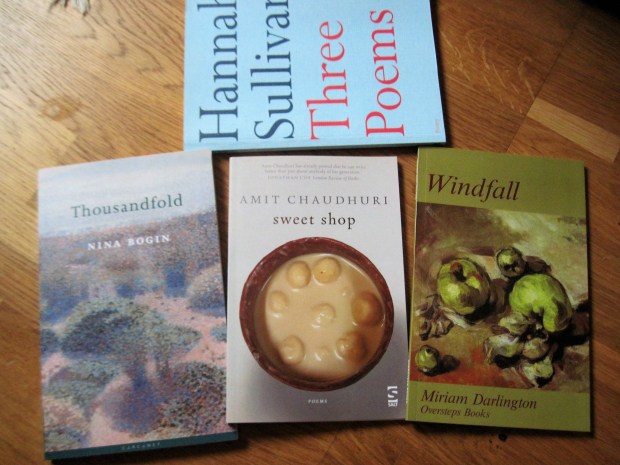
Thousandfold by Nina Bogin (2019)
 This is a lovely collection whose poems devote equal time to interactions with nature and encounters with friends and family. Birds – along with their eggs and feathers – are a frequent presence. Often a particular object will serve as a totem as the poet remembers the most important people in her life: her father’s sheepskin coat, her grandmother’s pink bathrobe, and the slippers her late husband shuffled around in – a sign of how diminished he’d become due to dementia. Elsewhere Bogin greets a new granddaughter and gives thanks for the comforting presence of her cat. Gentle rhymes and half-rhymes lend a playful or incantatory nature. I’d recommend this to fans of Linda Pastan.
My rating:
Thousandfold will be published by Carcanet Press on January 31st. My thanks to the publisher for the free copy for review.
Sweet Shop by Amit Chaudhuri (2019)
 I was previously unfamiliar with Chaudhuri’s work, and unfortunately this insubstantial book about his beloved Indian places and foods hasn’t lured me into trying any more. The one poem I liked best was “Creek Row,” about a Calcutta lane used as a shortcut: “you are a thin, short-lived, / decaying corridor” and an “oesophageal aperture”. I also liked, as stand-alone lines go, “Refugees are periodic / like daffodils.” Nothing else stood out for me in terms of language, sound or theme. Poetry is so subjective; all I can say is that some poets will click with you and others don’t. In any case, the atmosphere is similar to what I found in Korma, Kheer and Kismet: Five Seasons in Old Delhi by Pamela Timms.
My rating: 
My thanks to Salt Publishing for the free copy for review.
Windfall by Miriam Darlington (2008)
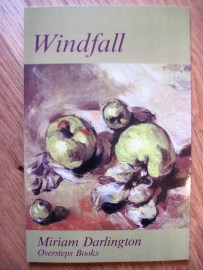 Before I picked this up from the bookstall at the New Networks for Nature conference in November, I had no idea that Darlington had written poetry before she turned to nature writing (Otter Country and Owl Sense). These poems are rooted in the everyday: flipping pancakes, sitting down to coffee, tending a garden, smiling at a dog. Multiple poems link food and erotic pleasure; others make nature the source of exaltation. I loved her descriptions of a heron (“a standing stone / perched in silt / a wrap of grey plumage”) and a blackbird (“the first bird / a glockenspiel in C / an improvisation on morning / a blue string of notes”), Lots of allusions and delicious alliteration. Pick this up if you’re missing Mary Oliver.
My rating: 
A Responsibility to Awe by Rebecca Elson (2018)
 Elson, an astronomer who worked on the Hubble Space Telescope, died of breast cancer; this is a reprint of her posthumous 2001 publication. Along with a set of completed poems, the volume includes an autobiographical essay and extracts from her notebooks. Her impending mortality has a subtle presence in the book. I focused on the finished poems, which take their metaphors from physics (“Dark Matter”), mathematics (“Inventing Zero”) and evolution (indeed, “Evolution” was my favorite). In the essay that closes the book, Elson remembers long summers of fieldwork and road trips across Canada with her geologist father (I was reminded of Margaret Atwood’s Cat’s Eye), and traces her academic career as she bounced between the United States and Great Britain.
My rating: 
My thanks to Carcanet Press for the free copy for review.
These next two were on the Costa Prize for Poetry shortlist, along with Hannah Sullivan’s Three Poems, which was one of my top poetry collections of 2018 and recently won the T. S. Eliot Prize. I first encountered the work of all three poets at last year’s Faber Spring Party.
Us by Zaffar Kunial (2018)
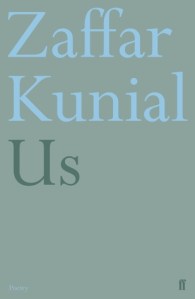 Many of these poems are about split loyalties and a composite identity – Kunial’s father was Kashmiri and his mother English – and what the languages we use say about us. He also writes about unexpectedly developing a love for literature, and devotes one poem to Jane Austen and another to Shakespeare. My favorites were “Self Portrait as Bottom,” about doing a DNA test (“O I am translated. / The speech of numbers. / Here’s me in them / and them in me. … What could be more prosaic? / I am split. 50% Europe. / 50% Asia.”), and the title poem, a plea for understanding and common ground.
My rating:
Soho by Richard Scott (2018)
 When I saw him live, Scott read two of the amazingly intimate poems from this upcoming collection. One, “cover-boys,” is about top-shelf gay porn and what became of the models; the other, “museum,” is, on the face of it, about mutilated sculptures of male bodies in the Athens archaeological museum, but also, more generally, about “the vulnerability of / queer bodies.” If you appreciate the erotic verse of Mark Doty and Andrew McMillan, you need to pick this one up immediately. Scott channels Verlaine in a central section of gritty love poems and Whitman in the final, multi-part “Oh My Soho!”
My rating:
Don’t Call Us Dead by Danez Smith (2017)
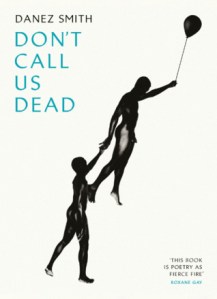 Like Claudia Rankine’s Citizen, this is a book whose aims I can admire even though I didn’t particularly enjoy reading it. It’s about being black and queer in an America where both those identifiers are dangerous, where guns and HIV are omnipresent threats. “reader, what does it / feel like to be safe? white?” Smith asks. “when i was born, i was born a bull’s-eye.” The narrator and many of the other characters are bruised and bloody, with blood used literally but also metaphorically for kinship and sexual encounters. By turns tender and biting, exultant and uncomfortable, these poems are undeniably striking, and a necessary wake-up call for readers who may never have considered the author’s perspective.
My rating:
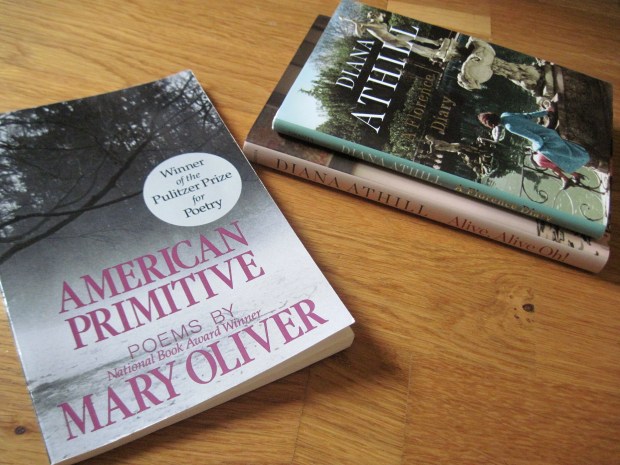
Up next: This Pulitzer-winning collection from the late Mary Oliver, whose work I’ve had mixed success with before (Dream Work is by far her best that I’ve read so far). We lost two great authors within a week! RIP Diana Athill, too, who was 101.
Any recent poetry reads you can recommend to me?
Recent Writing for BookBrowse, Shiny New Books and the TLS
Here are excerpts from (and links to, where available) some of my recent reviews for other places. A few of these books will undoubtedly be showing up on my end-of-year best lists in a couple weeks’ time.
BookBrowse
I was pleased to have three of the books I reviewed show up on BookBrowse’s list of the top 20 books of the year, as voted for by the site’s readers. What’s more, Educated was voted their top nonfiction book of the year and Where the Crawdads Sing (below) their #1 debut novel. (The third on the list was Unsheltered.)
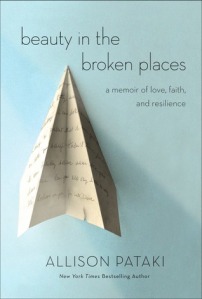 Beauty in the Broken Places by Allison Pataki: Ernest Hemingway wrote that we are strong at the broken places, and Allison Pataki found that to be true when her husband, David Levy, a third-year orthopedic surgery resident in Chicago, had a near-fatal stroke at age 30. On June 9, 2015, Dave and five-months-pregnant Allison were on a flight from Chicago to Hawaii for their babymoon, planning to stop in Seattle to visit Dave’s brothers. But they never made it there. On the plane Dave told her he couldn’t see out of his right eye.The plane made an emergency landing in Fargo, North Dakota and Dave was rushed to a hospital for testing. Doctors found he had suffered a bithalamic midbrain ischemic stroke, even though he’d had no risk factors and this stroke type was virtually unknown in patients of his age. Pataki goes back and forth between the details of this health crisis and her past with Dave. Hers is a relatable story of surviving the worst life can throw at you and finding the beauty in it.
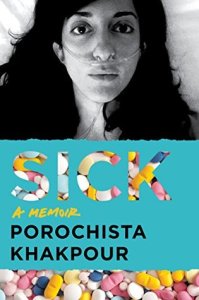 Sick by Porochista Khakpour: Khakpour can’t remember a time when she didn’t feel unwell and like she wanted to escape. “I had no idea what normal was. I never felt good,” she writes in her bracing memoir. Related to this sense of not being at home in her body was the feeling of not having a place where she fit in. Throughout Sick, she gives excellent descriptions of physical and mental symptoms. Her story is a powerful one of being mired in sickness and not getting the necessary help from medical professionals. Lyme disease has cost her $140,000 so far, and a lack of money and health insurance likely delayed her diagnosis by years. There is, unfortunately, some inherent repetition in a book of this nature. At times it feels like an endless cycle of doctors, appointments, and treatment strategies. However, the overall arc of struggling with one’s body and coming to terms with limitations will resonate widely.
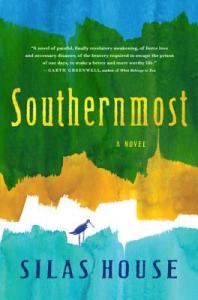 Southernmost by Silas House: In Silas House’s sixth novel, a Tennessee preacher’s family life falls apart when he accepts a gay couple into his church. We go on a long journey in Southernmost: not just a literal road trip from Tennessee to Florida, but also a spiritual passage from judgment to grace. Reconciliation is a major theme, but so is facing up to the consequences of poor decisions. I found the plotting decisions rewarding but also realistic. The pattern of a narrow religious worldview ebbing away to no faith at all and eventually surging back as a broader and more universal spirituality truly resonates. I loved House’s characters and setups, as well as his gentle evocation of the South. His striking metaphors draw on the natural world, like “She had the coloring of a whip-poor-will” and “The sky is the pink of grapefruit meat.” It’s a beautiful, quietly moving novel of redemption and openness to what life might teach us.
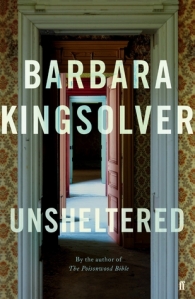 Unsheltered by Barbara Kingsolver: Kingsolver’s bold eighth novel has a dual timeline that compares the America of the 1870s and the recent past, revealing how they are linked by distrust and displacement. The book’s themes and structure emphasize similarities between two time periods that might initially appear very different. Chapters alternate between the story lines, and the last words of one chapter form the title of the next. It’s a clever and elegant connecting strategy, as is the habit of using variations on the title word as frequently as possible – something Jonathan Franzen also does in his novels. (I counted 22 instances of “shelter” and its variants in the text; how many can you spot?) Kingsolver can be heavy-handed with her messages about science, American politics and healthcare, etc. All the same, Unsheltered is a rich, rewarding novel and an important one for our time, with many issues worth pondering and discussing.
 Where the Crawdads Sing by Delia Owens: It’s easy to see why so many have taken this debut novel into their hearts: it’s a gripping mystery but also a tender coming-of-age story about one woman’s desperately lonely upbringing and her rocky route to finding love and a vocation. Not only that, but its North Carolina marsh setting is described in lyrical language that evinces Delia Owens’s background in nature writing, tempered with folksy Southern dialect. The title refers to places where wild creatures do what comes naturally, and throughout the book we are invited to ponder how instinct and altruism interact and what impact human actions can have in the grand scheme of things. In Kya, Owens has created a truly outstanding character. The extremity of her situation makes her a sympathetic figure in spite of her oddities. Crawdads is a real treat.
Shiny New Books
 Under the Rock by Benjamin Myers: When Myers moved to the Calder Valley of West Yorkshire from London over a decade ago, he approached his new patch with admirable curiosity, and supplemented the observations he made from his study window with frequent long walks with his dog (“Walking is writing with your feet”) and research into the history of the area. The result is a divagating, lyrical book that ranges from literature and geology to true crime but has an underlying autobiographical vein. This isn’t old-style nature writing in search of unspoiled places. Instead, it’s part of a growing interest in the ‘edgelands’ where human impact is undeniable but nature is creeping back in. Interludes transcribe his field notes, which are stunning impromptu poems. I came away from this feeling that Myers could write anything – a thank-you note, a shopping list – and make it profound literature. Every sentence is well-crafted and memorable. “Writing is a form of alchemy,” he declares. “It’s a spell, and the writer is the magician.” I certainly fell under his spell here.
 Nine Pints by Rose George: Nine Pints dives deep into the science and cultural history of blood. George’s journalistic tenacity keeps her pushing through the statistics to find the human stories that animate the book. In the first chapter we track the journey of a pint of blood that she donates in her hometown of Leeds. I was particularly interested, if morbidly so, in the chapter on leeches and bloodletting. Other sections journey further afield, chiefly to South Africa and India, to explore AIDS and menstruation taboos. The style can be choppy and repetitive, given to short sentences and identical paragraph openers, and there are a couple of places where the nine-chapter structure shows its weaknesses. While Nine Pints is quite uneven, it does convey a lot of important information about the past, present and future of our relationship to blood.
Times Literary Supplement
 Face to Face: True stories of life, death and transformation from my career as a facial surgeon by Jim McCaul: Eighty percent of a facial surgeon’s work is the removal of face, mouth and neck tumors in surgeries lasting eight hours or more. McCaul also restores patients’ appearance as much as possible after disfiguring accidents. Here he pulls back the curtain on the everyday details of his work life: everything from his footwear (white Crocs that soon become stained with blood and other fluids) to his musical choices (pop for the early phases; classical for the more challenging microsurgery stage). Like neurosurgeon Henry Marsh, he describes the awe of the first incision – “an almost overwhelming sense of entering into a sanctuary.” There’s a vicarious thrill to being let into this insider zone, and the book’s prose is perfectly clear and conversational, with unexpectedly apt metaphors such as “Sometimes the blood vessels can be of such poor quality that it is like trying to sew together two damp cornflakes.” This is a book that inspires wonder at all that modern medicine can achieve.
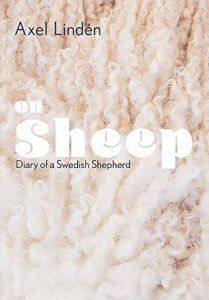 On Sheep: Diary of a Swedish Shepherd by Axel Lindén: Lindén left city life behind to take on his parents’ rural collective in southeast Sweden. This documents two years in his life as a shepherd aspiring to self-sufficiency and a small-scale model of food production. Published diaries can devolve into tedium, but the brevity and selectiveness of this one prevent its accounts of everyday tasks from becoming tiresome. Instead, the rural routines are comforting, even humbling, as the shepherd practices being present with these “quiet and unpretentious and stoical” creatures. The attention paid to slaughtering and sustainability issues – especially as the business starts scaling up and streamlining activities – lends the book a wider significance. It is thus more realistic and less twee than its stocking-stuffer dimensions and jolly title font seem to suggest.
New Networks for Nature 2018
This past weekend was my fourth time attending part of Nature Matters, the annual New Networks for Nature conference. I’ve written about it here a couple of times, once when there was a particular focus on nature poetry and another time when it was held in Cambridge. This year it was back in Stamford for a last time for the 10th anniversary. Next year: York.
What’s so special about the conference is its interdisciplinary nature: visual artists, poets, musicians, writers, politicians, academics and conservationists alike attend and present. So although the event might seem geared more towards my biologist husband, there’s always plenty to interest me, too. The roster is a who’s who of British nature writing: Mark Avery, Tim Birkhead, Mark Cocker, Mary Colwell, Miriam Darlington, Richard Kerridge, Peter Marren, Michael McCarthy, Stephen Moss, Adam Nicolson, Katharine Norbury, Ruth Padel, Laurence Rose and Mike Toms were all there this year. I also appreciate the atmosphere of friendly disagreement about what nature is and how best to go about conserving it.
I attended on Friday, a jam-packed day of sessions that began with Bob Gibbons presenting on the flowers and wildlife of Transylvania, a landscape and culture that are still almost medieval in character. Then Jeremy Mynott interviewed Mark Cocker about his latest book, Our Place: Can We Save Britain’s Wildlife before It Is Too Late? I’ve read other Cocker books, but not this one yet. Its main point seems to be that the country’s environmental organizations need to work together. Individuals and NGOs are doing passionate and wonderful things towards nature conservation, Cocker said, but overall “we ain’t getting there.” Bad news doesn’t sell, though, he noted: his book has sold just 6,000 copies compared to 30,000 for Wilding, Isabella Tree’s story of the rewilding success at Knepp.
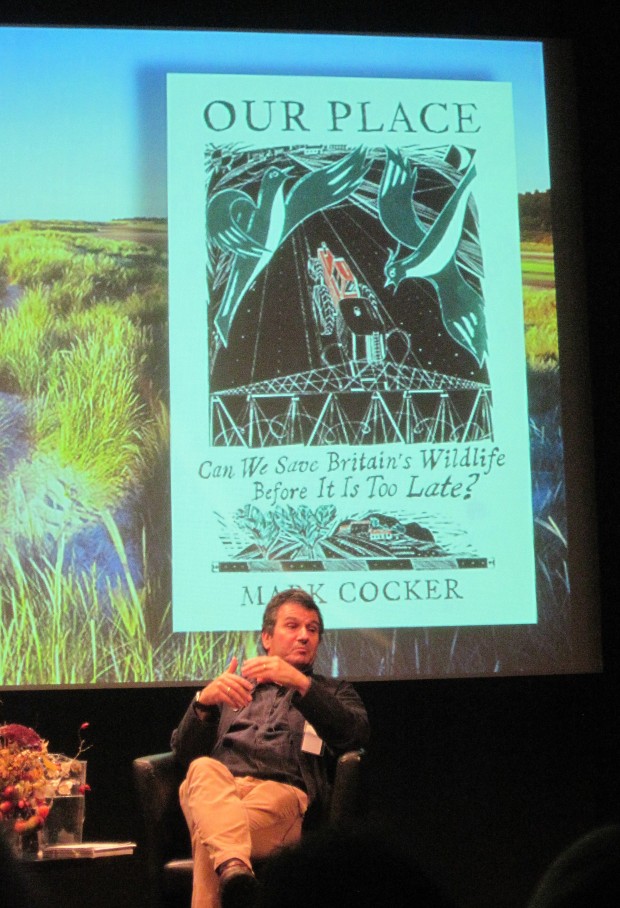
Mark Cocker
Cocker refused to define nature in a one-sentence soundbite, but argued that we have to consider ourselves a part of it rather than thinking about it as a victim ‘out there’ (the closest he came to a definition was “the totality of the system we are a part of”). “Our responsibility, terrifyingly, is unending,” he said – every time you open a new plastic toothbrush, you can’t forget that the old one you throw away will effectively be around forever. Our Place isn’t just composed of polemic, though: it’s structured around six beloved landscapes and finds moments of transcendence in being out in nature. You find hope by walking out the door, feeling the wind on your face and hearing the starling singing, Cocker remarked. He closed by reading a description from the book of the north Norfolk coast.
Either side of lunch were panels on how social media (mostly Twitter, plus smartphone apps) can serve nature and the role that poetry might play in environmental activism, with a brief interlude from visual artist Derek Robertson, who responded to the refugee crisis by traveling to Calais and Jordan and painting human figures alongside migratory birds. In the poetry session I especially enjoyed hearing from Ben Smith, a University of Plymouth lecturer and poet with a debut novel coming out in April 2019 (Doggerland, from Fourth Estate). He recently collaborated with Dr. Lee de Mora on a set of poems inspired by the Earth System Model, which provides the data for the International Panel on Climate Change. Climate modeling might seem an odd subject for poetry, but it provides excellent metaphors for failure and hope in “Spinning Up,” “Data Sets” and “Alternate Histories.”
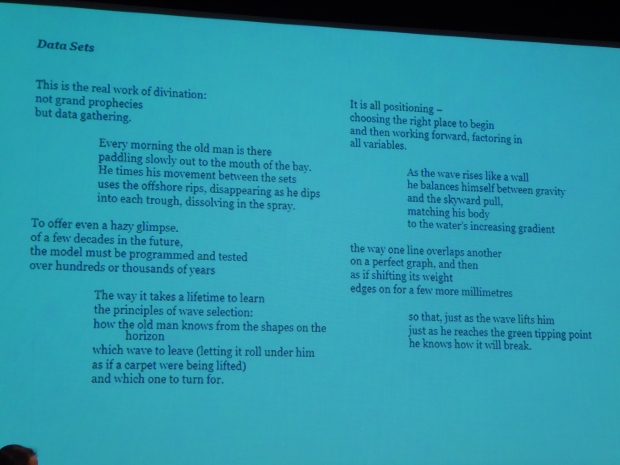
Ben Smith’s poem links unlikely subjects: surfing and climate modeling. Photo by Chris Foster.
Birmingham lecturer Isabel Galleymore, whose debut collection Significant Other is coming out from Carcanet Press in March, talked about how she uses the tropes of love poetry (praise, intimacy, pursuit and loss) when writing about environmental crisis. This shift in her focus began at university when she studied Wordsworth through an ecocritical lens, she said. Jos Smith and Luke Thompson were the other two poets on a panel chaired by Matt Howard. Howard quoted Keats – “We hate poetry that has a design on us” – and asked the poets for reactions. Smith agreed that polemic and poetry don’t mix well, yet said it’s good to have a reason for writing. He thinks it’s best when you can hold two or more ideas in play at a time.
After tea and a marvelous cake spread, it was time for a marathon of three sessions in a row, starting with three short presentations on seabirds: one by a researcher, one by a nature reserve manager, and one by a young artist who produced Chinese-style scroll paintings of the guillemot breeding colonies on Skomer and exhibited them in Sheffield Cathedral.
Next up was a highlight of the weekend: Green Party MP Caroline Lucas and Labour peer Baroness Barbara Young conversed with Michael McCarthy on the topic “Can Conventional Politics Save the Environment?” Both decried short-term thinking, the influence of corporations and the media, and government departments not working together. No one was ever elected on the promise of “less,” McCarthy suggested, but in reply Lucas talked about redefining terms: less of what? more of what? If we think in terms of quality of life, things like green energy and the sharing economy will become more appealing. She also believes that more people care about green issues than we think, but, e.g., a London mum might speak out about air quality without ever using the word “environment.” Baroness Young concluded that “adversarial politics, flip-flopping between parties, isn’t working” and we must get beyond it, at the local level if nothing else. That rang true for me for American politics, too.
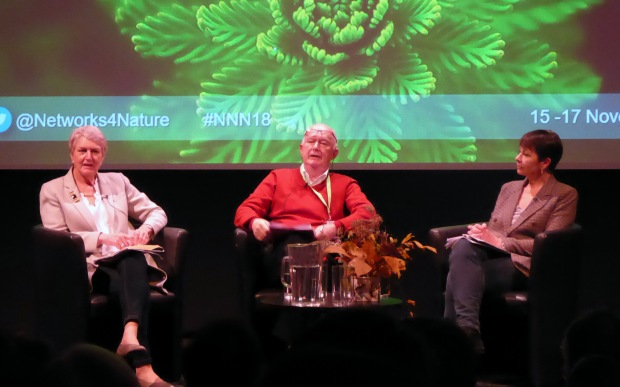
Young, McCarthy and Lucas. Photo by Chris Foster.
Before the day ended with a drinks reception, we were treated to a completely different presentation by Lloyd Buck, who raises and trains birds, mostly for television footage. So, for instance, the greylag geese flying in formation alongside the boat in David Attenborough’s 2012 Sixty Years in the Wild TV special had imprinted on Lloyd’s wife, Rose. Buck spoke about bonding with birds of very different personalities, and introduced the audience to five starlings (who appeared in Poldark), a peregrine, a gyrfalcon, a golden eagle, and Bran the raven, who showed his intelligence by solving several puzzles to find hidden chunks of meat.


I purchased two books of poetry from the bookstall – I had no idea Darlington had written poetry before her nature books – and the conference brochure itself is a wonderful 75-page collection of recent artwork and short nature writing pieces, including most of the presenters but also Patrick Barkham, Tim Dee, Paul Evans, Philip Hoare, Richard Mabey, Helen Macdonald and Chris Packham – a keynote speaker announced for next year. I’ve been skipping through the booklet and have most enjoyed the pieces by Melissa Harrison and Helen Scales so far. Altogether, an inspiring and worthwhile weekend.
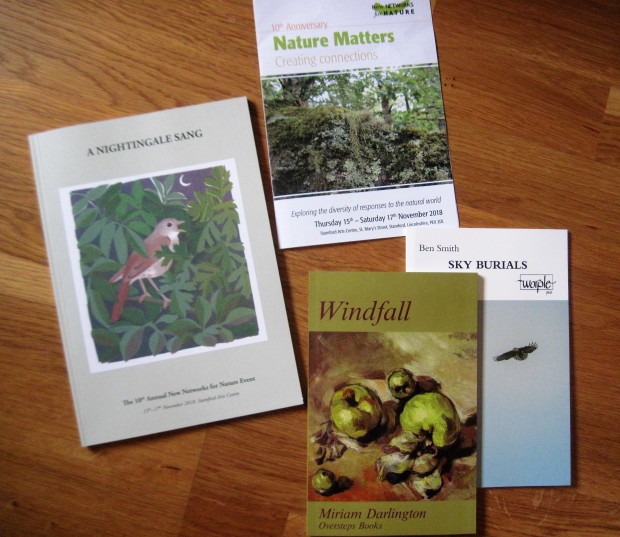
Would any of the conference’s themes or events have interested you?
Novellas in November, Batch #2: 2 Fiction, 2 Nonfiction
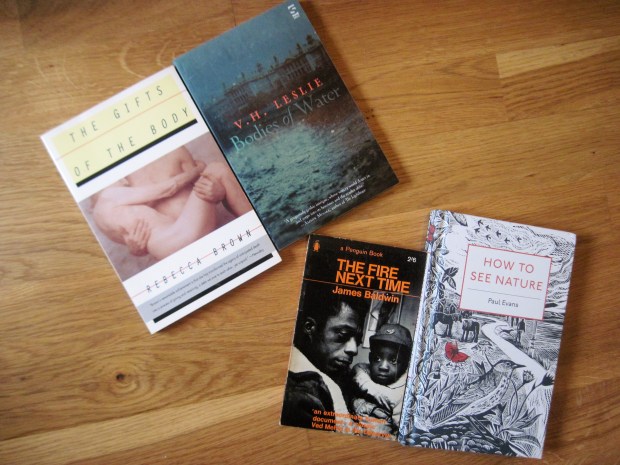
Fiction about caregiving for AIDS patients and Victorian ghosts; nonfiction about American race relations and British wildlife: novellas have it all! Here are my latest four reads. All were .
Fiction:
The Gifts of the Body by Rebecca Brown (1994)
[163 pages]
 This is rather like a set of linked short stories, narrated by a home care aide who bathes and feeds those dying of AIDS. The same patients appear in multiple chapters titled “The Gift of…” (Sweat, Tears, Hunger, etc.) – Rick, Ed, Carlos, and Marty, with brief appearances from Mike and Keith. But for me the most poignant story was that of Connie Lindstrom, an old woman who got a dodgy blood transfusion after her mastectomy; the extra irony to her situation is that her son Joe is gay, and feels guilty because he thinks he should have been the one to get sick. Several characters move in and out of hospice care, and one building is so known for its AIDS victims that a savant resident greets the narrator with a roll call of its dead and dying. Brown herself had been a home-care worker, and she delivers these achingly sad vignettes in plain language that keeps the book from ever turning maudlin.
A favorite passage:
“I’d thought about the sores all week long, about how they looked and how it frightened me. But I’d worked myself up to acting like it didn’t bother me. … I also kept telling myself that even if I wasn’t feeling or thinking the right things, at least he was getting fed, at least he was getting his sheets changed, at least his kitchen was getting cleaned, at least his body was getting salve.”
(I found my copy over the summer in a Little Free Library in my mother’s new town in the States and read it in one day, on my travel to and from London for the Barbara Kingsolver event. Rebecca Brown is a repeat presence on my novellas list: Excerpts from a Family Medical Dictionary was in my 2016 roster.)
Bodies of Water by V. H. Leslie (2016)
[130 pages]
 Left over from my R.I.P. reading plans. This was nearly a one-sitting read for me: I read 94 pages in one go, though that may be because I was trapped under the cat. The first thing I noted was that the setup and dual timeframe are exactly the same as in Barbara Kingsolver’s Unsheltered: we switch between the same place in 2016 and 1871. In this case it’s Wakewater House, a residential development by the Thames that incorporates the site of a dilapidated Victorian hydrotherapy center. After her partner cheats on her, Kirsten moves into Wakewater, where she’s alone apart from one neighbor, Manon, a hoarder who’s researching Anatomical Venuses – often modeled on prostitutes who drowned themselves in the river. In the historical strand, we see Wakewater through the eyes of Evelyn Byrne, who rescues street prostitutes and, after a disastrously ended relationship of her own, has arrived to take the Water Cure.
The literal and metaphorical connections between the two story lines are strong. Annabel described this novella as “watery,” and I would agree: pretty much every paragraph has a water word in it, whether it’s “river,” “sea,” “aquatic” or “immersion.” Both women see ghostly figures emerging from the water, and Manon’s interest in legends about water spirits and the motif of the drowned girl adds texture. Short chapters keep things ticking over, and I loved the spooky atmosphere.
A favorite line: “Sometimes old places like this retain a bit of the past, in the fabric of the building, and occasionally, they seep.”
(Purchased from Salt Publishing during their #JustOneBook fundraising campaign in late May.)
Nonfiction:
The Fire Next Time by James Baldwin (1963)
[89 pages]
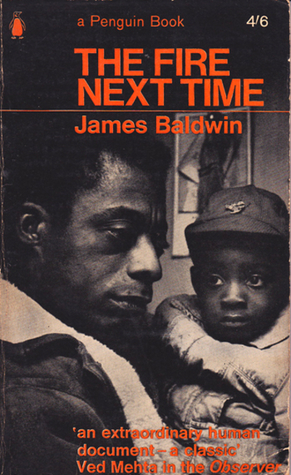 This was written yesterday, right? Actually, it was 55 years ago, but apart from the use of the word “Negro” you might have fooled me. Baldwin’s writing is still completely relevant, and eminently quotable. I can’t believe I hadn’t read him until now. This hard-hitting little book is composed of two essays that first appeared elsewhere. The first, “My Dungeon Shook,” a very short piece from the Madison, Wisconsin Progressive, is a letter addressed to his nephew and namesake on the 100th anniversary of emancipation. No doubt it directly inspired Ta-Nehisi Coates’s Between the World and Me.
“Down at the Cross: Letter from a Region in My Mind” is a 66-page essay that first appeared in the New Yorker. It tells of a crisis of faith that hit Baldwin when he was a teenager. Whereas he used to be a fervent young preacher in his church, he started to question to what extent Christianity of all stripes was upholding white privilege and black subjugation. Unless religion was making things better, he decided he wanted no part of it. Curiosity about the Nation of Islam led to Baldwin meeting Elijah Muhammad for dinner at his home in Chicago. I marked out so many passages from this essay. Here are a few that stood out most:
“To be sensual, I think, is to respect and rejoice in the force of life, of life itself, and to be present in all that one does, from the effort of loving to the breaking of bread.”
“If the concept of God has any validity or any use, it can only be to make us larger, freer, and more loving. If God cannot do this, then it is time we got rid of Him.”
“When a white man faces a black man, especially if the black man is helpless, terrible things are revealed.”
How to See Nature by Paul Evans (2018)
[164 pages]
 How to See Nature (1940), a quaint and perhaps slightly patronizing book by Shropshire naturalist and photographer Frances Pitt, was intended to help city evacuees cope with life in the countryside. Recently Pitt’s publisher, Batsford, commissioned Shropshire naturalist Paul Evans to revisit the topic. The result is a simply lovely volume (with a cover illustration by Angela Harding and black-and-white interior drawings by Evans’s partner, Maria Nunzia) that reflects on the range of modern relationships with nature and revels in the wealth of wildlife and semi-wild places we still have in Britain.
He starts with his own garden, where he encounters hedgehogs and marmalade hoverflies. Other chapters consider night creatures like bats; weeds and what they have to offer; and the wildlife of rivers, common land, moors and woods. I particularly enjoyed a section on reintroduced species such as beavers and red kites. The book closes with an A–Z bestiary of British wildlife, from adders to zooplankton.
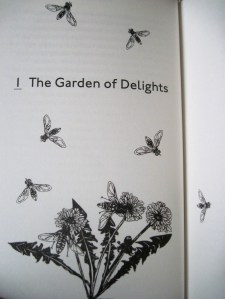 Throughout, Evans treats issues like tree blight, climate change and species persecution with a light touch. Although it’s clear he’s aware of the diminished state of nature and quietly irate at how we are all responsible for pollution and invasive species, he writes lovingly and with poetic grace. I would not hesitate to recommend this to fans of contemporary nature writing.
Favorite lines:
“the orb-weavers wait: sexual cannibals adorned in the extra-terrestrial glow of their pearl diadems, suspended in ethereal scaffolds woven from hundreds of glands controlled by their own sovereign will and unique metabolism”
“The last ‘woo-oooo’ of a tawny owl meets the first clockwork hiccup of a pheasant, then bird by bird in the scanty light, the songs begin”
(Paul Evans is a repeat presence on my novellas list: Herbaceous was in my 2017 roster.)
How to See Nature was published by Batsford on November 6th. My thanks to the publisher for a free copy for review.
Have you read any of these novellas? Which one takes your fancy?
A Patroness of the Arts
I recently sponsored my first book via Unbound, the UK’s crowdfunding publisher. You’re probably familiar with some Unbound titles even if that name doesn’t ring a bell. For instance, you might remember that The Wake by Paul Kingsnorth, an Unbound title from 2014, became the first crowdfunded novel longlisted for the Man Booker Prize. I’ve reviewed another previous Unbound title, Martine McDonagh’s Narcissism for Beginners, and will be participating in the blog tour for Lev Parikian’s Why Do Birds Suddenly Disappear? in May.

 The forthcoming title I’ve chosen to support is Women on Nature by Katharine Norbury, which promises to be a wide-ranging and learned anthology celebrating the tradition of women’s writing about nature (both fiction and non-). I enjoyed Norbury’s first book, The Fish Ladder, which is a memoir in the vein of H Is for Hawk, and also saw her speak at the New Networks for Nature conference in 2016.

Albums that exist because I helped crowdfund them.
I’d only ever crowdfunded music before – albums by The Bookshop Band, Krista Detor, Duke Special and Marc Martel. Beaming internally at feeling like a patroness of the arts after funding my Women on Nature hardback, I kept the smug glow going by signing up to support The Bookshop Band via Patreon (where you can commit to a certain amount per creation, e.g. per music video, and have the option of setting a monthly cap) and to fund an album by their singer/cellist Beth Porter and her band The Availables via Indiegogo.
Have you ever gotten involved in a crowdfunding project? How about for the arts?
A Wood of One’s Own by Ruth Pavey
In 1999 Ruth Pavey bought four acres of Somerset scrubland at a land auction. It wasn’t exactly what she’d set out to acquire: it wasn’t a “pretty” field, and traffic was audible from it. But she was pleased to return to her family’s roots in the Somerset Levels area – this “silted place of slow waters, eels, reeds, drainage engineers, buttercups, church towers, quiet” that her father came from, and where she was born – and she fancied planting some trees.
There never was a master plan […] I wanted to open up enough room for trees that might live for centuries […] I also wanted to keep areas of wilderness for the creatures […] And I wanted it to be beautiful. Not immaculate, that was too much to hope for, but, in its own ragged, benign way, beautiful.
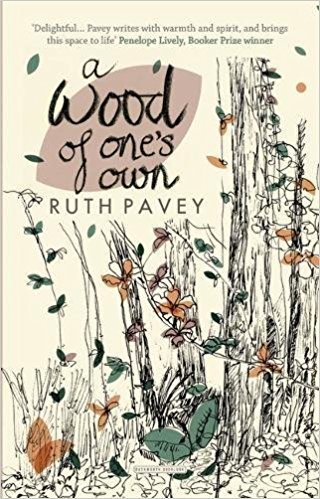 This pleasantly meandering memoir, Pavey’s first book, is an account of nearly two decades spent working alongside nature to restore some of her land to orchard and maintain the rest in good health. The first steps were clear: she had to deal with some fallen willows, find a water source and plan a temporary shelter. Rather than a shed, which would be taken as evidence of permanent residency, she resorted to a “Rollalong,” a mobile metal cabin she could heat just enough to survive nights spent on site. Before long, though, she bought a nearby cottage to serve as her base when she left her London teaching job behind on weekends.
Then came the hard work: after buying trees from nurseries and ordering apple varieties that would fruit quickly, Pavey had to plant it all and pick up enough knowledge about pruning, grafting, squirrel management, canker and so on to keep everything alive. There was always something new to learn, and plenty of surprises – such as the stray llama that visited her neighbor’s orchard. Local history weaves through this story, too: everything from the English Civil War to Cecil Sharp’s collecting of folk songs.
Britain has seen a recent flourishing of hybrid memoirs–nature books by the likes of Helen Macdonald, Mallachy Tallack and Clover Stroud. By comparison, Pavey is not as confiding about her personal life as you might expect. She reveals precious little about herself: she tells us that her mother died when she was young and she was mostly raised by an aunt; she hints at some failed love affairs; in the acknowledgments she mentions a son; from the jacket copy I know she’s the gardening correspondent for the Hampstead & Highgate Express. But that’s it. This really is all about the wood, and apart from serving as an apt Woolf reference the use of “one” in the title is in deliberate opposition to the confessional connotations of “my”.
 Still, I think this book will appeal to readers of modern nature writers like Paul Evans and Mark Cocker – these two are Guardian Country Diarists, and Pavey develops the same healthy habit of sticking to one patch and lovingly monitoring its every development. I was also reminded of Peri McQuay’s memoir of building a home in the woods of Canada.
What struck me most was how this undertaking encourages the long view: “being finished, in the sense of being brought to a satisfactory conclusion, is not something that happens in a garden, an orchard or a wood, however well planned or cultivated,” she writes. It’s an ongoing project, and she avoids nostalgia and melodrama in planning for its future after she’s gone; “I am only there for a while, a twinkling. But [the trees and creatures] … will remain.” This would make a good Christmas present for the dedicated gardener in your life, not least because of the inclusion of Pavey’s lovely black-and-white line drawings.
A Wood of One’s Own was published on September 21st by Duckworth Overlook. My thanks to the publisher for a free copy for review.
My rating:
Finding a Home in Nature: Singing Meadow by Peri McQuay
For 30 years Peri McQuay and her family lived in the idyllic 700-strong village of Westport in Eastern Ontario. Her husband, Barry, was the park supervisor at Foley Mountain Conservation Area, the subject of her first nature-themed memoir, The View from Foley Mountain (1995), and they lived on site amid its 800 acres. The constant push to engage in fundraising gradually made it a less pleasant place to live and work, so as Barry’s retirement neared they knew it was time to find a new home of their own. That quest is the subject of her third book, Singing Meadow: The Adventure of Creating a Country Home.
McQuay fantasized about a farmhouse surrounded by 50–100 acres of their own land, but was aware that their limited finances might not stretch to match their dreams. Long before they found their home they were buying little items for it, like an acorn door knocker that functioned as a reassuring totem object during the long, discouraging process of looking at houses. Over the course of two years, McQuay and her husband viewed more than 80 properties! Two pieces of advice they received turned out to be prescient: their loquacious real estate agent opined that “the house you end up in won’t be the one you set out to find,” and a woman in the doctor’s office waiting room counseled her, “don’t try too hard. It’ll happen when it’s time.”
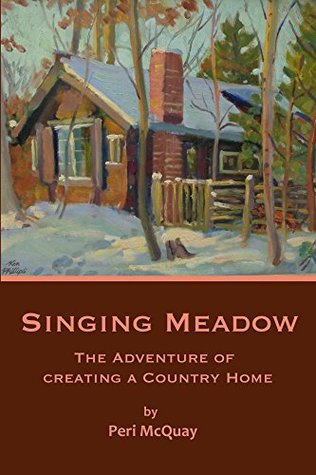 In the end, they fell in love with a plot of land with a water meadow that was home to herons and beavers. With no handyman skills, they never thought they’d embark on building a home of their own. And as it turned out, finding the land was the easy bit, as opposed to the nitty-gritty details of designing what they wanted and meeting with builders who could make it a reality. But as they planted trees and looked ahead to their move in a year’s time, they were already forming a relationship with this place before the house was ever built, learning “the hard lessons of patience and possibility.”
Woven through the book are short flashbacks to other challenging times in McQuay’s life: having chronic fatigue syndrome in her 40s, her mother’s death a few years earlier, and a terrible ice storm at the park that left them without power for 17 days and caused damage to the forest that it might take 30 years to recover from. What all of these situations, as well as looking for a home, have in common is that they forced the author to take the long view, recognizing the healing effects of time rather than the tantalizing option of quick fixes.
I’ve never owned a home, but I’ve lived in 10 properties in the last 10 years. A lot of that nomadism has been foisted upon us rather than chosen, so I could relate to McQuay’s frustration throughout the property search, as well as her feelings of being uprooted – that “the very stuff of my life was being dismantled.” I can also see the wisdom of choosing the place that feeds your soul rather than the one that seems most convenient. She remembers one of the first properties she and Barry rented as a married couple: it was an old place with an outhouse and no running hot water, but they filled it with laughter and music and felt at peace there. It was infinitely better than any soulless town apartment they might have resorted to.
The book ends with a bit of a shocker, one of two moments that brought a lump to my throat. It’s a surprisingly bittersweet turn after what’s gone before, but it’s realistic and serves as a reminder that life is an ongoing story with sad moments we can’t prepare for.
Overall, this memoir reminds me most of Michael Pollan’s A Place of My Own (which appears in McQuay’s bibliography) and May Sarton’s journals, in which the search for a long-term home in Maine is a major element. Although this will appeal to people who like reading about women’s lives and transitions, I would particularly recommend it to readers of nature writing as the book is full of lovely passages like these:
It was bliss visiting the trees and caring for them. Each one was precious. Across the meadow I could see the black, white and yellow nesting bobolink plus an unidentifiable bird with a square seed-eating beak perched on a cattail. A crow flew by, checking to see what I was doing, then a blue jay. In the distance the newly returned yellow warbler was calling “witchetty witchetty.” Over and over, I needed to keep saying that I felt deep down, richly happy in the meadow. In the glassy eye of the pond, water was burbling up in such a powerful spilling-over that it chuckled musically. Indeed, while there was such a flow only the boldest, largest minnows could swim strongly enough to approach the rushing source.
Now I was walking slowly down to the water meadow, hearing the strange, quarrelsome-sounding talk of herons beginning another season here. I was teaching myself how to be aware every moment of every step so I could keep walking longer on this rough land. With any luck, this beloved place would be my last home. And, after the unignorable message of recent fierce summers, I was here to bear witness, to stand with the great maples, beeches, and oaks through whatever might come, to accompany with whatever grace I could for as long as I could sustain it. Living here, this was who I wanted to be—an old woman vanishing into the light.
I’m keen to get hold of McQuay’s other two books as well. Her work makes for very pleasant, meditative reading.
Note: The front cover is an oil painting of Peri’s childhood home by her artist father, Ken Phillips.
Singing Meadow: The Adventure of Creating a Country Home was published by Wintergreen Studios Press in 2016. My thanks to the author for sending a PDF copy for review.
My rating:
Blog Tour: Foxes Unearthed by Lucy Jones
Cold, delicately as the dark snow
A fox’s nose touches twig, leaf;
[…]
Across clearings, an eye,
A widening deepening greenness,
Brilliantly, concentratedly,
Coming about its own business
~Ted Hughes, “The Thought-Fox” (1957)
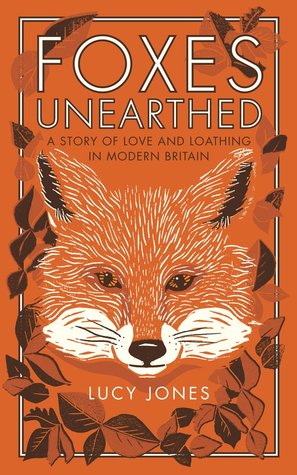
Foxes Unearthed, freelance journalist Lucy Jones’s first book, won a Society of Authors’ Roger Deakin Award for nature writing. If you’re familiar with Patrick Barkham’s Badgerlands, you’ll recognize this as a book with a comparable breadth and a similar aim: clearing the reputation of an often unfairly reviled British mammal. Jones ranges from history to science and from mythology to children’s literature in her search for the truth about foxes. Given the media’s obsession with fox attacks, this is a noble and worthwhile undertaking.
 The book proper opens with a visit to Roald Dahl’s house, now a Buckinghamshire museum, where he wrote Fantastic Mr. Fox. Still one of the best-known representations of foxes in British literature, Dahl’s Mr. Fox is a Robin Hood-like hero, outsmarting a trio of mean-spirited farmers to provide a feast for his family. Foxes’ seemingly innate wiliness prompts ambivalent reactions, though; we admire it, but we also view it as a threat or an annoyance. As Jones puts it, the fox of fables and traditional stories is “a villain we cheer for.”
Not everyone cheers, of course. Under Henry VIII, the Vermin Acts of 1532 (not repealed until the 1750s) promised a reward to anyone who killed foxes, then considered a nuisance animal. Fox hunting and the cruel sport of “tossing” have a long history that eventually came up against the movement towards animal welfare, starting with Jeremy Bentham in the 1740s and codified by the 1911 Protection of Animals Act. Meanwhile, Jones notes, children’s books advocating compassion for animals, such as Anna Sewell’s Black Beauty (1877), ensured that the message made it out of the legislative chamber and into everyday life.
The second chapter is a useful survey of fox behavior. Foxes are omnivores, and in recent decades have started to move into Britain’s cities, where they find plenty of food to scavenge. In rural settings, foxes are still the subject of farmers’ loathing even though they rarely take lambs and actually help keep rabbit numbers in check. Still, the stereotype of foxes killing for fun instead of for hunger persists, whereas they in fact cache their surplus food. Chapter 3 asks whether fox numbers have reached pest status and considers various control strategies, from straightforward culling to the non-lethal methods supported by conservationists.
I enjoyed Jones’s meetings with figures from both sides of the debate. She goes along on a fox hunt, but also meets or quotes animal rights activists, academics, and high-profile nature promoters like Chris Packham. All told, though, I felt the book could have been closer to 200 pages than 300. Most chapters are very long, and some could easily be combined and/or shortened. For instance, Chapter 1 relays the amount of information about fox hunting that most readers will be prepared to absorb, yet it’s then the subject of two more chapters.

At the British Wildlife Centre in Surrey. Photo by Chris Foster.
This is an important book for correcting misconceptions, but your enjoyment of it may be in proportion to your personal interest in the subject. In terms of fonts and cover design, though, you’re unlikely to come across a more gorgeous book this year.
Foxes Unearthed was published in paperback by Elliott & Thompson on March 16th. Thanks to Alison Menzies for arranging my free copy for review.
To encounter foxes in fiction, try the following:
- Glow by Ned Beauman
- The Many Selves of Katherine North by Emma Geen
- Midwinter by Fiona Melrose
- The Soho Leopard by Ruth Padel (a poetry book with a sequence on urban foxes)
& the forthcoming How to Be Human by Paula Cocozza (April 6th).
 Bookish Beck = Rebecca Foster. American transplant to England. Freelance proofreader and book reviewer.
 Bookish Beck