Love Your Library, June 2024
Everyone is welcome to join in with this meme that runs on the last Monday of the month.
Thanks to Eleanor (here and here) and Laura (and image below) for posting about their recent library reads! I loved seeing Marina Sofia feature beautiful public library designs in one of her Friday Fun posts. Tom Beer, the Kirkus Reviews editor-in-chief, wrote about the love of books starting with libraries. And Sarah Turley shared this New York Times article (no paywall for the next few weeks) about the history of Black librarians during the Harlem Renaissance, including Nella Larsen.

The computer system was down at my library for a couple of weeks in May–June, such that I had to spend my volunteering sessions shelf-tidying or processing returns rather than filling reservations as I usually do. After the system update, I found that my saved lists had disappeared from my online account. Along with a general list of ~170 books I might want to borrow in the future, I had shelves for short stories, novellas, and Literary Wives. It is annoying that they’re gone, but maybe also freeing. If I hadn’t borrowed a book already, I must not have really wanted to read it, right?
There have also been tweaks to what certain categories are called. “Bestsellers” are now listed as “Short term loan,” which makes more sense for the two-week-loan collection as not all the books are blockbusters. But instead of Young Adult, the call number is now “Older teenage fiction” in the “Young person’s fiction” collection. Rather than School-Age Picture Books, it’s now “Picture books for older readers.” Seems like reinventing the wheel to me, but oh well…
My library use over the last month:
READ
- Piglet by Lottie Hazell

- Soldier Sailor by Claire Kilroy

- Knife: Meditations After an Attempted Murder by Salman Rushdie

- The Invention of Hugo Cabret by Brian Selznick


SKIMMED
- Languishing by Cory Keyes
CURRENTLY READING
- Death Valley by Melissa Broder
- The Tale of Despereaux by Kate DiCamillo
- Learning to Think: A Memoir about Faith, Demons, and the Courage to Ask Questions by Tracy King
- Unearthing: A Story of Tangled Love and Family Secrets by Kyo Maclear
- Late Light: Finding Home in the West Country by Michael Malay
- Mrs Gulliver by Valerie Martin
- After Dark by Haruki Murakami
- Excellent Women by Barbara Pym
- Stowaway: The Disreputable Exploits of the Rat by Joe Shute
- Mrs Hemingway by Naomi Wood (a reread)
RETURNED UNFINISHED
- Restless Dolly Maunder by Kate Grenville – It somehow seemed like I’d read this fictionalized family history before. The first two chapters were fine but I didn’t need to continue.
- Kay’s Incredible Inventions by Adam Kay – Silly and insubstantial, yet felt endless. I loved Kay’s Anatomy, his first book for kids, but the sequels have been unnecessary. I read 57 pages. (The other day at church I was amused to see a boy of ~11 years old walk in with this book under his arm. Truly, he is the target audience. I hope it kept him entertained during service!)

RETURNED UNREAD
- Bookshops & Bonedust by Travis Baldree – Seemed weird/twee/try-hard.
- You Are Here by David Nicholls – I read a few mini-chapters and thought, meh; I should release this to the 52 other people of my library system who appear to be desperate to read it. I did like the “Accept All Changes” section about the proofreader protagonist’s pedantry (I read a similar passage in a Mary Costello short story recently). If I ever want to try again, I have it on my Kindle from Edelweiss.
- The Spoiled Heart by Sunjeev Sahota – The first few pages were not just dull but actively awkwardly written, such that I had to go back and read particular sentences two to three times. Even the tiny fraction that I read felt dated and arbitrary: why focus on this situation, this time period, these people? Again, if I wish to try again I have it on my Kindle from NetGalley.
- Quilt on Fire by Christie Watson – I read a few pages and it seemed like this midlife memoir was going to be scattered and cliched.
What have you been reading or reviewing from the library recently?

Share a link to your own post in the comments. Feel free to use the above image. The hashtag is #LoveYourLibrary.
The #1929Club: Passing and Letters to a Young Poet
A year club hosted by Karen and Simon is always a great excuse to read more classics. I appear to be getting in training for Novellas in November – both of these were notably short at under 100 pages, particularly the Rilke, which is little more than a pamphlet. (Both:  )
)

Passing by Nella Larsen
By the time of her death in 1964, this Harlem Renaissance author had mostly fallen into obscurity, but she has received renewed attention in recent decades. I learned about Passing in connection to Brit Bennett’s The Vanishing Half, which it partially inspired.
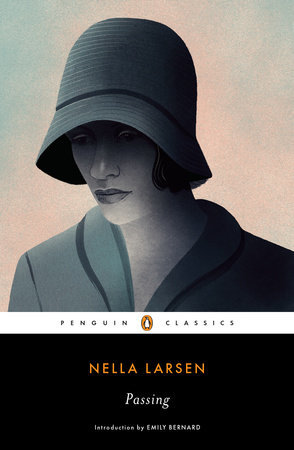 Irene Redfield and Clare Kendry grew up together in Chicago. Both are light-skinned African American women, their features described as “olive” or “golden.” Irene has remained within the Black community, marrying a doctor named Brian and living a comfortable life in Harlem. However, she is able to pass as white in certain circumstances, such as when she and Clare meet for tea in a high-end establishment. Clare, on the other hand, is hiding her ancestry from her white husband, Jack Bellew, who spews hatred for Black people. “It’s such a frightfully easy thing to do. If one’s the type, all that’s needed is a little nerve,” she insists.
Clare and Irene’s relationship could be characterized as that of frenemies, though critics have posited repressed homoeroticism based on how Larsen describes Clare’s beauty from Irene’s perspective. This is very subtle – I only spotted potential infatuation in the letter from Clare that Irene reads in the opening pages. Most of the time, Irene appears to disapprove of Clare for her recklessness, knowing that there could be dire consequences if Jack discovers her deception. She also starts to suspect that Clare is having an affair with Brian, and for these reasons, as well as her own discomfort and guilt, she avoids Clare as much as possible.
The trouble with Clare was, not only that she wanted to have her cake and eat it too, but that she wanted to nibble at the cakes of other folk as well.
Things come to a head in the final six pages, turning what had for much of its length been an ambling read into something of a shocker. Apparently scholars feel that Larsen flubs her endings, but I thought this one was fantastic, giving a Gatsby-esque tragic weight. Comparing Black women’s strategies of coping with a white world was also fascinating. My experience with African American classics is limited, so I was happy to increase my repertoire.
My secondhand copy – a dual volume with Quicksand, which I’ll plan on reading next November – came from the much-mourned Bookbarn International.
Letters to a Young Poet by Rainer Maria Rilke
[Translated from the German by Charlie Louth]
 I’d long wanted to read this and couldn’t find it through a library, so bought a copy as part of a Foyles order funded by last year’s Christmas money. I’m not clear on whether the Penguin Little Black Classics edition is abridged, but the 1929 preface by Franz Xaver Kappus, Rilke’s correspondent, only mentions 10 letters, which is how many are printed here, so I have at least gotten the gist. Most of the letters were sent in 1903–4, with a final one dated 1908, from various locations on Rilke’s European travels.
Kappus sent Rilke his early poetic efforts and received in reply a frank letdown – “the poems are not yet anything in themselves” – but also much kind, general advice about creativity, confidence, post-faith life, and thriving in spite of suffering. Even so tiny a book is almost endlessly quotable, with many self-help-oriented phrases I’d read in other contexts and found wonderfully reassuring:
Go into yourself. Examine the reason that bids you to write; check whether it reaches its roots into the deepest region of your heart, admit to yourself whether you would die if it should be denied you to write.
To be an artist means: not to calculate and count; to grow and ripen like a tree which does not hurry the flow of its sap and stands at ease in the spring gales without fearing that no summer may follow. But it comes only to those who are patient, who are simply there in their vast, quiet tranquillity, as if eternity lay before them.
be patient towards all that is unresolved in your heart and … try to love the questions themselves
I also got this 1929 autobiography out from the library. While I much admire the tone in the first paragraph and final pages (especially that last word!), I find I don’t have enough interest in the WWI poets to read what’s in between. It put a Sufjan Stevens song in my head, though.


I’ve previously participated in: 1920 Club, 1956 Club, 1936 Club, 1976 Club and 1954 Club.
 Bookish Beck = Rebecca Foster. American transplant to England. Freelance proofreader and book reviewer.
 Bookish Beck