Recommended June Releases
I have an all-female line-up for you this time, with selections ranging from a YA romance in verse to a memoir by a spiritual recording artist. There’s a very random detail that connects two of these books – look out for it!

In Paris with You by Clémentine Beauvais
[Faber & Faber, 7th]
 I don’t know the source material Beauvais was working with (Eugene Onegin, 1837), but still enjoyed this YA romance in verse. Eugene and Tatiana meet by chance in Paris in 2016 and the attraction between them is as strong as ever, but a possible relationship is threatened by memories of a tragic event from 10 years ago involving Lensky, Eugene’s friend and the boyfriend of Tatiana’s older sister Olga. I’m in awe at how translator Sam Taylor has taken the French of her Songe à la douceur and turned it into English poetry with the occasional rhyme. This is a sweet book that would appeal to John Green’s readers, but it’s more sexually explicit than a lot of American YA, so is probably only suitable for older teens. (Proof copy from Faber Spring Party)
Favorite lines:
“Her heart takes the lift / up to her larynx, / where it gets stuck / hammering against the walls of her neck.”
“an adult with a miniature attention span, / like everyone else, refreshing, updating, / nibbling at time like a ham baguette.”
“helium balloons in the shape of spermatozoa straining towards the dark sky.”
My rating: 
Implosion: A Memoir of an Architect’s Daughter by Elizabeth W. Garber
[She Writes Press, 12th]
 The author grew up in a glass house designed by her father, Modernist architect Woodie Garber, outside Cincinnati in the 1960s–70s. This and his other most notable design, Sander Hall, a controversial tower-style dorm at the University of Cincinnati that was later destroyed in a controlled explosion, serve as powerful metaphors for her dysfunctional family life. Woodie is such a fascinating, flawed figure. Manic depression meant he had periods of great productivity but also weeks when he couldn’t get out of bed. He and Elizabeth connected over architecture, like when he helped her make a scale model of Le Corbusier’s Villa Savoye for a school project, but it was hard for a man born in the 1910s to understand his daughter’s generation or his wife’s desire to go back to school and have her own career.
Mixed feelings towards a charismatic creative genius who made home life a torment and the way their fractured family kept going are reasons enough to read this book. But another is just that Garber’s life has been so interesting: she witnessed the 1968 race riots and had a black boyfriend when interracial relationships were frowned upon; she was briefly the librarian for the Oceanics School, whose boat was taken hostage in Panama; and she dropped out of mythology studies at Harvard to become an acupuncturist. Don’t assume this will be a boring tome only for architecture buffs. It’s a masterful memoir for everyone. (Read via NetGalley on Nook)
My rating: 
Florida by Lauren Groff
[William Heinemann (UK), 7th / Riverhead (USA), 5th]
 My review is in today’s “Book Wars” column in Stylist magazine. Two major, connected threads in this superb story collection are ambivalence about Florida, and ambivalence about motherhood. The narrator of “The Midnight Zone,” staying with her sons in a hunting camp 20 miles from civilization, ponders the cruelty of time and her failure to be sufficiently maternal, while the woman in “Flower Hunters” is so lost in an eighteenth-century naturalist’s book that she forgets to get Halloween costumes for her kids. A few favorites of mine were “Ghosts and Empties,” in which the narrator goes for long walks at twilight and watches time passing through the unwitting tableaux of the neighbors’ windows; “Eyewall,” a matter-of-fact ghost story; and “Above and Below,” in which a woman slips into homelessness – it’s terrifying how precarious her life is at every step. (Proof copy)
Favorite lines:
“What had been built to seem so solid was fragile in the face of time because time is impassive, more animal than human. Time would not care if you fell out of it. It would continue on without you.” (from “The Midnight Zone”)
“The wind played the chimney until the whole place wheezed like a bagpipe.” (from “Eyewall”)
“How lonely it would be, the mother thinks, looking at her children, to live in this dark world without them.” (from “Yport”)
My rating:
The Most Beautiful Thing I’ve Seen: Opening Your Eyes to Wonder by Lisa Gungor
[Zondervan, 26th]
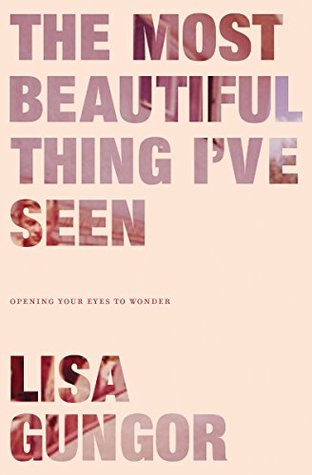 You’re most likely to pick this up if you enjoy Gungor’s music, but it’s by no means a band tell-all. The big theme of this memoir is moving beyond the strictures of religion to find an all-encompassing spirituality. Like many Gungor listeners, Lisa grew up in, and soon outgrew, a fundamentalist Christian setting. She bases the book around a key set of metaphors: the dot, the line, and the circle. The dot was the confining theology she was raised with; the line was the pilgrimage she and Michael Gungor embarked on after they married at 19; the circle was the more inclusive spirituality she developed after their second daughter, Lucie, was born with Down syndrome and required urgent heart surgery. Being mothered, becoming a mother and accepting God as Mother: together these experiences bring the book full circle. Barring the too-frequent nerdy-cool posturing (seven mentions of “dance parties,” and so on), this is a likable memoir for readers of spiritual writing by the likes of Sue Monk Kidd, Mary Oliver and Terry Tempest Williams. (Read via NetGalley on Kindle)
My rating:
 Orchid & the Wasp by Caoilinn Hughes
[Oneworld, 7th] – see my full review. 
Ok, Mr Field by Katharine Kilalea
[Faber & Faber, 7th]
 Mr. Field is a concert pianist whose wrist was shattered in a train crash. With his career temporarily derailed, there’s little for him to do apart from wander his Cape Town house, a replica of Le Corbusier’s Villa Savoye, and the nearby coastal path. He also drives over to spy on his architect’s widow, with whom he’s obsessed. He’s an aimless voyeur who’s more engaged with other people’s lives than with his own – until a dog follows him home from a graveyard. This is a strangely detached little novel in which little seems to happen. Like Asunder by Chloe Aridjis and Leaving the Atocha Station by Ben Lerner, it’s about someone who’s been coasting unfeelingly through life and has to stop to ask what’s gone wrong and what’s worth pursuing. It’s so brilliantly written, with the pages flowing effortlessly on, that I admired Kilalea’s skill. Her descriptions of scenery and music are particularly good. In terms of the style, I was reminded of books I’ve read by Katie Kitamura and Henrietta Rose-Innes. (Proof copy from Faber Spring Party)
My rating:
This came out in the States (from Riverhead) back in early April, but releases here in the UK soon, so I’ve added it in as a bonus.
The Female Persuasion by Meg Wolitzer
[Chatto & Windus, 7th]
 An enjoyable story of twentysomethings looking for purpose and trying to be good feminists. To start with it’s a fairly familiar campus novel in the vein of The Art of Fielding and The Marriage Plot, but we follow Greer, her high school sweetheart Cory and her new friend Zee for the next 10+ years to see the compromises they make as ideals bend to reality. Faith Frank is Greer’s feminist idol, but she’s only human in the end, and there are different ways of being a feminist: not just speaking out from a stage, but also quietly living every day in a way that shows you value people equally. I have a feeling this would have meant much more to me a decade ago, and the #MeToo-ready message isn’t exactly groundbreaking, but I very much enjoyed my first taste of Wolitzer’s sharp, witty writing and will be sure to read more from her. This seems custom-made for next year’s Women’s Prize shortlist. (Free from publisher, for comparison with Florida in Stylist “Book Wars” column.)
My rating:
What June books do you have on the docket? Have you already read any that you can recommend?
Orchid & the Wasp by Caoilinn Hughes
Gael Foess, the antiheroine of Caoilinn Hughes’ debut novel, is a trickster. When we first meet her in Dublin in 2002, the 11-year-old is promptly kicked out of school for trying to sell other girls “virginity pills.” As the years pass we see her con her way into a London Business School interview, self-assuredly teach a literature class when her professor doesn’t show up, pretend to be a journalist to get an exclusive interview, and use deception to try to boost the careers of both her mother, Sive (a conductor), and her younger brother, Guthrie (a painter and single dad). In the title metaphor, which refers to an orchid species that lures pollinating wasps, Gael is the seductive flower that gets what it wants. We’re also invited to think of her, with that typically Gael-ic name, as an incarnation of mythological Irish hero Cúchulainn.
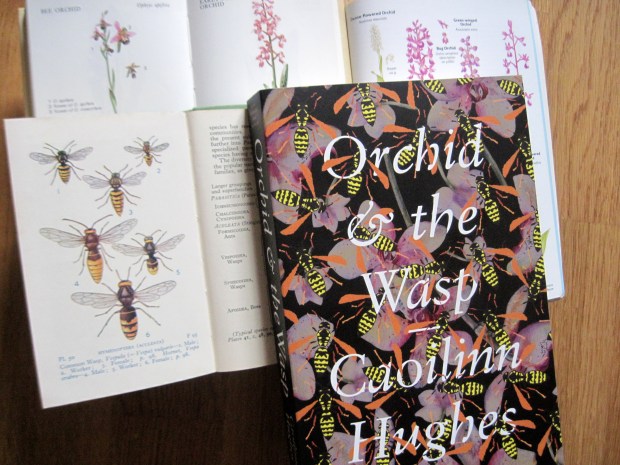
The novel spans about nine years: a politically turbulent decade that opens with Iraq War protests and closes with the Occupy movement in New York City. The financial crisis temporarily jolts Gael and Guthrie’s father, Jarleth, a high-flying Barclays banker who leaves the family in 2008. The biblical parable of the talents, which he recounted to Gael when she was a little girl, comes back to resonate: It’s a potent reminder that money and skills don’t get distributed fairly in this life. When Gael gets to New York in 2011, she plans to redress the balance in two paradoxical ways: living in the Occupy camp and taking part in protests; and secretly earning her brother a fortune on his modern art. For even while decrying her father’s privilege, she indulges her own love of fine things; even if ironically, she says that she aspires to be in the 1%, too.
With all her contradictions, Gael is an unforgettable character. I also found Guthrie fascinating. It was serendipitous that I read this novel alongside Suzanne O’Sullivan’s new book, Brainstorm. Guthrie was a mystically religious child and suffered from seizures, which doctors determined weren’t due to epilepsy but to somatic delusions – psychological rather than physiological. The seizures, ironically, became a boon because they inspire his art: “they’re hallowed and each aura is an absolution – a benison – and not just a synaptic blip.”

The U.S. cover
Hughes is wonderfully adept at voices, bringing secondary characters to life largely through how they speak. I especially warmed to Art, Sive’s boyfriend, who’s a Yorkshireman; and Harper, Gael’s OCD-plagued flatmate from Las Vegas. Even a brief run-in with American officialdom gets the perfect deadpan rendering: “United States Customs has no interest in surprises. Matter of fact, we hate surprises.” The novel often has a frenetic pace – an energy that’s well matched by the virtuosic use of language, with wordplay, neologisms, and metaphors drawn from art, music and nature. An orchestra is compared to a flock of starlings; a despondent Sive “began to resemble a bass clef.” The Irish are like radishes: “Pink on the outside, white underneath. Speck of mud on their cheeks.” Harper’s entire upbringing is pithily reduced to an “only-childhood of sprinkler weather, window glare and doughnut glazing.” I also loved this tiny poem of a phrase: “sobbing hampers syntax.”
My only real misgiving about the novel is the ending: After Gael comes back from New York, things sort of fizzle out. I even wondered if the story line could have stopped a chapter earlier. But in a way it makes sense to get no tidy closure for our protagonist. Gael is still only 20 years old at the book’s end, so it’s no surprise that she remains a restless wanderer. I certainly wouldn’t object to hearing about her further adventures in a sequel. Hughes is an exciting writer who has rightfully attracted a lot of buzz for her debut, and this is sure to be one of my novels of the year. It’s a perfect follow-on read from Tom Rachman’s The Italian Teacher, and I’d also recommend it highly to fans of Sweetbitter, The Art of Fielding, The Nix, and The Life and Death of Sophie Stark. Watch out for it in two weeks’ time.
My rating: 
Orchid & the Wasp will be published by Oneworld in the UK on June 7th. It’s not out in the USA until July 10th (Hogarth). My thanks to Margot Weale for a proof copy for review.
 Bookish Beck = Rebecca Foster. American transplant to England. Freelance proofreader and book reviewer.
 Bookish Beck