Paris in July, II: Beauvais, Brown, Elkin and Lebovitz
July has been one long heat wave here in southern England. Luckily, it’s a bit cooler than it was earlier in the month, and we’re developing strategies for coping with what seems to be the new normal – until it gets worse again. My main tactic has been doing very little on most days apart from sitting on the couch or reclining on a mattress with a stack of books to hand. So it’s been good for one thing (maybe two): finishing books – and watching swifts. Following on from my first set of four Paris reads, I have another four (and five more coming up before the end of the month): a teen novel about overcoming peers’ prejudice, an essay anthology about the enduring appeal of the city for authors, a fragmentary memoir composed on a phone during a bus commute, and a record of a chef’s home renovation journey from hell.

Piglettes by Clémentine Beauvais (2014; 2017)
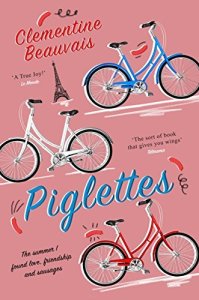 This was my second YA novel by Beauvais (after In Paris with You); she translated both herself and her proficiency in both languages allowed her to include wordplay that might have been lost otherwise (“I finally get what it means to have l’esprit de l’escalier, when I scream to her, from the bottom of the staircase…”). Mireille LaPlanche’s former friend Malo introduced a cruel annual tradition at their high school: a “Pig Pageant” in which classmates pick the fattest, ugliest girls – including her. She decides to team up with two other finalists, Astrid and Hakima, and show their persecutors what they can do. After a period of planning and training, they undertake a week-long cycle ride from their home in Bourg-en-Bresse to Paris, timed so that they’ll arrive on Bastille Day and crash the president’s garden party. Hakima’s older brother, Kader, who lost his legs in the Iraq War and uses a wheelchair, is their chaperone. They’ve dubbed themselves the “Three Little Piglettes” and tow a trailer full of sausages that they cook and sell at each stop. Soon they’re a social media phenomenon. This sweet, funny Cinderella story about defusing fatphobia includes good diversity rep and touches on lots of issues including anxiety, bullying, and unrequited love – all with an unmistakably French enthusiasm for wine, cheese and philosophy. (Edelweiss)
A Paris All Your Own: Bestselling Women Writers on the City of Light, ed. Eleanor Brown (2017)
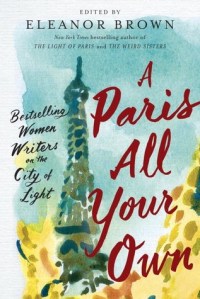 A reread that I started shortly after our trip to Paris in December 2023 but left half-finished on a shelf until this month. The roster of 18 contributors leans very much towards women’s fiction. While I probably most enjoyed the third of the book that was by authors I’d read and liked before – J. Courtney Sullivan, Susan Vreeland, Paula McLain, Julie Powell, Therese Anne Fowler and Maggie Shipstead – all of the pieces are cosy and undemanding. They tell of time spent living, working or travelling in the city. Sometimes it meets expectations; other times, mishaps and faux pas create disillusionment until a future visit grants a second chance. There are favourite foods and language struggles, art treasures and magical spots to discover, and stereotypes to confirm or overturn. The experience of Paris can vary based on who the travel companion is – an enthusiastic child, a needy parent or a soon-to-be ex. Fowler made her research trip before writing a biographical novel about Zelda Fitzgerald, while McLain only saw Hemingway’s haunts after she’d written The Paris Wife. Each essay finishes with a quickfire list of favourite Paris moments, books, sites, songs, etc. Not a bad substitute for being there! (Secondhand – 2nd & Charles)
My original rating (2017): 
My rating now:
No. 91/92: Notes on a Parisian Commute by Lauren Elkin (2021)
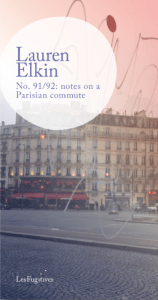 Just imagine keeping a diary of your bus journeys in the Notes app of your phone for seven months and getting a book out of it. Elkin’s mostly unedited observations are based on people-watching and her own swirling thoughts in 2014–15. She covers obnoxious behaviours on public transport (the same the world over, it seems: “Oi. Manspreader. Bouge ton cul”); her teaching work; overheard conversations; and Paris as seen in different seasons. Her mind wanders across history and theory. The bus is a melting pot: She’s thrown into false intimacy with people she’s never seen before and hopes never to encounter again. Nothing much happens until it does. First it’s the Charlie Hebdo attacks. Then she falls pregnant but it’s ectopic and she loses the baby. And, after she’s switched to Métro commuting, the Hypercacher attacks. In the prologue and epilogue, Elkin talks about only understanding major events in retrospect. She also cites lockdown diaries as being a new subgenre her project fit into. But let’s be honest: if she’d not already made a name for herself as a cultural critic, this would never have been published. While it has some value as an in-the-moment historical document, I didn’t find it nearly as profound as, say Deborah Levy’s autobiography. (Secondhand – Awesomebooks.com with SellItBack voucher)
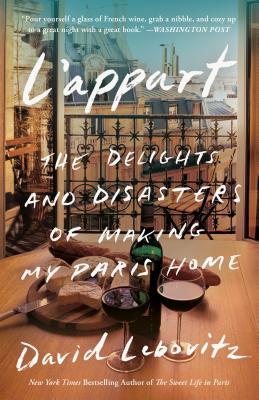
L’appart: The Delights and Disasters of Making My Paris Home by David Lebovitz (2017)
Lebovitz is a San Francisco pastry chef who moved to Paris a couple of decades ago. We get a lot of ideas from his dessert cookbook and extensive blog archive. Like The Sweet Life in Paris, this contains lighthearted musings about cultural differences between France and the US and many tantalizing recipes (most of them sweet but also a few savoury) that I am actually likely to make. But it’s primarily about the several-year saga of buying and restoring an apartment. Lebovitz had a grand plan for the kitchen, especially: a huge space with American-style appliances that would ease his cookbook writing and testing. French bureaucracy made the purchase difficult enough as the property had to be officially reregistered as residential rather than commercial, and the seller and realtor were both antagonistic.
 But that was nothing compared to the nightmare of the renovation. To start with, Lebovitz was friendly with his contractor and his workers. In fact, too friendly, his partner, Romain, warned. He called the builders “tu,” brought fresh-baked treats for them, and always paid their bills promptly. They started taking liberties: hardly ever showing up, failing to meet deadlines, replying to every concern with “pas de problème” but never fixing the issues. The shoddiness and incompetence are truly astounding: counters at the wrong height, an unusable faucet, melted fuses, an electricity leak, buckled floorboards, askew windows, an upside-down water softener. Every mistake cost time and money, such that the whole job was three times longer and more expensive than projected. (A lawyer dissuaded Lebovitz from suing because in the French legal system it could take five years and not even go his way.)
Depending on your own experience, this might be cathartic, or too close to home, or a cautionary tale. (We’d already long decided we won’t do any major building projects because we can’t tolerate noise, disruption or strangers and our house is good enough for our needs.) Keep in mind that Lebovitz dealt with all this in a second language and his fortitude is impressive. Scenes at Ikea and conversations with his contractor are amusingly surreal. But I confess I did find this a little overlong and repetitive, and every setback made me cringe for him. I’ll have to bake some frangipane plum-raspberry gratins and try to forget the pain. (Secondhand – Better World Books with Little Free Library voucher)
Recommended June Releases
I have an all-female line-up for you this time, with selections ranging from a YA romance in verse to a memoir by a spiritual recording artist. There’s a very random detail that connects two of these books – look out for it!

In Paris with You by Clémentine Beauvais
[Faber & Faber, 7th]
 I don’t know the source material Beauvais was working with (Eugene Onegin, 1837), but still enjoyed this YA romance in verse. Eugene and Tatiana meet by chance in Paris in 2016 and the attraction between them is as strong as ever, but a possible relationship is threatened by memories of a tragic event from 10 years ago involving Lensky, Eugene’s friend and the boyfriend of Tatiana’s older sister Olga. I’m in awe at how translator Sam Taylor has taken the French of her Songe à la douceur and turned it into English poetry with the occasional rhyme. This is a sweet book that would appeal to John Green’s readers, but it’s more sexually explicit than a lot of American YA, so is probably only suitable for older teens. (Proof copy from Faber Spring Party)
Favorite lines:
“Her heart takes the lift / up to her larynx, / where it gets stuck / hammering against the walls of her neck.”
“an adult with a miniature attention span, / like everyone else, refreshing, updating, / nibbling at time like a ham baguette.”
“helium balloons in the shape of spermatozoa straining towards the dark sky.”
My rating: 
Implosion: A Memoir of an Architect’s Daughter by Elizabeth W. Garber
[She Writes Press, 12th]
 The author grew up in a glass house designed by her father, Modernist architect Woodie Garber, outside Cincinnati in the 1960s–70s. This and his other most notable design, Sander Hall, a controversial tower-style dorm at the University of Cincinnati that was later destroyed in a controlled explosion, serve as powerful metaphors for her dysfunctional family life. Woodie is such a fascinating, flawed figure. Manic depression meant he had periods of great productivity but also weeks when he couldn’t get out of bed. He and Elizabeth connected over architecture, like when he helped her make a scale model of Le Corbusier’s Villa Savoye for a school project, but it was hard for a man born in the 1910s to understand his daughter’s generation or his wife’s desire to go back to school and have her own career.
Mixed feelings towards a charismatic creative genius who made home life a torment and the way their fractured family kept going are reasons enough to read this book. But another is just that Garber’s life has been so interesting: she witnessed the 1968 race riots and had a black boyfriend when interracial relationships were frowned upon; she was briefly the librarian for the Oceanics School, whose boat was taken hostage in Panama; and she dropped out of mythology studies at Harvard to become an acupuncturist. Don’t assume this will be a boring tome only for architecture buffs. It’s a masterful memoir for everyone. (Read via NetGalley on Nook)
My rating: 
Florida by Lauren Groff
[William Heinemann (UK), 7th / Riverhead (USA), 5th]
 My review is in today’s “Book Wars” column in Stylist magazine. Two major, connected threads in this superb story collection are ambivalence about Florida, and ambivalence about motherhood. The narrator of “The Midnight Zone,” staying with her sons in a hunting camp 20 miles from civilization, ponders the cruelty of time and her failure to be sufficiently maternal, while the woman in “Flower Hunters” is so lost in an eighteenth-century naturalist’s book that she forgets to get Halloween costumes for her kids. A few favorites of mine were “Ghosts and Empties,” in which the narrator goes for long walks at twilight and watches time passing through the unwitting tableaux of the neighbors’ windows; “Eyewall,” a matter-of-fact ghost story; and “Above and Below,” in which a woman slips into homelessness – it’s terrifying how precarious her life is at every step. (Proof copy)
Favorite lines:
“What had been built to seem so solid was fragile in the face of time because time is impassive, more animal than human. Time would not care if you fell out of it. It would continue on without you.” (from “The Midnight Zone”)
“The wind played the chimney until the whole place wheezed like a bagpipe.” (from “Eyewall”)
“How lonely it would be, the mother thinks, looking at her children, to live in this dark world without them.” (from “Yport”)
My rating:
The Most Beautiful Thing I’ve Seen: Opening Your Eyes to Wonder by Lisa Gungor
[Zondervan, 26th]
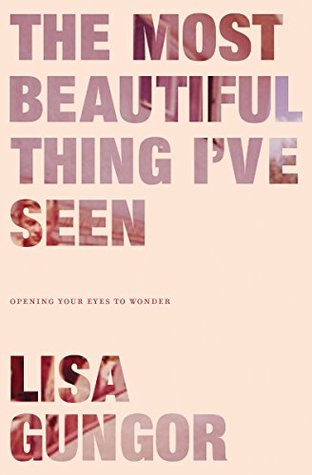 You’re most likely to pick this up if you enjoy Gungor’s music, but it’s by no means a band tell-all. The big theme of this memoir is moving beyond the strictures of religion to find an all-encompassing spirituality. Like many Gungor listeners, Lisa grew up in, and soon outgrew, a fundamentalist Christian setting. She bases the book around a key set of metaphors: the dot, the line, and the circle. The dot was the confining theology she was raised with; the line was the pilgrimage she and Michael Gungor embarked on after they married at 19; the circle was the more inclusive spirituality she developed after their second daughter, Lucie, was born with Down syndrome and required urgent heart surgery. Being mothered, becoming a mother and accepting God as Mother: together these experiences bring the book full circle. Barring the too-frequent nerdy-cool posturing (seven mentions of “dance parties,” and so on), this is a likable memoir for readers of spiritual writing by the likes of Sue Monk Kidd, Mary Oliver and Terry Tempest Williams. (Read via NetGalley on Kindle)
My rating:
 Orchid & the Wasp by Caoilinn Hughes
[Oneworld, 7th] – see my full review. 
Ok, Mr Field by Katharine Kilalea
[Faber & Faber, 7th]
 Mr. Field is a concert pianist whose wrist was shattered in a train crash. With his career temporarily derailed, there’s little for him to do apart from wander his Cape Town house, a replica of Le Corbusier’s Villa Savoye, and the nearby coastal path. He also drives over to spy on his architect’s widow, with whom he’s obsessed. He’s an aimless voyeur who’s more engaged with other people’s lives than with his own – until a dog follows him home from a graveyard. This is a strangely detached little novel in which little seems to happen. Like Asunder by Chloe Aridjis and Leaving the Atocha Station by Ben Lerner, it’s about someone who’s been coasting unfeelingly through life and has to stop to ask what’s gone wrong and what’s worth pursuing. It’s so brilliantly written, with the pages flowing effortlessly on, that I admired Kilalea’s skill. Her descriptions of scenery and music are particularly good. In terms of the style, I was reminded of books I’ve read by Katie Kitamura and Henrietta Rose-Innes. (Proof copy from Faber Spring Party)
My rating:
This came out in the States (from Riverhead) back in early April, but releases here in the UK soon, so I’ve added it in as a bonus.
The Female Persuasion by Meg Wolitzer
[Chatto & Windus, 7th]
 An enjoyable story of twentysomethings looking for purpose and trying to be good feminists. To start with it’s a fairly familiar campus novel in the vein of The Art of Fielding and The Marriage Plot, but we follow Greer, her high school sweetheart Cory and her new friend Zee for the next 10+ years to see the compromises they make as ideals bend to reality. Faith Frank is Greer’s feminist idol, but she’s only human in the end, and there are different ways of being a feminist: not just speaking out from a stage, but also quietly living every day in a way that shows you value people equally. I have a feeling this would have meant much more to me a decade ago, and the #MeToo-ready message isn’t exactly groundbreaking, but I very much enjoyed my first taste of Wolitzer’s sharp, witty writing and will be sure to read more from her. This seems custom-made for next year’s Women’s Prize shortlist. (Free from publisher, for comparison with Florida in Stylist “Book Wars” column.)
My rating:
What June books do you have on the docket? Have you already read any that you can recommend?
A Publisher Party and a One-Man Play
I was a veritable social butterfly this past week: I went out two evenings in a row! (Believe me, that’s rare.) On Tuesday I met up with bloggers Annabel, Eric and Kim at the Faber Spring Party held at Crypt on the Green in London, and on Wednesday my husband and I attended a performance at the University of Reading of Michael Mears’s one-man play on the plight of Britain’s conscientious objectors during World War I, This Evil Thing.
Faber Spring Party
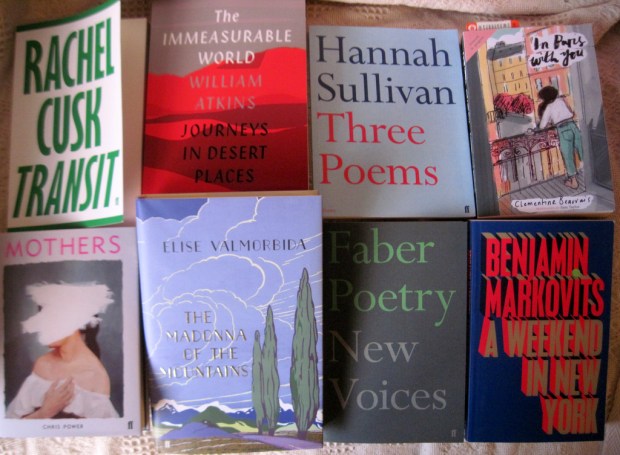
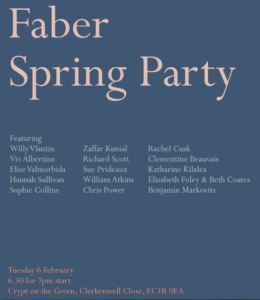 I’ve never been to an event quite like this. Publisher Faber & Faber, which will be celebrating its 90th birthday in 2019, previewed its major releases through to September. Most of the attendees seemed to be booksellers and publishing insiders. Drinks were on a buffet table at the back; books were on a buffet table along the side. Glass of champagne in hand, it was time to plunder the free books on offer. I ended up taking one of everything, with the exception of Rachel Cusk’s trilogy: I couldn’t make it through Outline and am not keen enough on her writing to get an advanced copy of Kudos, but figured I might give her another try with the middle book, Transit.

For the evening’s presentation, each featured author had a few minutes to introduce their new book and/or give a short reading.
Rachel Cusk opened the evening with a reading from Kudos. If you’re familiar with her recent work, you won’t be surprised at this synopsis: a man on a plane recounts having his dog put to sleep. (Out on May 3rd.)
William Atkins’s book on deserts, The Immeasurable World, is based on three years of travel and is, he is not ashamed to say, in the old-fashioned travel writing tradition. (Out on June 7th.)
Hannah Sullivan’s Three Poems is a hybrid work of poem-essays. #2 is more philosophical, she said; #3 is about her father’s death and her son’s birth. She read sonnet 3.21. (Out now.)
Clémentine Beauvais’s In Paris with You is a YA romance in free verse, loosely based on Eugene Onegin. I don’t know the source text but started this on the train ride home and it’s enjoyable thus far. I’m in awe at how translator Sam Taylor has taken the French of her Songe à la douceur and turned it into English poetry. (Out on June 7th.)
Chris Power’s Mothers is a book of linked short stories, three of which are about a character named Eva. He read a portion of a story about her having an encounter with an unpleasant man in Innsbruck. (Out on March 1st.)
Elise Valmorbida’s The Madonna of the Mountains, set in 1923–50, is a saga that resembles “an Italian Mother Courage,” she says. She read a scene in which a character comes across a madwoman. (Out on April 5th.)
Zaffar Kunial read the poem “Spark Hill” from his forthcoming collection Us. It’s about a childhood fight in the area of Birmingham where he grew up. He had a folder open in front of him but, impressively, recited the long poem completely from memory. (Out on July 5th.)
American novelist Benjamin Markovits was a professional basketball player in Germany for six months. Like the tennis-playing protagonist of his upcoming book, A Weekend in New York, he got tired of being measured. After 15 years, his hero is eager to escape a life of being constantly ranked. This is the first in a quartet of novels that inevitably invites comparison with John Updike’s “Rabbit” books. (Out on June 7th.)
I confess I didn’t previously know the name Viv Albertine; she was the guitarist for the female punk band The Slits, and To Throw Away Unopened is her second memoir. Albertine realized that it was her mother who had made her an angry rebel; the title is the label on a bag she found in her mother’s room after her death. (Out on April 5th.)
Sophie Collins incorporates hybrid forms in her poetry – what she calls “lyric essays.” The theme of her book Who Is Mary Sue? is perceptions of women’s writing (with “Mary Sue” as a metonym for the stereotypical good girl). She read from “Engine.” (Out now.)
Katharine Kilalea’s debut novel Ok, Mr Field is about an injured concert pianist who becomes obsessed with a house he buys in South Africa. (Out on June 7th.)
Elizabeth Foley and Beth Coates are the authors of two Homework for Grown-Ups books. Their new book, What Would Boudicca Do?, is about lessons we can draw from the women of history. For instance, the sampler booklet has pieces called “Dorothy Parker and Handling Jerks” and “Frida Kahlo and Finding Your Style.” There’s a heck of a lot of books like this out this year, though, and I’m not so sure this one will stand out. (Out on September 6th.)
Richard Scott read two amazingly intimate poems from his upcoming collection, Soho. One, “cover-boys,” was about top-shelf gay porn; the other was about mutilated sculptures of male bodies in the Athens archaeological museum. If you appreciated Andrew McMillan’s Physical, you need to get hold of this the second it comes out. I went back and read “cover-boys” in the sampler booklet and it wasn’t nearly as powerful as it was aloud; Scott’s reading really brought it to life, in contrast to some other authors’ dull delivery. (Out on April 5th.)
Sue Prideaux’s forthcoming biography of Friedrich Nietzsche is entitled I Am Dynamite! She encountered her subject when she wrote her first biography, of Edvard Munch. Although Nietzsche has been embraced by far-right groups in America, he was in fact against racism, nationalism, and anti-semitism, so he has important messages for us today. I’ll be keen to get hold of this one. (Out on September 6th.)
Guitar in hand, Willy Vlautin closed the evening with a performance of the title track from the soundtrack album to his fifth novel, Don’t Skip Out on Me – he was the singer in Portland, Oregon alt-country band Richmond Fontaine, which has recently stopped touring. He said the novel asks, “can you make the scars of broken people bearable?” (Out now.)

Now that I’ve got this terrific stack of books, wherever do I start?! I’m currently reading the Beauvais; from there I’ll focus on ones that have already been released, starting with Vlautin and the two poetry collections. The titles that aren’t out until June can probably wait – though it’s tempting to be one of the privileged few who get to read them nearly four months early. One Faber book per week should see me getting through all these by the final release date.
This Evil Thing
Michael Mears plays about 50 different characters in this one-man production. He’s an actor and pacifist who has written a number of solo pieces over 20 years. In this commemorative year of the end of the First World War, he knew we would hear a lot about battles, soldiers, and their families back home. But conscientious objectors weren’t likely to be remembered: theirs is a “story that’s rarely told,” he realized. This Evil Thing sets out to correct that omission. The title phrase refers not to war in general but specifically to conscription.
 The two main characters Mears keeps coming back to in the course of the play are Bert Brocklesby, a Yorkshire preacher, and philosopher Bertrand Russell. Brocklesby refused to fight and, when he and other COs were shipped off to France anyway, resisted doing any work that supported the war effort, even peeling the potatoes that would be fed to soldiers. He and his fellow COs were beaten, placed in solitary confinement, and threatened with execution. Meanwhile, Russell and others in the No-Conscription Fellowship fought for their rights back in London. There’s a wonderful scene in the play where Russell, clad in nothing but a towel after a skinny dip, pleads with Prime Minister Asquith.
As in solo shows I’ve seen before (e.g. A Christmas Carol with Patrick Stewart), Mears had to find subtle ways to distinguish between characters: he used a myriad different voices, including regional accents; he quickly donned a jacket, hat, or pair of glasses. Russell was identified by his ever-present pipe. The most challenging scene, Mears said in the Q&A at the end, was one with four characters in a French street café.
Mears reveals during the play that his grandfather fought in WWI and his father in WWII, but he has never had to put his own pacifist views to the test. What about Hitler? people always ask. Mears is honest and humble enough to admit that he doesn’t know what he would have done had he been called on to fight Hitler, or had he faced persecution as a CO in WWI. Ultimately, what Mears hopes audiences take from his play, which won acclaim at the Edinburgh Festival Fringe, is that “this is not an irrelevant piece of history.” Standing up for what you believe in, especially if it goes against the spirit of the times, is always valuable.
 Bookish Beck = Rebecca Foster. American transplant to England. Freelance proofreader and book reviewer.
