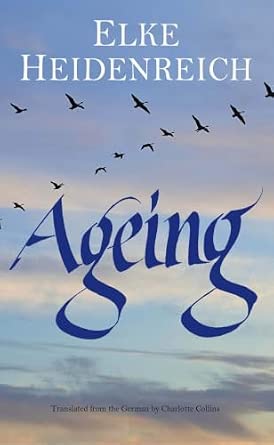
Ageing by Elke Heidenreich for #NovNov26 & #GermanLitMonth Nonfiction Week
This review does triple duty for Nonfiction November, Novellas in November, and the nonfiction week of German Literature Month, hosted by Caroline and Tony.
Now in her early eighties, the author is well known in Germany as a TV presenter and print journalist. This punchy work falls somewhere between a commonplace book and an anti-self-help guide, meandering pleasantly from topic to topic along with her train of thought. Heidenreich takes a frank look at older age, acknowledging where she is an outlier and imparting insight from her own experience as well as from literature and philosophy.
I’m not a nice old lady. I’m me, just the same as ever.
First, as to how she’s unusual: she never had children, so doesn’t have grandchildren as would be typical at her age. From the author photograph, she could easily pass for 60, and her partner and many of her friends are of a younger generation. She is in rude health and stays physically and intellectually active. Still, certain questions bother her. What will become of her possessions when she’s gone? Not so much valuables as sentimental treasures. Unlike Margareta Magnusson (author of The Gentle Art of Swedish Death Cleaning and The Swedish Art of Ageing Well), she doesn’t address the practicalities; she only documents the worry.
A mind-over-matter approach is evident from the start, when Heidenreich contrasts two précis of her life. Either she completely messed everything up (a bad early home life, two divorces, cancer, being kicked off her most famous program) or she’s had a great life (many advantages, illness overcome, a long life of ease). It’s all about your perspective, she argues: “I’m quite convinced that our consciousness, our thoughts, affect the way we age.”
Nostalgia strikes her as a temptation to which it would be best not to give in. “The present is not made more bearable by retrospective comparisons. It is made bearable and meaningful by active participation in it.” She confesses to feeling exhausted and overwhelmed at the thought of the world’s future under the current crop of reactionary leaders. Her angst is relatable. But by maintaining that her generation isn’t to blame for the state of the environment, mocking ‘faddish’ dietary intolerances, and lamenting that no one understands opera, she’s veering close to denial of privilege, knee-jerk rejection of the “woke,” and cultural snobbery. (OK, Boomer.) I admired her forthright attitude and blithe disregard for ‘niceness’ and political correctness, but felt that she’s on safer ground when discussing universal emotions.
Like Richard Holloway in books such as Waiting for the Last Bus and The Heart of Things, Heidenreich draws much wisdom from her reading. She has a wide frame of reference, citing everyone from Goethe to Kent Haruf. “Reading – that has always been and is still my prescription,” she insists. Her examples run the gamut of world literature, which she believes “can console, help, explain.” Bibliophiles of every stripe will surely feel the same. The book is somewhat over-reliant on quotation, but its openness to learning from literature resonated with me. I also appreciated the assurance that, as May Sarton affirms in her journals, ageing is a process of becoming one’s essential self while not giving in to despair or bitterness.
This is it: we must preserve the vulnerable, emphatic, empathetic, loving heart of our beginnings until the end. Remain shockable. Remain compassionate. Do not grow hard.
Ageing by Elke Heidenreich (2024; 2026)
[Translated from German by Charlotte Collins]
[121 pages]
With thanks to Open Borders Press and publicist Nicolette Praça for the free copy for review.
 Bookish Beck = Rebecca Foster. American transplant to England. Freelance proofreader and book reviewer.

