August Releases: Bright Fear, Uprooting, The Farmer’s Wife, Windswept
This month I have three memoirs by women, all based on a connection to land – whether gardening, farming or crofting – and a sophomore poetry collection that engages with themes of pandemic anxiety as well as crossing cultural and gender boundaries.
My August highlight:
Bright Fear by Mary Jean Chan
Chan’s Flèche was my favourite poetry collection of 2019. Their follow-up returns to many of the same foundational subjects: race, family, language and sexuality. But this time, the pandemic is a lens through which all is filtered. This is particularly evident in Part I, “Grief Lessons.” “London, 2020” and “Hong Kong, 2003,” on facing pages, contrast Covid-19 with SARS, the major threat when they were a teenager. People have always made assumptions about them based on their appearance or speech. At a time when Asian heritage merited extra suspicion, English was both a means of frank expression and a source of ambivalence:
“At times, English feels like the best kind of evening light. On other days, English becomes something harder, like a white shield.” (from “In the Beginning Was the Word”)
“my Chinese / face struck like the glow of a torch on a white question: / why is your English so good, the compliment uncertain / of itself.” (from “Sestina”)
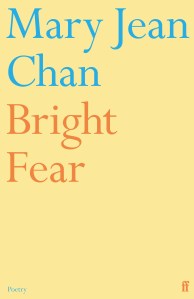 At the centre of the book, “Ars Poetica,” a multi-part collage incorporating lines from other poets, forms a kind of autobiography in verse. Chan also questions the lines between genres, wondering whether to label their work poetry, nonfiction or fiction (“The novel feels like a springer spaniel running off-/leash the poem a warm basket it returns to always”).
The poems’ structure varies, with paragraphs and stanzas of different lengths and placement on the page (including, in one instance, a goblet shape). The enjambment, as you can see in lines I’ve quoted above and below, is noteworthy. Part III, “Field Notes on a Family,” reflects on the pressures of being an only child whose mother would prefer to pretend lives alone rather than with a female partner. The book ends with hope that Chan might be able to be open about their identity. The title references the paradoxical nature of the sublime, beautifully captured via the alliteration that closes “Circles”: “a commotion of coots convincing / me to withstand the quotidian tug-/of-war between terror and love.”
Although Flèche still has the edge for me, this is another excellent work I would recommend even to those wary of poetry. 
Some more favourite lines, from “Ars Poetica”:
“What my mother taught me was how
to revere the light language emitted.”
“Home, my therapist suggests, is where
you don’t have to explain yourself.”
With thanks to Faber for the free copy for review.
Three land-based memoirs:
(All:  )
)
Uprooting: From the Caribbean to the Countryside – Finding Home in an English Country Garden by Marchelle Farrell
 This Nan Shepherd Prize-winning memoir shares Chan’s attention to pandemic-era restrictions and how they prompt ruminations about identity and belonging. Farrell is from Trinidad but came to the UK as a student and has stayed, working as a psychiatrist and then becoming a wife and mother. Just before Covid hit, she moved to the outskirts of Bath and started rejuvenating her home’s large and neglected garden. Under thematic headings that also correspond to the four seasons, chapters are named after different plants she discovered or deliberately cultivated. The peace she finds in her garden helps her to preserve her mental health even though, with the deaths of George Floyd and so many other Black people, she is always painfully aware of her fragile status as a woman of colour, and sometimes feels trapped in the confining routines of homeschooling. I enjoyed the exploration of postcolonial family history and the descriptions of landscapes large and small but often found Farrell’s metaphors and psychological connections obvious or strained.
With thanks to Canongate for the free copy for review.
The Farmer’s Wife: My Life in Days by Helen Rebanks
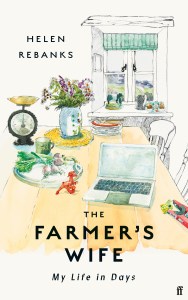 I fancied a sideways look at James Rebanks (The Shepherd’s Life and Wainwright Prize winner English Pastoral) and his regenerative farming project in the Lake District. (My husband spotted their dale from a mountaintop on holiday earlier in the month.) Helen Rebanks is a third-generation farmer’s wife and food and family are the most important things to her. One gets the sense that she has felt looked down on for only ever wanting to be a wife and mother. Her memoir, its recollections structured to metaphorically fall into a typical day, is primarily a defence of the life she has chosen, and secondarily a recipe-stuffed manifesto for eating simple, quality home cooking. (She paints processed food as the enemy.)
Growing up, Rebanks started cooking for her family early on, and got a job in a café as a teenager; her mother ran their farm home as a B&B but was forgetful to the point of being neglectful. She met James at 17 and accompanied him to Oxford, where they must have been the only student couple cooking and eating proper food. This period, when she was working an office job, baking cakes for a café, and mourning the devastating foot-and-mouth disease epidemic from a distance, is most memorable. Stories from travels, her wedding, and the births of her four children are pleasant enough, yet there’s nothing to make these experiences, or the telling of them, stand out. I wouldn’t make any of the dishes; most you could find a recipe for anywhere. Eleanor Crow’s black-and-white illustrations are lovely, though.
With thanks to Faber for the free copy for review.
Windswept: Life, Nature and Deep Time in the Scottish Highlands by Annie Worsley
 I’d come across Worsley in the Wildlife Trusts’ Seasons anthologies. For a decade she has lived on Red River Croft, in a little-known pocket of northwest Scotland. In word pictures as much as in the colour photographs that illustrate this volume, she depicts it as a wild land shaped mostly by natural forces – also, sometimes, manmade. From one September to the next, she documents wildlife spectacles and the influence of weather patterns. Chronic illness sometimes limited her daily walks to the fence at the cliff-top. (But what a view from there!) There is more here about local history and ecology than any but the keenest Scotland-phile may be interested to read. Worsley also touches on her upbringing in polluted Lancashire, and her former academic career and fieldwork in Papua New Guinea. Her descriptions are full of colours and alliteration, though perhaps a little wordy: “Pale-gold autumnal days are spliced by fickle and feisty bouts of turbulent weather. … Sunrises and sunsets may pour with cinnabar and henna; dawn and dusk can ripple with crimson and purple.” The kind of writing I could appreciate for the length of an essay but not a whole book.
With thanks to William Collins for the free copy for review.
Would you read one or more of these?
Writers & Lovers by Lily King
(This was meant to be one entry in a roundup of mini-reviews, but I found that I had far too much to say about it. On Sunday I’ll feature three more May releases I’ve read.)
1997. Following a breakup and her mother’s sudden death, Casey Peabody is drowning in grief and debt. At 31, she lives in a tiny studio apartment off of her brother’s friend’s house and cycles everywhere. Between shifts waitressing at Iris, a trendy restaurant above a Harvard social club, she chips away at the Cuba-set novel she’s been writing for six years.
Through her writer friend Muriel she meets two love interests at a book launch for Oscar Kolton, a former Boston University professor and novelist who’s been leading a fiction workshop since his wife’s death a few years ago. One is the fortysomething Oscar himself; the other, who initially seems more promising, is Silas, a would-be writer from the workshop. But before they have a chance to see if this will go somewhere, Silas is off. He leaves Casey a voicemail saying he needs to get away for a while. Oh well; just another flake, she thinks.
After he and his adorable young sons come in to the restaurant for brunch one day, her interest is squarely in Oscar. Or, that is, until Silas comes back and she finds herself dating two men at the same time. A museum trip with Silas here, a dinner out with Oscar there. As if her love life isn’t complication enough, before long she finds herself looking for a new job, a place to live, a literary agent, and reassurance that she’ll be okay when she takes advantage of her short-lived health insurance to get some minor medical issues checked out.

I almost passed on reading this one because I’d gotten it in my head that it was nothing more than a romantic comedy with a love triangle. I’m so glad that Kate’s review convinced me to give it a try after all. On the face of it this could hardly be more different from King’s previous novel, Euphoria, about anthropologists doing field work in Papua New Guinea in the 1930s, but King’s attention to the intricacies of human relationships links the two. When I read Euphoria in late 2014, I noted the natives’ practice of cutting off a finger for every close relative lost. Here you also get the sense that everyone has lost someone, and that these losses are as visible as physical traits. Casey is only on her second conversation with Silas when she thinks, “I can tell he lost someone close somehow. You can feel that in people, an openness, or maybe it’s an opening that you’re talking into. With other people, people who haven’t been through something like that, you feel the solid wall. Your words go scattershot off of it.”
There are so many things to love about this novel, including the wonderful/terrible scenes where she rattles off her mother’s story to two doctors and her awful father and stepmother show up for lunch. Count the rest: The Boston-area setting, the restaurant bustle, that feeling we’ve all had of wasting our talents while stuck in the wrong job and the wrong living situation. Casey’s confiding first-person, present-tense narration, the little observations on writers (when John Updike comes into the restaurant she touches his loafer for luck; she nearly swoons when Jayne Anne Phillips is at one of her tables—“Black Tickets is like a prayer book to me”; she thinks she’s blown a high school English teacher interview when she states a dislike for Cormac McCarthy—“he seemed to be alternating between imitating Hemingway and imitating Faulkner”), and even the choice between Silas and Oscar (“Fireworks or coffee in bed”). She doesn’t make the ‘right’ choice I was expecting, but if you’ve been following the clues closely you’ll realize it’s the only one she could have made.
What I loved most, though, was that we see this character at rock bottom but also when things start to go well at long last. “There’s a particular feeling in your body when something goes right after a long time of things going wrong. It feels warm and sweet and loose.” I felt I knew Casey through and through, and I cheered for her as I did for Ana in Dominicana by Angie Cruz. Those who have tried writing a book will probably get even more out of this than I did, but it will resonate for anyone who’s ever felt lost and uncertain about life’s direction. “Isn’t our whole life just one long improvisation?” Casey hears at a writing festival.
Think of this as an older, sadder Sweetbitter, perhaps as written by Elizabeth Strout. It gives you all the feels, as they say.
A real standout and one of my few early favorites from 2020.
My rating: 
With thanks to Picador for the unsolicited copy for review.
20 Books of Summer, #11–13: Harrison, Pym, Russell
It’s cats and butterflies in the spotlight this time, adding in a gazelle as a metaphor for Freddie Mercury’s somebody to love.
Travelling Cat: A Journey round Britain with Pugwash by Frederick Harrison (1988)
If Tom Cox had been born 20 years earlier, this is the sort of book he might have written. In 1987, saddened more by his cat Podey being run over than by the end of his marriage, Harrison set out from South London in his Ford Transit van for a seven-month drive around the country. He decided to take Pugwash, one of his local (presumably ownerless) cats, along as a companion.
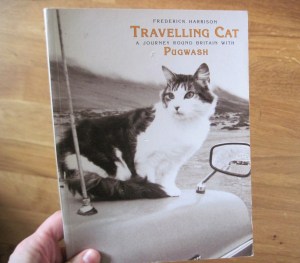 They encountered Morris dancers, gypsies, hippies at Stonehenge for the Summer Solstice, sisters having a double wedding, and magic mushroom collectors. They went to a county fair and beaches in Suffolk and East Yorkshire, and briefly to Hay-on-Wye. And on the way back they collected Podey, whom he’d had stuffed. Harrison muses on the English “vice” of nostalgia for a past that probably never existed; Pugwash does what cats do, and very well.
It’s all a bit silly and dated and lightweight, but enjoyable nonetheless. Plus there are tons of black-and-white photos of “Pugs” and other feline friends. This was a secondhand purchase from The Bookshop, Wigtown. 
Favorite lines:
“Cats hate to make prats of themselves. But then, don’t we all?”
(last lines) “Warm, fed, contented, unemployable, and entirely at peace with the world. Yes indeed. Cats certainly know something we don’t.”
Some Tame Gazelle by Barbara Pym (1950)
(An example of a book that just happens to have an animal in the title.) I’d only read one other Pym novel, Quartet in Autumn, a late and fairly melancholy story of four lonely older people. With her first novel I’m in more typical territory, I take it. The middle-aged Bede sisters are pillars of the church in their English village. Harriet takes each new curate under her wing, making of them a sort of collection, and fends off frequent marriage proposals from the likes of a celebrity librarian and an Italian count.
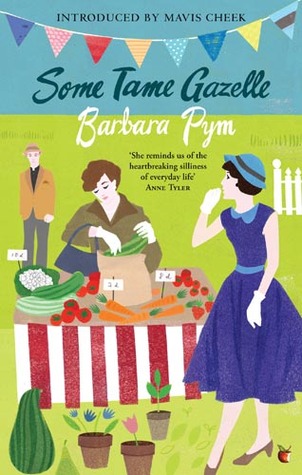 Belinda, on the other hand, only has eyes for one man: Archdeacon Hochleve, whom she’s known and loved for 30 years. They share a fondness for quoting poetry, the more obscure the better (like the title phrase, taken from “Some tame gazelle, or some gentle dove: / Something to love, oh, something to love!” by Thomas Haynes Bayly). The only problem is that the archdeacon is happily married. So single-minded is Belinda that she barely notices her own marriage proposal when it comes: a scene that reminded me of Mr. Collins’s proposal to Lizzie in Pride and Prejudice. Indeed, Pym is widely recognized as an heir to Jane Austen, what with her arch studies of relationships in a closed community.
There were a handful of moments that made me laugh, like when the seamstress finds a caterpillar in her cauliflower cheese and has to wipe with a Church Times newspaper when the Bedes run out of toilet paper (such mild sacrilege!). This is enjoyable, if fluffy; it was probably a mistake to have read one of Pym’s more serious books first: I expected too much of this one. If you’re looking for a quick, gentle and escapist read in which nothing awful will happen, though, it would make a good choice. Knowing most of her books are of a piece, I wouldn’t read more than one of the remainder – it’ll most likely be Excellent Women.
An Obsession with Butterflies: Our Long Love Affair with a Singular Insect by Sharman Apt Russell (2003)
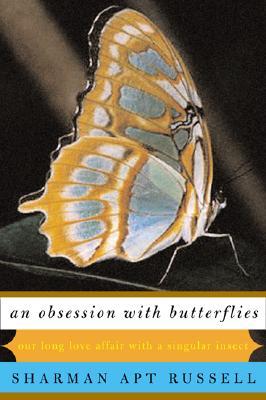 This compact and fairly rollicking book is a natural history of butterflies and of the scientists and collectors who have made them their life’s work. There are some 18,000 species and, unlike, say, beetles, they are generally pretty easy to tell apart because of their bold, colorful markings. Moth and butterfly diversity may well be a synecdoche for overall diversity, making them invaluable indicator species. Although the history of butterfly collecting was fairly familiar to me from Peter Marren’s Rainbow Dust, I still learned or was reminded of a lot, such as the ways you can tell moths and butterflies apart (and it’s not just about whether they fly in the night or the day). And who knew that butterfly rape is a thing?
The final third of the book was strongest for me, including a trip to London’s Natural History Museum; another to Costa Rica’s butterfly ranches, an example of successful ecotourism; and a nicely done case study of the El Segundo Blue butterfly, which was brought back from the brink of extinction by restoration of its southern California dunes habitat. Russell, a New Mexico-based author of novels and nonfiction, also writes about butterflies’ cultural importance: “No matter our religious beliefs, we accept the miracle of metamorphosis. One thing becomes another. … Butterflies wake us up.”
 I also recently read the excellent title story from John Murray’s 2003 collection A Few Short Notes on Tropical Butterflies. Married surgeons reflect on their losses, including the narrator’s sister in a childhood accident and his wife Maya’s father to brain cancer. In the late 1800s, the narrator’s grandfather, an amateur naturalist in the same vein as Darwin, travelled to Papua New Guinea to collect butterflies. The legends from his time, and from family trips to Cape May to count monarchs on migration in the 1930s, still resonate in the present day for these characters. The treatment of themes like science, grief and family inheritance, and the interweaving of past and present, reminded me of work by Andrea Barrett and A.S. Byatt.
(I’ve put the book aside for now but will go back to it in September as I focus on short stories.)
Other butterfly-themed books I have reviewed:
- Four Wings and a Prayer: Caught in the Mystery of the Monarch Butterfly by Sue Halpern (one of last year’s 20 Books of Summer)
- Ruins by Peter Kuper (a graphic novel set in Mexico, this also picks up on monarch migration)
- Magdalena Mountain by Robert Michael Pyle (a novel about butterfly researchers in Colorado)
Ladders to Heaven: The Secret History of Fig Trees
 A whole book about fig trees? That’s right! If you’re a voracious nonfiction reader like me, you’ll find freelance journalist Mike Shanahan’s history of fig trees unexpectedly fascinating. It opens with him atop a series of ladders in a national park in Borneo, reaching past a venomous snake to pick some figs. He did many such exciting things in his research towards a PhD in rainforest ecology, but that 1998 encounter was significantly more intrepid than his earliest experience with the genus: he remembers a potted weeping fig in the hallway of his childhood home.
From that little tree to the largest banyans, Ficus encompasses 750+ species and has had a major place in human culture for millennia. Fig trees turn up in Greek origin myths and are sacred to Hindus. Romulus and Remus were rescued from drowning in the Tiber by fig tree roots. The tree the Buddha sat under to meditate? A fig. The fruit Adam and Eve ate in the Garden of Eden? More likely a fig than an apple given the Middle Eastern climate and the fact that they then sew fig leaves together to cover their nakedness. (The confusion may have come about because in Latin malum means either “apple” or “evil”.)
Figs offer some biological surprises. For one thing, the plants have no apparent flowers. That’s because the flowers are internal: a fig is not technically a fruit but a hollow ball lined with tiny flowers that must be pollinated by two-millimeter-long fig-wasps. Strangler figs colonize a host tree, starting as a seed in the canopy and enveloping it in long tangled roots. Many tropical birds and mammals rely on figs, including monkeys and hornbills. Figs were, Shanahan writes, the “original superfood” for our primate ancestors.
The habitats where fig trees thrive face severe challenges, including drought, forest fires and poaching. However, history offers encouraging examples of how fig species can be key to tropical forest restoration. After a volcano erupted on Papua New Guinea in 1660, for example, the razed land was fairly quickly recolonized by Ficus species from seeds dropped by birds and bats – a prerequisite for wildlife returning. Similarly, fig trees were all that remained of the forest on Krakatoa after its famous volcanic eruption in 1883.
Building on this precedent, the Forest Restoration Research Unit, based in Thailand, now uses fig species to kickstart the restitution of tropical landscapes; one in every five of their plantings is a fig. Likewise, figs can be used to restore post-mining landscapes and lock up carbon. Researchers are looking into using drones to collect and deposit the seeds.
I’d never realized how often figs show up in the historical record, or how dependent on them we and other creatures have been. “Look after fig trees and they will look after you. It’s a lesson we have all but forgotten, but one we could learn again,” Shanahan concludes. Have a look at the bibliography and you’ll see just how much information is synthesized into this short, engaging book. It’s another gorgeous design from Unbound, too: the colorful cover was what first attracted me, and the author’s black-and-white pointillist illustrations adorn the text.

Nowadays I tend to think of figs as an exotic, luxury food. Every year we add some dried figs to our Christmas cake, creating caramel bursts of crunchy seeds. When my husband and I lived in Reading, we briefly had a LandShare arrangement to look after an established garden. Hidden behind a suburban fence, it was a secret paradise overflowing with fruit: plum, greengage and apple trees plus a fruit cage containing berries, currants, and – in one corner – a small fig. I remember one glorious late summer when we were inundated with more ripe figs than I’d ever seen before. We would heat them in the oven and serve them split open and oozing with goat’s cheese and runny honey. Our very own taste of Eden.
My rating: 
Ladders to Heaven was first published by Unbound in 2016 and releases in paperback today, September 6th. My thanks to the publisher for the free copy for review.
Better Late than Never: The Signature of All Things
 Who knew Elizabeth Gilbert had it in her? I’ve read and loved all of her nonfiction (e.g. Big Magic), but my experience of her fiction was a different matter: Stern Men is simply atrocious. I’m so glad I took a chance on this 2013 novel anyway. Many friends had lauded it, and for good reason. It’s a warm, playful doorstopper of a book, telling the long and eventful story of Alma Whittaker, a fictional nineteenth-century botanist whose staid life in her father’s Philadelphia home unexpectedly opens outward through marriage, an adventure in Tahiti, and a brush with the theories of Charles Darwin and Alfred Russel Wallace.
The novel’s voice feels utterly natural, and though Gilbert must have done huge amounts of research about everything from bryophytes to Tahitian customs, nowhere does the level of historical detail feel overwhelming. There are truly terrific characters, including mystical orchid illustrator Ambrose Pike, perky missionary Reverend Welles, and a charismatic Polynesian leader named Tomorrow Morning.
We see multiple sides of Alma herself, like her enthusiasm for mosses and her sexual yearning. For a short time in her girlhood she’s part of a charming female trio with her adopted sister Prudence and their flighty friend Retta. I loved how Gilbert pins down these three very different characters through pithy (and sometimes appropriately botanical) descriptions: “Prudence’s nose was a little blossom; Alma’s was a growing yam,” while Retta is “a perfect little basin of foolishness and distraction.”
Gilbert also captures the delight of scientific discovery and the fecundity of nature in a couple of lush passages that are worth quoting in full:
(Looking at mosses on boulders) Alma put the magnifying lens to her eye and looked again. Now the miniature forest below her gaze sprang into majestic detail. She felt her breath catch. This was a stupefying kingdom. This was the Amazon jungle as seen from the back of a harpy eagle. She rode her eye above the surprising landscape, following its paths in every direction. Here were rich, abundant valleys filled with tiny trees of braided mermaid hair and minuscule, tangled vines. Here were barely visible tributaries running through that jungle, and here was a miniature ocean in a depression in the center of the boulder where all the water pooled.
The cave was not merely mossy; it throbbed with moss. It was not merely green; it was frantically green. It was so bright in its verdure that the color nearly spoke, as though—smashing through the world of sight—it wanted to migrate into the world of sound. The moss was a thick, living pelt, transforming every rock surface into a mythical, sleeping beast.
Best of all, the novel kept surprising me. Every chapter and part took a new direction I never would have predicted. Like The Goldfinch, this is a big, rich novel I can imagine rereading.
My rating: 
One of my favorite parts of reviewing (e.g. for Kirkus and BookBrowse) is choosing “readalikes” that pick up on the themes or tone of the book in question. I’ve picked four for The Signature of All Things:
 Lab Girl, Hope Jahren: An enthusiastic, wide-ranging memoir of being a woman in science. There’s even some moss! This was a really interesting one for me to be reading at the same time as the Gilbert novel. (See Naomi’s review at Consumed by Ink.)
Euphoria, Lily King: Based on Margaret Mead’s anthropological research among the tribes of Papua New Guinea in the 1930s, this also has a wonderfully plucky female protagonist.
 The Paper Garden, Molly Peacock: This biography of Mary Delany, an eighteenth-century botanical illustrator, examines the options for women’s lives at that time and celebrates the way Delany beat the odds by seeking a career of her own in her seventies.
The Seed Collectors, Scarlett Thomas: A quirky novel full of plants and sex.
 Bookish Beck = Rebecca Foster. American transplant to England. Freelance proofreader and book reviewer.
 Bookish Beck