Sophie’s World by Jostein Gaarder for #NordicFINDS
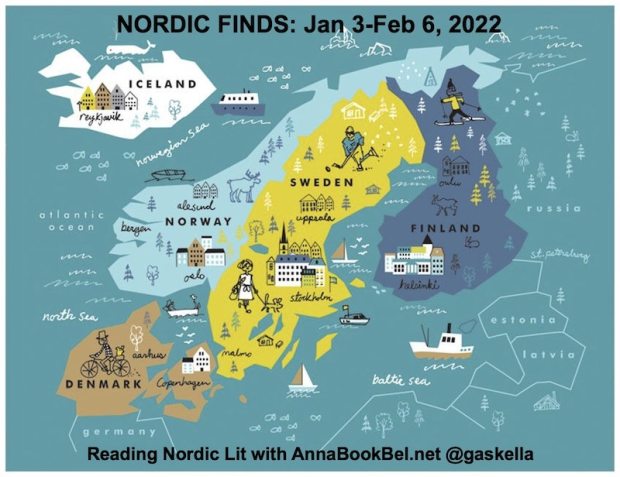
For my meager contribution to Annabel’s five-week Nordic FINDS challenge, I got out my copy of Sophie’s World by Jostein Gaarder that came from the free mall bookshop in 2020.
Sophie’s World: A Novel about the History of Philosophy (1994)
[Translated from the Norwegian by Paulette Møller]
 Sophie Amundsen, 14 going on 15, starts receiving mysterious letters asking her life’s big questions: Who are you? Where does the world come from? Soon her anonymous correspondent starts sending whole sheaves of paper elaborating on episodes from the unfolding history of philosophy, from creation myths through the Greek philosophers to Marxism and Darwinism via the Renaissance and Enlightenment. She’s so engrossed in her impromptu philosophy course that she starts to neglect her schoolwork and worry her mother. Sophie identifies the letter-writer as one Alberto Knox, who perhaps lives in a lake cabin nearby, and starts to interact with him by writing back. (I loved that their letters are delivered by a golden Labrador named Hermes.) Meanwhile, she’s perplexed by all the postcards she receives addressed to “Hilde,” also 15. Is she reading Hilde’s story, or is Hilde reading hers?
I’ll be honest … I made it just 96 pages (out of 394) before I started skimming, flipping past big chunks to get to the story. As to what I did experience, my feelings are mixed:
- On the one hand, this is certainly a more fun way to encounter philosophy than the textbook I had in college, while still offering accurate and thorough information.
- On the other hand, is the novel’s young adult audience really going to stick around for all the talky/preachy bits surrounding the slightly magical, mind-bending plot?
I think this became a word-of-mouth bestseller a couple of decades ago because of its novelty value. It’s a book that asks and assumes a lot of its readers: that we be curious and diligent, that we engage in the universal search of meaning. As Alberto writes in his first proper letter, “We feel we are part of something mysterious and we would like to know how it all works.” I feel I missed my moment to read it, though I can admire its aim. 
(See Annabel’s review here.)
My current Scandinavian read is Land of Snow and Ashes by Petra Rautiainen, a Finnish author, about the treatment of Sámi people during World War II (coming out from Pushkin Press tomorrow).
 Bookish Beck = Rebecca Foster. American transplant to England. Freelance proofreader and book reviewer.
 Bookish Beck