A Review for PKD Awareness Day: The Mourner’s Bestiary by Eiren Caffall
Today is PKD Awareness Day. Because the author and I both have polycystic kidney disease, I’m doing something I rarely do and reprinting an early review of mine that has already appeared on Shelf Awareness. I could hardly believe it when I was trawling through the list of review book offers and saw that Eiren Caffall also has PKD, then even more astonished to learn that it is a major theme in her memoir, which also weaves in marine biology and environmental concerns. An altogether intriguing book that, of course, held personal interest for me.
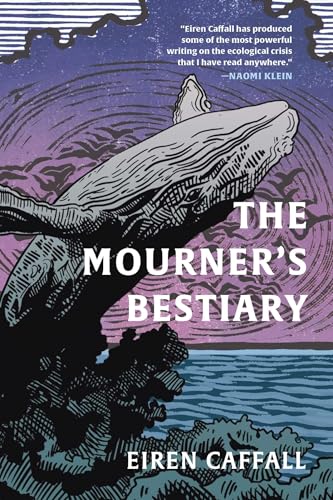
The Mourner’s Bestiary by Eiren Caffall
Eiren Caffall’s debut is an ardent elegy for her illness-haunted family and for the ailing marine environments that inspire her.
For centuries, the author’s family has been subject to “the Caffall Curse.” Polycystic kidney disease, a degenerative genetic condition, causes fluid-filled cysts to proliferate in a person’s enlarged kidneys. PKD can involve pain, fatigue, high blood pressure, kidney failure, and a heightened risk of brain aneurysm. Given Caffall’s paternal family history, she expected to die before age 50.
 Caffall’s melancholy memoir spotlights moments that opened her eyes to medical and environmental catastrophe. In 1980, when she was nine years old, she and her parents vacationed at a rental cottage on Long Island Sound. They nicknamed the pollution-ridden site “Dogshit Beach”—her mother spent idyllic summers there as a child, yet now “both the ecosystem and my father were slipping away.” For the first time, Caffall became aware of her father’s suffering and lack of energy. She realized that she, too, might have inherited PKD and could face similar struggles as an adult.
In 2014, Caffall, then a single mother, took her nine-year-old son, Dex, on vacation to the Gulf of Maine. During the trip, she had a fall that prompted a seizure, and she and Dex were evacuated from Monhegan Island by Coast Guard ship. Although no further seizures ensued and no clear cause emerged, the crisis served as a wake-up call, reminding her of how serious PKD is and that it might afflict her son as well.
The book draws fascinating connections between personal experiences and ecological threats. Caffall structures her story as a gallery of endangered marine animals such as the Longfin Inshore Squid and Humpback Whale, tracing their history and exposing the dangers they face in degraded environments. Red tides (massive algal blooms) and floods are apt metaphors for physical trials: “the Sound was dying, hypoxic … from an overwhelm of nutrients flooding an ecosystem—nitrogen, phosphorus, imbalanced saline—the same things that overwhelm a body when kidneys can no longer filter blood properly.”
Re-created scenes enliven accounts of family illness and therapeutic developments. The lyrical hybrid narrative, informed by scientific journals and government publications, is as impassioned about restoring the environment as it is about ensuring equality of access to health care. Personal and species extinction are just cause for “permanent mourning,” Caffall writes, but adapting to change keeps hope alive.
(Coming out in the USA from Row House Publishing on October 15th)
Posted with permission from Shelf Awareness.
[I couldn’t help but compare family members’ trajectories. Like her father, my mother was on dialysis for a time before getting a transplant, from her cousin. Like her aunt, my uncle died of a brain aneurysm, which is an associated risk. It sounds like Caffall has been much more severely affected than I have thus far. She is 53 and on Tolvaptan, a cutting-edge drug that slows the growth of cysts and thus the decline in kidney function. But even within families, the disease course is so varied. A cousin of mine was in her thirties when she had a transplant, whereas I am still very much in the early stages.]
A shout-out to the PKD Foundation in the States and the PKD Charity here in the UK.
A related post: In 2017 I reviewed four books for World Kidney Day.
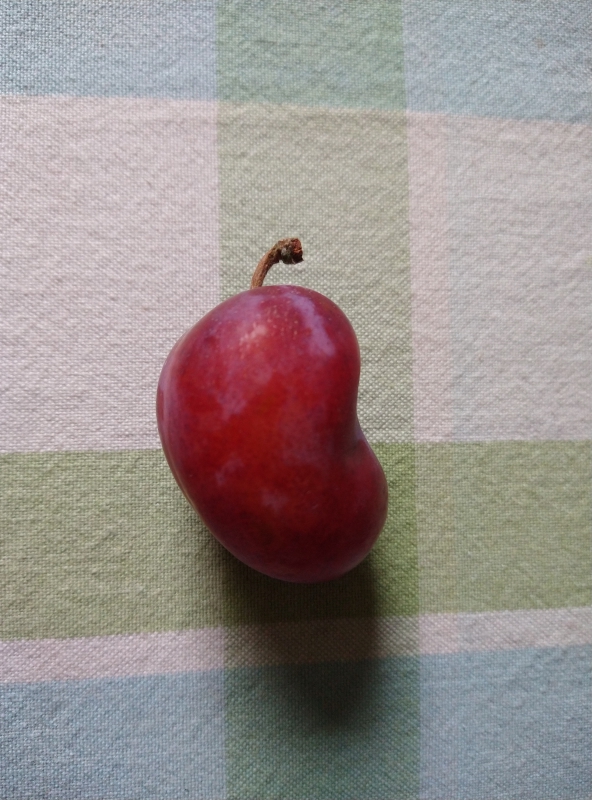
From the supermarket last week: a plum that wanted to be a kidney.
Four Books for World Kidney Day
Today, March 9th, is World Kidney Day. “The kidneys are like the Rodney Dangerfield of vital organs—they get no popular respect,” Vanessa Grubbs (whose memoir I discuss below) wryly comments. Chances are you rarely have occasion to think about your kidneys. But I’m honoring them with a reading list because several years ago I was diagnosed with polycystic kidney disease, a degenerative condition that runs in my family. My maternal grandmother had it – we’ve never definitively traced it further back than her – and four of her six children have it, too. (If you took a high school genetics class, you might remember that with an autosomal dominant condition offspring have a 50% chance of inheriting the gene for the disease.) A few cousins of my generation also have PKD, and starting with my mom we’ve had a few successful kidney transplants in the family so far.
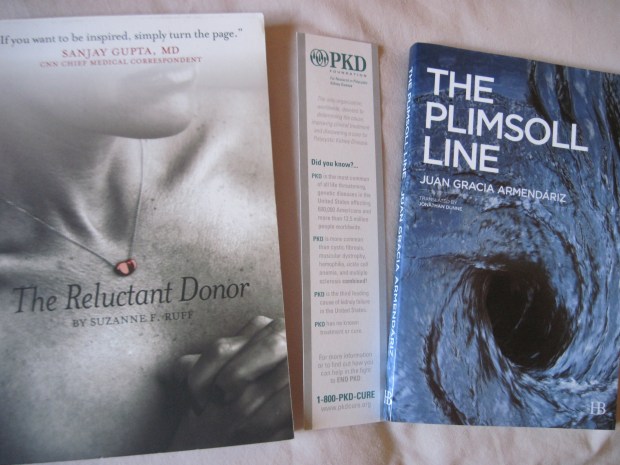
I must mention the excellent work done by the PKD Foundation in the States and the PKD Charity here in the UK. Both are a great support and source of information for me and my wider family.
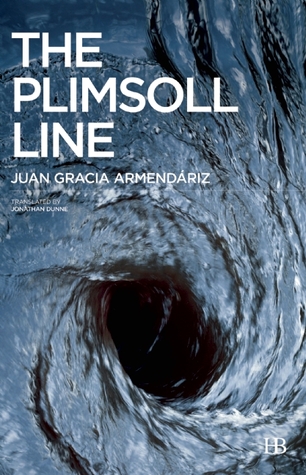
The Plimsoll Line by Juan Gracia Armendáriz
As soon as I read Melissa’s review at The Book Binder’s Daughter, I knew I had to get this one. “The Plimsoll line” is a maritime term indicating how low a cargo-laden ship can sit in the water without sinking; here it’s used metaphorically to ask just how much one man can take. Gabriel Ariz is a 52-year-old art professor who lives not far from the city yet surrounded by oak woods. He’s divorced from Ana, who’s pressuring him to sell the house, and their young adult daughter Laura died a few years ago in a car accident. Now this pack-a-day smoker who gets drunk with his brother, traveling photographer Óscar, learns that he has end-stage renal disease and his life will have to change. On indefinite leave from work, he attends a dialysis clinic several times a week and joins the organ transplant list.
 At times this was a bit overwritten for my tastes – some paragraphs stretch to several pages, and I’ve had to look up words, including “lentitude” and “logomachy” – but I did love the author’s trick of jumping into different perspectives. On multiple occasions he employs an “anonymous observer,” and in various chapters the point-of-view shifts to a member of the animal kingdom: Polanski the cat, a black kite flying overhead, a mole popping up in the garden, or a beetle winging across the detritus of Gabriel’s untidy household. We also get an extended section from Laura’s journals that reveals a disturbing family secret.
This is not one for the squeamish as it gives an unflinching account of dialysis: “His forearm throbbed, lacerated by needle marks. Sara had taken a while to find the fistula, and now the pain spread under the surgical tape like a jellyfish sting.” But for every passage that makes you cringe there’s a beautiful one that captures things perfectly: “he is living in constant deferment, between parentheses” and “If the succubus of his bad dreams were to say to him, ‘Make a wish,’ he would ask to be able to mold himself to the geological quietude of stones.”
The Plimsoll Line won Spain’s Premio Tiflos de Novela in 2008 and first appeared in English translation in 2015. It is part of a “Trilogy of Illness”; I presume the other volumes are not yet available in English, though I’ve enquired of the translator, Jonathan Dunne, via a Facebook message just in case. Forget Ferrante and Knausgaard; this is the semi-autobiographical series I’ll be awaiting the next installment of with bated breath.
My rating: 
Hundreds of Interlaced Fingers by Vanessa Grubbs
 Grubbs is a nephrologist and assistant professor of medicine at San Francisco General Hospital. Well before she made the kidneys her clinical area of expertise, a personal encounter made them special to her. In 2003 she met Robert Phillips when she was an attending trying to get support for her Office of Diversity Affairs; he was a hospital trustee. She only later learned, after they started dating, that due to FSGS his kidneys had failed in his twenties and he’d been on dialysis for years. In 2005 she donated him one of her kidneys. Robert’s health was touch-and-go for a little while there, but he proposed to her soon afterwards. I read about a third of this and then skimmed the rest because I wasn’t all that interested in their separate histories. However, I did like the context Grubbs gives, such as a brief history of dialysis, nephrology case studies, and a great set of FAQs. She also notes that minorities are less likely to get organ transplants, a disparity she is working to rectify.
This memoir grew out of an essay for Health Affairs, “Good for Harvest, Bad for Planting.” Releases June 13th.
My rating: 
The A to Z of You and Me by James Hannah
 (First reviewed in November 2015; here’s a shortened version.) Lying in a hospice bed, 40-year-old Ivo looks back on his life. Even after just four short decades and a modest career at a garden center, he has plenty to regret. Hard partying and drug use exacerbated his diabetes and prompted kidney failure. His lifestyle also led indirectly to his girlfriend, nursing student Mia (the “you” he often addresses directly), leaving him. He’s estranged from his sister and his friends from school days, especially Mal. How did he mess up so badly and cut himself off so completely that he’s now dying alone? And how much can he put right before he goes?
There’s plenty of affecting writing in Hannah’s debut novel. I liked how he captures the routines of institutional life. Nurse Sheila’s A to Z game, encouraging Ivo to think of a memory attached to body parts starting with each letter of the alphabet, provides a hokey but effective structure. Keeping in mind that in British English Z is pronounced ‘zed’, the title doesn’t rhyme, but this is still somewhat sappy. I’d recommend it to fans of Mark Haddon and David Nicholls. I’ll follow Hannah’s career and hope he avoids melodrama and a contrived setup – the two near-pitfalls of this one – in the future.
My rating: 
The Reluctant Donor by Suzanne F. Ruff
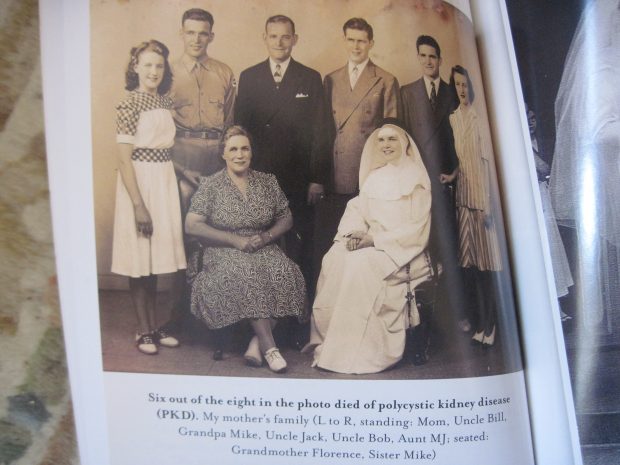
A sepia-toned photograph at the centerfold tells a solemn tale: six of these eight members of Ruff’s Irish-Catholic Chicago family died, directly or indirectly, as a result of PKD. I’ve always known there’s a long waiting list for transplant kidneys, but I was surprised to learn that dialysis machines used to be rare; demand far exceeded supply, and the procedure was not covered by Medicare until 1973. Ruff’s aunt, Sister Mike, decided the lives of people with children were more important than her own, so didn’t press for dialysis; when her kidneys failed in her forties, death followed just a few months later.
 Things had greatly improved by the time Ruff’s mother needed a transplant. Joan sounds like a feisty, lovable character, with plenty of good advice on being a patient: fight for your rights (the meek ones often end up being carried out feet first), get up and walk as soon after surgery as you possibly can, and appreciate the joy of an entirely ordinary day. Ruff’s parents had her and her sisters tested for PKD when they were teenagers. Having gone to the trouble, they then lied about the results! They said no one had PKD, but in the end two out of three did; only Ruff was spared. This is how she ended up donating a kidney to her younger sister, JoAnn. The more interesting sections of the book are about Ruff’s family history; her internal struggle to convince herself to commit to organ donation makes for pretty repetitive moaning.
 In general, the writing isn’t great. Skimming through, I found a page with 16 of my proofreading marks; on most pages it’s more like 2–3. There’s also a tendency to over-write when portraying emotion: “Genetic disease. Those two words made my spine shiver, my ears ring, my throat close, and my heart pound; I became lightheaded and faint. Terror crept into my core and gripped me in its vice [sic].” While I’m not sure I could recommend this to someone who doesn’t have a personal stake in organ donation, for those who are interested in an autobiographical account of genetic disease/transplant surgery, it’s a quick, pleasant read.
My rating:
Plus two more kidney-themed novels I’m on the look-out for:
- Useful, Debra Oswald, about a man who decides to donate a kidney to a stranger
- The Kidney Hypothetical: Or How to Ruin Your Life in Seven Days, Lisa Yee, a YA comedy in which a girl asks her boyfriend if he’d give her a kidney. Hypothetically, right?
 I’m on the fence about:
- Larry’s Kidney: Being the True Story of How I Found Myself in China with My Black Sheep Cousin and His Mail-Order Bride, Skirting the Law to Get Him a Transplant—and Save His Life, Daniel Asa Rose (I think the subtitle says it all!)
- I, Kidney, Chris Six: a self-published, semi-autobiographical novel
 Bookish Beck = Rebecca Foster. American transplant to England. Freelance proofreader and book reviewer.
 Bookish Beck