A Trip to Wigtown, Scotland’s Book Town
Wigtown is tucked away in the southwest corner of Scotland in Galloway, a region that doesn’t draw too many tourists. It did remind us a lot of Hay-on-Wye, the Book Town in Wales, what with the dry-stone walls, rolling green hills with more imposing mountains behind, sheep in the fields, and goodly number of bookshops. Wigtown is a sleepier place – it’s really just one main street and square – and has fewer bookshops and eateries overall, but the shops it does have are mainly large and inviting, and several are lovely bookshops-cum-cafés where you can pause for tea/coffee and cake before continuing with your book browsing. It rained for much of our trip and even snowed on a couple of brief occasions, but we got one day of very good weather and made the best of all the rest.


Day 1, Monday the 2nd: Six-plus hours of driving, partially in the sleet and snow, saw us arriving to our spacious and comfortable B&B by 6 p.m., giving us an hour to freshen up before dinner in the dining room. Cullen skink (leek and potato soup with chunks of smoked haddock); pork chops in a mustard cream sauce with roast parsnips, boiled potatoes and carrots, and mashed swede (aka rutabaga); and chocolate cake with gingerbread sauce. All delicious!
Day 2, Tuesday the 3rd: Smoked salmon and scrambled eggs for breakfast, accompanied by plenteous tea and toast. Off in the drizzle to see some local sites: Torhouse stone circle and Crook of Baldoon RSPB bird reserve. Nice sightings of whooper swans, pink-footed geese and lapwings, and a panoramic view of Wigtown across the way. Back to the car in the steady rain to find that we had a flat tire. Thanks to our foot pump, we got back to the W. Barclay garage in town, where they ordered a new tire and fitted the spare wheel. In the afternoon we drove to the Isle of Whithorn to see the 13th-century St. Ninian’s Chapel ruins and St. Ninian’s Cave. In the evening we went to Craft for beer/cider and the weekly acoustic music night, which, alas, just ended up being two old guys playing Americana songs on guitars.


Today’s book shopping: Glaisnock Café, where we also stopped for coffee and a tasty slice of courgette and avocado cake; The Open Book (run by Airbnb customers – this week it was Maureen from Pennsylvania and her niece Rebecca from Switzerland; they’d booked the experience two years ago, and the wait is now up to three years); the Wigtown Community shop (a charity shop); and browsing at Old Bank Books and Byre Books.


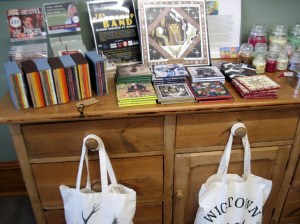
I loved seeing lots of Bookshop Band merchandise around. This was in the Festival Shop.
Day 3, Wednesday the 4th: Vegetarian ‘full Scottish’ cooked breakfast to fuel us for a rainy day of bookshops and explorations further afield. 12 p.m.: return trip to the garage to have our tire fitted. All the staff were so friendly and pleasant. They seemed delighted to see tourists around, and were interested in where we came from and what we were finding to do in the area. Mr. Barclay himself had one of the thickest Scottish accents I’ve ever heard, but I managed to decipher that he thinks of Galloway as “the next best place to heaven,” despite the weather. We spotted a local ‘celebrity’, Ben of the Bookshop Band, in the Co-op, but didn’t say hello as he was trying to pay for his shopping and had the baby in tow.
In the afternoon we ventured to Newton Stewart, the nearest big town, to buy petrol, picnic supper food, and another secondhand book at the community shop there. We retreated from the sudden snow for a scrumptious dinner of smoked salmon, black pudding and haggis (all of them battered and fried, with chips!) at a diner-like smokehouse. Back in Wigtown, we got a mainly dry evening to do the Martyrs’ Walk. In 1685 two Covenanters (Scottish reformers who broke from Charles I’s Anglican Church), Margaret McLachlan, 63, and Margaret Wilson, 18, were tied to stakes on the mud flats and allowed to drown in the rising tide.


Today’s book shopping: THE BOOKSHOP. I’ve meant to visit ever since I read Jessica Fox’s memoir, Three Things You Need to Know about Rockets, in February 2013. Previously based in California, Fox decided on a whim to visit a bookshop in Scotland and ended up here at the country’s largest. She promptly fell in love with the bookshop owner and with Wigtown itself; though she and Shaun Bythell are no longer an item, she has been a major mover and shaker in the town, playing a role in the annual festival and establishing The Open Book.


The Bookshop is a wonderfully rambling place with lots of nooks and crannies housing all sorts of categories. Look out for the shot and mounted Kindle, the Festival bed, the stuffed badger, a scroll of bookseller’s rules, Captain the cat, and a display of Bythell’s The Diary of a Bookseller. Together we found £35 worth of books we wanted to buy – whew! – thanks to my husband’s niche nature books, and had a nice chat with the man himself at the till. He signed my book, commiserated with us about the weather and our trip to see “Willie” (Barclay), and gave us tips for what to see locally. You’d hardly believe he’s the same curmudgeon who wrote the book. Now that I’ve been to the town and the shop, it’s time for me to start rereading it.


We also perused the smallish but very nice selection at Beltie Books, where we made a welcome stop for a cappuccino and some cookies, and I bought a cut-price new book at the Festival Shop. (They stock books by festival speakers plus a curated selection of new releases.)
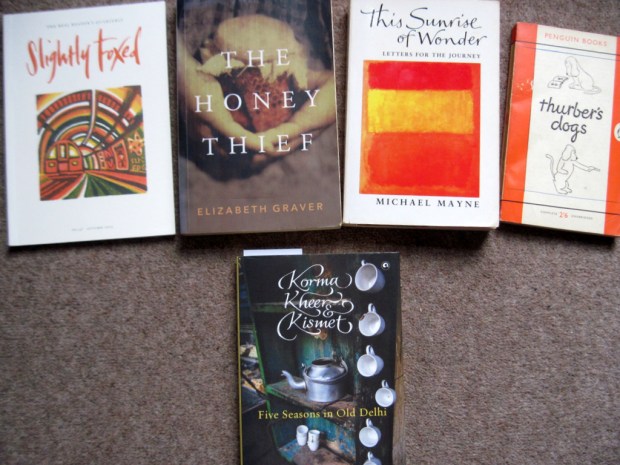
Day 4, Thursday the 5th: SUNSHINE, at last! After hearty omelettes, we headed to the hill that overlooks the town to get the best views of the week. On to Monreith for a charming coastal walk up to the Gavin Maxwell monument of a bronze otter. (He wrote Ring of Bright Water, which my husband brought along to read on our trip.) After a lunch stop back in town, it was out to the red kite feeding station about 40 minutes away – I came for the books; my husband came for the red kites. Though they’re common enough in our part of Berkshire, he was keen to see the site of another recent reintroduction. Wales also has a feeding station we visited some years ago, and on both occasions seeing dozens of birds swoop down for meat was quite the spectacle – though here you sit on an open porch, even closer to the action. We did a few other short walks in the area, finishing off with a sunset sit in Wigtown’s bird hide.


Today’s book shopping: ReadingLasses calls itself Britain’s only women’s bookshop. They stock Persephone Books direct from Bloomsbury, and they also have a large selection of secondhand books. This is the best place to go in town for a light meal and a snack. We had delicious homemade soup with soda bread for an early lunch, followed by coffee and tiffin. I bought a novel by Candia McWilliam, a Scottish author I’ve only read nonfiction by before.


At Curly Tale Books, the children’s bookshop next-door to The Bookshop, we bought a picture book about the local ‘belted’ Galloway cows for our niece. We didn’t realize the shop owner is also the author! She offered to sign the book for us, but we decided that a five-year-old wouldn’t appreciate it enough.
Day 5, Friday the 6th: Full Scottish breakfast to see us on our way, and a farewell to the two B&B cats, including the fluffiest cat on earth. To break up the rather arduous journey, we stopped early on at the Cairn Holy stone circle/tomb and the Cream o’ Galloway farm shop for cheese and ice cream. Home at 7:30 p.m. to find something from the freezer for dinner, unpack and shelve all these new books.
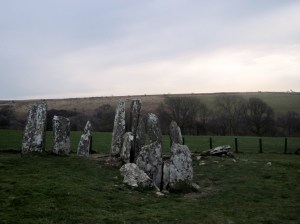
Cairn Holy
Total acquisitions: 13 books for me, 7 books for my husband, 3 books for gifts
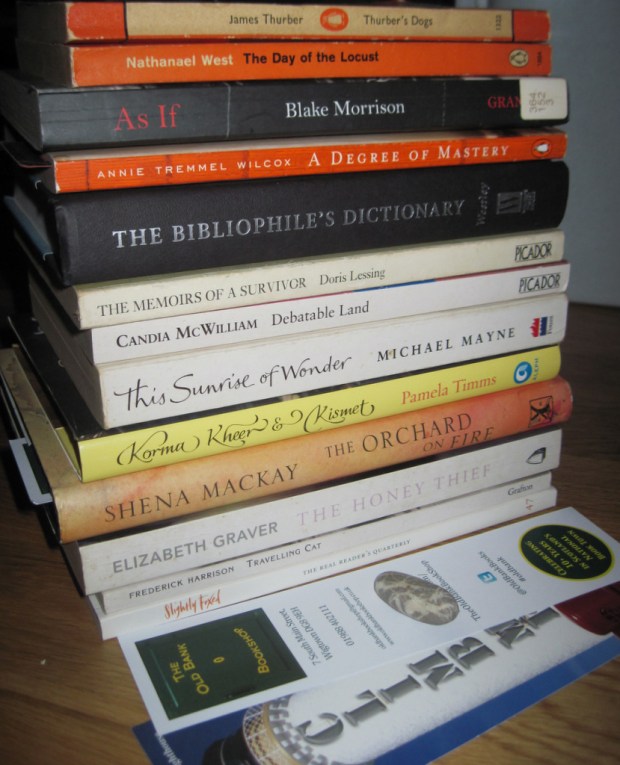
Wigtown is more than twice as far away as Hay is for us, so we’re less likely to go back. (It’s also a tough place to find a decent evening meal.) However, I’d like to think that life will take me back to Wigtown someday, perhaps for the Festival, or for a stay at The Open Book – though I’d have to start planning ahead to 2021!
What I read:
Bits of lots of books I had on the go, but mostly a few vaguely appropriate titles:
Under the Skin by Michel Faber was the perfect book for reading on rainy Scottish highways. I’m so glad I decided at the last minute to bring it. Isserley drives along Highland roads picking up hitchhikers – but only the hunky males – to take back to her farm near the Moray Firth. It’s likely that you already know the setup of this even if you haven’t read it, perhaps from the buzz around the 2013 film version starring Scarlett Johansson. It must have been so difficult for the first reviewers and interviewers to discuss the book without spoilers back in 2000. David Mitchell, in his introduction to my Canons series reprint, does an admirable job of suggesting the eeriness of the contents without giving anything significant away.
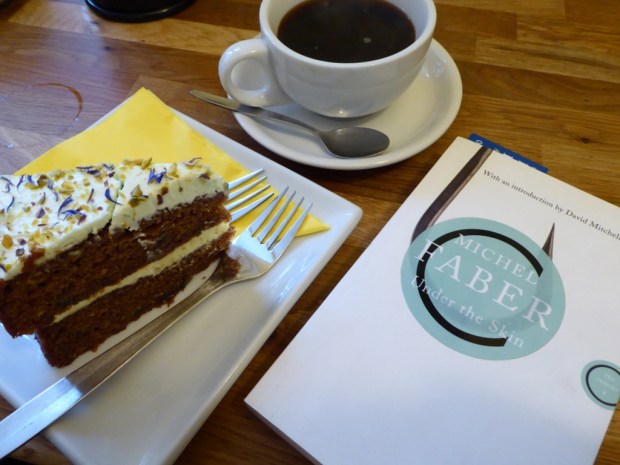
Shelve this under science fiction, though it veers towards horror and then becomes a telling allegory. I knew the basic plot beforehand, but there were still some surprises awaiting me, and I was impressed with how Faber pulled it all off. Keep an eye open for how he uses the word “human.” This has a lot to say about compassion and dignity, and how despite our differences we are fundamentally the same “under the skin.” 
An atmospheric line: “The fields all around her house were shrouded in snow, with patches of dark earth poking through here and there as if the world were a rich fruit cake under cream.”
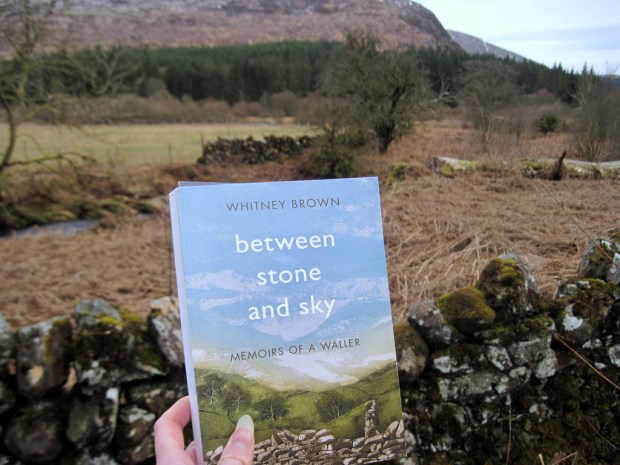
Between Stone and Sky: Memoirs of a Waller by Whitney Brown: For a TLS review. Brown, from South Carolina, trained as a dry-stone waller in Wales (where she fell in love with a man who wouldn’t marry her), but we saw plenty such walls in Scotland too. As an expat I could relate to her feeling of being split between two countries.  (Releases May 17th.)
I n the Days of Rain: A daughter. A father. A cult. by Rebecca Stott: I read the first two-fifths or so, mostly in the car and over our leisurely B&B breakfasts. One branch of Stott’s Exclusive Brethren family came from Eyemouth, a Scottish fishing village. A family memoir, a bereavement memoir, a theological theme: this brings together a lot of my favorite things. And it won last year’s Costa Biography Award, so you know it’s got to be good.
I also started two books by Scottish novelists, The Orchard on Fire by Shena Mackay and The Accidental by Ali Smith – though I don’t know if I’ll make it through the latter.
My Bibliotherapy Appointment at the School of Life
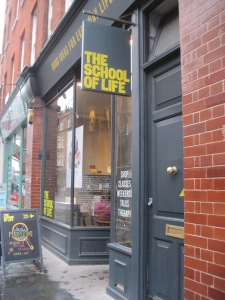 I’ve been interested in bibliotherapy for years, and I love The Novel Cure (see my review), the learned and playful advice book from Ella Berthoud and Susan Elderkin, two of the bibliotherapists at Alain de Botton’s London School of Life. Earlier this month I had the tremendous opportunity to have a personalized bibliotherapy appointment with Ella Berthoud at the School of Life. She’d put out a call on Twitter for volunteers to come for a free session (usually £100) to be observed by a journalist from La Repubblica writing about bibliotherapy – the translation of The Novel Cure has sold remarkably well in Italy. The feature will be part of a special color supplement in February, and I look forward to seeing if my story makes the cut! That is, if I can decipher any of the Italian.
Now, you might not think I’m the kind of person who needs a bibliotherapy assessment since I already find 300+ books per year I want to read; I worried that too, and felt a little bit guilty, but in the end I couldn’t pass up the chance, and Ella was happy to have me.

I took my copy of The Novel Cure along for Ella to sign.
Before my appointment I’d been asked to complete a two-page questionnaire about my reading habits and likes/dislikes, along with what’s going on in my life in general (the ‘therapy’ aspect is real). Once we were set up in the basement therapy room with hot drinks, Ella asked me more about how I read. I’d told her my reading was about two-thirds print books and one-third e-books. Had I ever tried audiobooks or reading aloud, she asked? The answer to both of those is no, I’m afraid. There’s no obvious place for audiobooks in my life because I work from home. However, as I’d mentioned I haven’t been able to get through a Dickens novel in five years, Ella suggested I try listening to one – abridged, it can be more like eight hours long instead of 42, and you still get a terrific story. She also highly recommended New Yorker and Guardian podcasts based around short stories and discussion.
 For reading aloud with my husband, Ella prescribed one short story per evening sitting – a way for me to get through short story collections, which I sometimes struggle to finish, and a different way to engage with books. We also talked about the value of rereading childhood favorites such as Watership Down and Little Women, which I haven’t gone back to since I was nine and 12, respectively. In this anniversary year, Little Women would be the ideal book to reread (and the new television adaptation is pretty good too, Ella thinks).
One other reading habit Ella is adamant about is keeping a physical reading journal in which you record the title of each book you read, where you read it, and about a paragraph of thoughts about it. It’s not meant to be a comprehensive response to every book; more like an aide-mémoire that you can get off the shelf in years to come to remind yourself of what you thought about a book. Specifically, Ella thinks writing down the location of your reading (e.g., on a train to Scotland) allows you to put yourself back in the moment. I tend to note where I bought a book, but not necessarily where I read it – for that, I would probably have to cross-reference my annual book list against a calendar. Since 2010 I’ve kept my book lists and responses in computer files, and I also keep full records via Goodreads, but I can see why having a physical journal would be a good back-up as well as a more pleasant representation of my reading. I’ll think about starting one.
 Various books came up over the course of our conversation: Abraham Verghese’s Cutting for Stone [appearance in The Novel Cure: The Ten Best Novels to Cure the Xenophobic, but Ella brought it up because of the medical theme], Tom Robbins’ Jitterbug Perfume [cure: ageing, horror of], and Julia Cameron’s The Artist’s Way, a nonfiction guide to thinking creatively about your life, chiefly through 20-minute automatic writing exercises every morning. We agreed that it’s impossible to dismiss a whole genre, even if I do find myself weary of certain trends, like dystopian fiction (I introduced Ella to Claire Vaye Watkins’ Gold Fame Citrus, one of my favorite recent examples).
 I came away with two instant prescriptions: Heligoland by Shena Mackay [cure: moving house], about a shell-shaped island house that used to be the headquarters of a cult. It’s a perfect short book, Ella tells me, and will help dose my feelings of rootlessness after moving more than 10 times in the last 10 years. She also prescribed Family Matters by Rohinton Mistry [cure: ageing parents] and an eventual reread of Jonathan Franzen’s The Corrections. As we discussed various other issues, such as my uncertainty about having children, Ella said she could think of 20 or more books to recommend me. “That’s a good thing, right?!” I asked.


Before I left, I asked Ella if she would ever prescribe nonfiction. She said they have been known to do so, usually if it’s written in a literary style (e.g. Robert Macfarlane and Alain de Botton). We chatted about medical memoirs and reading with the seasons for a little while, and then I thanked her and headed on my way. I walked around the corner to Skoob Books but, alas, didn’t find any of the books Ella had mentioned during our session. On the way back to the Tube station, though, I stopped at Judd Books and bought several secondhand and remaindered goodies, including these two:


(Imagine my surprise when I spotted The Year of the Hare in The Novel Cure under midlife crisis! Age seemed to be the theme of the day.)
 As soon as I got back from London I ordered secondhand copies of Heligoland, Jitterbug Perfume and The Artist’s Way, and borrowed Family Matters from the public library the next day. Within a few days four further book prescriptions arrived for me by e-mail. Ella did say that her job is made harder when her clients read a lot, so kudos to her for prescribing books I’d not read – with the one exception of Sebastian Barry’s Days Without End, which I love.
I’ve put in another order for Maggie and Me, the memoir by Damian Barr, plus (for reading aloud) Sum: Forty Tales from the Afterlives by David Eagleman and the collected short stories of Saki. I’m also keen to find The Victorian Chaise-Longue by Marghanita Laski, Ella’s final prescription, but as the Persephone Books reprint is pricey at the moment I may hold off and hope to chance upon a secondhand copy later in the year. Ella has been very generous with her recommendations, especially considering that I didn’t pay a penny. I certainly have plenty to be getting on with for now! I’ll report back later on in the year when I’ve had the chance to read some of these prescriptions.

The prescribed books I have gotten hold of so far.
 Bookish Beck = Rebecca Foster. American transplant to England. Freelance proofreader and book reviewer.
 Bookish Beck