Six Degrees of Separation: From The End of the Affair to Nutshell

 This month we begin with The End of the Affair by Graham Greene, a perfect excuse for me to review a novel I finished more than a year ago. This was only my second novel from Greene, after The Quiet American many a year ago. It’s subtle: low on action and majoring on recollection and regret. Mostly what we get are the bitter memories of Maurice Bendrix, a writer who had an affair with his clueless friend Henry’s wife Sarah during the last days of the Second World War. After she broke up with him, he remained obsessed with her and hired Parkis, a lower-class private detective, to figure out why. To his surprise, Sarah’s diaries revealed, not that she’d taken up with another man, but that she’d found religion. Maurice finds himself in the odd position of being jealous of … God? (More thoughts here.)
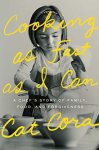 #1 I asked myself if I’d ever read another book where someone was jealous of a concept rather than a fellow human being, and finally came up with one. I enjoyed Cooking as Fast as I Can by Cat Cora even though I wasn’t aware of this Food Network celebrity and restaurateur. Her memoir focuses on her Mississippi upbringing in a half-Greek adoptive family and the challenges of being gay in the South. Separate obsessions plagued her marriage; I remember at one point she gave her wife an ultimatum: it’s either me or the hot yoga.
 #2 Yoga for People Who Can’t Be Bothered to Do It by Geoff Dyer is one of my favourite-ever book titles. The title is his proposed idea for a self-help book, but … wait for the punchline … he couldn’t be bothered to write it. It’s a book of disparate travel essays, with him as the bumbling antihero, sluggish and stoned. This wasn’t one of his better books, but his descriptions and one-liners are always amusing (my review).
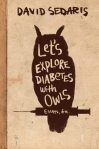 #3 Another book with a fantastic title that has nothing to do with the contents: Let’s Explore Diabetes with Owls by David Sedaris. Again, not my favourite of his essay collections (try Me Talk Pretty One Day or When You Are Engulfed in Flames instead), but he’s reliable for laughs.
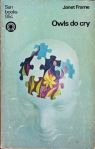 #4 No more about owls than the previous one; Owls Do Cry by Janet Frame is an autobiographical novel that tells the same story as her An Angel at My Table trilogy (but less compellingly): a hardscrabble upbringing in New Zealand and mental illness that led to incarceration in psychiatric hospitals. The title phrase is from Ariel’s song in The Tempest, which the Withers siblings learn at school. I’ve been ‘reading’ this for nearly a year and a half; really, it’s mostly been on the set-aside shelf for that time.
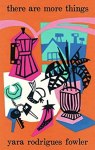 #5 Another title drawn from Shakespeare: there are more things by Yara Rodrigues Fowler is one of my Most Anticipated Books of 2022. It’s about a female friendship that links Brazil and London. I’m holding out hope for a review copy.
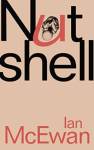 #6 Fowler’s title comes from Hamlet, which provides the plot for Ian McEwan’s Nutshell, one of his strongest novels of recent years. Within a few pages, I was captivated and utterly convinced by the voice of this contemporary, in utero Hamlet. Not even born and already a snob with an advanced vocabulary and a taste for fine wine, this foetus is a delight to spend time with. His captive state pairs perfectly with Hamlet’s existential despair, but also makes him (and us as readers) part of the conspiracy: even as he wants justice for his father, he has to hope his mother and uncle will get away with their crime; his future depends on it.
Where will your chain take you? Join us for #6Degrees of Separation! (Hosted on the first Saturday of each month by Kate W. of Books Are My Favourite and Best.)
Have you read any of my selections? Tempted by any you didn’t know before?
Six Degrees: From No One Is Talking About This to The White Garden
This month marks two years that I’ve been participating in the Six Degrees meme. I’m an off-and-on contributor – I skipped last month – but this month’s starting book hooked me in. We begin with No One Is Talking About This by Patricia Lockwood, critically acclaimed but divisive among regular readers. It made my Best of 2021 list. (See Kate’s opening post.)

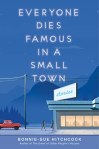 #1 No one is talking about the danger/allure of social media and the real-life moments that matter so much more … or maybe everyone is by now? What else is ‘everyone’ up to? Well, according to an appealing 2021 title from my TBR, Everyone Dies Famous in a Small Town (a YA linked short story collection by Bonnie-Sue Hitchcock). My library has a copy, so I need to catch up.
 #2 I did a search of my Goodreads library to find other small-town stories and FOUR of the results were unread nonfiction books by Heather Lende, set in Alaska (where lots of the Hitchcock stories are set as well). Now, my rule is that I can only have ONE book by an untried author on my virtual TBR; only if I read and enjoy a book of theirs can I add further titles. So I culled the other three but kept Find the Good, about the simple lessons Lende learned from writing obituaries in her small town.
 #3 I’ve read a few books with a lemon on the cover, but the one that was most about, you know, lemons, was The Land Where Lemons Grow by Helena Attlee. I chose it as one of my location-appropriate reads – written up here – during a vacation to Tuscany in 2014, my first time in Italy. It contains (more than) all you ever wanted to know about lemons.
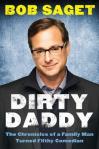 #4 A less apt read for time spent in Florence, but I distinctly remember lying in bed in our hotel room, which was basically part of a medieval villa, and reading it on my Nook when I couldn’t sleep because of the noisy nightlife out the window: Dirty Daddy by the late comedian Bob Saget. I rarely choose celebrity memoirs and this one was kinda crummy, but I’d requested it from Edelweiss because of my fond memories of the 1990s sitcom Full House.
 #5 Full house? How about A House Full of Daughters, a family memoir by Juliet Nicolson (sister of Adam)? It covers seven generations of women, including her grandmother, Vita Sackville-West. I loved my visits to Sissinghurst Castle and Knole Park, two of Vita’s homes, and have devoured Adam Nicolson and Sarah Raven’s writings about their work at Sissinghurst. When a neighbour was giving away a copy of this book, I snatched it up. It’s packed in a box and will be awaiting me after our move (coming up in March, we hope).
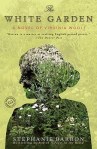 #6 During the lockdown spring I wrote about a silly novel called The White Garden by Stephanie Barron, which imagines that Virginia Woolf did not commit suicide upon her disappearance in March 1941, but hid with Vita at Sissinghurst. An American garden designer tasked with recreating Sackville-West’s famous White Garden at a wealthy client’s upstate New York estate ends up investigating what happened. My interest in the historical figures involved was enough to keep me going through a rather frothy book.
From one contemporary novel that swaps farce for poignancy to another that descends into ridiculousness, my chain has travelled via Alaska, Italy and Hollywood to Kent, England. The overarching theme has been fame: on the Internet, in small towns, in show business, and (my kind of celebrity) in the literary world.
Where will your chain take you? Join us for #6Degrees of Separation, hosted on the first Saturday of each month by Kate W. of Books Are My Favourite and Best. Next month’s starting point is The End of the Affair by Graham Greene, my perfect excuse to finally review it (I finished it more than a year ago!).
Have you read any of my selections? Tempted by any you didn’t know before?
Six Degrees: Ethan Frome to A Mother’s Reckoning
This month we began with Ethan Frome by Edith Wharton, which was our buddy read for the short classics week of Novellas in November. I reread and reviewed it recently. (See Kate’s opening post.)
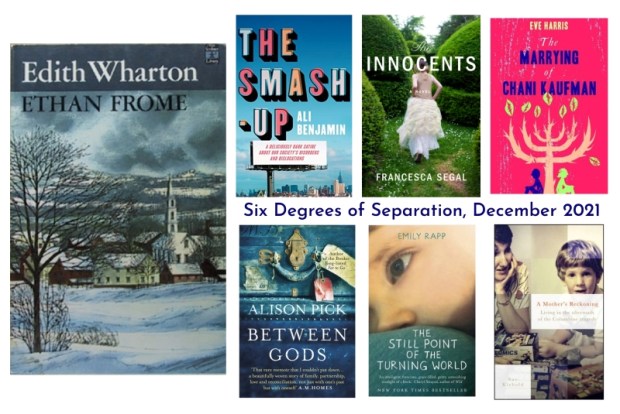
 #1 When I posted an excerpt of my Ethan Frome review on Instagram, I got a comment from the publicist who was involved with the recent UK release of The Smash-Up by Ali Benjamin, a modern update of Wharton’s plot. Here’s part of the blurb: “Life for Ethan and Zo used to be simple. Ethan co-founded a lucrative media start-up, and Zo was well on her way to becoming a successful filmmaker. Then they moved to a rural community for a little more tranquility—or so they thought. … Enter a houseguest who is young, fun, and not at all concerned with the real world, and Ethan is abruptly forced to question everything: his past, his future, his marriage, and what he values most.” I’m going to try to get hold of a review copy when the paperback comes out in February.
 #2 One of my all-time favourite debut novels is The Innocents by Francesca Segal, which won the Costa First Novel Award in 2012. It is also a contemporary reworking of an Edith Wharton novel, this time The Age of Innocence. Segal’s love triangle, set in a world I know very little about (the tight-knit Jewish community of northwest London), stays true to the emotional content of the original: the interplay of love and desire, jealousy and frustration. Adam Newman has been happily paired with Rachel Gilbert for nearly 12 years. Now engaged, Adam and Rachel seem set to become pillars of the community. Suddenly, their future is threatened by the return of Rachel’s bad-girl American cousin, Ellie Schneider.
 #3 Also set in north London’s Jewish community is The Marrying of Chani Kaufman by Eve Harris, which was longlisted for the Booker Prize in 2013. Chani is the fifth of eight daughters in an ultra-Orthodox Jewish family in Golders Green. The story begins and closes with Chani and Baruch’s wedding ceremony, and in between it loops back to detail their six-month courtship and highlight a few events from their family past. It’s a light-hearted, gossipy tale of interclass matchmaking in the Jane Austen vein.
 #4 I learned more about Jewish beliefs and rituals via several memoirs, including Between Gods by Alison Pick. Her paternal grandparents escaped Czechoslovakia just before the Holocaust; she only found out that her father was Jewish through eavesdropping. In 2008 the author (a Toronto-based novelist and poet) decided to convert to Judaism. The book vividly depicts a time of tremendous change, covering a lot of other issues Pick was dealing with simultaneously, such as depression, preparation for marriage, pregnancy, and so on.
 #5 One small element of Pick’s story was her decision to be tested for the BRCA gene because it’s common among Ashkenazi Jews. Tay-Sachs disease is usually found among Ashkenazi Jews, but because only her husband was Jewish, Emily Rapp never thought to be tested before she became pregnant with her son Ronan. Had she known she was also a carrier, things might have gone differently. The Still Point of the Turning World was written while her young son was still alive, but terminally ill.
 #6 Another wrenching memoir of losing a son: A Mother’s Reckoning by Sue Klebold, whose son Dylan was one of the Columbine school shooters. I was in high school myself at the time, and the event made a deep impression on me. Perhaps the most striking thing about this book is Klebold’s determination to reclaim Columbine as a murder–suicide and encourage mental health awareness; all author proceeds were donated to suicide prevention and mental health charities. There’s no real redemptive arc, though, no easy answers; just regrets. If something similar could happen to any family, no one is immune. And Columbine was only one of many major shootings. I finished this feeling spent, even desolate. Yet this is a vital book everyone should read.
So, I’ve gone from one unremittingly bleak book to another, via sex, religion and death. Nothing for cheerful holiday reading – or a polite dinner party conversation – here! All my selections were by women this month.
Where will your chain take you? Join us for #6Degrees of Separation! (Hosted on the first Saturday of each month by Kate W. of Books Are My Favourite and Best.)
Next month’s starting point is Rules of Civility by Amor Towles; I have a copy on the shelf and this would be a good excuse to read it!
Have you read any of my selections? Are you tempted by any you didn’t know before?
Six Degrees of Separation: What Are You Going Through to No Saints Around Here
I’ve become an occasional Six Degrees of Separation post-er, when the mood strikes me and/or I get a flash of inspiration. This month we began with What Are You Going Through, which I reviewed back in October 2020. (See Kate’s opening post.)
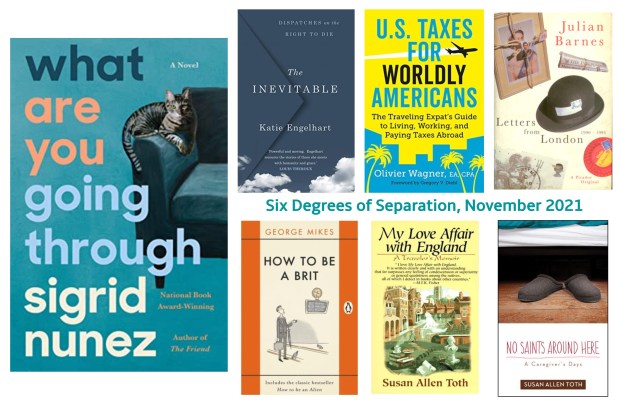
 Between that, The Friend and A Feather on the Breath of God, Sigrid Nunez has quickly become one of my favourite contemporary authors. I have two more of her novels on the shelf to read soon, one from my birthday haul.
In What Are You Going Through, the narrator is called upon to help a terminally ill friend commit suicide. However, I summed up the message as “Curiosity about other lives fuels empathy,” and noted “a sort of slapstick joy early in this morbid adventure.”
 #1 One of the stand-out books from my 2021 reading so far has been The Inevitable, which is about assisted dying. The case studies are wrenching but compassionately told. Katie Engelhart explores the nuances of situations, crafting expert portraits of suffering people and the medical professionals who seek to help them, and adding much in the way of valuable context.
 #2 As the saying goes, if there’s one thing inevitable besides death, it’s taxes. And if you’re a U.S. citizen, you will remain accountable to the IRS until the day you die, no matter where you live. (Eritrea is the only other country that requires expatriates to fill in tax returns.) I’ve now gotten my U.S. tax forms down to a science, keeping a list of pointers and previous years’ forms as scanned files so that I just have to plug in the year’s numbers, put zeroes in all the important boxes (since I’ve already paid income tax in the UK), and send it off. A matter of an hour or two’s work, rewarded by a G&T.
But I distinctly remember the Junes when I would spend days muddling through byzantine IRS forms, so I am very grateful that an offer for this e-book arrived in my inbox via my blog contact form in 2017: U.S. Taxes for Worldly Americans by Olivier Wagner. It goes through each form, often line by line. Three cheers for actually helpful self-help guides!
 #3 Another expat tip that I found extremely useful, small as it might seem, is that “quite” means something different in American vs. British English. To an American it’s a synonym for “very”; to the guarded Brits, it’s more like “rather.” I have the Julian Barnes essay collection Letters from London to thank for this vital scrap of etymological knowledge.
 #4 Unsurprisingly, I have built up a small library of books about understanding the English and their ways. In the How to Be a Brit omnibus, collecting three short volumes from the 1940s–70s, George Mikes (a Hungarian immigrant) makes humorous observations that have, in general, aged well. His mini-essays on tea, weather and queuing struck me as particularly apt. I would draw a straight line from this through Bill Bryson’s Notes from a Small Island to the Very British Problems phenomenon.
 #5 As I was preparing to fly to England for the first time for my study abroad year, one of the authors who most whetted my appetite for British travel was Susan Allen Toth, whose trilogy of UK-themed memoirs-with-recommendations began with My Love Affair with England – included in one of my Landmark Books in My Life posts. I’m rereading one of the other three now.
 #6 Toth is a very underrated author, I feel. I’ve read most of her memoirs and have a short nonfiction work of hers on my pile for #NovNov. Her most recent book is No Saints Around Here: A Caregiver’s Days (2014), in which she chronicled the last 18 months of her husband James’s life, as she and an army of caregivers coped with his decline from Parkinson’s disease. Toth gets the tone just right: although she is honest, she is never melodramatic; although she often feels sorry for herself, she also recognizes how lucky she has been, not just to have done a good job of looking after James, but to have had him in her life at all.
I’ve gone full circle from one story of caregiving to another, via death, taxes and Englishness. The starting and ending books are reminders that you never fully know what another person is going through; all we can do is our best while cutting others some slack.
Where will your chain take you? Join us for #6Degrees of Separation! (Hosted on the first Saturday of each month by Kate W. of Books Are My Favourite and Best.) Next month’s starting point is our buddy read for week 4 of #NovNov, Ethan Frome by Edith Wharton.
Have you read any of my selections? Are you tempted by any you didn’t know before?
Six Degrees of Separation: Second Place to Woman on the Edge of Time
The last Six Degrees of Separation post I did was back in April; I’ve fallen out of the habit since then. But this month an idea seized me and I’m back! This time we begin with Second Place by Rachel Cusk, which is on the Booker Prize longlist. (See Kate’s opening post.)

When I saw Cusk speak at the online Hay Festival, I learned that Second Place (my review) was loosely inspired by Mabel Dodge Luhan’s 1932 memoir Lorenzo in Taos, about the time when D.H. Lawrence came to visit her in New Mexico. Thoughts of Lawrence in Taos inevitably take me back to my first (and only) academic conference in 2005, hosted by the D.H. Lawrence Society of North America in Santa Fe, with a fieldtrip out to his Taos ranch.
 #1 One of the books I read ‘in preparation’ for attending that conference was Small World by David Lodge, a comedic novel about professors on the international conference circuit. I’ve included it as one of the Landmark Books of My Life.
 #2 Flights and “small world” connections also fill the linked short story collection Turbulence by David Szalay.
 #3 If you can bear to remember the turbulence of recent history, UnPresidented by Jon Sopel is a breezy diary of the 2020 U.S. election. We were lucky enough to have the author, a BBC presenter and brother of one of our members, join our book club discussion on Zoom.
 #4 That punning title reminded me of A Sting in the Tale by Dave Goulson, his first and probably best work of popular science – all of his books since have been very similar, but that’s no problem because his enthusiasm for insect life is infectious and he writes with the wit and charm of Gerald Durrell.
#5 Goulson’s latest book, which I’ve recently reviewed for Shelf Awareness, is called Silent Earth, about the grave threats that insects face (pesticides, invasive species, climate change and much more). It’s the second book I’ve read in recent years (the first was Losing Eden by Lucy Jones) that is explicitly based on or inspired by Silent Spring by Rachel Carson. Like Carson’s book, these seek to effect real societal change.


#6 Carson, Goulson and Jones all conjure up dystopian scenarios of unimaginable natural loss to spur readers into action. A feminist classic my book club read earlier in the year, Woman on the Edge of Time by Marge Piercy, contrasts utopian and dystopian scenes experienced by a Latina woman who’s been confined to a mental hospital. Will society evolve into a utopian vision of subsistence living and absolute gender equality, or move towards further isolation and urban barrenness? It’s an unusual and fascinating novel with hints of science fiction, but grounded in the real world. I still haven’t managed to review it, but next month’s 1976 Club may be just the excuse I need. Do give it a try!

Cycling round from one feminist novel to another, I’ve also featured a couple of personal favourites, some recent works, and a classic of nature writing.
Where will your chain take you? Join us for #6Degrees of Separation! (Hosted on the first Saturday of each month by Kate W. of Books Are My Favourite and Best.) Next month’s R.I.P.-appropriate starting point is the short story “The Lottery” by Shirley Jackson.
Have you read any of my selections? Are you tempted by any you didn’t know before?
Six Degrees of Separation: From Shuggie Bain to Girl, Woman, Other

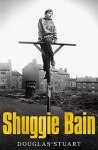
This month we begin with Shuggie Bain by Douglas Stuart (2020), last year’s Booker Prize winner. (See Kate’s opening post.) I tried it a couple of times and couldn’t get past page 100, but I’ve kept my proof copy on the shelf to try some other time.
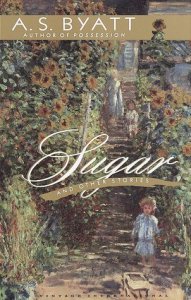 #1 The main character’s sweet nickname takes me to Sugar and Other Stories by A.S. Byatt. Byatt is my favourite author. Rereading her The Matisse Stories last year was rewarding, and I’d eventually like to go back to the rest of her short fiction. I read Sugar and Other Stories in Bath in 2006. (As my MA year in Leeds came to a close, I interviewed at several libraries, hoping to get onto a graduate trainee scheme so I could stay in the UK for another year. It didn’t work out, but I got to tour many wonderful libraries.) I picnicked on the grass on a May day on the University of Bath campus before my interview at the library.
I can’t claim to remember the book well overall, but I do recall the story “The July Ghost,” in which a man at a party tells a story about his landlady and the silent boy he’s seen in her garden. This turns out to be the ghost of her son, who died when he was hit by a car two summers earlier. I’ve never forgotten it because that’s exactly what happened to Byatt’s 12-year-old son.
 #2 The title of that memorable story takes me to The First Bad Man by Miranda July. This review from the early days of my blog is still inexplicably popular in terms of number of views. The novel is full of unlikable characters and quirkiness for the sake of it; I doubt I would have read it had I not been sent an unsolicited review copy by the U.S. publisher.
 #3 According to a search of my Goodreads library, the only other book I’ve ever read by a Miranda is A Girl Walks into a Book by Miranda K. Pennington, a charming bibliomemoir about the lives and works of the Brontës. I especially enjoyed the cynical dissection of Wuthering Heights, a classic I’ve never managed to warm to.
 #4 From one famous set of sisters in the arts to another with Vanessa and Her Sister by Priya Parmar, a novel about Vanessa Bell and Virginia Woolf. It is presented as Vanessa’s diary, incorporating letters and telegrams. The interactions with their Bloomsbury set are delightful, and sibling rivalry is a perennial theme I can’t resist.
 #5 Another Vanessa novel and one I would highly recommend to anyone wanting a nuanced look at the #MeToo phenomenon is My Dark Vanessa by Kate Elizabeth Russell. It’s utterly immersive and as good a first-person narrative as anything Curtis Sittenfeld has ever written. I also appreciated the allusions to other works of literature, from Nabokov (the title is from Pale Fire) to Swift. This would make a great book club selection.
 #6 Speaking of feminist responses to #MeToo, Girl, Woman, Other by Bernardine Evaristo is just as good as you’ve heard. If you haven’t read it yet, why not? It’s a linked short story collection about 12 black women navigating twentieth-century and contemporary Britain – balancing external and internal expectations to build lives of their own. It reads like poetry.
Cycling round from one Booker Prize winner to another, I’ve featured stories by and about strong women, with most of my links coming from names and titles.
Whatever could be on the 2021 Booker Prize longlist? We have a lot of literary prize races to see out before then, but I’m keen to learn what Rev. Rowan Williams and the rest of the judges deem worthy.
Where will your chain take you? Join us for #6Degrees of Separation! (Hosted on the first Saturday of each month by Kate W. of Books Are My Favourite and Best.) Next month’s starting point is Beezus and Ramona, in honour of Beverly Cleary (May 1, 2021).
Have you read any of my selections? Are you tempted by any you didn’t know before?
Six Degrees of Separation: From Phosphorescence to Sunburn

 This month we begin with Phosphorescence by Julia Baird (2020). (See Kate’s opening post.) It’s not currently available in the UK but is set to be published by HarperCollins in late May, and I’d be interested in reading it.
 #1 Baird’s premise and subtitle – “On Awe, Wonder and Things that Sustain You when the World Goes Dark” – remind me a lot of Wintering: How I learned to flourish when life became frozen by Katherine May, which I reviewed for the TLS early last year. (I also published an excerpt here.)
 #2 Winter and snow books together make up my favorite seasonal reading, though I’ll soon be moving on to spring themes instead. A wintry novel I recently loved was Snow Falling on Cedars by David Guterson (review here), which is doubly appropriate for this chain because I noticed the pretty rare word “phosphorescence” being used in it twice, including on the next-to-last page.
 #3 Cedars take me to Our Souls at Night by Kent Haruf (review here), which takes place on Cedar Street in the fictional Colorado town of Holt. I wouldn’t normally recall such a tiny detail, but I grew up on a Cedar Street (in Silver Spring, Maryland), so it stuck in my mind.
 #4 Whenever I think of Our Souls at Night, I remember John Boyne’s crude Twitter joke about someone asking a bookshop for “Arseholes at Night.” I’ve enjoyed a couple of Boyne’s novels, including A Ladder to the Sky, a Ripley-esque work of suspense (review here).
 #5 In 2018 I read a few books with the word “Ladder” in the title in quick succession. One of the others was Ladder of Years by Anne Tyler, currently my second-favorite of her novels.
 #6 Sunburn by Laura Lippman, a noir mystery, must have been inspired – unconsciously, at least – by Ladder of Years: both are set in the mid-1990s, have a woman walking away from her family and into a new life, and feature a Delaware beach. I read Sunburn during a week in Milan in July 2019 – our last holiday abroad (tacked onto my husband speaking at a conference); indeed, the last time we went away anywhere for longer than a night or two. We hope to manage a couple of mini-breaks this spring and summer.
I’ve gone round from one evocative, light-filled word to another, both of which offer a tantalizing glimpse of warmer, happier times to come.
 Where will your chain take you? Join us for #6Degrees of Separation! (Hosted on the first Saturday of each month by Kate W. of Books Are My Favourite and Best.) Next month’s starting point is Shuggie Bain.
Have you read any of my selections? Are you tempted by any you didn’t know before?
Six Degrees of Separation: From a Redhead to a Blue Dress
This month we begin with Redhead by the Side of the Road (2020). (See Kate’s opening post.) Anne Tyler’s lackluster latest somehow got longlisted for the Booker Prize. Still, I’m a solid Tyler fan and I’m taking advantage of Liz’s readalong to get to the books of hers that I own but haven’t read yet. Currently reading: The Clock Winder (1972).
#1 Sorry to break it to you if you haven’t read the book yet, but the title refers not to a person with red hair but to a fire hydrant: Micah, a typically useless Tyler antihero, makes this visual mistake commonly when he’s out running without his glasses on.
 The Unlikely Redemption of John Alexander MacNeil by Lesley Choyce (2017) is beloved of a couple of Canadian book blogger friends, including Naomi (here’s her review). I came across it on my Goodreads TBR the other day and the blurb caught my eye. An old man starts doing peculiar things, like picking up a hitchhiker … except that it’s actually a neighbour’s mailbox. This reminded me of Micah’s folly, not least because of the glasses on the cover.
 #2 One of the key images in The Great Gatsby (1925) is of the eyes of optician Dr. T. J. Eckleburg peering out from an old billboard. They’re explicitly equated to the eyes of God looking down on the immoral lifestyle of characters blinded by the pursuit of money and happiness. Gatsby was our neighbourhood book club choice this month. Whether we’d read it multiple times before (it was my third read) or not at all, we found a lot to talk about – and two members took the opportunity to dress up in vintage 1920s fashions for the Zoom meeting!
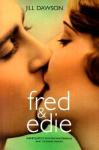 #3 Although those bespectacled eyes appeared on the copy I read in high school, the book group set cover featured a couple of 1920s figures: a woman on the front cover and a man on the back. They look rather like a young Scott and Zelda Fitzgerald, but I can’t find evidence that it’s an original photograph. In any case, I thought the image looked awfully familiar, and finally located it as the cover of Fred & Edie by Jill Dawson (2000), which is set in 1922 and was inspired by a true crime. In a sensational trial, Edith Thompson and her lover, Freddy Bywaters, were found guilty of murdering Edith’s husband and the pair were executed the following year. Cathy’s review whetted my appetite to read it.
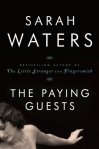 #4 Also featuring a murder committed in 1922 is The Paying Guests by Sarah Waters (2014). I will say no more – not least because I don’t fully remember what happens, though I have a vague sense that it is quite similar in plot to the Dawson – except that this was a stand-out from Waters. (My review for BookBrowse.)
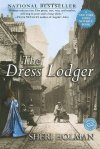 #5 “Paying guests” was an old-fashioned euphemism used by people who didn’t like to admit they had lodgers. Another random recent find on my virtual TBR was The Dress Lodger by Sheri Holman (2000), which is about a 15-year-old prostitute trying to provide for herself and her disabled baby boy during a cholera epidemic in Sunderland, England in 1831. Victorian pastiches can go either way for me, but when they’re good I adore them. There are enough positive friend reviews of this on Goodreads for me to keep it on the list: it sounds reminiscent of The Crimson Petal and the White, and the epidemic theme sure is relevant.
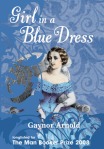 #6 The blue dress on the cover led me to Girl in a Blue Dress by Gaynor Arnold (2008), a novel about Charles Dickens’s longsuffering wife, Catherine. (Though the central pair are given different names, it’s very clear who they’re based on.) I’m a sucker for any book about Dickens. Like Redhead, this was longlisted for the Booker Prize.
This month I’ve gone round to a different primary colour, by way of a classic and much historical fiction (with 1920s settings aplenty, and lots of marcelled hair!).
Where will your chain take you? Join us for #6Degrees of Separation! (Hosted on the first Saturday of each month by Kate W. of Books Are My Favourite and Best.) Next month’s starting point is Phosphorescence by Julia Baird.
Have you read any of my selections? Are you tempted by any you didn’t know before?
Six Degrees of Separation: From Hamnet to Paula
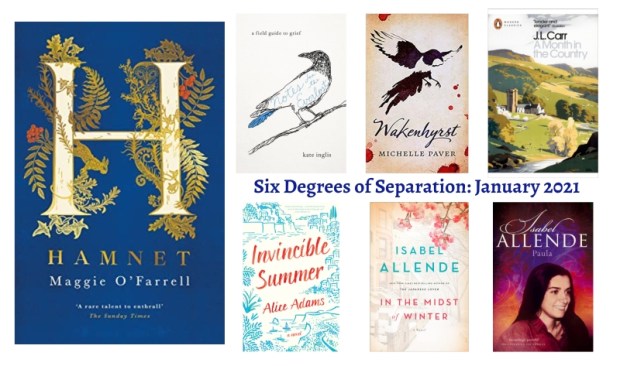
 I was slow off the mark this month, but here we go with everyone’s favorite book blogging meme! This time we start with Hamnet, Maggie O’Farrell’s Women’s Prize-winning novel about the death of William Shakespeare’s son. (See Kate’s opening post.) Although I didn’t love this as much as others have (my review is here), I was delighted for O’Farrell to get the well-deserved attention – Hamnet was also named the Waterstones Book of the Year 2020.
 #1 I’ve read many nonfiction accounts of bereavement. One that stands out is Notes from the Everlost by Kate Inglis, which is also about the death of a child. The author’s twin sons were born premature; one survived while the other died. Her book is about what happened next, and how bereaved parents help each other to cope. An excerpt from my TLS review is here.
 #2 Also featuring a magpie on the cover, at least in its original hardback form, is Wakenhyrst by Michelle Paver (reviewed for R.I.P. this past October). I loved that Maud has a pet magpie named Chatterpie, and the fen setting was appealing, but I’ve been pretty underwhelmed by all three of Paver’s historical suspense novels for adults.
 #3 One of the strands in Wakenhyrst is Maud’s father’s research into a painting of the Judgment Day discovered at the local church. In A Month in the Country by J. L. Carr (reviewed last summer), a WWI veteran is commissioned to uncover a wall painting of the Judgment Day, assumed to be the work of a medieval monk and long ago whitewashed over.
 #4 A Month in the Country spans one summer month. Invincible Summer by Alice Adams, about four Bristol University friends who navigate the highs and lows of life in the 20 years following their graduation, checks in on the characters nearly every summer. I found it clichéd; not one of the better group-of-friends novels. (My review for The Bookbag is here.)
 #5 The title of Invincible Summer comes from an Albert Camus quote: “In the midst of winter, I found there was, within me, an invincible summer. And that makes me happy.” Inspired by the same quotation, then, is In the Midst of Winter by Isabel Allende, a recent novel of hers that I was drawn to for the seasonal link but couldn’t get through.
 #6 However, I’ve enjoyed a number of Allende books over the last 12 years or so, both fiction and non-. One of these was Paula, a memoir sparked by her twentysomething daughter’s untimely death in the early 1990s from complications due to the genetic condition porphyria. Allende told her life story in the form of a letter composed at Paula’s bedside while she was in a coma.
So, I’ve come full circle with another story of the death of a child, but there’s a welcome glimpse of the summer somewhere there in the middle. May you find your own inner summer to get you through this lockdown winter.
Join us for #6Degrees of Separation! (Hosted on the first Saturday of each month by Kate W. of Books Are My Favourite and Best.) Next month’s starting point is Redhead at the Side of the Road by Anne Tyler.
Have you read any of my selections? Are you tempted by any you didn’t know before?
Six Degrees of Separation: From Margaret to This Cold Heaven
This month we’re starting with Are You There, God? It’s Me, Margaret (which I have punctuated appropriately!). See Kate’s opening post. I know I read this as a child, but other Judy Blume novels were more meaningful for me since I was a tomboy and late bloomer. The only line that stays with me is the chant “We must, we must, we must increase our bust!”
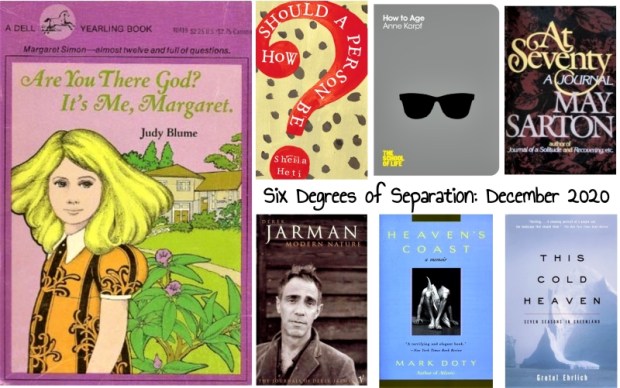
 #1 Another book with a question in the title (and dominating the cover) is How Should a Person Be? by Sheila Heti. I found a hardback copy in the unofficial Little Free Library I ran in our neighborhood during the first lockdown before the public library reopened. Heti is a divisive author, but I loved Motherhood for perfectly encapsulating my situation. I think this one, too, is autofiction, and the title question is one I ask myself variations on frequently.
 #2 I’ve read quite a few “How to” books, whether straightforward explanatory/self-help texts or not. Lots happened to be from the School of Life series. One I found particularly enjoyable and helpful was How to Age by Anne Karpf. She writes frankly about bodily degeneration, the pursuit of wisdom, and preparation for death. “Growth and psychological development aren’t a property of our earliest years but can continue throughout the life cycle.”
 #3 Ageing is a major element in May Sarton’s journals, particularly as she moves from her seventies into her eighties and fights illnesses. I’ve read all but one of her autobiographical works now, and – while my favorite is Journal of a Solitude – the one I’ve chosen as most representative of her usual themes, including inspiration, camaraderie, the pressures of the writing life, and old age, is At Seventy.
 #4 Sarton was a keen gardener, as was Derek Jarman. I learned about him in the context of nature helping people come to terms with their mortality. Modern Nature reproduces the journal the gay, HIV-positive filmmaker kept in 1989–90. Prospect Cottage in Dungeness, Kent, and the unusual garden he cultivated there, was his refuge between trips to London and further afield, and a mental sanctuary when he was marooned in the hospital.
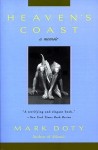 #5 One of the first memoirs I ever read and loved was Heaven’s Coast by Mark Doty, about his partner Wally’s death from AIDS. This sparked my continuing interest in illness and bereavement narratives, and it was through following up Doty’s memoirs with his collections of poems that I first got into contemporary poetry, so he’s had a major influence on my taste. I’ve had Heaven’s Coast on my rereading shelf for ages, so really must get to it in 2021.
 #6 Thinking of heaven, a nice loop back to Blume’s Margaret and her determination to find God … one of the finest travel books I’ve read is This Cold Heaven, about Gretel Ehrlich’s expeditions to Greenland and historical precursors who explored it. Even more than her intrepid wanderings, I was impressed by her prose, which made the icy scenery new every time. “Part jewel, part eye, part lighthouse, part recumbent monolith, the ice is a bright spot on the upper tier of the globe where the world’s purse strings have been pulled tight.”
A fitting final selection for this week’s properly chilly winter temperatures, too. I’ll be writing up my first snowy and/or holiday-themed reads of the year in a couple of weeks.
Join us for #6Degrees of Separation if you haven’t already! (Hosted on the first Saturday of each month by Kate W. of Books Are My Favourite and Best.)
 Bookish Beck = Rebecca Foster. American transplant to England. Freelance proofreader and book reviewer.
 Bookish Beck