Review Catch-up: Matt Gaw, Sheila Heti, Liz Jensen (and a Pile of DNFs)
Today I have a travel book about appreciating nature in any weather, a sui generis memoir drawn from a decade of diaries, and an impassioned cry for the environment in the wake of a young adult son’s death.
I’m also bidding farewell to a whole slew of review books that have been hanging around, in some cases, for literal years – I think one is from 2021, and several others from 2022. Putting a book on my “set aside” shelf can be a kiss of death … or I can go back at a better time and end up loving it. It’s hard to predict which will occur. On these, alas, I have had to admit defeat and will pass the books on to other homes.
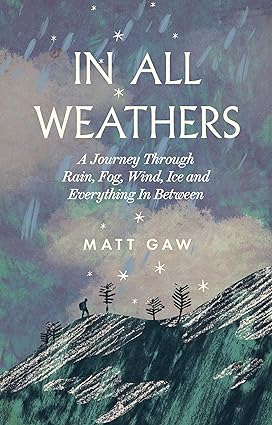
In All Weathers: A Journey through Rain, Fog, Wind, Ice and Everything in Between by Matt Gaw
Gaw’s two previous nature/travel memoirs, the enjoyable The Pull of the River and Under the Stars, involve gentle rambles through British landscapes, along with commentary on history, nature and science. The remit is much the same here. The book is split into four long sections: “Rain,” “Fog,” “Ice and Snow,” and “Wind.” The adventures always start from and end up at the author’s home in Suffolk, but he ranges as far as the Peak District, Cumbria and the Isle of Skye. Wild swimming is one way in which he experiences places. He notices a lot and describes it all in lovely and relatable prose.
 I was tickled by the definitions of, and statistics about, a “white Christmas”: in the UK, it counts if there’s even a single snowflake falling, whereas in the US there has to be 2.5 cm or more of standing snow. (Scotland is most likely to experience white Christmases; it has had 37 since 1960 vs. 26 in northern England. The English snow record is 43 cm, at Buxton and Malham Tarn in 1981 and 2009.) There’s underlying mild dread as he notes how weather patterns have changed and will likely continue changing, ever more dramatically, into his children’s future.
I find I don’t have much to say about this book because it is very nice but doesn’t do anything interesting or tackle anything that isn’t familiar from many other nature books (such as Rain by Melissa Harrison and Forecast by Joe Shute). It’s unfortunate for Gaw that his ideas often seem to have been done before – his book on night-walking, in particular, was eclipsed by several other works on that topic that came out at around the same time. I hope that the next time around he’ll get more editorial guidance to pursue original topics. It might take just a little push to get him to the next level where he could compete with top UK nature writers.
With thanks to Elliott & Thompson Books for the free copy for review.
Alphabetical Diaries by Sheila Heti
Heti put the contents of ten years of her diaries into a spreadsheet, alphabetizing each sentence (including articles), and then ruthlessly culled the results until she had a 25-chapter (no ‘X’) book. You could hardly call it a narrative, yet looking for one is so hardwired that every few sentences you are jolted out of what feels like a mini-story and into something new. Instead, you might think of it as an autobiographical mosaic. The recurring topics are familiar from the rest of Heti’s oeuvre, with obsessive cogitating about relationships, art and identity. But there are also the practicalities of trying to make a living as a woman in a creative profession. Tendrils of the everyday poke out here and there as she makes a meal, catches a plane, or buys clothes. Men loom large: explicit accounts of sex with Pavel and Lars (though also Fiona); advising her friend Lemons on his love life. There are also meta musings on what she is trying to achieve with her book projects and on what literature can be.
 Grammatically, the document is a lot more interesting than it could be – or than a similar experiment based on my diary would be, for instance – because Heti sometimes writes in incomplete sentences, dropping the initial pronoun; or intersperses rhetorical questions or notes to self in the imperative. So, yes, ‘I’ is a long chapter, but not only because of self-absorbed “I…” statements; there’s also plenty of “If…” and “It’s…” ‘H’ and ‘W’ are longer sections than might be expected because of the questioning mode. But it’s at the sentence level that the book makes the biggest impression: lines group together, complement or contradict each other, or flout coherence by being so merrily à propos of nothing. Here are a few passages to give a flavour:
Am I wasting my time? Am low on money. Am making noodles. Am reading Emma. Am tired and will go to sleep. Am tired today and I feel like I may be getting a cold. Ambivalence gives you something to do, something to think about.
Best not to live too emotionally in the future—it hardly ever comes to pass. Better to be on the outside, where you have always been, all your life, even in school, nothing changes. Better to look outward than inward. Blow jobs and tenderness. Books that fall in between the cracks of all aspects of the human endeavour.
It’s 2:34 every time I check the time these days. It’s 4 p.m. It’s 4:41 now. It’s a fantasy of being saved. It’s a stupid idea. It’s a yellow, cloudy sky. It’s amazing to me how life keeps going. It’s better to work, to go into the underground cave where there are books, than to fritter away time online. It’s crazy that I need all of these mental crutches in order to live. It’s fiction. It’s fine.
Scrambled eggs on toast at Yaddo. Second-guessing everything. Second, he said that no one is buying fiction. See the complexity. See the souls. See what kind of story the book can accommodate, if any. Seeing her for coffee was not so bad.
It’s surprising how much sense a text constructed so apparently haphazardly makes, perhaps because of the same subject and style throughout. Sometimes aphoristic, sometimes poetic (all that anaphora), the book is playful but overall serious about the capturing of a life on the page. Heti transcends the quotidian by exploding the one-thing-after-another tedium of chronology. Remarkably, the collage approach produces a more genuine, crystalline vision of the self than precise scenes and cause-and-effect chains ever could. A work of life writing like no other, it must be read in a manner all its own that it teaches you as you go along. I admire it enormously and hope I might write something even half as daring one day.
With thanks to Fitzcarraldo Editions for the free copy for review.
Your Wild and Precious Life: On grief, hope and rebellion by Liz Jensen
Jensen’s younger son, Raphaël Coleman, was just 25 when he collapsed while filming a documentary in South Africa and died of a previously undiagnosed heart condition. Raph had been involved in Extinction Rebellion and Jensen is a founding member of Writers Rebel. They both deemed activism “the best antidote to depression.” Her son had been obsessed with wildlife from a young age and was rewilding acres of their land in France, as well as making environmentalist films (he had achieved minor fame as a child actor in Nanny McPhee) and participating in direct action, such as at the Brazilian embassy in London.
 For Jensen, the challenge, especially after lockdown confined her to her Copenhagen flat, was to channel grief into further radicalism rather than retreating into herself or giving in to the lure of suicide. She tried to see personal grief as a reminder of ecogrief, and therefore as a spur. One way that she coped was turning towards the supernatural. She continued to hear and speak to Raph, in daily life as well as through a medium, and interpreted bird sightings as signs of his continued presence. An additional point of interest to me was that the author’s husband is Carsten Jensen, the writer of one of my favourite books, We, the Drowned.
This doesn’t particularly stand out among the dozens of bereavement memoirs I’ve read. (It was also remarkably similar to Alexandra Fuller’s Fi, which I’d read not long before.) Perhaps more years of reflection would have helped – Mary Karr advises seven – though I suspect Jensen felt, quite rightly, that given the current state of the environment we have no time to waste. And I have no doubt that the combination of a mother’s love and an ecological conscience will make this book meaningful to many readers.
With thanks to Canongate for the free copy for review.
And the DNFs…
there are more things, Yara Rodrigues Fowler – I loved Stubborn Archivist so much that I leapt at the chance to read her follow-up, but it was just too dull and involved about Brazilian versus UK politics. Nor did the stylistic tricks feel as novel this time around. I read 66 pages. (Fleet)
The Rabbit Hutch, Tess Gunty – Gunty dazzled critics and prize judges in the USA, winning a National Book Award. I was drawn to her debut novel for the composite picture of the residents of one Indiana apartment building and the strange connections that develop between them over one summer week, including perhaps a murder? Blandine, the central character, is a sort of modern-day mystic but hard to warm to (“She normally tries to avoid saying in which out loud, to minimize the number of people who find her insufferable”), as are all the characters. This felt like try-hard MFA writing. I read 85 pages. (Oneworld)
Eve: The Disobedient Future of Birth, Claire Horn – I usually get on well with Wellcome Collection books. I think the problem here was that there was too much material that was familiar to me from having read Womb by Leah Hazard – even the SF-geared stuff about artificial wombs. I read 45 pages. (Profile Books)
Blessings, Chukwuebuka Ibeh – This debut novel has a confident voice, buttressed by determination to reveal what life is like for queer people living in countries where homosexuality is criminalized. Obiefuna is cast out for having a crush on Aboy, his father’s apprentice, even though the two young men share nothing more physical than a significant gaze into each other’s eyes. The strict boarding school his father sends him to is a place of privation, hierarchy, hazing and, I suspect, same-sex experimentation. I found the writing capable but couldn’t get past a sense of dread about what was going to happen. Meanwhile, I didn’t think the alternating chapters from Obiefuna’s mother’s perspective added anything to the narrative. I read 62 pages. (Penguin Viking)
The War for Gloria, Atticus Lish – Lish’s debut novel, Preparation for the Next Life, was excellent, but I could never get stuck in to this follow-up, despite the appealing medical theme. When Gloria Goltz is diagnosed with ALS, her 15-year-old son Corey turns to his absent father and others for support. It was also unfortunate that Lish mentions the Ice Bucket Challenge: that was popularized in 2014, whereas the book is set in 2010. I read 75 pages. (Serpent’s Tail)
Snow Widows: Scott’s Fatal Antarctic Expedition through the Eyes of the Women They Left Behind, Katherine MacInnes – I seriously overestimated my interest in polar exploration narratives. MacInnes seems to have done quite a good job of creating novelistic scenes through research, though. I read 35 pages. (William Collins)
The Woodcock, Richard Smyth – I feel particularly bad about this one as I’ve read and enjoyed three of Smyth’s nature books and my husband and I are friendly with him on Twitter. Initially, I got Thomas Hardy, D.H. Lawrence and Sarah Perry (The Essex Serpent, anyway) vibes from this 1920s-set novel about the upheaval a naturalist and his wife experience when an American whaler and his daughters arrive in their small coastal English town. I read 90 pages. (Fairlight Books)
Better Broken than New: A Fragmented Memoir, Lisa St Aubin de Terán – I accepted this for review because I’d often seen the author’s name on spines in secondhand bookstores but didn’t know anything about her work. The précis of her globe-trotting life is stranger than fiction: marriage to a Venezuelan freedom fighter, managing a sugar plantation in the Andes, living in an Italian palace for 20 years, founding a charity in Mozambique. The vignettes in the early part of the book (e.g., skipping school and going on daytrips by train at age eight) are entertaining, if written with blithe disregard for a reader’s need for context or perspective. But the fragmented nature means it all feels as random as life, without the necessary authorial shaping. The publisher has done her a disservice as she seeks to relaunch her career by not proofreading properly: Many small errors slipped through the net, making this look like a sloppy manuscript. The worst happen to be other authors’ names: Jane ‘Austin’, ‘Kahil’ Gibran, Virginia ‘Wolfe’. Are you kidding me?! I read 53 pages. (Amaurea Press)
Miscellaneous #ReadIndies Reviews: Mostly Poetry + Brown, Sands
Catching up on a few final #ReadIndies contributions in early March! Short responses to some indie reading I did from my shelves over the course of last month.

Bloodaxe Books:
Parables & Faxes by Gwyneth Lewis (1995)
 I was surprised to discover this was actually my fourth book by Lewis, a bilingual Welsh author: two memoirs, one of depression and one about marriage; and now two poetry collections. The table of contents suggest there are only 16 poems in the book, but most of the titles are actually headings for sections of anywhere between 6 and 16 separate poems. She ranges widely at home and abroad, as in “Welsh Espionage” and the “Illinois Idylls.” “I shall taste the tang / of travel on the atlas of my tongue,” Lewis writes, an example of her alliteration and sibilance. She’s also big on slant and internal rhymes – less so on end rhymes, though there are some. Medieval history and theology loom large, with the Annunciation featuring more than once. I couldn’t tell you now what that many of the poems are about, but Lewis’s telling is always memorable.
Sample lines:
For the one
who said yes,
how many
said no?
…
But those who said no
for ever knew
they were damned
to the daily
as they’d disallowed
reality’s madness,
its astonishment.
(from “The ‘No’ Madonnas,” part of “Parables & Faxes”)
(Secondhand purchase – Westwood Books, Sedbergh) 
&
Fields Away by Sarah Wardle (2003)
 Wardle’s was a new name for me. I saw two of her collections at once and bought this one as it was signed and the themes sounded more interesting to me. It was her first book, written after inpatient treatment for schizophrenia. Many of the poems turn on the contrast between city (London Underground) and countryside (fields and hedgerows). Religion, philosophy, and Greek mythology are common points of reference. End rhymes can be overdone here, and I found a few of the poems unsubtle (“Hubris” re: colonizers and “How to Be Bad” about daily acts of selfishness vs. charity). However, there are enough lovely ones to compensate: “Flight,” “Word Tasting” (mimicking a wine tasting), “After Blake” (reworking “Jerusalem” with “And will chainsaws in modern times / roar among England’s forests green?”), “Translations” and “Word Hill.”
Favourite lines:
(oh, but the last word is cringe!)
Catkin days and hedgerow hours
fleet like shafts of chapel sun.
Childhood in a cobwebbed bower
guards a treasure chest of fun.
(from “Age of Awareness”)
(Secondhand purchase – Carlisle charity shop) 
Carcanet Press:
Tripping Over Clouds by Lucy Burnett (2019)
 The title is a setup for the often surrealist approach, but where another Carcanet poet, Caroline Bird, is warm and funny with her absurdism, Burnett is just … weird. Like, I’d get two stanzas into a poem and have no idea what was going on or what she was trying to say because of the incomplete phrases and non-standard punctuation. Still, this is a long enough collection that there are a good number of standouts about nature and relationships, and alliteration and paradoxes are used to good effect. I liked the wordplay in “The flight of the guillemet” and the off-beat love poem “Beer for two in Brockler Park, Berlin.” The noteworthy Part III is composed of 34 ekphrastic poems, each responding to a different work of (usually modern) art.
Favourite lines:
This is a place of uncalled-for space
and by the grace of the big sky,
and the serrated under-silhouette of Skye,
an invitation to the sea unfolds
to come and dine with mountain.
(from “Big Sands”)
(New (bargain) purchase – Waterstones website) 
&
The Met Office Advises Caution by Rebecca Watts (2016)
 The problem with buying a book mostly for the title is that often the contents don’t live up to it. (Some of my favourite ever titles – An Arsonist’s Guide to Writers’ Homes in New England, The Voluptuous Delights of Peanut Butter and Jam – were of books I couldn’t get through). There are a lot of nature poems here, which typically would be enough to get me on board, but few of them stood out to me. Trees, bats, a dead hare on the road; maps, Oxford scenes, Christmas approaching. All nice enough; maybe it’s just that the poems don’t seem to form a cohesive whole. Easy to say why I love or hate a poet’s style; harder to explain indifference.
Sample lines:
Branches lash out; old trees lie down and don’t get up.
A wheelie bin crosses the road without looking,
lands flat on its face on the other side, spilling its knowledge.
(from the title poem)
(New (bargain) purchase – Amazon with Christmas voucher)
Faber:
Places I’ve Taken My Body by Molly McCully Brown (2020)
 The title signals right away how these linked autobiographical essays split the ‘I’ from the body – Brown resents the fact that disability limits her experience. Oxygen deprivation at their premature birth led to her twin sister’s death and left her with cerebral palsy severe enough that she generally uses a wheelchair. In Bologna for a travel fellowship, she writes, “There are so many places that I want to be, but I can’t take my body anywhere. But I must take my body everywhere.” A medieval city is particularly unfriendly to those with mobility challenges, but chronic pain and others’ misconceptions (e.g. she overheard a guy on her college campus lamenting that she’d die a virgin) follow her everywhere.
A poet, Brown earned minor fame for her first collection, which was about historical policies of enforced sterilization for the disabled and mentally ill in her home state of Virginia. She is also a Catholic convert. I appreciated her exploration of poetry and faith as ways of knowing: “both … a matter of attending to the world: of slowing my pace, and focusing my gaze, and quieting my impatient, indignant, protesting heart long enough for the hard shell of the ordinary to break open and reveal the stranger, subtler singing underneath.” This is part of a terrific run of three pieces, the others about sex as a disabled person and the odious conservatism of the founders of Liberty University. Also notable: “Fragments, Never Sent,” letters to her twin; and “Frankenstein Abroad,” about rereading this novel of ostracism at its 200th anniversary. (Secondhand purchase – Amazon)
New River Books:
The Hedgehog Diaries: A Story of Faith, Hope and Bristle by Sarah Sands (2023)
 Reasons for reading: 1) I’d enjoyed Sands’s The Interior Silence and 2) Who can resist a book about hedgehogs? She covers a brief slice of 2021–22 when her aged father was dying in a care home. Having found an ill hedgehog in her garden and taken it to a local sanctuary, she developed an interest in the plight of hedgehogs. In surveys they’re the UK’s favourite mammal, but it’s been years since I saw one alive. Sands brings an amateur’s enthusiasm to her research into hedgehogs’ place in literature, philosophy and science. She visits rescue centres, meets activists in Oxfordshire and Shropshire who have made hedgehog welfare a local passion, and travels to Uist to see where hedgehogs were culled in 2004 to protect ground-nesting birds’ eggs. The idea is to link personal brushes with death with wider threats of extinction. Unfortunately, Sands’s lack of expertise is evident. This was well-meaning, but inconsequential and verging on twee. (Christmas gift from my wishlist)
Recommended July Releases: Donoghue, Maizes, Miller, Parikian, Trethewey
My five new releases for July include historical pandemic fiction, a fun contemporary story about a father-and-daughter burglar team, a new poetry collection from Carcanet Press, a lighthearted nature/travel book, and a poetic bereavement memoir about a violent death.
The Pull of the Stars by Emma Donoghue
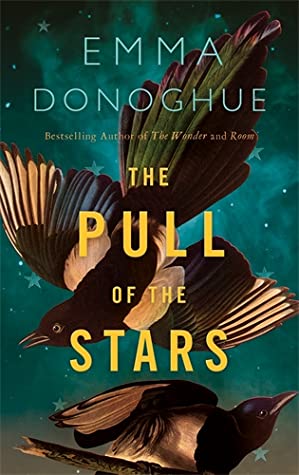 Donoghue’s last two novels, The Wonder and Akin, were big hits with me. Less than a year after the contemporary-set Akin, she’s back to a historical setting – and an uncannily pertinent pandemic theme – with her latest. In 1918, Julia Power is a nurse on a Dublin maternity ward. It’s Halloween and she is about to turn 30, making her a spinster for her day; she lives with her mute, shell-shocked veteran brother, Tim, and his pet magpie.
Because she’s already had “the grip” (influenza), she is considered immune and is one of a few staff members dealing with the flu-ridden expectant mothers in quarantine in her overcrowded hospital. Each patient serves as a type, and Donoghue whirls through all the possible complications of historical childbirth: stillbirth, obstructed labor, catheterization, forceps, blood loss, transfusion, maternal death, and so on.
It’s not for the squeamish, and despite my usual love of medical reads, I felt it was something of a box-ticking exercise, with too much telling about medical procedures and recent Irish history. Because of the limited time frame – just three days – the book is far too rushed. We simply don’t have enough time to get to know Julia through and through, despite her first-person narration; the final 20 pages, in particular, are so far-fetched and melodramatic it’s hard to believe in a romance you’d miss if you blinked. And the omission of speech marks just doesn’t work – it’s downright confusing with so many dialogue-driven scenes.
Donoghue must have been writing this well before Covid-19, but I wouldn’t be surprised if the publication was hurried forward to take advantage of the story’s newfound relevance. It shows: what I read in May and June felt like an unpolished draft, with threads prematurely tied up to meet a deadline. This was an extremely promising project that, for me, was let down by the execution, but it’s still a gripping read that I wouldn’t steer you away from if you find the synopsis appealing. (Some more spoiler-y thoughts here.)
Prescient words about pandemics:
“All over the globe … some flu patients are dropping like flies while others recover, and we can’t solve the puzzle, nor do a blasted thing about it. … There’s no rhyme or reason to who’s struck down.”
“Doctor Lynn went on, As for the authorities, I believe the epidemic will have run its course before they’ve agreed to any but the most feeble action. Recommending onions and eucalyptus oil! Like sending beetles to stop a steamroller.”
Why the title?
Flu comes from the phrase “influenza delle stelle” – medieval Italians thought that illness was fated by the stars. There’s also one baby born a “stargazer” (facing up) and some literal looking up at the stars in the book.
My rating:
My thanks to Picador for the proof copy for review.
Other People’s Pets by R.L. Maizes
 This is Maizes’ debut novel, after her 2019 short story collection We Love Anderson Cooper. Louise “La La” Fine and her father, Zev, share an unusual profession: While outwardly they are a veterinary student and a locksmith, respectively, for many years they broke into homes and sold the stolen goods. Despite close shaves, they’ve always gotten away with it – until now. When Zev is arrested, La La decides to return to her criminal ways just long enough to raise the money to post bail for him. But she doesn’t reckon on a few complications, like her father getting fed up with house arrest, her fiancé finding out about her side hustle, and her animal empathy becoming so strong that when she goes into a house she not only pilfers valuables but also cares for the needs of ailing pets inside.
Flashbacks to La La’s growing-up years, especially her hurt over her mother leaving, take this deeper than your average humorous crime caper. The way the plot branches means that for quite a while Zev and La La are separated, and I grew a bit weary of extended time in Zev’s company, but this was a great summer read – especially for animal lovers – that never lost my attention. The magic realism of the human‒pet connection is believable and mild enough not to turn off readers who avoid fantasy. Think The Twelve Lives of Samuel Hawley meets Hollow Kingdom.
My rating: 
My thanks to the author and Celadon Books for the free e-copy for review.
The Long Beds by Kate Miller
 Here and there; now and then: the poems in Miller’s second collection enlarge such dichotomies by showcasing the interplay of the familiar and the foreign. A scientist struggles to transcribe birdsong, and a poppy opens in slow motion. “Flag” evokes the electric blue air and water of a Greek island, while “The Quarters” is set in the middle of the night in a French village. A few commissions, including “Waterloo Sunrise,” stick close to home in London or other southern England locales.
Various poems, including the multi-part “Album Without Photographs,” are about ancestor Muriel Miller’s experiences in India and Britain in the 1910s-20s. “Keepers of the States of Sleep and Wakefulness, fragment from A Masque,” patterned after “The Second Masque” by Ben Jonson, is an up-to-the-minute one written in April that names eight nurses from the night staff at King’s College Hospital (and the short YouTube film based on it is dedicated to all NHS nurses).
My two favorites were “Outside the Mind Shop,” in which urban foxes tear into bags of donations outside a charity shop one night while the speaker lies awake, and “Knapsack of Parting Gifts” a lovely elegy to a lost loved one. I spotted a lot of alliteration and assonance in the former, especially. Thematically, the collection is a bit scattered, but there are a lot of individual high points.
My rating:
My thanks to Carcanet Press for the free e-copy for review.
Into the Tangled Bank: In Which Our Author Ventures Outdoors to Consider the British in Nature by Lev Parikian
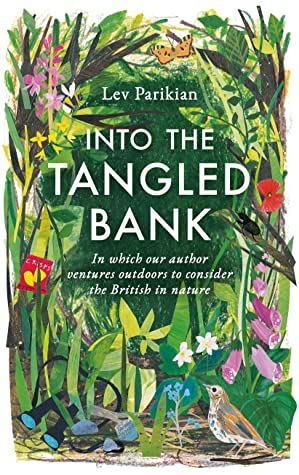 In the same way that kids sometimes write their address by going from the specific to the cosmic (street, city, country, continent, hemisphere, planet, galaxy), this book, a delightfully Bryson-esque tour, moves ever outwards, starting with the author’s own home and garden and proceeding to take in his South London patch and his journeys around the British Isles before closing with the wonders of the night sky. By slowing down to appreciate what is all around us, he proposes, we might enthuse others to engage with nature.
With the zeal of a recent convert, he guides readers through momentous sightings and everyday moments of connection. As they were his gateway, many of these memories involve birds: looking for the year’s first swifts, trying to sketch a heron and realizing he’s never looked at one properly before, avoiding angry terns on the Farne Islands, ringing a storm petrel on Skokholm, and seeing white-tailed eagles on the Isle of Skye. He brings unique places to life, and pays tribute to British naturalists who paved the way for today’s nature-lovers by visiting the homes of Charles Darwin, Gilbert White, Peter Scott, and more.
I was on the blog tour for Parikian’s previous book, Why Do Birds Suddenly Disappear?, in 2018. While the books are alike in levity (pun intended!), being full of self-deprecation and witty asides along with the astute observations, I think I enjoyed this one that little bit more for its all-encompassing approach to the experience of nature. I fully expect to see it on next year’s Wainwright Prize longlist (speaking of the Wainwright Prize, in yesterday’s post I correctly predicted four on the UK nature shortlist and two on the global conservation list!).
Readalikes (that happen to be from the same publisher): Under the Stars by Matt Gaw and The Seafarers by Stephen Rutt
My rating: 
My thanks to Elliott & Thompson for the free copy for review.
Memorial Drive: A Daughter’s Memoir by Natasha Trethewey
 Trethewey grew up in 1960s Mississippi with a Black mother and a white Canadian father, at a time when interracial marriage remained illegal in parts of the South. After her parents’ divorce, she and her mother, Gwen, moved to Georgia to start a new life, but her stepfather Joel was physically and psychologically abusive. Gwen’s murder opens and closes the book. Trethewey only returned to that Atlanta apartment on Memorial Drive after 30 years had passed. The blend of the objective (official testimonies and transcripts) and the subjective (interpreting photographs, and rendering dream sequences in poetic language) makes this a striking memoir, as delicate as it is painful. I recommend it highly to readers of Elizabeth Alexander and Dani Shapiro. (Full review forthcoming at Shiny New Books.)
My rating: 
My thanks to Bloomsbury for the proof copy for review.

 I’m reading two more July releases, Mostly Dead Things by Kristen Arnett (Corsair, 2 July; for Shiny New Books review), about a family taxidermy business in Florida, and The Liar’s Dictionary by Eley Williams (William Heinemann, 2 July), about an unusual dictionary being compiled in the Victorian period and digitized in the present day.
 Bookish Beck = Rebecca Foster. American transplant to England. Freelance proofreader and book reviewer.
 Bookish Beck