Reading Ireland Month, Part II: Dowd, Enright, Madden & Nugent
I’m catching up with a final set of reviews for #ReadingIrelandMonth26. I read two novels set at least partially during the Troubles, one of them for teenagers; a quiet novel about adultery and bereavement; and a thriller about consent and family legacy. I also read the first half of one more novel, a sombre one about the aftermath of a mental health crisis. Between this post and my first one, I covered 6.5 novels by Irish women, which I’ll call a win.
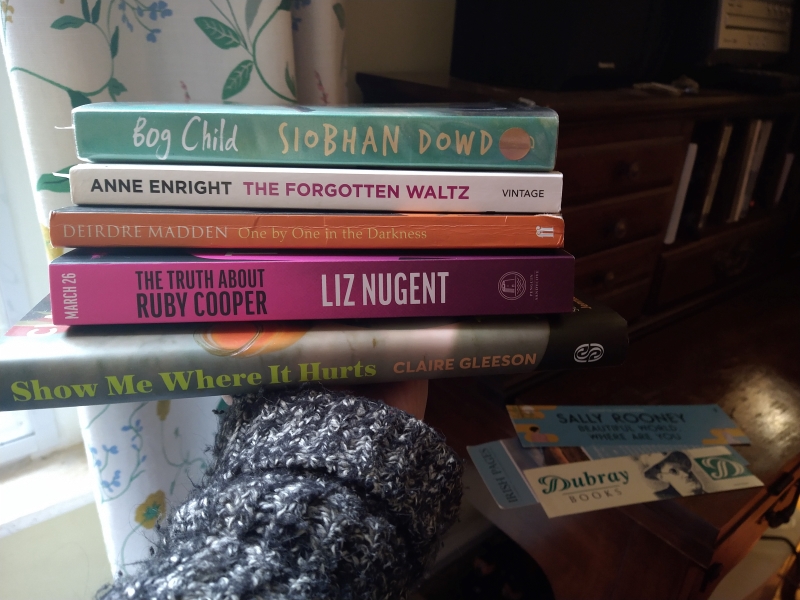
Bog Child by Siobhan Dowd (2008)
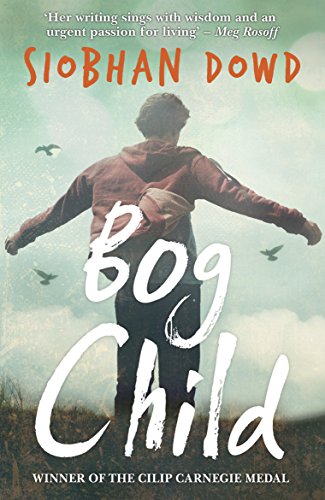 Fergus McCann is 18 and taking A levels; if he can only get three Bs, he’ll have his ticket out of Northern Ireland to study medicine at Aberdeen. This is no ordinary summer, though. He loves running on the hills at the border and here he makes a landmark discovery and embarks on a risky mission. The plot opens with Fergus and his uncle stumbling on the corpse of a girl while cutting peats. It’s a case for archaeologists rather than the police: the body is from the Iron Age and there’s evidence that the girl was sacrificed. An acquaintance then pressures Fergus into running parcels up and down the hill, right under the noses of the British at the checkpoint. He makes friends with Owain, a Welsh soldier, but gets a horrible feeling he’s partially responsible for the bombings he soon hears about on the radio. His family is enmeshed in the IRA anyway: his brother is among the hunger strikers in the local prison. There’s every chance that Joey could die before the summer is out, as much a victim of injustice as “Mel” (as Fergus names the girl from the bog, whose story he dreams).
This was Dowd’s third novel, published posthumously after her death from cancer, and won the Carnegie Medal. I’d say it’s one of the few best young adult novels I’ve ever read. (It’s shelved under Teenage Fiction at my library.) It’s an excellent peripheral glance at history ancient and modern – Fergus’s letter to Margaret Thatcher is brilliant – and effectively recreates a teen’s divided attention: friends, schooling, family drama, the future, and romance (via the daughter of the archaeologist). I searched my library catalogue for further books on bog bodies after reading Anna North’s Bog Queen and it really paid off! (Public library)
The Forgotten Waltz by Anne Enright (2011)
 I’ve only read a handful of Enright novels and wanted to experience more, so picked this one because it was shortlisted for the Orange Prize. On the face of it, it’s a fairly straightforward adultery story, but the unshowy potency of Enright’s writing and her realistic insight into relationships set it apart. While married to Conor, Gina has an affair with Seán, who’s older and married to Aileen. Seán is part of their social circle but also someone she knows through work, and business trips are an easy excuse. “The office game was another game for us to play, after the suburban couples game, and before the game of hotel assignations and fabulous, illicit lust, and neither of us thought there might come a moment when all the games would stop. It was a lot of fun.” Gina narrates matter-of-factly, rejecting cause-and-effect language. She doesn’t defend herself, or fool herself that Seán is perfect. This new relationship involves as many challenges as her marriage, what with her mother’s death and Seán’s preteen daughter, Evie, who appears to be autistic and epileptic. The short chapters are all headed with song lyrics, mostly from love songs (“Will You Love Me Tomorrow,” “Stop! In the Name of Love”) whose ironic optimism underlines the novel’s gently melancholy tone. This reminded me most of Maggie O’Farrell’s early work, and more than justified delving into Enright’s back catalogue. (Secondhand – Awesomebooks.com)
{SPOILERS IN THE REST!!}
One by One in the Darkness by Deirdre Madden (1996)
 Louise Kennedy’s Trespasses was our book club selection for March; I’d read it just two years ago, so skimmed back through and was impressed by its construction. Some were less convinced by the framing story and not emotionally engaged with Michael and Cushla’s affair, but we all appreciated it as a sideways look at Northern Irish history. One by One in the Darkness, which was also shortlisted for the Women’s (then Orange) Prize, is set close to its publication in the 1990s but returns to the Troubles through memories and flashbacks. Set over one week – Saturday to Friday – it’s the story of the three Quinn sisters. Cate is a journalist in London who flies home to Antrim to break the news that she’s pregnant out of wedlock. Helen is a lawyer and Sally a schoolteacher. They, their mother, and Uncle Brian have all gotten on with life as best they could, but their father’s murder is something they can’t forget and won’t ever get over. By saving that scene for the very last page of this novella, she keeps the horror of it fresh. Through one family’s story, she gives a sense of the scope of the country’s loss. But the book is not without a dark sense of humour, either. Madden was a new author for me. I found her work profound at the sentence level (see below for some favourite lines) rather than engaging at the plot level. (Secondhand – Awesomebooks.com)
“‘What’s wrong with Uncle Peter?’ ‘Two things,’ [Granny] said. ‘He thinks too much, and then he drinks too much.’”
“Once when [Cate] was home she’d remarked to Helen that she thought the forecasts were often inaccurate in Northern Ireland. ‘It’s probably deliberate,’ Helen had replied. ‘If they read out the average day’s news here and then said at the end of it, “Oh, and by the way, it’s going to bucket rain for the next twenty-four hours,” it might be more than people could take.’”
“Cate had remarked once that it was only when you lived away from Northern Ireland that you realised on returning how deeply divided a society it was, and how strange the effect of that could be.”
“There’d been well over three thousand people killed since the start of the Troubles, and every single one of them had parents or husbands and wives and children whose lives had been wrecked. It would be written about in the paper for two days, but as soon as the funeral was over it was as if that was the end, when it was really only the beginning.”
The Truth about Ruby Cooper by Liz Nugent (2026)
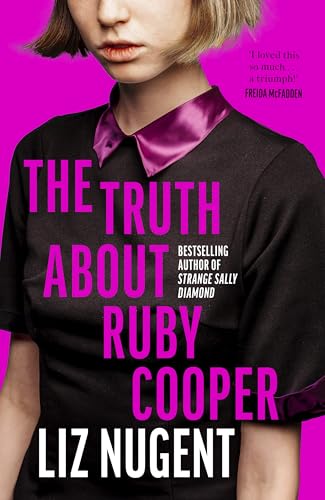 We read Nugent’s Strange Sally Diamond for book club a couple years ago and it was a great Northumberland holiday read for me, with a deliciously off-kilter narrator whose traumatized (and perhaps neurodivergent) perspective carried the novel. Here again Nugent prioritizes unreliable women’s voices and dark happenings, but Ruby is awfully hard to like. At age 16, she falsely accuses her older sister Erin’s boyfriend Milo of raping her. Milo maintains his innocence all along, but goes to jail for the crime; after all, DNA evidence can’t lie, right? Years of his life – and a heartbroken Erin’s – are stolen, his mother dies by suicide, Ruby becomes dependent on alcohol: all of this because of sisterly jealousy and an elaborate lie that their mother upholds rather than expose the family to further shame.
Narration alternates between Erin in Boston and Ruby, who’s moved back to Ireland with their mother. For Ruby’s confession to work, readers are kept in the dark about the truth of the incident, though only for 76 pages. Together the sisters give a tedious blow-by-blow of the intervening years – until Ruby’s daughter, Lucy, is raped by her boss on a drunken night out. Ruby refuses to believe her “because if it was true, that was karma coming to bit me on the ass.” This is where things finally get interesting, as Nugent explores ironies and familial patterns. But I’m sure I won’t be the only one to find the whole thing distasteful. Nugent clearly anticipates a backlash, stating in a prefatory letter, “I need to be very clear about the fact that girls and women like Ruby Cooper are extremely rare.” Was it worth undermining the #BelieveWomen campaign to explore a certain state of mind? Nah.
With thanks to Sandycove (Penguin) for the proof copy for review.
I’d also hoped to finish one more, but ran out of time. Here are my thoughts on the first half:
Show Me Where It Hurts by Claire Gleeson (2025)
 Rachel knew Tom had recurring problems with depression, but had no idea he was on the verge of a breakdown when he deliberately drove their car off the road with the intention of killing his entire family. Their two young children die in the crash but they both survive – Tom held in a psychiatric hospital and Rachel resuming her life as a nurse. The chapters alternate between “After” and “Before,” giving relative date markers in weeks, months or years out from the incident. Gleeson’s understated prose makes it possible for readers to face a tragedy so awful we’d otherwise look away; it never tips over into mawkishness.
Autumn Reads: Don Freeman, Seamus Heaney, Jo Lindley, Alice Oseman
I keep a whole box full of future seasonal reads. Winter is the largest contingent because it includes Christmas, cold, snow and ice; followed by summer, which also covers heat, sun and so on. Every once in a while, I’ll come across a spring-related book. Autumn may be great for misty canal walks, vibrant leaves and variegated squashes, but it’s the hardest of the seasons to find books for. I’ve read all the obvious ones by now. Some of the below connections are more abstract but not too much of a stretch, I hope.


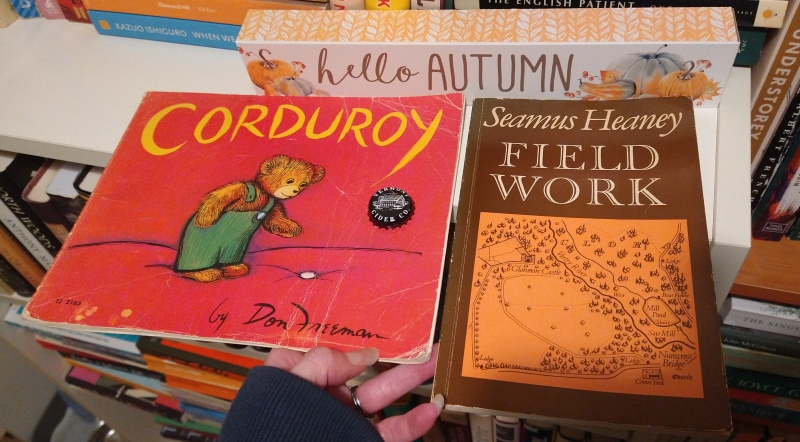
Corduroy by Don Freeman (1968)
Autumn is when I wear the most corduroy, sometimes (accidentally) head to toe.
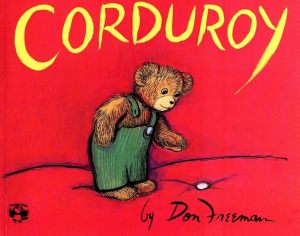
 I knew I’d read this as a child, but didn’t expect individual pages to feel so familiar. It must have been on frequent rotation in my house growing up. Corduroy the bear is among the toys on offer in a large department store. One morning Lisa, a little Black girl, picks him out, but her mother says no, they’ve spent too much already – and besides, the toy is damaged. He didn’t realize until her mother said: his green overall is missing a button. That night he rides the escalator to go look for the button, thinking he’ll never be loved until he’s complete. His adventure doesn’t turn out as planned, but Lisa hasn’t stopped thinking about him. Long before Toy Story, here was a sweet book about what toys get up to when we’re not around. And the repeated expressions of the bear’s meek wonderment – “This must be home,” “You must be a friend” – gave me the warm fuzzies. (Little Free Library)
Field Work by Seamus Heaney (1979)
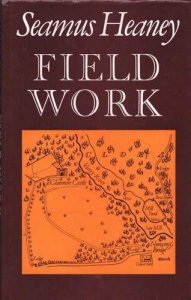 Harvest is a secondary theme in this poetry collection, which also has an overall melancholy tone that seems appropriate to the season of All Souls. Two poems are headed “In Memoriam” and another is titled “Elegy.” Even when they are not the stated topic, the Troubles rear up, as in the first section of “Triptych”: “Two young men with rifles on the hill, / Profane and bracing as their instruments. // Who’s sorry for our trouble?” The countryside can nevermore be an idyll when armoured cars and bombs could be anywhere. “The end of art is peace,” a late line from “The Harvest Bow,” may well be the poet’s motto (so long as “end” is interpreted as “goal”). There is a sequence of 10 sonnets and several poems devoted to animals. I experience Heaney’s poetry as linguistically fertile and formally rigorous; probably best heard out loud. (Secondhand – Oxfam, Marlborough)
Autumnal passages I marked:
“We toe the line / between the tree in leaf and the bare tree.” (from “September Song”)
“the sunflower, dreaming umber” (from “Field Work”)
“A rowan like a lipsticked girl” (from “Song”)
“the sunset blaze / of straw on blackened stubble, a thatch-deep, freshening barbarous crimson burn” (from “Leavings”)
But none of those stood out to me as much as “Oysters,” the opening poem, which I photographed here. I’ve read and savoured every line of it five times now. It’s gold.
Hello Autumn by Jo Lindley (2023)
 Depicted as elfin children, the seasons take turns wearing a single crown. Autumn is a timid soul worried about what might go wrong. But when one of the others is at risk, he rushes to help even if it might take him outside his comfort zone. By doing so, he realizes how much there is to enjoy in every season. This is part of a didactic series (Little Seasons/Best Friends with Big Feelings) about coping with anxiety. I’m surprised it wasn’t classified in the mostly-nonfiction “Family Matters” section of the children’s library, which includes books on feelings, illnesses, death, divorce, siblings, first experiences, etc. It was a little heavy-handed for me and I wasn’t sure why the characters had to be elves. (Public library)
Heartstopper: Volume 1 by Alice Oseman (2019)
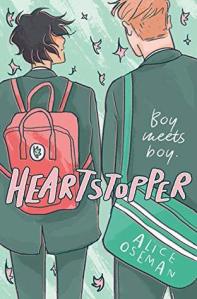 I’ve been rereading the series through the hardback reissue; I’m now on Volume 5 (and WHERE is Volume 6, huh?). I’ve included the first book because of the falling leaves motif on the cover, which fits the back-to-school vibe. (Public library)
What I thought this time: Just as cute the second time around. All the looks, all the blushes, all the angst! I’d forgotten the details of how Nick and Charlie met and got together. Single best page: when Tori appears out of nowhere and says to Charlie of Nick, “I don’t think he’s straight.”
Original review: It’s well known at Truham boys’ school that Charlie is gay. Luckily, the bullying has stopped and the others accept him. Nick, who sits next to Charlie in homeroom, even invites him to join the rugby team. Charlie is smitten right away, but it takes longer for Nick, who’s only ever liked girls before, to sort out his feelings. This black-and-white YA graphic novel is pure sweetness, taking me right back to the days of high school crushes.
Reading Ireland Month, Part II: Hughes, Kennedy, Murray
My second contribution to Reading Ireland Month after a first batch that included poetry and a novel.

Today I have a poetry collection based around science and travel, and two multi-award-winning novels, one set in the thick of the Troubles in Belfast and another about the crumbling of an ordinary suburban family.
Gathering Evidence by Caoilinn Hughes (2014)
 I bought this in the same order as Patricia Lockwood’s poetry collection, thinking a segue to another genre within an author’s oeuvre (I’d enjoyed Hughes’s 2018 debut novel, Orchid & the Wasp) might be a clever strategy. That worked out with Lockwood, but not as well here. A collection about scientific discoveries and medical advances seemed likely to be up my street. “The Moon Should Be Turned” is about the future of the HeLa cells harvested from Henrietta Lacks; poems are dedicated to the Curies and Johannes Kepler and one has Fermi as a main character. Russian nuclear force is a background menace. There are also some poems about growing up in Dublin and travels in the Andes. “Vagabond Monologue” stood out for its voice, “Marbles” for its description of childhood booty: “A netted bag of green glass marbles with aquamarine swirls / deep in the otherworld of spherical transparency (simultaneous opacity) / was the first thing I ever stole when I was three and far from the last.” Elsewhere, though, I found the precision vocabulary austere and offputting. (New purchase with Amazon voucher)
Trespasses by Louise Kennedy (2022)
Despite its many accolades, not least a shortlisting for the Women’s Prize, I couldn’t summon much enthusiasm for reading a novel about the Troubles. I don’t know why I tend to avoid this topic; perhaps it’s the insidiousness of fighting that’s not part of a war somewhere else, but ongoing domestic terrorism instead. Combine that with an affair – Cushla is a 24-year-old schoolteacher who starts sleeping with a middle-aged, married barrister she meets in her family’s pub – and it sounded like a tired, ordinary plot. But after this won last year’s McKitterick Prize (for debut authors over 40) and I was sent the whole shortlist in thanks for being a manuscript judge, I thought I should get over myself and give it a try.
 Little surprise that Kennedy’s writing – compassionate, direct, heart-rending – is what sets the book apart. With no speech marks, radio reports of everyday atrocities blend in with thoughts and conversations. We meet and develop fondness for characters across classes and the Catholic–Protestant divide: Cushla’s favourite pupil, Davy, whose father was assaulted in the street; her alcoholic mother, Gina, who knows more than she lets on, despite her inebriation; Gerry, a colleague who takes Cushla on friend dates and covers for her when she goes to see Michael. An Irish language learning circle introduces the 1970s bourgeoisie with their dinner parties and opinions.
This doesn’t read like a first novel at all, with each character fully realized and the plot so carefully constructed that I was as shocked as Cushla by a revelation four-fifths of the way through. Desire is bound up with guilt; can anyone ever be happy when violence is so ubiquitous and random? “Booby trap. Incendiary device. Gelignite. Nitroglycerine. Petrol bomb. Rubber bullets. Saracen. Internment. The Special Powers Act. Vanguard. The vocabulary of a seven-year-old child now.” But a brief framing episode set in 2015 gives hope of life beyond seemingly inescapable tragedy. (Free from the Society of Authors) 
The Bee Sting by Paul Murray (2023)
“The trouble is coming from inside; from his family. And unless something happens to stop it, it will keep billowing out, worse and worse”
Another great Irish novel I nearly missed out on, despite it being shortlisted for the Booker Prize and Writers’ Prize and winning the inaugural Nero Book Awards’ Gold Prize, this one because I was daunted by its doorstopper proportions. I’d gotten it in mind that it was all about money: Dickie Barnes’s car dealership is foundering and the straitened circumstances affect his whole family (wife Imelda, teenage daughter Cass, adolescent son PJ). A belated post-financial crash novel? Again, it sounded tired, maybe clichéd.
 But actually, this turned out to be just the kind of wry, multi-perspective dysfunctional family novel that I love, such that I was mostly willing to excuse a baggy midsection. Murray opens with long sections of close third person focusing on each member of the Barnes family in turn. Cass is obsessed with sad-girl poetry and her best friend Elaine, but self-destructive habits threaten her university career before it’s begun. PJ is better at making friends through online gaming than in real life because of his family’s plunging reputation, so concocts a plan to run away to Dublin. Imelda is flirting with Big Mike, who’s taking over the dealership, but holds out hope that Dickie’s wealthy father will bail them out. Dickie, under the influence of a weird handyman named Victor, has become fixated on eradicating grey squirrels and building a bunker to keep his family safe.
There are no speech marks throughout, and virtually no punctuation in Imelda’s sections. There are otherwise no clever tricks to distinguish the points-of-view, though. The voice is consistent. Murray doesn’t have to strain to sound like a teenage girl; he fully and convincingly inhabits each character (even some additional ones towards the end). I particularly liked the final “Age of Loneliness” section, which starts rotating between the perspectives more quickly, each one now in the second person. It all builds towards a truly thrilling yet inconclusive ending. I could imagine this as a TV miniseries for sure.
SPOILERS, if you’re worried about that sort of thing:
It was all the details I didn’t pick up from my pre-reading about The Bee Sting that made it so intricate and rewarding. Imelda’s awful upbringing in macho poverty and how it seemed that Rose, then Frank, might save her. The cruelty of Frank’s accidental death and the way that, for both Imelda and Dickie, being together seemed like the only way of getting over him, even if Imelda was marrying the ‘wrong’ brother. The recurrence of same-sex attraction for Dickie, then Cass. The irony of the bee sting that never was.
BUT. Yes, it’s too long, particularly Imelda’s central section. I had to start skimming to have any hope of making it through. Trim the whole thing by 200 pages and then we’re really talking. But I will certainly read Murray again, and most likely will revisit this book in the future to give it the attention it deserves. I read it from the library’s Bestsellers collection; the story of how I own a copy as of this week is a long one…

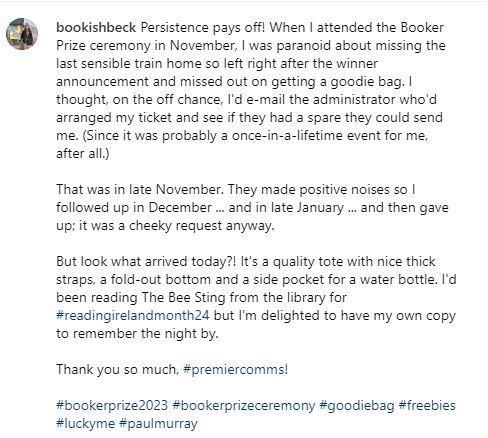
(Public library; free from the Booker Prize/Premier Comms)

I’ll be catching up on reviewing March releases in early April.
Happy Easter to those who celebrate!
Introducing the 2023 McKitterick Prize Shortlist
For the second year in a row, I was a first-round judge for the McKitterick Prize (for a first novel by a writer over 40), helping to assess the unpublished manuscripts. Perhaps lockdowns gave people time to achieve a long-held goal of writing a novel, because submissions were up by 50%. None of the manuscripts made it through to the shortlist this year or last, but one day it could happen!

The Society of Authors kindly sent me a parcel with five of the shortlisted novels, and I picked up the remaining one from the library this week. Below are synopses from Goodreads and author bios from the SoA:
 The Return of Faraz Ali by Aamina Ahmad (Sceptre): “Sent back to his birthplace—Lahore’s notorious red-light district—to hush up the murder of a girl, a man finds himself in an unexpected reckoning with his past. … Profoundly intimate and propulsive, The Return of Faraz Ali is a spellbindingly assured first novel that poses a timeless question: Whom do we choose to protect, and at what price?”
Aamina Ahmad was born and raised in London, where she worked for BBC Drama and other independent television companies as a script editor. Her play The Dishonoured was produced by Kali Theatre Company in 2016. She has an MFA from the Iowa Writers’ Workshop and is a recipient of a Stegner Fellowship from Stanford University, a Pushcart Prize and a Rona Jaffe Writers Award. Her short fiction has appeared in journals including One Story, the Southern Review and Ecotone. She teaches creative writing at the University of Minnesota.
 When We Were Birds by Ayanna Lloyd Banwo (Hamish Hamilton): “Yejide and Darwin will meet inside the gates of Fidelis, Port Angeles’s largest and oldest cemetery, where the dead lie uneasy in their graves and a reckoning with fate beckons them both. A masterwork of lush imagination and immersive lyricism, When We Were Birds is a spellbinding novel about inheritance, loss, and love’s seismic power to heal.”
Ayanna Lloyd Banwo is a writer from Trinidad and Tobago. She is a graduate of the University of the West Indies and holds an MA in Creative Writing from the University of East Anglia, where she is now a Creative and Critical Writing PhD candidate. Her work has been published in Moko Magazine, Small Axe and PREE, among others, and shortlisted for the Small Axe Literary Competition and the Wasafiri New Writing Prize. When We Were Birds, Ayanna’s first novel, was shortlisted for the Jhalak Prize and won the OCM Bocas Prize for Fiction. She is now working on her second novel. Ayanna lives with her husband in London.
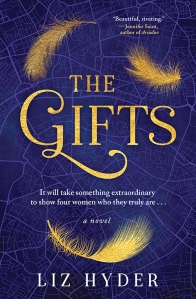 The Gifts by Liz Hyder (Manilla Press): “October 1840. A young woman staggers alone through a forest in the English countryside as a huge pair of impossible wings rip themselves from her shoulders. In London, rumours of a “fallen angel” cause a frenzy across the city, and a surgeon desperate for fame and fortune finds himself in the grips of a dangerous obsession. … [A] spellbinding tale told through five different perspectives …, it explores science, nature and religion, enlightenment, the role of women in society and the dark danger of ambition.”
Liz Hyder has been making up stories for as long she can remember. She has a BA in drama from the University of Bristol and, in early 2018, won the Bridge Award/Moniack Mhor Emerging Writer Award. Bearmouth, her debut young adult novel, won a Waterstones Children’s Book Prize, the Branford Boase Award and was chosen as the Children’s Book of the Year by The Times. Originally from London, she now lives in South Shropshire. The Gifts is her debut adult novel.
 Trespasses by Louise Kennedy (Bloomsbury Publishing): “Set in Northern Ireland during the Troubles, a shattering novel about a young woman caught between allegiance to community and a dangerous passion. … As tender as it is unflinching, Trespasses is a heart-pounding, heart-rending drama of thwarted love and irreconcilable loyalties, in a place what you come from seems to count more than what you do, or whom you cherish.”
Louise Kennedy grew up a few miles from Belfast. She is the author of the Women’s Prize-shortlisted novel Trespasses, and the acclaimed short story collection The End of the World is a Cul de Sac, and is the only woman to have been shortlisted twice for the Sunday Times Audible Short Story Award (2019 and 2020). Before starting her writing career, she spent nearly thirty years working as a chef. She lives in Sligo.
 The Whalebone Theatre by Joanna Quinn (Fig Tree): “One blustery night in 1928, a whale washes up on the shores of the English Channel. By law, it belongs to the King, but twelve-year-old orphan Cristabel Seagrave has other plans. She and the rest of the household … build a theatre from the beast’s skeletal rib cage. … As Cristabel grows into a headstrong young woman, World War II rears its head.”
Joanna Quinn was born in London and grew up in the southwest of England, where her bestselling debut novel, The Whalebone Theatre, is set. Joanna has worked in journalism and the charity sector. She is also a short story writer, published by The White Review and Comma Press, among others. She lives in a village near the sea in Dorset.
 Other Names for Love by Taymour Soomro (Harvill Secker): “A seductive coming-of-age story about queer desire, Other Names for Love is a charged, hypnotic debut novel about a boy’s life-changing summer in rural Pakistan: a story of fathers, sons, and the consequences of desire. … Decades later, Fahad is living abroad when he receives a call from his mother summoning him home. … [A] tale of masculinity, inheritance, and desire set against the backdrop of a country’s violent history, told with uncommon urgency and beauty.”
Taymour Soomro is the author of Other Names for Love and co-editor of Letters to a Writer of Colour. His writing has been published in the New Yorker, the New York Times and elsewhere. He is the recipient of fellowships from the Wisconsin Institute for Creative Writing, Bread Loaf Writers’ Conference and the Sozopol Fiction Seminars. He has degrees from Cambridge University and Stanford Law School and a PhD in creative writing from the University of East Anglia. He currently teaches on the MFA program at Bennington College.
Fellow judge Selma Dabbagh summarises the shortlist thus: “Family estates in rural Pakistan (Other Names for Love) and England (The Whalebone Theatre) fall into decline reflecting the hubris and short-sightedness of their owners[;] in The Return of Faraz Ali, it is the decaying grandeur of the courtesans of Lahore that is lovingly depicted. Whereas in both The Gifts and When We Were Birds, the otherworldly brings new possibilities to the tawdry and impoverished as mystical wings fly over the slums of Victorian London and the graveyards of Trinidad.”
I was already interested in reading a couple of these novels, and was pleased to discover a few new-to-me titles. As it’s also shortlisted for the Women’s Prize (which will be awarded on Wednesday), it seems to make sense to start with Trespasses, and I’m also particularly keen on The Gifts, which sounds like a great holiday read and right up my street, so I’m packing it for our trip to Scotland later this month. One or more of the others might end up on my 20 Books of Summer list. I’ll be sure to follow up with reviews of any I manage to read this summer.
The winner and runner-up will be announced at the SoA Awards ceremony in London on 29 June. I’ll be away at the time but will hope to watch part of the livestream. For more on all of the SoA Awards, see the press release on their website.
See any nominees you’ve read? Who would you like to see win?
Eighth Blog Anniversary! & Thoughts on the Women’s Prize Longlist
Last year, in the manic busyness that preceded moving into our house, I completely forgot to mark my blog anniversary. This time (8 years!) I wanted to be sure to remember it. Why have I not noted before that it coincides with International Women’s Day?! I’m pleased with that.

By Հայկ Ափրիկյան, CC BY-SA 3.0, via Wikimedia Commons.
Yesterday evening the Women’s Prize longlist was announced.** Of my predictions, 4 were correct, which is pretty good going for me. I got none of my personal wishes, however. Of course, I would have preferred for us to have one of my lists. Still, overall, it’s a fairly interesting mix of new and established authors, with a full half of the list being debut work. Seven of the authors are BIPOC. I’ve read 2 of the nominees and would be amenable to reading up to 7 more. My library always buys the entire longlist, so I’ll eventually get the chance to read them, but not soon enough to add to the conversation.

Read:
Demon Copperhead by Barbara Kingsolver (CORRECT PREDICTION): Follows the contours of Charles Dickens’s David Copperfield, transplanting the plot to 1990s southwest Virginia to uncover the perils of opiate addiction. Ten-year-old Damon Fields lives in a trailer home with his addict mother, who works at Walmart, and his new stepfather, a mean trucker. Tragedy strikes and Damon moves between several foster homes before running away. His irrepressible, sassy voice is reminiscent of Holden Caulfield’s in this Appalachian cousin to Shuggie Bain. 
Black Butterflies by Priscilla Morris: Drawing on her own family history, Morris has crafted an absorbing story set in Sarajevo in 1992, the first year of the Bosnian War. Zora, a middle-aged painter, has sent her husband, Franjo, and elderly mother off to England to stay with her daughter, Dubravka, confident that she’ll see out the fighting in the safety of their flat and welcome them home in no time. But things rapidly get much worse than she is prepared for. It was especially poignant to be reading this during the war in Ukraine. 
Requested from the library:
Fire Rush by Jacqueline Crooks – Sounds good, if too much like this year’s Opal & Nev.
The Marriage Portrait by Maggie O’Farrell (CORRECT PREDICTION) – I was going to skip this because I wasn’t keen on Hamnet, but I do love O’Farrell in general, so I guess I’ll give it a try.
Interested in reading (but can’t find):
Homesick by Jennifer Croft – N.B. This was subtitled “A Memoir” at its U.S. release.
Children of Paradise by Camilla Grudova
Memphis by Tara M. Stringfellow
I’m a Fan by Sheena Patel (CORRECT PREDICTION)
Wandering Souls by Cecile Pin
Not interested in reading:
Glory by NoViolet Bulawayo – Like I said when it was nominated for the Booker, I have to wonder why we needed an extended Animal Farm remake…
Stone Blind by Natalie Haynes – I really should have predicted this one. It’s a hard pass on the Greek myth retellings for me.
Trespasses by Louise Kennedy (CORRECT PREDICTION) – I avoid anything set during The Troubles. (Sorry!)
Cursed Bread by Sophie Mackintosh – The Water Cure was awful.
The Dog of the North by Elizabeth McKenzie – The Portable Veblen was trying too hard.
Pod by Laline Paull – Her novels always sound so formulaic.
The Bandit Queens by Parini Shroff – Nah.
See also the reactions posts from Cathy, Clare, Eric and Laura.
**The announcement has traditionally been on International Women’s Day, but I’m guessing that this year they brought it forward to pre-empt news of the inaugural Carol Shields Prize for Fiction longlist. This prize is open to novels, short stories and graphic novels by women, published in calendar year 2022, with parameters otherwise quite similar to those of the WP except that it’s only for U.S. and Canadian residents. {EDITED} To be honest, I was not convinced that the literary world needed an additional prize for women’s fiction, especially as North Americans tend to do well in the WP race. However, at first glance, its longlist is a lot less obvious and more interesting, with 11/15 BIPOC and some short story collections as well as a graphic novel in the running. It remains to be seen if I’ll follow both prizes or switch allegiance. Some of the CSP books may prove difficult to access in the UK. So far I have read Brown Girls and can get The Furrows from the library. Of note: the Carol Shields Prize is worth a lot more ($150,000 U.S. vs. £30,000).
What have you read, or might you read, from the longlist?
Reading Ireland Month 2020: Nuala O’Faolain and More
It feels like the whole world has changed in the past week, doesn’t it? I hope you all are keeping well and turning to books for comfort and escape. Reading Ireland Month is run each March by Cathy of 746 Books. I’m wishing you a happy (if subdued) St. Patrick’s Day with this post on the Irish books I’ve been perusing recently. Even before this coronavirus situation heated up, I’d been struggling with my focus, so only one of these was a proper read, while the rest ended up being skims. In the meantime, I’m trying out a new blog design and have been working to create more intuitive menu headings and helpful intro pages.

Are You Somebody? The Accidental Memoir of a Dublin Woman by Nuala O’Faolain (1996)
 Before writing this landmark memoir, O’Faolain was a TV documentary producer and Irish Times columnist. Her upbringing in poverty is reminiscent of Frank McCourt’s: one of nine children, she had a violent father and an alcoholic mother who cheated on each other and never seemed to achieve happiness. Educated at a convent school and at university in Dublin (until she dropped out), she was a literary-minded romantic who bounced between relationships and couldn’t decide whether marriage or a career should be her highest aim. Though desperate not to become her mother – a bitter, harried woman who’d wanted to be a book reviewer – she didn’t want to miss out on a chance for love either.
O’Faolain feels she was born slightly too early to benefit from the women’s movement. “I could see sexism in operation everywhere in society; once your consciousness goes ping you can never again stop seeing that. But I was quite unaware of how consistently I put the responsibility for my personal happiness off onto men.” Chapter 16 is a standout, though with no explanation (all her other lovers were men) it launches into an account of her 15 years living with Nell McCafferty, “by far the most life-giving relationship of my life.”
Although this is in many respects an ordinary story, the geniality and honesty of the writing account for its success. It was an instant bestseller in Ireland, spending 20 weeks at number one, and made the author a household name. I especially loved her encounters with literary figures. For instance, on a year’s scholarship at Hull she didn’t quite meet Philip Larkin, who’d been tasked with looking after her, but years later had a bizarre dinner with him and his mother, both rather deaf; and David Lodge was a friend. The boarding school section reminded me of The Country Girls. Two bookish memoirs I’d recommend as readalikes are Ordinary Dogs by Eileen Battersby and Leave Me Alone, I’m Reading by Maureen Corrigan.
Skims (all: )
Actress by Anne Enright (2020)
 The Green Road is among my most memorable reads of the past five years, so I was eagerly awaiting Enright’s new novel, which is on the Women’s Prize longlist. I read the first 30 pages and found I wasn’t warming to the voice or main characters. Norah is a novelist who, prompted by an interviewer, realizes the story she most needs to tell is her mother’s. Katherine O’Dell was “a great fake,” an actress who came to epitomize Irishness even though she was actually English. Her slow-burning backstory is punctuated by trauma and mental illness. “She was a great piece of anguish, madness and sorrow,” Norah concludes. I could easily see this making the Women’s Prize shortlist and earning a Booker nomination as well. It’s the sort of book I’ll need to come back to some years down the line to fully appreciate.
Cal by Bernard MacLaverty (1983)
 As Catholics, Cal McCluskey and his father are a rarity in their community and fear attacks on their home. Resistant to join his father in working at the local abattoir, Cal spends his days doing odd jobs and lurking around the public library – he has a crush on a married librarian named Marcella. Aimless and impressionable, he’s easily talked into acting as a driver for Crilly and Skeffington, the kind of associates who have gotten him branded as “Fenian scum.” The novella reflects on the futility of cycles of violence (“If you’re not part of the solution, you’re part of the problem,” Crilly says, to which Cal replies, “But it all seems so pointless”), but is definitely a period piece. Cal is not the most sympathetic of protagonists. I didn’t enjoy this as much as the two other books I’ve read by MacLaverty.
Full Tilt: Ireland to India with a Bicycle by Dervla Murphy (1965)
 Murphy and her bike “Roz” set out on an epic Fermor-like journey in the first six months of 1963. She covered 60 to 100 miles a day, facing sunburn, punctured tires and broken ribs. She was relieved she brought a gun: it came in handy for fending off wolves, deterring a would-be rapist, and preventing bike thieves. For some reason travel books are slow, painstaking reads for me. I never got into the flow of this one, and was troubled by snap judgments about groups of people – “I know instinctively the temper of a place, after being five minutes with the inhabitants. … the Afghans are, on balance, much dirtier in clothes, personal habits and dwellings than either the Turks or Persians.” Murphy does have a witty turn of phrase, though, e.g. “I suppose I’ll get used to it but at the moment I wouldn’t actually say that camel’s milk is my favourite beverage.”
My Father’s Wake: How the Irish Teach Us to Live, Love and Die by Kevin Toolis (2017)
 Toolis is a journalist and filmmaker from Dookinella, on an island off the coast of County Mayo. His father Sonny’s pancreatic cancer prompted him to return to the ancestral village and reflect on his own encounters with death. As a young man he had tuberculosis and stayed on a male chest ward with longtime smokers; despite a bone marrow donation, his older brother Bernard died from leukemia.
As a reporter during the Troubles and in Malawi and Gaza, Toolis often witnessed death, but at home in rural Ireland he saw a model for how it should be: accepted, and faced with the support of a whole community. People made a point of coming to see Sonny as he was dying. Keeping the body in the home and holding a wake are precious opportunities to be with the dead. Death is what’s coming for us all, so why not make its acquaintance? Toolis argues.
I’ve read so much around the topic that books like this don’t stand out anymore, and while I preferred the general talk of death to the family memoir bits, it also made very familiar points. At any rate, his description of his mother’s death is just how I want to go: “She quietly died of a heart attack with a cup of tea and a biscuit on a sunny May morning.”
What have you been picking up for Reading Ireland Month?
Reading Ireland Month 2018: Seamus Deane and Edna O’Brien
It’s my first time participating in Reading Ireland Month, run each March by Cathy of 746 Books and Niall of The Fluff is Raging. I enjoyed scouring my shelves for Irish reads – though in the end I only had time for two.

Reading in the Dark by Seamus Deane (1996)
I don’t recall how I first heard about this book, but its title was familiar to me when I picked it up for a matter of pence at a charity shop last year. When I saw it on Cathy’s recent list of her top five Irish books of all time, I knew I was in for something special. These vivid vignettes of childhood and young adulthood are so convincing that I could have been fooled into believing I was reading a memoir. Indeed, this debut novel has generally been interpreted as heavily autobiographical, with the anonymous narrator, the third of seven children born to Catholic parents in Derry, Northern Ireland, taken to be a stand-in for Deane.
 Ireland’s internecine violence is the sinister backdrop to this family’s everyday sorrows, including the death of a child and the mother’s shaky mental health. The narrator also learns a family secret from his dying maternal grandfather that at first thrills him – he knows something his father doesn’t! – but later serves to drive him away from his parents. The short chapters take place between 1945 and 1971: starting when the boy is five years old and encountering a household ghost on the stairs and ending as, in his early thirties, he lays his father to rest in the midst of the Troubles.
The Irish have such a knack for holding humor and tragedy up side by side – think John Boyne, James Joyce and Frank McCourt. The one force doesn’t negate the other, but the juxtaposition reminds you that life isn’t all gloom or laughs. There are some terrifically funny incidents in Reading in the Dark, like the individual sex ed. chat with Father Nugent (“And semen is the Latin for seed. Do you have to know Latin to do this?”) and going to investigate the rumor of a brothel by the football ground. But there is also perhaps the best ghost story I’ve ever read, an eerie tale of shape-shifting children he hears from his aunt.
This book captures all the magic, uncertainty and heartache of being a child, in crisp scenes I saw playing out in my mind. If I have one small, strange complaint, it’s that there’s too much plot – most of the chapters function perfectly well as stand-alone short stories, so, particularly in the last third, the growing obsession with the family secret feels like an unnecessary attempt to tie everything together. That plus the slight irrelevance of the title are the only reasons this misses out on 5 stars from me.
Still, I’d agree with Cathy: this is probably one of my favorite Irish reads, along with Boyne’s The Heart’s Invisible Furies, Mary Costello’s Academy Street, Anne Enright’s The Green Road, and Joyce’s A Portrait of the Artist as a Young Man. It’s no wonder Deane won so many prizes for this: the Irish Times International Fiction Prize, the Guardian Fiction Prize, and the Irish Literature Prize; he was also shortlisted for the 1996 Booker Prize.
Favorite lines:
“Child, she’d tell me, I think sometimes you’re possessed. Can’t you just let the past be the past?”
“He looked up at me, smiling, to say: ah well, it was all blood under the bridge now”
“Politics destroyed people’s lives in this place, he said. People were better not knowing some things”
My rating: 
Mother Ireland by Edna O’Brien (1976)
 This slim volume combines travel writing, history and memoir, with plentiful black and white photographs (by Fergus Bourke) along the way. Often, even where O’Brien is clearly drawing on autobiographical material, she resists saying “I”, instead opting for “one,” “you,” or “we.” I think she was aiming at the universalities of the Irish experience, but instead it ends up coming off as generic. That and a long opening chapter on Ireland’s history set me to skimming. (Also, the book is maddeningly underpunctuated, and the photos in particular seem very dated.) By far my favorite of the seven essays was the last, “Escape to England.” In just three pages, she explains what it’s like to start a new life in another country and how the experience allowed her to appreciate home all the more. Should I try O’Brien’s fiction?
Favorite lines:
“Irish people do not like to be contradicted. Foiled again and again[,] they have in them a rage that comes at you unawares like a briar jutting out of a hedge.”
“You are Irish[,] you say lightly, and allocated to you are the tendencies to be wild, wanton, drunk, superstitious, unreliable, backward, toadying and prone to fits, whereas you know that in fact a whole entourage of ghosts resides in you, ghosts with whom the inner rapport is as frequent, as perplexing, as defiant as with any of the living.”
My rating:
No time for these this year – maybe next year, if not sooner?

 Bookish Beck = Rebecca Foster. American transplant to England. Freelance proofreader and book reviewer.
 Bookish Beck