“Ten years ago, my smile walked off my face, and wandered out in the world. This is the story of my asking it to come back.”
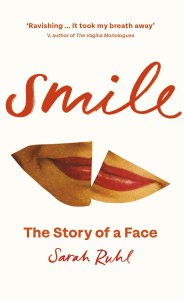 Sarah Ruhl is a lauded New York City playwright (Eurydice et al.). These warm and beautifully observed autobiographical essays stem from the birth of her twins and the slow-burning medical crises that followed. Shortly after the delivery, she developed Bell’s palsy, a partial paralysis of the face that usually resolves itself within six months but in rare cases doesn’t go away, and later discovered that she had celiac disease and Hashimoto’s disease, two autoimmune disorders. Having a lopsided face, grimacing and squinting when she tried to show expression on her paralyzed side – she knew this was a minor problem in the grand scheme of things, yet it provoked thorny questions about to what extent the body equates to our identity:
Can one experience joy when one cannot express joy on one’s face? Does the smile itself create the happiness? Or does happiness create the smile?
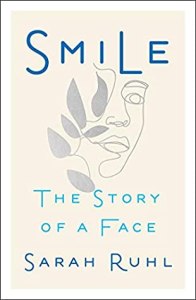
As (pretty much) always, I prefer the U.S. cover.
Women are accustomed to men cajoling them into a smile, but now she couldn’t comply even had she wanted to. Ruhl looks into the psychology and neurology of facial expressions, such as the Duchenne smile, but keeps coming back to her own experience: marriage to Tony, a child psychiatrist; mothering Anna and twins William and Hope; teaching and writing and putting on plays; and seeking alternative as well as traditional treatments (acupuncture and Buddhist meditation versus physical therapy; she rejected Botox and experimental surgery) for the Bell’s palsy. By the end of the book she’s achieved about a 70% recovery, but it did take a decade. “A woman slowly gets better. What kind of story is that?” she wryly asks. The answer is: a realistic one. We’re all too cynical these days to believe in miracle cures. But a story of graceful persistence, of setbacks alternating with advances? That’s relatable.
The playwright’s skills are abundantly evident here: strong dialogue and scenes; a clear sense of time, such that flashbacks to earlier life, including childhood, are interlaced naturally; a mixture of exposition and forceful one-liners. She is also brave to include lots of black-and-white family photographs that illustrate the before and after. While reading I often thought of Lucy Grealy’s Autobiography of a Face and Terri Tate’s A Crooked Smile, which are both about life with facial deformity after cancer surgery. I’d also recommend this to readers of Flesh & Blood by N. West Moss, one of my 2021 favourites, and Anne Lamott’s essays on facing everyday life with wit and spiritual wisdom.
More lines I loved:
imperfection is a portal. Whereas perfection and symmetry create distance. Our culture values perfect pictures of ourselves, mirage, over and above authentic connection. But we meet one another through the imperfect particular of our bodies.
Lucky the laugh lines and the smile lines especially: they signify mobility, duration, and joy.
My rating: 
With thanks to Bodley Head for the free copy for review.
 Bookish Beck = Rebecca Foster. American transplant to England. Freelance proofreader and book reviewer.
 Bookish Beck
This sounds fascinating! I’d heard of Ruhl as a playwright but not this memoir, which I will definitely try to get a hold of.
LikeLiked by 1 person
It’s such a lovely read, Cathy, and you will find things to relate to in raising twins as well. I’m not up to speed on the theatre world, but her other books sound good too — letters and essay collections.
LikeLiked by 1 person
What starkly different covers: I feel as though they are targeting two completely different sets of readers! Stories like this are so interesting, thinking about how adaptable people are (and, sometimes, aren’t). Also, I feel like every memory I have of a man cajoling me to smile is filed in a very particular corner of my mind!
LikeLiked by 1 person
I like that the U.S. cover brings to mind the comedy/tragedy theatre masks — very appropriate for her story.
LikeLike
Sounds like one I’d enjoy. Will seek it out.
LikeLiked by 1 person
The medical, grief, and parenting themes should be right up your street.
LikeLiked by 1 person
That sounds fascinating, and the pressure to heal quickly is interesting, another way people are asked to conform, like women smiling.
LikeLiked by 1 person
My parents have both had Bell’s palsy, thankfully only temporarily. I think it is harder for women, who are sure to get accused of resting bitch face…
LikeLike
Love the title. Love that first quote. And love the sound of the whole thing.
LikeLiked by 1 person
Hurrah, glad I could entice you. I wonder if it’s readily available in Canada?
LikeLiked by 1 person
It’s at my library! 🙂
LikeLike
Woohoo!
LikeLike
[…] read Ruhl’s memoir Smile, I recognized the contours of her life and the members of her family. In early poems, cooking and […]
LikeLike
[…] Poems in Quarantine by Sarah Ruhl: Having read Ruhl’s memoir Smile, I recognized the contours of her life and the members of her family. Cooking and laundry recur: […]
LikeLike
[…] Smile by Sarah Ruhl: These warm and beautifully observed autobiographical essays stem from the birth of her twins and the slow-burning medical crises that followed. Shortly after delivery, Ruhl developed Bell’s palsy, a partial paralysis of the face. Having a lopsided face, grimacing and squinting when she tried to show expression – it was a minor problem in the grand scheme of things, yet provoked questions about whether the body equates to identity. […]
LikeLike